

MAIN STREET CAPITAL (MAIN)
Investment Research Report
Fundamentals and Company Overview
Main Street Capital Corporation is a Texas-based Business Development Corporation specializing in lending to smaller middle market companies with revenues between $50 million and $500 million. Most lending is in the form of a senior debt that must be paid back in the case of a bankruptcy or company liquidation, although Main Street will also do smaller deals of subordinated debt and equity, which carry slightly higher risk.
Part of Main Street’s value proposition to investors is its ability to manage risk by identifying which companies are solvent enough and have the highest growth potential to be offered higher-risk credit, and which companies deserve any credit at all. With a two-decade history and over 200 companies in its portfolio in that time, Main Street has proven its ability to find companies that have growth potential and quality credit.
Portfolio Quality and Leverage History
The company’s portfolio is weighed towards senior debt, but Main Street has a history of using riskier equity investments to boost overall investment returns, providing extra income beyond the debt portfolio that can be used to pay special dividends (which it has done for the last four years). Here is CEO Vince Foster on the portfolio structure in February: "We continue to seek and receive significant equity participation in our lower middle market investments and as of quarter-end, we owned an average of 36% equity ownership in the 96% of these investments in which we currently have equity exposure."
The company’s portfolio has shifted towards larger companies, with 40% in lower middle market firms, 36% in middle market, and 14% private loans.
Main Street has also maintained what is a low debt-to-equity ratio by BDC standards. Having stayed around a 75% debt-to-equity ratio for three years, Main Street has been able to keep a balanced portfolio even as it has increased its Net Asset Value (NAV) significantly, and has issued new shares over the years, discussed below.
NAV Trend and Dividend Track Record
Main Street increased dividends in March 2015 and two special dividends in 2015 of $0.275 per share each. Including those dividends, Main Street’s yield is over 8.7%. Since going public four years ago, the company has consistently raised dividends while also issuing special dividends every year:

At the same time, the company has also seen steady capital gains as a result of a higher NAV thanks to the company’s high quality investments:
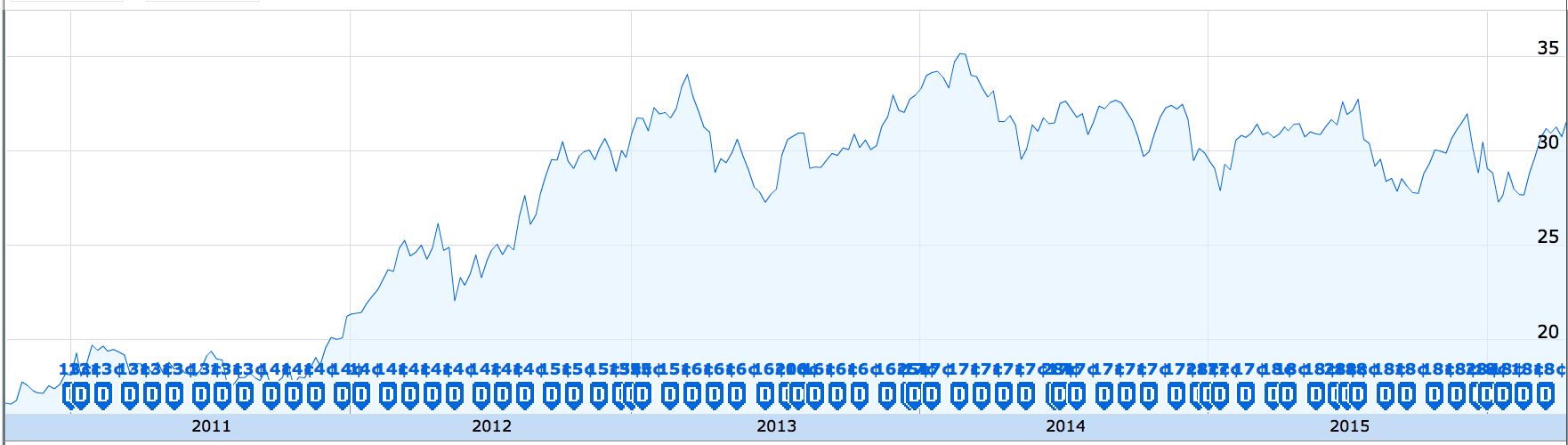
In 2015, the company’s NAV rose 4% per share on a Y/Y basis. However, it should be noted that the company’s NAV since then has fallen 2% largely as a result of the company’s energy exposure. Nonetheless, the company’s overall performance in its investments is impressive. For example, the company’s investment in energy service provider irth Solutions (that IS the correct spelling!) earned the company a $6 million return on an equity stake and an internal rate of return of 40%.
While such staggering returns aren’t always to be expected, the company is very good at earning returns of between 8% and 12% on its credit offerings to firms, while keeping costs lower than many other BDCs. Its expenses are usually about 1.5% of its assets under management - a low figure considering fees are over 2% for competitors like Prospect Capital (PSEC: $7.30). Furthermore Main Street has significantly outperformed them in both dividends, capital gains, and NAV growth.
Risks and Considerations
The biggest risk with Main Street is its exposure to energy. In the past, it has invested nearly 10% of assets in energy and energy-related companies, but has recently shied away from the industry by recognizing investor concerns about taking on too much exposure to oil prices, as CEO Vince Foster said during the third quarter earnings call: "We probably would not be looking at new service type, energy service type investments. I don't think that our investors, our lenders and our [bankers] particularly don’t want to see us having much more in a way of energy exposure, particular on the service side."
Another consideration is that Main Street is trading above net asset value, when some BDCs are trading at significant discounts. Prospect’s current discount of around 30% makes it appear to be a bargain, while Main Street’s 45% premium to NAV looks like a foolish overpayment.
The easy counterargument can be made with one chart:
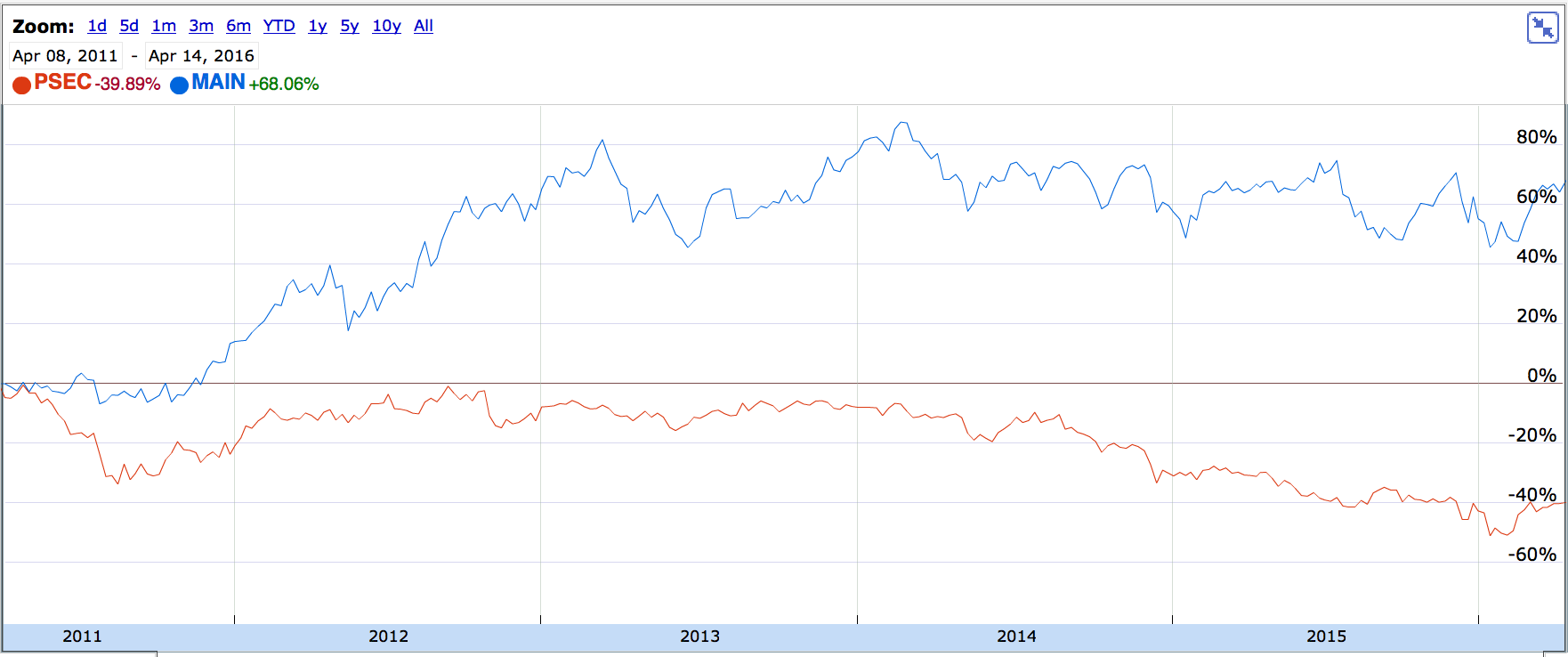
A more cogent response would be to bear in mind that the market has priced in expected mark-to-market discounting of Prospect Capital’s portfolio, which contains several leveraged loan derivatives that analysts have argued are overvalued. While Prospect has already discounted some of these, causing its NAV to fall, more discounting is expected. Main Street, however, has no such derivatives in its portfolio.
BMR TAKE
All considered, Main Street can be considered one of the lowest risk 8% yielders on the market. Even forgetting the special dividends, a 6.9% dividend growth stock is incredibly good, and the risks from its energy exposure and premium to NAV look to be fairly inconsiderate relative to the company’s track record of high returns by investing smartly in growth-positioned firms.
Finding an entry point is difficult, however; Main Street is up 14% from February’s low point and is 5% below its 52-week high. The BDC sector has substantially outperformed just about everything else as the market realizes just how oversold the sector was earlier this year, making timing purchases tricky. If a market correction comes, Main Street is a definite buy at any point below $30, but buying now will still secure a solid income stream for many years to come.
Interested in additional research? Explore all references to MAIN on BullMarket.com
Stock Price, Historical Chart
