

Government Properties Income Trust (GOV)
Investment Research Report
Coverage initiated April 21, 2016 at $18
Updated May 3, 2018
Fundamentals and Company Overview
Government Properties Trust is a real estate investment trust specializing in leasing office and warehouse space to government agencies. The company has historically been most reliant on the Federal government as a tenant, with about three-quarters of rental income coming from the Feds. More recently, it has diversified into non-government tenants, which are growing and projected to be over 10% of the company’s income stream by the end of 2016.
As a landlord to the government, the firm provides an interesting and unique value proposition. On the one hand, the company should be counter-cyclical, in that government spending doesn’t tend to decline in recessions (and, if the government follows Keynesian economics, will actually spend more during recessions). This means a bet on Government Properties Trust could theoretically be a hedge against a broader portfolio of “normal” stocks.
However, the company can also be a victim to political pressures to curb spending. As voters demand lower taxes and less waste in government, that will mean demand to pay less rent; and, in many cases, for the government to buy buildings instead of renting them out. This isn’t always practical, but it is a trend that Government Properties has admitted is an issue for them, and has also been a reason for recent weakness in the stock, causing it to be down over the past year despite a recent recovery alongside the REIT space in general.
So how does this all play out going forward?
Portfolio Quality and Occupancy Rates
In the last year, we’ve seen Government Properties flourish despite trends that would appear challenging on the surface, which is a testament to management’s talent. With 84 properties around the country in over 30 states, the firm is well-diversified in its niche of catering to demand for space from government agencies.
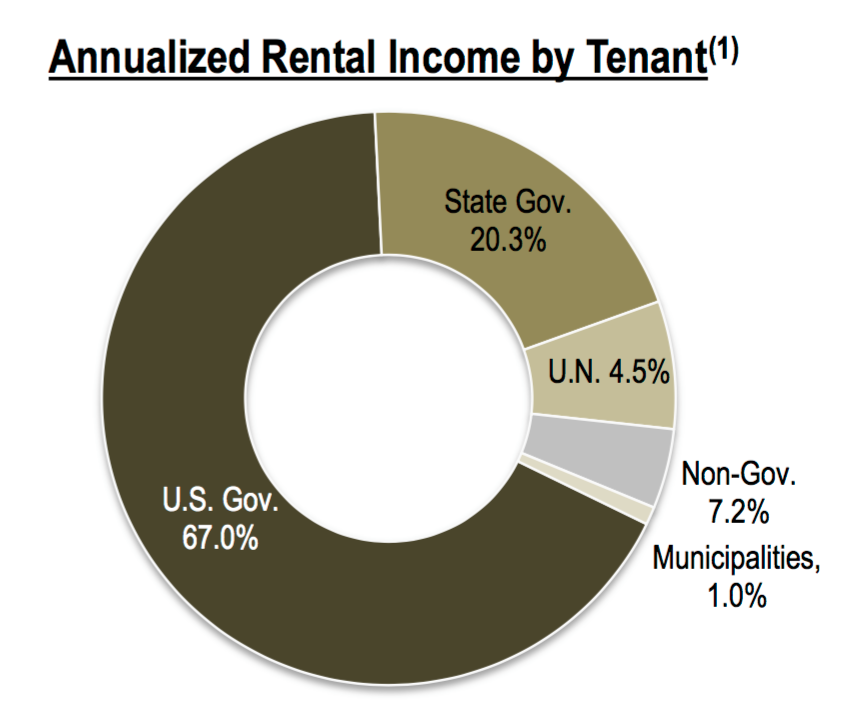
There are two problems with the company’s business model, however. First, there is a secular decline in government spending, which has made many agencies unusually thrifty. This has hurt their ability to lease more space to agencies that are actually declining in size.
Federal government spending has been falling significantly since 2010, and further declines are expected. With that decline, Government Properties has a serious headwind on its hands, which is partly why its dividend return has been priced so high.
Yet Government Properties has proven resilient. In its last quarter, its occupancy rate was 95%, a full 100 basis points higher than the prior quarter. Its funds from operations (FFO) increased 5% last quarter, and has been steadily rising throughout most of its history.
FFO Trend and Dividend Payouts
The company’s dividend payouts have remained stable for the last three years, after rising considerably in previous years. The reason for this payout plateau is clear; the company is aware of the challenges of government spending headwinds and is being prudent in their payouts.
That doesn’t mean the dividend is threatened; the company has met or beat FFO expectations for over a year and a half, and its current annual FFO per share is $1.98, while its annual dividends per share are $1.72. That means only 85% of FFO is being paid out as dividends, leaving a margin of error before dividends get cut.
Risks and Considerations
As mentioned repeatedly here, the biggest risk with Government Properties is its exposure to belt-tightening government agencies. However, the company’s ability to grow its footprint and its strategy of shifting towards the office renting space can theoretically help hedge against the secular decline in government spending.
Nonetheless, at a dividend of over 13%, investors are clearly being compensated for the higher risk that lower government spending poses. Additionally, the company’s proven ability to out-earn its dividend and its diversification strategy indicate that this concern may be overblown.
BMR TAKE
We rate Government Properties a buy thanks to its high dividend yield, high dividend coverage, and high quality management. These three factors defend against the expected dividend decline that has been priced in for a while but has failed to materialize.
Additionally, we like Government Properties’ diversification with the purchase of the stake in Select Income and the idea that it can improve management performance there. That move, combined with the added diversification that the investment provides, just adds to our conviction that Government Properties provides robustness for a high yield portfolio.
Interested in additional research? Explore all references to GOV on BullMarket.com
Stock Price, Historical Chart
