
Hybrid Cloud Opportunity Can Take Shares Higher
VMware: (VMW: $82)
January 18, 2017

Company Description
VMware provides virtualization solutions from the desktop to the data center. The company's products address a range of IT problems, which includes cost and operational inefficiencies, business continuity, software lifecycle management, and desktop management.
VMware was founded in 1998 and was acquired by EMC for $625 million in cash in 2004. Looking to unlock some of the value in its subsidiary, EMC sold some of its stake in a 2007 IPO. Today, EMC holds 80% of the company and controls about 96% of VMware's voting shares. EMC was acquired by Michael Dell late last year for $67 billion, operating as Dell Technologies.
Business Description
VMware makes a virtue of being virtual. The company’s legacy business is developing software used to create and manage virtual machines -- computer functions spread across multiple systems. Companies use its applications to more efficiently integrate and manage server, storage, and networking functions, to lower the cost of operating their IT systems. VMware also provides an extensive range of consulting, technical support, training, and certification services that account for just over half of sales. The company has marketing relationships with top computer hardware vendors, including Dell, Hewlett-Packard, and Cisco. Lastly, but most importantly, more recently the company has been working on new products aimed at the hybrid-cloud opportunity with partners like Amazon AWS and IBM.
Operations and Geographic Reach
VMware derives its revenue from the licensing of software and related services, which includes software maintenance, professional services, and software as service subscriptions. Overall, maintenance and services account for about 57% of the firm's total revenue. More than half of Silicon Valley-based VMware's revenue comes from outside the US. The company operates about 100 offices across the Americas, Europe, the Asia-Pacific Region, and the Middle East and Africa. With all the geopolitical changes occurring with the Trump Administration, we do need to be conscious of the international exposure, from the standpoint of currency risk at the very least. But in actuality, this international exposure makes the firm stronger in our opinion.
Strategy
Going beyond providing services that enable cloud computing, VMware offers its own cloud computing services: VMware vCloud Air. While opening new markets, the move also opens VMware up to additional competitors. VMware vCloud Air's infrastructure-as-a-service goes head-to-head with services from Amazon, Microsoft, Google, IBM, and newer companies. Companies such as Cisco Systems that provide software for managing systems as well as hardware also compete with VMware. We say: bring it on.
Central to VMware's strategy is partnerships with hardware, software, and cloud computing service vendors to sell each other's products through joint marketing, product interoperability, collaboration, and cooperative development. VMware extended its partnership with security firm Palo Alto Networks to offer secure access to information from mobile devices, including those covered in bring-your-own-device plans.
In another step that combines security and mobility, VMware acquired AirWatch in 2014. AirWatch offers services for enterprise mobile management and security. The deal propelled the release of VMware's AirWatch Chat product, a secure instant messaging application for iOS devices and Android devices.
As you can see, the company does it all right now. That said, the legacy business is virtualization products. The standalone cloud opportunity has tough uphill battles facing Amazon AWS, Google Cloud, and Microsoft Azure. But there is a real niche for VMware in the hybrid-cloud market. Hybrid-cloud is Amazon/VMware offering a middle ground solution so companies that have tons of on-premise equipment can also do the cloud.
Framing The Bull Case
Most recently, VMware reported Q316 financial performance, which topped expectations. Specifically, they reported total revenue of $1.78 billion (up 6% from last year) and EPS of $1.14, both of which were ahead of consensus of $1.76 billion and $1.10, respectively. License revenue of $690 million (up 1% from last year) also beat consensus of $685 million. We note that total and license billings growth accelerated for the second consecutive quarter and grew 13% from a year ago. Management indicated that Asia performed “particularly well” during the quarter and a major customer doubled down on the amount of money being spent on VMware technologies. Looking out to 2017, for total and license revenue growth, management indicated that VMware expects to see at least the same levels that it is seeing this year. This implies at least 6% growth at the mid-point, versus consensus at 4.8% currently.
The bullish case for the stock is closely tied to VMware’s partnerships with Amazon Web Services (AWS) – the clear leader in the cloud - and IBM, which help establish VMware as a critical hybrid cloud partner. VMware has done a good job of addressing the public cloud through partnerships with IBM and, more significantly, AWS. Hybrid cloud is the future for enterprise IT, and VMware’s dominant position puts it in a strong position to enable hybrid cloud architectures. In other words, companies used to build out their technology department in-house by buying hardware, software, and services. However, now they are using cloud services like Amazon. But the hybrid-cloud option VMware can provide with a AWS or IBM is playing a key role in the transition of the market.
The bulls are also very excited about all of VMware’s new products. We were going to tell you all about them here, but they are so complex it is best to just sum it up. All that you need to know is that the new solutions are now of size, and can drive an improvement in license revenue growth in 2017. The proof is in the numbers. In 3Q16, VMware posted the strongest license bookings growth since 4Q14. We’ll keep a close eye on the numbers to make sure they remain healthy.
Lastly, we are balanced here at The Bull Market Report, so we must give you what the bears say. For much of the past three years, the investor debate around VMware has centered on whether the company could produce an Act 2 of enough scale (and growth) to offset the declines in the core server virtualization infrastructure business (an incredibly successful Act 1). We’ll say this, the debate continues and won’t go away. That said, we note some of the smartest guys in the room have this to say on the debate: “Newer product categories have now reached sufficient scale to overcome the drag on overall growth from the maturing virtualization business. With hardware and software bookings now accounting for less than half of overall license bookings, the key inflection point has been reached and overall license growth is poised to trend higher. Better cost discipline should end the recent downward estimate revision cycle, creating a favorable backdrop for management to exceed consensus estimates in the quarters ahead.”
Amazon and IBM Partnerships
Amazon has partnered with VMware to extend its cloud computing business into a segment of the market it previously could not serve on its own. The partnership allows customers the ability to run computing operations on both their VMware-equipped data centers and/or Amazon’s web-based servers. The partnership is huge for VMware because it connects their business to the explosive growth being recorded in the Cloud.
The deal bolsters Amazon’s competitive position against other cloud providers like Google, IBM, and Microsoft. It is a big step for Amazon Web Services, which started out catering to startups that had little or no on-premise operations, but now is increasingly serving corporate clients that have their own data centers, many of which are built on VMware technology.
Amazon and VMware announced a service for hybrid-cloud deployments, applications that run partly on a customer’s private servers and partly in publicly available cloud data centers. The service, called VMware Cloud on AWS, lets VMware customers take advantage of the cloud without abandoning their data centers and attendant investments in servers and software. This announcement is exciting for VMware, as it is an offensive move to mitigate potential attrition of customers moving over to AWS or other cloud services.
The VMware deal should help Amazon go after Microsoft’s customers, who, like IBM’s, often use VMware’s technology. This absolutely should be seen as creating a risk to Microsoft. Stepping back, it is interesting to see how VMware is the key to opening the door to winning new customer relationships for a company like Amazon. Clearly, the VMware franchise is valuable.
In fact, the Amazon AWS deal actually followed a similar, earlier agreement between IBM and VMware. Those companies announced a collaboration to help VMware customers move some computing tasks from their own servers to IBM’s cloud services. The companies also agreed to collaborate on marketing and selling hybrid-cloud products and services. It is great to see VMware working with multiple big tech players.
BMR Take:
Few software companies have achieved VMware’s scale of nearly $7 billion in annual revenue, and even fewer have been able to reinvent themselves to sustainably reaccelerate growth. We believe VMware’s bold new vision in hybrid cloud represents an attractive opportunity for an otherwise stable business with low-teens revenue growth and long-term cash flow growth to match.
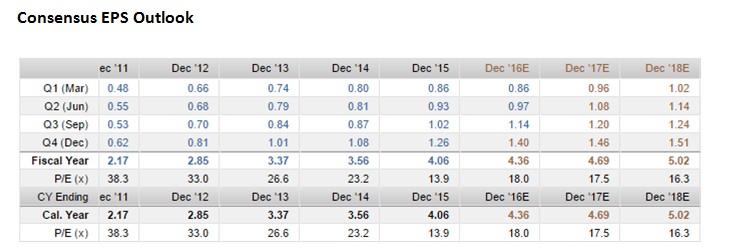
We are bullish on the shares with a $95 price target equal to 19x the consensus 2018 EPS outlook of $5. We do not think this is a stretch in terms of valuation as the historical trading range has been upward of 40x earnings. Admittedly, growth remains robust though not what it once was. Either way, we see the next chapter for the company to continue to bring ongoing lucrative cash flow generation, which will ultimately be returned to shareholders.
Consensus EPS Outlook
(This chart may be hard to read. Sorry.)
Good investing,
Todd Shaver, CEO and Founder
The Bull Market Report