December 23, 2019

by Todd Shaver | Dec 23, 2019 | Free Newsletter (Sent Weekly Monday at 12pm), Weekly Newsletter 7pm Sunday
The Weekly Summary
December was chaotic last year, keeping investors glued to their screens as we watched a miserable season turn into one of the biggest rebounds in recent memory. This time around, conditions are unusually quiet as a late Thanksgiving turns into a compressed holiday season. Wall Street is already looking toward the Christmas and New Year breaks. So are we.
After all, Santa came early and often this year. The market as a whole has rebounded 28% YTD, handily recovering all ground lost in the 4Q18 rout and then continuing to push into record territory. The S&P 500 has now rallied a healthy 12% past last year's peak, with more than half of that surge coming in the last four months. Whether the motive is relief that we've skirted another year without a recession or more straightforward optimism, the mood is as good as it gets.
If anything, we're inclined to urge a little caution here. When a full 44% of investors are actively bullish and the so-called "greed index" flashing at extreme levels, this is as good a time as ever to take a little profit and rotate the returns back into stocks that haven't flown as far as the rest of your holdings or offer a comparable return for lower risk. The perfect time to buy was a year ago when everyone but us was terrified that the trade war and the Fed had triggered the end of the world. While today this is not an awful entry point, a selective approach can be your friend here . . . we would definitely not pour money into index funds right now.
After all, while the active BMR universe is up 42% so far this year, our stocks have tangible growth on their side. Earnings for the S&P 500, on the other hand, have spent the entire year in a stall, so there's no compelling mathematical reason for the index to keep moving up without straining historical multiples to the bubble point. Right now the market as a whole carries an 18X earnings multiple, well above the 15-16X that investors have normally been willing to pay.
In exchange for those inflated fundamentals, investors are getting negative growth. Those companies are actually tracking lower earnings than they did a year ago, and are likely to keep deteriorating at least into the 4Q19 reporting season. After that, we'll simply have to see if the combination of lower interest rates and a truce in the global trade war shakes a little growth free. If not, stocks will look increasingly vulnerable to any external shock to sentiment . . . the higher the multiples get, the more precipitous the fall from grace becomes.
However, there's a lot to be said for a sympathetic Federal Reserve and any relief from the trade war. The White House estimates that even Phase One in a deal with China coupled with a new NAFTA accord will boost GDP growth 0.5% in the coming year, which is enough to drive a so-so economic expansion into something approaching spectacular. It's definitely far from the recession zone that everyone was worried about a few months ago.
You need growth to decline in order to realistically talk about recession ahead. No decline means no recession. And no recession means people who retreated to the market sidelines are now having a hard time resisting the urge to get back in before they miss out completely.
Remember, while earnings haven't moved up in the past year, they haven't dropped a lot either. The trade war has delayed a lot of new corporate investment initiatives without driving executives to pull the plug on any established cost centers. We haven't seen mass layoffs. No sprawling Financial conglomerates or prominent hedge funds have imploded the last time the Treasury yield curve briefly inverted.
And that curve is healthier than a few months ago. Barring a lot of dread around the coming election, the rate environment once again reflects lower risk in the short term and higher uncertainty farther out into the future, exactly as it should. The Fed has done its work well. Investors have a reason to cheer.
So what can go wrong? While we are always quick to accentuate the positive, we also acknowledge that other investors make errors when the mood swings too far in either direction. Expectations can get stretched to unsustainable levels, setting up the next inevitable round of disappointment, second guessing and nervous selling. That's ultimately a good thing for those of us who have been watching and waiting for a chance to buy great stocks on the dip. Throughout our career (collectively well past a half century actively in the market) the long-term trend always points up and the dip is always worth buying.
There’s always a bull market here at The Bull Market Report! Gary Jefferson has the week off and with the holiday approaching, we decided to use his absence to try something new with an in-depth review of Todd's Stocks For Success. We hope that you come away from this issue with deeper understanding of why our founder likes Berkshire Hathaway so much. He would buy any of these stocks on weakness.
Finally, a scheduling note ahead of the Christmas holiday. The market will close early on Tuesday and stay shut until Thursday morning, so news will be light and our News Flashes will probably taper off a bit. We'll use the time to reflect on the year that's gone and cement our thinking on the year ahead. Ideally we'll also be able to update the site a little and perform other housekeeping as we get the portfolios in position for 2020. We'll be in touch either way, but as always, we wish you a happy holiday and the best possible experience as an investor.
Key Market Indicators
-----------------------------------------------------------------------------
BMR Companies and Commentary
The Big Picture: Big Rally, Narrow Bench
While the last few months have been great for the S&P 500 and our stocks as well, the gains remain restricted to a narrow field of relatively safe bets. Investors simply aren't thinking outside the box right now. They're content to park their money in a few big stocks that don't require a lot of patience or even conviction. While we'd love a little of that capital to flow immediately to a few of our smaller and more neglected recommendations, we don't mind in the slightest.
For one thing, we already recommend many of the leaders. Just seven BMR stocks account for 40% of the S&P 500's gains for the past quarter, and Apple (AAPL: $279, up 2%) alone contributed almost half of that upside. If you weren't bullish on Apple in the last few months, you missed the boat. We were right to keep the giant in our sights, and it gave us everything we hoped to see. Apple has surged a full 77% this year, recovering $700 billion in market capitalization along the way.
Microsoft, Alphabet and to some extent Facebook, Berkshire Hathaway, Johnson & Johnson and Visa also contributed a significant amount to the market's gains in the last few months . . . not to mention the year as a whole. Big stocks got big because the enterprises driving them were some of the most dynamic companies around. This year, they got even bigger. All are hitting all-time highs. How far can they go before taking a break? We'll simply have to see, but as long as earnings keep outperforming everyone else around, the stocks have all the room they need.
Then there's Amazon (AMZN: $1,787, up 1%), which is as dynamic as ever but the stock hasn't gone anywhere in the last quarter. It's also down 12% from its peak, so there's no sense of straining any kind of historical limit. When investors come back, this can once again be a $2,000 stock and a trillion-dollar company. And in that scenario, the S&P 500 gets enough of a boost to break another record. No other stock has to do any work. Amazon can do it on its own.
We see that story play out again and again. A full 3 in 5 S&P 500 constituents are actively lagging the market and the lower you go on the market food chain, the rarer true leadership gets. A staggering 85% of the stocks on Wall Street have underperformed the S&P 500 this quarter. Most are doing okay. True losses are limited. They're simply getting left out.
But the market will never tolerate an imbalance for long. Sooner or later, one or more giants will hit a wall and the money that's flowing to them now will rotate into smaller stocks. When that happens, we'll have a reason to cheer. On average, our recommendations are still down 12% from their 52-week highs, let alone lifetime peak levels. We've come a long way back in the last few months without even clearing what are still formally correction conditions from late in the summer, when Technology took a huge step back. There's money to be made here.
Look at Roku (ROKU: $137, up 3%). It's up close to 350% YTD but is 22% off its peak. That's an opportunity. Even though a handful of giant companies are doing most of Wall Street's work, plenty of smaller names keep breaking records as well. Splunk (SPLK: $151, up 5% this week), for example, is once again within sight of an all-time high, set in early December, capping a year that's literally run rings around the market as a whole. This stock has gained 44% YTD but the ride has been wild. We've seen it plunge from above $140 to below $110 twice this year, so the moral here is to hold on tight through the retreats.
-----------------------------------------------------------------------------
Berkshire Hathaway (BRK-B: $226, flat last week but setting an all-time high)
This stock is a must-own. If you believe in America, then Berkshire is the place to put your money where your mouth is. The stock is worth $553 billion, making it one of the top 10 largest companies in the world. Do you want to know what they do? Well, here it is, straight from Yahoo Finance. Breathe it all in:
Berkshire Hathaway Inc., through its subsidiaries engages in insurance, freight rail transportation, and utility businesses. It provides property and casualty insurance and reinsurance, as well as life, accident, and health reinsurance; and operates railroad systems in North America. The company also generates, transmits, stores, and distributes electricity from natural gas, coal, wind, solar, hydro, nuclear, and geothermal sources; operates natural gas distribution and storage facilities, interstate pipelines, and compressor and meter stations; and holds interest in coal mining assets. In addition, it offers real estate brokerage services; and leases transportation equipment and furniture. Further, the company manufactures boxed chocolates and other confectionery products; specialty chemicals, metal cutting tools, and components for aerospace and power generation applications; flooring, insulation, roofing and engineered, building and engineered components, paints and coatings, and bricks and masonry products, as well as offers homebuilding and manufactured housing finance; recreational vehicles, apparel products, jewelry, and custom picture framing products; and alkaline batteries. Additionally, it manufactures castings, forgings, fasteners/fastener systems, and aerostructures; titanium, steel, and nickel; and seamless pipes and fittings. The company distributes newspapers, televisions, and information; franchises and services quick service restaurants; distributes electronic components; and offers logistics services, grocery and foodservice distribution services, professional aviation training programs, and fractional aircraft ownership programs. In addition, it retails automobiles; furniture, bedding, and accessories; household appliances, electronics, and computers; jewelry, watches, crystal, china, stemware, flatware, gifts, and collectibles; kitchenware; and motorcycle accessories.
Here are the company’s top five holdings:
Apple
Comprising 24% of the Berkshire Hathaway portfolio, Apple represents Buffett's largest holding, with a whopping 250 million shares in the tech giant, as of November 2019. Currently worth approximately $65 billion, in 2018, Apple surpassed Wells Fargo to capture the #1 spot after Berkshire Hathaway purchased additional shares of the Steve Jobs-founded company in February of that year.
Bank of America
Warren Buffett's second-largest holding is in Bank of America, valued at $27 billion and comprising 13% of his portfolio. Buffett's interest in this company began in 2011 when he helped solidify the firm's finances, following the 2008 economic collapse. Investing in Bank of America, which is the nation's second-largest bank by assets, falls in line with Buffett's attraction to financial stocks, including Wells Fargo & Company and American Express (see below).
The Coca-Cola Company
Buffett once claimed to consume at least five cans of Coca-Cola per day, which may explain why the Coca-Cola stock is his third-largest holding. But one thing is for certain: Buffett appreciates the durability of the company’s core product, which has remained virtually unchanged over time, with the exception of the ill-fated "New Coke" formula rebranding, in the mid-1980s. This makes sense, given that Buffett started buying Coca-Cola shares in the late 1980s, following the stock market crash of 1987. Presently with 400,000,000 shares, valued at $22,000,,000,000, Coca-Cola accounts for 10% of the portfolio.
Wells Fargo
At 9% of his portfolio, Buffett currently holds shares valued at over $19 billion. Although this is Buffett's fourth-largest position, Wells Fargo previously occupied the top slot for many years. A series of scandals that began in 2016, including the creation of millions of dummy bank accounts, unauthorized modifications to mortgage plans, and the fraudulent sale of unnecessary car insurance, has hurt the bank's reputation.
American Express
This company is the third financial services company to make Buffett's top five list, occupying 8% of the portfolio. Valued at nearly $18 billion, Buffett acquired his initial stake in the credit card company in 1963, when it sorely needed capital to expand its operations. Buffett has since been a savior to the company, many times over, including during the 2008 financial crisis. With 12.5% average annual return over the past quarter-century, American Express has proven to be a valuable asset.
We’d like to say THEY COVER IT ALL. Again, if you believe in America and free enterprise, you might just want to buy one share of the A series – it’s only $340,000 per share! (A good friend of ours used to call us up at the office back in our Morgan Stanley days in the 1990s and would leave a message: “I just called to place an order for 100 shares.” That’s when the stock sold for $35,000 a share, so 100 shares was worth $3.5 million. He thought this was hilarious! Well, how about now? 100 shares is worth $34 million! HAHA.
What’s the point about all of this hilarity? Get a piece of this company. 10 shares. 100 shares. 1000 shares. Whatever you can afford. You’ll never regret it. Our Target of $230 is about to be breached. We hereby raise it to $255. Our Sell Price remains the same: We would not sell Berkshire Hathaway.

-----------------------------------------------------------------------------
Good Investing,
Todd Shaver, Founder and CEO
The Bull Market Report
Since 1998
February 11, 2018
by Todd Shaver | Feb 11, 2018 | Weekly Newsletter 7pm Sunday
The Weekly Summary
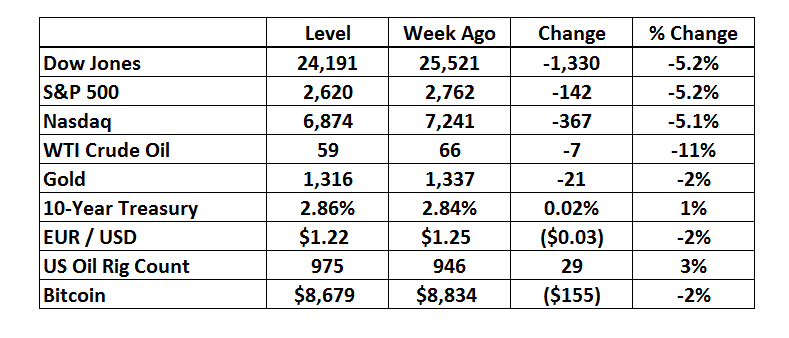
Volatility is back and in an uproar. We’ll run through what is happening in the markets below, but don’t lose sight that although the backdrop warrants caution, the bull market is alive and well. US equities ended their worst week in two years on a positive note with the Dow up 330 points on Friday, but rate-hike fears that pushed markets down remain in place as investors await inflation figures on Wednesday. The S&P 500 tumbled 5.2% in the week, its steepest slide since early 2016, jolting equity markets from an unprecedented stretch of calm. At one point, stocks were 12% below the highs set just two 11 days ago, before a strong rally Friday left the equity benchmark 1.5% higher on the day.
Still, the selloff has wiped out gains for the year. Signs are mounting that jitters spread to other assets, with measures of market unrest pushing higher junk bonds, emerging-market equities and treasuries. The CBOE Volatility Index ended at 29, almost 3x higher than its level January 26th. We at The Bull Market Report are staying calm. We believe stocks are on sale so we would suggest picking out one or two of your favorites and slowly buying more shares.
No matter what is happening out there, there is always a bull market here at The Bull Market Report! This week we highlight: Blackrock, The Carlyle Group, Synaptics, Tesla, CBRE Group, and Ventas.
Key Market Measures (Friday’s Close)
BMR Companies & Commentary
Blackrock (BLK: $522, down 5%)
BlackRock is trusted to manage more money than any other investment firm. Its business is investing on behalf of clients from large institutions, to parents and grandparents, teachers, nurses, doctors and people from all walks of life who entrust their savings to the firm. Well, the company is getting even bigger.
BlackRock is seeking to raise $10 billion for "BlackRock Long-Term Private Capital" to buy and hold $500 million to $2 billion minority stakes in companies for periods of up to more than a decade. The move establishes BlackRock as a potential competitor to Wall Street private-equity giants like Carlyle Group and Apollo Global Management. It is the first-ever attempt by the world's largest asset manager to make such direct investments.
BlackRock has praised Berkshire Hathaway as the best-known example of the strategy. Well, of course. No one has ever done it better. We all know this. BlackRock Long-Term Private Capital will operate differently from most private equity funds, taking full commitments up front and reinvesting as it exits investments. As compared with most investments that return capital to investors after one deal. This is great for Blackrock shareholders because there is no need for ongoing fundraising.
BMR Take: The rock of the investment management industry right now is Blackrock. The company is going to generate nearly $14 billion of revenue this year and produce about $28.60 of EPS. With revenue and EPS growing to over $15 billion and $32.00 next year, respectively, the stock is far from expensive leaving a lot of room for upside.
---------------------------------------------------------------------------------------
The Carlyle Group (CG: $23, down 10%)
Carlyle delivered a solid quarter. Revenue was $1.0 billion versus just $435 million a year ago. EPS hit $1.01 versus just $0.02 a year ago.
Management discussed how the business concluded 2017 with great momentum across all businesses. Carlyle had record activity deploying $22 billion into new investments and raising $43 billion of capital across the platform. Investment performance was exceptional with 20% appreciation across carry funds enabling realizations of $26 billion that went to investors as proceeds for their investments.
The company declared a quarterly distribution of $0.33 per share on February 21st. For full year 2017, they paid out $1.41. That is nearly a 6% yield at the current price.
BMR Take: In private equity The Carlyle Group is a top-notch franchise, known everywhere, the who’s who of business, doing deals in the top floor offices of every major city. The business is raising money like weeds and generating big returns. It is a very compelling opportunity. EPS should hit $3.00 next year leaving this stock dirt cheap.
---------------------------------------------------------------------------------------
Synaptics (SYNA: $44, up 7% - yes really!)
Synaptics reported revenue of $430 million versus $461 million last year. EPS was $1.11 versus $1.49 a year ago. Not terribly pretty, but Synaptics is starting to benefit from the transition encompassing a more diversified product portfolio and customer base, and expects to see strong momentum from investments in infinity displays and consumer IoT in the second half of this calendar year. They continue to make meaningful strides across core growth priorities within chip-on-film, OLED (organic light-emitting diode*), in-display fingerprint technology, and consumer IoT. This includes retail availability of flagship smartphone products, such as new fingerprint, display, and voice-enabled technologies.
* OLED panels are made from organic (carbon based) materials that emit light when electricity is applied through them. Since OLEDs do not require a backlight and filters (unlike LCD displays), they are more efficient, simpler to make, and much thinner - and in fact can be made flexible and even rollable.
BMR Take: With all of the growth investments happening, and the lucrative opportunity emerging for consumer IoT, the quarter’s results were less important than the outlook for attacking this major opportunity. And the outlook is bright. EPS is expected to ramp from around $4 this year to $5 next year and substantially more in the years ahead. We added the stock at $41 in December and our Price Target is $54 and we are hopeful of seeing this during the current year. It would be helpful in achieving this goal if the market calms down and resumes its bull run.
---------------------------------------------------------------------------------------
Tesla (TSLA: $310, down 9%)
Tesla reported revenue of $3.3 billion this quarter versus $2.3 billion last year. For the full year Tesla did $12 billion versus $7 billion a year ago. EPS this quarter was a loss of $3.04.
However, the big ramp in profitability is on the horizon. Revenue is expected to jump to $20 billion this year and $27 billion next year. EPS is expected to swing from a loss to a positive $3.25 in 24 months.
The stock traded about flat after the earnings release that included a fractional revenue miss, and narrower-than-consensus EPS loss. Gross margins came in 190 basis points below consensus, with the Model 3 production ramp weighing on the overall margin profile. But that didn’t really matter as management reiterated its target of 5,000 Model 3 production units per week by the end of Q2.
BMR Take: Most continue to see many moving parts to the Tesla story, with the guidance for sustainable positive operating profits sometime in 2018 garnering more of a show-me attitude, especially given the checkered track record of not hitting guidance milestones or production targets. However, most agree the healthy demand for the Model 3 continues to be a good problem to have, and are spectators on the pace of production execution.
We put a Sell Price of $335 on the stock a few weeks ago so we don’t lose the tremendous profits we have on the stock, but the market this week smashed most stocks down including Tesla. Our Sell Prices are for YOU to decide what to do.
--- We love the concept of the company.
--- We love Elon Musk (Space X with its new successful launch this week has had positive ramifications on Tesla).
--- We love the cars they make.
--- But the debt is crushing.
--- But they have been able to weather the storm through debt and equity sales.
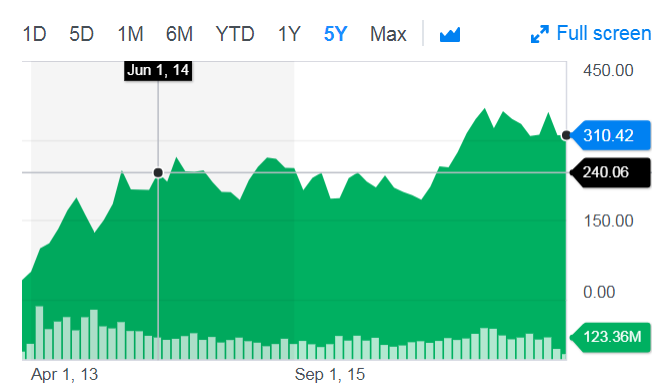
As we’ve said before, this stock could go to $200 or $500. And we’re not sure which will come first? It is very speculative. Should you be in this stock for the wild ride ahead? Only you can decide.
Here’s a 5-year chart. Pretty impressive:
---------------------------------------------------------------------------------------
CBRE Group (CBG: $42, down 5%)
CBRE is crushing it. The company reported revenue of $4.4 billion versus $3.8 billion last year. EPS was $0.99 up from $0.93 a year ago. The consensus expects this year’s revenue to grow from $14.2 billion to $16.5 billion in 2019. EPS is similarly expected to grow from $2.70 this year to $3.20 in 2019.
Fourth-quarter results capped another excellent year for CBRE. Performance significantly exceeded the expectations discussed on the third-quarter earnings call as some concerns surfaced about occupier outsourcing and leasing fee revenue growth. But all that went to the wayside as revenue and earnings for 2017 ended up reaching all-time highs. 2017 marked the 8th consecutive year of double-digit EPS growth for CBRE.
BMR Take: The macro environment is a supportive backdrop for this business, and management continues to operate within an industry poised for long-term growth. This is due to the growing acceptance of outsourced commercial real estate services, the increasing capital allocation to commercial real estate as an institutional asset class, and the continuing consolidation of activity within the industry to the highest-quality, globally diversified market leaders. CBRE Group is a must-own holding in your portfolio in the real estate sector.
We’re up over 60% in two years on this wonderful firm. No dividend yet, but we can see that coming. Our target is $54 and there’s an outside chance it can hit that this year. We know what this company does first hand – they save big multi-national companies money. Big money as in millions and millions of dollars. And the firm gets rewarded in brokerage fees, fixed fees and more. And so few people know about this great firm.
This chart shows the value this stock offers here, after this rough week:

---------------------------------------------------------------------------------------
Ventas (VTR: $52, down 5%)
Ventas reported revenue for the quarter of $895 million versus $875 million a year ago. Revenue for 2017 ended at $3.6 billion versus $3.4 billion in 2016. EPS was $0.50 versus $0.58 a year ago. EPS for 2017 ended at $1.78 versus $1.86 in 2016. Consensus expects revenue to drift upward toward $3.7 billion over the next 2 years. EPS is expected remain stable around $1.75 although we see several sources of EPS upside that are likely to drive revisions closer to the highest Street forecast of $2.15.
All in all, 2017 was another excellent year for Ventas, as the business generated record cash flow from operations and delivered same-store property cash net operating income growth at the high end of internal expectations. To further enhance their diverse portfolio, the company made nearly $2 billion in value-creating investments, including significant expansion of their university-based life science business. And they profitably disposed of almost $1 billion in assets and completed innovative deals with leading operating partners.
BMR Take: Ventas has proven resilient through cycles for two decades. They remain one of the world's best REITs with a specialty in healthcare among other areas.
This success is founded on solid strategic vision, superior foresight and innovation, intelligent and timely capital allocation decisions, rigorous execution and a cohesive, expert team. As they enter 2018 – the company’s 20th anniversary year – management is confident that they can continue the long track record of superior consistent performance as the industry leader.
We added Ventas at $60 in last 2016, a little over a year ago. Until the last two weeks, it was hovering around $56, down a bit, but still paying a nice 6% dividend. It’s worth $18 billion, and has over 1200 properties across the US, Canada and the UK. And as you know, they are in the senior living business along with medical facilities as well. Yes, the stock is down, but this company is strong, and we can only see good things happening from here. If you bought at $60 now is the time to add to your position to bring your cost down. Two years from now we wouldn’t be surprised to see the stock in the 70s, as remember, 10,000 people a day turn 65 in the US. They have to live somewhere!
---------------------------------------------------------------------------------------
We got a letter from one of our readers about Ventas
From: Richard Reed [mailto:reed995@]
Sent: Wednesday, February 07, 2018 10:21 AM
To: The Bull Market Report <Info@bullmarket.com>
Subject: Re: EARNINGS PREVIEW FOR THE WEEK AHEAD
Hi Todd,
Ventas (VTR) is below your Sell Price. Are you lowering the sell price? Thanks.
Richard
Our answer:
Hi Richard –
Look – they own 1200 assets in the United States, Canada and the UK. The properties are senior living properties and more. Are they all going down the tubes? NO WAY. A $19 billion asset paying 6%. We would buy more.
Furthermore, our Sell Price on Ventas is $58. But at $52, we have to say that we like it even more. Nothing has changed for the company in the past two weeks. Yes, interest rates are a shade higher, but nothing out of the ordinary. When the economy is good, rates go out. This is just normal. So to answer your question above, yes, we are lowering our Sell Price to $48. Of course, YOU can make up your own mind on this one, as always, but we would take this opportunity to buy an amazing company at an even lower price.
---------------------------------------------------------------------------------------
---------------------------------------------------------------------------------------
Economic Calendar
CPI Ex-Food & Energy
Wednesday, February 14th, 8:30 AM
Period: January
Consensus: 1.7%
Prior: 1.8%
CPI
Wednesday, February 14th, 8:30 AM
Period: January
Consensus: 1.9%
Prior: 2.1%
PPI
Thursday, February 15th, 8:30 AM
Period: January
Consensus: 2.5%
Prior: 2.6%
Housing Starts
Friday, February 16th, 8:30 AM
Period: January
Consensus: 3.7%
Prior: -8.2%
---------------------------------------------------------------------------------------
---------------------------------------------------------------------------------------
Apple has $285 Billion in Cash
Can you believe this? Again – a record high for any company in history. Apple (AAPL: $156, flat for the week) has $285 billion in cash, or $56 a share. With the stock at $156, that’s 36% of each share of stock in cash. We’re not sure of the Wall St. record, but we are guessing this is twice as much than any other company in history. With the stock flat for the week (amazing) this just screams out at us to add more to the portfolio.
---------------------------------------------------------------------------------------
If the Market Heads Back Up
No one knows where the market is heading. Will it calm down and move higher this coming week and month? Or will it be heading for 23,000 and lower? Again, we don’t know. But if things simmer down and the volatility abates – AND IT WILL – there are a few stocks that we would want to add to our positions in. Here are just a few:
Microsoft
PayPal
Google
Facebook
Apple
Eli Lilly
Yes, many of these are the super Tech stocks that have been leading the market. But guess what? These stocks will continue to lead the market for many years to come.
And one more note. Did you see Annaly Capital Mortgage (NLY: $10.21, down 1%) this week? Solid as a rock. So if you are super worried about things, we believe Annaly can be a store of value for a month or two or 12, and you can enjoy the 11% dividend in this $12 billion market cap company.
---------------------------------------------------------------------------------------
---------------------------------------------------------------------------------------
A Word from Gary Jefferson
Jefferson Financial Group
First Vice-President, Investments
UBS Financial Services, Inc.
There was no comment Monday or Tuesday because everything I wrote was outdated and the numbers were obsolete within minutes of writing, rewriting and re-rewriting them. The dust may or may not have settled, but a few things are much clearer today.
In short, the seismic swings over the past few days have been based on three primary factors that we believe now form a consensus:
1. The threat of higher inflation (Rising bond yields)
2. The possibility of more Fed hikes
3. The long streak without a normal and healthy market shakeout.
How does that stack up against the best economy we've seen in over a decade? In other words, is it good news or bad news that economic growth is so strong the Fed may have to raise rates sooner than expected? Or, is it good news or bad news that nearly half the companies in the S&P 500 have reported fourth quarter results and more than 80% of them have beaten Wall Street's revenue expectations, the highest percentage since the third quarter of 2008? And, is it good news or bad news that the tax law will boost those profits further in the quarters ahead?
Let's put all this in perspective:
First, the market isn’t overbought anymore. We now know that. There was a "10% correction." Let’s get over it.
Second, earnings are robust.
Third, the rise in bond yields has been a headwind, but it’s not signaling a looming recession. Importantly, the 10-year vs. 2-year Treasury yield spread has widened out as yields have risen, implying the bond market is now discounting higher inflation and better economic growth, which over the medium term has almost always been positive for stocks.
While volatility has returned with a vengeance, the market fundamentals are now better and earnings growth prospects haven't looked better in years. Basically, all of the reasons why investors have been bullish on the market last week, last month and last year are still here.
---------------------------------------------------------------------------------------
The High Yield Report
by Michael Foster
VP High Yield
It should always be emphasized that much of a stock's action is not caused by only the underlying company, but also by the industry and the overall market. In a volatile environment, this emphasis is especially important. While our High Yield and REIT portfolios have shown lackluster performance over the past two weeks, the fundamental aspects of the companies that make up the portfolios have not changed.
The S&P 500 decreased 5.1% over the past week, leading to stocks officially being in correction territory. Much of the decline is being attributed to interest rate and liquidity fears, which is why much of the analysis on the portfolio below will focus on those aspects. It takes just one week to rattle bullish sentiment. As an investor, you should not put too much weight on what the general financial media is discussing. What should take priority is thinking about whether the fundamental aspects of the economy and market have changed. When this is the priority, our fear diminishes as we realize that earnings are still strong, nonfarm payrolls on February 2nd were above expectations, and a deregulatory environment is still present.
One metric, the yield curve, is worth looking at though. The spread between the 10-year Treasury yield and the 2-year Treasury yield has been constantly decreasing as a result of the Federal Reserve tightening policies and the lack of inflation. On a basic level, you can note that the presence of an inverted yield curve, if it were to happen, has been a common predictor of past recessions. Going deeper, the economic repercussions of the inversion are much more important. Consumers and banks are directly impacted. For consumers, the cost of credit increases, which leads to a larger portion of expendable income being dedicated to servicing debt. For banks, the spread between long-dated loans and deposits decreases, which leads to worse financial performance. We’re sharing this information so that you can keep the yield curve on your radar, but there’s no need to worry as of now. When the curve inverted in the past, it still took between 7 to 24 months to reach any sort of recessionary state.
AllianzGI Equity & Convertible Income Fund (NIE: $20.59, down 4%) fared slightly better than the S&P’s drop of over 5%. It moved from the weekly low of $19.50 to its current level after recovering about 2.5% in the last hour of trading on Friday. The performance of individual equities which it holds, including Microsoft, Alphabet, and Amazon, led to the recovery in the last hour. Given that the fund invests little in the bonds and the scenario of the inverted yield curve, we can expect the funds to be shifted from Equity to Bonds.
We still see Apollo Commercial RE Finance (ARI: $17.70, down 3%) as a cyclical play on the U.S. commercial real estate sector. Given that commercial real estate in the U.S. remains solid, with Apollo’s loan originations hitting $1.5 billion YTD and the economy of the US continuing to get stronger and stronger, Apollo is not a position to be worried about.
Digital Realty Trust (DLR: $102, down 5%) dropped almost by the same amount as the S&P. This was the opposite of the week prior, where the company maintained strength in the midst of widespread declines. While we noted the continued demand for data centers in the last summary, there are some other metrics to note. Digital Realty, owning many data centers in US and internationally, is affected by rising interest rates as the cost of borrowing rises. The company has a massive debt level of $5.8 billion with a Debt/EBITDA ratio of 22. Rising interest rates could cripple the company’s dividend payout and future prospects.
Invesco Municipal Trust (VKQ: $11.83, flat) ended up at the same level as the beginning of the week. With its investments primarily in investment grade U.S. municipal bond obligations (85%), the fund can expect to yield better returns amidst the current rising interest rates scenario. Also, a Fitch report stating that plans to cut federal funds to them won't impact the revenues of the municipal bond funds and ETFs, played a large part in keeping the fund’s price level stable. Nuveen Municipal (NVG: $14.43, flat), another high yield fund with major investments in U.S. investment grade municipal bonds, also maintained its price level.
Pimco Dynamic Fund (PDI: $30, down 1%) was less volatile. The firm, investing primarily in a range of debt securities, including mortgage-backed securities, high yield corporates, and emerging market bonds, could witness further issues with rising interest rates, changes in tax structure, and better yields.
The REIT sector has been partially impacted by the recent economic data, heightening fears of higher interest rates. Primarily, the sector is engaged in massive borrowings, and rising interest rates could increase the cost of the borrowings. With that said, rising interest rates often occur in a booming economy, which indicates higher demand by consumers.
Market corrections generally provide prudent investors with great buying opportunities. One way of going about this is finding relative strength in strong industries. Applying this analysis to REITs, the overall REIT sector was down only 3%. Within out portfolio, three of the five positions outperformed the sector. Annaly Capital Management (NLY: $10.21, down 1%), Government Properties (GOV: $16.37, down 1%), and Omega Healthcare Investors (OHI: $26, flat) composed that group.
As a company that primarily engages in buying mortgages and mortgage-backed securities (as well as other assets), Annaly could fare very well as interest rates go up and correspondingly coupon rates do as well. While this is not necessarily the reason for the less-than-average drop this week, going forward it is something we will keep in mind. Both Government Properties and Omega should not feel a significantly negative impact by rising rates either. The former gets offered attractive rates by the government as a result of its leases and the latter’s healthcare-related real estate is, for the most part, unaffected by the business cycles.
The other two positions, Ventas (VTR: $52, down 5%) and Welltower (HCN: $55, down 5%), ended up having declines that were in-line with the S&P 500 but larger than the move in the REIT sector.
Ventas reported positive 4th quarter earnings on Friday, which provided a minor boost to the stock. The reported income from continuing operations for 2017, $640,000, was a record for the company. In turn, the EPS and FFO per share numbers were also records. In a rising rate environment, this is a positive sign. With the earnings report occurring during a stock market decline, any overall S&P bounce should result in outperformance by Ventas.
The other relatively weak company, Welltower, did not have any news this week to explain the larger than average decline in the stock. As it is focused on owning senior living properties and funding real estate infrastructure, the large amount of debt maintained could pose an issue within the rising rate environment. Currently, though, the extensive track record of stock appreciation over the past 25 years leaves us unworried. Welltower is also at the lower end of its range for the past four years, so it is a good area to pick up more shares.
Good Investing,
Todd Shaver, Founder and CEO
The Bull Market Report
Since 1998
February 7, 2018
by Todd Shaver | Feb 7, 2018 | Earnings Preview 6 AM
Carlyle Group (CG: $24)
Bull Market Report Target Price: $28
Bull Market Report Sell Price: $24
Earnings Date: Wednesday, 8:30 AM ET
Consensus: 4Q17
Revenues: $780 million
EPS: $0.62
Year Ago Quarter Results
Revenues: $435 million
EPS: $0.02
Key Things to Watch For in the Quarter
Analysts expect The Carlyle Group to report a 79% increase in revenues with a huge increase in earnings per share for 4Q17. The stock has beaten analyst estimates in three of the past four quarters, and is up 43% since this time last year. The Carlyle Group is an investment firm specializing in direct investments in the Fintech Sector. We do not expect the recent selloff to have a grave effect on the stock because of the firm’s concentrated line of business.
--------------------------------------------------------------------------------------------------
Synaptics (SYNA: $41)
Bull Market Report Target Price: $54
Bull Market Report Sell Price: $35
Earnings Date: Wednesday, after market close
Consensus: 4Q17
Revenues: $430 million
EPS: $1.09
Year Ago Quarter Results
Revenues: $460 million
EPS: $1.49
Key Things to Watch For in the Quarter
Synaptics is expected to report a 7% decrease in revenues and a 27% decrease in earnings per share for 4Q17. Despite having beaten estimates in the past four quarters, the stock is down almost 30% since this time last year. We expect the firm’s underlying technology and management team to spur growth over the long-term horizon. Our Target is $54 and our Sell Price is $35.
--------------------------------------------------------------------------------------------------
Tesla (TSLA: $334)
Bull Market Report Target Price: $375
Bull Market Report Sell Price: $335
Earnings Date: Wednesday, 5:30 PM ET
Consensus: 4Q17
Revenues: $3.3 billion
EPS: -$3.10
Year Ago Quarter Results
Revenues: $2.3 billion
EPS: -$0.69
Key Things to Watch For in the Quarter
Analysts expect Tesla to report a 43% increase in revenues and an increase in the earnings deficit for 4Q17. Despite beating estimates in only one of the past four quarters, the stock is still up 27% this year, and that includes the recent sell-off. We expect Elon Musk to continue to drive top line growth as the economy continues to strengthen and electric cars continue to penetrate our roads.
But as we have mentioned we are worried about the capital that Tesla will need to sustain its growth. So we have a Sell Price in place of $335. With the latest market fall-off, the stock dropped from $354 to $333 on Monday, quite a bit below our Sell Price. The Sell Price is there for YOU to decide what to do. Sell? Hold? Buy more? We love this company but with the production delays and thus little money coming in, we're a bit concerned. We may have an update about the firm in the next few days.
--------------------------------------------------------------------------------------------------
CBRE (CBG: $42.50)
Bull Market Report Target Price: $52
Bull Market Report Sell Price: $40
Earnings Date: Thursday, 7:00 AM ET
Consensus: 4Q17
Revenues: $4.0 billion
EPS: $0.92
Year Ago Quarter Results
Revenues: $3.8 billion
EPS: $0.93
Key Things to Watch For in the Quarter
CBRE is expected to report a 6% increase in its revenues and a 1% decrease in its earnings per share for 4Q17. The stock is up 33% on the year, and has been at the forefront of its peers in the real estate industry. CBRE has beaten estimates in each of the past four quarters which helps explain the firm’s bull run. The stock took a pretty heavy hit early this week when investors shaved 10% off the market cap. We believe it has been oversold, especially given the strong economic growth and investor’s natural fear of real estate when markets turn south. We are big believers in CBRE and would accumulate shares here.
--------------------------------------------------------------------------------------------------
Ventas (VTR: $53)
Bull Market Report Target Price: $72
Bull Market Report Sell Price: $58
Earnings Date: Friday, 10:00 AM ET
Consensus: 4Q17Revenues: $875 million
EPS: $0.63
Year Ago Quarter Results
Revenues: $875 million
EPS: $0.58
Key Things to Watch For in the Quarter
Ventas is expected to report no growth in revenues and an 8% increase in earnings for 4Q17. Despite Ventas’s ability to beat estimates in each of the past four quarters, the stock is down 15% since this time last year. The stock currently yields a 6% dividend, and has developed a trend for earnings growth. While some investors are selling the stock due to a lack of revenue growth, we are confident in the ability of management to cut costs and produce growth their bottom line.
February 4, 2018

by Todd Shaver | Feb 4, 2018 | Weekly Newsletter 7pm Sunday
The Weekly Summary
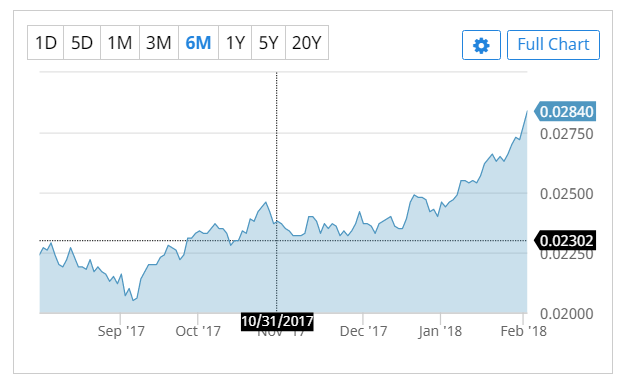
The stock market took a hit this week. It was down almost 200 on Monday, almost 400 on Tuesday, rallied a tad on Wednesday and Thursday, and got hammered on Friday to the tune of 666 points. It’s a week we can happily say has been put to bed and we can now forget about it. The long-awaited correction has now occurred. Happy now Wall Street pundits? (We don’t feel this way.) The big reason for the sell-off was interest rates. The 10-year was up again to 2.84%. And the 30-year moved up above 3%. But this is what happens when you have a strong economy – interest rates move up. This has been happening for over 100 years. The economy shines; interest rates go up. Why do you think rates have been so low? Because the Fed drove down rates after the debacle of 2008-2009 and kept them there for almost 10 years. Look at this chart here; it’s a bit hard to read at first – note that the right column shows the rate today – 1.48% and in 2008 it was 1.04%.
Now take a look at these two charts. The first one is the 10-year Treasury for the past six months. It's gone straight up.
And this one is the 10-year for the past 20 years. Basically straight down.

The key takeaway here is the interest rates are STILL VERY LOW HISTORICALLY. This is actually good news for the economy and stocks. Thus it is our take that 1) We had a bad week last week 2) Things will calm down this week and in the coming months, and 3) Good solid companies will continue to thrive and grow as the US economy continues to strengthen.
Easy for us to say. Hard for you to implement. We understand that. But we want you to put this past weekly move in perspective. The market is where it was just three weeks ago, at 25,500. A year ago it was at 20,000.
The big oil companies came up a bit short on the earnings front last week. Most of the Street was expecting good things, as the price of crude has remained strong at $65. But Exxon’s production dropped by 130,000 barrels a day and has lost money now for 12 quarters a row on its US drilling business, even as US production touched the record production of 10 million barrels a day in November, the previous record being set in 1970. Plus they took a $1.3 billion write-down on its natural gas business. But overall, Exxon made $3.73 billion, a decline of just 2%. These big companies are expected to generate huge amounts of cash in 2018, so we aren’t feeling too sorry for them. The number could be over $40 billion, in excess of dividends and new spending.
Super Bowl Sunday is here! $5 million for a 30 seconds ad. Over 110 million viewers likely watched. The legacy of Tom Brady’s Patriots against the surprisingly better than you think Eagles. The Patriots are favored by 4.5 points. It is interesting. Very often in sports or in the markets whatever people expect to happen, doesn’t materialize. For all sorts of reasons: Cognitive dissonance. Conservative bias. Confirmation bias. Extrapolating past performance. Loss aversion. Overconfidence. Self-control. Regret aversion. Affinity. Status quo. The list of mental mistakes people make when investing is long and always at play. We saw a 666 point drop on the Dow on Friday. This was the 3rd largest one-day point decline in history. The market is digesting something. The Bull & Bear indicator managed by Merrill Lynch has finally flashed a firm sell signal after weeks of overextended conditions. We will see what happens Monday. The unexpected could happen. Just like in football.
No matter what is happening out there, there is always a bull market here at The Bull Market Report! This week we highlight: Microsoft, Google, Amazon, Facebook, PayPal, and Blackstone.
Key Market Measures

BMR Companies & Commentary
Microsoft (MSFT: $92, down 2%)
Revenue was $28.9 billion and increased 12%. EPS hit a solid $0.96 crushing the $0.87 consensus. This quarter’s results speak to the differentiated value Microsoft is delivering to customers across productivity solutions and as the hybrid cloud provider of choice. The firm’s investments in IoT, data, and AI services across cloud, position the business to further accelerate growth. In particular, Microsoft delivered another strong quarter with commercial cloud revenue growing 56% year-over-year to $5.3 billion, which is just amazing to see such a huge growth figure in the lucrative cloud opportunity. Guidance for Q3 was largely in-line or better than consensus expectations. All in all, a very good quarter.
BMR Take: Microsoft is a stock market darling. The business is well-rounded. Legacy Window products to the up and coming Azure product in commercial cloud. We see Microsoft continuing to piece together solid earnings results in the year ahead. With $4.25 of EPS in direct sight, the stock still screens reasonable at around 22x.
----------------------------------------------------------------------------------
Google (GOOG: $1,112, down 5%)
Revenue of $32 billion increased 24% from a year ago. EPS of $9.70 just missed the consensus for $10.00. Overall, we are interpreting the quarter’s results favorably (unlike the Street.) Mobile and desktop search along with YouTube are powering accelerating growth and these trends should drive sustained above average growth going forward. Google Cloud momentum is good now generating $1 billion in revenue per quarter, where the number of $1 million or more contracts across cloud products tripled in 2017. Google has now sold ‘tens of millions’ of its Mini, Max, and Chromecast devices as Google Assistant is now on over 400 million devices globally. Waymo’s progress is accelerating. They plan to launch a ride-sharing program in Phoenix operated by self-driving cars this year. Wow.
BMR Take: We really don’t care much about the slight EPS miss. The stock being down is an opportunity to accumulate shares. Scouring through all the analysis on the quarter, nobody is really saying anything that seriously concerns us. What we want to see going forward is more progress on the cloud business. Amazon AWS is now at 35% market share versus Google Cloud only in the high single digits. If Google can close that gap, this stock can continue its strong move higher. With nearly $50 of EPS coming into view, the current valuation of 23x is far from stretched.
----------------------------------------------------------------------------------
Amazon (AMZN: $1,430, up 2%)
Amazon is crushing it. What else is new? (!) Net sales increased 38% to $60 billion in the fourth quarter, compared with $44 billion in 4Q16. EPS of $6.15 was well above $4.90 a year ago. There is so much to discuss here. What we are really excited about is the Echo business. Earlier in the year Amazon introduced three new Echo devices: the all-new Echo ($100), featuring a new design, improved sound, a lower price, and a choice of colors to personalize your device; Echo Plus ($150) with a built-in smart home hub so customers can easily set up and control their smart home devices; and Echo Spot ($130), a compact Echo with a screen so you can see the weather, get the news with a video flash briefing, view lyrics with Amazon Music, watch a camera monitor, browse and listen to Audible, and more.
This new business opportunity could be huge. Said Jeff Bezos, Amazon founder and CEO, “Our 2017 projections for Alexa were very optimistic, and we far exceeded them. We don’t see positive surprises of this magnitude very often — expect us to double down. We’ve reached an important point where other companies and developers are accelerating adoption of Alexa. There are now over 30,000 skills from outside developers; customers can control more than 4,000 smart home devices from 1,200 unique brands with Alexa; and we’re seeing strong response to our new far-field voice kit for manufacturers. Much more to come and a huge thank you to our customers and partners.”
While Amazon doesn’t break out the financials on Alexa and its other electronics business, the results from its cloud-computing business, Amazon Web Services (AWS), were obvious and contributed much more to the company’s record profit total. AWS saw revenue shoot 45% higher to $5.1 billion, with profits of $1.3 billion. Wow – that’s 26% after tax. AWS and the tax gain of $790 million for the changes in the U.S. tax code, which lowers Amazon’s tax rate to 21%, were the biggest contributors to the company’s overall net income of $1.86 billion. Watch for a possible spin-off of the cloud business sometime this year. Can you imagine what this will do to the stock? Does “shoot higher” ring in your head?
BMR Take: Look, when Jeff Bezos gets surprised by how good a business is doing, and says he is doubling down, you have to take note. But don’t just take note. Take action on it too. You have to have Amazon in your portfolio. You can’t look at the business on current revenue or earnings and say it’s cheap or expensive. It’s an innovation machine. They are constantly doing start-ups, like Echo. More new paid members joined Prime in 2017 than any previous year — both worldwide and in the US. The business is roaring with momentum and still has a very bright future ahead even at the current stock price level.
----------------------------------------------------------------------------------
Facebook (FB: $190, flat)
Flat for the week. Not bad in the whole scheme of things. Facebook increased revenue 47% to $13 billion. EPS of $1.44 was up 19%. What a good quarter frankly. Though while 2017 was a strong year for Facebook, it was also a hard one," said Mark Zuckerberg, Facebook founder and CEO. "In 2018, we're focused on making sure Facebook isn't just fun to use, but also good for people's well-being and for society. We're doing this by encouraging meaningful connections between people rather than passive consumption of content. Already last quarter, we made changes to show fewer viral videos to make sure people's time is well spent. In total, we made changes that reduced time spent on Facebook by roughly 50 million hours every day. By focusing on meaningful connections, our community and business will be stronger over the long term."
Some analysts were scrambling a bit to figure out what this all mean. But monthly active users increased 14% from a year ago to 2.13 billion. Essentially, the issue is that Facebook has had a huge growth engine coming from adding users. Seriously 2.2 billion users is huge. The runway here is slowing down and that means Facebook is going to have to find another way to take over the world. And that is what Zuckerberg is saying. They will be focusing on quality of usage and fully monetizing existing users.
BMR Take: The company is look at EPS growing from $5.40 in 2017 to $8.70 in 2019. It is not easy to find a 20% earnings growth story. We really like the global platform Facebook has built and all the future opportunities it creates for advertising and other revenue opportunities. We see the same story here as elsewhere in large cap tech, trading for 22x is just not stretched.
The stock hit a new all-time high of $195 on Thursday and even traded at $194 on Friday, before the deluge. What a great company.
Stay the course.
Look at this 5-year chart. Where do you think it is headed, as it moves to 2.5 billion users?

Active Users Chart

----------------------------------------------------------------------------------
PayPal (PYPL: $77, down 10%)
PayPal delivered strong numbers. Revenue increased 26% to $3.7 billion. EPS increased 57% to $0.50. Overall, PayPal had a transformative year in 2017. The company brought record numbers of new customer accounts to the platform by simplifying life for consumers and merchants.
PayPal also substantially expanded its opportunities for future growth and redefined its competitive position through successful partnership strategies. For example, PayPal and Synchrony Financial announced an agreement expanding their consumer credit relationship. Under the terms of the transaction, Synchrony Financial will acquire PayPal's U.S. consumer credit receivables portfolio, which totaled approximately $6.4 billion at the end of 2017.
BMR Take: So why is the stock down? PayPal and eBay have signed a term sheet to make PayPal available as a way to pay on eBay, through July 2023. But the fact that PayPal’s exclusivity on eBay is going away has people up in arms. This aspect of the PayPal and eBay relationship has been well-discussed and should not surprise people. Don’t let it fool you.
We look at PayPal like this. This quarter new customers increased 9 million up to 227 million total customers. Facebook has over 2 billion users. With time PayPal could look a lot more like Facebook. That means massive growth still lies ahead. We believe in riding this train. We are talking about the next gen MasterCard or Visa here. A 10% drop in the stock is a good opportunity to take advantage of.
----------------------------------------------------------------------------------
The Blackstone Group (BX: $35, down 4%)
Total revenue ended the year at $7 billion up 39% from last year. EPS of $2.21 compared to just $1.56 a year ago, a huge 42% jump. This business is grooving! It was another strong quarter of core business trends. Specifically, total assets under management increased an elevated 12% sequentially to a record $435 billion, driven primarily by $62 billion of inflows. Capital deployment of $20 billion in the quarter represented a record. And dry powder remained elevated at $95 billion, which bodes well for future capital deployment levels. Just to put that in perspective, Blackstone realized half of the $7 billion of revenue this year from carried interest on prior year inflows, that were deployed to generate big gains of which Blackstone gets a percentage of the profits.
You are telling me the company has $95 billion to put to work to do more of this? Let’s assume on average they can collect a 10% carry on that money. They just doubled the business.
BMR Take: It was a truly exceptional year for Blackstone, reflected by outstanding earnings growth and record capital activity that drove their highest-ever level of aggregate cash distributions to shareholders. Blackstone’s tireless drive to innovate has enabled the company to launch large-scale new product areas that reach a wider client base and serve existing clients in new ways. Our investors in turn have entrusted the company with more capital than ever before, leading to a new record total assets under management of $435 billion, up 18% year-over-year. The stock is a good value at just 10x the current EPS of $3.25.
----------------------------------------------------------------------------------
----------------------------------------------------------------------------------
Economic Calendar
Total Light Vehicle Sales
Monday, February 5th, 10:00 AM
Period: January
Consensus: 17.2 million
Prior: 17.8 million
Consumer Credit
Wednesday, February 7th, 3:00 PM
Period: December
Consensus: $19.5 billion
Prior: $28.0 billion
Initial Claims
Thursday, February 8th 8:30 AM
Period: February 3rd
Consensus: 233,000
Prior: 230,000
----------------------------------------------------------------------------------
----------------------------------------------------------------------------------
Apple Reports Earnings
Apple (AAPL: $161, down 6%) sold 77 million iPhones in the holiday quarter. Apple’s forecast for the next quarter was also lighter than expected. Apple says they expect to sell 50 million iPhones this quarter, slightly lower than the Street expected, and this equates to slightly lower revenue and the main reason the stock got hammered last week.
Apple still blew past its own and analysts’ expectations for revenue and profit for its fiscal first quarter, reporting record sales of $88.3 billion and net income of slightly more than $20 billion. The company was able to increase revenue by 13% year-over-year by increasing iPhone prices and generating more money from the people buying Apple’s smartphones.
Apple jacked up the price on its premium iPhone X smartphone, starting the 10th-anniversary model at $1,000, pushing the average selling price, or ASP, of an iPhone far higher than analysts had ever experienced. IPhone buyers paid an average of more than $796 for their phones in Apple’s fiscal first quarter; iPhone ASP had never previously topped $700.
Apple also boosted its software and services segment revenue 18% year-over-year in the quarter to $8.5 billion. And listen to this:The App Store, Apple Music, iCloud and Apple Pay all had their biggest quarters ever.
Apple said, “During the week beginning Dec. 24, a record number of customers made purchases or downloaded apps from the App Store, spending $900 million in that 7-day period, followed by $300 million in purchases on New Year’s Day alone.”
“Other products” revenue grew the biggest of all. This includes smartphone accessories like the Apple Watch, which grew sales 50% year-over-year for the fourth consecutive quarter, as well as AirPods. Revenue hit $5.5 billion by selling such hardware, up 36% more than a year ago.
Apple is capitalizing on the opportunity at hand by producing more money out of iPhone users in every way possible. Apple is making more money on each iPhone, selling a few accessories to go with it, then signing up iPhone users for monthly subscription plans for services such as Apple Music and iCloud.
If Apple Music continues to grow at its current rate, it will officially overtake Spotify this summer as the streaming world's number one service. Apple Music has a monthly growth rate of around 5%. Spotify has a growth rate of just around 2%. If that keeps up, Apple Music will officially bump Spotify off the top in summer - and there's no reason to believe it can't, given that part of Apple's success in building an audience for Apple Music lies in the fact that the service comes bundled with most of the major devices the company sells.
BMR Take: The all-time high of $180 was hit January 18th. Two weeks ago the stock was down $7 and last week $11. Looks like a sale is going on in shares of this great company. Wait until that overseas cash starts hitting the books here in the US.

----------------------------------------------------------------------------------
VMware (VMW: $123) is Wrapped Up in a Dell Move
One way or the other it’s time to move on from VMware. Why? Dell Technologies owns 80% of the company and is discussing in the press whether to have VMware buy Dell in order for Dell to go public. It’s a back door tactic very rarely, if ever used before. It has impacted VMware greatly because no one really knows how it is going to play out. It looks like VMware might end up owning Dell, creating a behemoth Tech company consisting of Dell, VMware and EMC, plus a host of other tech businesses like cloud computing and cybersecurity. This might be a good investment, but little is known of its financials at this time, so we feel it best to wait and see how things shake out.
VMware was much higher a week ago, and Wall Street is quite nervous because it doesn’t really understand what is going on. The Street doesn’t like uncertainty, remember? (!)
BMR Take: We added the stock a year ago at $83 and we are up a shade under 50%. We think that’s a nice return (a GREAT return) and with everything going on with these new moves by Dell, we think it is time to take profits, sit on the sidelines and watch. Dell may be a stock to buy someday after they go public, but we will leave that decision for another day.
----------------------------------------------------------------------------------
----------------------------------------------------------------------------------
The High Yield Corner
By Michael Foster
Vice President of High Yield
After the S&P 500’s 2% drop on Friday, which has inspired headlines such as “stocks have worst decline in 2 years”, it’s easy to lose sight of the fact that the S&P 500 is up 3.4% YTD.
Before the decline, stocks were up 7.5%, so a drop was clearly necessary [so they say.] Investors who have gotten comfortable with a bull market may be a little scared, because they aren’t used to down days. And it’s easy to forget what is driving the bull market. Wages are up nearly 3% in the U.S., unemployment keeps dropping, corporate earnings are rising, and, perhaps most impressively, this strong economy is being mirrored around the world. The typically cautious IMF and World Bank have asserted that growth is strong around the world, and while these institutions have made a lot of blunders in the past, they aren’t SO euphoric as to bring out the contrarian bear in us.
For high yield, the cautions are amplified. Riskier income producers like Government Properties Income Trust (GOV: $16.65, down 7%) and AllianzGI Equity & Convertible Fund (NIE: $21, down 5%) are down heavy, although they operate in very different markets and are entirely different asset classes (REITs versus convertible bonds and covered-call stocks). To wit: the AllianzGI’s 5% decline on the stock is far steeper than its 2.9% NAV decline, which is itself slightly better than the S&P 500’s 3.2%. Now, of course we can’t read too heavily into short-term price movements, but at the very least this tells us something about the AllianzGI Fund: it is not making extremely risky bets on very volatile assets, so it isn’t in any danger right now. So why did it sell off in excess of its NAV selloff? You got it. Because of fear. And that’s why the fund remains a buy. It’s up 1.6% for the year, lagging the overall market by a bit.
And what about Government Properties Trust (GOV: $16.65, down 7%)? We recommended this REIT back in 2016 and although the REIT is down 7% since then on a price return basis, much more importantly its dividend has not been cut since then, and investors have actually gotten cash dividends of about 19% on their original investment since our recommendation. As a result, we’ve made a profit on a total return basis. And the dynamics of the fund haven’t changed. The REIT’s FFO over the last 12 months is $2.28, while the dividend is $1.72. Thus its FFO is 133% of dividend payouts, so it’s out-earning its dividend. There is no threat to the dividend stream in the short term, and rising rents thanks to a booming economy mean FFO will go up, resulting in even higher FFO coverage.
The income stream here is not at any risk, despite the implications of the recent absurd sell-off. Revenues have been rising by about 8%, so we don’t see any indication that revenues can’t support the current dividend payout. For this reason, there’s no reason to be more cautious about Government Properties, and plenty of reason to shrug off the recent price declines. In fact, it is a great time to add more to this very stable company that is absurdly undervalued.
Elsewhere in REITs, declines were much less severe. Only Omega Healthcare Investors (OHI: $26, down 3%) saw a decline in-line with the S&P 500, but that’s not surprising. We’ve discussed at length why this company’s dividend hikes are threatened, but the threat won’t materialize for years (we’ve estimated 5 years). Dips are buying opportunities for now, as long as investors are cognizant of the fact that the dividend hikes won’t last forever and the stock could sell off in a few years as a result. But if you want a strong and secure high income stream now, Omega is one way to do it.
Digital Realty Trust (DLR: $108) was the second-best investment in the Bull Market Report High Yield portfolio. It was flat for the week. That sounds bad, especially if you’ve gotten used to gains upon gains and few down days, which has been the market norm since the High Yield portfolio began in 2016. But it also shows, interestingly, that the market has a lot of confidence in Digital Realty (which also outperformed a lot of the Tech sector). This week, Amazon, Apple, and Alphabet reported earnings that proved the world’s demand for data centers isn’t going away. Alas, Digital Realty’s yield is tiny, but as an investment in a good company, it’s a great option for investors.
Apollo Commercial Real Estate (ARI: $18.14, down 1%), Ventas, (VTR: $54, down 3%), and Welltower (HCN: $58, down 3%) all saw slight declines, which we can consider to be more a result of REIT investors following the broader market trend. No big news came from any of these companies last week to warrant the selloff.
Similarly, AstraZeneca (AZN: $36, down 2%) fell a lot less than the broader market after weeks of strength in the Biopharma sector. AstraZeneca has not released any major news and there wasn’t any major sector announcements. We can dismiss this 2% decline as being relatively good in a week of short-term worriers cutting bets on all kinds of things more because of fear than for any fundamental reason.
Now, on to municipal bonds. The end-of-year sell-off in this asset class in anticipation of 2018’s rate cuts meant that these funds were attractively priced for income investors, and we still think long-term capital gains are in the cards. What we need to see is the market get used to our new Fed Chairman. While Janet Yellen did a wonderful job of managing monetary policy and bringing the Fed funds rate closer to historical norms, the job isn’t done. Jay Powell has already said that he will continue in the same mode. And that will limit enthusiasm for municipal bonds. that is, until the booming economy results in higher tax revenues for municipalities that, in turn, results in credit upgrades and thus increasing NAVs for our muni Closed End Funds. The timing on this eventuality is unclear, but there is good reason to be confident that it will happen eventually. Nuveen AMT-Free Municipal Credit Fund (NVG: $14.48, down 3%) and Invesco Municipal Trust (VKQ: $11.83, down 4%) are worth holding for the tax-free income as we wait.
PIMCO Dynamic Income Fund (PDI: $30) is the only High Yield holding to be up for the week, and for that we are grateful! But just as there’s little to read into the short-term declines, the short-term gain here isn’t a reason to celebrate. The market is all about short-term emotion-driven trading. If anything, the fact that the panic didn’t hit the Pimco fund may indicate that no matter how crazy the broader market is, we aren’t in full-blown panic mode. And that, quite possibly, could mean this correction won’t last very long.
Good Investing,
Todd Shaver, Founder and CEO
The Bull Market Report
Since 1998
January 21, 2018
by Todd Shaver | Jan 21, 2018 | Weekly Newsletter 7pm Sunday
The Weekly Summary
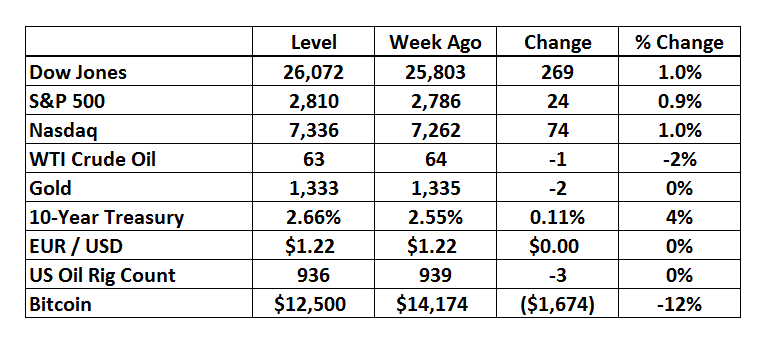
Time to get down to business. This week the US budget is in focus. The Senate rejected a one-month spending bill early Saturday, triggering the shutdown of many government services and setting off a partisan fight over who would bear the political consequences. The bill was blocked in a 50-49 vote, well short of the 60 votes it needed. After the vote, McConnell indicated he would take steps to set up a later vote on a 3-week spending bill, keeping the government funded through February 8th, but Senate Democrats are currently opposed to it, leaving lawmakers with no path to reopen the government. Fortunately, both chambers of Congress are expected to be in session Saturday, continuing discussions over how to resolve the underlying disputes over immigration and government funding. We are hopeful to see some progress made before the markets re-open on Monday.
No matter what is happening out there, there is always a bull market here at The Bull Market Report! This week we highlight: Celgene, Microsoft, Splunk, Square, Cloudera and VMware.
BMR Companies & Commentary
Celgene (CELG: $103, down 3%)
Celgene is on a shopping spree to fill a looming revenue hole - a sensible course of action. The trouble is, there is no guarantee their purchases will solve anything. The biotech giant is in talks to acquire Juno Therapeutics (JUNO: $68, up 41%). This comes after Celgene announced the purchase of cancer startup Impact Biomedicines earlier this month for $1.1 billion upfront, plus significant milestone payments. Celgene, which already owns about 10% of Juno, would be acquiring a new kind of cancer treatment, known as CAR-T. The price tag of an outright purchase will be high - Juno’s market value approached $8 billion when trading opened on Wednesday and Celgene shares dropped Wednesday morning, which makes sense. CAR-T technology, which modifies and deploys a patient’s own immune cells to fight cancer, is a brilliant scientific innovation with highly uncertain commercial prospects. The treatment carries a high price tag and employs a complex, labor-intensive manufacturing process. When Gilead Sciences (GILD: $81) acquired Juno’s peer Kite Pharma over the summer, they warned that the deal wouldn’t contribute to earnings for about three years. Gilead and Novartis have programs that are already on the market, while Juno still is awaiting regulatory approval.
BMR Take: Celgene needs to take risks right now as some of their other pipeline drugs have not panned out as well as expected. For example, its best-selling product, the multiple myeloma drug Revlimid, is expected to face generic competition within a couple of years. Any erosion of the Revlimid business will sting. While financially speaking, Celgene can comfortably swallow Juno, the risk is that Celgene may soon have to open its wallet again to solidify its future.
Look, we get it, there are risks everywhere. We’ve had thoughts of throwing in the towel with Celgene. But the more we think about it, the more you have to stick with Celgene. Projections call for EPS of $8.80 in 2018 and $10.35 in 2019. Much of the bad news is already in the stock, as a major sell-off having recently occurred. Celgene is an $80+ billion large cap bellwether in Healthcare. They will figure this out. And when they do, we could be staring at big upside well in excess of standard market returns.
-------------------------------------------------------------------------------
Microsoft (MSFT: $90, flat)
Should the government break up large Tech companies? Standard Oil, American Telephone and Telegraph were the technological titans of their day, commanding more than 80% of their markets.
Today’s Tech giants are just as dominant: In the US, Google drives 89% of internet search; 95% of young adults on the internet use Facebook; and Amazon accounts for 75% of electronic book sales. Those firms that aren’t monopolists are duopolies: Google and Facebook absorbed 63% of online ad spending last year; Google and Apple provide 99% of mobile phone operating systems; while Apple and Microsoft supply 95% of desktop operating systems. A growing number of critics think these Tech giants need to be broken up or regulated as Standard Oil and AT&T once were. Microsoft has long dominated desktop operating systems, but has failed to extend that dominance to internet search or to mobile operating systems. It’s possible Microsoft might have become the dominant company in search and mobile without the scrutiny a federal antitrust case brought that opened the door for Apple and Google. Throughout history, entrepreneurs have often needed the government’s help to dislodge a monopolist - and may one day need it again.
BMR Take: We recognize this is a very real risk facing Microsoft and many of our other high technology companies. However, we see no near-term developments that suggest that anything materializes in 2018. Accordingly, we see compelling value in Microsoft as EPS is expected to grow from $3.40 this year to $4.50 in 2020. Without any major disruptions like an antitrust headache, we see this stock riding much higher.
Our Target has been $92 and it hit $92.80 on Tuesday, a new all-time high. With a market cap of close to $700 billion we expect to see $800 billion in the next 12-18 months. We’re going to leave our target at $92 for the time being, but we expect to raise it to $100 shortly.
-------------------------------------------------------------------------------
Splunk (SPLK: $90, flat)
Splunk, first in delivering “aha” moments from machine data, announced that Daimler, the German automotive group, will replace its legacy SIEM with Splunk® Enterprise and Splunk Enterprise Security (ES). The group will use Splunk ES as its nerve center for security analytics to gain security insights across the entire organization, including business critical environments such as vehicle systems and manufacturing lines. The company chose Splunk over open source alternatives as part of its strategy to buy best-of-breed solutions rather than building things in house. The automotive group will use Splunk ES to analyze multiple terabytes of data each day. The team expects to reduce security investigation times from hours to seconds, utilizing visualizations to improve analysts’ ability to explore and interrogate data as well as help spot and respond to issues more quickly to limit any potential impact to the business. By committing to a Splunk, the company is able to plan security for the future while benefiting from Splunk’s predictable pricing. The flexibility of the Splunk platform was also important; the group expects to realize future value from traditional IT use cases as well as in newly developed digital applications and services.
BMR Take: As digitization continues to transform industries and create new sources of security-relevant data, security strategies need to be built upon a strong data foundation. Splunk is very well-positioned in this megatrend happening around big data and artificial intelligence. This is a great example of how organizations are taking an analytics-driven approach and turning to Splunk software to do it. With EPS expected to grow from $0.60 this year to $1.30 in 2020 and $2.10 in 2021, there is a really big thing happening at Splunk and you definitely want to be involved.
Our Target is $95 and our Sell Price is $74. We hereby raise the Sell Price to $83. We don’t want to lose our tremendous gains in the stock, having added it at $46 a year and a half ago.
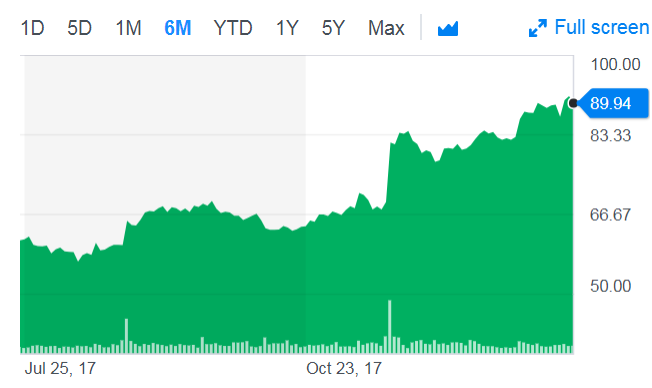
-------------------------------------------------------------------------------
Square (SQ: $43, up 3%)
The meteoric rise in the price of bitcoin in 2017, from just under $1,000 to above $15,000 at year-end, has attracted the attention of investors around the world. Powered by the blockchain, the distributed ledger technology which verifies transactions without the need for third-party validation, the cryptocurrency made great strides during the past year in achieving acceptance by businesses willing to accept it as a means of payment. Investors are looking beyond bitcoin itself to find companies that stand to benefit from the growing usage of bitcoin for commercial transactions. Square. The has released a beta trial enabling users to buy and sell bitcoin on its cash app.
BMR Take: Bitcoin and the blockchain is a windowpane into what euphoria looks like. We haven’t seen this kind of excitement in the markets since the peak of the housing market last cycle. We’ll save a discussion of the future of bitcoin, blockchain, and cryptocurrency for another forum. All that matters is that Square has been caught up in the mix due to this beta cash app trial and investors have benefitted. While we remain optimistic that CEO Jack Dorsey can innovate and create great new products, we still don’t see any specific EPS contribution being called out from the bitcoin cash app, so just be aware. All of that might not matter too much anyway, as the company’s EPS is expected to grow from $0.25 this year to over $1.00 by 2020.
Square Price Target Raised to $64 from $48 at Nomura
This represents a 59% potential upside from current levels. A "looming positive inflection" in gross payment volume growth can help "ensure that 2018 will be yet another phenomenal year" for Square, the company said. Accelerating share gains from payment peers and "relentless disruption of services" like payroll and human resources will make Square a very different company in 10 years. They believe little of this upside is evident using conventional valuation methodologies. The analyst keeps a Buy rating on Square.
BMR Take II: We’ve been saying this all along of course and Square has been a big winner for us here at The Bull Market Report. We added the stock at $17 last year in March and it is up 150% in that short time. It is going a lot higher. Our Target is $45, but we expect to raise that soon. What Nomura said above is very interesting – they can’t value this company on “conventional valuation methodologies.” We’ve been trying to put this in words for you but Nomura has done it for us. The company is in a business that is sweeping the globe, is the clear leader, sells at a high multiple – we know, and is going higher in our opinion.
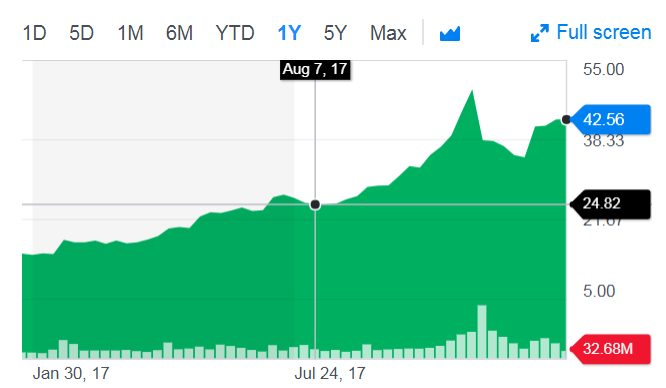
-------------------------------------------------------------------------------
Cloudera (CLDR: $18.45, up 2%)
Cloudera, the modern platform for machine learning and analytics optimized for the cloud, announced that it has been named a winner of two Internet of Things (IoT) Breakthrough Awards: the Overall Connected Car Innovation of the Year with Navistar, and Connected Car Insurance Solution of the Year with Octo Telematics. Cloudera Enterprise was recognized by this year's judging panel for empowering their customers, Navistar and Octo, to become data-driven enterprises with innovative solutions that combine data from (IoT) sensors, machine learning, and predictive analytics. The IoT Breakthrough Awards honor the world's top IoT companies, products, and people for the creativity, hard work, and success of their achievements.
BMR Take: This is a huge deal as we are sure you are well aware, of how big this mega trend of IoT, machine learnings, and predictive analytics is to the future of the market and our economy. We could rant and rave to you about our opinion of how good Cloudera is at it, but the industry itself just selected Cloudera as the best. This company will scale revenue from $350 million to nearly $600 million by 2020 and break the $1 billion milestone in the not too distant future after that.
-------------------------------------------------------------------------------
VMware (VMW: $136, up 3%)
This week at the National Retail Federation’s annual show, VMware highlighted several customers who have deployed their technology to modernize data centers, integrate public cloud solutions, empower the digital workspace and transform networking and security. The velocity of change in retail IT is making recognized brands rethink their IT strategies and consider cloud as a way to speed delivery. VMware helps create a foundation of shared technologies to serve both digital and in-store needs to create a connected retail environment. For example, one of the UK's largest furniture producers - DFS - moved to a scalable cloud-first infrastructure powered by VMWare. With this solution, the retailer said it can handle spikes in online traffic year-round with ease.
BMR Take: We continue to see so much potential for ecommerce and companies that are part of the explosive growth still occurring. VMware is expected to increase EPS from $5.15 this year to over $6.00 by 2020. The company's steady business model as an IT vender provides great visibility and a reliable source of earnings that will benefit your portfolio.
Our Price Target is $137, so we are oh so close. The Sell Price is $118, so we hereby raise it to $128 – again, so we don’t lose these great profits, having added the stock at $83, exactly a year ago. 64% is solid, don’t you think?
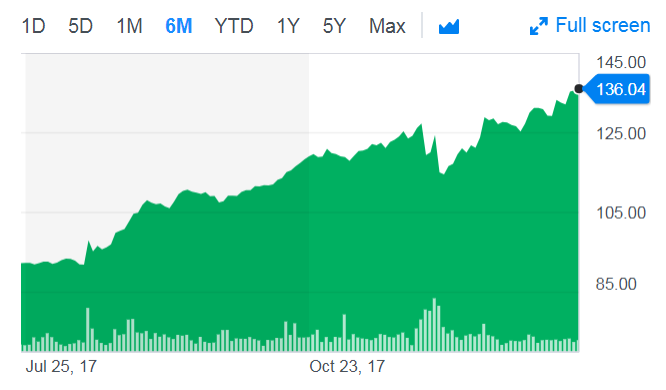
-------------------------------------------------------------------------------
Economic Calendar
Richmond Fed Index
Tuesday, January 23rd, 10:00 AM
Period: January
Consensus: 17.5
Prior: 20.0
Existing Home Sales
Wednesday, January 24th, 10:00 AM
Period: December
Consensus: 5,700,000
Prior: 5,810,000
GDP
Friday, January 26th, 8:30 AM
Period: Q4
Consensus: 2.5%
Prior: 2.3%
-------------------------------------------------------------------------------
-------------------------------------------------------------------------------
A Word from Gary Jefferson
Jefferson Financial Group
First Vice-President, Investments
UBS Financial Services, Inc.
UBS recently upped our estimate of S&P 500 earnings for 2017 from $131 to $133, and increased our forecast for 2018 earnings from $151 to $154 (last week Bank of America estimated 2018 earnings at $153). Also, UBS estimated earnings for 2019 would come in around $162. These are numbers which will obviously be revised as we go through the next two years, but they give at least a reasonable base line for valuing the current market based on earnings. The S&P 500 ended the year at 2674, which would mean it was trading at 20X trailing earnings and 17.3X forward earnings. Today, at 2810, it is trading at 18X forward earnings and 21X trailing earnings. As you see, the higher it goes, the higher both the trailing and forward PE's become. However, if the market trades at 20X trailing earnings at the end of 2018 as it just did last year, the S&P 500 would be at the 3080 level ($154 X 20). This is 10% higher than today, and that would make for another very good year in the market.
Apple is a one-company global economic stimulus plan. Apple plans to invest $350 billion in the U.S. economy along with paying $38 billion in repatriation tax as it brings back over $200 billion from overseas. Apple is also granting $2,500 in restricted stock units to all non-director level employees including retail employees at its stores. The tax reform bill again drives all these actions.
China reported that Q4 GDP growth increased 6.8% YoY which is slightly above the 6.7% consensus and in line with the 6.8% increase in Q3. China’s full year 2017 growth rate was 6.9% which is significantly above the government’s growth target of 6.5%. Expectations for 2018 are for another year above the 6.5% target growth rate. China’s strong GDP growth remains the world’s economic growth driver. This is good news for both the U.S. economy and the U.S. stock market.
-------------------------------------------------------------------------------
-------------------------------------------------------------------------------
Update on BlackRock
BlackRock (BX: $590, up 6%) brought in $1 billion every day of the year in 2017. (On average of course.) Now THAT is amazing. And the $6 trillion in assets is amazing too, having added $1 trillion last year. They are the largest by far. Most of this money went to its iShares division, the ETF group. as investors are flocking to these indexed investments. Profits were big last year too as the income of $2.3 billion or $14 a share, compared with $850 million the year before, or $5.10 a share. Revenue was up a solid 20%.
We added the stock at $415 in August of last year, about five months ago, and we are sure some of you groaned that it was another high-priced stock that is hard to swallow. We tried to convince you not to worry about the stock "price" and we hope we did. We can see a stock split coming this year. Wouldn’t it be nice to see this thing split 5-1 and bring the price down around $100? You bet. If we were running the show and not Larry Fink, we would do a 10-1 split! Down to $50 a share. Well, even if that doesn’t happen, we can see this stock at $700 someday.
BMR Take: Guess what? We like this company. $590 was our Target. We are raising it to $650 now, and raising the Sell Price from $470 to $550.
-------------------------------------------------------------------------------
Tesla Update
Last week we were worried that Tesla (TSLA: $350) might drop due to all of the financing needs it faces this year and next. So we raised the Sell Price to $320 to protect our gains. Well the stock rose $14 or 4% to our Target Price of $350. Now what?
Good question. We are going to raise the Target to $375 and raise our Sell Price to a tight $335 and sit back and watch. We love this company, we love Elon Musk, but his delivery problems are making us nervous. This stock is going to $500 or $200. We just don’t know which one will hit first! So be careful with this great concept company.
-------------------------------------------------------------------------------
The High Yield Corner
By Michael Foster
Vice President High Yield
Ventas (VTR: $54, down 1%) was strong last week, but still sitting with a year-to-date loss of over 9%. That is a massive loss in a very short period of time. At the same time, both the REIT sector and the market as a whole are doing much better, which makes the situation with Ventas even more worrisome.
Let’s dig a bit deeper to understand what’s going on and how to respond.
Ventas has not released any news, and nothing particularly newsworthy has happened either to Ventas or to the Healthcare REIT world. The selloff, which really began in earnest back in September, has gained significant momentum in the last couple of weeks despite no news. Sales volumes, however, have increased significantly in the last two weeks, indicating that the number of sellers who are worried about Ventas’s future have increased.
This, then, is a typical market panic.
Market panics are rarely justified, and this is unjustifiable, too. Ventas increased its dividend in December slightly, and with the recent price collapse that means the stock is yielding close to 6%. Ventas has not yielded this much since early 2016. If an investor had bought at that time, their total return from then to now would be 9.6% - but much more importantly, their income stream would have gone up.
The reason for this is that Ventas is covering its dividends by a wide margin. The company’s dividend coverage ratio at its new dividend payout is 132% - just above the 130% level that readers know we prefer for REITs. This means that the dividend is well covered by rental income and is in no danger of being cut.
Yet it’s yielding near 6%, which is the market’s way of saying that the payout is in jeopardy. The market is wrong.
If the high dividend coverage ratio wasn’t enough to prove the market is wrong, let’s consider some recent disclosures from the company. The company’s senior housing property occupancy rate increased last quarter, reaching 88.7%. While that is slightly low (90% is typically the standard REITs aim for), the fast-expanding senior housing industry has faced a lot of headwinds from intense competition and looming bankruptcies or insolvencies from tenants who are poorly managing their businesses. For Ventas to get through these problems with an 88.7% occupancy and over 130% dividend coverage is a testament to management’s acumen and savviness.
Then there’s the life science portfolio - a part of Ventas that has seen the most aggressive growth. The numbers are breathtakingly good. Total occupancy is 97.5% and has remained at that level despite the company’s expansion. 75% of rents come from investment-grade tenants, and rents in the industry continue to rise.
Medical offices, another fast-growing part of Ventas’s more diversified strategy, have also seen strong, encouraging numbers. This arm of Ventas saw 91.8% occupancy rates and 80% tenant retention rates. These are high numbers for any REIT industry, but they are very high for healthcare REITs. Obviously, Ventas is doing a lot right.
So why is it crashing? Two reasons: SNF panic and the Fed.
Let’s start with the Senior Nursing Facilities panic, since that has hit Omega Healthcare Investors (OHI: $26.50, up 1%) for a long while. Omega’s 1% rise last week for a good showing for a stock that’s been beaten up a lot in the last few months. The reason, as we’ve discussed here repeatedly, is the looming bankruptcy or rent renegotiation with one of Omega’s big tenants.
Ventas does not have these problems.
Thanks to Ventas’s higher quality tenants, the company isn’t facing major declines in its cash flow from bankrupt tenants. That’s why the stock has always had a yield near half that of Omega. But recent sell-offs are coming from investors who are scared anyway, worried that the problems with some SNF operators are coming to the rest of the REIT universe. There’s no reason to believe this is the case.
A second and arguably much bigger specter that is hitting Ventas and REITs more broadly is the concern about the Federal Reserve. Interest rates are clearly going to go up three times this year. Even more rate hikes are a possibility, unthinkable a year ago. Aggressive hikes in interest rates are bad for REITs, because they cause debt costs to go up. Since REITs effectively work by arbitraging low interest rates on long-term loans and the higher rates buildings can get from rents, the higher rates theoretically cut into REITs’ profit margins. That is, however, if rents don’t go up.
But, as we all know, rents go up all the time. And, in fact, rents tend to go up faster in better economic times, because there’s more money floating around to pay rent and more demand to rent spaces. Thus, rising interest rates, while in theory bad for REITs, are only bad if they are not met with a commensurate rise in rents.
Rents are going up in America, although admittedly they are not going up as fast for SNF facilities. So there is a risk there, but the risk was priced into both Omega and Ventas at the end of 2017. Now instead of pricing in the risks of cash flow getting cut by 5% or so, we’re seeing the market price in a risk of a 20% or 30% reduction to cash flow. The math makes no sense. It’s impossible for these REITs to see such a major disruption to their cash flow unless there’s a really horrible recession AND the Fed keeps raising rates. But the Fed doesn’t raise rates when the economy is doing poorly. So. the market is pricing in a hypothetical that is impossible. And that is when assets get oversold, underpriced, and a bargain. That is the situation with Ventas and Omega right now.
Good Investing,
Todd Shaver, Founder and CEO
The Bull Market Report
Since 1998
