May 7, 2017
by Todd Shaver | May 7, 2017 | Weekly Newsletter 7pm Sunday
The Week Ahead
Well, it’s graduation week. Class of 2017 graduates are hitting the stage to accept their diplomas, listen to a keynote speech, make one last party, and then head out into the great big world. What will they find? GDP growth moving to 4% or stalling out around 2%. Will geopolitical tensions escalate as early as this year or find a sustainable comfort zone? Can equity prices hold? How bad will rising rates hurt the bond market? Everybody from the newest participant in the labor force to the most experienced must wrestle with these questions in the year ahead. We at The Bull Market Report hope to help you with some good insights about what to make of it all—week in and week out.
There is always a bull market here at The Bull Market Report! This week we highlight the following securities: Eli Lilly, Home Depot, Netflix, Splunk, PayPal, and VMWare. And a few others!
Highlights From The Past Week
Federal government expanding investigation of Fox News. The aggression against the media continues. Current and former Fox News employees have been interviewed, as authorities try to determine how settlement payments for sexual-harassment allegations were structured and which executives played roles in the payments. One source tells the WSJ that the investigators seem to be interested in intimidation tactics that former CEO Roger Ailes signed off on. The investigators are in the securities unit of the US attorney’s office, and no prosecution will necessarily follow. What does this all mean? You need to find trusted sources of information in this world. We strive to make The Bull Market Report a reliable and honest source of information for you to rely on.
It's the strangest thing: A hedge-fund manager apologizing for bad calls. Wellington Management Sr. VP Nick Adams isn't just apologizing for his mistakes on Silicon Valley venture deals -- which differ from the bank stocks he has a proven record with -- he's refunding fees. Adams, who has lost money two out of the past three years, put hundreds of millions of dollars into Mozido and Powa Technologies, which are both financially distressed. Adams has promised he won't ever invest in similar private deals in his flagship fund again. People familiar with the firm's finances say that after investors including Blackstone (BX) withdrew their cash, Adams's portfolio at the start of 2017 was $6 billion, down 40% from 2014. Adams has now returned to investing in traditional lenders like Bank of America and Citi, and his main fund rose 12% in Q1. We think there are lots of lessons to learn from this situation. For instance, if you ever wonder why many of The Bull Market Report’s stock picks are in household names that are often large cap stocks, well, now you know why. Traditional investing is a proven money maker and we try to take you where you can make money.
Don't assume the Healthcare industry will be fine. We think the market is right to assume that the Republican replacement for Obamacare won't be passed in its current version, but anything that hurts earnings for the sector could bring prices down, and the failure to pass any sort of healthcare reform may make a tax reform harder to achieve, which will be a negative for stocks more broadly. We all must keep an eye on this important event unfolding in Washington in the weeks ahead.
BMR Companies and Commentary
Eli Lilly (LLY: $83, +0.5% - All changes are for the week) Eli Lilly has more growth drivers than all its peers, but its continued pledge of "at least 5% annual sales growth" for 2015-20 is being called into question because a big portion of growth comes from two drugs - Jardiance and Trulicity - that have recently faced setbacks. We think Eli Lilly is a topnotch franchise in Healthcare and will overcome these hurdles.
Jardiance is a drug for type 2 diabetes. Johnson & Johnson has a competing drug called, Invokana, which is set to release new trial data in June. Everybody is saying that if Johnson & Johnson’s drug has good data, then there will be more pricing competition in 2018 for Eli Lilly’s drug. We think this risk is widely known, already factored into the numbers, and not a reason to not own Eli Lilly’s common stock.
Trulicity is also used for type 2 diabetes. It faces risks from the FDA's decision last August on Novo Victoza, specifically that this drug had problematic heart effects. Will the FDA say the same thing about Trulicity? We will find out in 2018. For now, it is overly pessimistic to assume Trulicity faces serious FDA challenges.
Note that Lilly's drug unit accounted for 83% of 2016 sales, with the balance coming from animal health, so the story is not just all about drugs. Also, Eli Lilly's operating margin trails most of its peers, except Bayer, and by leveraging new-drug launches, it aims to reduce R&D and SG&A expenses to 50% or less of sales in 2018 versus 56% in 2015. This target is achievable by Pharma standards as Jardiance's new heart label drives growth and Trulicity, an established product, continues to add to margins.
Lilly investors may be relieved by the good set of results in 1Q following recent drug setbacks. Older drugs, such as Cymbalta and Strattera, beat consensus, lifting margins and feeding through to the 2% EPS beat. Diabetes was strong with both Trulicity and Humalog beating consensus, while Jardiance missed by a little. Jardiance is a key driver of growth and while the miss raised eyebrows we say stay the course.
BMR Take: Eli Lilly is a top franchise in Healthcare boasting a market cap of $91 billion. On track to clear $5 of EPS, the stock is a good value.
Home Depot (HD: $156, flat)
A lingering debit/credit card breach has kept a lid on shares of Home Depot. The bad news is that it is so sad to see some large-scale breaches at US companies like Target and now Home Depot. The good news is Home Depot has taken strong steps to remedy the situation. In any case the stock is $1 from an all-time high, fast approaching $200 billion in market cap.
Companies hit by data breaches often face class action complaints filed by consumers. They also face lawsuits from shareholders looking to thwart future breaches and restore financial stability to companies in which they have invested. Home Depot's willingness to take meaningful but financially limited remedial mitigating action achieves a mutually beneficial resolution that companies facing any kind of data breach lawsuits, such as Yahoo, may rely on to improve their corporate data governance.
Under the proposed settlement, Home Depot will change many of its cybersecurity corporate governance policies. Home Depot agreed to document the duties and responsibilities of the chief information security officer; conduct table top exercises; monitor computer networks; maintain a “Data Security and Privacy Governance Committee;” hire a “dark web mining service;” receive reports on the company's information technology budget; join an information sharing program; and authorize the board to retain its own IT and data security professionals. Home Depot also agreed to pay $1.1 million in attorney’s fees and and $1.5 million to the shareholder representatives. They agreed to the settlement because it saw the attorneys’ fees as a minimal money issue and it believed the actions “would restore trust” in the company.
BMR Take: Home Depot is on track to deliver $10 of EPS and $100+ billion of sales. Don’t sweat the small stuff. Sorry to see the cyber breach, but the core business is doing great.
Netflix (NFLX: $157, +3%)
What could be more exciting than a Netflix merger with Apple? The world continues to talk about the prospects. Let’s break down the potential reality.
There may be as good as 40% odds that Apple acquires Netflix. The research arm of the investment bank Citi released a report with seven potential merger and acquisition targets for Apple. Tops on the list is Netflix. Elon Musk's Tesla, on the other hand, is only 5% likely. The full list of acquisition targets includes three media firms, three game developers, and, of course, one car manufacturer. Disney and Hulu are the media firms joining Netflix, while Activision, Electronic Arts, and Take-Two are the gaming companies.
Netflix makes a ton of sense, of course, as the company dominates streaming media both domestically and abroad. Disney has a strong list of properties as well, but slightly more oriented to traditional media consumption, whereas Netflix is well-positioned to take advantage of the continuing trend to cut the cord (cord-cutting has jumped 5x). Plus, Disney is worth $177 billion, whereas Netflix is worth $67 billion.
BMR Take: The future of TV consumption swings in the balance as the world moves away from traditional cable to the internet. Netflix is the powerhouse making the company a coveted asset in media. On track to do $10 of EPS by 2020 we see compelling value in the shares as a standalone entity even at current levels. A take-out could offer huge upside.
PayPal (PYPL: $49, +3%)
The PayPal network effect is working like charm. Investors in PayPal had plenty of reason to cheer last week when the company reported earnings. Nearly every metric was up by a better-than-expected percentage, surpassing expectations of all but the most bullish on the company.
More exciting to long-term investors, however, was the account growth and increase in user engagement with the company's core platform. Six million active accounts were added during the quarter, increasing the total to 203 million for the digital payments company. These active accounts now average almost 32 transactions per year, a 12% increase year over year. More customers using the company's platforms more often was a winning combination that the market liked.
PayPal's growth is beginning to fuel a powerful network effect opening a new window for the company. The beauty of this type of growth is that it drives itself. The more users that sign up for the platform the more important the service becomes for retailers to adopt it and the more places that accept it, the more attractive it becomes to new users. Get it?
At the end of March, 16 million retailers were accepting PayPal's core platform as a method of payment. Management is well aware of this virtuous cycle. During the conference call, CEO Dan Schulman stated: “Our powerful two-sided network engages both consumers and merchants, and the larger our scale, the stronger our network effect becomes. We made meaningful progress in advancing merchant adoption of PayPal in the quarter. At the end of March, the number of active merchant accounts on our platform increased to 16 million. The size of our merchant base is a formidable competitive advantage and is extraordinarily difficult for others to replicate.”
BMR Take: We think PayPal is in the middle of a decade-plus growth cycle that will deliver real value for shareholders. Stick around. They are already closing in on $3 of EPS.
Splunk (SPLK: $67, +4%)
Progress at Splunk is happening. Splunk, a provider of the leading software platform for real-time Operational Intelligence, recently announced support for SaaS Contracts in AWS Marketplace. Working with Amazon is a big deal!
The new globally available API capability* enables seamless procurement and deployment of Splunk® Cloud. The automated and accelerated purchasing process for Splunk Cloud via AWS Marketplace ensures fast time-to-value for customers leveraging Splunk solutions to gain real-time security, operational and cost management insights across their Amazon Web Services (AWS) and hybrid environment.
* Application program interface (API) is a set of routines, protocols, and tools for building software applications
The University of San Francisco is home to an innovative academic community of more than 12,000 students, faculty and staff. “As a higher education institution, USF prides itself on being at the forefront of technology, which is why we turned to Splunk and AWS,” said the vice president of information technology and chief information technology officer, University of San Francisco.
BMR Take: Working with Amazon gives Splunk big growth potential. The EPS outlook calls for great than 3x growth from $0.41 of EPS in 2017 to $1.35 of EPS in 2020. Ride this growth wave!
VMware (VMW: $94, flat)
VMware is out with some good news. The company is the first mobile application management provider to manage and secure hundreds of Oracle business applications and custom applications. As such, enterprise IT organizations can manage their Oracle application suite on a single unified platform together with their other business-critical applications and devices. Users who count on Oracle's business applications to make better decisions, reduce costs and increase performance can benefit by being able to access these applications through a simple digital workspace environment – be it from a mobile device, laptop or desktop – with VMware Workspace ONE and AirWatch.
What does that mean? VMware is continuing to make end roads in the lucrative cloud business, where growth is driving real results for stockholders.
The Chief Operating Officer, customer operations, said: "Mobilizing critical business processes is at the core of both of our organizations' DNA and this collaboration will help us advance this shared vision for our customers and their end users alike. We're proud to come together with Oracle to make it easier for IT administrators to secure and manage these critical mobile apps and help their end users seamlessly access them from any endpoint.” VMware Workspace ONE is the industry's only integrated platform for application and access management and unified endpoint management that enables simple enterprise secure access to any app from any device, accelerating adoption of digital workspaces.
BMR Take: The company is working. EPS is on track for $4.90 this year with growth upside to $6 in the next few years led by the cloud business and partnerships like the one described above serving Oracle.
Economic Outlook for the Coming Week
Monday, May 08, 2017 10:00 AM ET
United States - Labor Market Conditions
Period: APR
Actual: N/A
Consensus: N/A
Prior: 0.40
Labor market conditions index is derived from a dynamic factor model that extracts the primary common variation from 19 labor market indicators. It measures the changes of condition in the labor market. We expect to continue to see signs of a healthy labor market.
Tuesday, May 09, 2017 6:00 AM ET
United States - NFIB Small Business Index
Period: APR
Actual: N/A
Consensus: N/A
Prior: -$176B
NFIB Research Foundation has collected Small Business Economic Trends data from a sample of members from the National Federation of Independent Business (NFIB). Data from quarterly surveys since 1973 is based on 10 survey indicators. We expect to see an improving small business economy.
Tuesday, May 09, 2017 10:00 AM ET
United States - JOLTS Job Openings
Period: MAR
Actual: N/A
Consensus: 5,750K
Prior: 5,740K
Part of the US Bureau of Labor Statistics, the Job Openings and Labor Turnover Survey (JOLTS) program produces a monthly study that has been developed to address the need for data on job openings, hires, and separations. With the release of 2003 data, the JOLTS program began publishing industry estimates. We expect to see the JOLTS figures reveal a healthy labor market.
Wednesday, May 10, 2017 2:00 PM ET
United States - Treasury Budget NSA
Period: APR
Consensus: $166B
The monthly U.S. government surplus/deficit is published in the Monthly Treasury Statement (MTS). The MTS is assembled from data in the central accounting system. The major sources of data include monthly accounting reports by Federal entities and disbursing officers, and daily reports from the Federal Reserve banks. These reports detail accounting transactions affecting receipts and outlays of the Federal Government and off-budget Federal entities, and their related effect on the assets and liabilities of the U.S. Government. It is very critical what happens with Trump now negotiating the government budget and we are excited to see if he can get it under control and address the national debt.
Friday, May 12, 2017 08:30 AM ET
United States - Retail Sales ex-Auto
Period: APR
Actual: N/A
Consensus: 0.45%
Prior: 0.0%
Retail and food service sales data excluding motor vehicle are included in the Advance Monthly Sales for Retail and Food Service report, which provides an early indication of sales of retail and food service companies. We are keenly concerned about brick and mortar Retail sales declines and look to this economic release to assess the damage and potential impact.
MORE COMMENTARY ON BULL MARKET REPORT STOCKS
First Solar (FSLR: $35, up 17%) reported first-quarter earnings of 25 cents a share. The Street was looking for a loss of 13 cents.
Revenues hit $890 million in the quarter destroying the estimate of $700 million. (Who are these analysts anyway?) Revenues grew slightly from last year, up 2%. Profit was $84 million, down from $275 million a year ago. Ouch, but expected.
First Solar has $1.65 billion in cash, up from $1.35 billion at the end of the previous quarter. Long-term debt is $265 million at the end of the first quarter.
The big news is guidance. The company raised its revenue guidance to $2.9 billion from $2.85 billion. This is minuscule, but the Street liked it, pushing the stock up big. Gross margins guidance was moved to 13.5% from 12%.
Full-year earnings are now expected in the range of 25−75 cents per share, compared with the prior guidance of a breakeven to 50 cents.
We’ve said many times that this company is innovative and successful and that the turnaround will take time. This is the first positive information we have seen publicly that good things are actually happening. If you have patience, stick with First Solar. If you don’t, now is the time to take it off the table after this nice 17% run-up.
Facebook (FB: $150, flat)
Monthly active users totaled 1.94 billion while daily active users hit 1.28 billion. Expectations were for these numbers to hit 1.90 billion and 1.26 billion, respectively.
Facebook reported earnings of $2.5 billion or $1.04 per share on revenue of $8.03 billion. Expectations were for earnings of $0.87 on revenue of $7.83 billion. Huge beat. “We had a good start to 2017,” Mark Zuckerberg, Facebook founder and CEO, said. “We’re continuing to build tools to support a strong global community.”
Mobile is big at the company, as advertising revenue on mobile represented 85% of total advertising revenue, up from 82% a year ago. Ad revenue grew 51% over last year to $7.85 billion.
As of the end of the first quarter, the company had $32 billion in cash, and had almost 19,000 employees, up 38% from last year.
As Facebook nears the 5-year anniversary of its initial public offering, note this: In 2012, Facebook was the world's 10th-biggest seller of ads behind a bunch of traditional media companies such as CBS and 21st Century Fox. It has trounced almost all of them to rise to number two in the rankings, surpassed only by Alphabet, the Google parent that dominates search ads. Together, these two companies controlled 20% of the $550 billion spent on ads last year, up from 10% in 2012.
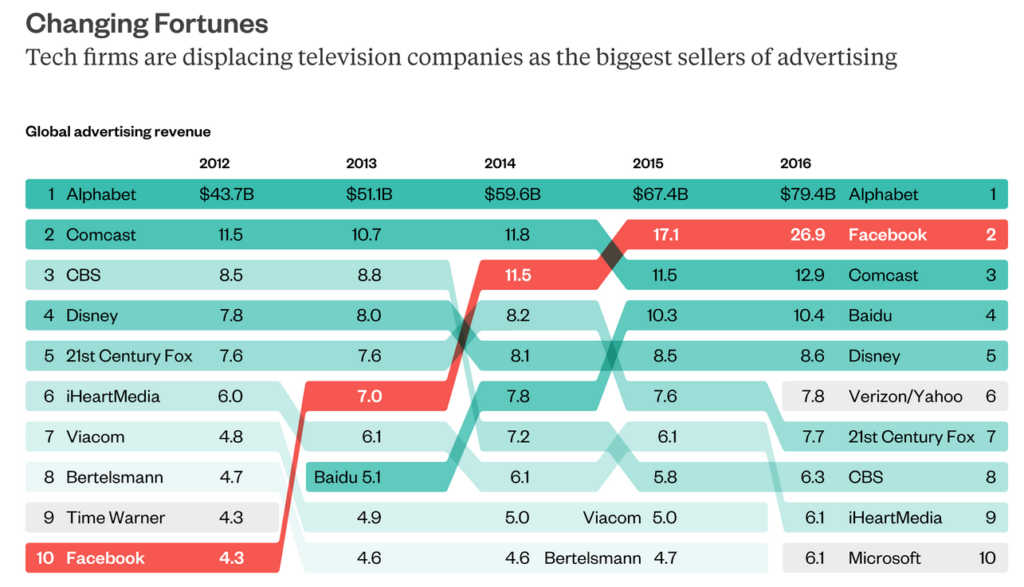
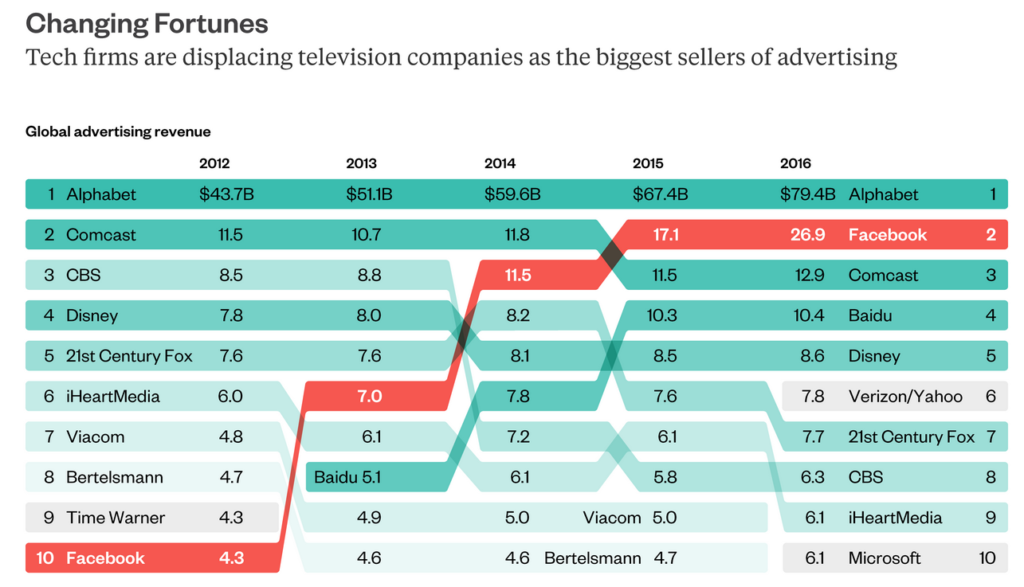
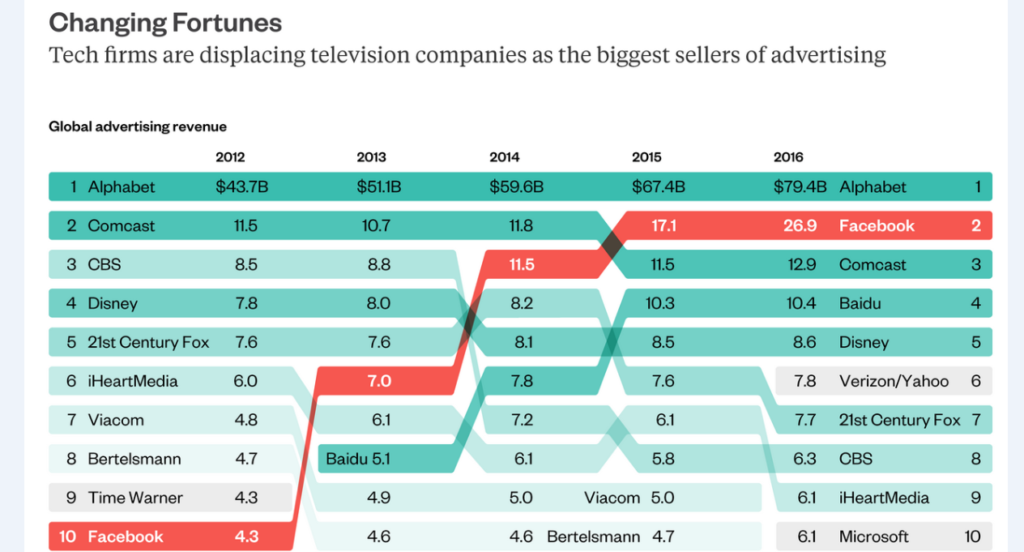
Source: Zenith Media
Jefferies hiked its price target on Facebook to $192 from $175, JPMorgan to $182 from $170, RBC Capital to $185 from $175, and Cowen to $170 from $156.
BMR Take: Our Target is in reach at $165. We would add to our positions at every opportunity. Wait until they hit 2 billion users. There will be fireworks and articles about the company galore and we just might see this as early as July. When this happens we can predict new all-time highs hit left and right.
Shopify News
We Tweeted this out on Friday:
“Shopify is on fire! All-time high at $86, up 5%. Stock was $73 a week ago. STRONG REVENUES will do it! Will eBay make an offer?” [The stock closed at $86 on Friday, up 13% for the week!]
The stock (SHOP) closed at $86 on Friday. We’re up 18% since we added the stock a little over a month ago. Our Target is $90. We can’t wait for it to hit so we can raise it to $100 or higher. And wouldn’t it be nice to see a stock split soon? What ever happened to stock splits? The markets in the 80s and 90s LOVED splits. We could see a 10-1 split for Amazon, bringing the price down to $93, and Google could split 20-1 bringing the price down to $46. Now wouldn’t THAT shake things up on Wall Street! The market would go wild.
Square (SQ: $19.78, up 8%) had a super good week. Square makes credit-card readers that plug into mobile phones and tablets and we were happy to see Square swing to a profit in the first quarter and raise full-year revenue guidance.
Led by Twitter Chief Executive Jack Dorsey, the company posted a quarterly loss of 4 cents per share on a revenue jump of 22% of $460 million. Analysts had expected a loss of 8 cents per share on revenue of $450 million, so of course the market liked what they saw. Square has predicted 2017 total revenue of $2.14 billion.
The company's gross payment volume - the total dollar amount of all credit card payments processed by sellers - jumped 33% to about $14 billion. We like numbers like this.
Another subsidiary, Square Capital, which offers loans to customers in exchange for a fixed percentage of their daily card sales, originated $250 million in loans in the first quarter of 2017, up 64% from a year earlier. We like large percentage increases like this. (We sound like a broken record…)
Square continues to move towards bigger customers. They said that 44% of the money flowing through its systems came from merchants that have over $125,000 in volume on the company’s platform, up from 39% a year ago. CFO Sarah Friar said: “That ongoing shift is good to see because those folks are not new to the payments world.”
Citigroup upped its price target on Square to $23 from $21, and Pacific Crest to $21 from $19.
BMR Take: We’re looking for $24, and hereby raise our Sell Price from $14 to $17.
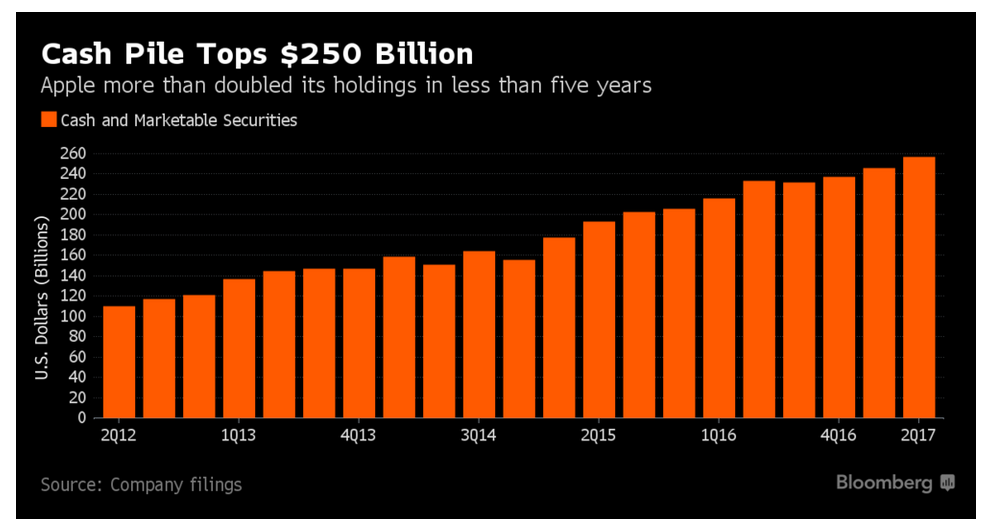
Apple (AAPL: $148, up 4%) announced that it has $257 billion in cash as of the end of the quarter. They added $10 billion in the quarter which equates to about $800 million a week, or over $150 million per work day! Repeat: $150 million per work day. The company said it will return more of that to shareholders, announcing $50 billion in new stock buybacks and a 63-cent quarterly dividend. The company had already announced $175 billion in repurchases, helping maintain the stock price in lulls between new products, so the upcoming total is now $225 billion. Take a look at this chart of their cash buildup over the years:
Twilio (TWLO: $24, down 27%) We reported via News Flash on Tuesday that despite strong revenues the market didn’t like the results. The biggest knockoff was the fact that one of their big customers, Uber, has decided to go it alone. Uber provides 12% of total revenue for the company, but Twilio grew revenue by 60% not including Uber. So ultimately, we are not that worried about future revenues. We believe they will continue strong. (We think they will come back to Twilio at some point.) WhatsApp, owned by Facebook is also a large customer, so some people are worried about this large concentration of revenue in one customer. We’re not. There is no word as to whether they are considering leaving. We would suggest that they are quite happy with the service they receive. And again, note that the company added 4,000 customers in the quarter – amazing really – giving them more than 41,000 customers, up from 29,000 at this time last year.
We had a letter from a reader about Twilio and we said this to him:
Bob -- Be prepared for anything that might happen. We could see $20 before we see $30. I hope this is not the case, but it could happen. Uber is slowly leaving as a customer and they had 12% of revenues. So, this will take some time to work out. They did add 4000 customers last quarter and are now over 40,000. They normally add 2800 a quarter. But unfortunately, like First Solar, this is going to take some time.
The Options Corner
We had mentioned in our News Flash about Twilio that we would do a column about options if anyone was interested. Well, we had a strong show of support for this. So here you go.
There are myriad of options strategies if you want to maintain a position in Twilio and you believe it will come back like we do. Of course, most options trades are risky except for selling covered calls, which are still risky but less so than buying options outright. The premiums on Twilio options are relatively high so that usually points to two types of options trades: doing covered calls, and selling naked puts or calls. The latter two are very dangerous.
Selling covered calls: Selling covered calls on Twilio is fairly straight forward. With the stock at $24 you can get about $1.80 for the January $30 call. If you have 1000 shares, you can sell 10 options and receive $1800 in your account that day. The downside is that you would be obligated to sell your stock at $30 if it goes higher than that. But, you can always buy back the option if the stock goes above $30. Depending on how long it takes the stock to get there will determine the price at which you have to buy back the options. If the stock goes to say $32 by January, then you could buy them back for about $2, losing about 20 cents, or $200. But with the stock at $32, you would feel good about that. The downside is that if someone buys Twilio out at $40 a share, you would be forced to sell your stock at $30. Not pretty.
If the stock stays below $30 until January, then you can turn around and sell another out-of-the-money option for a few dollars and wait for the stock to move higher and each time you do this you put cash into your account.
As you can see there are lots of scenarios that can happen so you have to watch carefully. Make sure you have the advice of your broker.
Buying options: If you think the stock can get to the $40 level or higher by say January 2019, you can buy out-of-the-money options inexpensively. But you could lose all of your money if the stock doesn’t reach the strike price that you choose. For example, you can buy 10 options, controlling 1000 shares, at a strike price of $40 expiring in January 2019 for about $2,300. If the stock goes to $45, these options would be worth at least $5,000. If it goes to $50, the options would be worth $10,000.
Or you could buy the January 2019 50s for about $1400 and if the stock goes to $55 they would be worth $5,000. BUT, if the stock doesn’t get to your strike price, they expire worthless.
Selling naked puts: YOU SHOULD ONLY DO THIS IF YOU WISH TO BUY THE STOCK and if you have the money to do so. You could sell the January 2019 $25 put for about $7, or $7,000 for 10 options. That would obligate you to buy the stock at some point between now and the expiration date at $25, BUT you got $7 per share so your net price is $18. You could do the same thing with a $20 put and get $4.30 per share, obligating you to buy the stock for a bit below $16. We like this latter strategy. Suffice it to say that selling naked puts on stocks you want to buy at a lower price, is a good thing. Again – very risky. Why? What if the stock goes to $10. You would be forced to buy the stock at $18 or $16 as described above. Not fun.
Send us your questions and comments please! Info@BullMarket.com.
Tesoro (TSO: $80, up 1%) moves in the wind with crude oil. Crude got down to $45 early Friday and bounced back to $46 by the close. We like the company but can’t be part of it if crude is headed to $40. If you know where crude is headed you’ll know what to do with your position in this fabulous refiner. Unfortunately, we don’t. If we knew, we could make $1 million trading crude oil futures. We added the stock at $85 in November and have a Sell Price of $75. But we would hate to have the stock go that low, so we are hereby raising our Sell Price to $78, which is two dollars below the current price. So, if Tesoro closes below $78 we are out.
Carlyle Group (CG: $18.10, up 2%) posted first quarter earnings that handily beat expectations on Wednesday, in line with its peers, after a strong stock market last quarter lifted investment returns. Carlyle's peer Blackstone Group (BX: $30, down 2%), a Bull Market Report favorite, reported first-quarter earnings that surpassed expectations.
Carlyle said it earned economic net income (ENI)* of $365 million after taxes, more than six times what it earned a year earlier. That translated into $1.09 EPS, well above analyst forecasts for 38 cents per share and the second-highest on record since the fourth quarter of 2013.
* ENI is a crucial performance measure for U.S. private equity firms as it accounts for unrealized gains or losses in investments.
Carlyle said its private equity investments appreciated 9% in the first three months, better than a 5% gain in the S&P 500 index in the same period. Carlyle Co-CEO William E. Conway, Jr. said, “We deployed capital at a strong pace in the first quarter, with $4.4 billion of capital invested despite a difficult environment. We believe we are well-positioned to continue this strong pace. We have already announced substantial new investments and almost $4 billion of exits that we expect to close in the coming quarters.”
BMR Take: Carlyle is still way undervalued but is paying you 4% while you wait. We’re waiting patiently for the market to recognize this situation. We are up 12% since March, but we sure would like to see our Target hit of $20.
The High Yield Corner
By Michael Foster
It’s finally started.
It’s a bit late, but we’re finally seeing a correction in the BDC world. The UBS BDC ETF (BDCS: $23, down 3%) got hammered in a week that was pretty humdrum for high yield and not bad for the stock market as a whole, despite a lot of drama. Yet BDCs are back to underperforming, as they should. Overstretched valuations and high premiums to NAV were unjustifiable before this week. Now that many companies have reported lackluster earnings, those premiums are even less justifiable.
Ironically, however, this isn’t hurting the most overvalued BDC of them all: Main Street Capital Corporation (MAIN: $40, up 1%), which closed the week strong as investors sighed relief following the company’s earnings. Net interest income rose 9% from a year ago to 61 cents per share and the company’s NAV rose nearly 2% to $22.44. There are two big implications for this: firstly, the company’s dividend coverage is 109% and there’s room for years of dividend growth to continue. We have a feeling Main Street management has the ultimate goal of becoming the first BDC Dividend Aristocrat*. We’ve still got about two decades until they can qualify, so it won’t be easy. But if that is their goal, Main Street is easily the best managed and most long-term focused BDC in the world.
* The Dividend Aristocrats are a select group of 51 S&P 500 stocks with 25+ years of consecutive dividend increases.
That doesn’t mean you should go out and buy. We at The Bull Market Report were happy with our pick and happy to see it rise. But we are not happy to pay an 80% premium to net asset value. Consider this: if you considered Main Street to be the best BDC in the world, you wouldn’t want to compare its premium valuation to the valuation of other BDCs. You’d probably want something safer, like a megabank like Bank of America, which not only lends to small and medium sized banks but also mega-corps and governments while diversifying in other banking activities like M&A advisory, retail deposits, and so on. Or at least you’d want your BDC valuation to be less than the valuation of these banks, right? But if you compare Main Street’s valuation to the price-to-book valuations of these big banks, Main Street is overvalued by 40% at a minimum. This just isn’t good enough for a very well-run but extremely undiversified asset.
The market has begun to realize just how silly BDC valuations were getting, but the market has made an exception for main Street largely due to the fact that just about every other BDC reported awful earnings. Net investment income fell for almost all BDCs that have reported so far, with Hercules Capital (HTGC: $13) seeing NII down 33% from the prior quarter. The dividend is now less than 100% covered. NAV fell a bit as well (over 1%). What happened? The market dumped shares, which fell over 16% in a week. This used to be considered one of the safest and best specialty BDCs out there, but the market can turn very quickly on this asset class. We’re not saying anything similar will happen to Main Street anytime soon, but it is a serious risk.
Then there’s Goldman Sachs’s BDC (GSBD: $24), which fell 3% this week due to a decline in net investment income and virtually flat NAV. The stock is still up 3% year-to-date so you’re paying a higher premium for shares, though. Now you’re paying 32% over what the underlying assets are worth. Of course, this BDC is up big over the past year, thanks in part to the secular bull market in BDCs and thanks in part to the Goldman brand. But, as we’ve written here previously, there is a complicated conflict of interest going on with this BDC that makes us extremely cautious. Goldman Sachs’s management is not duty bound to restrict their deal making just to this BDC, and so there’s a chance (although no evidence this is the case) that management can select better deals for the parent company and keep lesser deals for the BDC business. Without clearer governance resolutions, this makes us extremely cautious. And, at the end of the day, this demonstrates one of the structural problems with many BDCs: management and investors’ interests do not align.
Some of the BDCs in the business were loved for avoiding this trap. The big Ares Capital Corporation (ARCC: $16.60, down 6%) is a good example. But this stock tanked as well, after reporting earnings fell 50% from a quarter ago and NAV rose less than 1%. We don’t need to emphasize how bad those results are, and how they deserve a discounted valuation. But Ares is still trading at a slight premium to NAV.
Obviously, a bigger correction in the BDC market is coming, so where else can we look? REITs and municipal bonds remain our favorite corners of the high yield market. The iShares S&P National AMT-Free Municipal Bond Fund (MUB: $109, flat) remained sleepy due to the risk-on nature of the market encouraging more investors to avoid the asset class, despite the growing number of undervalued bonds and great opportunities to get low risk yield for fund managers. Bull Market Report favorites remained flat for the week, Invesco Municipal Trust (VKQ: $12.69, flat) and The Nuveen AMT-Free Fund (NVG: $14.79, flat) Buying more of either fund at this juncture would make a lot of sense.
And then as REITs go, the SPDR Dow Jones REIT ETF (RWR: $92, down 1%) fell slightly with investor apathy hitting the asset class on little news. This again is resulting in plenty of good deals among REITs, and The Bull Market Report continues to have high conviction for long-term sustainable yields from Digital Realty Trust (DLR: $114, down 1%), Omega Healthcare Investors (OHI: $32, down 2%), and Care Capital Properties (CCP: $27, flat) in particular. Looking forward, we will be looking closely at how REIT earnings results and more market responses from the BDC market causes a reset in high-yield land that offers an opportunity to rebalance the portfolio.
Good Investing,
Todd Shaver, Founder
The Bull Market Report
CEO and Editor in Chief
Founded 1998
July 24, 2016
![THE BULL MARKET REPORT for July 25, 2016]()
by Todd Shaver | Jul 24, 2016 | Weekly Newsletter 7pm Sunday
New Records Set Once Again
Even after a week of heavy earnings reports and a pile of political campaign promises, this market can’t be stopped. Both the Dow and S&P 500 made new records, while the Nasdaq showed the strongest weekly gains out of the three major averages. It is the fourth week in a row of rising prices. Not even the prospect of another week of political conventions can dampen investors’ spirits.
S&P 500 Closes at Record High as Investors Bet on U.S. Stability
The S&P 500 hit new all-time records this week. A better-than-expected jobs report a week ago Friday was the latest boost to the S&P, which has gained more than 16% since falling to a yearly low in February. Stocks have been bolstered by signs of strength in the U.S. economy, a recovery in oil prices and the Federal Reserve's cautious stance toward raising interest rates. The S&P 500 climbed 13 to close at 2,175, a record high. The Dow Jones Industrial Average rose 54 points to 18,571, closing just 24 points off its all-time high set Wednesday at 18,595.
There was a slug of company earnings out last week. It is too early to make a final analysis, but there appear to be more upside surprises coming like Microsoft, Qualcomm, and Goldman Sachs already did. Of these three, only Qualcomm blew through revenue forecasts. Revenue comparisons from the others were unimpressive. The reason for mentioning this is simply that the corporate mantra of cost control is working hard these days, and when revenue growth resumes, this will provide outsized profit gains.
One of the only commodities that went down last week was Crude Oil. On Friday the Baker Hughes rig count showed 14 US additions, the fourth straight weekly gain which brought the total to 371.
Let the good times flow.
Here is How The Major Indices Performed Last Week

BMR: Companies and Commentary
Qualcomm (QCOM: $61, up 12% for the week) 2Q16 results beat the Street both in revenues ($6.0 billion versus consensus $5.6 billion). EPS at $1.03 was $0.20 greater than most estimates. More good news is the double-digit gains in CDMA chipsets, up 15%. These are the very chipsets used in the iPhone and Smartphones from many other makers. This should dispel all the chatter going around that Qualcomm was on the losing end of business for the iPhone 7.
Between these results and the analyst call, estimates are expected to rise in the days and weeks ahead. The stock had a strong positive reaction to the news, but the ride is not over. The price is still well below the high of $82.
Adeptus Health (ADPT: $47, down 13%) Last week, we took the unpleasant but necessary step of removing Adeptus Health from our list Opportunities in Healthcare. We remain a believer in the business model of free-standing Emergency Care because this addresses one of the worst problems in the American healthcare system.
The explanation offered by management for revenues falling almost 30% below guidance as a “bit of softness” in June is inconsistent with common sense. If we cannot trust management’s guidance, we are compelled to bid adios. Not everyone will agree with us as this is what makes markets interesting. The stock may bounce from here so there may be good reason to be patient. But if Wall Street picks up on this the way we have, the stock could drop sharply in the coming weeks. We sadly say goodbye.
Kinder Morgan (KMI: $21, up 1%) The company hit the $0.15 per share target for 2Q16 on 9% lower revenues of $3.1 billion. This revenue number was a cool $400 million shy of estimates, but even so, earnings hit their target, which means management’s plan for cost reduction is working effectively. The deleveraging of the balance sheet and the recovery of drilling activity represents the appeal of Kinder Morgan at this stage in its life.
For the full year, operating cash flow equals about $1 billion, with capital expenditures slashed by over 60% to less than $3 billion. The stock has been a winner. In just the last month, the price has moved up about 15% on its way back to the 2015 high of $43.
Netflix (NFLX: $86, down 13%) As we noted in our Earnings Preview, the only thing worth watching in 2Q16 results is the number and growth of subscribers. US subscriber growth in 2Q16 fell at 11% rate from 17% in the same quarter a year earlier. In the earnings call, management noted that the slowing is expected to continue. There are several possible explanations including customer adverse response to price increases for long standing users. But the data, does not suggest this is solely the problem. This conclusion is based on the fact that slowing growth took place in new users (+11%) as well as customer renewals (+12%). For this reason, our belief is that the slowdown is a fluke and not the reflection of weak strategy or management errors. Nevertheless, this key metric will be watched like a hawk with even more intensity that ever before.
Netflix shares took a beating following the 2Q16 report. It raised questions about the company’s growth prospects and more importantly about the so called “ungrandfathering” move to raise prices on long standing customers that are still paying monthly fees of less than $10. Critics don’t like these moves. We understand and agree. When this issue came up in the past, management backed down. This could happen again. The stock could be volatile until this becomes a reality. There is a clear line between taking an intelligent risk and being foolishly greedy. Netflix management has proven to be a savvy group; this is not their first rodeo. We always like to stand behind intelligent management.
One research firm that we admire says Netflix is positioned to be a leader in global video. They said: "Despite soft Q2 results and Q3 guidance, we continue to believe Netflix's core competitive advantages and long-term opportunity are intact, and that growth can re-accelerate following the negative impact of the price increase." With that said, this firm lowered its price target just $5, from $130 to $125, basically a non-event, telling us that there is still strong belief in this company on the Street.
But we will say this. If they let investors down again, the stock could get slammed. The PE is still in the triple digits which is insane, so any disappointment in future growth rates could be punished harshly. Thus, this stock is not for the weak investor. With that said, they are like an Amazon -- growing fast, hoarding cash, not producing profits, but capturing market share. Repeat - capturing market share. For Netflix, that’s what it’s all about. Disappoint the world however, and the stock goes to $50.
Goldman Sachs (GS: $160, down 1%) Management demonstrated how effective their cost control efforts have been with a positive earnings surprise for 2Q16. The company announced cost-cutting plan in the first half of the year that will save $700 million a year. Earnings rose 78%, easily beating much lower analyst expectations, but overall revenue declined 13% as all of its other businesses reported weaker results. Goldman's profit was buoyed by cost cuts and the fact that it had a large legal provision in the second quarter of 2015.
Overall, Goldman's net income rose to $1.63 billion, or $3.72 per share, from $915 million, or $2.00 per share a year earlier. Analysts had expected earnings of $3 per share.
Revenues of $7.9 billion also beat the Street’s numbers. Unfortunately there was still a YoY decline of 13%. The stock remains a value at 15 times earnings with a very respectable dividend yield of 1.6%, better than the US 10-Yr Note, and probably about as safe, and yet offers the upside of a stock. To us, this is the definition of value.
Headcount is down 2% annually and 6% quarterly. Its cost-cutting program has involved staff reductions, and will have related severance expenses of about $350 million, Schwartz said. As a result, the bank will only see about half of the annual savings of its cost-cutting initiative in 2016.
But at least they are working on it. We still maintain Goldman to be undervalued.
Blackstone Group (BX: $28, up 10%) The adage on Wall Street is “you are judged by your bottom line.” Never has this been truer than 2016 where growth in world economies has been elusive. In 2Q16, Blackstone produced a better bottom line beating consensus by 10% reaching $0.44. Lower performance-based fees were the big drag on revenues that fell 3% to $1.2 billion.
Bull markets help Blackstone’s prospects, and opportunistic investors have gotten the message lately. Over the last month, the stock gained over 10% including the positive reaction to 2Q16 results. There is only one way to interpret this action. Investors have realized the strong upside operating leverage to Blackstone’s business. The stock is performing well lately but is still a long way from its all-time high of $44.
And listen to this: Blackstone may take one of its divisions focused on single-family rentals public in the first half of 2017. Their wholly-owned subsidiary, Invitation Homes currently owns 50,000 single-family homes across the country that are rented out. Bloomberg News reported that it would go public as a real estate investment trust.
Blackstone bought most of these homes after the 2008 debacle and most of them are up dramatically in price. They feel now is the time to take profits from this investment. Furthermore, this is just one step that Chairman and CEO Schwarzman is taking to boost the price of the stock. Look for much more of this ahead.
Microsoft (MSFT: $57, up 5.3%) The company matched revenue expectations at $22 billion but solidly beat EPS forecasts of $0.58 at $0.69. The quarter showed how much the future is moving away from traditional markets like PC software. Not that software with its 90%+ profit margins are bad. They just aren’t the growth engine of the past. The growth engine of the present and future is the Cloud. Microsoft’s key cloud product, Azure, put up big numbers in 4Q16 increasing at a rate of 108%.
Finally, expectations for Microsoft are rising along with rising earnings estimates. In the coming days, look for Wall Street’s new herd of bulls to put out glowing opinions. July is turning out to be one of the most productive for the stock. There are still a few more days to go but if you look at the last 30 days, the stock is up 11% and in positive territory for the entire year. Don’t forget the dividend of $1.44 that goes with the stock. It offers an attractive yield of 2.6%. The future of Microsoft is just beginning.
Visa (V: $80, up 2%) 3Q16 results beat EPS estimates by $0.02 reaching $0.69. Visa’s huge multinational operations can best be measured using constant dollar translations rates. By this measure, revenues increased 6%. Were it not for the strong dollar that penalized translations, Visa would have ranked as one of the best financial service companies of the June quarter.
Each major segment performed well: Data Processing (+10%), Services (+6%), International (+4%). Virtually every part of the company showed above-average performance. Unfortunately, the market invests in dollars, so much is lost in currency conversion. Long-term investors understand the nature of investing in multinational financial services companies and this is why Visa has been a steady winner since before the turn of the decade.
Upcoming Economic News
This week is time once again for monthly housing numbers, starting on Tuesday with the Case-Shiller index of home prices, along with New Home Sales the same day. Wednesday brings Pending Home Sales and on Thursday something new, the 2Q Rental Vacancy Rate.
What we are constantly looking for is insight into housing affordability. In many metropolitan regions the sharply rising cost to purchase or rent is an inflationary issue that gets overlooked by many economists. Our interest in the rental vacancy measure, of course relates to our friends at Equity Residential (EQR).

PayPal (PYPL: $37, down 4% for the week) PayPal Holdings dropped 7% Friday after two new announcements. The company reported its 2Q16 results on Thursday night; the results first went over well - in after-hour trading hours PayPal rose to $40 a share. But after the news sunk in, the stock sold off.
Here’s what has gotten investors so unnerved. On July 22nd the current deal with Visa (V: $80, up 2%) went through, which proved to be a point of contention for investors. There were varying negative opinions from investors. PayPal and rivals have entered into a partnership to collaborate in its market. Investors believe that PayPal agreed to terms that were more advantageous to Visa. Part of the deal is to offer Visa Cards as an option to pay as opposed to having PayPal members link bank accounts.
Initially a reaction like this was expected, but the long-term effect of this deal bodes well for PayPal’s future. PayPal has argued that the partnership will speed up digital payment adaption in the retail sectors, thus increasing revenue for the company.
Exceeding Expectations
PayPal beat predictions from Wall Street by a slim amount, but still exceeded them. The company brought in $2.65 billion in revenue, more than the expected $2.6 billion. It’s also a great time to be an investor in PayPal as last quarter it repurchased 8 million shares back for around $300 million.
This is a transitionary period for PayPal as the company is shifting its focus to more areas of moneymaking services. Some of these include business and personal loans and one-touch online checkout. This is a sign of a company that is looking forward to the future to stay competitive. Venmo, a PayPal company, doubled its volume to $3.9 billion in the second quarter, allowing PayPal to stay ahead of other instant mobile app payment companies. PayPal needs to stay cutting edge and ahead of the competition and with deals like this, it is doing just that.
The Option Corner
Let’s look at some Apple strategies. Do you like Apple? We do. Has it been a laggard lately? Yes. Will it jump out of its trading range here in the upper 90s? We certainly think so. As you know, the stock closed Friday at $99, up 1% for the week.
Strategy #1 – How to get a huge bump in income from the stock. Answer: Sell the January 100 call. Let’s say you have 100 shares worth just less than $10,000. The dividend is currently 2.3% giving you an income of $230 per year. If you sell the January 100 call for its current price of $5.25, you would have an immediate inflow of $525, or an annual return of 10.6% . [The math: $9900 investment; Income of $525; Time period – six months.] Now, if the stock goes higher than $100, you will get called away and have to sell the stock. But we are not talking about anything other than an income plan here. If you don’t want to lose the stock, then you should consider selling a higher-priced options like the January $110. That only gives you $2.00 ($200) on 100 shares. But, it does give you $10 of upside on the stock which is worth $1000.
Strategy #2 - We all know that the all-time high for Apple is $134, but obviously it is stuck in a range and many investors have given up on it. Not us. We think it will go there again, but just don’t know the time frame. If you think it could happen in the next 18 months, you could buy a call at the $130 level for a fairly small premium and sit back and wait to see what will happen. Now this is a purely speculative undertaking, so be prepared to lose all of your investment here. The cost of a $130 call expiring in January of 2018 is $2.60. You could buy one of them or 10, or more. One would cost you $260; 10 would be $2,600. Obviously, you are buying a wasting asset and if the stock doesn’t get to $130 in 18 months, the option will expire worthless. However, if it gets to $135, if you had bought 10 of them, the options will be worth $5,000 and you will just about double your money. If it goes to $150, which is quite possible, they will be worth $20,000. And that folks, again, is called sheer speculation.
Notes from the Margin
By Phil Verleger
Former Director of the Office of Energy Policy
www.PKVerlegerLLC.com
“Insanity” as defined by Albert Einstein is “doing the same thing over and over and expecting different results.” By this definition, the oil industry seems to be certifiably insane. We provide evidence for this assertion by comparing the rise in global inventories to the oil price forecasts being widely circulated. The world is awash in petroleum products. Across the globe, traders are scrambling to find tanks and ships for storing unneeded crude and product. Excess returns to storage point to a widening glut. Yet oil prices forecasters (with the exception of this author and a few others) expect significantly higher prices.
Forecasters today are seeing the same cycle of stock increases as observed in the past. However, they somehow expect prices to rise rather than fall, which seems to meet the Einstein definition of insanity.
The situation in the current oil market is not unique. Recently Financial Times published a story headlined “World Grain Glut to Enter Fourth Year.” The author explained that four years of record harvests have left inventories high and prices low. Corn stocks as of June 1, for example, were at their highest levels since 1988, almost 30 years ago. Prospects for a turnaround are slim thanks to recent rainfalls and record per-acre yields. Matters have been made worse by increased plantings.
While some believe energy and especially oil markets are different, the historical evidence does not support their view. From our perspective, it appears that oil markets are following the pattern set in other markets. This suggests that lower prices are in the offing for some time to come, absent a coordinated production cut by some group of oil-exporting countries
BMR Take: Love this guy Verleger! Hmmm. Let’s watch Devon Energy (DVN: $38) closely from here. If you bought when we recommended it you are up over 100%. If Verleger is right, above, this stock may be heading lower.
High Yield Corner
It was another strong week for the markets, with some high yield assets outperforming the broader stock market yet again. With earnings season in full swing, and some relatively strong results coming out so far, investors realize that the Brexit selloff was a foolish mistake, and there are still great values and high quality assets to be bought and held even as stock prices continue to reach new all-time highs.
The strongest performing sector this week was Business Development Companies (BDCs), which jumped 2% amidst continued inflows from yield-hungry investors. The UBS BDC Etrac ETF (BDCS: $21, up 2%) rose the most on Friday, when it climbed over 1% as investors piled into its constituent companies. But not all BDCs performed alike. For instance, Medley Capital Corporation (MCC: $7.40) rose half of 1% on Friday and closed the week up less than 1%, while the largest BDC, Ares Capital Corporation (ARCC: $15.10) rose over 1% on Friday and closed the week up an impressive 6%. While this is good for short-term traders, the stock is still down 8% over the past year as a result of weak net asset value growth and persistent concerns about defaults in the energy sector, which Ares Capital is particularly exposed to.
Bull Market Report’s favorite BDC, Main Street Capital Corporation (MAIN: $33) had a less eventful week, staying mostly range bound and ending the week up very slightly on thin trading. But this is actually a good thing for Main Street holders, as paradoxical as it may seem. The company is currently trading at a massive premium to net asset value - one of the highest premiums the stock has ever seen. Up over 14% for 2016, it is also one of the best BDC performers on these longer time horizons (and the best BDC performer since its IPO). We still see Main Street covering its dividend nicely thanks to its high quality loan portfolio, with the chance of dividend increases growing stronger as we head to the end of 2017. With strong management and high dividend coverage, its premium is well-deserved and we maintain holding Main Street as a great way to get reliable and lower-risk current high income.
Another strong asset class this week was REITs, with the SPDR Dow Jones REIT ETF (RWR: $103) rising 2% for the week, again with most of those gains coming on Friday. But The Bull Market Report picks fared much better.
Omega Healthcare Investors (OHI: $36) had a monstrous week, climbing over 6% with steady gains every day of the week. The rise is in anticipation of the company’s earnings release, which is due in a little over a week. The market is expecting a strong release, and investors are buying ahead of the announcement. While this puts the stock in a dangerous “buy the rumor, sell the news” situation, we remain unconcerned. When looking at Omega Healthcare’s price to FFO ratio, we see that the stock is significantly cheaper than its peers - at a 13x ratio whereas others in the healthcare REIT sector are closer to 22. Yet Omega Healthcare is significantly larger and better positioned to gain on current investments, making it a strong stock to keep, even with its recent climb.
Another Bull Market Report favorite had a less impressive week. Government Properties Income Trust (GOV: $23.10) fell just 2% on analyst downgrades, but paid a 43 cent dividend. After a 45% year-to-date climb, downgrades aren’t surprising - analysts are getting scared that the large stock growth is unsustainable, and it’s time to call a top. We don’t see a top, however, since the company is still more than covering dividends with FFO and its expansionary plans are still on track to help the REIT boost payouts even further. The company will release earnings next week, and we will look closely at what they report to see if those investments will help the company fly even higher.
Finally, another important sector to watch this week is the junk bond market. The SPDR Barclays High Yield Bond ETF (JNK: $36) rose slightly more than the S&P 500 this week, again with most gains coming on Friday. There are growing concerns that junk bond yields are getting too low. At 6.6%, the average yield of junk is now over 3 percentage points lower than it was in February, startling many investors. But the yield on junk bonds is a volatile metric, often changing radically from one level to another. This massive decline has happened in tandem with a major decline in the U.S. Treasury yield - currently at 1.57%, much lower than the 2.0% we saw back in February. With Treasury yields falling, it’s no surprise junk bond yields would fall as well. For this reason, we see relative safety in the junk bond market right now, although this could change very quickly and very soon.
Note that we have no junk bonds in our High Yield portfolio. We think owning individual junk issues is not someplace we want to be. If you want to venture into junk then buy the SPDR Barclays High Yield Bond ETF (JNK: $36), discussed above. Founded in 2007, it is an $11 billion fund, pays 6.3% and is professionally managed.
Our favorite bond fund remains the Pimco Dynamic Income Fund (PDI: $28), which rose nearly 3% this week, helping it stay in positive territory year-to-date. The fund is still covering dividends and has very high quality assets. Although it has swung from trading at a discount (when we first recommended it) to now trading at a premium, it remains one of the highest quality bond funds out there with very high payout coverage.
All in all, it was a very good week for high yield investors, and an even better week for those who bought our recommendations. Looking forward, we remain eager to see how earnings results play out for REITs and how the bond market will evolve next, which could get us to rethink our current positions in the high income space. No guesses here though, as we are very pleased with our portfolio entries and look for further steadiness and high dividend payouts ahead.
Good Investing,
Todd Shaver
Editor in Chief
May 8, 2016

by Todd Shaver | May 8, 2016 | Weekly Newsletter 7pm Sunday
Market Rally Runs Out of Gas
The market rally born on that February day two and a half months ago has been amazing with lots of money being created. But the rally is showing signs of getting long in the tooth.
It is now two weeks in a row that the market has pulled back with all major stock indices ending lower. For the week, Crude pretty much held its own in the mid $45 area (which amazes us and pleases us.) Gold, however, retreated for most of the week before attempting a brief rally on Friday. It didn’t last long once the Jobs data was released.
Renewed global concerns about the pace of growth in China sent the market on a downward course early in the week. But the big focus in the US equity markets was on company earnings reports. Based on the volatility alone, it is easy to conclude that the grand prize for biggest paycheck goes to the option traders. The divergence between the winners and losers, judging solely on stock price volatility had to do with management’s guidance for the future. Those who met or exceeded expectations for 1Q16 were rewarded. Those who met or exceeded but offered even the slightest downward bias in their outlook got taken to the woodshed.
Traveling the East Coast
We are traveling for the month of May and observing the state of the economy, as well as meeting with investors and corporate executives of companies we like or are thinking about adding to our portfolios. Our take so far is that the economy is strong and resilient, and it is our feeling that it will be very difficult to bring this economy down. It is just too robust. This country is huge. Every time we leave our home in Aspen to see the real world we are amazed. The traffic in Washington DC is out of control; the number of homes and buildings that are going up around the Beltway in Washington are literally astounding. Jobs are being created and in some sectors companies are having trouble filling them. With interest rates at the lowest levels in history, we see no reason for anything to change this year or next. We have a very strong outlook on the future of commerce in the country this year.
Here is How the Major Averages Performed
Is The Market Telling Us to Go Away in May?The Job Market: The Flower Wilted Last Week
Interest rate hawks got some bad news last week. Data on the job market took a surprising turn to the soft side. Wednesday’s employment report for April fell 40,000 below the prior month and set the stage for Friday’s government numbers on Non-Farm Payrolls. These were even worse, falling 50,000. As we know, a healthy job market has been the Fed’s main argument for raising interest rates. Well, this argument is obviously no longer valid. We know you are familiar with the fact that interest rate futures can predict markets: According to traders in interest rate futures, the first month where there is a greater than 50% chance of a rate hike is mid-2017. That is surprising to us so let’s look at other metrics to see how 2016 is going to play out.
One of the oldest pearls of wisdom dished out by market pundits is: “Sell in May and go away.” So far we have only a week’s worth of evidence but already there is a small voice in the background whispering this time-tested advice. To be clear, we are not sellers. Our goal here is to position you to make good investment decisions that will lead to great money making. Market corrections give us this opportunity. The reason most investors are unable to take advantage of bargain prices is a lack of cash. So it is time to get some cash ready as the opportunity is presenting itself.
The market by historic measures is overvalued. In the last 140 years, whenever the market is valued more than 20 times earnings, it is a sign there is limited upside. As of Friday’s close the S&P 500 was valued at 24 times. Granted that interest rates are the benchmark off of which stock values are set, and we appreciate that interest rates these days are near record lows. Under these circumstances, it is easy to fall into the investment trap of thinking, “this time is different”.
There have only been two times in history when valuations were significantly higher. The first was the dotcom bubble of 2000 and the second was in 2008 during the financial crisis. We aren’t naysayers, we’re opportunists – we are looking for value.
Knee-Jerk Reaction To Earnings
A key point to observe is investor reaction to earnings reports during the past two weeks. Those companies whose results have varied even the slightest from guidance have been punished with double-digit price declines. This alone suggests caution. Remember, markets overreact - it happens all the time. It is our job to spot opportunities.
So far the Dow and S&P stocks have held up the best so opportunity may be easier to find in the Nasdaq where weakness has been evident for a while. In the last month the index has fallen over 4%. A “correction” is not before a fall of 10% takes place, so we are not even close yet. But this we have observed: Whenever a stock market correction occur, very often it starts with the Nasdaq.
The composition of the Nasdaq is weighted with technology, healthcare and energy. In the past month, technology has been down more than 6%. This is the hardest hit sector owing to heavyweights like Apple (AAPL: $93, unch for the week), Netflix (NFLX: $91, up 1%) Twitter (TWTR: $14.40, down 1%), Alphabet (GOOG: $711, up 3%) and Microsoft (MSFT: $50, up 1%). But the correction in Tech stocks is broader. Last week the big cybersecurity stocks including Palo Alto Networks (PANW: $141, down 10%) and our favored play, Splunk (SPLK: $47, down 10%) joined the correction.
So Technology represents the first group of opportunities being presented to us, but Healthcare is not far behind. A good example from last week is Endo International (ENDP: $16.17, down 40%) a manufacturer of branded and generic drugs. On Thursday the company’s first quarter results beat guidance both in revenues and earnings. However, the company revised its guidance downward for full year earnings from $5.85 to $4.50 per share. This bit of honesty on the part of management cost stockholders a cool 40% in the stock. With this in mind, we will be watching Healthcare in search of opportunities.
Economic Reports This Week
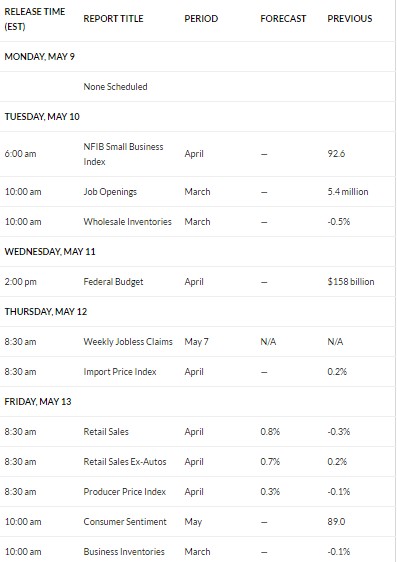
Investors who get easily bored of economic statistics will get a break with an unusually light calendar this week. The most important data point is on Friday with the Producer Price Index, which is expected to hit an annual rate of 3.6%. This would mark the biggest increase since December 2013. The number includes the pop in Crude prices, and is likely to produce a market reaction to the downside.
The other area to watch is Friday’s release of April Retail Sales. Economists are looking for 0.8% overall. This is a very ambitious forecast. So, overall, Friday is the most important day when the Washington Data Factory will have an impact on the market.
HIGH YIELD CORNER
The last week has been one of significant activity and significant stability in the high yield market, depending on which corner you look at.
Municipal bonds ended the week flat to close year-to-date up 1.5%, as evidenced by the iShares S&P National AMT Municipal Bond Fund (MUB: $112). The reason for the stability is quite clear: municipal bond defaults are rare and not rising. This is not the message many investors are getting, as the high profile non-payments in Puerto Rico have brought the municipal bond market back into the spotlight.
Besides defaults, municipal bonds tend to have less risk than corporate bonds or stocks, and their tax free payments make them attractive for retirees looking to receive tax-free income immediately. Defaults have remained absurdly low, far less than a tenth of 1%, according to Moody’s. That’s substantially less than the over 4% default rate that the corporate bond market is seeing, which is why municipal bonds pay a significantly lower yield than corporates. It’s also why municipal bonds and bond funds have considerably less volatile prices than corporate bonds.
And this was a bad week for corporates, especially high yield bonds. The SPDR Barclays Capital High Yield Bond ETF (JNK: $35) lost 1.7% with every day of the week slightly lower. As we noted last week, the junk bond market has been getting complacent, and in this week we may see that investors are getting a little too worried about that complacency. Yields on junk bonds have gone up over the last week, but remain still over 2 percentage points below their highest this year, indicating more price declines could be coming for the junk bond market.
Part of the pressure on bonds was a rash of disappointing results from Business Development Companies (BDCs.) Hercules Capital (HTGC: $11.90), Pennant Park Floating Rate Capital (PFLT: $11.70), Pennant Park Investment (PNNT: $6.10), THL Credit (TCRD: $10.55), Golub Capital BDC (GBDC: $17.10), Triangle Capital (TCAP: $17.40), and TPG Specialty Lending (TSLX: $16.00) all reported NAV declines, with Ares Capital (ARCC: $15.20) being the rare BDC to see a NAV increase. Worries about the quality of debt holdings and the ability of debtors to pay their debts are mounting, despite BDC price growth over the last few weeks. With these soft results, investors are being a bit more cautious about both BDCs and junk bonds.
With all the fears in the debt world, it was refreshing to see property REITs recover last week, as the SPDR Dow Jones REIT ETF (RWR, $97) shot up nearly 5%. That’s a strong recovery over the previous week’s declines, especially in the week before many REITs begin reporting results. Likely, the flow of money into some REITs is the result of investors predicting that the quarter won’t be as bad as many fear. So far, some big names have already reported with mixed results. Bull Market Report favorite Omega Healthcare Investors (OHI: $34) reported a 2 cent FFO beat that puts the already well-covered dividend in an even greater margin of safety, while the company’s full-year earnings guidance was reaffirmed.
Going into next week, we remain interested to see how the debt markets play out and whether a new risk averse trend is growing. The results in the REIT world will also have a major impact on the high yield market, while municipals will likely remain a constant in a sea of turbulent waters.
The Options Corner
Naked Calls
Last week we talked about naked puts which is a way to bring cash into your account with little work. It can also be a way to buy a stock you like at a lower price than it is at present. But it is very risky. This week, we’ll cover naked calls. First: Is this risky? YES IT IS RISKY. It is the riskiest type of option trading – equal to selling naked puts. Why? Because you can lose more than you invested. Repeat – you can lose more than you have invested. Why talk about this then? Because in moderation, selling naked calls can be very lucrative.
Start with a stock that you don’t think will go up. Many times we are good at this without knowing it – in other words, we try to find a stock that will go up and it goes nowhere. Of course this never happens at The Bull Market Report, right? Right! Let’s use real numbers. We can’t use a stock that we have in one of our portfolios because we are bullish on them all, by definition. So let’s go out and find a stock that we think will do one of three things – go down; go nowhere; or go up just a little. How about…….. Cisco? We actually like Cisco so we wouldn’t want to use this one. How about…… Valeant – Well, we secretly think the selling of the stock is way overdone and just might be the turnaround of the year. So that won’t work. What about Herbalife (HLF: $64)? You remember this one. This is the stock that Bill Ackman shorted heavily, went public with his position saying the company was a Ponzi scheme and saying it was worth ZERO (the ultimate short of course.) Remember? Well, Bill has lost at least $2 billion on the short and maybe as much as $3 billion. (Note what we said about risk above!) Friday the stock was up big as the company said it is in advanced talks to settle an FTC investigation into claims that it's a pyramid scheme. The stock was up $5 or 9% to close at $64.
OK, naked calls. WHAT IF you think the rise in Herbalife is about over? Remember, this is your decision and will be based on the situation that YOU believe will play out. Just like buying a stock like Apple that you think has great value and will go up, thinking that Herbalife will not go much higher for various reasons is your decision that you will act on and in this case, sell naked calls on.
Why does one do this? Option is a wasting asset. It has a value now based on what it is really worth (intrinsic value) and what people will pay for it since there is so much leverage (time value.) If the stock stays the same in price the intrinsic value won’t change, but as time goes by, the time value of an option will move towards zero. And if you SELL an option you get cash in your account and can sit back and watch the time value of the option go away, making you a little money each day.
The August options expire a little over three months from now (the 3rd Friday is on the 19th.) This works out to about 100 days, so the math works out really well here. Listen to this: The time value of the option loses about 1% every day. Get it? 100 days of life in the option - it loses 1% a day. So if you have $10,000 in options that you have sold, you make 1% a day, or $100 a day. Not bad. Now it turns out that an option that is out of the money is ALL time value. There is no intrinsic value. That’s perfect for what we want to do here.
Let’s look at some real prices. Herbalife is at $65 now and was up $5 on Friday. Let’s say that you think the run-up in price is about over and you don’t think it will go much higher. Let’s say you don’t think it will get to $70. Now you must ask yourself that question that we have suggested that you HAVE to ask each time you deal with options, and that is: What is the chance that Herbalife will get to $70 by August 19th? To be safer, you could look at the $75 price level too.
The price of an August 70 call is just less than $5 and the August 75 call is $3. Obviously there is less chance the stock will get to $75 than $70, right? So let’s analyze both. If you sell 10 August 70 calls for $5, your account will be credited with $5,000 the next day. (Note that you have to use “margin” to do this, but if you keep your portfolio at your broker, they will tell you how much margin you have and how many options you can sell. There is no cost for this.) Now, the fun begins. If the stock stays at $65 or so for two weeks, there will be 14 fewer days of life. There will be about 86 days left. The option should be worth about 14% less (yea). You will have “made” 14% x $5000 or $700. If the option heads towards $60, that’s even better. The further away from that dreaded strike price of $70 the better. But what if the stock heads towards $70? Then the option will generally rise in price which can put you in the red. The key is to kill the days off one by one, without the stock moving up sharply to the strike price. You want to get to August 19th and have the stock be under $70 so the option expires worthless. It turns out that your breakeven price for the stock is $75. Above that you start to lose money on the trade. This is on the day of expiration. If it goes to $75 in the first few weeks, this is not a good thing because there is so much more time left in the option’s life and the stock could go even higher.
If the stock goes to $80 you will be down at least $5 per share or $5,000. If it goes to $85, you are out $10,000. Do you see the risk?
But if the stock stays below $70, you stand to gain $5,000 by putting up just the margin necessary to do this.
And the “safer” $75 call for $3? That would put $3,000 in your pocket if the stock does not get to $75.
All for now. Next week we will talk about strangles, where you sell a naked put and a naked call on the same stock.
Discussion of Stocks in our Portfolios
AmerisourceBergen (ABC: $77, down 9%) is the most recently added name to our group of favored stocks. So far the stock has not lived up to its billing. Last week the company reported its March quarter ahead of guidance but lowered the outlook for 2016 EPS from $ 5.75 to $ 5.50. The reason for the change is in their generic drug business where deflation is greater than at any time in history. This is clearly disappointing but not a life threatening development by any measure.
The stock got hammered. At the end of last week, the price was at our sell point of $77. We are reviewing our research on the company and will let you know our thoughts on the stock this week. This we know with certainty: The stock is valued at 14 times revised earnings while offering a 2% dividend yield. Earnings are growing faster than average while the stock is valued at just over one-half the overall market. In a normal market these are very positive statistics.
Gilead Sciences (GILD: $85, down 4%) The stock drifted lower last week much to our surprise. The news a week ago on Friday that the Judge in the case of Merck vs. Gilead was reopening the case did not get much press coverage. We think it could be huge for Gilead. This completely opens the issue of who actually own the patents for Gilead’s Harvoni and Sovaldi and Merck’s Zepatier. Sales of these products are more than $12 billion, so this is a really big deal.
Based on false testimony by a former Merck employee, the March ruling of $200 million in favor of Merck is likely to be thrown out. Merck could actually end up owing Gilead for royalty payments on Zepatier. Gilead could even deny a license to Merck. This is extremely good news and makes us all the more excited about owning the stock.
Barrick Gold (ABX: $18.47, down 90 cents for the week) Barrick Gold has been solid for some time now, rising from the $16 level in mid-April to its present level, after hitting $19.40 a week ago. Gold itself has moved up $50 in the same time frame, so one would think the stock would have moved up. But this doesn’t concern us but in fact boldens us as we are confident that stock will catch up to the price of gold. If gold heads to $1325 and higher, we would expect to see Barrick above $20.
Netflix (NFLX: $91, up $1 for the week) Netflix is recuperating from an earnings report this week that made some on Wall Street a bit wary. We think this new lower price level makes the stock even more attractive. The more we read about this company the more we like it. As the internet continues to disrupt the world we live in (think Uber, Skype, Facetime, Alexa) the more we think Netflix can take a huge chunk of the TV viewing world from the Big Three – ABC, CBS and NBC. Amazon is already doing it; Hulu too. And soon Netflix. Watch out for Netflix. There is big money to be made here and we think this company will be a leader. And they continue to add subscribers to their base at a rapid pace and all of them are potential TV subscribers as well.
Facebook (FB: $119, up $2) Facebook continues strong. Some folks on the Street including some of our readers have decided to cash in their Apple and buy Facebook. They consider Facebook the future and Apple the past. We are certainly not going to say anything like this but we are just telling you this as food for thought. Facebook had a good week amidst a rough one for the market and many our stocks. They reported a huge quarter with big growth on the top line and big growth to the bottom line of profits as well. Zuckerberg says they are just in the 2nd inning.
The Energy Corner
Notes at the Margin
By Phil Verleger
www.PKVerlegerLLC.com
Saudi Arabia - Ministry of Petroleum IS OUT: Ministry of Energy, Industry, and Mineral Resources IS IN
The story next week and for the rest of the year will be Ali Naimi’s dismissal. Bloomberg reports that according to the Kingdom’s official news agency, the Saudi oil minister will be replaced by Khalid Al-Falih, chairman of Saudi Aramco. In addition, the mandate of the Ministry of Petroleum will be expanded as it becomes the Ministry of Energy, Industry, and Mineral Resources.
Al-Falih’s views on oil were captured in an April interview with The Economist. In it, he revealed that senior Saudis were worried about peak oil demand: Mr. Falih says that many policymakers in Saudi Arabia think that because of climate change, rising fuel efficiency and other factors, oil demand will probably peak before the supply starts to run out. The timing of peak demand is unclear, but whether it is 15 or 40 years away, he says the pressure is on to transform the Saudi economy: “If we end up being too anxious and calling it sooner than it really happens, it’s going to be for our betterment, because we will be ready sooner than others.”
With this background, it seems likely that Saudi Arabia will push for a change in OPEC’s direction. At the organization’s June meeting, expect the Kingdom to call on OPEC to become a reporting and monitoring agency, one that collects and publishes data.
Prices will not fall immediately, though. The fires in Canada, terrorist attacks in Nigeria, and the collapse in Venezuelan output will support crude for a time. Still, the long-term consequences are clear. Oil is the new corn. Indeed, oil has been the new corn for some time. Prices will rise when supply falls relative to demand, and drop when supply exceeds demand.
Apple Corner
Apple, the value stock(!), was unchanged this week at $93. In a week of weak earnings reports and a ho-hum stock market environment, hanging in there unchanged is a good sign for the future. We can’t imagine Apple going any lower so we would certainly add here at these prices. The company will be buying back its stock aggressively, so you might as well be on the same side of the fence as corporate Apple.
Under Armour (US: $39, down $5) The stock has been under pressure for a few weeks, but we are not concerned. We just stopped in an Under Armour store yesterday and the place was packed. We had to wait in line for a cashier. We use their products – they NEVER wear out and every athlete we know wears their stuff. Cotton is toast (disruptive); Under Armour is a stock to own for the next 10 years.
Good Investing,
Todd Shaver, Editor in Chief