February 4, 2018

by Todd Shaver | Feb 4, 2018 | Weekly Newsletter 7pm Sunday
The Weekly Summary
The stock market took a hit this week. It was down almost 200 on Monday, almost 400 on Tuesday, rallied a tad on Wednesday and Thursday, and got hammered on Friday to the tune of 666 points. It’s a week we can happily say has been put to bed and we can now forget about it. The long-awaited correction has now occurred. Happy now Wall Street pundits? (We don’t feel this way.) The big reason for the sell-off was interest rates. The 10-year was up again to 2.84%. And the 30-year moved up above 3%. But this is what happens when you have a strong economy – interest rates move up. This has been happening for over 100 years. The economy shines; interest rates go up. Why do you think rates have been so low? Because the Fed drove down rates after the debacle of 2008-2009 and kept them there for almost 10 years. Look at this chart here; it’s a bit hard to read at first – note that the right column shows the rate today – 1.48% and in 2008 it was 1.04%.
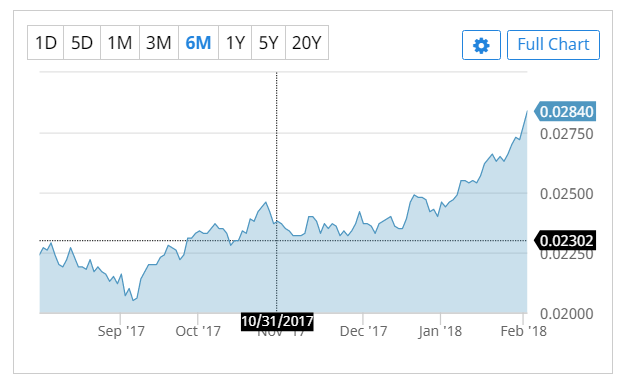
Now take a look at these two charts. The first one is the 10-year Treasury for the past six months. It's gone straight up.
And this one is the 10-year for the past 20 years. Basically straight down.

The key takeaway here is the interest rates are STILL VERY LOW HISTORICALLY. This is actually good news for the economy and stocks. Thus it is our take that 1) We had a bad week last week 2) Things will calm down this week and in the coming months, and 3) Good solid companies will continue to thrive and grow as the US economy continues to strengthen.
Easy for us to say. Hard for you to implement. We understand that. But we want you to put this past weekly move in perspective. The market is where it was just three weeks ago, at 25,500. A year ago it was at 20,000.
The big oil companies came up a bit short on the earnings front last week. Most of the Street was expecting good things, as the price of crude has remained strong at $65. But Exxon’s production dropped by 130,000 barrels a day and has lost money now for 12 quarters a row on its US drilling business, even as US production touched the record production of 10 million barrels a day in November, the previous record being set in 1970. Plus they took a $1.3 billion write-down on its natural gas business. But overall, Exxon made $3.73 billion, a decline of just 2%. These big companies are expected to generate huge amounts of cash in 2018, so we aren’t feeling too sorry for them. The number could be over $40 billion, in excess of dividends and new spending.
Super Bowl Sunday is here! $5 million for a 30 seconds ad. Over 110 million viewers likely watched. The legacy of Tom Brady’s Patriots against the surprisingly better than you think Eagles. The Patriots are favored by 4.5 points. It is interesting. Very often in sports or in the markets whatever people expect to happen, doesn’t materialize. For all sorts of reasons: Cognitive dissonance. Conservative bias. Confirmation bias. Extrapolating past performance. Loss aversion. Overconfidence. Self-control. Regret aversion. Affinity. Status quo. The list of mental mistakes people make when investing is long and always at play. We saw a 666 point drop on the Dow on Friday. This was the 3rd largest one-day point decline in history. The market is digesting something. The Bull & Bear indicator managed by Merrill Lynch has finally flashed a firm sell signal after weeks of overextended conditions. We will see what happens Monday. The unexpected could happen. Just like in football.
No matter what is happening out there, there is always a bull market here at The Bull Market Report! This week we highlight: Microsoft, Google, Amazon, Facebook, PayPal, and Blackstone.
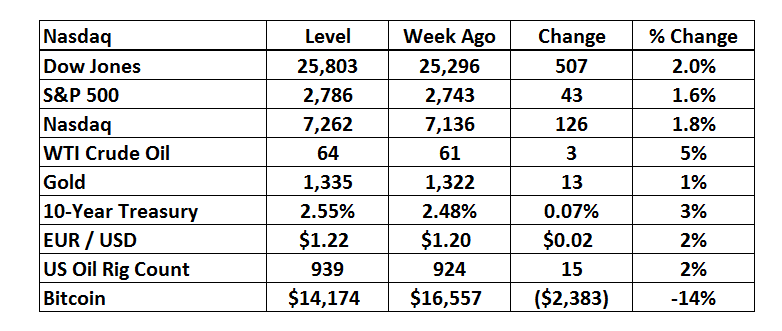
Key Market Measures

BMR Companies & Commentary
Microsoft (MSFT: $92, down 2%)
Revenue was $28.9 billion and increased 12%. EPS hit a solid $0.96 crushing the $0.87 consensus. This quarter’s results speak to the differentiated value Microsoft is delivering to customers across productivity solutions and as the hybrid cloud provider of choice. The firm’s investments in IoT, data, and AI services across cloud, position the business to further accelerate growth. In particular, Microsoft delivered another strong quarter with commercial cloud revenue growing 56% year-over-year to $5.3 billion, which is just amazing to see such a huge growth figure in the lucrative cloud opportunity. Guidance for Q3 was largely in-line or better than consensus expectations. All in all, a very good quarter.
BMR Take: Microsoft is a stock market darling. The business is well-rounded. Legacy Window products to the up and coming Azure product in commercial cloud. We see Microsoft continuing to piece together solid earnings results in the year ahead. With $4.25 of EPS in direct sight, the stock still screens reasonable at around 22x.
----------------------------------------------------------------------------------
Google (GOOG: $1,112, down 5%)
Revenue of $32 billion increased 24% from a year ago. EPS of $9.70 just missed the consensus for $10.00. Overall, we are interpreting the quarter’s results favorably (unlike the Street.) Mobile and desktop search along with YouTube are powering accelerating growth and these trends should drive sustained above average growth going forward. Google Cloud momentum is good now generating $1 billion in revenue per quarter, where the number of $1 million or more contracts across cloud products tripled in 2017. Google has now sold ‘tens of millions’ of its Mini, Max, and Chromecast devices as Google Assistant is now on over 400 million devices globally. Waymo’s progress is accelerating. They plan to launch a ride-sharing program in Phoenix operated by self-driving cars this year. Wow.
BMR Take: We really don’t care much about the slight EPS miss. The stock being down is an opportunity to accumulate shares. Scouring through all the analysis on the quarter, nobody is really saying anything that seriously concerns us. What we want to see going forward is more progress on the cloud business. Amazon AWS is now at 35% market share versus Google Cloud only in the high single digits. If Google can close that gap, this stock can continue its strong move higher. With nearly $50 of EPS coming into view, the current valuation of 23x is far from stretched.
----------------------------------------------------------------------------------
Amazon (AMZN: $1,430, up 2%)
Amazon is crushing it. What else is new? (!) Net sales increased 38% to $60 billion in the fourth quarter, compared with $44 billion in 4Q16. EPS of $6.15 was well above $4.90 a year ago. There is so much to discuss here. What we are really excited about is the Echo business. Earlier in the year Amazon introduced three new Echo devices: the all-new Echo ($100), featuring a new design, improved sound, a lower price, and a choice of colors to personalize your device; Echo Plus ($150) with a built-in smart home hub so customers can easily set up and control their smart home devices; and Echo Spot ($130), a compact Echo with a screen so you can see the weather, get the news with a video flash briefing, view lyrics with Amazon Music, watch a camera monitor, browse and listen to Audible, and more.
This new business opportunity could be huge. Said Jeff Bezos, Amazon founder and CEO, “Our 2017 projections for Alexa were very optimistic, and we far exceeded them. We don’t see positive surprises of this magnitude very often — expect us to double down. We’ve reached an important point where other companies and developers are accelerating adoption of Alexa. There are now over 30,000 skills from outside developers; customers can control more than 4,000 smart home devices from 1,200 unique brands with Alexa; and we’re seeing strong response to our new far-field voice kit for manufacturers. Much more to come and a huge thank you to our customers and partners.”
While Amazon doesn’t break out the financials on Alexa and its other electronics business, the results from its cloud-computing business, Amazon Web Services (AWS), were obvious and contributed much more to the company’s record profit total. AWS saw revenue shoot 45% higher to $5.1 billion, with profits of $1.3 billion. Wow – that’s 26% after tax. AWS and the tax gain of $790 million for the changes in the U.S. tax code, which lowers Amazon’s tax rate to 21%, were the biggest contributors to the company’s overall net income of $1.86 billion. Watch for a possible spin-off of the cloud business sometime this year. Can you imagine what this will do to the stock? Does “shoot higher” ring in your head?
BMR Take: Look, when Jeff Bezos gets surprised by how good a business is doing, and says he is doubling down, you have to take note. But don’t just take note. Take action on it too. You have to have Amazon in your portfolio. You can’t look at the business on current revenue or earnings and say it’s cheap or expensive. It’s an innovation machine. They are constantly doing start-ups, like Echo. More new paid members joined Prime in 2017 than any previous year — both worldwide and in the US. The business is roaring with momentum and still has a very bright future ahead even at the current stock price level.
----------------------------------------------------------------------------------
Facebook (FB: $190, flat)
Flat for the week. Not bad in the whole scheme of things. Facebook increased revenue 47% to $13 billion. EPS of $1.44 was up 19%. What a good quarter frankly. Though while 2017 was a strong year for Facebook, it was also a hard one," said Mark Zuckerberg, Facebook founder and CEO. "In 2018, we're focused on making sure Facebook isn't just fun to use, but also good for people's well-being and for society. We're doing this by encouraging meaningful connections between people rather than passive consumption of content. Already last quarter, we made changes to show fewer viral videos to make sure people's time is well spent. In total, we made changes that reduced time spent on Facebook by roughly 50 million hours every day. By focusing on meaningful connections, our community and business will be stronger over the long term."
Some analysts were scrambling a bit to figure out what this all mean. But monthly active users increased 14% from a year ago to 2.13 billion. Essentially, the issue is that Facebook has had a huge growth engine coming from adding users. Seriously 2.2 billion users is huge. The runway here is slowing down and that means Facebook is going to have to find another way to take over the world. And that is what Zuckerberg is saying. They will be focusing on quality of usage and fully monetizing existing users.
BMR Take: The company is look at EPS growing from $5.40 in 2017 to $8.70 in 2019. It is not easy to find a 20% earnings growth story. We really like the global platform Facebook has built and all the future opportunities it creates for advertising and other revenue opportunities. We see the same story here as elsewhere in large cap tech, trading for 22x is just not stretched.
The stock hit a new all-time high of $195 on Thursday and even traded at $194 on Friday, before the deluge. What a great company.
Stay the course.
Look at this 5-year chart. Where do you think it is headed, as it moves to 2.5 billion users?

Active Users Chart

----------------------------------------------------------------------------------
PayPal (PYPL: $77, down 10%)
PayPal delivered strong numbers. Revenue increased 26% to $3.7 billion. EPS increased 57% to $0.50. Overall, PayPal had a transformative year in 2017. The company brought record numbers of new customer accounts to the platform by simplifying life for consumers and merchants.
PayPal also substantially expanded its opportunities for future growth and redefined its competitive position through successful partnership strategies. For example, PayPal and Synchrony Financial announced an agreement expanding their consumer credit relationship. Under the terms of the transaction, Synchrony Financial will acquire PayPal's U.S. consumer credit receivables portfolio, which totaled approximately $6.4 billion at the end of 2017.
BMR Take: So why is the stock down? PayPal and eBay have signed a term sheet to make PayPal available as a way to pay on eBay, through July 2023. But the fact that PayPal’s exclusivity on eBay is going away has people up in arms. This aspect of the PayPal and eBay relationship has been well-discussed and should not surprise people. Don’t let it fool you.
We look at PayPal like this. This quarter new customers increased 9 million up to 227 million total customers. Facebook has over 2 billion users. With time PayPal could look a lot more like Facebook. That means massive growth still lies ahead. We believe in riding this train. We are talking about the next gen MasterCard or Visa here. A 10% drop in the stock is a good opportunity to take advantage of.
----------------------------------------------------------------------------------
The Blackstone Group (BX: $35, down 4%)
Total revenue ended the year at $7 billion up 39% from last year. EPS of $2.21 compared to just $1.56 a year ago, a huge 42% jump. This business is grooving! It was another strong quarter of core business trends. Specifically, total assets under management increased an elevated 12% sequentially to a record $435 billion, driven primarily by $62 billion of inflows. Capital deployment of $20 billion in the quarter represented a record. And dry powder remained elevated at $95 billion, which bodes well for future capital deployment levels. Just to put that in perspective, Blackstone realized half of the $7 billion of revenue this year from carried interest on prior year inflows, that were deployed to generate big gains of which Blackstone gets a percentage of the profits.
You are telling me the company has $95 billion to put to work to do more of this? Let’s assume on average they can collect a 10% carry on that money. They just doubled the business.
BMR Take: It was a truly exceptional year for Blackstone, reflected by outstanding earnings growth and record capital activity that drove their highest-ever level of aggregate cash distributions to shareholders. Blackstone’s tireless drive to innovate has enabled the company to launch large-scale new product areas that reach a wider client base and serve existing clients in new ways. Our investors in turn have entrusted the company with more capital than ever before, leading to a new record total assets under management of $435 billion, up 18% year-over-year. The stock is a good value at just 10x the current EPS of $3.25.
----------------------------------------------------------------------------------
----------------------------------------------------------------------------------
Economic Calendar
Total Light Vehicle Sales
Monday, February 5th, 10:00 AM
Period: January
Consensus: 17.2 million
Prior: 17.8 million
Consumer Credit
Wednesday, February 7th, 3:00 PM
Period: December
Consensus: $19.5 billion
Prior: $28.0 billion
Initial Claims
Thursday, February 8th 8:30 AM
Period: February 3rd
Consensus: 233,000
Prior: 230,000
----------------------------------------------------------------------------------
----------------------------------------------------------------------------------
Apple Reports Earnings
Apple (AAPL: $161, down 6%) sold 77 million iPhones in the holiday quarter. Apple’s forecast for the next quarter was also lighter than expected. Apple says they expect to sell 50 million iPhones this quarter, slightly lower than the Street expected, and this equates to slightly lower revenue and the main reason the stock got hammered last week.
Apple still blew past its own and analysts’ expectations for revenue and profit for its fiscal first quarter, reporting record sales of $88.3 billion and net income of slightly more than $20 billion. The company was able to increase revenue by 13% year-over-year by increasing iPhone prices and generating more money from the people buying Apple’s smartphones.
Apple jacked up the price on its premium iPhone X smartphone, starting the 10th-anniversary model at $1,000, pushing the average selling price, or ASP, of an iPhone far higher than analysts had ever experienced. IPhone buyers paid an average of more than $796 for their phones in Apple’s fiscal first quarter; iPhone ASP had never previously topped $700.
Apple also boosted its software and services segment revenue 18% year-over-year in the quarter to $8.5 billion. And listen to this:The App Store, Apple Music, iCloud and Apple Pay all had their biggest quarters ever.
Apple said, “During the week beginning Dec. 24, a record number of customers made purchases or downloaded apps from the App Store, spending $900 million in that 7-day period, followed by $300 million in purchases on New Year’s Day alone.”
“Other products” revenue grew the biggest of all. This includes smartphone accessories like the Apple Watch, which grew sales 50% year-over-year for the fourth consecutive quarter, as well as AirPods. Revenue hit $5.5 billion by selling such hardware, up 36% more than a year ago.
Apple is capitalizing on the opportunity at hand by producing more money out of iPhone users in every way possible. Apple is making more money on each iPhone, selling a few accessories to go with it, then signing up iPhone users for monthly subscription plans for services such as Apple Music and iCloud.
If Apple Music continues to grow at its current rate, it will officially overtake Spotify this summer as the streaming world's number one service. Apple Music has a monthly growth rate of around 5%. Spotify has a growth rate of just around 2%. If that keeps up, Apple Music will officially bump Spotify off the top in summer - and there's no reason to believe it can't, given that part of Apple's success in building an audience for Apple Music lies in the fact that the service comes bundled with most of the major devices the company sells.
BMR Take: The all-time high of $180 was hit January 18th. Two weeks ago the stock was down $7 and last week $11. Looks like a sale is going on in shares of this great company. Wait until that overseas cash starts hitting the books here in the US.

----------------------------------------------------------------------------------
VMware (VMW: $123) is Wrapped Up in a Dell Move
One way or the other it’s time to move on from VMware. Why? Dell Technologies owns 80% of the company and is discussing in the press whether to have VMware buy Dell in order for Dell to go public. It’s a back door tactic very rarely, if ever used before. It has impacted VMware greatly because no one really knows how it is going to play out. It looks like VMware might end up owning Dell, creating a behemoth Tech company consisting of Dell, VMware and EMC, plus a host of other tech businesses like cloud computing and cybersecurity. This might be a good investment, but little is known of its financials at this time, so we feel it best to wait and see how things shake out.
VMware was much higher a week ago, and Wall Street is quite nervous because it doesn’t really understand what is going on. The Street doesn’t like uncertainty, remember? (!)
BMR Take: We added the stock a year ago at $83 and we are up a shade under 50%. We think that’s a nice return (a GREAT return) and with everything going on with these new moves by Dell, we think it is time to take profits, sit on the sidelines and watch. Dell may be a stock to buy someday after they go public, but we will leave that decision for another day.
----------------------------------------------------------------------------------
----------------------------------------------------------------------------------
The High Yield Corner
By Michael Foster
Vice President of High Yield
After the S&P 500’s 2% drop on Friday, which has inspired headlines such as “stocks have worst decline in 2 years”, it’s easy to lose sight of the fact that the S&P 500 is up 3.4% YTD.
Before the decline, stocks were up 7.5%, so a drop was clearly necessary [so they say.] Investors who have gotten comfortable with a bull market may be a little scared, because they aren’t used to down days. And it’s easy to forget what is driving the bull market. Wages are up nearly 3% in the U.S., unemployment keeps dropping, corporate earnings are rising, and, perhaps most impressively, this strong economy is being mirrored around the world. The typically cautious IMF and World Bank have asserted that growth is strong around the world, and while these institutions have made a lot of blunders in the past, they aren’t SO euphoric as to bring out the contrarian bear in us.
For high yield, the cautions are amplified. Riskier income producers like Government Properties Income Trust (GOV: $16.65, down 7%) and AllianzGI Equity & Convertible Fund (NIE: $21, down 5%) are down heavy, although they operate in very different markets and are entirely different asset classes (REITs versus convertible bonds and covered-call stocks). To wit: the AllianzGI’s 5% decline on the stock is far steeper than its 2.9% NAV decline, which is itself slightly better than the S&P 500’s 3.2%. Now, of course we can’t read too heavily into short-term price movements, but at the very least this tells us something about the AllianzGI Fund: it is not making extremely risky bets on very volatile assets, so it isn’t in any danger right now. So why did it sell off in excess of its NAV selloff? You got it. Because of fear. And that’s why the fund remains a buy. It’s up 1.6% for the year, lagging the overall market by a bit.
And what about Government Properties Trust (GOV: $16.65, down 7%)? We recommended this REIT back in 2016 and although the REIT is down 7% since then on a price return basis, much more importantly its dividend has not been cut since then, and investors have actually gotten cash dividends of about 19% on their original investment since our recommendation. As a result, we’ve made a profit on a total return basis. And the dynamics of the fund haven’t changed. The REIT’s FFO over the last 12 months is $2.28, while the dividend is $1.72. Thus its FFO is 133% of dividend payouts, so it’s out-earning its dividend. There is no threat to the dividend stream in the short term, and rising rents thanks to a booming economy mean FFO will go up, resulting in even higher FFO coverage.
The income stream here is not at any risk, despite the implications of the recent absurd sell-off. Revenues have been rising by about 8%, so we don’t see any indication that revenues can’t support the current dividend payout. For this reason, there’s no reason to be more cautious about Government Properties, and plenty of reason to shrug off the recent price declines. In fact, it is a great time to add more to this very stable company that is absurdly undervalued.
Elsewhere in REITs, declines were much less severe. Only Omega Healthcare Investors (OHI: $26, down 3%) saw a decline in-line with the S&P 500, but that’s not surprising. We’ve discussed at length why this company’s dividend hikes are threatened, but the threat won’t materialize for years (we’ve estimated 5 years). Dips are buying opportunities for now, as long as investors are cognizant of the fact that the dividend hikes won’t last forever and the stock could sell off in a few years as a result. But if you want a strong and secure high income stream now, Omega is one way to do it.
Digital Realty Trust (DLR: $108) was the second-best investment in the Bull Market Report High Yield portfolio. It was flat for the week. That sounds bad, especially if you’ve gotten used to gains upon gains and few down days, which has been the market norm since the High Yield portfolio began in 2016. But it also shows, interestingly, that the market has a lot of confidence in Digital Realty (which also outperformed a lot of the Tech sector). This week, Amazon, Apple, and Alphabet reported earnings that proved the world’s demand for data centers isn’t going away. Alas, Digital Realty’s yield is tiny, but as an investment in a good company, it’s a great option for investors.
Apollo Commercial Real Estate (ARI: $18.14, down 1%), Ventas, (VTR: $54, down 3%), and Welltower (HCN: $58, down 3%) all saw slight declines, which we can consider to be more a result of REIT investors following the broader market trend. No big news came from any of these companies last week to warrant the selloff.
Similarly, AstraZeneca (AZN: $36, down 2%) fell a lot less than the broader market after weeks of strength in the Biopharma sector. AstraZeneca has not released any major news and there wasn’t any major sector announcements. We can dismiss this 2% decline as being relatively good in a week of short-term worriers cutting bets on all kinds of things more because of fear than for any fundamental reason.
Now, on to municipal bonds. The end-of-year sell-off in this asset class in anticipation of 2018’s rate cuts meant that these funds were attractively priced for income investors, and we still think long-term capital gains are in the cards. What we need to see is the market get used to our new Fed Chairman. While Janet Yellen did a wonderful job of managing monetary policy and bringing the Fed funds rate closer to historical norms, the job isn’t done. Jay Powell has already said that he will continue in the same mode. And that will limit enthusiasm for municipal bonds. that is, until the booming economy results in higher tax revenues for municipalities that, in turn, results in credit upgrades and thus increasing NAVs for our muni Closed End Funds. The timing on this eventuality is unclear, but there is good reason to be confident that it will happen eventually. Nuveen AMT-Free Municipal Credit Fund (NVG: $14.48, down 3%) and Invesco Municipal Trust (VKQ: $11.83, down 4%) are worth holding for the tax-free income as we wait.
PIMCO Dynamic Income Fund (PDI: $30) is the only High Yield holding to be up for the week, and for that we are grateful! But just as there’s little to read into the short-term declines, the short-term gain here isn’t a reason to celebrate. The market is all about short-term emotion-driven trading. If anything, the fact that the panic didn’t hit the Pimco fund may indicate that no matter how crazy the broader market is, we aren’t in full-blown panic mode. And that, quite possibly, could mean this correction won’t last very long.
Good Investing,
Todd Shaver, Founder and CEO
The Bull Market Report
Since 1998
January 28, 2018

by Todd Shaver | Jan 28, 2018 | Weekly Newsletter 7pm Sunday
The Weekly Summary
The big news this week was Davos. Davos is an annual event hosted by the World Economic Forum that’s mission is to improve the state of the world by engaging business, political, academic, and other leaders of society to share global, regional and industry agendas. Davos is a mountain resort in the Alps of Switzerland. All of the top brass from companies and countries attend. Trump rocked the party with his message of America first. He said America first does not mean America alone, and that America is open for business. He promoted our 3% GDP growth, our massive tax reform, and our historic reduction in regulation. We put a billionaire in office exactly to do this. The S&P 500 is already up 6% so far this year and Trump’s deals in Davos could drive gains higher.
No matter what is happening out there, there is always a bull market here at The Bull Market Report! This week we highlight: Gilead, Shopify, Bristol Myers, Nutanix, Google, and Tesla.
Key Market Measures
BMR Companies & Commentary
Gilead (GILD: $86, up 6%)
Gilead has had a tough time since 2015; however, its fortunes may finally be changing. The big event is that Celgene is buying Juno Therapeutics for a 50% premium. One of Juno’s most promising drugs directly competes with Gilead. Clearly, Gilead is playing in the right sandbox. The Wall Street research firm Jefferies poured some gas on the fire of excitement now burning for Gilead. They upgraded the stock this week and said to look for good things to happen soon. The company is looking at a February approval and launch of a drug for HIV, and highlighted some key Phase 3 data on another drug to be released by 2019.
BMR Take: The stock appears to be inexpensive at this level, as it trades at just 8x this year’s EPS of $8.70. But we know that earnings are set to decline to $6.50-$7.25 over the next few years as Gilead’s top two drugs face declining sales. These two drugs were among the top three best sellers of all time – but nothing lasts forever. Could Gilead fetch 15-20x EPS when the dust settles and new drugs re-invigorate some excitement? Possibly, but it’s going to take quite some time.
As you may remember, we had the stock in our portfolio and removed it a year ago as we were tired of waiting. It took a year to come back, but from here we think the run is over for at least the next few years. We will remain on the sidelines.
=========================================================
Shopify (SHOP: $129, up 12%)
Somebody stopped by Shopify this week to work on collaboration for the future of augmented reality. Tim Cook. CEO of Apple. No big deal. (HA!) He praised the companies “profound” emerging technology. No further explanation needed. Apple + Shopify = $1.8 billion added to Shopfy’s market cap, now at $13 billion. Wow.
BMR Take: Tim Cook met with developers and coders and listened to demonstrations. Augmented and virtual reality is a major part of Apple’s future plans. These markets are likely to balloon to $215 billion by just 2021. Maybe Apple works with Shopify. Maybe Apple buys Shopify. Either way we see this all leading to good things ahead for Shopify. Their sales are expected to grow from $660 million this year to $1.6 billion by 2020, without factoring in anything from the possibilities with Apple.
Andrew Left of Citron is crying in his beer. (He’s the guy who shorted the stock at $119 and made a big deal about it in the press. He drove it down to $92, and now is losing money big-time. YES!!! We don't like the way this guy operates.) Remember, if you hear that a stock is heavily shorted, that’s a BULLISH signal. Why? Because after you short a stock the only thing you can do from that point on is to BUY THE STOCK BACK. Very bullish.
Look at this chart:

=========================================================
Bristol-Myers Squibb (BMY: $64, up 3%)
Bristol-Myers received a big regulatory approval in Europe this week. The European Commission (EC) expanded the indication of Yervoy to include treatment of advanced melanoma in pediatric patients. The EC approval marks Bristol-Myers’ first pediatric indication for an Immuno-Oncology medicine in the European Union and allows for the marketing of Yervoy for this indication in all 28 Member States of the EU. This is just a key development for geographic market expansion and ultimately sales. Hip hip hooray!
BMR Take: Bristol-Myers is a leader in Immuno-Oncology. This space is red hot. Bristol’s EPS is expected to grow from $3.00 this year to $4.00 in 24 months. This Healthcare bellwether is overdue for a breakout in the stock. Remember, activist Carl Icahn is making some noise here and pushing for good things for all shareholders.
Looking at the 1-year chart, you can see that it is a slow mover, but steadily up. We’ll take that any day. The company is no small firm. The market cap is $105 billion and the stock is moving towards its all-time high of $74 set two years ago.

=========================================================
Nutanix (NTNX: $33, down 8%)
Nutanix caught some heat this week from a downgrade at JP Morgan. The report said nothing specific. They said: The market rally has gone on for eight long years. Valuations aren’t cheap. Nutanix is up a lot lately.
We say: Ignore this report – it appears to be just one person’s opinion. We believe there is more money to be made here. In fact, just this week Nutanix spoke to investors about how hosting providers like Amazon Web Services are taking steps to work with customers more broadly to support bare services, expanding the market opportunity for Nutanix.
BMR Take: Nutanix is a must-own stock. “The opportunity of a decade,” says Goldman Sachs. The customer base has doubled in 18 months. The average annual sales per customer is expanding from $1 million to $5 million, fueling greater than 30% top line growth. And we could see this $5 billion market cap company get bought by the likes of an IBM or Oracle any day. The stock is down this week to where it was in December. But in October, just three months ago, it was $22. Stay on this train!
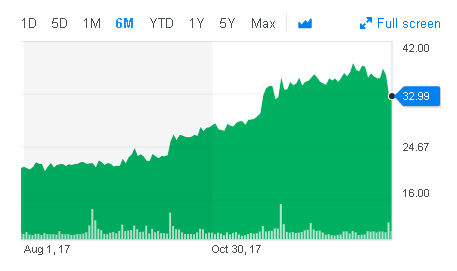
More on Nutanix below.
=========================================================
Google (GOOG: $1,176, up 3%)
The future of the Smart Home is a big deal. Whoever wins this market is going to make some big bucks. Google Home is now installed in 14 million homes and is well on its way to cementing itself as a key player in the space. The Smart Home of the future will allow you to use voice to control your thermostat, your TV, your lights, your locks, your security cameras, your car ignition, your coffee machine, and on and on. The hardware sales and the multi-year services contracts make for a lucrative revenue opportunity. Google is positioning itself to get in on the action.
BMR Take: One thing we really like about Google is its valuation. When you look elsewhere in Tech – like Facebook, Amazon, Netflix, or Adobe – the price to earnings ratios are way up there. Look, we understand growth and innovation can’t be valued just on a price to earnings ratio alone. But that subjectivity in the analysis leaves room for the high flyers to be in for a rougher valuation reversal in a correction. In contrast, Google is set to generate about $42 of EPS in 2018, which is 29% growth from 2017, and the price to earnings ratio is exactly 29. When the price to earnings ratio is equal to or is less than the earnings growth rate you know as an investor you are paying a reasonable price for growth. Again, that is why we like Google’s valuation.
And again, please have no fear of the high stock price. It’s just a number. Pretend that it has a 20-1 split tomorrow. The price would drop to $59. Would you buy more then? It’s all psychological. Google HAS split their stock 2-1 – once – in 2014. They just might be thinking of doing that again. And we would suggest the stock would shoot higher.

=========================================================
Tesla (TSLA: $343, down 2%)
Tesla’s Gigafactory is exciting! Tesla’s mission is to accelerate the world’s transition to sustainable energy through increasingly affordable electric vehicles and energy products. To achieve its planned production rate of 500,000 cars per year by 2018, Tesla alone will require today’s entire worldwide supply of lithium-ion batteries. The Tesla Gigafactory was born out of necessity and will supply enough batteries to support Tesla’s projected vehicle demand.
Tesla broke ground on the Gigafactory in 2014 in Nevada. The name Gigafactory comes from the word “Giga,” the unit of measurement representing “billions.” The factory’s planned annual battery production capacity is 35 gigawatt-hours (GWh), with one GWh being the equivalent of 1 billion watts for one hour. This is nearly as much as the entire world’s current battery production combined. With the Gigafactory ramping up production, Tesla’s cost of battery cells will decline significantly through economies of scale, innovative manufacturing, reduction of waste, and the simple optimization of locating most manufacturing processes under one roof. By reducing the cost of batteries, Tesla can make products available to more and more people, allowing them to make the biggest possible impact on transitioning the world to sustainable energy.
BMR Take: Seriously. Who builds a Gigafactory in Nevada because their business is using up all of the world’s lithium-ion batteries? Only Elon Musk. So innovative. So groundbreaking. World changing. If Tesla is right about the future of vehicles and takes over the crown of the auto industry from the old guards in Detroit, you don’t want to miss out on the future earnings potential of the company and what this stock could do in your portfolio.
As noted last week, we do have a $335 Sell Price on the stock because of our concern about how much capital they will have to raise this year. It would upset us to have to sell this wonderful company run by a genius, but we have to protect our gains. Watch closely this week.
Note on Musk’s New Pay Package:
Tesla announced a huge pay package this week for Elon Musk that again ties his compensation to key performance benchmarks. This time the goals include taking the electric-car maker to $650 billion in market value
Tesla outlined a massive compensation plan for its unorthodox CEO on Tuesday, setting a series of ambitious growth targets that, if various conditions are met, could net Musk as much as $55 billion over the next decade The package is based entirely on performance, guaranteeing no salary and no bonus, and requires Musk to reach aggressive market capitalization and financial goals in order to be paid. He would also have to hold onto his shares for five years after he receives them before selling. Musk would only receive the full payout if the company reaches a market capitalization of $650 billion, a more than 11-fold increase over its current $57 billion market cap.
=========================================================
=========================================================
Economic Calendar
Consumer Confidence
Tuesday, January 30th, 10:00 AM
Period: January
Consensus: 122.1
Prior: 122.1
Pending Home Sales
Wednesday, January 31st, 10:00 AM
Period: December
Consensus: 109.5
Prior: 109.5
Nonfarm Payrolls
Friday, February 2nd, 8:30 AM
Period: January
Consensus: 172.5K
Prior: 148.0K
=========================================================
=========================================================
We got a letter about Nutanix from Stanley Makovsky, of Stan Lee Marketing, one of our subscribers. He said:
"Todd,
Any opinion on the below report?
Nutanix Stock Falls After J.P. Morgan Warns That Software Shift Could Prove Disruptive"
Stanley Makovsky
Stan Lee Marketing
Hi Stanley – I many times take these things with a grain of salt. Yes, the stock is down 8%, but will it stay down here? Maybe. It might go to $30. But that just might be an amazing buying opportunity.
JP Morgan wrote this opinion based on this:
“on concerns that shares could lag those of peers in the near future following a recent rally.”
Lagging peers? What does that really mean? Who cares about their peers.
This is what matters to us:
The last four quarters of revenue:
$275 million
$226 million
$192 million
$160 million.
I call that growth.
Todd Shaver
=========================================================
The Carlyle Group (CG: $25.60, up 5%)
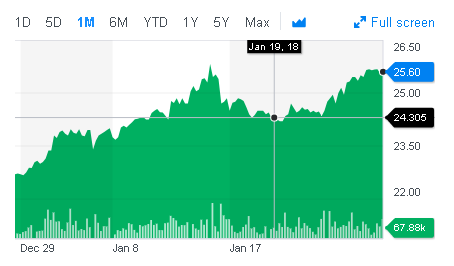
We've been pounding the table on this stock for months. On December 19th the stock was $21.50. It's now at $26, up 21%. We are pounding the table on this one NOW. We expect $30 in a few months. Do the math. That's another 17%. We have it on good authority that one of the major stockholders is not selling a share until it hits $30. Our Target is $28, but we sure will be happy to raise it to $33 when it hits $28. The Sell Price is hereby raised from $20 to $24. We're up 54% on this one in less than a year; it's paying a 5% dividend. How can you go wrong.
Look at this chart:
=========================================================
CBRE (CBG: $46) Hits All-Time High
Friday saw another all-time high. Earnings are coming out soon and we understand that they will be announcing another solid quarter. Some say it might be called a blowout. We've passed our Target of $40 so we hereby raise it to $52. Our Sell Price is at $35, so we are raising that to $40. The company is in business to save corporations money with their real estate. And that they are doing with relish. This one is a sleeper.

=========================================================
=========================================================
The High Yield Corner
By Michel Foster
VP High Yield, The Bull Market Report
We wish to do a bit of a deep dive into what’s happening in stocks, the economy, and society at large - and what this tells us about high yield.
The reason we want to do this now is that there is a trend that looks very alarming on the surface that is actually not a problem at all. We’re referring to the incessant bull market of 2018.
January is ending in a few days, yet the S&P 500 is up over 6% already this year. Remember that this index goes up about 8% on average every year, so that a 6% gain in a month is very intense. So intense, in fact, that the market has already hit and surpassed the price target that a lot of big bank analysts had on the market for the entire year.
At the same time volatility is down, the financial mass media is getting more bullish, and the general anxieties in society seem to be drifting further and further away from economic issues and towards other domains of human life - politics, religion, identity. This is usually a cyclical trend.
To explain what we mean, think back to 2005 and 2011. Very different years with very different social concerns and economies. 2005 was the height of the housing bubble - a time when exotic dancers in Las Vegas were buying multiple homes to flip (as brilliantly documented in Michael Lewis’s The Big Short.) But Americans are a contentious bunch, so there was plenty of angst and debate going around - a lot of it about gender equality, the war in Iraq, Guantanamo Bay, race relations, and other things. Little talk about income inequality, wage growth, or other economic issues.
Now think about 2011. This was the time of the short-lived Occupy Wall Street movement. The Iraq War, still going on, wasn’t an issue; Guantanamo Bay didn’t come up unless you brought it up to the protestors. Race relations, gender issues were given brief lip service. But the real concern? Income inequality. “We are the 99%” was a rally cry of socio-economically disaffected people.
Whether or not you agreed with their message, their means or their complaints, doesn’t really matter - not for rational investors like us who want to grow our wealth by understanding what’s happening in the world. What matters much more is acknowledging what was going on and why it was going on. Namely, 2011 was a time when political and social unrest hinged on economic issues - because the 99% weren’t getting richer and weren’t even getting the illusion of getting richer that the debt-fueled housing bubble gave so many Americans.
Fast forward to 2018. What are the hot topics of the day? Donald Trump is the obvious one. And, again, whether you support Trump or do not, what does matter is acknowledging that the cultural fixation of the moment is on an issue that has relatively little to do with the economy.
From this perspective, 2018 feels a lot like 2005. The economy is, at least on the surface, showing enough strength to keep people from focusing on economic and financial issues. Corporate profits are rising and look to rise even further. Stocks are going up, as are housing prices and U.S. incomes. A weaker U.S. dollar is hurting imports, but it’s also helping exports and encouraging more tourism to the U.S. - another big boost.
What does all this have to do with the stock market and high yield investments? Two things. First, we seem to be at that stage in the business cycle where hope has already turned into optimism. But we aren’t at the point where optimism turns into euphoria, although it’s getting closer and closer on the horizon. In other words, a lot like 2005.
This tells us that the best thing to do is to buy and hold stocks. Stay in the market. Despite the monstrous gains in the market for 2018, the S&P 500 P/E ratio is down from where it was in the middle of 2016, and if earnings growth meets expectations (13% growth for the year), that P/E ratio isn’t going to go up much further.
It also tells us that high yield remains an option, but investors may become choosier when it comes to high yield as we go further into the greedy stage of the business cycle and away from the fearful stage. That could mean municipal bond prices will remain lower while junk bonds remain higher. That may mean little capital gains from Invesco Municipal Trust (VKQ: $12.30, flat) and Nuveen AMT-Free Municipal Credit (NVG: $15.09, down 2%) despite the fundamental strength in both funds’ incomes. Income may begin to rise if municipal bond yields rise alongside Treasuries. It does not mean a big crash in either fund, however - so don’t rush to sell. Just recognize that these funds’ income streams will remain intact, with some possible upside.
AllianzGI Equity & Convertible (NIE: $22.55, up 2%) and Pimco Dynamic Income Fund (PDI: $30, up 1%) are interesting options for investors. Since these funds have exposure to junk bonds and convertible bonds, the continued increase in profitability and financial strength among America’s companies could drive demand for these funds in excess of what we’ve seen in the past. Both have provided strong total returns since The Bull Market Report first recommended them. More good returns are becoming more likely, thanks to America’s increasingly complacent and euphoric economic mood.
Where does that leave us investors, concerned about volatility, wishing to preserve capital, and hoping for a reliable high income stream? It is too early to worry about a euphoric market, but it is time to recognize that worrisome euphoria and the bubbles they produce could come. That could take a couple of years, perhaps even longer. What matters is that we remain keenly aware of what’s happening in our economy and our society in an impartial and calm way, investing accordingly, and constantly looking, listening, and watching.
Good investing,
Todd Shaver
The Bull Market Report
Since 1998
January 14, 2018
by Todd Shaver | Jan 14, 2018 | Weekly Newsletter 7pm Sunday
The Weekly Summary
Everybody has an opinion. Go search the internet and you’ll hear one fellow say the market is going to crumble, the next person say new highs are on the horizon, and the third individual tell you something that doesn’t make sense because they don’t even know what they are talking about. Accordingly, we feel the need to break it all down this week. No fluff. No spin. No wild opinions. Just a little ‘telling it like it is’ as a reminder that this The Bull Market Report. We aren’t like what you see on TV. And we aren’t like what you read elsewhere. We are just like you. Looking for the cold hard honest facts.
US equities ended the week higher in a quiet Friday of trading. Cyclical and value plays were among the better performers. The equity market is already up over 3% this year with some of our stocks like Amazon and Nutanix up more. Bonds are down this year and Treasuries were mostly weaker as investors realize the Fed is serious about raising rates. We saw more flattening of the yield curve indicating caution. In fact, the two-year T-note rose and hit 2.0% for the first time since 2008. Gold was higher for fifth straight week. Crude ended higher for the fourth straight week.
No matter what is happening out there, there is always a bull market here at The Bull Market Report! This week we highlight: Cloudera, Blackstone, Amazon, Google, Eli Lilly, and Home Depot.
BMR Companies & Commentary
Cloudera (CLDR: $18.14, up 5%)
Cloudera met with investors this week at Citi’s Global TMT West Conference. The CEO discussed all that they are doing in terms of new technology. Let’s recap. Remember, understanding the big picture of what the company is doing is how you build real confidence in your investments.
First it is important to understand the backdrop of why Cloudera is such an exciting company. Everything right now is going through a major technological revolution. Look what is happening in cars, health, and virtual reality. Everything is getting connected. This newly-created connected world is creating a backdrop for data that is unprecedented. And in this area of the economy is where the world’s most valuable companies reside—Apple, Google, Facebook, and Amazon. They are all data driven. Economists say the world’s most valuable resource is now no longer oil, but data.
So where does Cloudera fit it? Cloudera helps enterprises enter this new world of machine learnings and artificial intelligence. Cloudera gives them access to this data to transform their business to become data dependent. The old days of just working with a database storage provider and some simple analytics are gone. Today, companies turn to Cloudera to build best-in-class artificial intelligence solutions that optimize all the available data out there, not just their own.
BMR Take: Machine learning and artificial intelligence are megatrends for the next 5 years. Get involved. Cloudera is a great opportunity. Revenue will explode from $360 million this year to $570 million in 2 years. We see Cloudera breaking the $1 billion revenue mark possibly as early as 2020. We added the stock at $22 in June so it has certainly been an underperformer for us. But we are very confident in the success of this company and continue to have a $28 price target on the stock. Sometimes one has to be patient to see the big gains that we expect. Cloudera is still tiny with a market cap of $2.5 billion. But they are growing 40% a year. We would expect to see this little gem grow to the $10 billion level at some point and then get plucked up by one of the big boys. And this might even happen sooner than you think.
------------------------------------------------------------------------------
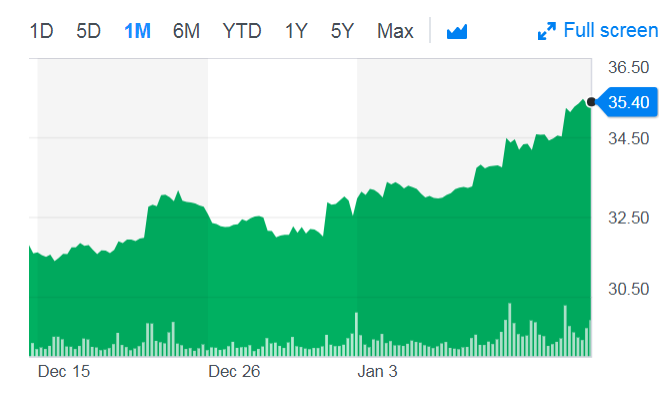
Blackstone (BX: $35, up 7%)
Blackstone is on a roll and caught an upgrade from JP Morgan. We love it when the professionals come around to our side of the table!
The reason to be excited at this point is that there is going to be a major fundraising cycle for Blackstone over the next two years. The company is expected to raise over $200 billion. The way the company makes money is through these massive fundraisings, then deploying the capital, and then getting a share in the profits from the investments.
The fundraising will happen in two funds. The first is Flagship Real Estate BREP-IX in 2018. The second is Flagship Private Equity BCP-VII in 2019.
BMR Take: Blackstone has been an underperformer relative to its peer group. And the peer group of these private equity companies hasn’t done too well. The entire space is relatively new to the public equity markets. Retail investors just don’t have the comfort level they have with other financials like AIG or JP Morgan. But we think that will all change. These companies print money. Blackstone will do over $3.00 of EPS in 2018. The stock is very inexpensive right now.
We’re up 30% on the stock since we added it in early 2016. Good but not great. The dividend has helped though, as that 5% a year adds up. But we expect more from this great company. Our Target was just reached this week, so we are going to go out on a limb and raise the Target to $42. If things go right, we would expect to see this by year end, but perhaps sooner.

------------------------------------------------------------------------------
Amazon (AMZN: $1,305, up 6%)
Amazon Fresh prices are up to 20% cheaper than major UK supermarkets.
Look out! We are going to see Amazon really shake-up the grocery market this year. Amazon's online grocery service Amazon Fresh is selling some products up to 19% cheaper than major supermarkets, new research suggests.
Amazon Fresh is a subsidiary of the Amazon.com. It is a grocery delivery service currently available in some U.S. states, London, Tokyo, Berlin, Hamburg and Munich. It will also launch in Australia soon.
The cost of a shopping cart from Amazon Fresh turned out to be 11% cheaper than the same online shopping from Tesco, and up to 19% cheaper than other competitors. The study was done by the consulting firm Oliver Wyman. The geography was in London.
Amazon Fresh is still relatively small but the internet giant has very serious ambitions in the grocery sector, suggesting that it may be looking at more acquisitions.
BMR Take: Amazon is a never-ending innovation machine; essentially a massive start-up. Look, the company will do $177 billion of revenue this year and we could rant and rave about the revenue growth outlook. But nobody knows what businesses Amazon will even be in over the next 3 years. They are knocking down doors and running through walls into new markets. Grocery will be tens of billions of dollars for Amazon in a market that the firm has been in for less than a year.
The stock had a banner week and hit our $1300 Target, setting a new all-time high. We believe we will see $2,000 someday in the future, but obviously not right away. But we can see $1,500 in the not-too-distant future, so we hereby raise our target to that level. The Sell Price is raised from $1,030 to $ 1,225.
------------------------------------------------------------------------------
Google (GOOG: $1,122, up 2%)
Apple came under massive scrutiny this week. Parental oversight organizations said Apple should take more responsibility over how children use their devices in particular addition to the technology. We think Apple, Google, and Facebook in particular are making so much money they are likely to be the target of increased scrutiny by governmental authorities. In fact, we saw this week similar outcries against Google. We keep an eye on this risk but would not let it shake us out of any of these holdings.
Google has been profiting from a practice in the United Kingdom but banned in the US, in which brokers secretly reap millions of pounds from addicts seeking treatment in the UK. An undercover investigation by the Sunday Times has discovered a large fraud in this area. As a result of an in-house investigation, Google pulled all addiction-industry-related advertisements from its UK platforms.
BMR Take: Without question, Google and its peers will have to invest more in meeting social responsibilities and being a good corporate citizen. That said, Google can manage through this. We are looking at EPS going from $32 this year to nearly $60 by 2020. We can live without $1 or $2 of EPS if the company addresses these social issues and spends money to prevent thing like this advertising scheme being run through the platform in the UK. In fact, we encourage it, as it could result in a premium valuation.
Google set a new all-time high this week and is now worth $780 billion, closing in on Apple at $900 billion. (Of course, Apple set a new all-time high this week as well, so it’s certainly a good race!) Our Target has been $11,00 which was hit this week, and we expect a continued strong stock market which should proper Google higher. Thus, we hereby raise our Target to $1,450 and our Sell Price to $1,010.
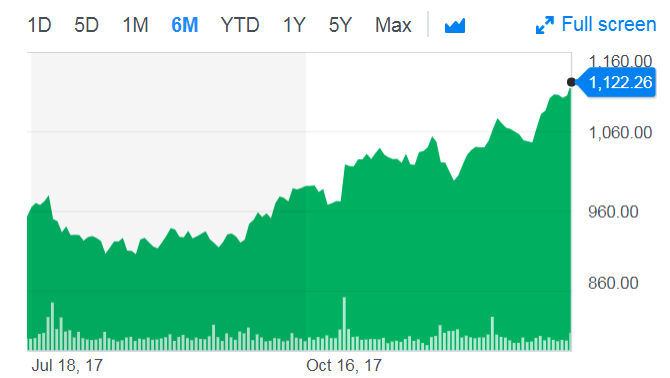
Don’t like high-priced stocks? GET OVER IT. Buy some Google. Buy some Amazon. Buy 7 shares. Buy 23 shares. Just own these fabulous companies!
------------------------------------------------------------------------------
Eli Lilly (LLY: $87, flat)
Eli Lilly caught a big upgrade from Argus Research. Again, we love it when the professionals come around to liking our holdings!
What’s the excitement? Tax reform is a major positive for the company. Additionally, the company is working to sell its Animal Health business. The combination of these two events will create a cash windfall. Now the CEO is talking about doing a large acquisition.
Previously, big time M&A was just a distraction for the company as Lilly could not be competitive due to its balance sheet. However, now there is some real interest to move bigger into immune-oncology. Could we see them try to buy Bristol-Myers? (BMY: $63) Maybe; but that’s a big bite to chew off – around $120 billion.
BMR Take: Lilly is going to do $4.65 of EPS in 2018. They have $4.5 billion of cash. They have more cash than debt. They could do a mega-deal and this could get really exciting. We see why Argus upgraded the stock with a $115 price target.
We at The Bull Market Report have a Price Target of $88 on the stock at the moment, but we expect mid-90s by summer, so we hereby raise our Target to $96. Our Sell Price moves higher too, from $76 to $82.
------------------------------------------------------------------------------
Home Depot (HD: $196, up 2%)
To be honest, we are frankly a bit upset at Home Depot right now. We expect a lot from our companies - we wouldn’t recommend them to you otherwise. Home Depot put out this official statement on tax reform back in November, “The Home Depot is very supportive of tax reform that would fuel the economy by putting more money in the majority of Americans' pockets while improving the competitive position of companies so they can create more jobs. We applaud Congress for its efforts in moving tax reform forward.”
What is it missing?
Where is the minimum wage hike? Where is the $1,000+ bonus to employees. Walmart, some big banks, and many other companies took additional actions. All Home Depot did was issue a press release of encouragement.
We will get over it. But Home Depot missed an opportunity to demonstrate its corporate leadership in this country.
BMR Take: Home Depot is going to do nearly $9 of EPS in 2019. EPS should grow at least mid-single digits. The housing market is doing great and we expect ongoing favorable tailwinds for Home Depot. The stock is still going to go higher, but it could go much higher if they would not miss opportunities to build goodwill with the market as an exceptional corporate citizen.
Our Price Target is $205 which we will leave here for the time being. The Sell Price of $178 is hereby increased to $186.
------------------------------------------------------------------------------
------------------------------------------------------------------------------
Economic Calendar
Capacity Utilization
Wednesday, January 17th, 9:15 AM
Period: December
Consensus: 77.3%
Prior: 77.1%
Housing Starts
Thursday, January 18th, 8:30 AM
Period: December
Consensus: 1,278,000
Prior: 1,297,000
Michigan Sentiment
Friday, January 19th, 10:00 AM
Period: January
Consensus: 97.0
Prior: 95.9
------------------------------------------------------------------------------
------------------------------------------------------------------------------
Time to Take Our Profits in Tesla?
Tesla (TSLA: $336, up 6%) had a great week, but the more we think about it, the more worried we become. They have orders for 400,000 Model S cars and said last year that they would be delivering 5,000 a week starting in October, 2017. Well, guess what, this 5,000 number has slipped a number of times so that now they are talking about the 2nd quarter of this year. That’s a big slip. Maybe there is something seriously wrong here. No one seems to know and the company certainly isn’t helping us with solid information.
The company is going to need massive amounts of cash this year. They are bleeding money each day, each week, each month, so we expect more secondaries this year, diluting existing stockholders. And more bond sales as well.
Can the company survive and thrive? That’s the question that we are wrestling with.
We love the company; the world loves the cars. We love Elon Musk, but he is a promoter for sure. A loveable genius with a $56 billion market cap company.
The more we think about it and the more we write about it, we just have to book our profits. We are up 69% since we added the company two years ago at $199. OK, wait a minute. We’ll let the market tell us when to sell: If the stock goes to $320, we are OUT.
It’s tough to invest in a visionary. The vision always takes longer than the genius or the masses of followers expect.
------------------------------------------------------------------------------
Apple's App Store Broke Records this Holiday Season
Apple’s App Store started off 2018 by breaking app purchasing records on New Year's Day. Consumers spent $300 million in app purchases on January 1, 2018, marking the highest sales day for the App Store since its launch in 2008.
This outstrips last year’s record-breaking figure of $240 million in purchases on New Year’s Day. Customers spent $890 million on apps from December 24th-31st. Insights into app spending during the holiday season are indicative of the strength of the iOS platform for the year to come, as many consumers receive smartphone devices and purchase new apps, games, and subscriptions over the holiday period.
Apple’s App Store revenue gets bigger each quarter and each year. Developers received $26.5 billion for the year, up 30% year-over-year, and is now over $86 billion since 2008. For 2017 the $11.4 billion in revenue was almost 5% of the company’s projected $237 billion in total revenue.
------------------------------------------------------------------------------
------------------------------------------------------------------------------
A Word from Gary Jefferson
Jefferson Financial Group
First Vice-President, Investments
UBS Financial Services, Inc.
Earnings season officially kicked off last week with the big banks leading the way. We expect decent to good numbers, but the big thing to watch for will be forward guidance, particularly on how much tax cuts will impact the bottom lines. Some sectors like Energy will likely benefit more than others which traditionally have been able to pay lower effective rates such astech.
Last week, Bank of America analysts raised their earnings forecast for the S&P 500 by $14 to $153 per share, as a result of the new lower 21% tax rate. (Source: Merrill Lynch). In market-speak, that means that if corporate earnings for 2018 reach $153, and the market's trailing PE is 18, the S&P 500 will be trading at 2754. Today it is trading at 2786…………………….oops, that doesn't sound very promising. For the market to reach 3029 (a 9% gain), the S&P 500 would need to trade around 20X trailing earnings. That is of course doable, and not outside the realm of just being a high-priced market rather than a bubble, but it would be a lot better from a fundamental standpoint if the market could see fit to earn a higher number this year. We should have a better grasp on a projected year-end earnings target after earnings and guidance are announced over the next several weeks.
Meanwhile, what a week the market enjoyed two weeks ago. It was one of the best first weeks of any new year in history. There are plenty of historical stats which show that if the market has a good January, most of the time the year will end up with positive numbers as well.
Even though the jobs report missed expectations for 191,000 new jobs being created last month by coming in at 148,000 instead, the great big story was that this number had 146,000 private sector jobs versus only 2,000 public sector ones. Always remember that government doesn't create jobs – it only takes away from the private sector when it grows, and because it is the private sector that creates jobs, a growing government is the worst case scenario for a growing economy. So "hip, hip hooray" for this ratio of jobs because it is just what the doctor could order for a healthy and robust economy.
The biggest winners for job creation were in Healthcare with 31,000 new jobs (300,000 for 2017), Construction with 30,000 new jobs (210,000 for all of last year), and Manufacturing with 25,000 new jobs (196,000). We also saw gains in Food Services & Drinking Places (government-speak for restaurants and bars), and Professional & Business Services. Thus, these are not part time or low paying jobs for the most part, which is equally important for a growing economy.
Again, we have to keep everything in perspective. The following stats are from Pension Partners:
"From August 18th to November 29th, the Dow went 72 straight trading days without an intraday move greater than 1%, by far the longest stretch in history.
“The S&P has now risen for 14 consecutive months, the longest run in history.
“The Dow closed at an all-time high 71 times during the year, the most in history.
“There was a sharp flattening in the yield curve throughout 2017. At 0.51%, the spread between 10-year and 2-year yields on the last day of trading was the flattest level of the expansion. (This is a "flag" we are watching).
“In spite of this backdrop, the Fed only hiked rates 3 times in 2017, to a year-end range of 1.25 to 1.50%. After subtracting inflation (core CPI of 1.7%), this leaves the Real Effective Fed Funds Rate in negative territory for the 9th year in a row – another longest stretch in history.
“On the flip side:
Unemployment rate (4.1%) – lowest since 2000
Jobless Claims – lowest since 1973
Consumer Confidence – highest since 2004
ISM Manufacturing Index – highest since 2004"
Our take is that we should expect a correction along the way this year to keep this market from reaching the dreaded "bubble status", but we should also not be scared out of the market due to the length of this bull market. All good things eventually come to an end, but all records are also made to be broken. We have no idea when this earnings growth cycle will come to an end, but we simply do not see earnings growth stuttering or falling at this time - just the opposite, in fact, as corporations become ever so more competitive with the reduction of what had been among the world's highest and most onerous tax rates. (35% now cut to 21%). In this environment, we believe earnings will be the game changer – i.e., we are in the proverbial market of stocks, not a stock market. Companies with outstanding earnings growth will continue to provide outstanding returns.
------------------------------------------------------------------------------
PayPal Holdings (PYPL: $80.50) was upgraded by analysts at Cowen from a "market perform" rating to an "outperform" rating. They now have a $88 price target on the stock, up previously from $79. They must be reading The Bull Market Report. Interesting: Our price Target is $87, because that’s the price at which the company will be worth $100 billion. The stock set a new all-time high on Friday.
------------------------------------------------------------------------------
------------------------------------------------------------------------------
The High Yield Corner
By Michael Foster
Vice President, High Yield
Let’s start with a stock that fell below an important number and then quickly recovered.
Omega Healthcare Investors, Inc (OHI: $26, down 3%) has been The Bull Market Report’s big contrarian call for a while now. If you’re a regular reader, you know that we’ve frequently discussed the issues regarding Omega’s tenant insolvency and current negotiations. This has spooked a lot of investors and turned a once 8% yielding stock into a 9% yielding one. At the start of last week, the stock dipped below $27 for the first time since 2014 - a significant development.
There’s no news to drive this. No insider selling announcements, no updates on the ongoing negotiations with Orianna, which could result in a small decline in income or a protracted dispute in bankruptcy court. In either case, Omega is very likely to get paid out something. In both cases, though, Omega’s cash flow is going to suffer.
And what of that cash flow? Again, it’s helpful to look at the numbers. FFO for the last 12 months is $3.40, while annualized dividends are $2.60. In other words, the dividend coverage ratio is 131% - just above the important 130% level that we demarcate as the start of the safest REIT distributions. At its current level, Omega will maintain its payouts with ease.
But what about the haircuts? Orianna provides 5% of Omega’s FFO, so if Omega lost all of that money (a virtual impossibility), the FFO would fall to $3.23, leaving Omega with a 124% coverage ratio. That’s lower than we like, but it’s still over 100%, meaning we aren’t anywhere near a cut.
Let’s project into the future to see exactly when the dividend would get risky. If Omega lost 5% of its portfolio every year, 2019’s FFO would fall to $3.07. The next year’s would be $2.92…and in fact, it would take until 2023 (i.e., 5 years from now) before Omega’s FFO would fall to less than its current payouts. Then, it would hit $2.50.
Keep in mind that we’re playing with the worst possible case here - but let’s play with the math and see what happens to our income stream.
If the future was as bleak as this, 2023 would result in a 3.8% dividend cut to make payouts sustainable. At current prices, that would make Omega Healthcare yield 9.2% (instead of its current 9.6%).
If this is our worst case scenario, it looks pretty rosy. Getting a near 10% dividend over 5 years before a dividend cut that then brings your yield to a still impressive 9% - that’s not much downside.
There is one other consideration. Omega increases its dividend by a penny per quarter. We’ve have written in the past about this; it’s good for investors in the short term, but it will expedite the schedule for when Omega will have to cut its distributions. For that reason, we think it would be best for Omega to stop its quarterly hikes and telegraph to the market its plans to do so many, many months in advance.
We are disappointed that Omega hasn’t done that yet, but we also wouldn’t be surprised if they did this sometime this year. The recent price action demonstrates that the market is expecting the dividend hikes to stop relatively soon. That gives Omega a nice window to make the move without hitting the stock too much further - but we are not sure they will actually make this move at all.
And the reason is simple. We on the outside see a very slow demise of the dividend - management does not. In the last earnings call, CEO Taylor Pickett addressed the issue with some promising numbers:
"We are hopeful, we can develop an out-of-court plan, which if successful, would likely result in cash rents of $32 million to $38 million per year, as compared to the current annual contractual rent of $46 million.”
If successful, that would lower FFO by 1.5% - in other words, hardly anything at all.
Additionally, Omega continues to expand. The company invested over $300 million in the third quarter of 2016, which on its own more than covers the lost FFO from the Orianna issue. By how much? Pickett noted that Omega targets a 9% capitalization rate for investments, meaning that $300 million investment will be almost twice that of the lost cash rents from Orianna.
What about the properties currently occupied by Orianna? Omega is currently working to sell or rent to new operators who are in a better financial position. If successful, this could cause FFO to grow significantly in the next 2 years - and that will make Omega shares skyrocket.
We have faith that Omega’s managers can navigate this admittedly complicated and tricky transition, and that’s why we remain constructive on the stock.
Finally, let’s quickly turn to some other high yield assets: Municipal bonds and closed-end funds. Nuveen AMT-Free Municipal Credit (NVG: $15.65, down 2%) and Invesco Municipal Trust (VKQ: $12.65, down 1%) had a decent showing for the week, in no small part thanks to a seasonal and rather predictable trend. Retail investors sell municipal bonds at the end of the year and buy again in January. This is classic tax loss harvesting at work, and any year where losses in munis are to be found, this trend is noticeable. So far, 2018 has been good to munis - and that is likely to continue. Thanks to the investors looking for their tax-free income streams, both the Nuveen and Invesco funds are seeing positive inflows - something that we are also seeing across the municipal bond market.
Good Investing,
Todd Shaver, CEO and Founder
The Bull Market Report
Since 1998
December 10, 2017

by Todd Shaver | Dec 10, 2017 | Weekly Newsletter 7pm Sunday
The Weekly Summary
The countdown to Christmas is underway, which means this year is coming to an end and the focus is turning to the outlook for 2018. This bull market has been nothing short of spectacular. We expect high-single digit returns in the stock market again in 2018. Our view is supported by rigorous analysis from Guggenheim Research, which points to the US not reaching a recession until late 2019 or 2020. Specifically, they say, the business cycle is one of the most important drivers of investment performance. It is therefore critical for investors to have a well-informed view on the business cycle so portfolio allocations can be adjusted accordingly.
At this stage, with the current U.S. expansion showing signs of aging, focus is now just gradually shifting toward the timing of the next downturn. Using history as a guide, however, you will find that it is possible to get an early read on when the next recession will begin by analyzing the late-cycle behavior of several key economic and market indicators. Together, they have provided advance warnings of a downturn. The best indicator is the Leading Economic Indicator Index, which compiles all the various indicators into one data set. The 10 components of the index cover weekly hours worked, manufacturing orders, initial jobless claims, building permits, new private housing units, interest rate spreads, and consumer sentiment. An analysis of these metrics suggests that the current expansion won’t end until late 2019. So keep your foot on the gas!
No matter what is happening out there, there is always a bull market here at The Bull Market Report! This week we highlight some of our favorite stocks where you can still make good money, including: Tesla, Twilio, PIMCO Dynamic Income Fund, Amazon, Google, First Solar, and more.
BMR Companies & Commentary
Tesla (TSLA: $315, up 3%)
Anheuser-Busch has placed an order for 40 of Tesla’s new all-electric Semi trucks. The maker of Budweiser seeks to reduce fuel costs and vehicle emissions, along with other companies across sectors through the Tesla revolution.
Anheuser-Busch plans to use the trucks for shipments to wholesalers within 150 to 200 miles of its brewery locations - well within the 500-mile range that Tesla Chief Executive Elon Musk has promised. The vehicles would be deployed among the brewer’s dedicated fleet of 750 trucks, which bear the company’s branding but are owned and managed by outside carriers.
Anheuser-Busch’s preorder is still tiny relative to the broader heavy-duty-truck market, which produces 250,000 to 300,000 big rigs a year. Anheuser-Busch spends about $120 million on fuel each year for its dedicated fleets and long-haul transportation by for-hire carriers moving beer between breweries and wholesalers. The company wants to cut its carbon footprint by 30% by 2025, and has invested in alternative-fuel vehicles, such delivery trucks that run on compressed natural gas. This is big stuff!
BMR Take: Tesla is currently losing money, but the consensus 2020 EPS outlook is over $10. At some point we see all the innovation, like electric trucks, turning into major profits. Tesla remains one of the most exciting businesses in America.

--------------------------------------------------------------------
Twilio (TWLO: $25, down 5%)
Twilio hosted its analyst day in San Francisco this week. It was a good day. Twilio did a nice job of conveying the momentum in its business and how it plans to continue to drive rapid revenue growth at scale, but it did not guide to gross margins for 2018, and suggested that near term, gross margins may still move around a bit, even though management is confident in its longer-term target of 60-65%. The stock was under modest pressure accordingly.
Twilio provided three new disclosures to help investors better understand these gross margin dynamics, including: 1) gross margins have consistently been around 60%; 2) gross margins are negatively impacted by the international mix, which was 53% in 3Q17 for core voice and messages, far higher than the 24% figure Twilio discloses for the international revenue breakdown by account location; and 3) gross margins are positively impacted by application services revenue, which was $10 million in 3Q17, up 100% from a year ago and representing 9% of total revenue.
The company reinforced that demand is not an issue for Twilio. For example, the COO shared a story about how one sales representative was “drowning in leads.” He also disclosed that Twilio receives more than 7,000 “data-driven alerts,” or leads per month.
Twilio claims that it won 80% of new business opportunities against the top-five competitors in the first three quarters of the year. According to management, the top reasons customers select Twilio include: 1) trust; 2) omni-channel capabilities; 3) flexibility; and 4) innovation.
Twilio Investor Day tone was positive, says Baird. They remain positive on the company's competitive position and long-term growth opportunity fueled by increasing cloud communications use cases. They also remain positive on its stronger revenue growth and ability to improve margins long term. Baird reiterated their Outperform rating and $37 price target on Twilio shares.
BMR Take: Twilio currently trades at a big discount to where comparable high-growth cloud communications companies trade. We think this valuation disconnect will correct itself, leading to strong stock appreciation. With revenue exploding at greater than 60% per year towards $600 million by 2019, we see a compelling value here. The stock has been painful to watch but one of these days, Wall Street will take notice (again) and we will all be rewarded with our patience. If you can't take the pain, then you may just want to switch to some of the larger, safer investments like Apple or Google. We’re going to be right on this. Eventually. Watch and wait.
--------------------------------------------------------------------
PIMCO Dynamic Income Fund (PDI $31, up 1%)
With rising geopolitical tensions and good money been made in the stock market, we stress the importance of increasing your bond allocation. Pimco Dynamic Income is a great way to do it.
The portfolio maintains moderate exposure to US interest rates, where Pimco continues to emphasize the intermediate portion of the yield curve. However, due to historically low yield levels and continued flattening of the yield curve, the fund has some exposure to the long end of the US Treasury curve. Outside of the US, Pimco also has modest exposure to UK rates and an underweight to Eurozone rates.
Pimco maintains a focus on non-agency Mortgage-back securities (MBS) purchased at discounts to par, which provide a potential source of income and capital appreciation, as prices in this asset class continue to be supported by limited new supply and a strong US housing market. Pimco maintains exposure to corporate credit, including an allocation to high yield bonds in the Financial sector. The banking exposure is focused on slightly more risky opportunities that are more lucrative, given how stable the banking system is at this moment. PDI has exposure elsewhere in corporate credit, including allocations to select attractive names in Retail, Media, and Telecom. Pimco’s exposure to emerging markets remains highly selective and is focused on issues offering attractive spread premium and real yields coupled with strong underlying fundamentals, such as select Brazilian and Russian corporates, as well as Argentinian sovereign debt.
BMR Take: Pimco is offering just less than a 9% yield. And the fund is up over 20% this year. For fixed income this is amazing. This fund is a great place to increase your fixed income exposure and protect against unexpected drawdowns in the stock market.
--------------------------------------------------------------------
Amazon (AMZN: $1,162, flat)
The road is not always easy. Not even for Amazon.
Maine has canceled Amazon’s application to become a pharmaceuticals wholesaler. Their applications were canceled because they did not contain all the required information, and no action had been taken by the applicant to complete them, according to the state Department of Professional & Financial Regulation.
Amazon had submitted three pharmaceutical applications in October – all three expired on Friday, Dec. 1, according to the board’s online license check. Analysts are trying to decide whether Amazon merely stumbled and missed a local deadline, or if Amazon abandoned the license applications because it realized they were unnecessary if all it wants to sell are medical devices, not pharmaceuticals.
We have confidence Amazon will get it right!
BMR Take: The innovation machine is disrupting the globe. EPS estimates are now up over $20 by 2020. Amazon continues to have a long way to run. Our Target is $1200, but in our heads we are looking for $1500 and then $2000. We can’t tell you when the latter will occur, but we sure would like to see the former happen sometime next year.
--------------------------------------------------------------------
Google (GOOG: $1,037, up 3%)
Google is about to launch a small but useful update to Google Maps that will give you live guidance and interactive real-time notifications during your journey. The idea here is to give you real-time updates while you are traveling.
To get started, you search for your transit directions in Google Maps as usual. So far, so good. What’s new here is that you’ll soon be able to tap a “start” button at the bottom the screen with the details about your route and get live updates as you walk or ride on your local buses and trains.
Our understanding is that Google Maps will even remind you to get off your bus or train when you get close to your stop. That’s definitely useful when you’re traveling somewhere new. The notifications on the lock screen are also new. One nifty feature here is that they are interactive, so you can scroll right through your journey’s steps.
While Google Maps always did a good job of giving you detailed directions, the process generally involved keeping track of your own progress along the route. With this update, transit notifications become a bit more like using Maps for walking, biking and driving. This update is to go live soon.
BMR Take: Google is always advancing the world and this is just the latest example. When you can make the world a better place, revenue and profits follow. Google is expected to earn $57 of EPS by 2020 up from $32 this year. What a great place to invest!
The information here isn’t earth-shattering – (it’s hard to come up with earth-shattering news every single day (but we try)), but we’re trying to make a point here and that is that this company continues to innovate every day. A little here and a little there and eventually it goes to the bottom line. Revenues for the past few years look like this: $55 billion in 2013, $66 billion in 2014, $75 billion in 2015 and $90 billion in 2016. What about 2017? They’re on track for $105 billion. They made $19 billion after tax last year and they are going to better that for 2017, and with $100 billion in cash on the books and virtually no debt, we can’t think of a better place to put some of our hard-earnings savings.
--------------------------------------------------------------------
First Solar (FSLR: $70, up 16%)
A lot of bad press is confusing the outlook for renewables. Don’t get confused. Renewables are the future and First Solar is going to play a critical role.
What is being said? Less than a year into President Trump’s time in office, clean energy developers face a slew of unanticipated threats from the White House and Republicans in Congress that could slow the industry’s growth in ways unimaginable just a year ago. During Trump’s presidential campaign, energy analysts were skeptical of his promise to preserve the coal industry at the expense of wind and solar. Even the most aggressive attempts at regulatory rollback couldn’t reverse the market forces driving the decline in coal, they reasoned.
But the administration has not stopped at mere deregulation. From the threat of a subsidy for coal-fired power plants to a tax bill that hurts the financing of clean-energy projects, Republicans in Washington have launched a campaign against renewable energy that includes market interventions that alarm other industries, including Oil and Gas. Even if these measures never come to fruition (advocates of transitioning from fossil fuels are pushing back) the changed mood in Washington threatens to undermine the confidence of companies planning to invest in renewables.
BMR Take: First Solar is taking the Energy sector forward with the most sustainable technology on the market. Expected EPS of nearly $4 by 2020 is up from $2.50 this year, but the 10-year outlook is where the real money is. This company is just getting started. Our Target is $65, but the stock has blown through this. So we hereby raise our Target to $78 and our Sell Price from $45 to $61.
--------------------------------------------------------------------
--------------------------------------------------------------------
Economic Calendar
JOLTS Job Openings
Monday, December 11th, 10 AM Eastern
Period: October
Actual: N/A
Consensus: 6,100,000
Prior: 6,093,000
PPI ex-Food & Energy NSA
Tuesday, December 12th, 8:30AM
Period: November
Actual: N/A
Consensus: +2.3%
Prior: +2.4%
Initial Claims
Thursday, December 14th, 8:30 AM
Period: December 9th
Actual: N/A
Consensus: 240,000
Prior: 236,000
Capacity Utilization
Friday, December 15th, 9:15 AM
Period: November
Actual: N/A
Consensus: 77.2%
Prior: 77.0%
--------------------------------------------------------------------
--------------------------------------------------------------------
Some Tidbits – Apple, Home Depot, Cloudera, Bitcoin
Apple (AAPL: $169, down 1%) is confident that apps removed from the China app store will be reinstated, Reuters says. Apple's CEO Tim Cook said the company is optimistic that apps that were pulled from its China App Store will be reinstated.
Also, Dialog Semiconductor is losing staff to Apple, Business Insider reports. Apple is continuing to hire away designers and engineers from Dialog Semiconductor (DLGNF), one of its suppliers. Around 28 Dialog engineers and designers have moved to Apple between March 2016 and now.
Also, the new tax plan would cut $47 billion from Apple's tax liability, The Financial Times reports, if Republicans push through their current tax plan, making it the biggest beneficiary of the legislation now working its way through Congress.
--------------------------------------------------------------------
Home Depot (HD: $183, up 2%) set a new all-time high this week. It is now worth $215 billion. Wow. The company announced a $15 billion stock buyback, and the initial reaction on the Street was a slight sell-off. Silly.
How’s this for a 6-month chart?
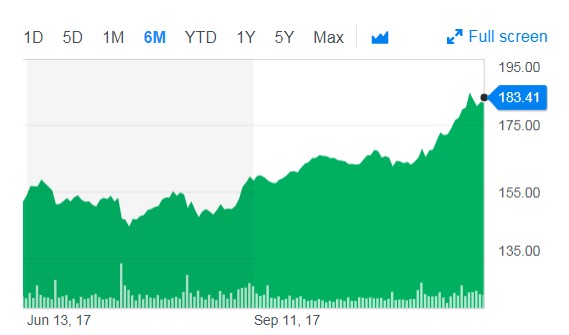
--------------------------------------------------------------------
Cloudera Reports Strong Revenues
Cloudera (CLDR: $16.84, up 6%) reported that revenue rose to $95 million from $67 million in the year-ago period, a gain of 42%. Profits were in the negative, so although we are pleased with the revenue growth, we’re not happy with the losses. The stock had a little bump last week and it may go a bit higher, but it is not going to $30 or higher where it ought to be until it starts actually making money. We love this company but realize this is a multi-year investment from here. Patience is key here. But our patience is certainly running thin. The quarter was strong, so that gives us hope.
Bitcoin (BTC-USD: $14,840) has a market cap of about $250 billion, about the size of Visa. It was quite a week, as it rose from the $11,000 just one week ago. In the interim it hit $17,000 or so, and futures trading starts Sunday (the 10th).
Bitcoin Chart for the Past Month

--------------------------------------------------------------------
--------------------------------------------------------------------
The High Yield Corner
By Michael Foster
While the stock market went nowhere fast last week, high yield investments were a bit more mixed. We saw strength in municipal bonds for the first time in a long while, as this was overdue. The uncertainty regarding tax reforms caused some selling, but now the market is realizing that muni bonds are vastly oversold, which is helping to bring some money back into the market. Additionally, the slightly more risk-averse market is helping some money flow into muni bond funds, driving them up again.
As a result, Nuveen AMT-Free Municipal Credit (NVG: $15.68, up 2%) and Invesco Municipal Trust (VKQ: $12.57, up 2%) both had a good week, meaning the strong buying opportunity is mostly over. It’s not entirely over, however. Both funds are trading at about a 6% discount to NAV on average, a bit lower than the 5% discount we saw for much of 2017. What’s much more encouraging is the positive change in NAV we’ve enjoyed throughout 2017 - these funds are up about 5% on average on their net asset value even after their 5% dividend payouts. That means these dividend payouts remain sustainable and investors can expect a strong total return in addition to the tax-free income stream these funds provide. We wouldn’t be surprised if we saw more investors jump into the muni market, driving these funds higher and their discounts lower.
Elsewhere in the high yield world, we saw growing discontent. Specifically, Government Properties Income Trust (GOV: $18.29, down 3%) had a challenging weak on no news. This is largely a result of continued concern that Government Properties is overly levered and highly dependent on government agencies who are squarely in the majority Republicans’ crosshairs when it comes to cutting expenses wherever possible.
Of course, neither of these facts have changed in the last week, but admittedly the 8% and 7.5% yields that this stock offered earlier in the year were too low to compensate for the risks that the fund’s portfolio afforded.
Some context is important here. The Bull Market Report first recommended this stock back in April of last year when it was yielding 9.5%. Since then, the stock has given a near 14% total return to investors thanks to a slight bump in price and a consistent 43 cent quarterly dividend payout.
The Bull Market Report did not recommend selling this fund during its run-up earlier in 2017 for one specific reason: income sustainability. The most crucial metric to look at with REITs is FFO* and its relation to dividend payouts. Over the last 12 months, this REIT’s FFO was $2.15, while the dividend is an annualized $1.72. That’s a 125% dividend coverage ratio, slightly short of our preferred 130% dividend coverage target. But that shortfall is compensated for by the higher yield.
* Funds From Operations
To put that into context, let’s think about another beaten-down REIT: Omega Healthcare Investors, Inc (OHI: $28, up 1%), which has around a 130% dividend coverage ratio and a 9.4% dividend yield. With such a strong and sustainable income stream and a high yield, these are ideal contrarian income plays despite the justifiable concerns about the fundamentals. With Omega, the worry is that there are too many skilled nursing facilities and lower-than-expected demand. With Government Properties, the worry is that there is going to be depressed demand from a belt-tightening government.
These concerns are well compensated for by yields over 9%. When you get to double-digit yields (which is very unlikely with Omega but not impossible with Government Properties), you’re getting paid too much for the risks. We believe there is a chance of seeing its stock drop to a level where yields are 10%, which makes it a hold right now but not an absolute great buy. But when it comes to the sustainability of the dividend, we clearly see no risks at all to the dividend for a long time - in fact, possibly for several years.
How many years? To answer that, we need to look at the duration of outstanding leases in Government Properties’ portfolio. At 5.1 years, 28% of the company’s leases will expire before 2020. And in the next 5 years, almost 60% of the company’s leases will expire.
This is a double-edged sword. On the one hand, there is a risk that the company won’t be able to lease those properties to new tenants, causing occupancy rates to fall, income to fall as well, and the dividend to be increasingly at risk. On the other hand, there’s an opportunity for the company to lease those properties to those tenants or new tenants at the same or higher (possibly much higher) rents. This latter scenario is how we feel. The government needs the space and the record of the government in cutting down its size is, as you know, abominable.
So what is the likelier scenario - falling occupancies or rising rents? Bears are arguing for the former, and we would argue that that scenario is already priced in. However, falling occupancies is more unlikely than the market is expecting for a couple reasons.
Firstly, commercial leasing activities are going up. According to Jones Lang LaSalle, one of the biggest commercial leasing firms in America, leasing activity is at its highest point in 2 years and it’s trending higher. Government Properties has been shifting away from government leasing to office leasing, so it will benefit more and more from this trend. Thus the chances of finding new tenants paying higher rents is actually pretty good.
Secondly, there’s a paradoxical market lockup in commercial real estate REITs despite strong rent growth. Office-space REITs are one of the most heavily discounted (infrastructure and data centers are the most premium priced) in large part because of the market jitters about future occupancy rates, which paradoxically is forcing more conservative fiscal decisions among office REITs like Government Properties. But we have clearly hit a bottom in terms of pessimism, and when enthusiasm comes back to office space REITs, which will likely come as soon as the market notes the strong growth in leasing activity and rent growth, companies like Government Properties will be able to expand even more.
That means patience is in order. Expect more negativity and worries about Government Properties in the short term. But the fears about its soon-to-expire portfolio are overblown, and when the market realizes this, more capital will flood into the stock. It may take until 2019, when 18% of the company’s portfolio expires. If those spaces are re-leased at the same or higher rates (which seems inevitable given the strength in the commercial real estate market), expect the stock to rise. Best to hold the stock now, collect the income, and wait for that bump in a couple of years.
Good Investing,
Todd Shaver, Founder and CEO
The Bull Market Report
Since 1998
December 3, 2017
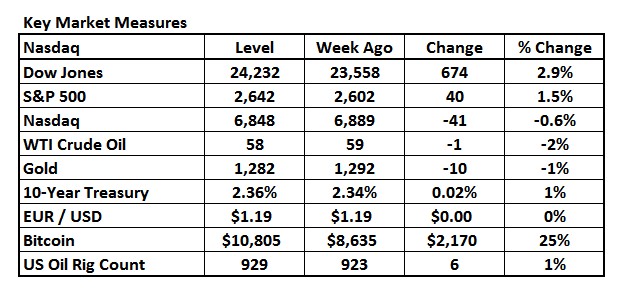
by Todd Shaver | Dec 3, 2017 | Weekly Newsletter 7pm Sunday
The Weekly Summary
Before we tell you the big news for the week. Let’s just remember: The politicians in our country still have a lot of room for improvement. Let’s not praise them for accomplishing something they should be doing. With that said, Senate Republicans narrowly approved the most sweeping rewrite of the U.S. tax code in three decades, slashing the corporate tax rate and providing temporary tax-rate cuts for most Americans. It was a close vote of 51-49 that was placed just before 2 AM Saturday. Trump expects to sign the bill before Christmas but before that, there are a number of discrepancies to resolve, which could cause a lot of commotion in the weeks ahead. All in all, tax reform is a major milestone and had this not happened we could have seen a jolt to the markets. But the Bull Market remains alive and well!
No matter what is happening out there, there is always a bull market here at The Bull Market Report! This week we highlight some of our favorite stocks where you can still make good money, including: WageWorks, Blackrock, PayPal, Square, Nutanix, and Annaly.
BMR Companies & Commentary
WageWorks (WAGE: $64, up 2%)
WageWorks is catching a bid as they say, when a stock starts to work. What is happening recently? Well, the company has published its latest update for “The Definitive Guide To HSAs”. This is the best blueprint on the planet for how to run your business for your employees. Most employees are not prepared to handle unexpected medical expenses. A recent survey from Aflac found that 65% of respondents have less than $1,000 to pay for out-of-pocket expenses related to an unforeseen illness or injury. So, how do you offset rising healthcare costs, while keeping employees happy and healthy? For many organizations, the answer is a high-deductible health plan (HDHP) paired with a Health Savings Account (HSA). All of this detail is covered in the updated guide just published. The key takeaway is that December is the point in the year where all of WageWorks’ clients renew and many new clients come onto the platform. Revenue will be strong, and we will get an updated client count in the next earnings release, which will give us great visibility into just how good business will be in 2018.
BMR Take: The consensus EPS is currently $1.80 this year heading to almost $2.00 next year. We expect upside to next year’s EPS estimate to be evident on the upcoming earnings call, as the company announces a number of new client wins during this year’s selling season.
---------------------------------------------------------------------------------
BlackRock (BLK: $502, up 5%)
BlackRock and Citibanamex, a subsidiary of Citigroup, announced a definitive agreement for BlackRock to acquire the asset management business of Citibanamex. The two companies will also enter into a distribution agreement to offer BlackRock asset management products to Citibanamex clients in Mexico. Through its network of 1,500 branches in Mexico, Citibanamex provides wealth management products and services to more than 20 million clients. The transaction involves approximately $31 billion in assets under management of Citibanamex, across local fixed income, equity and multi-asset products, primarily for retail clients. The transaction is part of Citi’s emphasis on expanding access to best-in-class investments products, rather than on manufacturing proprietary asset management products. BlackRock’s business in Mexico currently focuses mostly on institutional clients, offering international investment and risk management products and services across asset classes, strategies and geographies.
BMR Take: This is why we like BlackRock. The company’s reach globally is unbelievable and getting bigger. Consensus calls for EPS to grow from $22 this year toward $33 in 2020. This ride is just getting started.
---------------------------------------------------------------------------------
PayPal (PYPL: $75, down 4%)
PayPal has had to suspend operations and that has weighed on the stock. PayPal announced an update on the suspension of operations of TIO Networks (TIO), a payment processor PayPal acquired in July 2017. A review of TIO's network has identified a potential compromise of personally identifiable information for approximately 1.6 million customers. The PayPal platform is not impacted in any way, as the TIO systems are completely separate from the PayPal network, and PayPal's customers' data remains secure. As announced on November 10th, PayPal suspended the operations of TIO to protect customer data as part of an ongoing investigation of security vulnerabilities of the TIO platform. This ongoing investigation has identified evidence of unauthorized access to TIO's network, including locations that stored personal information of some of TIO's customers. As a result, PayPal is taking steps to protect affected customers.
BMR Take: While this isn’t great, we applaud PayPal’s swift and serious preventative measures. So many other companies, like Equifax, have done it all wrong. This is why PayPal is a market leader in payments as they set the example. With EPS set to grow from $1.90 this year to over $3.00 by 2020 there is more room to run in PayPal’s stock, unreal considering how much the stock has already appreciated.
---------------------------------------------------------------------------------
Square (SQ: $38, down 22%)
Square has been red hot, moving straight up from below $10 since the summer of 2016. We added the stock at $17 in March of this year and are still up over 120% even after last week. We saw a big pullback last week but are not overly concerned. One of the reasons was that an analyst at BTIG (who?) came out with a Sell rating on the company saying the bitcoin rally was speculative, overdone, and ripe for a correction. (The company created a buzz announcing the Square Cash app that will buy and sell bitcoin.) It is not optimal or correct for the company’s fortunes to be tied to cryptocurrency. This is just a small experiment which we applaud, but if it doesn’t work out we’re not worried and it certainly won’t impact the company materially. Shares dropped about 16% on the release of this report. All in all, we like what Square is doing.
BMR Take: The major takeaway is not getting caught up in the volatility of cryptocurrency, but that Square is pioneering payments in a manner not seen at its major peers. This makes Square the innovation leader in the space and a must-own stock for the long haul, like a Tesla or Amazon, where it’s not that the numbers don’t matter, but just not yet and won’t for a long time. Revenues are growing dramatically and ultimately the Street believes in revenues first and then profits.
---------------------------------------------------------------------------------
Nutanix (NTNX: $36, up 5%)
Nutanix absolutely crushed the quarter and the stock went flying higher. Revenue of $276 million grew 46% year-over-year. Billings of $315 million grew 32% year-over-year. The loss per share of $0.39 compares to a loss of $1.89 a year ago, but recall that if the company stopped marketing heavily tomorrow, EPS would increase over $1.00. We don’t want this to happen as we want long term marketing investments for future revenue growth. The cash balance ended the quarter at $365 million, a healthy figure. Nutanix ended the first quarter of fiscal 2018 with 7,800 customers, adding over 760 during the quarter. First quarter customer wins included ConocoPhillips; Toyota Motor North America, and Trek Bicycle Corporation. Nutanix increased the number of $1 million+ deals in the quarter, up 36% from last year.
BMR Take: Nutanix delivered a great quarter. The stock is a great investment opportunity and we have seen a massive move since we added the position to our portfolio in May at $17. From here, we look for more steady revenue performance in 2018 and believe this can continue to push the stock higher. We see the company clearing the $1.0 billion revenue milestone for the first time next year! Revenues for the past three years ending July were $765 million last year, $445 million in 2016 and $240 million the year before. Now that’s called growth! At $6 billion in market cap the company has reached the medium-time (in other words not the big-time! Yet.) but they are moving swiftly in the right direction. Of course, the company remains a buy-out candidate as $6-10 billion is chump change for the big boys. Now wouldn’t it be nice to have this one bought out at $50 a share sometime next year. Our Target is $42, recently raised, but we sure wouldn’t mind raising this Target to $50 if the stock hits $40 in the next few months.
Upgrades this week: Nutanix price target raised to $51 from $39 at Maxim and kept their Buy rating after this week’s earnings beat. The company's latest guidance looks to improve the sales productivity metric from 32% to 39% in FY19.
Nutanix price target raised to $40 from $34 at Oppenheimer saying the company reported another strong quarter ahead of expectations. The "clear highlight" was management's commitment to a software-focused model going forward. The research company is bullish on the transition and looks forward to a "large gross margin boost over time." He maintains an Outperform rating on Nutanix.
Nutanix price target raised to $40 from $28 at Piper Jaffray saying the company's transition to a software model highlighted its "solid" Q1 results. The transition will result in "significant" gross and operating margin expansion, and should ultimately drive a "re-rating of the multiple." They have an Overweight rating on the stock.
---------------------------------------------------------------------------------
Annaly (NLY: $11.80, flat)
Annaly is worth a close look right here. The company is a leading diversified capital manager. The yield on the stock right now is greater than 10%. They are the largest Mortgage REIT in the world with a market cap of almost $14 billion, which is 20x the market cap of the median Mortgage REIT. Their diversified business model has them investing in agency loans, residential credit, commercial real estate, and middle marketing lending. Let’s review these:
--- The Agency group invests in agency Mortgage Backed Securities collateralized by residential mortgages which are guaranteed by Fannie Mae or Ginnie Mae. These are the safest government bonds around, but do carry interest rate risk.
--- The Residential Credit group invests in non-agency residential mortgage assets. This area is more complex because there is no government guarantee, but the opportunity for enhanced investment returns is greater.
--- The Commercial Real Estate group originates and invests in commercial mortgage loans, securities, and other commercial real estate debt and equity investments, which is a great way to pick-up real estate exposure in your portfolio.
--- The Middle Market Lending group provides financing to private equity-backed middle market businesses across the capital structure, which can be quite lucrative. The company is very well run, in fact the best in the industry, and the Board of Directors appointed Chief Executive Officer and President Kevin G. Keyes as Chairman effective January 1, 2018.
BMR Take: With a 10% dividend yield, and sturdy fixed income investments across asset classes, we see compelling value in the stock. If we see a volatile equity market, their portfolio of mortgage-backed securities should provide steady income to support the $1.20 dividend that is covered by earnings. Higher interest rates could cause some near term volatility, but Annaly will be able to reinvest at the higher rates ultimately driving higher dividends that should appeal to any high income seeking investor.
---------------------------------------------------------------------------------
---------------------------------------------------------------------------------
Upcoming Economic Calendar
Factory Orders
Monday, December 4th, 10 AM ET
Period: October
Actual: N/A
Consensus: -0.40%
Prior: 1.4%
Trade Balance
Tuesday, December 5th, 8:30AM
Period: October
Actual: N/A
Consensus: -$47.0B
Prior: -$43.5B
Consumer Credit
Thursday, December 7th, 3:00 PM
Period: OCT
Actual: N/A
Consensus: $16.5B
Prior: $20.8B
Unemployment Rate
Friday, December 8th, 8:30 AM
Period: November
Actual: N/A
Consensus: 4.1%
Prior: 4.1%
---------------------------------------------------------------------------------
---------------------------------------------------------------------------------
A Word from Gary Jefferson
First Vice-President, Investments
Jefferson Financial Group
UBS Financial Services, Inc
I remember riding as a kid over the desolate highways in west Texas and every now and then you would see a great big billboard with the ominous message "The End Is Near". Well, as investing goes in the year 2017, the end really is near, except the message thus far is extremely positive - although it still contains a slightly menacing element. We haven't had the almost obligatory 5-10% market correction after such a strong run-up. That's because through today, there is still a little bit more than just "hope" that tax reform will happen. Should tax reform fail, then we would be in the shock-and-awe camp if the market treated it as a non-event. Whatever the result, the year-end should be a net positive one.
As we approach the new year, we do not see a scenario that would involve making major changes to our asset allocations or investment strategies. First and foremost, we don't see a recession anywhere on the horizon. It is just the opposite – we see continued expansion in both US and global corporate earnings. It is that simple and we don't see any reason to try and make it any more complicated. We will certainly keep an eye out for the accepted early warning signs of potential trouble ahead such as an inverted yield curve or runaway inflation. And, there is always the proverbial geopolitical risk and the energy wild card. At this time, however, the energy card looks to be fairly stable, as do the Mideast and North Korean tensions.
We think Technology will still be a leader because we are right in the heart of the 4th Industrial Revolution and it is all about technology – artificial intelligence, augmented reality, the Internet-of-Things, the "Cloud", driverless cars, e-commerce and the list goes on and on. The first Baby Boomer is only 71 and 10,000 people turn 65 every day now, which will continue for another 10 years. Healthcare can't help but be a tremendously important sector for years to come because of its unstoppable momentum. While we continue to like these two sectors, we also see a lot of potential in many other areas. That is why we continue to use diversification as the cornerstone of our investment strategy. For several years the large-cap S&P 500 stocks were about the only positive area in worldwide markets and diversified portfolios lagged their performance. Today, however, Europe, Asia, Emerging markets, small caps and alternatives are finally participating in the overall success of global markets, allowing traditional diversification to reward investors. We, along with most major firm analysts, expect this broad-based positive performance to continue into 2018, albeit at a lesser pace than this year's torrid rate.
One thing we are sure of is that a market correction will happen – we just don't have any idea as to the timing (nor does anyone else, so run away as fast as you can whenever you hear someone specify the time and date). Unless the fundamentals that got us here collapse, we will view a correction as a normal market event, not as a reason to panic but rather more likely as an opportunity to seize. Bearing that in mind, while the "end is near" for investing in 2017, we think of it as a useful billboard alerting us to plan and prepare for investing in 2018. Diversification, with some emphasis on Technology and Healthcare, remain solid portfolio choices.
---------------------------------------------------------------------------------
Amazon (AMZN: $1162, down 2%) price target raised to $1,525 from $1,430 at Wells Fargo to reflect increased outer-year estimates for Web Services as well as a higher sum-of-the-parts valuation. The research firm highlighted the "very successful" five-day Amazon Wed Services conference in Las Vegas, "record-breaking" early holiday sales data, and another Healthcare industry development with CNBC reporting* the company is in talks with generic manufacturers Mylan (MYL) and Novartis (NVS). They see an increasing likelihood that Amazon "ultimately becomes a disruptor" in Healthcare, with generics representing a potential point of entry. The Wells Fargo Healthcare team sees generics as a "simple entry point" in Pharma as it involves many players with ready supply and a price competitive market. They keep an Outperform rating on Amazon.
* CNBC reports that Amazon has held preliminary talks with generic drug companies, including Mylan and Novartis' Sandoz, regarding the ecommerce giant's possible entry into the pharmacy market. It is unclear whether Amazon is planning to enter the space as a drug wholesaler or as a retailer but Sandoz said it does not expect the move, which could potentially disrupt the drug distribution industry led by McKesson (MCK), AmerisourceBergen (ABC) and Cardinal Health (CAH), and which could have a "major impact' on its business.
---------------------------------------------------------------------------------
Visa (V: $111, down 1%) remains solid as a rock. This company is BIG, at $250 billion in market cap. The dividend is not worth mentioning, but the company is all about growth. Revenues the last three years were $14 billion in fiscal 2015 (ending September), $15 billion in 2016 and $18.4 billion in 2017. With after-tax income of $6.7 billion, this company is a cash machine. 36% after tax? Simply astounding. The company has $10 billion in cash and $16 billion in long-term debt, a good ratio. We sure would like to see a higher dividend, but we’ll settle for our Target Price of ….. Wait a second. It just hit our Target of $110. So we hereby raise it to $123. Our Sell Price is: We would not sell Visa. Invest in this puppy for the grandkids. They'll be happy you did.
---------------------------------------------------------------------------------
The High Yield Report
By Michael Foster
There are a couple of big-picture items to talk about. One kinda big and one really, really big.
Let’s start with the kinda big item. Pimco. The Bull Market Report has recommended the PIMCO Dynamic Income Fund (PDI: $30, up 1%) for nearly two years now, and in that time the fund’s distributions have remained constant. But what really has pushed this fund over that period has been its special distributions. In late 2016, this fund gave out an extra $1.45 in a special end-of-year payout that boosted its annual dividend to over $4, which makes the return a whopping 13% on stock. And the fund’s net assets have actually grown while paying those distributions. This kind of performance is the thing dreams are made of.
Now we’ve come to the end of 2017, and we’re wondering if that same lightning will strike again. If you were reading our columns last year, you know that we were expecting an end-of-year payout of over $1, and Pimco crushed our expectations with nearly 50% more cash to shareholders than what we were hoping. So what about this year?
Unfortunately, this is the weirdest year in the history of this fund. Keep in mind that the Dynamic Income Fund specializes in mortgage-backed securities (MBS’s), which are one of the few asset classes to be Hollywood famous. In the movie-adaptation of Michael Lewis’s The Big Short (and, if we may say, the book is much better than the movie and definitely worth a read), the public was given an insight into these derivative investments that, frankly, were one of the primary weapons of the 2007-2009 financial crisis.
That big crash is, paradoxically, why Pimco spun off this fund in 2012 and why it’s done so well since. With a focus on MBS’s, the fund looked to find assets in the marketplace that were trading at absurd discounts to their NAV. Pimco found MBS’s that had been discounted to trade for 20 cents on the dollar, and then they did an analysis to see if more than 20% of the underlying mortgages would avoid defaulting. If so, they bought the MBS.
They did a lot of this in 2012 and 2013, which was really the bottom of the MBS market. Since then, Pimco has been collecting the income from those mortgages, and that massive interest payment (since those assets were bought at a huge discount) has resulted in a high yield for investors.
It’s been a decade since the crisis began, which means the total number of distressed mortgages has declined as a result of payoffs, refinancing, and so on. That means there are fewer distressed mortgage-backed securities in the market. At the same time, more investors have realized how oversold the MBS market was in the aftermath of the financial crisis, and a lot of competition to buy these assets began in 2013. That has heated up extremely in 2017, which means the Dynamic Income fund has been buying fewer and fewer MBS’s at those big discounts and buying more at much smaller discounts.
As a result, the Dynamic Income fund has been earning a lower yield on its investments - but its dividend has remained constant. That has translated into a lower dividend coverage ratio that actually fell below 100% in 2017 for the first time in years.
This has worried a lot of investors, but it shouldn’t. We are still years and years away from this fund being a sell. It does mean that it is harder to earn the massive income stream that it has had in the past, but it is still very easy to earn capital gains by identifying underpriced MBS’s in the market. Pimco is particularly good at this, so the fund is seeing its NAV rise at a faster pace than any other time since 2012.
But all of this puts the special dividend at risk. Will Pimco give out a special distribution from capital gains? We simply don’t know. In the past, the fund has paid out a special distribution from investment income, which makes sense (this is the structure many Closed End Funds and mutual funds follow). PDI can choose to give a special distribution from capital gains or not give a special distribution at all. No one knows whether they’ll choose to give a special distribution from cap gains or no special at all.
So, sadly, we cannot predict an end-of-year payout this year. It could be anywhere from $0 to $2.00 (the amount the fund’s price has gone up in 2017). Personally, we would like to see Pimco offer no special dividend and use that cash to get better returns - but, then again, investors would’ve been well-served had Pimco done that in previous years, and they didn’t. So the future of the fund’s special dividend is in question.
The normal dividend is not in question, however, and the NAV growth is strong enough to keep holding the fund in your portfolio.
The second really big issue is a lot bigger but also a lot simpler: the tax code.
Municipal bond funds Nuveen AMT-Free Municipal Credit (NVG: $15.31, down 1%) and Invesco Municipal Trust (VKQ: $12.30, down 1%) have taken a hit alongside all municipal bond funds on the uncertainty of municipal bond tax credits. Specifically, there is worry that the new tax plan will remove the tax-free status of “private activity bonds,” or PABs, which tend to be used by local governments to provide funding for private entities that will develop a new building or piece of infrastructure that has a broader public use (for instance, a new hospital). There remains uncertainty as to whether munis will maintain their tax-free status. The tax plan from Congress eliminates their tax-free status, and the Senate retains them. That split indicates to us that this is a battleground for quid-pro-quo politics, and we may see a last-minute reversal as a result of a back-door deal.
Nonetheless, the municipal market is assuming this is just plain bad for municipal bonds. The reality is much less clear. This may result in fewer bonds in the market, and that would mean higher prices for bonds (especially older bonds). That would be very good for existing muni bond funds. But it really depends on the final legislation, which no one knows yet.
We don’t believe munis will be stripped of their tax-free status. We see this as a buying opportunity for municipal bonds, since the potential upside is something the market isn’t focusing on. The market is too big and too important for such a major change to occur.
Good Investing,
Todd Shaver
Founder and CEO
The Bull Market Report
Since 1998