February 18, 2018

by Todd Shaver | Feb 18, 2018 | Weekly Newsletter 7pm Sunday
The Weekly Summary
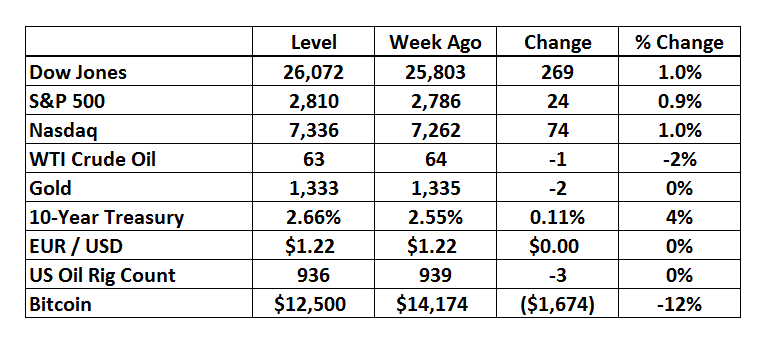
US stocks rebounded to have the best weekly gain since 2011 - how do you like that for a turnaround? So it turns out the bull is still running after a quick breather. Now all the talk on TV is “don’t worry about volatility. That markets had been abnormally calm for years. That we should now just expect more noise.” We concur. We adhere to the old adage: “Bull markets are born on pessimism, grow on skepticism, mature on optimism, and die on euphoria.” This means that bear markets are born on euphoria and grow on pessimism. Frankly we just don’t see that much euphoria in the markets. For example, while bank stocks are up 50% since the election, profits are up more, which suggests gains in bank stocks are honestly tied to the realities of profit levels. As another example, GDPnow suggests first quarter GDP is above 3.0%, again meeting the growth targets underpinning recent stock market gains. All in all, wake us up when you see broad-based euphoria, because until then this bull market is on cruise control, the ride might be a bit more bumpy going forward.
No matter what is happening out there, there is always a bull market here at The Bull Market Report! This week we highlight: Twilio, Shopify, Square, Splunk, Amazon, and AstraZeneca.
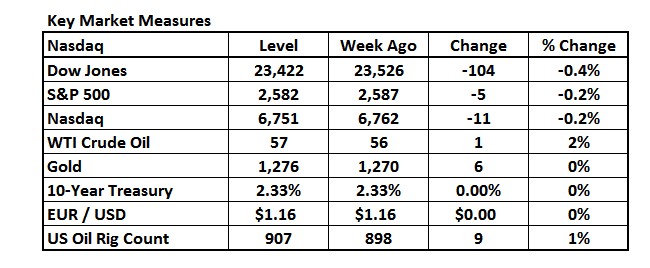
Key Market Measures (Friday’s Close)
----------------------------------------------------------------------------------------
BMR Companies & Commentary
Twilio (TWLO: $33, up 35%)
Twilio crushed the quarter. We mean absolutely crushed it. Revenue was $115 million up 41% from a year ago. EPS was a loss of $0.03 versus breakeven a year ago. There were so many good things that happened we can’t cover them all, but we will share a few.
The tone of business at Twilio continues to be exceptional. Founder/Chairman/CEO Jeff Lawson commented, “We feel we are poised for a great year ahead.”
The big focus for investors was on Twilio’s gross margins. Specifically, after Twilio’s gross margin declined for three consecutive quarters from a peak of 59% in 4Q16, investors were concerned it might continue to trend downwards into the 40s. Twilio’s 4Q17 gross margin of 53.5% was up sequentially from 3Q17. In addition, CFO Lee Kirkpatrick said, “For 2018, you should expect gross margins around this level or better.” That’s a relief!
Uber has been the biggest area of concern for investors. After peaking at $14 million in 4Q16, revenue from Uber declined sequentially three quarters in a row to $5.0 million in 3Q17, but ticked back up to $5.8 million in 4Q17. Despite the drop off in Uber revenue, the company continues to grow the top line greater than 40% and we haven’t seen any other big customers leave, which is a major reassurance.
BMR Take: Founded in 2008, Twilio is the leading cloud platform for communications. Similar to Amazon Web Services, Twilio plays a critical role for software developers by allowing them to easily and securely build communications services, such as voice, messaging, video, and authentication into their software applications and then scale those services elastically and globally. This stock has a bright future and the current valuation of 5x sales is still at an unwarranted discount to the peer group of high-growth cloud communication companies trading for 7x.
----------------------------------------------------------------------------------------
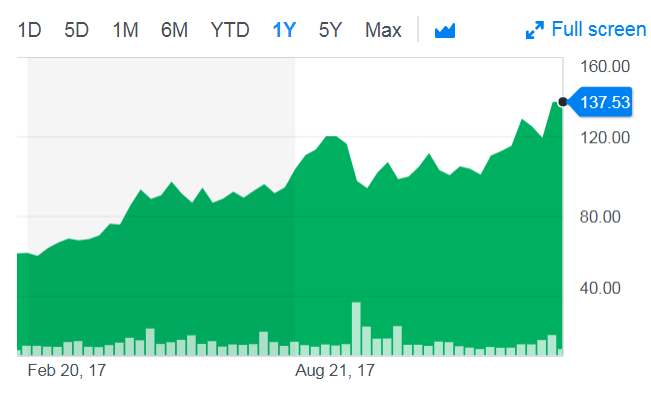
Shopify (SHOP: $138, up 15%)
Another stock crushed earnings for us this week. Shopify. Revenue of $223 million was up 71% from a year ago. EPS was a loss of $0.16 versus a loss of $0.12 a year ago.
2017 was undoubtedly the company’s best year yet. There was exceptional top line growth, but also immense learnings that will drive meaningful progress in terms of product and geographic expansion in the future.
The proof is in the pudding. Fourth quarter is the seasonally strongest of the year with the holidays. Shopify’s merchants sold more in this fourth quarter than in all of 2015, in fact doing $1 billion of sales over just a 4-day period.
For all of 4Q, Shopify’s merchants sold $9.1 billion, an increase of 65% or $3.6 billion from a year ago. This is the definition of sales flying off the shelf. The more Shopify’s merchants sell, the more opportunity there is for Shopify shareholders to make money.
BMR Take: Shopify is a clear leader in commerce, that is building scale, realizing strong growth consistently, and the firm is now considering additional product and geographic expansion to sustain these explosive growth rates for a long time. Revenue is set to double from $675 million in 2017 to $1.4 billion in 2019.
Our Target has been $125 and we wanted to make sure it smashed this target before we raised. Well, “smashed” is the right word here, as the stock shot higher to $140, before dropping a tad on Friday. Yup – an all-time high – never been higher. The company is now worth $14 billion and anyone buying the firm would have to pay $20 billion and we think that management would probably fight any buyout at that level. Why? Because they feel like we do that the company will be worth $30 billion someday. What? Yes. You heard it here first - $250 a share. (We didn’t say when!)
We hereby raise the Target to $160 and the Sell Price from $105 to $122.
----------------------------------------------------------------------------------------
Square (SQ: $44, up 11%)
The one and only CEO of two publicly traded companies at the same time, Mr. Jack (Billionaire) Dorsey tweeted this week that Square’s Cash App is now up and running for instant buying and selling of bitcoin. We’ll cover the product below, but first the most important point needs to be made.
CEO’s like JP Morgan Jamie Dimon called bitcoin a fraud. Countless more expressed dissent or caution about the new sector. Regardless of what is the truth and what you or we think, the question to ask is what did Jack do? Well, he is already out with a product. It is undeniable that wherever the world is going in payments, Jack and Square are the NextGen warriors that are moving … and moving fast. The innovation is impressive.
According to Square’s Cash App, you can buy and sell bitcoin right from your Square Cash App. You have to fund it with a cash balance and have to read and agree to Square’s virtual currency terms of service, prior to proceeding. Interestingly, the terms of agreement are very onerous giving Square the right to withhold payments if fraud is suspected, for example.
BMR Take: We see Square growing revenue from just under $1 billion 2017 to $1.3 billion in 2018 driving EPS growth from $0.25 to $0.45 over the period. To be honest, we care a lot more about the long run revenue growth than the EPS picture. Visa’s market cap is $275 billion. MasterCard’s is $185 billion. Square is only worth $17 billion today and we believe the company can easily chip away at these giants to find strong growth over the next 10 years.
----------------------------------------------------------------------------------------
Splunk (SPLK: $93, up 7%)
Splunk was up but did not participate in the broad equity market rally as much as it should have. What’s the deal?
The big news was selling by key stakeholders. Activist Jana Partners was a large 5% holder. They exited completely. It was also reported that a Senior VP sold a big block of his stock. Several other prominent investors sold out, like Sands Capital, Clearbridge, and Winslow Capital.
You just have to take note of insider selling. There is no reason to fall in love with any stock. When money has been made, recycle it into the next idea when the time comes.
BMR Take: Splunk is covered by 43 Wall Street analysts. 80% rate the stock a buy. However, the average price target is only $92. (Our Target is $95 which it just hit this week.) With the stock up about 50% over the last year, we are taking a closer look at rotating into a new idea. The risk we see is that with big owners selling, and analysts not raising target valuations higher, we could be in a big correction in sentiment.
So, with that said, we are hereby raising our Sell Price from $83 to $88. If it falls to this level, we are out. Having added the stock at $46 in 2016, we are up exactly 100%. We want to make sure we don’t lose these gains.
----------------------------------------------------------------------------------------
Amazon (AMZN: $1,449, up 8%)
Amazon seems to announce a new disruptive business idea every week. This week Amazon is looking to expand its medical supplies Amazon Business marketplace offering to serve the Healthcare industry. Amazon is pushing to turn its nascent medical-supplies business into a major supplier to U.S. hospitals and outpatient clinics that could compete with incumbent distributors of items from gauze to hip implants.
Amazon has been making moves and dramatically disrupting the Healthcare industry over the last year. In October, analysts and the media noticed that Amazon was granted wholesale distribution licenses for medical devices in several states. CVS Health announced in December it will acquire Aetna for about $69 billion in cash and stock. Many Wall Street analysts said the merger was triggered by concerns Amazon will enter the drug business. Last month, Amazon, Berkshire Hathaway and J.P. Morgan Chase announced a partnership to cut health costs and improve services for employees. The announcement was light on details, but said three top executives from each company will take the lead on the project.
BMR Take: The stock was up $110 this week to another new all-time high! It’s leader is the richest man in the world by far, at $121 billion. Amazon just won’t stop. The company is an innovation machine. They are disrupting new industries seemingly every week. Essentially the company is the world's biggest start-up. There could be $50 billion or more of revenue down the road to come from Healthcare. We say you just have to have Amazon in your portfolio. We know it can look expensive on current revenue and earnings, but we don't know who Amazon will grow up to be yet. It's all still developing.
----------------------------------------------------------------------------------------
AstraZeneca (AZN: $34, up 4%)
There was a big drug development this week. According to the FDA, AstraZeneca has been granted Orphan drug designation for selumetinib (MK-2206 & AZD6244) for the treatment of Neurofibromatosis Type 1 (a disease causing tumors on nerve tissue). AstraZeneca and Merck collaborated to investigate the combination of the two compounds. All development costs are shared jointly. FDA orphan drug designation is primarily a function of the disease not the drug - drugs that target diseases with fewer than 200,000 US patients will be granted orphan designation, and in some cases drugs targeting more than 200,000 patients can be granted the designation when the FDA judges that costs could not otherwise be recovered.
The bigger driver right now is the oncology business. While the company has gone all-out in immuno-oncology, there is more work to be done. The potential of the broader cancer portfolio should see growth in 2018, in part by acquisition. We are excited to see new data and potential acquisitions related to immune-oncology this year. Remember, we are in a new era of fighting cancer that is honestly more exciting to think about than just simply what it means for stocks. It’s a big deal for the world.
BMR Take: We feel AstraZeneca is a strong value here. Revenues are steadily running around $16-17 billion annually. EPS is closing in on $3. Many argue the stock could be worth 20x EPS or more. And you get a 4% dividend yield while you wait. This feels like a profitable situation to us. And if we are wrong, it is hard to see the stock trading too much lower as the dividend yield should hold the stock up.
----------------------------------------------------------------------------------------
----------------------------------------------------------------------------------------
Economic Calendar
Existing Home Sales
Wednesday, February 21st, 10:00 AM
Period: January
Consensus: 5,600,000
Prior: 5,570,000
Initial Claims
Thursday, February 22nd, 8:30 AM
Period: 2/17
Consensus: 230,000
Prior: 230,000
Leading Indicators
Thursday, February 22nd, 10:00 AM
Period: January
Consensus: 0.65%
Prior: 0.60%
----------------------------------------------------------------------------------------
----------------------------------------------------------------------------------------
A Word from Gary Jefferson
Jefferson Financial Group
First Vice-President, Investments
UBS Financial Services, Inc.
Let’s talk about the recent volatility and what happened, why and what's next, and put it all in a historical perspective. The bottom line is that, from peak to trough, the S&P 500 fell 10.2% this month, while the VIX volatility index (^VIX: 19, down 33%) spiked to multi-year highs. We believe that the selloff itself was largely technical in nature, driven by forced selling among investors employing systematic strategies. These strategies are compounded (negatively, in our opinion) by the fact that there are now 5,025 exchange-traded funds (ETFs) trading globally and 9,510 publicly traded mutual funds that are all tied to computerized systems causing redemptions and liquidations of stocks during a market free fall. Yet, there are only about 4,000 companies that are actively traded on the NYSE or Nasdaq. Thus, ETF's and mutual funds outnumber available domestic stocks to own by nearly 4 to 1.
Whether the lows of this correction are in or not, volatility is baked into the cake – the numbers simply won't allow anything less than extreme moves whenever these "systems" are triggered. This brings to mind a quote from Peter Lynch, made nearly 30 years ago: "Everyone has the brainpower to make money in stocks. Not everyone has the stomach." Keeping emotions in check and sticking to the philosophy of being a "long-term" investor are more important today than ever before.
That said, from here, provided the fundamental economic and earnings growth picture remains unchanged (UBS forecasts 4.1% global GDP growth and 16% US earnings growth), we should still be confident that the market will eventually regain its footing.
----------------------------------------------------------------------------------------
Square is Upgraded on the Street
Nomura Instinet reiterated its buy rating for Square (SQ: $44, up 11%) and raised its price target to $64 from $48. This represents a substantial upside potential.
According to Nomura, Square is like Amazon and Google in their early days, meaning that it’s difficult to decode the company’s true potential using traditional valuation methods. Using a discounted cash flow model to value Square, Nomura gave it the highest price target on Wall Street. Amazon and Google have disrupted their industries of course, so this type of pronouncement carried some serious weight in our book.
Square is a financial technology company whose services span payment processing, cash transfer, investing, and lending, an area where it competes with PayPal and Amazon. Square has supplied more than $1.8 billion in loans since launching its credit service in 2014. PayPal and Amazon have loaned about $3.0 billion each.
Over $17 billion in payments processed
Nomura sees Square taking market share from its competitors, which could transform the company’s fortunes in the coming decade. Square processed $17.4 billion in payments in 3Q17, an increase of 31% from 3Q16.
BMR Take: If you’ve been reading The Bull Market Report you’ll know that we love this company and think a lot of its future potential. Our Target is $45 which it reached in November, a bit ahead of schedule. After a pullback at the end of last year which washed out a lot of non-believers, the stock has moved back nicely in the first six weeks of the new year. We can’t WAIT to move our Target up to $53! We are moving up the Sell Price from $32 to $38.

----------------------------------------------------------------------------------------
----------------------------------------------------------------------------------------
The High Yield Investor
By Michael Foster
VP, High Yield
The Bull Market Report
For the Bull Market Report portfolios, the story of the week was the multitude of earnings reports. Two reports came from our High Yield portfolio while the other two came from the REIT portfolio. The recap and analysis of these reports will be covered below, after a brief discussion of the broad market action over the past week. As we noted in last week’s summary, the quick drop in the S&P 500 Index was not a worrisome event. Fear might have taken control of your mind if you paid attention to the general financial media. If you didn’t, you probably saw many opportunities to add more to the positions in your portfolio. One prime example of this, which we’ll talk about in more detail below, is the situation with Apollo Commercial Real Estate Finance (ARI: $18.70, up 6%). The overall market drop pulled Apollo down by approximately 5% since the beginning of February, offering a fantastic price area to pick up shares before their earnings report.
With that said, it’s also true that short term price movements to the upside should not be immediately praised, just as one should not immediately become fearful when a drawdown occurs. While volatility may maintain a presence for the next few weeks, it should die down as the earnings season wraps up and investors realize how positive the 4th quarter was for most companies. Along with that note, inflation fears were slightly quelled after CPI (inflation) numbers were reported under the 2% mark at 1.8% for the month of January.
In relation to our portfolios, all signs are bullish. High Yield and REITs both lagged behind the market bounce last week, indicating slight caution among investors.
AllianzGI Equity & Convertible Income Fund (NIE: $21.53, up 4.5%) has been in line with the S&P’s rebound over the past week. Much of the increase can be attributed to the broad market. The fund’s investment in Tech stocks, in which it holds Microsoft, Alphabet, and Amazon, led to the strong performance for the fund, which comes during the best weekly gain for the Nasdaq since 2011.
Let’s dive deeper into Apollo’s report. As stated above, the dip prior to earnings ended up being a great opportunity and we should be content with this position. The Q4 results were stellar. While the company posted a 29% YoY growth in NII of $69 million, beating the consensus estimates of $68 million, it firm also posted an EPS of $0.12 against the consensus estimate of $0.10. Full-year operating earnings (backing out the CMBS sale – see below) of $191 million or $1.89 per share vs. $137 million in 2016 also helps maintain the bullish thesis. The total loan portfolio at the end of the year was about $3.7 billion, with a weighted average remaining term of 2.8 years and all-in yield of 9%. The company announced dividends of $0.46 per share, which translates to a dividend yield of 10%. The ending book value per share was $16.30 with a P/B ratio of 1.1x. The company also got rid of its loss-creating CMBS portfolio, which had become a lesser focus for ARI. Although the sale of CMBS portfolio resulted in one-time losses, the event was viewed positively by analysts.
Digital Realty Trust (DLR: $102, flat), the second earnings report within the High Yield portfolio, had relatively poor performance compared with the broader market, based on poor Q4 results. It dropped over 3% after the announcement. While the company showed a 27% YoY growth in Q4 revenues to $730 million, the company reported FFO of $1.48, down 6% from the year ago period of $1.58. These numbers led to a small drop in share price. Guidance is generally more important and this area left us reassured: the company reiterated a 2018 outlook for core FFO/share of $6.50 and EPS of $1.50. These numbers were based on assumptions of total revenues equaling $3.1 billion, and adjusted EBITDA margins of 59%.
Invesco Municipal Trust (VKQ: $11.90, up 2%) lagged slightly behind the broader market for the week, with no significant news to note. Nuveen Municipal (NVG: $14.45, up 2%), another fund with major investments in US investment grade municipal bonds, also ended up a bit for the week. We’ll take it. Little by little.
As we move on to the REIT portfolio, one should keep the CPI data that we noted above in mind. Annaly Capital Management (NLY: $10.68, up 5%) had a GREAT week. The company reported Q4 earnings, which was in-line with the consensus estimates. The interest income was down 7% YoY to $745 million in Q4, while core EPS was at $0.31 per share vs $0.30 per share in Q3. The ending book value per share, $11.34, was up from $11.16 in 2016. This represents the stock trading at a significant discount to its book value, so we are in no way paying a premium for this company with an 11.3% dividend yield. In fact, Annaly was another example of the general market in the large February drawdown pulling down a solid company, falling to $10.03 a week ago Friday when the S&P hit its lows. This drop provided prudent investors with bargain prices.
Government Properties (GOV: $16.10, down 2%) underperformed the market. The company posted a 52-week low of $15.63, although it recovered 3% at the close of the week with a sudden spike in volume during the last trading day. The spike should be viewed favorably, as it was the highest level of volume since mid-2017. When selling or buying occurs on small amounts of volume, the movement shouldn’t be taken as seriously as when large volume appears. Since this spike in volume corresponded with buy orders, we remain confident about the position.
Omega Healthcare Investors (OHI: $26.74, up 2%) didn’t fare especially well after posting its Q4 results and 2018 guidance, although the drop was a meager 2%. The company posted Q4 FFO per share at $0.77, in-line with estimates and slightly worse than the $0.84 per share one year ago. Rental revenue was flat at $194 million and missed the consensus of $220 million. The company guided full year FFO for 2018 at $3.00, much lower than the $3.60 reported in the current year. The company stated that 2018 would not be a growth year due to its strategic re-positioning of assets, with an estimated $300 million worth of assets to be sold in 2018. The company increased the dividend to $0.66, leaving the annual yield at close to 10%. However, the company highlighted challenges in increasing the dividend in 2018.
Owning this company requires patience. In past newsletters we’ve highlighted the events occurring within the company, from missed payments by Signature HealthCARE to the Orianna developments. During the earnings conference call, executives made sure to note considerable progress being made with Signature. The firm is in good hands and we can sit tight knowing the attractive dividend yield is being covered nicely by cash flow.
Good Investing,
Todd Shaver, Founder and CEO
The Bull Market Report
Since 1998
January 21, 2018
by Todd Shaver | Jan 21, 2018 | Weekly Newsletter 7pm Sunday
The Weekly Summary
Time to get down to business. This week the US budget is in focus. The Senate rejected a one-month spending bill early Saturday, triggering the shutdown of many government services and setting off a partisan fight over who would bear the political consequences. The bill was blocked in a 50-49 vote, well short of the 60 votes it needed. After the vote, McConnell indicated he would take steps to set up a later vote on a 3-week spending bill, keeping the government funded through February 8th, but Senate Democrats are currently opposed to it, leaving lawmakers with no path to reopen the government. Fortunately, both chambers of Congress are expected to be in session Saturday, continuing discussions over how to resolve the underlying disputes over immigration and government funding. We are hopeful to see some progress made before the markets re-open on Monday.
No matter what is happening out there, there is always a bull market here at The Bull Market Report! This week we highlight: Celgene, Microsoft, Splunk, Square, Cloudera and VMware.
BMR Companies & Commentary
Celgene (CELG: $103, down 3%)
Celgene is on a shopping spree to fill a looming revenue hole - a sensible course of action. The trouble is, there is no guarantee their purchases will solve anything. The biotech giant is in talks to acquire Juno Therapeutics (JUNO: $68, up 41%). This comes after Celgene announced the purchase of cancer startup Impact Biomedicines earlier this month for $1.1 billion upfront, plus significant milestone payments. Celgene, which already owns about 10% of Juno, would be acquiring a new kind of cancer treatment, known as CAR-T. The price tag of an outright purchase will be high - Juno’s market value approached $8 billion when trading opened on Wednesday and Celgene shares dropped Wednesday morning, which makes sense. CAR-T technology, which modifies and deploys a patient’s own immune cells to fight cancer, is a brilliant scientific innovation with highly uncertain commercial prospects. The treatment carries a high price tag and employs a complex, labor-intensive manufacturing process. When Gilead Sciences (GILD: $81) acquired Juno’s peer Kite Pharma over the summer, they warned that the deal wouldn’t contribute to earnings for about three years. Gilead and Novartis have programs that are already on the market, while Juno still is awaiting regulatory approval.
BMR Take: Celgene needs to take risks right now as some of their other pipeline drugs have not panned out as well as expected. For example, its best-selling product, the multiple myeloma drug Revlimid, is expected to face generic competition within a couple of years. Any erosion of the Revlimid business will sting. While financially speaking, Celgene can comfortably swallow Juno, the risk is that Celgene may soon have to open its wallet again to solidify its future.
Look, we get it, there are risks everywhere. We’ve had thoughts of throwing in the towel with Celgene. But the more we think about it, the more you have to stick with Celgene. Projections call for EPS of $8.80 in 2018 and $10.35 in 2019. Much of the bad news is already in the stock, as a major sell-off having recently occurred. Celgene is an $80+ billion large cap bellwether in Healthcare. They will figure this out. And when they do, we could be staring at big upside well in excess of standard market returns.
-------------------------------------------------------------------------------
Microsoft (MSFT: $90, flat)
Should the government break up large Tech companies? Standard Oil, American Telephone and Telegraph were the technological titans of their day, commanding more than 80% of their markets.
Today’s Tech giants are just as dominant: In the US, Google drives 89% of internet search; 95% of young adults on the internet use Facebook; and Amazon accounts for 75% of electronic book sales. Those firms that aren’t monopolists are duopolies: Google and Facebook absorbed 63% of online ad spending last year; Google and Apple provide 99% of mobile phone operating systems; while Apple and Microsoft supply 95% of desktop operating systems. A growing number of critics think these Tech giants need to be broken up or regulated as Standard Oil and AT&T once were. Microsoft has long dominated desktop operating systems, but has failed to extend that dominance to internet search or to mobile operating systems. It’s possible Microsoft might have become the dominant company in search and mobile without the scrutiny a federal antitrust case brought that opened the door for Apple and Google. Throughout history, entrepreneurs have often needed the government’s help to dislodge a monopolist - and may one day need it again.
BMR Take: We recognize this is a very real risk facing Microsoft and many of our other high technology companies. However, we see no near-term developments that suggest that anything materializes in 2018. Accordingly, we see compelling value in Microsoft as EPS is expected to grow from $3.40 this year to $4.50 in 2020. Without any major disruptions like an antitrust headache, we see this stock riding much higher.
Our Target has been $92 and it hit $92.80 on Tuesday, a new all-time high. With a market cap of close to $700 billion we expect to see $800 billion in the next 12-18 months. We’re going to leave our target at $92 for the time being, but we expect to raise it to $100 shortly.
-------------------------------------------------------------------------------
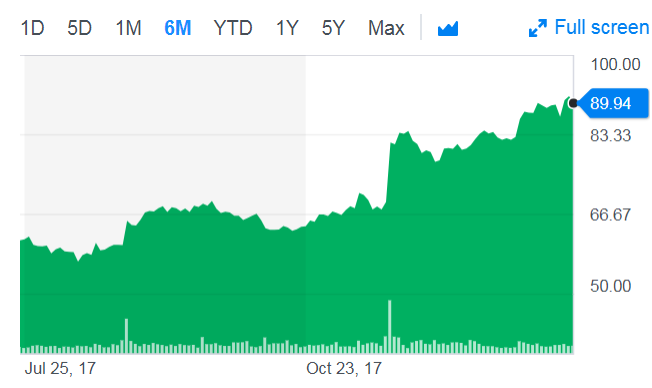
Splunk (SPLK: $90, flat)
Splunk, first in delivering “aha” moments from machine data, announced that Daimler, the German automotive group, will replace its legacy SIEM with Splunk® Enterprise and Splunk Enterprise Security (ES). The group will use Splunk ES as its nerve center for security analytics to gain security insights across the entire organization, including business critical environments such as vehicle systems and manufacturing lines. The company chose Splunk over open source alternatives as part of its strategy to buy best-of-breed solutions rather than building things in house. The automotive group will use Splunk ES to analyze multiple terabytes of data each day. The team expects to reduce security investigation times from hours to seconds, utilizing visualizations to improve analysts’ ability to explore and interrogate data as well as help spot and respond to issues more quickly to limit any potential impact to the business. By committing to a Splunk, the company is able to plan security for the future while benefiting from Splunk’s predictable pricing. The flexibility of the Splunk platform was also important; the group expects to realize future value from traditional IT use cases as well as in newly developed digital applications and services.
BMR Take: As digitization continues to transform industries and create new sources of security-relevant data, security strategies need to be built upon a strong data foundation. Splunk is very well-positioned in this megatrend happening around big data and artificial intelligence. This is a great example of how organizations are taking an analytics-driven approach and turning to Splunk software to do it. With EPS expected to grow from $0.60 this year to $1.30 in 2020 and $2.10 in 2021, there is a really big thing happening at Splunk and you definitely want to be involved.
Our Target is $95 and our Sell Price is $74. We hereby raise the Sell Price to $83. We don’t want to lose our tremendous gains in the stock, having added it at $46 a year and a half ago.
-------------------------------------------------------------------------------
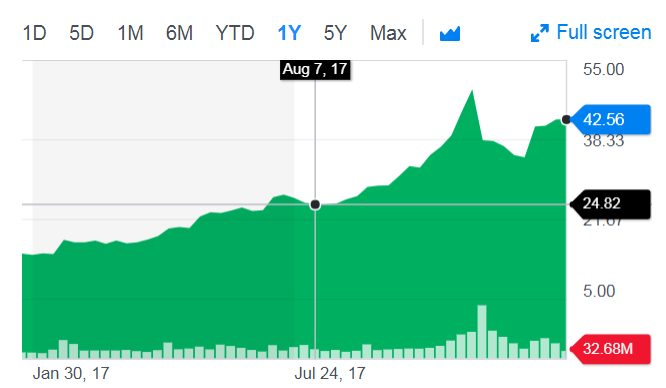
Square (SQ: $43, up 3%)
The meteoric rise in the price of bitcoin in 2017, from just under $1,000 to above $15,000 at year-end, has attracted the attention of investors around the world. Powered by the blockchain, the distributed ledger technology which verifies transactions without the need for third-party validation, the cryptocurrency made great strides during the past year in achieving acceptance by businesses willing to accept it as a means of payment. Investors are looking beyond bitcoin itself to find companies that stand to benefit from the growing usage of bitcoin for commercial transactions. Square. The has released a beta trial enabling users to buy and sell bitcoin on its cash app.
BMR Take: Bitcoin and the blockchain is a windowpane into what euphoria looks like. We haven’t seen this kind of excitement in the markets since the peak of the housing market last cycle. We’ll save a discussion of the future of bitcoin, blockchain, and cryptocurrency for another forum. All that matters is that Square has been caught up in the mix due to this beta cash app trial and investors have benefitted. While we remain optimistic that CEO Jack Dorsey can innovate and create great new products, we still don’t see any specific EPS contribution being called out from the bitcoin cash app, so just be aware. All of that might not matter too much anyway, as the company’s EPS is expected to grow from $0.25 this year to over $1.00 by 2020.
Square Price Target Raised to $64 from $48 at Nomura
This represents a 59% potential upside from current levels. A "looming positive inflection" in gross payment volume growth can help "ensure that 2018 will be yet another phenomenal year" for Square, the company said. Accelerating share gains from payment peers and "relentless disruption of services" like payroll and human resources will make Square a very different company in 10 years. They believe little of this upside is evident using conventional valuation methodologies. The analyst keeps a Buy rating on Square.
BMR Take II: We’ve been saying this all along of course and Square has been a big winner for us here at The Bull Market Report. We added the stock at $17 last year in March and it is up 150% in that short time. It is going a lot higher. Our Target is $45, but we expect to raise that soon. What Nomura said above is very interesting – they can’t value this company on “conventional valuation methodologies.” We’ve been trying to put this in words for you but Nomura has done it for us. The company is in a business that is sweeping the globe, is the clear leader, sells at a high multiple – we know, and is going higher in our opinion.
-------------------------------------------------------------------------------
Cloudera (CLDR: $18.45, up 2%)
Cloudera, the modern platform for machine learning and analytics optimized for the cloud, announced that it has been named a winner of two Internet of Things (IoT) Breakthrough Awards: the Overall Connected Car Innovation of the Year with Navistar, and Connected Car Insurance Solution of the Year with Octo Telematics. Cloudera Enterprise was recognized by this year's judging panel for empowering their customers, Navistar and Octo, to become data-driven enterprises with innovative solutions that combine data from (IoT) sensors, machine learning, and predictive analytics. The IoT Breakthrough Awards honor the world's top IoT companies, products, and people for the creativity, hard work, and success of their achievements.
BMR Take: This is a huge deal as we are sure you are well aware, of how big this mega trend of IoT, machine learnings, and predictive analytics is to the future of the market and our economy. We could rant and rave to you about our opinion of how good Cloudera is at it, but the industry itself just selected Cloudera as the best. This company will scale revenue from $350 million to nearly $600 million by 2020 and break the $1 billion milestone in the not too distant future after that.
-------------------------------------------------------------------------------
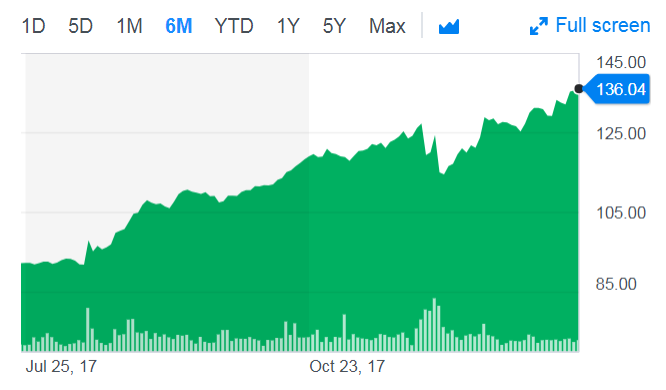
VMware (VMW: $136, up 3%)
This week at the National Retail Federation’s annual show, VMware highlighted several customers who have deployed their technology to modernize data centers, integrate public cloud solutions, empower the digital workspace and transform networking and security. The velocity of change in retail IT is making recognized brands rethink their IT strategies and consider cloud as a way to speed delivery. VMware helps create a foundation of shared technologies to serve both digital and in-store needs to create a connected retail environment. For example, one of the UK's largest furniture producers - DFS - moved to a scalable cloud-first infrastructure powered by VMWare. With this solution, the retailer said it can handle spikes in online traffic year-round with ease.
BMR Take: We continue to see so much potential for ecommerce and companies that are part of the explosive growth still occurring. VMware is expected to increase EPS from $5.15 this year to over $6.00 by 2020. The company's steady business model as an IT vender provides great visibility and a reliable source of earnings that will benefit your portfolio.
Our Price Target is $137, so we are oh so close. The Sell Price is $118, so we hereby raise it to $128 – again, so we don’t lose these great profits, having added the stock at $83, exactly a year ago. 64% is solid, don’t you think?
-------------------------------------------------------------------------------
Economic Calendar
Richmond Fed Index
Tuesday, January 23rd, 10:00 AM
Period: January
Consensus: 17.5
Prior: 20.0
Existing Home Sales
Wednesday, January 24th, 10:00 AM
Period: December
Consensus: 5,700,000
Prior: 5,810,000
GDP
Friday, January 26th, 8:30 AM
Period: Q4
Consensus: 2.5%
Prior: 2.3%
-------------------------------------------------------------------------------
-------------------------------------------------------------------------------
A Word from Gary Jefferson
Jefferson Financial Group
First Vice-President, Investments
UBS Financial Services, Inc.
UBS recently upped our estimate of S&P 500 earnings for 2017 from $131 to $133, and increased our forecast for 2018 earnings from $151 to $154 (last week Bank of America estimated 2018 earnings at $153). Also, UBS estimated earnings for 2019 would come in around $162. These are numbers which will obviously be revised as we go through the next two years, but they give at least a reasonable base line for valuing the current market based on earnings. The S&P 500 ended the year at 2674, which would mean it was trading at 20X trailing earnings and 17.3X forward earnings. Today, at 2810, it is trading at 18X forward earnings and 21X trailing earnings. As you see, the higher it goes, the higher both the trailing and forward PE's become. However, if the market trades at 20X trailing earnings at the end of 2018 as it just did last year, the S&P 500 would be at the 3080 level ($154 X 20). This is 10% higher than today, and that would make for another very good year in the market.
Apple is a one-company global economic stimulus plan. Apple plans to invest $350 billion in the U.S. economy along with paying $38 billion in repatriation tax as it brings back over $200 billion from overseas. Apple is also granting $2,500 in restricted stock units to all non-director level employees including retail employees at its stores. The tax reform bill again drives all these actions.
China reported that Q4 GDP growth increased 6.8% YoY which is slightly above the 6.7% consensus and in line with the 6.8% increase in Q3. China’s full year 2017 growth rate was 6.9% which is significantly above the government’s growth target of 6.5%. Expectations for 2018 are for another year above the 6.5% target growth rate. China’s strong GDP growth remains the world’s economic growth driver. This is good news for both the U.S. economy and the U.S. stock market.
-------------------------------------------------------------------------------
-------------------------------------------------------------------------------
Update on BlackRock
BlackRock (BX: $590, up 6%) brought in $1 billion every day of the year in 2017. (On average of course.) Now THAT is amazing. And the $6 trillion in assets is amazing too, having added $1 trillion last year. They are the largest by far. Most of this money went to its iShares division, the ETF group. as investors are flocking to these indexed investments. Profits were big last year too as the income of $2.3 billion or $14 a share, compared with $850 million the year before, or $5.10 a share. Revenue was up a solid 20%.
We added the stock at $415 in August of last year, about five months ago, and we are sure some of you groaned that it was another high-priced stock that is hard to swallow. We tried to convince you not to worry about the stock "price" and we hope we did. We can see a stock split coming this year. Wouldn’t it be nice to see this thing split 5-1 and bring the price down around $100? You bet. If we were running the show and not Larry Fink, we would do a 10-1 split! Down to $50 a share. Well, even if that doesn’t happen, we can see this stock at $700 someday.
BMR Take: Guess what? We like this company. $590 was our Target. We are raising it to $650 now, and raising the Sell Price from $470 to $550.
-------------------------------------------------------------------------------
Tesla Update
Last week we were worried that Tesla (TSLA: $350) might drop due to all of the financing needs it faces this year and next. So we raised the Sell Price to $320 to protect our gains. Well the stock rose $14 or 4% to our Target Price of $350. Now what?
Good question. We are going to raise the Target to $375 and raise our Sell Price to a tight $335 and sit back and watch. We love this company, we love Elon Musk, but his delivery problems are making us nervous. This stock is going to $500 or $200. We just don’t know which one will hit first! So be careful with this great concept company.
-------------------------------------------------------------------------------
The High Yield Corner
By Michael Foster
Vice President High Yield
Ventas (VTR: $54, down 1%) was strong last week, but still sitting with a year-to-date loss of over 9%. That is a massive loss in a very short period of time. At the same time, both the REIT sector and the market as a whole are doing much better, which makes the situation with Ventas even more worrisome.
Let’s dig a bit deeper to understand what’s going on and how to respond.
Ventas has not released any news, and nothing particularly newsworthy has happened either to Ventas or to the Healthcare REIT world. The selloff, which really began in earnest back in September, has gained significant momentum in the last couple of weeks despite no news. Sales volumes, however, have increased significantly in the last two weeks, indicating that the number of sellers who are worried about Ventas’s future have increased.
This, then, is a typical market panic.
Market panics are rarely justified, and this is unjustifiable, too. Ventas increased its dividend in December slightly, and with the recent price collapse that means the stock is yielding close to 6%. Ventas has not yielded this much since early 2016. If an investor had bought at that time, their total return from then to now would be 9.6% - but much more importantly, their income stream would have gone up.
The reason for this is that Ventas is covering its dividends by a wide margin. The company’s dividend coverage ratio at its new dividend payout is 132% - just above the 130% level that readers know we prefer for REITs. This means that the dividend is well covered by rental income and is in no danger of being cut.
Yet it’s yielding near 6%, which is the market’s way of saying that the payout is in jeopardy. The market is wrong.
If the high dividend coverage ratio wasn’t enough to prove the market is wrong, let’s consider some recent disclosures from the company. The company’s senior housing property occupancy rate increased last quarter, reaching 88.7%. While that is slightly low (90% is typically the standard REITs aim for), the fast-expanding senior housing industry has faced a lot of headwinds from intense competition and looming bankruptcies or insolvencies from tenants who are poorly managing their businesses. For Ventas to get through these problems with an 88.7% occupancy and over 130% dividend coverage is a testament to management’s acumen and savviness.
Then there’s the life science portfolio - a part of Ventas that has seen the most aggressive growth. The numbers are breathtakingly good. Total occupancy is 97.5% and has remained at that level despite the company’s expansion. 75% of rents come from investment-grade tenants, and rents in the industry continue to rise.
Medical offices, another fast-growing part of Ventas’s more diversified strategy, have also seen strong, encouraging numbers. This arm of Ventas saw 91.8% occupancy rates and 80% tenant retention rates. These are high numbers for any REIT industry, but they are very high for healthcare REITs. Obviously, Ventas is doing a lot right.
So why is it crashing? Two reasons: SNF panic and the Fed.
Let’s start with the Senior Nursing Facilities panic, since that has hit Omega Healthcare Investors (OHI: $26.50, up 1%) for a long while. Omega’s 1% rise last week for a good showing for a stock that’s been beaten up a lot in the last few months. The reason, as we’ve discussed here repeatedly, is the looming bankruptcy or rent renegotiation with one of Omega’s big tenants.
Ventas does not have these problems.
Thanks to Ventas’s higher quality tenants, the company isn’t facing major declines in its cash flow from bankrupt tenants. That’s why the stock has always had a yield near half that of Omega. But recent sell-offs are coming from investors who are scared anyway, worried that the problems with some SNF operators are coming to the rest of the REIT universe. There’s no reason to believe this is the case.
A second and arguably much bigger specter that is hitting Ventas and REITs more broadly is the concern about the Federal Reserve. Interest rates are clearly going to go up three times this year. Even more rate hikes are a possibility, unthinkable a year ago. Aggressive hikes in interest rates are bad for REITs, because they cause debt costs to go up. Since REITs effectively work by arbitraging low interest rates on long-term loans and the higher rates buildings can get from rents, the higher rates theoretically cut into REITs’ profit margins. That is, however, if rents don’t go up.
But, as we all know, rents go up all the time. And, in fact, rents tend to go up faster in better economic times, because there’s more money floating around to pay rent and more demand to rent spaces. Thus, rising interest rates, while in theory bad for REITs, are only bad if they are not met with a commensurate rise in rents.
Rents are going up in America, although admittedly they are not going up as fast for SNF facilities. So there is a risk there, but the risk was priced into both Omega and Ventas at the end of 2017. Now instead of pricing in the risks of cash flow getting cut by 5% or so, we’re seeing the market price in a risk of a 20% or 30% reduction to cash flow. The math makes no sense. It’s impossible for these REITs to see such a major disruption to their cash flow unless there’s a really horrible recession AND the Fed keeps raising rates. But the Fed doesn’t raise rates when the economy is doing poorly. So. the market is pricing in a hypothetical that is impossible. And that is when assets get oversold, underpriced, and a bargain. That is the situation with Ventas and Omega right now.
Good Investing,
Todd Shaver, Founder and CEO
The Bull Market Report
Since 1998
December 17, 2017

by Todd Shaver | Dec 17, 2017 | Weekly Newsletter 7pm Sunday
The Weekly Summary
Star Wars ‘The Last Jedi’ topped $100 million on opening weekend, only the second film to do it, the first being Star Wars ‘The Force Awakens’. Americans are feeling good right now watching movies and buying Christmas gifts, as all-time high equity markets have their portfolios in great shape. Mergers and acquisitions are popping off with Disney buying assets from Fox and several other big-name deals announced this week. These are great times. It has been an incredible bull market. In fact, they say this past year was the least volatile on record in a hundred years. From the depths of the Financial Crisis to today marks an amazing journey for the markets. We can’t help but keep stressing that it won’t always be this good.
We’re not worried – just watching. We heard a presentation from a research specialist from Citibank on Thursday and he talked about and gave us charts on where the market is historically. He said the PE of the market (S&P 500) is 26, way above the historical average of 16. He said the VIX (^VIX) is sitting at about 10, way below the historical average of 14 or so. And he said the market ALWAYS REVERTS TO THE HISTORICAL MEAN. We took this all in, have thought about it for days and much before that and we must say that we effectively agree with this analysis. Remember the phrase “the new normal”? They said this about Internet stocks in 1999-2000 – remember what happened. They said that about the bull market leading up to 2008. Remember what happened. And they are saying that about this bull market and the low interest rate environment that we have seen for decades, with the 10-year Treasury still at historic lows of 2.35%.
Again, we’re not worried – but we are watching. We think this bull can run for another two years at a minimum.
No matter what is happening out there, there is always a bull market here at The Bull Market Report! This week we highlight some of our favorite stocks where we think you can still make good money, including: Bristol-Myers Squibb, Nutanix, Annaly, Tesla, Splunk, and asset managers (Blackstone, BlackRock, and Carlyle Group).
BMR Companies & Commentary
Asset Managers:
Blackstone (BX: $31, down 2%)
BlackRock (BLK: $512, down 1%)
The Carlyle Group (CG: $22, up 3%)
Asset managers sure look like a compelling place to put money to work. We highlight some of the key data points about current market conditions. The strong fundamentals point to more and more money being made on Wall Street, which means more money for asset managers, and in turn more money for the investors in asset managers, meaning you of course.
Investment banking data were mixed in the week. Equity underwriting volume was 12% above the 4Q17 weekly average, and announced M&A volume was 67% above the 4Q17 weekly average, while completed M&A and debt underwriting were 45% and 20% below the 4Q17 weekly average, respectively; debt underwriting is steady.
Equity trading volume was 8% above the 4Q17 weekly average level, while equity option volume was 10% below the 4Q17 weekly average.
Corporate bond trading volume was steady. The 10-year Treasury yield increased 1 bp to 2.38% (up 4 bps quarter to date (QTD)), the Bank of America U.S. High yield increased 3 bps (up 32 bps QTD), and MBS securities yields (15-year and 30-year) declined 3 bps and 0 bps, respectively (up 14 bps and up 4 bps QTD, respectively).
Equity fund outflows (on a one-week lag) persisted, totaling $3.6B ($36B QTD), while bond fund inflows (also on a one-week lag) continued, totaling $4.3B ($52.0B QTD). This is certainly not good and amazing that the stock market has been able to absorb this negative news and rally like it has.
BMR Take: Take your pick between Blackstone, BlackRock, and The Carlyle Group, or own them all. These companies make money from all of the fees, deals, and rising asset prices. They are a center of profits. We see opportunity for meaningful stock price appreciation if current fundamental trends persist, as we believe it will. They are WAY UNDERVALUED in our opinion.
-------------------------------------------------------------------
Bristol-Myers Squibb (BMY: $62, flat)
Bristol-Myers Squibb has licensed a phase 1 immuno-oncology drug from Japan’s Ono in a $40 million upfront pact. This geographically complex deal, which builds on a collaboration the pair have had for a number of years now, sees Bristol-Myers solely responsible for the development, manufacturing and commercialization of Ono’s selective Prostaglandin E2 receptor 4 antagonist. This program is aimed at targeting immuno-suppressive factors in the tumor microenvironment.
To improve long-term outcomes for more patients with cancer, Bristol believes more immuno-oncology-based combinations may be required, and they are pleased to continue the long-standing collaboration with Ono with this focus in mind. This new program offers the potential to develop targeted therapies that counteract the effects of an immunosuppressive tumor microenvironment. Researching Prostaglandin E2 receptor antagonists in combination with the oncology portfolio has the potential to result in an enhanced response in a broad range of tumors.
BMR Take: Bristol is going to generate $3.00 of EPS this year and around $3.25 next year, then growing toward $4.50 by 2020 as the immune-oncology drugs gain traction. That means the stock is dirt cheap and now is a great entry point. Remember, activist investor Carl Icahn is in the stock and we could see him push for a sale of the company resulting in a huge M&A premium some day in the future.
-------------------------------------------------------------------
Nutanix (NTNX: $36, up 3%)
Wow, Nutanix has doubled in recent months. Got your attention now? Let’s review what’s happening.
Nutanix started out as a hyperconverged (HCI) vendor. Starting in 2009, they created the market for HCI. They thought that HCI was a step in the journey to where organizations were headed, which was around becoming truly enterprise cloud software companies. This is what you hear and see Nutanix focusing all their energy on. Nutanix customers are looking at HCI as a critical step in this new era journey. They're looking at Nutanix as a full stack offering that allows them to build this platform, above, that's beyond storage and compute and includes virtualization. It helps them with networking, security, but most importantly now helps them with the transition that's happening in the market around the world of multiple clouds, where customers are trying to figure out how to handle a hybrid cloud environment, where customers want to put some of their workloads in the public cloud, but they also have a private cloud infrastructure that gives them the security that actually is probably even more cost effective for their enterprise apps like SAP, Microsoft and Splunk.
BMR Take: Look, we can’t explain all the finer details around the inner workings of HCI. However, we know that tech-savvy people are thrilled about what is going on at Nutanix. The company is on track to swing from losses to over $1 of EPS in 2021. The company’s customer base has doubled. The stock has doubled. We see all the elements of success and continue to like the stock at this level.
-------------------------------------------------------------------
Annaly Capital Mortgage (NLY: $12.24, up 2%)
The Fed raised rates and guess what, Annaly’s stock went up. What? The company is going to be able to navigate the interest-rate environment just fine. In fact, the Chairman of the Board just bought 125,000 shares this week at $12. At the end of the day, it’s been proven by numerous studies, that following insider buying from key business leaders is a way to make money in the markets. People sell stocks for all sorts of reasons, but they only buy stocks with one thought in mind, “I am going to make money on this purchase.” When that buyer is the Chairman of the Board with all that insight and industry expertise, you have to assume either this guy is a reckless idiot with his money or he is on to something.
Who is Denahan J. Wellington? She is Chairman of the Board of Directors and Executive Chairman of Annaly. Ms. Denahan is a co-founder of Annaly and has over 20 years of financial services experience. She was one of the co-founders of Annaly in 1994 and has been with the firm all this time. Ms. Denahan holds a B.A. in Finance from Florida State University and is the third-highest paid female CEO making over $26 million a year.
BMR Take: We see value in Annaly shares which are trading just above book value of $11.20 with a dividend yield of 10%. We think placing your capital alongside Ms. Denahan is a smart move. We have to say we love this company. We’ve loved them for about 20 years through high interest rate environments, through bull and bear equity markets, through negative naysayers both personally and on the Street, and they just keep coming through year after year. Sorry for gushing!
-------------------------------------------------------------------
Tesla (TSLA: $343, up 9%)
Tesla looks to be catching a break in Congress, as electric vehicle tax breaks appear to be maintained in the current legislation.
House and Senate negotiators have agreed to spare the electric-vehicle tax credit and wind production tax credit in their compromise package, according to a Republican familiar with the process. As part of the $1.5 trillion House tax bill, the $7,500 electric-vehicle tax credit would have been eliminated and the wind production tax credit would have been curtailed. The Senate bill didn’t do either, and that is part of the package set for release.
The vehicle tax credit, adopted as part of the 2009 stimulus bill, helps automakers from Detroit to Yokohama bet big on an electric future with plans to spend billions of dollars on new pure-electric models to be rolled-out in the coming years despite limited sales of the vehicles to-date. Availability of the credit has been capped at the first 200,000 qualifying vehicles sold by each manufacturer. No automaker has reached that cap yet. Tesla sold about 127,000 Model S sedans and Model X sport utility vehicles through August.
BMR Take: The tax credit is a nice incentive for sales of Tesla vehicles. More sales means more cash flow. More cash flow means a greater franchise value on the stock. We like what we see happening with Tesla, from innovation to DC policies. Keep this stock tucked away in your portfolio (but know that is one of your most speculative holdings.)
-------------------------------------------------------------------
Splunk (SPLK: $83, up 2.5%)
Kaminario, a leading all-flash storage company, announced a partnership with Splunk to demonstrate compelling performance gains for customers running Splunk Analytics on the Kaminario K2 storage platform. The K2 Splunk Enterprise app provides users with actionable insight into real-time operational infrastructure.
It is imperative for enterprise customers to gain real-time insight into their infrastructure and turn machine-generated data into usable intelligence to stay competitive, with information automatically streamed and visualized into dashboards, alerts and reports,
Additionally, by supercharging Splunk on the K2 platform, organizations have the ability to meet modern information technology infrastructure needs. Splunk has a modern architecture that can leverage next-gen hardware to eliminate bottlenecks for Splunk’s heavy machine-learning-based processing.
With the Internet of Things and connected devices gaining in popularity, companies have to process and analyze the mountain of machine-generated data super-fast and in real time. This collaboration will allow customers using Splunk and K2 to gain critical insight from their infrastructure backed by the industry’s best performing all-flash array, further enhancing the capabilities to run an autonomous and intelligent datacenter.
BMR Take: Splunk is right at the center of the hottest trend in tech - the Internet of Things. EPS is set to explode from $0.57 this year to over $2.00 by 2021. Grab your share of this stock.
-------------------------------------------------------------------
-------------------------------------------------------------------
Economic Calendar
Housing Starts
Tuesday, December 19th, 10 AM ET
Period: November
Actual: N/A
Consensus: 1,240,000
Prior: 1,290,000
Initial Claims
Thursday, December 21st, 10 AM
Period: 12/16
Actual: N/A
Consensus: 235,000
Prior: 225,000
New Home Sales
Friday, December 22nd, 10 AM
Period: November
Actual: N/A
Consensus: 655,000
Prior: 685,000
-------------------------------------------------------------------
Update on Twilio (TWLO: $25, up 3%)
Twilio hosted its first-ever investor day two weeks ago. Despite many quarters of strong results, the stock has remained under pressure.
Twilio aims to be the "future of communications," the way other cloud platforms like AWS has reshaped compute infrastructure and Stripe has revolutionized payments.
Twilio addresses a huge marketplace and has the potential to scale into a much larger company than it is today. The company continues to grow at a 40% rate, even as it approaches a $500 million run-rate.
Twilio's gross margin is much lower than most software companies due to its position of being a "middleman" between developers and telecom networks. The rise of possible competition from services like AWS is a concern.
Based on research from Gartner, the leading software industry analyst, Twilio believes its opportunity in communications to be 40% of the global IT market ($3.6 trillion).
Twilio also reminded investors that its sales model is unique among enterprise software companies by focusing on software developers rather than enterprise CIOs, attributing to its lower spending on sales and marketing. In its most recent quarter, it spent just 23% of its revenues on sales and marketing. This is low compared to the majority of high-growth software companies, that can typically spend upwards of 50% of revenues on sales and marketing.
Twilio also plans to greatly expand its count of quota-carrying reps (QCRs). At the end of 2016, Twilio's sales organization only had 23% of its headcount as QCRs - indicating that the bulk of the company's new sales hires weren't fully ramped yet to the $1.5-$2 million in revenue that the typical QCR brings in. At the end of 2017, however, Twilio estimates that 46% of its sales organization will be QCRs. This will drive further growth in the company.
Revenue guidance calls for $104 million, a strong 25% growth rate. More good news is that active developer accounts are up 35% over last year, and customer retention rate is literally close to 100%.
The company has generated 56% in gross margins year-to-date, the company believes it can attain gross margins of up to 65% in the long term. Twilio is operating at near-breakeven now, but the company expects to attain an operating margin of at least 20% in the future.
BMR Take: We are hanging tough with this great company. Patience will win out in the end, as revenues drive all.
-------------------------------------------------------------------
-------------------------------------------------------------------
An Update on iShares US Energy ETF (IYE: $38, flat)
This is an ETF that owns a basket of 20 or 30 Energy stocks. If you want to own Energy you should own this stock. It holds about $1 billion of these stocks and is paying a dividend of just less than 3%. 40% of the fund is in two stocks – Exxon and Chevron, which together are worth almost $600 billion.
But it certainly has gone nowhere fast. We added the stock in September last year and it up a whopping 2%. Our Target is $44 which we believe to be in reach, if crude where to move higher from here. But even with the strength in crude of the past few months the stock has been flat. But it is up from the low of $34 in August.
BMR Take: Again, if you want to be in Energy, this is an easy place to be instead of trying to pick one of the many Energy companies out there. Energy will come back some day, of that there is no doubt. But when is the ultimate question and that is something The Bull Market Report can’t tell you!
-------------------------------------------------------------------
Cryptocurrency Update
Bitcoin (BTC-USD, $19,000 Sunday – prices change by the minute and trade 24-7)
The bitcoin boom is raging. It’s being discussed on every news network, in every paper, and even in questions asked to the Chairman of the Federal Reserve. The bitcoin rage is best exemplified by the following tale, which is a true story. Erik Finman invested a $1,000 cash gift from his grandmother into bitcoin six years ago. He was 12 years old. Erik is now a millionaire at 18. There are dozens and dozens of these situations being reported. Bitcoin has turned into a full-blown frenzy. It is said that the wealth created in bitcoin has served as an economic stimulus for millennials. Many feel that it going much higher The future of digital gold is here. The end of government controlled fiat money manipulation is upon us. That is what they are saying. But some more cautious investors are saying we will look back and call this the obvious bitcoin bubble. Will we? Only time will tell. Either way the frenzy is an exciting dynamic rarely seen in the markets. Place your bets wisely on the future of cryptocurrencies.
If you wish to learn more about bitcoin and other cryptocurrencies, go to bitcoin.com and sign up for their daily newsletter. Also, CoinTelegraph.com has a great one. For info on the 1300 ICOs – Initial Coin Offerings – go to CoinMarketCap.com.
-------------------------------------------------------------------
A Word from Gary Jefferson
Jefferson Financial Group
First Vice-President, Investments
UBS Financial Services, Inc.
The year is basically over and we will leave it with the following comments on what may lie ahead. The only thing we can be sure of next year is that the vast majority of predictions or forecasts will end up missing the mark to one degree or another, as the market never follows a predictable pattern or does what everyone, especially the experts, expect. The bottom line to all the following information is simply this - Investors should not get all worked up about the numbers or economic forecasts for 2018. We believe the single most important economic fact that investors need to know is that the world is doing OK.
The current UBS "technical" forecast:
[Be prepared for some serious technical jargon.]
“It is remains our contention that the confusion within the US equity markets, pitting the bulls against the bears, lies in the lack of understanding by investors and traders about the significance of the two current powerful but competing market trends. That is, there is a maturing/aging cyclical bull trend (March 2009) operating within a newly confirmed structural bull trend (secular bull markets last an average of 8 to 20 years in length) that began in earnest in May 2013 via a breakout above 1,576/1,600, which was further validated in 2016 by a positive outside year. As with all cyclical trends, the current 9-year cyclical bull will likely end as early as the second half of 2018 and possibly into early 2019. This will be followed by either a deep correction (10–20%) or by a cyclical bear decline (20–30%) rather than by another structural bear decline (30%-plus). Since the current structural bull trend is only four years old, this long-term trend can sustain for another four years (2021) and possibly extend for another 16 years under ideal conditions. This would imply that the S&P 500 may quickly achieve our technical target of 2,850 as early as the first half of 2018 and possibly overshooting to 3,000 before sustaining a major drawdown. Under the backdrop of a structural bull trend, the S&P 500 can reach an optimistic technical target as high as 3,685 in the years ahead."
Thus, under a worst-case scenario where this new secular bull market which began in 2013 only lasts the minimum 8 years instead of the maximum 20 years - therefore lasting another four years - the technicians are forecasting the S&P 500 could reach 3685 over that 4 year period. This would equate to about 40% upside or 10% annually. However, trying to time this projected correction or cyclical bear decline in later 2018 or the first half of 2019 (or reaching the level of 2994-3045) will be nearly impossible, and could cause timers to miss an important move higher.
Keep in mind that this is a "technical" forecast based on charting and technical historical patterns. It is one of many tools used by money managers in reaching their final investment strategy and asset allocation decisions.
The UBS "fundamental" forecast also offers a positive outlook:
“US stocks rarely experience a sustained downturn outside of economic recessions. In fact, since 1960, the median S&P 500 calendar year total return is 15% in non-recession years. While gains in 2018 are unlikely to match the advance of this past year, US equities should continue to rise and outperform bonds as the US and global economic expansion continues. Historically, stocks rise 88% of the time in non-recession years.
2017 review: Solid S&P 500 EPS growth of 10% underpinned US equities in 2017. Market gains were amplified by higher valuations driven by strengthening and synchronized global growth and inflation generally undershooting market expectations.
2018 outlook. We forecast 2018 S&P 500 EPS to rise another 8% to $141 if tax reform is not passed. With expected tax reform benefits, profits could get an additional 6-10% boost. Solid and steady economic growth and still-low interest rates should continue to support above-average market valuations, although we are not assuming further multiple expansions. Putting it all together, we expect that the S&P 500 will end 2018 between 2,850 and 2,950 if tax reform legislation is enacted. Should tax reform efforts fail, 2,600-2,700 is a more likely base case."
At this point we are going to assume that tax reform happens. Thus, the read we get on the economy is overwhelmingly positive. Maybe it's the Christmas Spirit, but it seems there’s so much going on right now that investors should celebrate. We just had two consecutive quarters of 3%+ GDP growth. We have historically low interest rates which make it cheaper for consumers and businesses and the government to borrow and spend. Inflation, which is a great enemy of both bond and stock investors, has been kept in check through many things such as demographics and technology innovation. We have cheap energy thanks to the technological revolution in fracking and horizontal drilling, and, most importantly, we have rising corporate profits. Ultimately, as they have for all of history, share prices will follow earnings.
So, if you look at this confluence of events: strong economic growth, strong corporate profit growth, low inflation, low interest rates, cheap energy – it’s almost ideal. Several noted stock "gurus" even refer to it as a “Goldilocks economy” where things could hardly be much better. We remain positive about 2018.
-------------------------------------------------------------------
The High Yield Corner
By Michael Foster
We need to spend this week discussing one our favorites - Pimco.
For nearly two years, The Bull Market Report has recommended PIMCO Dynamic Income Fund (PDI: $30, down -3%) for two reasons. The first and most important is the income. The Dynamic Fund has a sustainable 8.9% dividend yield, and it has earned that dividend solidly for as long as the fund has been around. Such a high-income stream is hard to find anywhere - but finding one that is as sustainable and high as this is near impossible. So there has always been good reason to buy and hold the fund.
The second reason to hold this fund is the underlying trends that are good for the main asset class in this fund: mortgage-backed securities. Without getting into a slew of data, the U.S. economy is improving and Americans are paying their mortgages on time more frequently than they did a decade ago. That has translated into a solid run-up for MBSs, many of which were bid down to absurdly cheap levels shortly after the housing crisis in 2007-2009. That, by the way, is what caused Pimco to start the Dynamic fund in the first place; they saw a ton of attractive assets in the mortgage market that were discounted to as little as pennies on the dollar, and they knew those mortgages were a lot safer than the market expected. So they launched the fund to capitalize on that unusual inefficiency in the market, and the Dynamic fund has benefitted healthily since then. It’s up 18% per year on average since its IPO nearly 6 years ago.
That massive run-up is the result of two things: strong income from the portfolio and capital gains from the value of the bonds in the portfolio. In years past, one or the other caused extra upside. In 2017, the upside was from capital gains: the value of the bonds went up. Income, on the other hand, did not exceed expectations. The reasons for that are complicated, but it largely is the result of the MBS market getting crowded. Back in 2011-2013, many people were so terrified of the MBS market that they wouldn’t touch it with a 10-foot pole. Yet it was the absolute bottom of the market. Pimco realized this, and bought when the assets were cheap. They were cheap because the market was expecting net investment income (NII) to be a lot lower on those bonds, but in reality, the income turned out to be higher because defaults were going down. Pimco benefitted handsomely in excess NII.
Closed End Funds tend to return excess NII to investors in the form of a year-end dividend. That’s why at the end of 2016 there was a special $1.45 dividend payout. The fund paid an extra $1.00 in 2015. In 2013? An eye-watering $5.00 in extra income! The special payout in 2013 was so high because the market just wasn’t expecting MBSs to be as safe as they were, so the yield on those bond prices was extremely high. Over time, MBSs in the fund’s portfolio have matured, and Pimco has been buying MBSs at a higher price and lower yield. So NII has declined - but there is still less demand in the MBS market than an equilibrium would assume, so there are still NAV gains in the Pimco fund.
It’s a little complicated, but the moral of the story is this: 2017 saw the Dynamic Fund's NAV total return at 21% and an 18% total price return. PDI’s fundamentals are still outperforming the stock, which is very good. It also means PDI’s NAV is going up. NAV started 2017 at $25.90 and it’s now at $28.70 (11%). The Dynamic Fund is both an appreciating asset and a sustainable high yield asset - both things that The Bull Market Report looks for in its high yield portfolio.
There is just one problem: The lower NII means there isn’t extra income to pass out to investors in the form of a special dividend. We had been saying earlier this year that we did not expect PDI to pay out a special dividend, and it looks like we’re right. Last week on Friday, the company announced that one of its other funds would issue a small special dividend, and the Dynamic Fund would issue no extra dividend at all. This means its yield is going to stay at 8.9% instead of the huge double-digit yields we’ve seen in the past. But the normal dividend is going to remain, and NAV gains could continue throughout 2018 and beyond.
Is it time to sell? No. Although the fund’s special dividends may have come to an end, and with it the near 18% annualized returns, this fund is still good for 10% or more annualized for at least a few years. There will come a day when the MBS market is overbought and it’s time to sell this fund. That day has not come yet. The lack of a special dividend might be a slight disappointment now, but the long-term gains this fund has provided are not going to stop. Enjoy the 8.9% yield and sleep well at night knowing it’s not going to get cut anytime soon.
Good Investing,
Todd Shaver
Founder and CEO
The Bull Market Report
Since 1998
November 13, 2017

by Todd Shaver | Nov 13, 2017 | Earnings Preview 12 PM
Home Depot (HD: $165)
Bull Market Report Target Price: $170
Bull Market Report Sell Price: $144
Earnings Date: Tuesday, 9:00 AM ET
Consensus: 3Q17
Revenues: $25 billion
EPS: $1.82
Year Ago Quarter Results
Revenues: $23 billion
EPS: $1.60
Key Things to Watch For in the Quarter
Home Depot is expected to report an 8% increase in earnings with a 9% increase in revenue for 3Q17. Home Depot has beaten estimates in each of the past four quarters, which has been reflected in the stock’s 30% increase over the course of the past year. The stock currently trades at a PE of 23 and yields 2%. Home Depot is one our favorite stocks for the long haul. Investors have realized incredible appreciation over the decades (445% since 2010) along with consistent income through the stock’s dividend payouts.
The stock has done so well that we hereby raise the Sell Price to $158 from $144. We can’t wait to raise our Target but will be patient and look for the stock to move $3-4 higher before we do.
----------------------------------------------------------------------------------------------------------
Splunk (SPLK: $69)
Bull Market Report Target Price: $75
Bull Market Report Sell Price: $60
Earnings Date: Thursday, 4:30 PM ET
Consensus: 3Q17
Revenues: $310 million
EPS: $0.14
Year Ago Quarter Results
Revenues: $245 million
EPS: $0.12
Key Things to Watch For in the Quarter
Analysts expect Splunk to report a 26% increase in sales along with a 16% increase in earnings for 3Q17. The stock has beaten estimates in each of the past four quarters and has appreciated 18% over the past year. Splunk successfully provides its customers with quality software that enables organizations to gain real-time operational intelligence. Gross margins of 70% indicates the firm's potential to generate significant profits down the road if it can improve on its operations. We strongly believe in management's ability to reduce their operating costs and in turn grow its bottom line.
As you can see from the chart, this one is volatile, but overall the stock has done well this year.

November 12, 2017
by Todd Shaver | Nov 12, 2017 | Weekly Newsletter 7pm Sunday
[Note that the formatting is not up to our normal layout. We are having some editing issues. Next week should be better.]
The Weekly Summary
The big story right now remains central banks. The reversal of easy central bank monetary policies across the globe has begun to reverse. Quantitative easing had a meaningful favorable impact to asset prices to the upside. The removal of this stimulus will work in reverse. Accordingly, investors should be prepared for more volatility in the months ahead. Major central banks say they want to normalize monetary policy, which suggests higher interest rates and the eventual end of nearly a decade of quantitative easing. As widely expected, the US Federal Reserve said in September that it would begin the multiyear process of reducing its $4.5 trillion portfolio of US Treasury and mortgage-backed bonds. But it also confirmed that another interest-rate hike is likely in December and we could see three more hikes in each of 2018 and 2019. By this time next year, investors will be staring at a completely different market environment.
No matter what is happening out there, there is always a bull market here at The Bull Market Report! This week we highlight some of our favorite stocks and one not so favorite including: First Solar, Opko Health, Apple, CBRE Group, Twilio, and Andeavor.
BMR Companies & Commentary
First Solar (FSLR: $62, up 3%)
First Solar designs and manufactures solar modules using a proprietary thin film semiconductor technology that is one of the lowest cost in the world. The firm’s objective is to reduce the cost of solar electricity to levels that compete on a non-subsidized basis with the price of retail electricity in key markets throughout the world. What a lofty goal and an exciting opportunity!
What is the most recent progress to report? First Solar has confirmed that PlantPredict, the company’s solar photovoltaic energy prediction software, has been used to generate the reference energy predictions in the sale of three utility-scale projects totaling more than 350 MW.
PlantPredict is a sophisticated solar energy modeling tool designed to develop energy estimates for utility-scale solar PV installations. Easy to use with advanced modeling options, PlantPredict reduces uncertainty to generate more accurate energy predictions. More than 500 companies have already used PlantPredict to model energy predictions for their solar sites.
The transactions demonstrate that the cloud-based modeling tool has gained acceptance by lenders and asset owners as a bankable primary resource in analyzing and predicting performance of utility-scale solar projects.
This is a lot of jargon. What it means is that there remains big demand out there for solar.
BMR Take: First Solar is doing $3 billion in sales and $2 of EPS right now. Looking down the road, we think there is plenty of room in the overall market opportunity for sales and EPS to double. Now that is the kind of growth we love to find.
----------------------------------------------
Opko Health (OPK: $5.50, down 16%)
Opko took an unfortunate nose dive on its earnings report this week. Revenue of $264 million badly missed the consensus for $319 million and was down from $298 million a year ago. OPKNet loss was $46 million compared to a loss of $15 million for the comparable 2016 period.
What the heck happened?
Rayaldee commercial activities continued to progress, but just not as much as expected. Total prescriptions for Rayaldee, as reported by IMS, increased 66% during the three months ended September 30th compared to the three months ended June 30th. Opko expanded its sales force from 35 to 71 as of October 1st. The commercial and medical science liaison teams now total more than 80 professionals.
BMR Take: Many are saying to be patient; that Rayaldee still has big time long term potential and this is just one of multiple opportunities in front of Opko; that revenue is forecast to double from $1.0 billion to $2.0 billion by 2020. Some say that if we see this top line growth, profitability is going to come quickly, and when that happens, the stock is off to the races.
Well, we say hogwash. We are VERY DISAPPOINTED in this company. They have one of the biggest hype machines out there and we have fallen for it. We have waited and waited, being very patient, as the stock goes down down and down.
Look, if you wish to stay in an wait another year, more power to you and I hope the company crushes from here and the stock goes to $15.
But we are OUT. We added the stock 14 months ago at $10 and exit Monday at $5.50. Not happy about this one.
----------------------------------------------
Apple (AAPL: $175, up 2%)
Augmented reality (AR) is a big theme in the markets. The technology is going to shake things up. This means some people are going to make money and some people are going to lose money. Apple is on the right side of the trend.
Apple is working on a augmented reality display. In the company’s most recent financial results conference call, Apple CEO Tim Cook once again made it clear that AR is at the top of his agenda, saying it will “change the way we use technology forever.”
Of the new iPhones and a new version of iOS just released, all boast augmented reality as a selling point. Apple says the A11 Bionic chip inside both the iPhone X and the iPhone 8 series is specifically designed for AR.
At least 13 brokerages raised their price targets on the stock, with Citigroup making the most bullish move by raising its price target by $30 to $200.Of the 37 analysts that track the stock, 31 had a “buy”, or higher rating. None had a “sell”. With the latest brokerage actions, at least nine Wall Street analysts now have target prices that put Apple’s market value above $1 trillion. Drexel Hamilton is still the most bullish raising their target price further to $235.
Apple has 5.17 billion shares outstanding and could reach the $1 trillion-dollar market cap level if its shares rose to $194.
Apple is already the largest market cap stock in the S&P 500 and made up 4.5% of the index's market cap as of Friday's close. If Apple's market cap rose to $1 trillion, the stock would be 4.75% of the S&P 500's market cap, ranking Apple ninth when looking at the stocks with the largest percentage of the S&P's market cap at year-end since 1980. IBM holds the top four spots with AT&T taking the next two and Exxon and Microsoft (in 1999) rounding out the top eight.
If Apple's stock can reach the $1 trillion market cap some on Wall Street say that it validates the belief that Apple is not just a smartphone business but a platform.
BMR Take: Apple did $9.21 of EPS this year and estimates call for greater than $11 next year. AR technology is the future and Apple’s ability to participate supports EPS growth continuing on like we are seeing now for a long time ahead. Apple set a new all-time high last week and since the stock has passed our Target of $170, we hereby raise our target to the level to which the market cap will reach $1 trillion. That number is $194. Our Sell Price remains: “We would not sell Apple.”
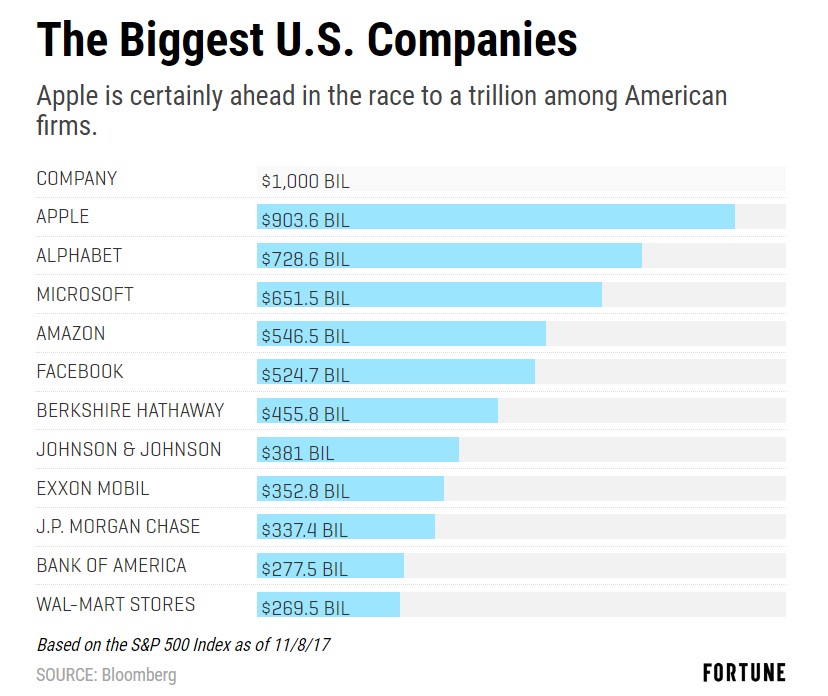
CBRE Group (CBG: $41.50, up 4%)
Never higher. CBRE has never been higher. CBRE is arguably the leading real estate company on the planet. As a highlight of how locked in the company is, look at CBRE Research’s 2017 Tech-30 report that was just published where they demonstrated exceptional expertise. The company ranked the strength of tech job growth across 30 North American office markets, which is creating stability and demand-driven performance through occupancy gains and rent premiums. Four key points are highlighted below.
--- Tech jobs grew four times faster than the national average. San Francisco was the top high-tech job growth market for the sixth year in a row.
--- Eighteen markets added more tech jobs over the past two years than the prior two-year period.
--- Tech’s share of major leasing activity has nearly doubled to 19% over the past five years, resulting in strong occupancy and net absorption gains.
--- Desirable tech submarkets are priced at a premium, while emerging submarkets often offer discounts. The overall average asking rent of tech submarkets is priced at a 16% premium.
BMR Take: We are staring at the company’s EPS power closing in on $3. This stock remains a compelling value at the current level. We don’t see the company doing anything but maintaining and growing its leading market share for the foreseeable future.
----------------------------------------------
Twilio (TWLO: $25.50, down 15%) on Earnings Report
Revenue reported was strong, and you know how we feel about revenue. We will tell you what happened, and let’s stay focused on the long term.
The company lost $0.08 versus $0.04 a year ago. Revenue was $101 million versus $72 million a year ago. The good news is that revenue beat the consensus of $93 million. Moreover, the company guided to a better outlook for the remainder of the year.
So what the happened here? Uber.
While total revenue growth of 41% was strong, we believe it is important to look at the underlying growth of Twilio’s core business. In particular, we consider base revenue excluding Uber, which came in at $87 million, up 63% from a year ago. Revenue from Uber hit $14 million in 4Q16 and came in at $5 million in 3Q17, down 53% y/y. Management expects a modest sequential decline in Uber revenue in 4Q17. The loss of Uber business continues to weigh on results.
Total revenue rose to $100 million from $71 million. Management itself had called for a net loss of $0.08 per share on sales near $92 million. The adjusted loss was right in line with that forecast, but Twilio crushed its own sales expectations.
For the upcoming quarter, Twilio expects an adjusted loss per share of 6 cents and revenue of $103 million. Analysts are predicting an adjusted loss per share of 6 cents and revenue of $99 million.
Jeff Lawson, Twilio’s Co-Founder and Chief Executive Officer said, “We hit a number of exciting milestones in Q3, including our first $100 million revenue quarter, our first enterprise license agreement for our higher level software products, and the launch of Twilio Studio. With Twilio Studio, the visual builder for Twilio, we can accelerate our customers’ roadmaps and help an even larger set of users build on our platform. We are excited by the size, scale and diversity of what new and existing customers are creating with Twilio.”
Recent Business Highlights – released by the company:
46,500 Active Customer Accounts compared to 34,400 a year ago. Twilio Studio was introduced in the third quarter, giving clients a simple drag-and-drop tool to simplify and accelerate their production efforts. Twilio already offers separate production tools for popular platforms such as Android and iOS, but the new Studio streamlines the development process in ways that had not been available before.
Announced our commitment to meet the new GDPR (General Data Protection Regulation) requirements coming from the EU, using this as an opportunity to raise the bar for data protection worldwide for all of our customers.
Expanded the reach of our Super Network by announcing the availability of Twilio phone numbers in more than 100 countries.
Average revenue per user rose 18% to $8,000.
Cash position strong: Twilio held $284 million of cash equivalents at the end of the third quarter, down from $289 million in the second quarter and $306 million by the end of fiscal year 2016.
Guidance: – released by the company:
Full year ending December 31, 2017:
Total Revenue - $387 million
Loss from operations (millions) $22.0 to $23.0
Net loss per share - 0.22 to 0.23
BMR Take: The good news is Twilio continues to innovate and add net new customers at a remarkable clip (3,100 in 3Q17), which is driving strong underlying revenue growth. The company remains one of the fastest top line growers in all of cloud computing.
This company is one the most frustrating that we follow. With another stellar report like we describe above, any normal stock would be up 10%. Not Twilio. Down 15%, now well below our Sell Price of $29. We are going to stay the course but you might get tired of waiting and sell in order to redeploy these assets into something better like Nutanix or Square. With that said, we believe Twilio should be a $50 stock, a long way from where it is today. But again, top line growth will win in the end. Do you and we have enough patience to endure these losses? That is the ultimate question.
----------------------------------------------
Andeavor (ANDV: $107, down 3%)
Could oil breech $80 before Christmas? Some options traders think so. With oil trading near its highest level in two years, some traders are betting that the price rise could have more room to run.
A total of 48,000 option contracts traded over the last few days that would profit most if crude spikes before Christmas, including several large individual trades. They all expire on Dec. 21.
Oil prices have rallied in recent weeks as OPEC supply cuts help to rebalance an oil market plagued by oversupply. More recently, growing tensions between Saudi Arabia, OPEC’s largest oil producer, and some of its neighbors helped prices break above $60 a barrel for the first time since 2015.
Andeavor Reported Third Quarter 2017 Results on November 8th.
Earnings of $550 million, or $3.50 per share; results included the following pre-tax items
Returned $345 million to shareholders including $252 million in share repurchases; they expect to repurchase $300 million of shares in 4Q17
Total retail and branded stations up 27% year-over-year to over 3,100 stores
On October 30th, Andeavor closed its $1.7 billion acquisition of Western Refining Logistics
New totals for Andeavor
Number of Refineries: 10
Refining Capacity: 1.2 million bpd
Employee Count: More than 13,000
Retail Sites: More than 3,100
Barrels of Storage Capacity: More than 46 million
Miles of Pipelines: More than 5,300
Marine, Rail and Storage Terminals: 40
Natural Gas Processing Complexes: 6
States where they operate: 18
BMR Take: Higher oil prices above $80 could be a huge positive for many companies including our beloved refiner Andeavor. Recall, Andeavor’s net asset value is $120 and the stock still trades an unwarranted discount. We think more stable energy markets are the first step needed for good sentiment to return to the oil patch stocks like Andeavor. And we’re certainly on the way with crude being so strong of late.
----------------------------------------------
Upcoming Economic News
PPI ex-Food & Energy
Tuesday, November 14th, 8:30 AM Eastern
Period: October
Consensus: 2.2%Prior: 2.2%
Retail Sales ex-Auto Wednesday, November 15th, 8:30 AM
Period: October
Consensus: 0.20%
Prior: 1.0%
Initial Claims
Thursday, November 16th, 8:30 AM
Period: 11/11
Consensus: 235,000
Prior: 239,000
Housing Starts
Friday, November 17th, 8:30 AM
Period: October
Consensus: 1,193,000
Prior: 1,127,000
----------------------------------------------
A Word from Gary Jefferson
Jefferson Financial Group
First Vice-President, Investments
UBS Financial Services, Inc.
The markets seem to be firing on all cylinders. Is there anything that could derail it before year-end? About all we can see is the Russian investigation (none and no chance), the tax-cut drama (possibly, but more likely to cause a correction rather than a derailment), a government shutdown (slim if any chance at all) or a major Fed rate hike (little to no chance).
A couple of things have caught our attention, however. What usually derails a bull market is a recession. At this point, we don't see the usual suspects that signal a coming recession, such as widening credit spreads, deteriorating market internals, collapsing commodity prices, falling new orders or falling earnings. In fact, it is just the opposite.
However, two things are not making sense from a historical perspective. First, with near full employment and accelerating worldwide growth, inflation remains stubbornly low. This is usually not the case. Inflation signals rising prices and continued rising earnings. It should be readily apparent but it simply isn't expressing itself even at this stage of the earnings growth cycle.
Secondly, if there is one warning signal for an approaching recession that is more reliable than all the others, it might be an inverted yield curve. Since January, the spread between the 10-year Treasury and the 2-year Treasury has fallen from about 1.30% to 0.75%. In our experience, whenever we have seen accelerating revenue growth, rising earnings, potential tax cuts – i.e. so many positives – the yield curve should be steepening, not flattening. Maybe we are experiencing a "new norm" in the markets, or it "is different this time" (the four most dangerous words in our industry), or this is going to be normal as part of the 4th Industrial Revolution we have supposedly entered (artificial intelligence, augmented reality etc.). In any event, we are going to closely follow the lack of inflation and the yield curve because neither is "confirming" this bull market rally as each would normally do if one looks back at the history of the market.
----------------------------------------------
Square (SQ: $39, up 6%) Continues to Shine
A few Wall Street firms had some new announcements on Square this week. The target raised to $38 from $34 at Stephens. They believe the stock "can grind higher" following the company's Q3 report. They still sees Square as likely to change the game for Small and Mid-sized business payments and thinks the likelihood of it achieving true "platform for small business" status gets more likely every quarter.
Square price target raised to $33 from $23 at Craig-Hallum
Square price target raised to $35 from $24 at SunTrust. SunTrust said that it is entering a period requiring heavier investment which will weigh on margin expansion. They said that Square trades at a significant premium of about 60-times FY18 EBITDA relative to 13-times for its peer group.
GoDaddy (GDDY: $48) announced two new integrations with Square that help small businesses thrive with online and offline selling and payment capabilities. By collaborating with Square, GoDaddy is making this an easy reality for tens of millions of people building small businesses. Integrating GoCentral Online Store and Square online payments enables small businesses to easily sell their products and services online and in person through a single Square account and GoDaddy website. The second integration provides service-based businesses, such as personal trainers, hair stylists and photographers, the ability to book client appointments online, sync calendars using GoCentral, and get paid using Square. Payment transactions can be processed online, in-person or both without switching accounts.
Square target raised to $41 from $31 at Cantor Fitzgerald citing accelerating revenue growth. The firm expects Square's "rapid growth" to continue and further margin expansion going forward. He notes that Gross Payment Volume growth remained above 30% in the quarter.
Square target raised to $41 from $31 at RBC Capital. The firm says the Q3 beat and raise for 2017 outlook is indicative of the company's ability to drive its products into existing partners and expanding to larger merchants.
BMR Take: This one has a long way to go on the upside.
----------------------------------------------
Options Corner – All about Square
From time to time we like to bring you an interesting options trade. We like to do long-term bullish trades on stocks, unless we find one that is going to go bankrupt in which case we can design a trade to profit from the demise of a firm using puts.
Square has been knocking the cover off of the ball of late. We added the stock at $17 in March of this year and it is now $39, setting a new all-time high on Friday, so we are up 130% in 8 months, giving us an annualized return of ……. Well, you get the point! A great stock pick. A great stock. Better yet: A great company. With a market cap of $15 billion now, it is moving into the big leagues. We have said quite a few times that Square would be a great buyout candidate for one of the big boys (Amazon, Microsoft, Apple, etc.) but they better move fast before the stock hits $20 billion.
And in fact, we think a $20 billion valuation is quite possible next year. That would equate to a $52 stock. Can that happen here with Square? We certainly think so.
An options trade can produce much bigger returns than this 33% increase, if it were to happen. But guess what? OPTIONS ARE RISKY! Please repeat after us. Options are very risky.
OK. Let’s get started.
We love long term options called LEAPS. They expire in January as long as they have at least six months of life. So the January 2018 options aren’t called LEAPs any more. But the Jan 2019 options are. And soon we should see the Jan 2020 options start trading. We can’t wait.
We like to buy options that are in the money. With the stock at $39, the 35s are $4 in the money. Better yet the 30s are $9 in the money. They are worth $9 but they trade for $13. Why is that? The $4 is the TIME PREMIUM. And note that that time premium will go to zero eventually as it approaches the end of its life in January 2019.
In order to pay for the time premium we like to SELL calls against the long LEAP to recoup this time premium and also to help us get our cost down on the option that we bought. Let’s look at some real numbers.
Buy the Jan 2019 30 LEAPs for $13,Sell the June 45 call for a little less than $6.
The cost of this trade is now $7 for an option WORTH $9. Do you understand this? If not, go back to the top of this article and re-read. These options discussions are confusing the first time, but It WILL come to you if you re-read this 3-4 times. We are serious.
Now, let’s say the stock goes up a bit and is selling at $45 in June. Your June option is going to expire worthless (great) and now you SELL a January 2019 call, say the 50 call, for approximately $7. (We are not sure of these numbers because it is so far into the future but we think this is about right -- we hope you get the point.) The cost of the trade is now zero. You are in this trade for zero dollars. (Gosh, we love this trade!)
Now, let’s tally up. If the stock goes to $50 or higher by January 2019, you will be left with an option worth $20 ($50-$30). If you had bought 10 options for $7,000, they are now worth $20,000, almost a triple (185%), with a stock that went from $39 to $50 or 28%. If you had put $25,000 in this trade (the equivalent of buying 640 shares of Square) you would now have $75,000 and that’s real money.
This options trade will more than likely take lots of tweaking of your position and the return could be better or worse depending on where the stock goes. No one is going to hand you a triple without a little bit of work. But it could be a super trade IF the stock heads to $50.
The downside is that the stock goes down to $30. You will lose money but if you religiously sell calls against your position, you can get your cost down to close to zero, thus minimizing your losses.
Note that if this all-options trade is too risky or confusing to you, you can just do a normal covered call trade by buying the stock and selling calls against it. If you were to buy 1000 shares at $39 for $39,000 and the sell the calls as described above, you would bring in $6000 for the June $45 call and $7000 for the January $50 call giving you a purchase price of $26,000. If the stock goes to $50 you have a $50,000 position, and a return of 92%. Not bad.
But, again, lots of “ifs” in these scenarios. Invest with caution.
----------------------------------------------
The High Yield Corner
By Michael Foster
Last week, AstraZeneca PLC (AZN: $33, down 5%) reported strong revenue and earnings above expectations, but that wasn’t enough to keep the stock from being the biggest loser of the week for the Bull Market Report’s high yield portfolio. A deeper dive into the results can explain what happened—and why this isn’t really a cause for concern.
To start with: revenues rose 9.3% on a year-over-year basis in the third quarter to $6.23 billion with solid EPS of $0.54, which was a little shy of expectations: analysts were expecting just 55 cents per share in earnings. In their press release, the company highlighted weak sales in the U.S. as a cause of the weaker earnings, while also pointing out that weakness was offset by major growth elsewhere: emerging markets were up 5%, China was up 12%, and Japan was up 3%. Those numbers were all higher on a constant currency basis.
But the U.S. weakness is a large part of the stock decline. AstraZeneca pointed to continued weakness in Symbicort as a cause for the weakness; the asthma drug’s challenges have been a major issue for this company, which analysts see as being heavily reliant on for future sales. Nonetheless, a closer look at the drug pipeline indicates there are other sources of growth to come.
More specifically, AstraZeneca highlighted that Lynparza, a breast cancer drug, has received priority reviews in America and Japan, while Imfinzi, a lung cancer drug, has received the same in America while also getting regulatory acceptance in the EU and Japan. A total of 7 drugs got new regulatory approvals as of the end of the reporting period, including two type-2 diabetes drugs that will obviously have tremendous appeal for this widespread ailment.
So the company’s pipeline looks fine. The focus on Symbicort unquestionably overlooks that fact, and provides a buying opportunity at this current price—provided the pipeline remains healthy.
Elsewhere in high yield investing, we saw a really mixed week despite the market’s weakness towards the end of the week. This is pretty unusual—high yield tends to be more volatile in REITs, high yield bonds, and BDCs, but we didn’t see that happen yet. That could mean more aggressive selling is yet to come in late 2017, especially as tax-loss harvesting becomes more commonplace, but that doesn’t change the fundamental strength and attractiveness of many high yield assets.
There are exceptions, however. Municipal bonds were relatively untouched by last week’s jitters, possibly as risk-averse investors were adding to municipal allocations as a result of what they saw in the stock market. Invesco Municipal Trust (VKQ: $12.34, flat) saw little movement on strong volume while Nuveen AMT-Free Municipal Credit (NVG: $15.36, up 1%) gained slightly. Both remain high-quality municipal bond funds with above-average yields and excellent management teams. Neither looks significantly overpriced right now.
Bigger news came from the REIT world, but the news had little effect. Welltower (HCN: $68, up 2.5%) had strong earnings, with FFO per share of $1.08 a 2 cent jump from the prior quarter and NOI up 4.1% on same-store senior housing operations. RevPAR also gained by 3.9%, which helped the company’s revenue rise nearly 1% to $1.1 billion for the quarter. FFO was a 3 cent beat over expectations, and higher earnings guidance (the company now expects normalized FFO per share of $4.19 to $4.25 for the full year) make Welltower’s valuations even more attractive, especially after the stock price remained stuck for the week. Defying negativity in the skilled nursing facility world, Welltower’s massive size and market penetration are proving stores of value and investor safety; the stock is a better buy now than it’s been for most of this year.
*Revenue per available room
That’s it for earnings news this week, but a lack of major news didn’t stop Government Properties Income Trust (GOV: $18.76, up 2%) from having a strong week, thanks in small part to the continued recovery from last month’s anxiety that the company’s earnings results at the end of October proved to be a paranoid non-issue. However, protracted worries about Omega Healthcare Investors, Inc (OHI: $28, down 1%) and their very disappointing earnings are keeping shares down and the yield up at the 9% level. That more than compensates for the risks, which makes this a very appealing option for investors who accept that the dividend growth is likely going to end in 3-5 years’ time. The market is discounting a cut to dividend growth much sooner, making this an irrational price and a good bargain right now.
Elsewhere, we are seeing growing anxiety in Collateralized loan obligations (CLO) and high yield corporate bonds, but that hasn’t stopped AllianzGI Equity & Convertible (NIE: $21, unch.) and PIMCO Dynamic Income Fund (PDI: $30, up 1%) from proving resilient. That’s in no small part thanks to the high-quality management teams of each, which have wisely avoided the more exotic high-yielding CLO markets and shifted towards much safer MBS’s and away from the riskiest junk bonds. The market is rewarding both with price stability. That may not last - after all, irrational selling is still very much a thing in modern markets - but that just means a buying opportunity will open up. Neither fund shows any indication of weakness despite the broader worries growing in the credit sectors.
Good Investing,
Todd Shaver, Founder and CEO
The Bull Market Report
Since 1998
(Again, sorry about the crazy formatting this week.)
