May 29, 2017

by Todd Shaver | May 29, 2017 | Weekly Newsletter 7pm Sunday
The Week Ahead
Is the bull market long in the tooth? Nah. In the past year, many fundamental and technical arguments have been offered to explain why the now eight-year-old bull market in U.S. stocks is due for at least a solid correction. And yet the stock market has gained ground in recent months, casting some doubt on these metrics but again suggesting the market is long in the tooth. Even news events that pro-market measures such as tax reform might be imperiled – or at least delayed – haven’t hurt stocks at all. So stay invested!
There is always a bull market here at The Bull Market Report! This week we highlight the following stocks: Nutanix, Twilio, The Blackstone Group, Splunk, and Tesoro. And a special report on Tesla.
Highlights From The Past Week
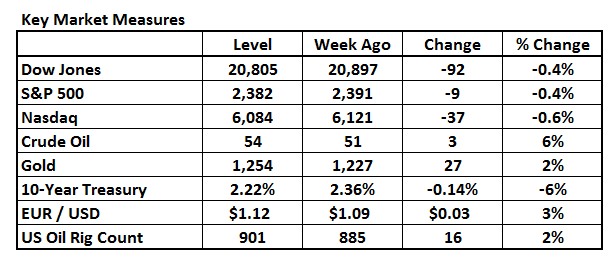
Short Sellers Resist Covering as S&P 500 Retakes Record Last Week It usually doesn’t work this way: Stocks vaulting to records, and bearish traders getting more aggressive. Lately, it has. The S&P 500 Index has climbed 8% since January, including its biggest gain since April in the just-completed week. Just one week ago, stocks suffered their worst rout in eight months as concerns over Trump’s presidency surfaced. Yet the loss was quickly erased and the S&P 500 rose seven straight days to reach a record high. It rose 1.4% to 2,416 last week, finishing with the best gain in a month. The Dow Jones Industrial Average added 279 points, or 1.3%, to 21,080, and closed just 3 points from its record high set Thursday. Technology shares continued to outperform as the Nasdaq 100 Index jumped 2.0% to close at a record high.
Short interest as a proportion of total shares outstanding has expanded, rising by 0.3 percentage point to 3.9%. Not since 2008 has an equity advance as big as this year’s occurred simultaneously with more short sales. It’s not hard to see why bears are standing firm, when any mishap from President Donald Trump could wreak havoc in a market where valuations sit at levels not seen since the dotcom era.
Fed's Williams doubtful of 3% economic growth. San Francisco Fed President John Williams said fiscal policy will not matter much to monetary policy over the next several months. He expressed doubt economic growth will rise sustainably to 3%, as assumed in President Donald Trump's budget proposal, because of certain possible changes in tax rates or policies. A giant jump in productivity growth is required to reach growth that much above the 1.50-1.75% range he thinks is currently sustainable. Williams supported gradual rate hikes and sees no pressure to do more than the two further hikes this year expected by most Fed officials, citing softer inflation readings. You may recall that Williams previously advocated 3-4 rate hikes this year. As to the Fed's balance sheet normalization*, Williams said details have yet to be decided, but promised a blueprint in coming months. Once the trimming begins, the Fed will not tinker with the plan unless there is a significant shock to the economy, emphasizing the process should be gradual and fundamentally on autopilot. In previous statements, Williams suggested the time horizon could be about five years.
* Normalization is the reducing of the size of the Fed's balance sheet. They bought a lot of assets in the Financial Crisis. Now it’s time to unwind that.
BMR Companies & Commentary
Nutanix (NTNX: $19.59, +22%, all changes in this newsletter are for the week)
Nutanix is a United States-based company that markets an enterprise cloud platform that converges silos* of server, virtualization, and storage into an integrated solution.
*An information management system that is unable to freely communicate with other information management systems. Communication within an information silo is always vertical, making it difficult or impossible for the system to work with unrelated systems. It occurs when departments or management groups do not share information, goals, tools, priorities and processes with other departments. The silo mentality is believed to impact operations, reduce employee morale and may contribute to the overall failure of a company or its products and culture.
The company delivered a great quarter highlighted by large-deal momentum. Nutanix reported fiscal 3Q17 EPS of -$0.42 versus the consensus -$0.45 on revenues 67% higher, year over year, of $192 million versus the $187 million expected. Management indicated Nutanix built up a significant backlog of deals that booked but did not ship in the quarter. Nutanix revenue topped analysts’ expectations, and produced a smaller-than-expected loss, and beat comfortably with its outlook for this quarter’s revenue. For the current quarter, the company sees revenue of $215 million to $220 million, and a net loss of 38 cents, better than consensus for $205 million and a 39-cent loss
There were three key takeaways from the quarter: (1) the sales transition toward large enterprise is progressing nicely (2) management's F4Q17 guidance implies billings growth of 32% Y/Y, compared to consensus of 24%, driven by continued confidence in the North American sales organization, large deal momentum, and a significant backlog buildup; and (3) we believe the momentum in large deals, combined with adoption of new technology (shipped on 23% of nodes compared to 9% in year-ago quarter), support the favorable thesis that Nutanix is becoming the preferred next-gen data center platform for enterprises.
The most exciting thing happening is that the shift to larger accounts is bearing fruit. As management indicated on its January-quarter earnings call, Nutanix is undergoing a transition to build a named account sales organization that targets larger enterprises. We think results in the April quarter demonstrate that the transition is now on a positive track and is generating noticeable returns. Management indicated its North American sales organization, which experienced sales execution issues last quarter, snapped back, with the region posting the best sales productivity since F4Q16, a period in which billings accelerated to 120% Y/Y growth.
We believe the better productivity was, in large part, driven by strong momentum in the large enterprise, where Nutanix has increasingly focused its sales efforts. Management indicated business from the world’s largest customers reached record levels in F3Q17, as they were 50% greater than any quarter in the company’s history. Nutanix landed 13 deals that were greater than $2 million in bookings in the quarter for a total of $45 million, compared to only four deals in F2Q17 over $2 million. We believe it has been an ongoing goal to move upmarket and we view the strong performance in the quarter as clear validation of the opportunity for Nutanix in that market.
CEO Deeraj Pandey said the results “reflect our continued focus on the global 2000, as well as a measurable improvement in the number of larger deals in the quarter, particularly in North America."
They ended the quarter with 6,200 customers, adding 800 new customers in the quarter, and ended the quarter with $350 million in cash and equivalents with no debt.
Nutanix shares still have 'significant upside,' says Piper Jaffray. They believe Nutanix has a strong competitive advantage and kept an Overweight rating on the name.
BMR Take: We feel Nutanix is undervalued, trading at 2.6x the consensus 2018 sales forecast, with sales growth of 70% this year and 35% next year.
Twilio (TWLO: $25, flat)
Founded in 2008, Twilio is the leading cloud platform for communications. Similar to Amazon Web Services, Twilio plays a critical role for software developers by allowing them to easily and securely build services such as voice, messaging, video, and authentication into their software applications and then scale those services globally.
We have a mix of good news and bad news to report from a major industry conference called SIGNAL 2017 that Twilio attended this week. The good news is that Twilio is doing the right things to win in the company’s addressable market, including: (1) building high quality, reliable technology services that have 99.99% availability that customers love; (2) introducing new features and products at a rate of one every 3.5 days, a rate competitors are hard-pressed to match; and (3) rapidly adding developers to its community, including 600,000 in the last 12 months, double the amount added in the prior 12 months, resulting in a total of 1.6 million developers on Twilio’s platform. (We find this hard to believe, but we have verified these numbers. Astounding.)
The bad news came from Airbnb, which indicated in its presentation that it is pursuing the same kind of multi-sourcing strategy that led to Uber significantly reducing its spending on Twilio in 1Q17.
BMR Take: Consensus estimates call for 2017 EPS of -$0.29 on revenue growth of 30% and for 2018 EPS of -$0.09 on revenue growth of 27%. Twilio currently trades at a 2018 price to sales multiple of 5x, which is cheaper than many other high growth internet companies. We hope Airbnb sticks around as a customer, but if they don’t, some part of the negative impact is already factored into the current lower valuation.
The Blackstone Group (BX: $33, +9%)
What a great week Blackstone had. Finally! Founded in 1985 as an M&A boutique, Blackstone has grown to become one of the largest and most broadly diversified global alternative asset manager in the world. Blackstone manages $370 billion of assets, roughly equally divided across four segments: Private Equity, Real Estate, Credit, and Hedge Fund Solutions.
This week Blackstone Group announced an investment management agreement in conjunction with CF Corporation’s acquisition of Fidelity & Guaranty Life (FGL), which we believe could represent an interesting longer-term opportunity. In addition to the agreement, Blackstone’s Tactical Opportunities and GSO businesses are investing capital alongside CF Corp. in the deal.
Upon the closing of the transaction, which is expected in 4Q17, Blackstone will earn roughly 20 bps on total assets ($28 billion today), which equates to $55 million of fees (around 1% of 2018E EPS). Not a bad little boost to the bottom line!
Over time, we believe the bigger opportunity for Blackstone will revolve around FGL’s ability to grow within CF Corp. (which we suspect is a big focus), which will drive incremental fees to Blackstone. While the near-term financial impact is small under conservative assumptions, we view the announcement as a positive, given the long-term strategic implications.
BMR Take: Blackstone has made some exciting announcements recently between FGL and the $40 billion infrastructure deal. Plus, the stock is inexpensive, trading under 11x 2018 EPS estimates with a juicy 7% dividend yield.
More Blackstone News
Saudi Arabia joined the parade of investors into U.S. public works by pledging a record investment with Blackstone Group. The country’s Public Investment Fund agreed to commit $20 billion to Blackstone’s new infrastructure fund in the latest push around the world by large investors to buy up airports, pipelines and other public projects, particularly in the U.S. Blackstone said the kingdom’s money would seed an investment fund that whose goal is to reach $40 billion and reach $100 billion with added debt, and by raising money from investors like sovereign-wealth funds, public pensions and rich families. With assets of $370 billion as of March 31, Blackstone manages nearly twice as much as its closest competitor, Apollo Global Management. Each of Blackstone’s four platforms - real estate, private-equity, hedge funds and credit - are among the largest investing businesses of their kind.
Our Thoughts on Things Going on in the World as it Relates to Our Stocks
We don’t talk much about world politics and the US administration here at The Bull Market Report. We watch it closely, but we understand that you are coming to The Bull Market Report for financial news, not mass murders, or the upsetting changes in the status quo in Washington DC. We know that that Trump does have an effect on the markets – we are not stupid or naïve. But the stock market is concerned with revenues and profits, and companies will do everything in their power to produce same, despite what Trump does. As we have seen, he has little effect on most of the things he campaigned about, and the S&P 500 and all the small companies in this country are focused on growing revenues and earnings. We like it that way. We believe in the financial health of America.
Splunk (SPLK: $63, -5%)
Splunk provides software solutions that enable organizations to gain real-time operational intelligence in the United States and internationally. By leveraging a proprietary technology to turn machine data into real-time operational intelligence, Splunk is benefitting from its position as a pioneer and leader in the world of machine data with its core software platform, Splunk Enterprise.
Starting off FY:2018 on the right foot, Splunk reported 1Q:FY18 revenue of $242 million (up 30% YoY) that exceeded the Street’s estimates at $234 million, and a loss per share of a penny that beat the Street at a loss of 4 cents. The company added more than 500 new enterprise customers during Q1. They lifted its revenue outlook for the fiscal year to $1.2 billion. Revenues for the past three years are $450 million, $670 million and $950 million. We’d say they are the right track. They have $1 billion in cash and no debt.
The tone of the call was positive for the seasonally weakest quarter of the year. We continue to believe that Splunk is very well-positioned to benefit from the Big Data wave in the coming years. Splunk is chasing down a big market opportunity and the company raised its total available market opportunity at its analyst meeting in January to $55 billion from the $45 billion.
BMR Take: After a strong performance in the seasonally weakest quarter of the year, we would be buyers of Splunk on any weakness. Despite Splunk more than tripling its revenue between FY:2014 to FY:2017 and consistently beating analyst expectations, the stock is 37% below the peak made in 2014. Now is a great time to take a closer look if you have not already!
Tesoro (TSO: $83, flat)
Tesoro is an independent refiner and marketer of petroleum products. Tesoro, through its subsidiaries, operates seven refineries in the western United States with a combined capacity of 900,000 barrels per day.
We are pleased that Tesoro announced that the waiting period applicable to its proposed acquisition of Western Refining has terminated. This satisfies one of the final conditions to the closing of the pending acquisition. Tesoro therefore expects the closing of the acquisition to occur on June 1, 2017. This news means the deal is highly likely to now close!
As a reminder, why do we like the Western Refining deal? The synergies of putting the two companies together are big. At first glance, we think the originally announced target synergies for the merger – including savings of $350-$425 million – look overly conservative. We believe there is opportunity to reach further into Tesoro’s legacy operations to optimize the retail business, and we believe the overall footprint in the Bakken could be sold for a lot. This is all just the low hanging fruit. Opportunities to optimize logistics in the Permian region could be another leg of upside over time. In summary, not only does Tesoro become an even larger franchise in the sector, but EPS is expected to go from $4 to $7 over the next few years.
BMR Take: We continue to see compelling value in Tesoro shares. The stock trades at a massive discount to post-merger net asset value estimates of $120-140 per share. In comparison, Berkshire Hathaway owns a 15% stake in Tesoro’s competitor Philllips66, which the market values at a premium to net asset value. With several big name institutional investors recently taking large positions in Tesoro, we can’t help but be excited about the prospects for this investment.
Note to our Readers:
We are well aware of the problems on our website getting current prices and data. We get our data feed from Yahoo and they have just informed us that they are discontinuing that service. Needless to say we are not pleased and we are working on the issue. We should be up and running with a solution this week.
Note: Just after we wrote this, we have a solution. Everything should be up and running perfectly Tuesday morning. Yea!
Upcoming Economic News
Consumer Confidence
Tuesday, May 30 10:00 AM
Period: MAY
Actual: N/A
Consensus: 119.5
Prior: 120.3
Note: The Conference Board's Consumer Confidence Survey is a monthly measure of the public's confidence in the health of the U.S. economy.
Personal Income
Tuesday, May 30, 8:30 AM
Period: APR
Actual: N/A
Consensus: 0.4% over last year
Prior: 0.2%
Note: Monthly Personal Income data are published by the U.S. Bureau of Economic Analysis. Personal income measures total pretax income earned by individuals, non-profit organizations, and private trust funds. Wages and salaries are the largest component of personal income.
Chicago PMI
Wednesday, May 31, 9:45 AM
Period: MAY
Actual: N/A
Consensus: 57.9
Prior: 58.3
Note: The Chicago Business Barometer provides an overall gauge of business activity as published in the NAPM - Chicago monthly Business Report. An index reading above 50% indicates that economic activity is generally expanding; below 50%, generally declining.
Pending Home Sales M/M
Wednesday, May 31, 10:00 AM
Period: APR
Actual: N/A
Consensus: 0.6% over last year
Prior: -0.8%
Note: The National Association of Realtor's Pending Home Sales Index is designed to be a leading indicator of housing activity. This indicator measures housing contract activity. It is based on signed real estate contracts for existing single-family homes, condos and co-ops. A signed contract is not counted as a sale until the transaction closes.
ISM Manufacturing
Thursday, June 1, 10:00 AM
Period: MAY
Actual: N/A
Consensus: 54.7
Prior: 54.8
Note: The Manufacturing ISM Report on Business is based on data compiled from monthly replies to questions asked of purchasing and supply executives in over 400 industrial companies. The PMI is a composite index based on the seasonally adjusted indices for five of the indicators with varying weights: New Orders; Production; Employment; Supplier Deliveries; and Inventories. An index reading above 50% indicates that economic activity is generally expanding; below 50%, that it is generally declining.
Nonfarm Payrolls
Friday, June 2, 8:30 AM
Period: MAY
Actual: N/A
Consensus: 175,000
Prior: 211,000
Note: This is survey data measuring nonfarm payroll employment. Employees on nonfarm payrolls are those who received pay for any part of the reference pay period, including persons on paid leave.
Average Workweek
Friday, June 2, 8:30 AM
Period: MAY
Actual: N/A
Consensus: 34.4
Prior: 34.4
Note: This is survey data measuring the average workweek for production or nonsupervisory workers on private nonfarm payrolls.
Is Tesla Where Apple Was 10 years Ago?
We read a great article in Business Insider about comparing Tesla and Apple which was written by Gene Munster of Loup Ventures. Formerly he was a senior research analyst at Piper Jaffray. Some excerpts:
Apple (AAPL: $153, flat) is the world’s largest company with a market cap of $800 billion. Tesla (TSLA: $325, up 5%) s an automaker with a market cap of $53 billion. There are many parallels between Apple about a decade ago and Tesla today, market cap being one of them. In 2005, Apple’s market cap was close to where Tesla’s is today. A decade from now, we think we’ll look back at Tesla and realize it was the next Apple. After all, the Tesla story is just getting started.
There are five major similarities to Tesla today and Apple in the mid-2000s:
1. Brand
2. Visionary leadership
3. Integrated hardware and software
4. Halo effect
5. Reshaping a market
Brand
Tesla has a great brand so far. Tesla owners love their Teslas, just as Apple users love their iPhones and Macs. 90% of Tesla owners state they would “definitely” buy their cars again, the highest rating of any automaker. The next two closest automakers are Porsche at 84% and Audi at 77%. By comparison, Tim Cook stated last year that the iPhone had a 97% satisfaction rate.
Tesla has built a brand around being a different kind of automaker. Not only because its vehicles are powered entirely by electric, but also because they don’t use model year numbers, and treat software updates more similar to updating an iPhone app than a car. The company has done this all while squarely placing itself in the conversation with BMW as one of the best-engineered cars in the world. Tesla is taking a new approach to the car market.
Visionary Leader
Elon Musk and Steve Jobs share similarities in that they are visionary entrepreneurs that simultaneously operated multiple groundbreaking companies. Musk with Tesla and SpaceX and Jobs with Apple and Pixar. However, both seem to have different guiding lights.
Where Jobs seemed to be singularly focused on developing the absolute best products he could to delight customers, Musk appears to be driven to save the world, from developing alternative energy products, to exploring space, to protecting humanity from AI. They both recognize the importance of quality to be successful.
Musk may be the biggest wild card in the comparison between the two companies. The drive to create great products is eternal from a business standpoint.
Obviously, the move to sustainable energy is a multi-decade opportunity. From an investment standpoint this may not matter, but from a philosophical standpoint it’s apparent that the world needs many things and Musk is convinced he can affect positive change.
He's already involved in Tesla and SpaceX as CEO. It was recently announced that he would also be CEO of Neuralink, a brain-computer interface company that creates a neural lace to enhance the human brain. Musk is also involved with The Boring Company, which is currently experimenting with tunneling under Los Angeles to reduce the traffic burden. Finally, Musk is involved with OpenAI, which is dedicated to creating open IP in artificial intelligence.
There will always be those capable of breaking conventional rules, in this case the importance of a laser focus. Musk is obviously one of those people. The only question may be if his desire to save humanity ultimately pulls him in too many directions. Musk has shown an ability to surround himself with great talent, enabling him to better leverage his own time.
Integrated Hardware and Software
Tesla, like Apple, produces its own hardware (cars) and its own software. Their integrated approach allows them to have complete control over the product experience, which is important because a car is a constant user experience when you’re in it.
Perhaps more importantly, Tesla has a multi-year head start over other automakers in terms of features like over-the-air updates and autonomous driving. As autonomous driving functionality becomes a requirement for modern auto buyers, Tesla holds an advantage in that its constantly improving self-driving software is an update away. Tesla's cars get wireless software updates that add new features to the car.
Looking at product categories beyond transportation, Tesla’s proven ability to integrate hardware and software will continue to set it apart from competitors looking to introduce real innovation. Their ability to control the product experience from end-to-end is an innovator’s advantage over the incumbents in industries that Tesla will address in the future.
Halo Effect
Perhaps more than any company in history, Apple has used the halo effect to its advantage. The company’s iPod represented a product that appealed to the masses, where the Mac computer line did not. Once customers adopted iPods and experienced Apple’s attention to detail in design and simplicity of use, it convinced customers to buy Macs.
The iPod also laid the groundwork for the iPhone. Combining the iPod with a phone had long been a topic of discussion, and those two features, combined with an Internet connection, were the iPhone’s features at launch. Now we see the halo effect in full with many iPhone owners also owning Macs, iPads, Apple Watches, and AirPods.
Tesla has a similar opportunity to create a halo effect through its cars. With the Model 3 starting at $35,000, a large audience of entry level luxury car owners are going to experience Tesla for the first time, and at a 90% satisfaction rate, they will be happy to join the club.
Aside from cars, Tesla also offers the Powerwall energy storage product ($5,500), as well as the Solar Roof and solar panels. We believe that Tesla owners will want to add other Tesla products to further reduce their dependence on traditional energy.
Tesla has taken over 400,000 pre-orders for the Model 3. For context, if you assume another 100,000 Tesla owners of Model S and Model X for a total of 500,000 Tesla owners in total by 2018-19, a 10% attach rate of Tesla owners buying the company’s Powerwall or solar products, and $30,000 in revenue from those products, there is an incremental $1.2 billion business opportunity in the near term due to the halo effect.
Reshaping A Market
Tesla’s stated mission is to accelerate the world’s transition to sustainable energy. The company is attacking two major industries - automotive ($1 trillion in US new vehicle sales in 2016) and electric utilities ($400 billion in US revenue in 2015). These industries make sense. Transportation accounts for 70% of total US oil consumption. 65% of electricity in the US is still produced by coal or natural gas. Tesla is creating a platform for sustainable energy from your vehicle to your home. Just as Apple captured significant value from the chain of industries it disrupted, we think Tesla can do the same.
As Tesla pursues its mission, it has a path to be one of the most valuable companies in the world. For the past 10 years, the largest company in the world as measured by market cap has been either Apple, Exxon Mobil, or Petrochina. Going back 20 years, the only other additions are Microsoft and General Electric. Therefore, either a consumer electronics company, an energy company, or a conglomerate represented the biggest company in the world. Tesla is all three.
Tesla’s cars are effectively consumer electronics, albeit expensive ones, that reduce our dependence on oil. Tesla’s acquisition of Solar City and introduction of the Powerwall and Powerpack are next-generation energy plays driving toward the replacement of coal and gas. Doing both makes it a conglomerate.
Tesla is not a car company. It's an operating system for sustainable energy that combines a powerful brand, a visionary founder, integrated hardware and software, and a halo effect all with the purpose of transforming a combination of large markets. Tesla might be the next Apple, as Tesla will forge its own path and the world will be better for it.
BMR Take: Wow. What a story. If this bullish scenario plays out and becomes reality, Tesla is a screaming buy - $1000 a share? $2000? If they run out of capital and have to be bailed out by a GM, Ford or Toyota, the stock is headed towards $100 and lower. But isn’t this the case with any new venture? Risk and reward. The stock market thrives on this.
We are in the bullish camp. We are Elon Musk believers and when the company starts producing cars in quantity in 2018 and 2019 and the world sees how great they are, then revenues and profits will accrue. What a story. We want to be a part of it.
Mazor Robotics (MZOR: $41, down 4.5%)
We are well aware of the price of the stock these past few days. The stock has been downgraded by a few firms due to valuation. Hmmm. What does that mean? It means the stock has gone up, perhaps higher than they ever thought. And yes, we know the stock has gone up. We are way up on the stock since we added it in the teens last year.
Needham restated a hold rating in a research report on May 11th. First Analysis downgraded shares from an overweight rating to an equal weight rating and boosted their target price for the company from $28 to $38 in a research report on the same day. Wells Fargo downgraded shares from an outperform rating to a market perform rating in a research report on May 11th as well. These aren’t stellar reports but they aren’t that bad either. As is common on Wall Street, they are just protecting themselves.
The recent downgrade was May 17th, 10-11 days ago, with nothing new since then. The stock is volatile and traded as high as almost $46 on the 18th, $45 on the 19th, and $43 on Monday of this week. It wasn’t until Tuesday that the stock sold off a bit. But it came right back later in the week. Note that the stock was at $35 a month ago. The point is that it’s not the end of the world. HOWEVER, we don’t know where the stock is going. We know where the COMPANY is going, but not the stock. We believe the COMPANY is doing well. Super well. But maybe the market will drop the stock to $35 or $30 and that would be devastating.
So what to do from here is up to you. We are going to stick with it a little bit longer and watch for it to get back on track. If it doesn’t we will exit with well over 100% gains.
The High Yield Report
By Michael Foster
One of the biggest events of the week was the big drawdown on Thursday of Omega Healthcare Investors (OHI: $32, down 6%), which is causing quite a bit of panic among high yield investors. The panic is in some ways compounded by the fact that this decline came on no news. Omega released their earnings back on May 3rd, with a slight miss on revenues that grew 9% year over year and in-line FFO, with reaffirmed full-year earnings guidance. This means that Omega’s dividend is covered by 135% - a very big number and unquestionably enough to not only support the current payouts but to even boost them higher. Since Omega has increased dividends every quarter since 2011, higher payouts aren’t too shocking.
That doesn’t mean Omega gets much love from markets. The stock has been range bound since shooting up in 2013, meaning its yield has gotten steadily higher thanks to those continual dividend hikes. But shares have remained below their all-time high in early 2015, and are now trading 16% below their 52-week high. Those metrics, combined with the recent sudden selloff, could cause panic in some investors’ eyes.
However, panic is unwarranted. The cause of the selloff is unknown (most likely one big institutional investor exited), but there’s no evidence that the long-term income growth behind this company is impeded by anything at all. What’s more, Omega shares are now at the upper end of their historical range, and will yield over 8% soon enough thanks to the company’s continual payout increases. This makes Omega a pretty good contrarian REIT play right now.
There’s just one problem: this company's been a good contrarian play for a few years now. Will Omega ever break out of this range and start to deliver capital gains?
There are a few reasons to think so, but let’s not get into that now. Instead, let’s think a bit about why you would want to buy Omega now or over the last six years. With increased dividends and ample dividend coverage, Omega has been a strong investment for anyone who wants capital preservation and a reliable income stream. Omega is a stock that reliably delivers about $65 per month in income for every $10,000 invested - and without loss of capital. It’s been doing that for years, which makes it a reliable play in a broader high yield portfolio.
So instead of asking whether Omega will earn us capital gains now or in the future, we should instead focus on the income stream. Is it in danger? Is there any reason to believe the dividend hikes won’t keep coming? Right now the answer to both questions is “no.” And for as long as it remains “no,” this is a stock worth considering for any high yield-focused investor.
Elsewhere in the high-yield world, the markets have been relatively quiet. The UBS BDC ETF (BDCS: $23, up 1%) and the SPDR Barclays High Yield Bond ETF (JNK: $37, flat) saw a modestly strong but mostly uneventful week. This is largely a result of a continually complacent credit market. Defaults are not spiking (despite harried tales of dying shopping malls and the end of retail commerce as we know it - this isn’t impacting corporate bonds to any significant scale.) And the future pace of Federal Reserve interest hikes is modest enough to not cause companies any big problems in repaying their debts. Also, as we have mentioned over the last few weeks, corporate profits are rising at large firms, which is making solvency more common and even encouraging more companies to take out more debt. In short, the corporate lending world is doing fine.
And beyond Omega Healthcare, REITs are fine too. The SPDR Dow Jones REIT ETF (RWR: $93, flat) had a decent showing this week thanks to the relative calm in many REITs, including the triple-net lease firms whose retail shopping focus was a cause for concern over the last couple of weeks. We’re also seeing a continual run-up in the tech-focused REIT world, a once sleepy and high-caution sector that is quickly turning into a market favorite. Digital Realty Trust (DLR: $118, up 3%) had yet another stellar week, bringing its yield even lower. We aren’t yet at a point where the tech REIT world is an overly crowded trade, but we are definitely inching in that direction every week.
Another big theme of the week has been OPEC, with the Saudis again doing all they can to put a floor on oil prices. They tried this back in November last year and failed miserably; oil prices fell after their oil production freeze, although that agreement spanned far beyond OPEC and reportedly had unusually high compliance. The high compliance and the multinational signatories indicates there is a lot of desperation among oil producers to do all they can to fight American shale. While it’s easy to interpret OPEC’s panic as a sign that oil prices will crash, that’d be overkill.
In reality, it looks like the range we’ve seen for crude oil futures will remain. That means oil companies who have gotten accustomed to this new price environment should be okay, and it also means companies that rely on energy to operate (i.e., just about everyone) won’t see input costs balloon. For high yield, this again is a good sign for seeing lower corporate defaults, but it also means MLPs aren’t as risky as they were in 2014 or 2015. The Alerian MLP ETF (AMLP: $12.16, flat) had a quiet week as a result, and MLPs haven’t seen either a panic selloff or an exuberant buy in the last year.
A quick word on Bull Market Report's diversified fund picks: The AGIC Equity and Convertible Income Fund (NIE: $20, up 1%) and the PIMCO Dynamic Income Fund (PDI: $30, up 1%) had a solid week thanks to NAV increases and higher demand for closed-end funds in general, while a sleepy municipal bond market meant Invesco Municipal Trust (VKQ: $12.70) and The Nuveen AMT-Free Fund (NVG: $15) saw little change. We are still waiting for more investors to realize the value in muni bonds, but with low volatility and market complacency, it may take a while for more investors to rotate back into munis and out of riskier stocks and corporate bonds. But it will happen - it’s just a question of when.
Good Investing,
Todd Shaver
Editor in Chief and CEO
The Bull Market Report
Since 1998
May 21, 2017
by Todd Shaver | May 21, 2017 | Weekly Newsletter 7pm Sunday
Let's Get Started
The President took Air Force One for an international tour to promote peace, justice, and stability. His first stop is in Saudi Arabia to meet with over 50 Muslim leaders to discuss a shared fight against radical beliefs and terrorism. He will make his way next to Jerusalem and Bethlehem to re-build relationships that deteriorated under the last administration. Thereafter, he will spend time with the Pope at the Vatican strategizing on how Christian beliefs can bring about more peace in the world. We learned Saturday morning that Trump was greeted on his first stop in Saudi Arabia with $110 billion of deals for US companies in the region, in particular for General Electric and Halliburton. This one of the reasons why America voted for the man? But we’ll see if anything comes of it.
There is always a bull market here at The Bull Market Report! This week we highlight the following stocks: Athenahealth, Home Depot, Amazon, Facebook VMware, and Kinder Morgan.
Highlights From The Past Week
Why have stocks bounced? We see no one specific factor behind a stock market bounce that followed the biggest selloff since last September on Wednesday. Some are focused on the pervasive buy-the-dip mentality since the financial crisis bottom in 2009. The initial flurry of Trump impeachment talk following the Comey memo leak seems overdone. Trump heading overseas may shift some of the focus away from recent controversies toward foreign policy (and dampen his more combative tone). A stabilizing influence is Robert Mueller’s appointment as special counsel in the Russia investigation which brings credibility amid the chaos. Despite all the talk about the threat to Republicans’ legislative agenda, policy expectations have already been meaningfully dialed back. There is little change in a fairly upbeat fundamental narrative that has revolved around expectations for an upswing in global growth. In addition, central banks are still in an easy money stance.
Bullard says Fed’s path may be “overly aggressive”. At an address at Washington University, St Louis Fed President James Bullard noted that in the wake of the Fed’s March rate hike, financial markets saw declining long-term yields and weakening inflation expectations. He observed that this may suggest that the FOMC’s contemplated policy rate path is overly aggressive relative to actual incoming data on US macroeconomic performance. Bullard noted that labor market improvements have slowed over the last two years, and that inflation and inflation expectations have surprised to the downsize in recent months. Note that Bullard has been quite dovish in the past relative to rates, saying in January that there was no reason to move rates dramatically and standing by his forecast for a single rate hike in 2017. In statements following his presentation, Bullard reiterated his call that the Fed should shrink its balance sheet to gain policy space, and said the central bank should retain the option for future quantitative easing should it be necessary.
Oil supported by deal extension headlines. Oil posted a nice gain this week on growing expectations exporters will extend output cuts to curb a persistent glut in inventories at next week’s OPEC meeting. This follows headlines earlier this week that Saudi Arabia and non-OPEC Russia agreed to a 9-month extension. Reuters, citing OPEC sources, said the cartel’s panel reviewing scenarios for the 25-May meeting is looking at the option of deepening and extending the deal to reduce oil output. No agreement has been made on final scenarios. Some say a deeper cut in output is an option depending on estimated growth in supply from non-OPEC producers and US shale oil.
BMR Companies & Commentary
Athenahealth (ATHN: $130, +19% - all price changes are for the week)
Top-notch hedge fund Elliott Associates disclosed a 9.2% stake in Athenahealth this week sending the stock soaring.
Elliot believes the company operates in a highly strategic area at the intersection of technology and healthcare with a disruptive value proposition, a leading competitive position, and a compelling product set, the value of which is not reflected in the company's current market value. Interpretation: The stock is cheap. Elliot believes that there are numerous operational and strategic opportunities to maximize shareholder value. Elliot will engage in a dialogue with the company's board regarding these matters.
Elliot may consider and develop plans and make proposals with respect to operations and management, and all types of other changes that will add value to the stock.
Looking at the software landscape, IBM and Inuit have expressed a desire to break into Healthcare. Reports have also speculated that Aetna and UnitedHealth may also be interested.
BMR Take: Elliot Associates is the real deal as highlighted by Athena’s 19% move higher last week. We hit our Target of $125, having added the stock at $101 in November, so we are up 30% in six months. Not bad. We definitely would stick around to see what happens here. We could see another big move higher should the company be sold. We hereby Raise the Target Price to $140, and the Sell Price which was originally at $90, is now at $105, to $125. We don’t want to lose any of these massive gains.
Home Depot: (HD: $156, down 2%, but up from $144 a month ago)
Home Depot just blew earnings out of the water while the rest of Retail keeps falling apart. With mall retailers such as Sears and J.C. Penney seemingly on their deathbed, Home Depot once again proves why it pays to sell lumber and nails.
Last week, the home improvement retailer delivered first quarter results. EPS of $1.67 beat consensus of $1.61 on revenue of $23.9 billion versus consensus of $23.7 billion. Management reaffirmed full year sales growth guidance of +5% and lifted expectations for EPS growth 11% to $7.15. In February they announced an increase to $15 billion in the stock buyback program.
All merchandise departments delivered sales increases. Sales from contractors were stronger than those from typical consumers. Online sales surged 23%. "The housing market is very strong", Home Depot CFO Carol Tome said, adding that sales in May have been "very good."
So far, the U.S. housing market has withstood the rising interest rate environment (which we see as very insignificant). In turn, home improvement retailers such as Home Depot have continued to thrive as existing homeowners renovate their homes -- which are rising in value -- and builders try quickly to bring on badly needed supply.
Home improvement spending still remains healthier than most areas in retail. Trends remain strong as building materials, hardware and garden supply sales have grown 6.4% year over year.
BMR Take: Stick with this blue chip. Many analysts see the EPS outlook as conservative. Despite its impressive $95 billion sales base, Home Depot has ample opportunity to grow, especially in eCommerce. The company will continue to benefit from healthy home improvement spending, market share gains, and strong execution. The home improvement sector remains well-positioned to benefit from continued modest GDP growth, home price appreciation, and solid household formation. Our Target is $160 – getting close. We can’t wait to raise the Target soon.
Amazon (AMZN: $960, flat)
Amazon cut the price of the Echo to the lowest level in 2017. For a limited time users can purchase two Amazon Echos with the promo code ECHO2PACK effectively dropping the price to $140 each. The normal price is $180.
Why do we care?
Echo is Amazon’s ticket into a massive Home Services Market. It lets Amazon gather data for what is happening in the house as it records everything. It also provides a door for instant on-demand ordering. We have one and we love it!
Amazon, which launched its Home Services unit in 2015, now offers 1,200 services in more than 50 U.S. cities. Customers can select assembly or installation services, which will compete against those offered by retailers like Home Depot or Best Buy, in addition to other services like house cleaning, home repair and yard work, which will compete with Angie’s List. Throughout its 20-year history, Amazon has continued to explore areas of commerce that it believes it could disrupt and this is one ripe for disruption. In March, Amazon estimated that the on-demand Home Services market was valued between $500 and $700 billion.
BMR Take: Amazon is a serial monopolist company that picks markets to enter, disrupts them entirely, and runs away with market share. Home Services looks like the next target. Amazon is really expensive at 145x this year’s earnings, but Amazon doesn’t trade like a normal company. Bezos has said profits will come in due time. Lately they have been knocking out much bigger profits and the Street is content to wait and wait as the stock goes up and up. There remains a ton of upside to Amazon long term as the company is investing massively for growth and future earnings power more than supports the current valuation.
Facebook (FB: $148, -1.5%)
Facebook and Major League Baseball struck a deal to live stream games. The move is the latest initiative by Facebook to expand into the world of live programming. Facebook said that it would stream one game a week beginning immediately and the broadcasts would be available to everyone on Facebook in the U.S.
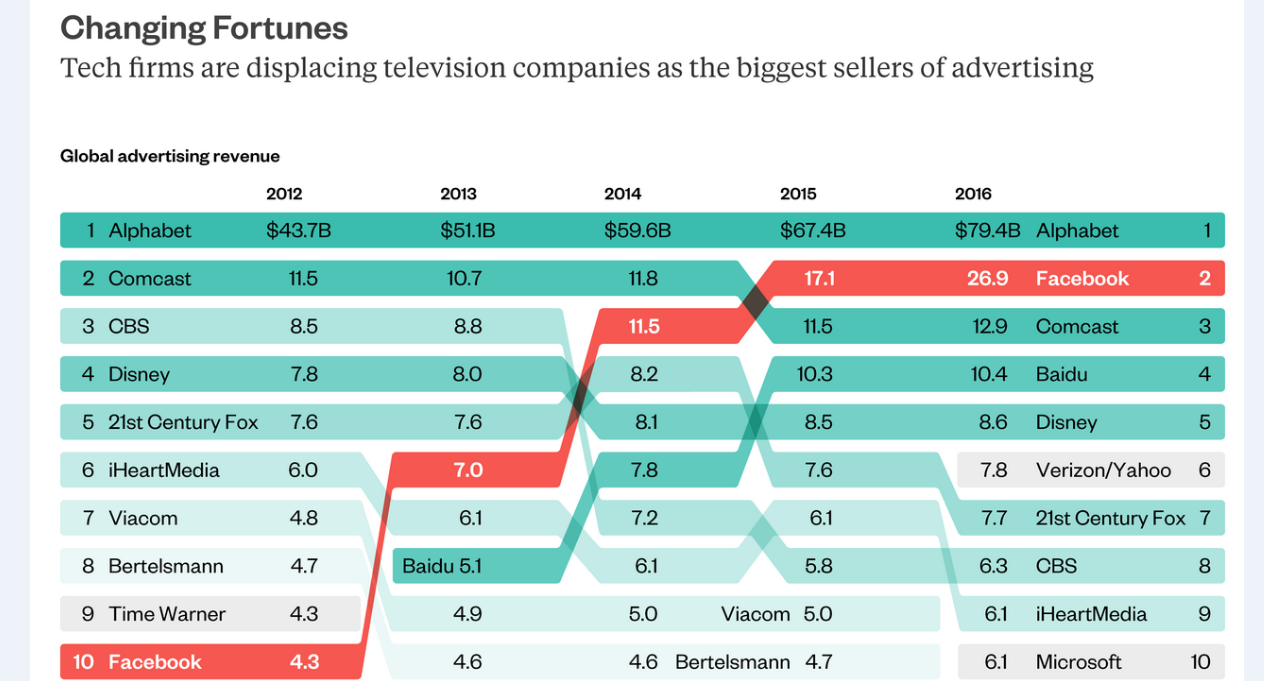
What does this mean? More engagement. More engagement means more advertising opportunities and more revenue. It’s great news.
MLB Commissioner Rob Manfred said at a news conference in New York, "Probably the most important single announcement is we've done an agreement with Facebook. It's really important for us in terms of experimenting with a new partner in this area. We are really excited about this."
"It's pretty cool," Ian Desmond of the Rockies said. "It's an opportunity to provide the game to everybody. That's what we're trying to do -- expand the game and make it more diverse. It's a step in the right direction. They're doing a good job with that."
BMR Take: The stock is having a great year so far, and we see so much more potential still. Consensus estimates call for EPS near $10 by 2020. At the current PE multiple or 27 where the stock is today, this implies shares can double.
VMware (VMW: $93, -1%)
VMware, a global leader in cloud infrastructure and business mobility, announced it will deliver VMware Horizon Cloud on Microsoft Azure. The integration helps customers accelerate the move to Windows 10 and brings VMware virtual desktops and applications to the increasing global presence of Azure in the enterprise -- available in 38 regions globally.
This is a great news item! Microsoft Azure is connected to so many of the world’s enterprises (large, medium and small) it is mind boggling. By becoming integrated with Microsoft Azure, VMware is now able to tap into all of these customer relationships. What a revenue opportunity.
BMR Take: The addition of a major cloud platform such as Microsoft Azure to VMware’s customer database has the potential to accelerate the growth of the company. VMware is expected to generate $5-6 of EPS consistently for the foreseeable future. Putting it all together, the outlook suggests the stock should continue to do well. We have a Target of $95 on the stock. We can’t wait to raise this Target when hit.
Kinder Morgan (KMI: $20, -2%)
Kinder Morgan had a rough week on some news about more obstacles surfacing. The Alberta Securities Commission is reviewing an environmental group’s request to halt a $1.28 billion share sale that Kinder Morgan needs to help finance the expansion of its Trans Mountain pipeline.
Earlier this month, Greenpeace Canada sent a letter to the Alberta commission, saying Kinder Morgan may have used outdated oil projections in its IPO prospectus. The Alberta commission acknowledged receiving the challenge and will give it "consideration.”
Kinder Morgan had been running a dual-track process, exploring both an IPO and a joint venture to finance the Trans Mountain expansion. In a regulatory filing earlier this month, the company said it was no longer looking into a joint venture.
BMR Take: Kinder Morgan needs to get this together and do so fast. With EPS in recovery mode from $0.66 this year back to $1.00 by 2020, this coincides with more normalized earnings levels prior to the recent drop in oil prices. We don’t need any hiccups to the business plans that push out earnings, especially as oil prices remain volatile.
You know what? The more we think about this company the more we think it is time to move on. $1.00 of earnings (previous paragraph) by 2020? That’s a long time to wait. We’ve got a LOT BETTER places to put our money than this one. Just take a look at any one of our High Yield portfolio stocks, or the REIT portfolio. We are just tired of waiting and waiting – it’s been over a year. We added the company in early 2016 at $18 and exit here at $20.
Upcoming Economic News
Tuesday, May 23, 2017 10:00 AM
New Home Sales
Period: APR
Consensus: 610,000
Prior: 620,000
Wednesday, May 24, 2017 10:00 AM
Existing Home Sales
Period: APR
Consensus: 5,650,000
Prior: 5,710,000
Thursday, May 25, 2017 08:30 AM
Initial Jobless Claims
Period: 5/20
Actual: N/A
Previous: 232,000
Consensus: 237,000
Friday, May 26, 2017 08:30 AM
GDP
Period: Q1
Actual: N/A
Consensus: 1.9%
Prior: 1.9%
A Word from Gary Jefferson
Jefferson Financial Group
First Vice-President, Investments
UBS Financial Services, Inc.
Friday the 12th marked the 13th straight day in which the S&P 500 failed to move more than 0.5% in either direction on a closing basis, the longest such streak since 1995.
Q1 results from 95% of S&P 500 members show earnings are up +14% from the same period last year on +8% higher revenues, with 72% beating EPS estimates and 66% beating revenue estimates. The proportion of companies beating both EPS and revenue estimates is 52%.
Importantly, the growth performance is broad-based and not narrowly concentrated. We had the leadership from the Finance space earlier in the reporting cycle, but the baton has since shifted to Tech and other areas, including Industrials, Basic Materials, and Energy. The big disappointment – you guessed it: brick and mortar retail stores. While brick and mortar stores may be ailing, however, online sales are doing great.
Here is the important takeaway: When looking at the last three quarters, the overall strong Q1 showing represents a notable acceleration in the growth momentum. We have never seen a bad market during a period when it was in the midst of an accelerating growth trend. It could happen of course as wild cards such as oil or geopolitical risks are always present, but if there was ever a silver bullet for the market, it is an accelerating earnings momentum. We do not expect to have a slew of 2nd quarter earnings revisions to the downside begin cropping up over the next few weeks. Rather, with any kind of good news from D.C. such as healthcare reform, tax reform or infrastructure programs, we expect the growth momentum to continue to accelerate on a year-over-year comparison.
Bottom line: Earnings are strong, rates should rise in conjunction with a tightening labor market and we believe stocks still offer greater upside than bonds or cash. Here are the numbers that we feel support this opinion:
The Q1 earnings season was better than expected, and it’s resulted in 2018 S&P 500 earnings estimates bumping up $1 from $134 to $137. (Source UBS) At the higher end of that range, the S&P 500 is trading at 17X next year’s earnings. That’s high historically to be sure, but it’s not "crazy" as some of the doom and gloomers are arguing, especially given low Treasury yield levels and expected macro-economic fundamentals. On the downside, if the S&P 500 were to drop to 2300, then the market would be trading at 16.7X 2018 earnings. In this environment (low yields, stable macro environment), the market could easily be considered fairly valued and a buying opportunity.
Right now, it’s more likely earnings expectations get revised higher in the future, not lower, and that will make the market cheaper.
Sectors which have strong momentum currently include Financials, Healthcare, Technology (including cyber security, which is in the forefront as "ransomware" attacks go worldwide) and Energy.
Square Announces a Debit Product
Square Cash, the mobile peer-to-peer (P2P) payment offering from Square, will launch a physical prepaid debit product. The card is funded by customers’ Square Cash balance, and can be used anywhere that accepts Visa.
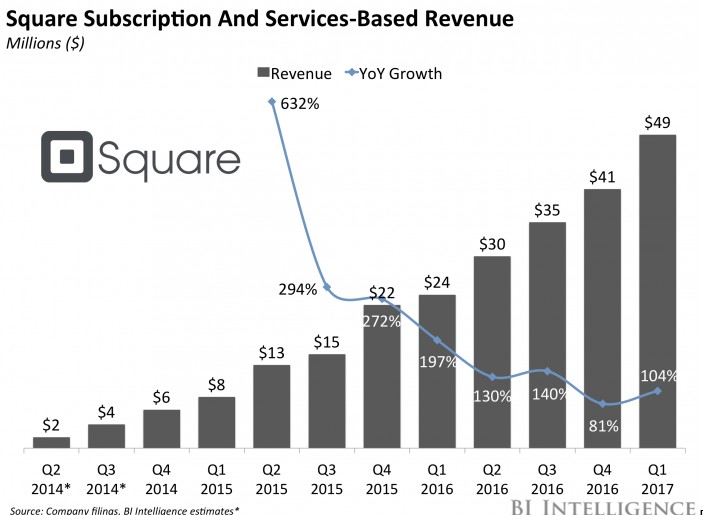
Square (SQ: $20, flat) wants to get a bigger piece of the P2P space. Mobile P2P payments are growing fast. That’s increasing competition in an industry where no one player holds a true market majority. Square Cash is an important player, but it's not as well-positioned as market leader Venmo, owned by PayPal (a Bull Market Report favorite) or Zelle, which will have access to up to 85 million customers and is backed by Bank of America, U.S. Bank, and Wells Fargo and 17 other banks. Zelle Network Banks Processed 170 million P2P Payments, Totaling $55 billion in 2016. The market is BIG!
Cash and checks have historically dominated the P2P world. But as smartphones become a primary computing device, top digital platforms, like Venmo and Google Wallet, have enabled customers to turn away from cash and make those payments digitally with ease. A shift to mobile payments across the board and increased spending power from the digital-savvy younger generation will cause the mobile P2P industry to skyrocket.
Consumers want mobile P2P services, and they’re turning to them. As smartphones are increasingly used as computing devices, these consumers look to such services for fast and easy ways to pay.
Monetizing P2P is more important than ever. As volume grows and user bases scale fast, finding ways to monetize quickly should be a priority for firms looking to stay ahead. We believe Square has a good shot of winning a good piece of this market.
In-store card payments are still substantially more popular than any form of P2P transfer. A physical card could help Square stand out. Gaining access to a traditional card could help users form habits and encourage customers to run a Square Cash balance, thus engaging them more with the product and increasing volume.
Our Target is $24. We can see this getting hit and our having to raise the Target to $34 and beyond. Square could be a big one.
And this just in:
Washington, D.C., is enlisting Square’s help as its taxi commission tries to help the city’s cabbies compete with Uber drivers. By the end of August, all of the taxis in Washington have to tear out their traditional meters and start using smartphones or tablets. The Department announced that Square will process the payments going through those mobile devices.
Wow – that’s good news. Our takeaway is that this is a great PR move that will get more and more people to use Square. We use it. We love it. You will too. And the more customers the better. AND a higher stock price.
Annaly Keeps Chugging Along
Annaly Capital Management (NLY, $11.50) was up 2% this week and showed us a nice bounce back from recent lows after trading in the high 11s in early May. We have said this many times – the stock has its ups and downs and they are not anything to be worried about. The “interest-raising-talk” will accelerate in the press in the next few weeks, as the Fed prepares to raise in June or July, so buckle up your seat belts and sit back and watch Annaly handle all the bumps in the air. We are not worried. We’re quite content to sit back and collect the fabulous 10.4% yield.
Mazor Keeps Chugging Along
Mazor (MZOR: $43) had a stellar week, closing up 7%. Pretty volatile little stock, isn’t it? It hit $45 on Thursday and closed at $43. Crazy. We think it better to watch this stock on a weekly basis instead of daily!
Amazon Keeps Chugging Along
Amazon (AMZN: $960) was flat for the week, even after dropping $22 on nasty Wednesday. It bounced right back on Thursday. Love this company. Are you still hung up on the stock PRICE? Well, don’t be. Get some shares on Monday. On May 22, 2018 you will be ONE HAPPY CAMPER!
The High Yield Corner
By Michael Foster
The financial press was particularly amusing this week. On Wednesday we had a market correction that was called a disaster, a sign of turmoil, and a harbinger for a market crash. What caused the crash? Depends on who you read. We’ve seen explanations range from algorithmic trading going haywire, bank unwinding, bad earnings (really?), and, of course, geopolitical turmoil because of the Russia scandals. None of these really make any sense, and some are just plain wrong (earnings growth has accelerated, making S&P 500s forward P/E ratio relatively low), but the media keeps clutching for a narrative.
What are the facts? [No FAKE NEWS here at The Bull Market Report!] The Fed announced industrial production rose 1% in April, the largest gain since 2014 and near its all-time high. Unemployment claims fell to 232,000, maintaining levels lower than what we saw in the 1990s and early 2000s. Mortgage rates also fell to less than 4% (mortgage rates have been falling for a few weeks), and some analysts expect this to go lower. [We do.]
This is all good news and better than expected. Macroeconomically, there’s little to worry about in the U.S. And that may explain why the VIX dipped into single-digit territory, which created its own kind of paradoxical panic as many fretted that people aren’t scared enough. But the slew of good news indicates there is little to be afraid of.
That brings us to the most important but most controversial data point: household debt and credit. The Federal Reserve’s Household Debt and Credit Report announced that total household debt reached its highest point since 2008 ($12.7 trillion). While this may ring alarm bells to debt conscious individuals, from a macroeconomic perspective this is a good thing.
Here’s why. American consumers, for the most part, will take on credit only when they feel reasonably confident in their ability to earn money in the future. That’s not to say people are innately responsible with credit, but rather that they will to a certain extent take credit only when they feel confident about their own personal economies. The massive decline in debt following the 2008 crisis is an indication of this, especially when you look into the details. It wasn’t just mortgage debt that fell during the housing crash - it was credit card debt, auto loan debt, and personal loan debt. People just stopped borrowing money during the crisis. This was partly because banks stopped lending, of course, but not entirely. For a large part of America, it was time to tighten belts and weather the storm.
What did this mean for companies? Declining sales. Weaker profits. The need to cut costs, which often meant layoffs which in turn meant more belt tightening and thus even lower sales and weaker profits. This is the "deflationary spiral” economists warn about, and it is the reason why government stimulus is used during a recession.
The opposite of this deflationary spiral is a winding up of credit across the board. Americans are confident of their ability to pay back loans, so they borrow more, and then use that money to spend more. That results in higher sales and bigger profits for U.S. firms. That, in turn, results in firms hiring more people, thus creating a cycle of spending begetting spending and helping GDP rise across the board.
This has several implications for all kinds of investors. For stocks broadly, the news is good: it means higher sales and higher earnings (the S&P 500 has already reported both for the start of 2017). For other sectors, the news is also good but for different reasons.
For business development corporations (BDCs), it’s good because it means small and medium-sized businesses will have much higher demand for credit as they expand operations. This is partly why BDCs have been on a tear for the last couple of years - the market anticipated this expansionary climate. So the UBS BDC ETF (BDCS: $22) is up 10% from a year ago.
There’s just one problem: BDCs aren’t actually better investments.
The distributions that this ETF pays out have fallen in the past year as a result of yields on loans falling for individual BDCs. We’ve seen both NAVs and distributions fall for many BDCs, both big and small, over the last few months. As a result, the BDC ETF is down year to date and the BDC sector is by no means as attractive as it seemed a year ago. But if the macroeconomic climate is better for BDCs, why is this happening?
As we’ve said repeatedly at The Bull Market Report, BDCs are getting squeezed because of the better environment. This is attracting more competition from banks and leveraged lending firms. We’re also seeing smaller BDCs set up shop and compete with big guys like Main Street Capital Corporation (MAIN: $38), making its 70%-ish premium to NAV untenable. That’s why we cut Main Street from the Bull Market Report High Yield portfolio a few months ago, and that decision is finally getting vindicated: Main Street is now 7% off its all-time high reached just a few weeks ago at $41 and is down for the week. We are keeping a close look on the BDC sector and are looking for a company that has a reasonable market price and a strong income-producing portfolio. Until that shows up, we recommend caution.
Better options exist in municipal bonds for income. This sector has lost market favor for a very long time due to its more risk-hungry approach, and that’s caused yields on many muni funds to rise. Bull Market Report favorites Invesco Municipal Trust (VKQ: $12.64, flat) and the Nuveen AMT-Free Fund (NVG: $14.81, up 1%) are now yielding near 6%, tax free. These funds have risen slightly (about 3%) in 2017 but remain down from a year ago. There is still time to jump into these funds, although it appears that the window to get munis at a discount is shrinking.
Over the coming weeks we are going to get more macroeconomic data to determine exactly where we are in the economic cycle. During that time, holding high yield investments and doubling down on munis makes a lot of sense for income-hungry investors. There is a strong chance that the Federal Reserve will raise interest rates next month, and we may see second quarter GDP numbers that are strong. Neither of these are bad for high yield investments, because both signal a market in which people are spending and companies and municipalities can repay their loans. While the market is obsessed over a one-day drop on Wednesday, we will keep our eyes focused on the data to tease out what is really going on beyond popular distractions.
Good Investing,
Todd Shaver, Founder, CEO and Editor
The Bull Market Report
Since 1998
May 15, 2017

by Todd Shaver | May 15, 2017 | Monthly Newsletter Daily 12pm if new
The Week Ahead
“President Fires FBI Director” was the headline of the week. Think of it. When was the last time you can recall the head of the FBI getting fired? What does this mean about the stability of the FBI (one of our most important institutions)? What does this mean about President’s Trump future in Washington DC? Democrats are not letting this one go. Democrats are now openly discussing impeaching Trump. Who knows what will happen. But one thing is for sure, uncertainty is at a high in terms of geopolitical risks. So far, the Bull Market doesn’t seem to mind. We hope that continues to be the case.
There is always a bull market here at The Bull Market Report! This week we highlight the following securities: Amazon, Netflix, Tesla, PayPal and Apple.
Highlights From The Past Week
Earnings season is off to a good start. Over 90% of the companies in the S&P 500 have now reported results for Q1. The blended Q1 S&P 500 EPS growth rate is 14%, better than the 9% expected at the end of the quarter. It also represents the strongest growth since the 17% in Q3 2011. We note favorable top-line trends and recognition of improving sentiment and growth expectations is prevalent on Q1 earnings calls. However, not all managers have seen it translate to higher demand. CEOs expressed hope for widespread deregulation and improved regulatory clarity, but uncertainty remains high. The US economy is at full employment and wage growth is accelerating. Rising labor costs as a headwind to profit margins.
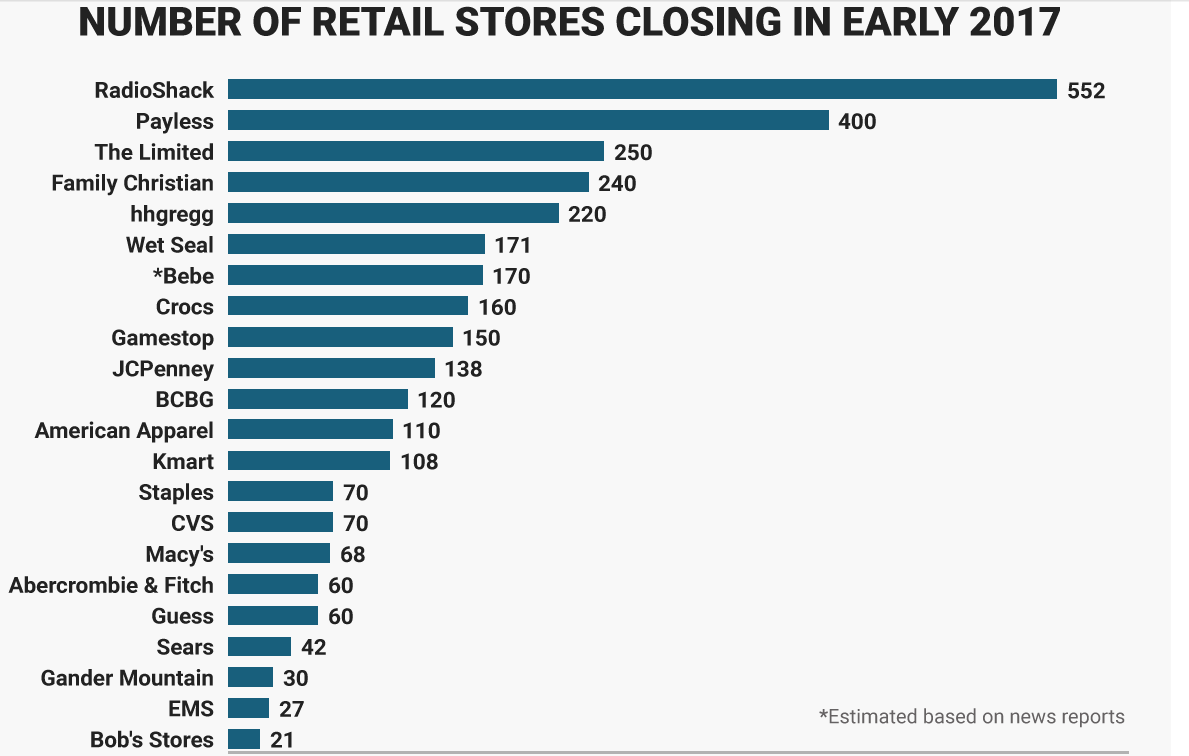
Watchful eye on the Retail sector. Headline retail sales increased 0.4% year over year in April following an upwardly revised 0.1% increase in March (originally -0.2%). However, consensus was for a 0.6% increase. Sales at both general merchandise stores and clothing and clothing accessories stores were down 0.5%. However, it was not all bad. Nine of the 13 categories in fact posted sequential increases. The non-store category (Internet) was a standout, increasing 1.4%. All in all, we are concerned about the Retail sector and need to be mindful of what it means to the broader economy. Case and point, this week we saw Macy’s (M: $24, down 19%) crater on a worse than expected update to its financial outlook. Many are now calling for large scale bankruptcies.
Financials and Industrials lag; Utilities and Tech higher. This week Industrials were the worst performer. The weakness was fairly broad based with GE (GE: $28, down 3%) causing much of the drag. Energy and Construction and Machinery also saw outsized pullbacks. Financials also underperformed. The lower rate backdrop is an easy excuse for bank sluggishness. Regional banks fared much worst that the large money center banks. Life insurers and online brokers also were notable decliners. Pharma found a big rally following upbeat trial data for lung cancer treatment for an industry bellwether. Though hospitals were laggards. Tech outperformed as FAANG stocks are up $250 billion in market cap for the year with the rest of the S&P 500 down $250 billion (so the equity market is essentially down excluding FAANG).
BMR Companies and Commentary
Amazon (AMZN: $962, +3%)
Our dear beloved Amazon. Another week has come and gone. What new world-changing breakthrough do you have for us? Space exploration trips? No, not yet. Home furniture? Alrighty then!
Amazon now wants to furnish your home. The online retail giant is making a major push into furniture and appliances, including building at least four massive warehouses focused on fulfilling and delivering bulky items. With that move, the Seattle-based retailer is taking on the two companies that dominate online furniture sales -- Wayfair and Pottery Barn owner Williams-Sonoma. Furniture is one of the fastest-growing segments of U.S. online Retail, growing 18% in 2015, second only to Groceries. About 15% of the $70 billion U.S. furniture market has moved online.
But even the biggest players in online furniture are struggling to get the market right. Unlike established categories such as books and music or even apparel, retailers are still hammering out basic concepts like how much variety to offer on their sites and the most efficient ways to deliver couches and dining sets to customers' homes.
While Amazon has been selling furniture for years, it has lately decided to tackle the sector more forcefully. Furniture is one of the fastest-growing retail categories at Amazon. The company is expanding its selection of products, with offerings including Ashley Furniture sofas and Jonathan Adler home décor, and it is adding custom-furniture design services. Amazon is also speeding up delivery to one or two days in some cities.
While Amazon has disrupted industries from publishing to fashion with free, fast shipping and easy, one-click buying, furniture can be a tough sector to crack. For one, it is expensive to deliver a couch and other big items, and consumers typically want what are known as "white glove" services, extras like bringing it into the home, setting it up and removing trash. And while packing more small packages onto a delivery van brings the costs down because it can make more stops, you can only fit so many pieces of furniture onto a truck.
Shoppers are still generally willing to pay for furniture delivery, but some retailers and logistics companies say they are facing growing pressure to ship online orders faster. Wayfair offers free shipping on orders over $49, but delivery times can range up to two weeks and longer. Pottery Barn charges on a sliding scale based on price, with delivery costs running above $100 for more expensive items. Furniture sold and shipped directly by Amazon is free for Prime members, while items sold by third-party sellers may cost extra.
To guarantee two-day shipping to 99% of consumers, a retailer or logistics company needs up to a dozen large warehouses spread around the country, plus around 110 smaller facilities to stage deliveries to customers' homes. Amazon is expected to rely on other third-party providers to manage distribution centers and handle delivery of furniture and appliances for the near future, even as it takes more of its logistics in house in other parts of its business. Rising sales may help reduce delivery costs by creating better density. Costs go up for transportation companies as deliveries get more spread out and infrequent.
BMR Take: We see Amazon winning this business opportunity, as they normally do.
Total sales growth is projected to run greater than 20% for several years from the current level of $165 billion predicted this year (up from $135 billion last year.) What an extraordinary growth story Amazon is. What a great ride this stock has and will continue to be. If the company can reach the $30 of EPS analysts project by 2020, this stock easily goes much. Much higher.
Note: See more on Amazon below in “The Death of Retail?”
Netflix (NFLX: $161, +3%)
Netflix announced 400 new jobs in Europe and two new European original series. The expanding workforce complements $1.75 billion of investment in European content, with at least six new Netflix European original projects to be announced in 2017. Netflix is now taking over Europe!
The creation of 400 jobs is happening at its new European customer service hub, which opened this week in Amsterdam. The customer service center will support customers across 11 European countries (Belgium, Denmark, Finland, Ireland, Luxembourg, the Netherlands, Norway, Poland, Romania, Sweden and the UK). The multilingual hub will employ initially a workforce of 170, growing to 400 by the end of 2018.
Amsterdam is the location also of Netflix’s recently expanded European, Middle East and Africa headquarters, which has doubled its workforce since the beginning of 2016. More than 120 employees from 18 countries work at the HQ in business development, marketing, PR, public policy and corporate functions such as finance, legal and recruiting.
The ongoing expansion of Netflix’s workforce in Europe complements the company’s ever-growing investment in European productions (licensed, original and co-productions). The company confirmed plans to announce at least six new European original projects before the end of 2017. Netflix has committed more than $1.75 billion to European productions since entering Europe in 2012, including more than 90 original productions in various stages of development.
BMR Take: We are delighted to see the creation of jobs in Europe and the opening of a new customer service hub in Amsterdam, as well as two new European original series. Moving outside the US, Europe is a great market for Netflix to tap in to to make money longer term. We think Netflix is on track to meet or exceed analyst estimates for $10 of EPS in 2020, meaning the stock can not only grow into the current valuation, but likely head much higher. Our Target is $165. We can’t wait to raise it soon. We do hereby raise the Sell Price from $125 to $145.
Tesla (TSLA: $325, +5%)
Elon Musk has discovered a new passion in life — and it could be Tesla's best product yet. Tesla CEO Elon is the best car salesman in history. And as CEO of SpaceX, he's declared his intention to retire on Mars. But electric vehicles and low-Earth orbits might not hold a candle to what Musk ultimately ends up doing in the roofing business.
Against all odds, Musk has become the biggest booster in the history of the roofing business, thanks to a new Tesla product, the Solar Roof, that officially went on sale last week. It's the first post-Solar City-acquisition product that Tesla is selling, and it sounds as if it's been occupying at least as much of Musk's attention as the forthcoming launch of Tesla's Model 3 car.
Musk has always been big on solar power. Prior to Tesla buying SolarCity for over $2 billion, Musk was the company's Chairman (his cousin was the CEO). He likes to point out that humanity has a compelling alternative to fossil-fuel energy: the giant fusion reactor in the sky that bathes the planet every day with free power. Solar also fits into his master plan, which involves eliminating greenhouse-gas emissions by electrifying transportation; backing up the biosphere with SpaceX, which would make humanity a multi-planetary species; and powering it all with solar energy.
SolarCity has long been able to sell or lease a homeowner solar panels, but the Solar Roof offers a different value proposition. If you have to replace your roof anyway, why not replace it with a roof that generates power and saves you money over the long haul? With a 30-year-mortgage if you stay in the house, you'll replace your roof at least once. At a cost of about $10,000, you maintain the value of the home, but you don't necessarily add much to it. The Solar Roof should last twice as long as a traditional roof (and maybe much longer) and it will both mitigate your electricity costs and, paired with a Tesla Powerpack battery, provide you with backup energy. The up-front costs are high, but the overall economics are compelling. And in sunny states where electricity is costly, such as California, a Solar Roof could net a homeowner tens of thousands of dollars over 30 years.
BMR Take: Solar is the future of energy. Elon Musk and Tesla are already finding opportunities to tap into the trend. Solar roofs have a very bright future and can be a key driver of EPS for Tesla. Analysts currently project EPS to flip from a loss of $5.15 this year to over $11 in 2020. This stock has great potential. The stock set new all-time highs last week, defying the bears. Let’s put it this way – the shorts are getting killed.
PayPal (PYPL: $49, +3%)
The PayPal network effect is working like charm. Investors in PayPal had plenty of reason to cheer last week when the company reported earnings. Nearly every metric was up by a better-than-expected percentage, surpassing expectations of all but the most bullish on the company.
More exciting to long-term investors, however, was the account growth and increase in user engagement with the company's core platform. Six million active accounts were added during the quarter, increasing the total to 203 million for the digital payments company. These active accounts now average almost 32 transactions per year, a 12% increase year over year. More customers using the company's platforms more often was a winning combination that the market liked.
PayPal's growth is beginning to fuel a powerful network effect opening a new window for the company. The beauty of this type of growth is that it drives itself. The more users that sign up for the platform the more important the service becomes for retailers to adopt it and the more places that accept it, the more attractive it becomes to new users. Get it?
At the end of March, 16 million retailers were accepting PayPal's core platform as a method of payment. Management is well aware of this virtuous cycle. During the conference call, CEO Dan Schulman stated: “Our powerful two-sided network engages both consumers and merchants, and the larger our scale, the stronger our network effect becomes. We made meaningful progress in advancing merchant adoption of PayPal in the quarter. At the end of March, the number of active merchant accounts on our platform increased to 16 million. The size of our merchant base is a formidable competitive advantage and is extraordinarily difficult for others to replicate.”
BMR Take: We think PayPal is in the middle of a decade-plus growth cycle that will deliver real value for shareholders. Stick around. They are already closing in on $3 of EPS.
Apple (AAPL: $156, +5%)
Apple chose Corning as the recipient of the first investment from its Advanced Manufacturing Fund, giving $200 million to the maker of glass used in iPhone and iPad screens. Corning, a longtime Apple partner, will use the cash on equipment and glass-processing technology mainly at its Kentucky facility that developed the protective Gorilla Glass used on smartphones. Some of the money will also go toward research and development costs. Corning’s partnership with Apple started 10 years ago with the first iPhone.
Apple Chief Executive Officer Tim Cook said in May that the company planned to invest at least $1 billion to back advanced manufacturing companies in the U.S. and help create jobs in the industry. President Donald Trump has been a vocal critic of American companies -- and Apple in particular -- that outsource production to non-U.S. manufacturers. Apple said it now supports 2 million jobs in the U.S. and that the Corning relationship has helped create about 1,000.
The investment is also a good-will gesture toward Republicans, including President Trump, who has criticized Apple for building its iPhones in China, and the Senate majority leader, Mitch McConnell, who represents Kentucky. Apple said it spent $50 billion last year with American suppliers, although it manufactures just one product line, the Mac Pro, in the United States.
Last month, Mr. Trump sketched out a plan to slash overall corporate tax rates and offer companies a special break for bringing back profits held overseas. Apple has accumulated more cash than any other company in the United States — $260 billion now - and virtually all of it is stashed untaxed in foreign bank accounts. Cook, has repeatedly complained that taxes in the United States are too high and has vowed not to bring the cash home until taxes are cut. The Corning investment is a nice gesture for Apple to show the US government that it is a good US citizen.
BMR Take: EPS are on track to be near $9 this year and grow to $10-11 in the years ahead. The Corning investment and improving government relations is reassuring for us to see. Apple remains a favorite for us. We’re up 66% on our investment since we added the stock early last year. Not bad for the largest a company with the largest market cap in the world, now $814 billion. Our Target is $155, which it has just eclipsed. Yes!!!!!!!
We’ve been waiting to say this: WE HEREBY RAISE THE TARGET PRICE ON APPLE TO $170. The Sell Price is “We would not sell Apple” and we no reason to change this. Good investing out there!
Economic Outlook for the Coming Week
Monday, May 15, 2017 10:00 AM ET
NAHB Housing Market Index SA
Period: MAY
Actual: N/A
Consensus: 68.5
Prior: 68.0
The NAHB/Wells Fargo Housing Market Index is derived from a monthly survey of builders conducted by NAHB . Home builders are asked to rate current sales of single-family homes, and prospects for sales activity in the next six months, as "good," "fair" or "poor." They are also asked to rate traffic of prospective buyers as "high to very high," "average" or "low to very low." Scores for each component are then used to calculate a seasonally adjusted index where any number over 50 indicates that more builders view sales conditions as good than poor. 68.5 is a pretty strong indication of future growth.
Tuesday, May 16, 2017 8:30 AM
Housing Starts SAAR
Period: APR
Actual: N/A
Consensus: 1,263K
Prior: 1,215K
The number of housing units started in the United States. The U.S. Census Bureau's New Residential Construction release provides statistics on the construction of new privately-owned residential structures in the United States. The data relate to new housing units intended for occupancy and maintained by the occupants. They exclude hotels, motels, and group residential structures such as nursing homes and college dormitories. Also excluded are "HUD-code" manufactured (mobile) home units.
Thursday, May 18, 2017 8:30 AM
Initial Unemployment Insurance Claims
Period: 05/13
Actual: N/A
Consensus: 240K
Prior: 236.0K
Weekly data on initial claims for unemployment insurance under state programs. The U.S. Department of Labor's Employment and Training Administration collects weekly data on new and continued claims for unemployment insurance benefits under state programs.
Thursday, May 18, 2017 10:00 AM
Period: APR
Actual: N/A
Consensus: 0.30%
Prior: 0.40%
Leading indicators are economic series that tend to change direction ahead of shifts in the business cycle. There are 10 components of the U.S. Leading Composite Indicator published by The Conference Board. The index is constructed by averaging the individual components in order to smooth out a good part of the volatility of the individual series. Historically, the cyclical turning points in the leading index have occurred before those in aggregate economic activity.
Second Quarter Earnings Reports
About 50% of firms have beaten earnings forecasts, above the long-term average of 46%, according to Goldman Sachs. Further, 40% of companies have exceeded revenue estimates, the most positive ratio of surprises in almost six years.
The VIX (^VIX: 10.40)
The lack of concern amongst US equity investors can be seen in the CBOE Volatility Index, the VIX, a 30-day barometer of investor nervousness calculated using S&P 500 options. The so-called fear gauge on fell on Tuesday to the lowest on record, at 9.67, according to data compiled by Bloomberg, before rallying to close at 10.40.
BMR Take: Low volatility is a sign of bullishness. In times of panic when the market is falling day after day, the Vix is usually in the 20s and sometimes in the 30s. In 2008 when the world was caving in financially, the Vix reached the 60s at the worst of the financial crisis and even spiked into the 90s. The historical average is about 15-16, so at 10 we are in very calm, uncharted territories. Because of this ultra-low volatility level some people say: LOOK OUT; watch for something to happen. We’re not like that. If this market can handle this last week of Trumponomics, then it can handle anything.

c/o Business Insider
The Death of Retail?
Warren Buffett just proclaimed the death of Retail as we know it. In an article in Business Insider he says the future of the retail department store is online. This is not rocket science to us, but to hear Warren say these things holds a lot of weight in our book. Berkshire Hathaway fired a warning signal for the retail industry in February when it sold off $900 million of Walmart stock, choosing instead to invest billions in airlines.
In the age of Amazon, "I think retailing is just too tough for me, generally," Buffett said. "We bought a department store in 1966, and I got my head handed to me. I've been in various things in Retailing. ... I bought Tesco over in the UK and got my head handed to me. Retailing is very tough, and I think the online thing is hard to figure out."
Brick-and-mortar retailers have announced more than 3,200 store closures so far this year, and Credit Suisse expects that number to increase to more than 8,600 before the end of the year. For comparison, 6,200 stores shut down in 2008, the worst year for closures on record. Department stores like Macy's, Sears, and J. C. Penney have been hit the hardest by these trends - since 2001, department stores have lost half a million jobs.
BMR Take: In March we thought about buying Simon Property Group (SPG: $157, down from $186 in February), but we changed our minds quickly. Instead, we would buy Amazon now. The stock closed at $962 Friday, up $27 or 3% last week. Yikes – 10-year bonds pay less than 3% PER YEAR.
Please DON’T WORRY ABOUT THE HIGH STOCK PRICE – pretend it is trading for 1/10 or $93 a share. Buy 11 shares, or 32 shares, or 100 shares – but buy some Amazon. We can see $1000 a share soon; then $1100; then $1200. This one might hit $2000 sometime next year.
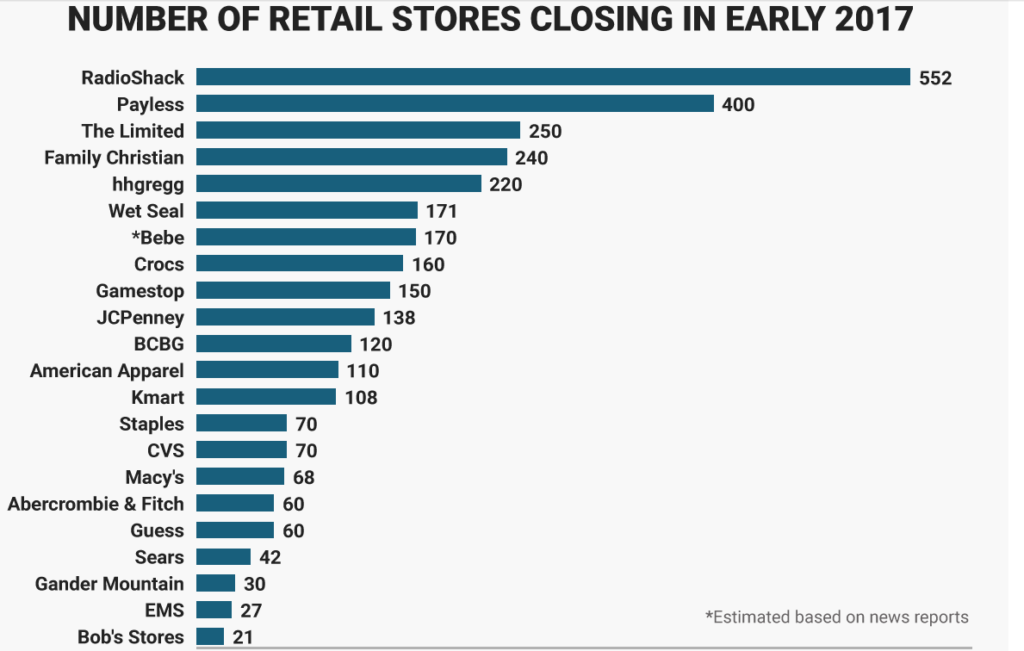
c/o Business Insider
Snap Posts $2.2 Billion Loss in First Quarterly Report
Snap (SNAP: $19.14, down 17%) reported a $2.2 billion loss Wednesday, in its first quarter as a publicly traded company, much deeper than the $105 million loss it posted a year ago, hurt by a one-time hit from IPO-related compensation expenses totaling $2 billion. The loss is one of the biggest in American corporate history. Snap had revenues of $150 million which more than quadrupled from the year-ago quarter but missed the consensus estimate of $158 million. Losses more than doubled to $188 million. We always find it strange for a company to lose more money than it actually took in in revenues.
Daily active users rose 36% to 166 million from the year-ago quarter, but the average revenue per user fell, while daily active user growth also disappointed.
Snap went public at $17 in March and reached $27 the second day of trading. We’ve been saying since the IPO that the company is overvalued. This earnings report goes a long way to backing us up on that.
Tesla Starts Taking Orders for its Rooftop Solar Tiles
Tesla has begun taking $1,000 deposits for its remarkable solar roof tiles at a lower price point than most folks expected. The company said it will begin with production of two of the four styles it unveiled in October: a smooth glass and a textured glass tile. They say that roofing a 2,000 square-foot home with 40% coverage of active solar tiles and battery backup for night-time use would cost about $50,000 after federal tax credits and generate $64,000 in energy over 30 years. That’s more expensive upfront than a typical roof, but less expensive than a typical roof with traditional solar and back-up batteries. The warranty is for the lifetime of your home.
They are obviously going after the wealthier clientele to start. Then again, so does Apple. And so do most companies. The cost for active solar tiles is about $42 per square foot, whereas normal roof tiles cost about $11 per foot. Tesla will manage the entire process of solar roof installation, including removal of existing roofs, design, permits, installation and maintenance. The company estimates that installation will take about a week.

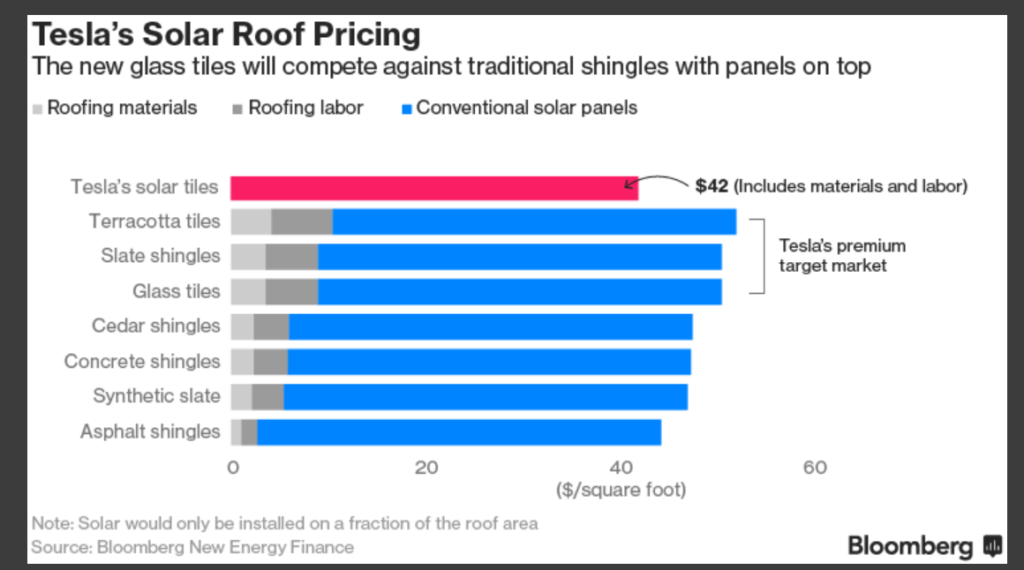
High Yield Report
The High Yield Corner
By Michael Foster
The biggest news of the week for The Bull Market Report’s High Yield portfolio came from AstraZeneca (AZN: $34), which jumped 9% thanks to positive results from a phase 3 study of its Imfinzi drug, a non-small cell lung cancer treatment. The FDA has already approved the drug for bladder cancer treatment, but of course lung cancer is a much bigger and more serious disease, so this is significant news for the company.
The stock had been struggling for nearly a year, falling precipitously both before and after the election. Before the election, fears that Clinton would gut pharma profits caused a big selloff, but that selling pressure increased tremendously following Trump’s election and the surprising news that Trump had little sympathy for pharma either, and he was going to take a scalpel to their profit margins as well. Things hit a low at the beginning of 2017, but recent political scandals and attention elsewhere, as well as the perhaps not too shocking news that Trump is finding it difficult to repeal the Affordable Care Act, have helped pharma companies revert back to a pre-election equilibrium.
Where does that leave us now? Clearly the market has taken its eye off the pipeline ball for a long time, and one has to wonder if the recent news on Imfinzi may in fact force some greater discipline on the market and make investors realize that a sub-30 P/E ratio on a company with many life-saving drugs in various stages of regulatory approval is perhaps unfair. Credit Suisse recently upgraded the stock for that very reason, and we expect more upgrades to come in coming weeks. We’re still 3% off the 52-week high, so there’s no reason to think the sudden buying pressure on Friday is a one-off.
In the more conventional world of ultra-high yield, we’re seeing a continuation of the BDC selloff and junk bond complacency that we have written about for several weeks now. BDC earnings results continue to come in, and for the most part things do not look good. The UBS BDC ETF (BDCS: $22, down 3%) was pummeled by a mix of falling NAVs at constituent firms and analyst downgrades. The downgrades partly come from the aforementioned weakness in NAV, but portfolio yields are also deteriorating at many BDCs. What is portfolio yield? Remember, a BDC is a collection of loans to small and medium-sized businesses. The BDC gets a coupon from each loan, which is the BDC’s yield per loan. Average those together and you get the BDC portfolio yield.
Here’s the real problem: those yields have been going down for a decade. That’s made investing in BDCs particularly tricky, and has caused the BDCs themselves to do a lot of things (lower fees, issue more stock, take on greater risk) to keep investors happy. But all that was supposed to stop when the Fed started raising interest rates, which would cause rates to rise everywhere else. And that is indeed happening elsewhere in the Financial world. Margin rates, preferred note rates, corporate debt rates, and even municipal bond rates have been inching up in anticipation of the Fed’s rate hikes. BDC rates have been on an almost constant slide downward - but the interest rates they need to pay for debt-based capital is going up. So BDCs’ cost of capital is broadly rising and their portfolio yields are going down, compressing margins.
This is a mess. Why is this happening? As far as we can tell, it’s a result of supply and demand. The supply of capital looking for yields has just grown and grown; there are more investors looking to lend to small and medium-sized businesses, thus competing with BDCs. Newer BDCs are showing up. Leveraged lending firms are competing with BDCs. Regional banks are getting back into the small business lending business too. All of this is a structural headwind to BDCs, as they face more competition and thus have to take on more risk or lower the rates they offer on loans. That’s a horrible place to be in, and is why we remain cautious on BDCs as a general rule.
So it’s not surprising that BDCs are down 3%, and we expect that to continue. At the same time, however, there is incredible calm in the junk bond market. The SPDR Barclays High Yield Bond ETF (JNK: $37, flat) barely shrugged this week thanks to little news of significance and a continuation of the declining bankruptcy trend that we’ve seen since early 2016. Again, this is a strong reminder that markets should be forward-looking. Bankruptcy rates were rising in 2015-2016, and junk bond funds were collapsing at the same time. But in early 2016 the bankruptcy problem largely came to a stop, partly thanks to a recovery in oil and partly thanks to the wave of bankruptcies already shaking out most of the weak hands. Yet investors were very slow to realize and jump in.
Now that oil is getting weaker again, one has to wonder if junk bonds are getting ready to peak and a new wave of defaults may be upon us. For sure, that is a possibility but few signs indicate that we will see a repeat of 2015-2016. Instead, we could see a lot of investors anticipate a repeat that never happens, resulting in a mini-correction that provides a buying opportunity.
This means right now is a good time to stick to well-yielding junk bond and high yield bond funds. The Bull Market Report portfolio includes the PIMCO Dynamic Income Fund (PDI: $29, down 1%) and the AGIC Equity and Convertible Income Fund (NIE: $20, down 1%). Admittedly, the discount to NAV on either fund is not particularly compelling right now, but the portfolio quality and historical track record are so good that investors are wise to hold onto these stocks if you have them. New purchases in new bond funds may be something worth considering in the future. More of that in future issues of The Bull Market Report.
Good Investing,
Todd Shaver, Founder, CEO and Editor
The Bull Market Report
www.BullMarket.com
Please consider subscribing to the Weekly Bull Market Report with all of our super research, as well as News Flashes during the week. We are just trying to help you find those stocks that will help you increase your wealth!
Go here: www.BullMarket.com/subscription
Thanks and Good Investing!
May 14, 2017
by Todd Shaver | May 14, 2017 | Weekly Newsletter 7pm Sunday
The Week Ahead
“President Fires FBI Director” was the headline of the week. Think of it. When was the last time you can recall the head of the FBI getting fired? What does this mean about the stability of the FBI (one of our most important institutions)? What does this mean about President’s Trump future in Washington DC? Democrats are not letting this one go. Democrats are now openly discussing impeaching Trump. Who knows what will happen. But one thing is for sure, uncertainty is at a high in terms of geopolitical risks. So far, the Bull Market doesn’t seem to mind. We hope that continues to be the case.
There is always a bull market here at The Bull Market Report! This week we highlight the following securities: Square, Amazon, Splunk, Netflix, Tesla, and Apple.
Highlights From The Past Week
Earnings season is off to a good start. Over 90% of the companies in the S&P 500 have now reported results for Q1. The blended Q1 S&P 500 EPS growth rate is 14%, better than the 9% expected at the end of the quarter. It also represents the strongest growth since the 17% in Q3 2011. We note favorable top-line trends and recognition of improving sentiment and growth expectations is prevalent on Q1 earnings calls. However, not all managers have seen it translate to higher demand. CEOs expressed hope for widespread deregulation and improved regulatory clarity, but uncertainty remains high. The US economy is at full employment and wage growth is accelerating. Rising labor costs as a headwind to profit margins.
Watchful eye on the Retail sector. Headline retail sales increased 0.4% year over year in April following an upwardly revised 0.1% increase in March (originally -0.2%). However, consensus was for a 0.6% increase. Sales at both general merchandise stores and clothing and clothing accessories stores were down 0.5%. However, it was not all bad. Nine of the 13 categories in fact posted sequential increases. The non-store category (Internet) was a standout, increasing 1.4%. All in all, we are concerned about the Retail sector and need to be mindful of what it means to the broader economy. Case and point, this week we saw Macy’s (M: $24, down 19%) crater on a worse than expected update to its financial outlook. Many are now calling for large scale bankruptcies.
Financials and Industrials lag; Utilities and Tech higher. This week Industrials were the worst performer. The weakness was fairly broad based with GE (GE: $28, down 3%) causing much of the drag. Energy and Construction and Machinery also saw outsized pullbacks. Financials also underperformed. The lower rate backdrop is an easy excuse for bank sluggishness. Regional banks fared much worst that the large money center banks. Life insurers and online brokers also were notable decliners. Pharma found a big rally following upbeat trial data for lung cancer treatment for an industry bellwether. Though hospitals were laggards. Tech outperformed as FAANG stocks are up $250 billion in market cap for the year with the rest of the S&P 500 down $250 billion (so the equity market is essentially down excluding FAANG).
BMR Companies and Commentary
Square (SQ: $20, +2%)
Square jumped to a record high after reporting results that beat analysts’ expectations, impressing investors with its ability to woo bigger sellers and offer newer software products that help merchants manage their businesses. Revenue in the first quarter rose 39% as more businesses signed on for payments processing, loans and software to help manage inventory. Square raised full-year sales and profit forecasts, adding an exclamation point to the quarter. The shares have now more than doubled from a low nearly a year ago.
Not long ago, investors questioned Square’s prospects as a provider of credit card processing for food trucks amid rising competition from PayPal and First Data. But the company, run by Twitter Chief Executive Officer Jack Dorsey, has plowed ahead with international expansion, partnerships and acquisitions. Square is targeting larger merchants with a growing suite of more-profitable services, including loans and software that manage inventory and analyze sales. In the fourth quarter of 2016, those newer offerings made up a quarter of revenue. It was even higher by the first quarter, Chief Financial Officer Sarah Friar said.
What continues to make us pleased with results is growth in large businesses. That ongoing shift is good to see because those folks are not net new to the payments world. They’ve probably had an alternate supplier, but now they want to be on the latest technology and their action of migrating over to Square speaks volumes. Square said revenue from larger sellers -- those with at least $125,000 in annualized gross payment volume -- grew 44% in the first quarter from a year earlier.
BMR Take: Square is battling it out with industry titans such as Visa, MasterCard, American Express, and PayPal. So far so good. The company is in growth mode as the top line is set to expand from $900 million this year to $1.8 billion in 2020. Profitability and EPS growth will follow, with some analysts calling for $0.50 of EPS as early as 2020. All in all, we think Square is a very sturdy long term growth story, one you definitely need in your portfolio.
Amazon (AMZN: $962, +3%)
Our dear Amazon. Another week has come and gone. What new world-changing breakthrough have you for us? Home furniture? Alrighty then!
Amazon now wants to furnish your home. The online retail giant is making a major push into furniture and appliances, including building at least four massive warehouses focused on fulfilling and delivering bulky items. With that move, the Seattle-based retailer is taking on the two companies that dominate online furniture sales -- Wayfair and Pottery Barn owner Williams-Sonoma. Furniture is one of the fastest-growing segments of U.S. online Retail, growing 18% in 2015, second only to Groceries. About 15% of the $70 billion U.S. furniture market has moved online.
But even the biggest players in online furniture are struggling to get the market right. Unlike established categories such as books and music or even apparel, retailers are still hammering out basic concepts like how much variety to offer on their sites and the most efficient ways to deliver couches and dining sets to customers' homes.
While Amazon has been selling furniture for years, it has lately decided to tackle the sector more forcefully. Furniture is one of the fastest-growing retail categories at Amazon. The company is expanding its selection of products, with offerings including Ashley Furniture sofas and Jonathan Adler home décor, and it is adding custom-furniture design services. Amazon is also speeding up delivery to one or two days in some cities.
While Amazon has disrupted industries from publishing to fashion with free, fast shipping and easy, one-click buying, furniture can be a tough sector to crack. For one, it is expensive to deliver a couch and other big items, and consumers typically want what are known as "white glove" services, extras like bringing it into the home, setting it up and removing trash. And while packing more small packages onto a delivery van brings the costs down because it can make more stops, you can only fit so many pieces of furniture onto a truck.
Shoppers are still generally willing to pay for furniture delivery, but some retailers and logistics companies say they are facing growing pressure to ship online orders faster. Wayfair offers free shipping on orders over $49, but delivery times can range up to two weeks and longer. Pottery Barn charges on a sliding scale based on price, with delivery costs running above $100 for more expensive items. Furniture sold and shipped directly by Amazon is free for Prime members, while items sold by third-party sellers may cost extra.
To guarantee two-day shipping to 99% of consumers, a retailer or logistics company needs up to a dozen large warehouses spread around the country, plus around 110 smaller facilities to stage deliveries to customers' homes. Amazon is expected to rely on other third-party providers to manage distribution centers and handle delivery of furniture and appliances for the near future, even as it takes more of its logistics in house in other parts of its business. Rising sales may help reduce delivery costs by creating better density. Costs go up for transportation companies as deliveries get more spread out and infrequent.
BMR Take: We see Amazon winning this business opportunity, as they normally do.
Total sales growth is projected to run greater than 20% for several years from the current level of $165 billion predicted this year (up from $135 billion last year.) What an extraordinary growth story Amazon is. What a great ride this stock has and will continue to be. If the company can reach the $30 of EPS analysts project by 2020, this stock easily goes much. Much higher.
Note: See more on Amazon below in “The Death of Retail?”
Splunk (SPLK: $67, +1%)
Splunk, a provider of the leading software platform for real-time Operational Intelligence, announced the results of new research that shows digital transformation* initiatives are more successful when they have buy-in from across the business.
* Digital transformation is the change associated with the application of digital technology in all aspects of human society. The transformation stage means that digital usages inherently enable new types of innovation and creativity in a particular domain, rather than simply enhance and support the traditional methods.
Findings from a survey of 400 senior IT executives across the U.S., U.K. and Germany show that adoption of digital transformation initiatives is widespread. When asked where they are in the journey, 36% believe they are ahead of the curve, while 55% believe they are moving with the masses. They said that 30% of their IT budget is dedicated to digital transformation projects, but the research reveals these initiatives are more likely to succeed when funded from outside IT. The organizations that are most mature when it comes to digital-first strategies are more likely to indicate that funding comes from departments such as product development, customer service, sales and marketing.
Having a digital transformation strategy and executing on it no longer means you have an edge. If the majority of organizations are ‘moving with the masses’ or believe they are ‘ahead of the curve’ then no one is really standing out. Organizations that rely on machine data to make better decisions gain a strategic advantage over their competitors. It is not surprising that those organizations with the most success are the ones collaborating – and funding – cross-functionally. Data is a key driver in enabling that collaboration and can help companies drive real-time business insights to move faster to differentiate, innovate, raise revenues, reduce costs and mitigate risks.
Key findings from the report include: (i) 67% of respondents expect digital transformation budgets to increase, while only 8% expect a decrease; (ii) 70% of respondents cite IT as a key funding source. (iii) 77% of respondents say security was a critical or very important driver; and (iv) insight into machine data is key to success: When asked about the ability to derive real-time insights and business value from machine data to achieve their digital business goals, more than two-thirds say this is a critical or very important priority.
BMR Take: Splunk is the market leader in analyzing machine data to deliver Operational Intelligence for security, IT and the business. Splunk software provides the enterprise machine data fabric that drives digital transformation. More than 13,000 customers in over 110 countries use Splunk solutions in the cloud and on premise. It is an exciting time for Splunk in this business. With EPS on track to go from $0.41 in this most recent fiscal year to $1.35 in 2020, the prospects for the stock look exciting too. We are up 46% since we added it in March of last year. Our Target is $75.
Netflix (NFLX: $161, +3%)
Netflix announced 400 new jobs in Europe and two new European original series. The expanding workforce complements $1.75 billion of investment in European content, with at least six new Netflix European original projects to be announced in 2017. Netflix is now taking over Europe!
The creation of 400 jobs is happening at its new European customer service hub, which opened this week in Amsterdam. The customer service center will support customers across 11 European countries (Belgium, Denmark, Finland, Ireland, Luxembourg, the Netherlands, Norway, Poland, Romania, Sweden and the UK). The multilingual hub will employ initially a workforce of 170, growing to 400 by the end of 2018.
Amsterdam is the location also of Netflix’s recently expanded European, Middle East and Africa headquarters, which has doubled its workforce since the beginning of 2016. More than 120 employees from 18 countries work at the HQ in business development, marketing, PR, public policy and corporate functions such as finance, legal and recruiting.
The ongoing expansion of Netflix’s workforce in Europe complements the company’s ever-growing investment in European productions (licensed, original and co-productions). The company confirmed plans to announce at least six new European original projects before the end of 2017. Netflix has committed more than $1.75 billion to European productions since entering Europe in 2012, including more than 90 original productions in various stages of development.
BMR Take: We are delighted to see the creation of jobs in Europe and the opening of a new customer service hub in Amsterdam, as well as two new European original series. Moving outside the US, Europe is a great market for Netflix to tap in to to make money longer term. We think Netflix is on track to meet or exceed analyst estimates for $10 of EPS in 2020, meaning the stock can not only grow into the current valuation, but likely head much higher. Our Target is $165. We can’t wait to raise it soon. We do hereby raise the Sell Price from $125 to $145.
Tesla (TSLA: $325, +5%)
Elon Musk has discovered a new passion in life — and it could be Tesla's best product yet. Tesla CEO Elon is the best car salesman in history. And as CEO of SpaceX, he's declared his intention to retire on Mars. But electric vehicles and low-Earth orbits might not hold a candle to what Musk ultimately ends up doing in the roofing business.
Against all odds, Musk has become the biggest booster in the history of the roofing business, thanks to a new Tesla product, the Solar Roof, that officially went on sale last week. It's the first post-Solar City-acquisition product that Tesla is selling, and it sounds as if it's been occupying at least as much of Musk's attention as the forthcoming launch of Tesla's Model 3 car.
Musk has always been big on solar power. Prior to Tesla buying SolarCity for over $2 billion, Musk was the company's Chairman (his cousin was the CEO). He likes to point out that humanity has a compelling alternative to fossil-fuel energy: the giant fusion reactor in the sky that bathes the planet every day with free power. Solar also fits into his master plan, which involves eliminating greenhouse-gas emissions by electrifying transportation; backing up the biosphere with SpaceX, which would make humanity a multi-planetary species; and powering it all with solar energy.
SolarCity has long been able to sell or lease a homeowner solar panels, but the Solar Roof offers a different value proposition. If you have to replace your roof anyway, why not replace it with a roof that generates power and saves you money over the long haul? With a 30-year-mortgage if you stay in the house, you'll replace your roof at least once. At a cost of about $10,000, you maintain the value of the home, but you don't necessarily add much to it. The Solar Roof should last twice as long as a traditional roof (and maybe much longer) and it will both mitigate your electricity costs and, paired with a Tesla Powerpack battery, provide you with backup energy. The up-front costs are high, but the overall economics are compelling. And in sunny states where electricity is costly, such as California, a Solar Roof could net a homeowner tens of thousands of dollars over 30 years.
BMR Take: Solar is the future of energy. Elon Musk and Tesla are already finding opportunities to tap into the trend. Solar roofs have a very bright future and can be a key driver of EPS for Tesla. Analysts currently project EPS to flip from a loss of $5.15 this year to over $11 in 2020. This stock has great potential. The stock set new all-time highs last week, defying the bears. Let’s put it this way – the shorts are getting killed.
Apple (AAPL: $156, +5%)
Apple chose Corning as the recipient of the first investment from its Advanced Manufacturing Fund, giving $200 million to the maker of glass used in iPhone and iPad screens. Corning, a longtime Apple partner, will use the cash on equipment and glass-processing technology mainly at its Kentucky facility that developed the protective Gorilla Glass used on smartphones. Some of the money will also go toward research and development costs. Corning’s partnership with Apple started 10 years ago with the first iPhone.
Apple Chief Executive Officer Tim Cook said in May that the company planned to invest at least $1 billion to back advanced manufacturing companies in the U.S. and help create jobs in the industry. President Donald Trump has been a vocal critic of American companies -- and Apple in particular -- that outsource production to non-U.S. manufacturers. Apple said it now supports 2 million jobs in the U.S. and that the Corning relationship has helped create about 1,000.
The investment is also a good-will gesture toward Republicans, including President Trump, who has criticized Apple for building its iPhones in China, and the Senate majority leader, Mitch McConnell, who represents Kentucky. Apple said it spent $50 billion last year with American suppliers, although it manufactures just one product line, the Mac Pro, in the United States.
Last month, Mr. Trump sketched out a plan to slash overall corporate tax rates and offer companies a special break for bringing back profits held overseas. Apple has accumulated more cash than any other company in the United States — $260 billion now - and virtually all of it is stashed untaxed in foreign bank accounts. Cook, has repeatedly complained that taxes in the United States are too high and has vowed not to bring the cash home until taxes are cut. The Corning investment is a nice gesture for Apple to show the US government that it is a good US citizen.
BMR Take: EPS are on track to be near $9 this year and grow to $10-11 in the years ahead. The Corning investment and improving government relations is reassuring for us to see. Apple remains a favorite for us. We’re up 66% on our investment since we added the stock early last year. Not bad for the largest a company with the largest market cap in the world, now $814 billion. Our Target is $155, which it has just eclipsed. Yes!!!!!!!
We’ve been waiting to say this: WE HEREBY RAISE THE TARGET PRICE ON APPLE TO $170. The Sell Price is “We would not sell Apple” and we no reason to change this. Good investing out there!
Economic Outlook for the Coming Week
Monday, May 15, 2017 10:00 AM ET
NAHB Housing Market Index SA
Period: MAY
Actual: N/A
Consensus: 68.5
Prior: 68.0
The NAHB/Wells Fargo Housing Market Index is derived from a monthly survey of builders conducted by NAHB . Home builders are asked to rate current sales of single-family homes, and prospects for sales activity in the next six months, as "good," "fair" or "poor." They are also asked to rate traffic of prospective buyers as "high to very high," "average" or "low to very low." Scores for each component are then used to calculate a seasonally adjusted index where any number over 50 indicates that more builders view sales conditions as good than poor. 68.5 is a pretty strong indication of future growth.
Tuesday, May 16, 2017 8:30 AM
Housing Starts SAAR
Period: APR
Actual: N/A
Consensus: 1,263K
Prior: 1,215K
The number of housing units started in the United States. The U.S. Census Bureau's New Residential Construction release provides statistics on the construction of new privately-owned residential structures in the United States. The data relate to new housing units intended for occupancy and maintained by the occupants. They exclude hotels, motels, and group residential structures such as nursing homes and college dormitories. Also excluded are "HUD-code" manufactured (mobile) home units.
Thursday, May 18, 2017 8:30 AM
Initial Unemployment Insurance Claims
Period: 05/13
Actual: N/A
Consensus: 240K
Prior: 236.0K
Weekly data on initial claims for unemployment insurance under state programs. The U.S. Department of Labor's Employment and Training Administration collects weekly data on new and continued claims for unemployment insurance benefits under state programs.
Thursday, May 18, 2017 10:00 AM
Period: APR
Actual: N/A
Consensus: 0.30%
Prior: 0.40%
Leading indicators are economic series that tend to change direction ahead of shifts in the business cycle. There are 10 components of the U.S. Leading Composite Indicator published by The Conference Board. The index is constructed by averaging the individual components in order to smooth out a good part of the volatility of the individual series. Historically, the cyclical turning points in the leading index have occurred before those in aggregate economic activity.
An Update on Twilio
Twilio (TWLO: $24, flat) survived another week in the low 20s. They reported earnings on Monday, two weeks ago with glowing revenues, weak earnings (expected), but gave notice that they are losing one of their big customers – Uber at 12% of revenues. They mentioned that they added 4,000 customers in the quarter to reach over 40,000 customers but the market only took notice of their losing the one customer. They have another big customer at over 10% of revenues – WhatsApp, which is owned by Facebook – and the market is worried about their losing this customer. We are not. We are focusing on the 12,000 customers a year that they are adding to their base.
Here is a letter to us on the day we issued the News Flash, from one of our subscribers, Bob Rood:
I bought some at the low yesterday. Bob
And our response:
OK, good, Bob. It has rallied a tad this morning. But be prepared for anything that might happen. We could see $20 before we see $30. I hope this is not the case, but it could happen. It looks like Uber is slowly leaving as a customer and they had 12% of revenues. So, this will take some time to work out. They did add 4,000 customers last quarter and are now at 41,000. They normally add 2,800 a quarter. But note that this is going to take some time.
Todd Shaver
Second Quarter Earnings Reports
About 50% of firms have beaten earnings forecasts, above the long-term average of 46%, according to Goldman Sachs. Further, 40% of companies have exceeded revenue estimates, the most positive ratio of surprises in almost six years.
The VIX (^VIX: 10.40)
The lack of concern amongst US equity investors can be seen in the CBOE Volatility Index, the VIX, a 30-day barometer of investor nervousness calculated using S&P 500 options. The so-called fear gauge on fell on Tuesday to the lowest on record, at 9.67, according to data compiled by Bloomberg, before rallying to close at 10.40.
BMR Take: Low volatility is a sign of bullishness. In times of panic when the market is falling day after day, the Vix is usually in the 20s and sometimes in the 30s. In 2008 when the world was caving in financially, the Vix reached the 60s at the worst of the financial crisis and even spiked into the 90s. The historical average is about 15-16, so at 10 we are in very calm, uncharted territories. Because of this ultra-low volatility level some people say: LOOK OUT; watch for something to happen. We’re not like that. If this market can handle this last week of Trumponomics, then it can handle anything.
c/o Business Insider
The Death of Retail?
Warren Buffett just proclaimed the death of Retail as we know it. In an article in Business Insider he says the future of the retail department store is online. This is not rocket science to us, but to hear Warren say these things holds a lot of weight in our book. Berkshire Hathaway fired a warning signal for the retail industry in February when it sold off $900 million of Walmart stock, choosing instead to invest billions in airlines.
In the age of Amazon, "I think retailing is just too tough for me, generally," Buffett said. "We bought a department store in 1966, and I got my head handed to me. I've been in various things in Retailing. ... I bought Tesco over in the UK and got my head handed to me. Retailing is very tough, and I think the online thing is hard to figure out."
Brick-and-mortar retailers have announced more than 3,200 store closures so far this year, and Credit Suisse expects that number to increase to more than 8,600 before the end of the year. For comparison, 6,200 stores shut down in 2008, the worst year for closures on record. Department stores like Macy's, Sears, and J. C. Penney have been hit the hardest by these trends - since 2001, department stores have lost half a million jobs.
BMR Take: In March we thought about buying Simon Property Group (SPG: $157, down from $186 in February), but we changed our minds quickly. Instead, we would buy Amazon now. The stock closed at $962 Friday, up $27 or 3% last week. Yikes – 10-year bonds pay less than 3% PER YEAR.
Please DON’T WORRY ABOUT THE HIGH STOCK PRICE – pretend it is trading for 1/10 or $93 a share. Buy 11 shares, or 32 shares, or 100 shares – but buy some Amazon. We can see $1000 a share soon; then $1100; then $1200. This one might hit $2000 sometime next year.
c/o Business Insider
A Word from Gary Jefferson
Jefferson Financial Group
First Vice-President, Investments
UBS Financial Services, Inc.
We have often referred to them as the four most dangerous words in our business – "this time is different.” We are beginning to pick up quite a bit of commentary lately that talks in terms of it being different this time. The words are not all the same, but the general gist is that "American equities may not be significantly overpriced; The market may be discounting a far-larger rise in future corporate earnings than most investors realize is possible (Trump tax cuts); or foreign investment may be altering the traditional valuation parameters used to determine share-price multiples so that it is quite possible that we have entered a new era for share price evaluation".
The bottom line to all of this is that we don't believe there are any "It's different this time fundamentals" that are going to change this market. There are obviously new and varied "wrinkles" attached to today's market scenario relative to history, but it will still, in our opinion, move in the direction that earnings take it. Earnings thus far have met or exceeded expectations. We believe that until they disappoint, the market will advance, but only so far as earnings allow……..not because of a pundit's idea that the market is going up due to some new theory about share price evaluation or of it being "different" this time.
Opko Health: A Letter from a Subscriber
We're sure you have all read the news on Opko Health (OPK: $7.19, down 4%) about their earnings report that we put out via News Flash on Thursday. After much consideration, we have decided to stick with it, even as the stock is down significantly from the price at which we added it in September. A reader wrote us on Friday:
From: John <jotenn@xxxxx.com>
To: The Bull Market Report <Info@BullMarket.com>
Sent: Thursday, May 11, 2017 11:03 AM
Subject: News Flash for May 11, 2017: Opko Health: An Uneventful Quarter. Time to Step Aside? Or Be Patient?
Hi Todd:
You are right about others buying OPKO. The CTO just bought 40,000 shares, and I see the Executive VP just picked up another couple of thousand shares under $7 too.
I bought a few hundred more shares at 6.80 yesterday also. I believe CEO Frost is playing the long game here. Lots of irons in the fire, and he is spending money to develop them, thus, less profit than analysts expected although revenue was good. Anyway, you win some (MZOR is a real home run, thanks!) and lose some, but I am still holding in there, and I keep averaging down whenever a whole number is breached. Did that with VRX too, and it is now paying off, big time!
Best, John Tennant
And we sent this back to John:
OK, thanks for sending this news, John. We were going to comment on it in the newsletter this weekend [which we are doing now!] Revenues are key. What do you have with no revenues? Nothing. Most biotech companies have no revenues and all they have is hope that their products will work out. Opko can coast while they work on the new stuff. But it sure is frustrating waiting and waiting….
Can’t wait to see if CEO Frost is buying more down here.
Todd Shaver
Snap Posts $2.2 Billion Loss in First Quarterly Report
Snap (SNAP: $19.14, down 17%) reported a $2.2 billion loss Wednesday, in its first quarter as a publicly traded company, much deeper than the $105 million loss it posted a year ago, hurt by a one-time hit from IPO-related compensation expenses totaling $2 billion. The loss is one of the biggest in American corporate history. Snap had revenues of $150 million which more than quadrupled from the year-ago quarter but missed the consensus estimate of $158 million. Losses more than doubled to $188 million. We always find it strange for a company to lose more money than it actually took in in revenues.
Daily active users rose 36% to 166 million from the year-ago quarter, but the average revenue per user fell, while daily active user growth also disappointed.
Snap went public at $17 in March and reached $27 the second day of trading. We’ve been saying since the IPO that the company is overvalued. This earnings report goes a long way to backing us up on that.
Tesla Starts Taking Orders for its Rooftop Solar Tiles
Tesla has begun taking $1,000 deposits for its remarkable solar roof tiles at a lower price point than most folks expected. The company said it will begin with production of two of the four styles it unveiled in October: a smooth glass and a textured glass tile. They say that roofing a 2,000 square-foot home with 40% coverage of active solar tiles and battery backup for night-time use would cost about $50,000 after federal tax credits and generate $64,000 in energy over 30 years. That’s more expensive upfront than a typical roof, but less expensive than a typical roof with traditional solar and back-up batteries. The warranty is for the lifetime of your home.
They are obviously going after the wealthier clientele to start. Then again, so does Apple. And so do most companies. The cost for active solar tiles is about $42 per square foot, whereas normal roof tiles cost about $11 per foot. Tesla will manage the entire process of solar roof installation, including removal of existing roofs, design, permits, installation and maintenance. The company estimates that installation will take about a week.
Kinder Morgan to raise up to $1.3 billion in Canadian IPO
Kinder Morgan (KMI: $19.91, down 1%) has a Canadian unit that is seeking to raise up to $1.3 billion in an IPO in Toronto. The deal would help fund the expansion of Kinder Morgan's Trans Mountain pipeline. Trans Mountain currently transports 300,000 barrels per day (bpd) of crude oil and refined petroleum products from the oil sands in Alberta to Vancouver, British Columbia and Washington State. In November, the Government of Canada granted approval for the $6.8 billion Trans Mountain Expansion Project, which will increase the capacity of the system to 890,000 bpd. The expanded pipeline is expected to be completed in 2019.
The company plans to offer between 80 million and 92 million shares. Toronto Dominion Bank and Royal Bank of Canada are the lead underwriters for the IPO.
The pipeline project has already won approval from the B.C. and federal governments.
Kinder Morgan will retain about 75% of Kinder Morgan Canada if the share sale were to proceed, the filing shows. Toronto-Dominion Bank and Royal Bank of Canada are leading the share sale.
BMR Take: We continue to feel Kinder Morgan is undervalued but we are content to wait patiently, collecting the 2.5% dividend. The stock was at $44 in the spring of 2015 and is now less than half that. It will start moving higher any day now.
High Yield Report
The High Yield Corner
By Michael Foster
The biggest news of the week for The Bull Market Report’s High Yield portfolio came from AstraZeneca (AZN: $34), which jumped 9% thanks to positive results from a phase 3 study of its Imfinzi drug, a non-small cell lung cancer treatment. The FDA has already approved the drug for bladder cancer treatment, but of course lung cancer is a much bigger and more serious disease, so this is significant news for the company.
The stock had been struggling for nearly a year, falling precipitously both before and after the election. Before the election, fears that Clinton would gut pharma profits caused a big selloff, but that selling pressure increased tremendously following Trump’s election and the surprising news that Trump had little sympathy for pharma either, and he was going to take a scalpel to their profit margins as well. Things hit a low at the beginning of 2017, but recent political scandals and attention elsewhere, as well as the perhaps not too shocking news that Trump is finding it difficult to repeal the Affordable Care Act, have helped pharma companies revert back to a pre-election equilibrium.
Where does that leave us now? Clearly the market has taken its eye off the pipeline ball for a long time, and one has to wonder if the recent news on Imfinzi may in fact force some greater discipline on the market and make investors realize that a sub-30 P/E ratio on a company with many life-saving drugs in various stages of regulatory approval is perhaps unfair. Credit Suisse recently upgraded the stock for that very reason, and we expect more upgrades to come in coming weeks. We’re still 3% off the 52-week high, so there’s no reason to think the sudden buying pressure on Friday is a one-off.
In the more conventional world of ultra-high yield, we’re seeing a continuation of the BDC selloff and junk bond complacency that we have written about for several weeks now. BDC earnings results continue to come in, and for the most part things do not look good. The UBS BDC ETF (BDCS: $22, down 3%) was pummeled by a mix of falling NAVs at constituent firms and analyst downgrades. The downgrades partly come from the aforementioned weakness in NAV, but portfolio yields are also deteriorating at many BDCs. What is portfolio yield? Remember, a BDC is a collection of loans to small and medium-sized businesses. The BDC gets a coupon from each loan, which is the BDC’s yield per loan. Average those together and you get the BDC portfolio yield.
Here’s the real problem: those yields have been going down for a decade. That’s made investing in BDCs particularly tricky, and has caused the BDCs themselves to do a lot of things (lower fees, issue more stock, take on greater risk) to keep investors happy. But all that was supposed to stop when the Fed started raising interest rates, which would cause rates to rise everywhere else. And that is indeed happening elsewhere in the Financial world. Margin rates, preferred note rates, corporate debt rates, and even municipal bond rates have been inching up in anticipation of the Fed’s rate hikes. BDC rates have been on an almost constant slide downward - but the interest rates they need to pay for debt-based capital is going up. So BDCs’ cost of capital is broadly rising and their portfolio yields are going down, compressing margins.
This is a mess. Why is this happening? As far as we can tell, it’s a result of supply and demand. The supply of capital looking for yields has just grown and grown; there are more investors looking to lend to small and medium-sized businesses, thus competing with BDCs. Newer BDCs are showing up. Leveraged lending firms are competing with BDCs. Regional banks are getting back into the small business lending business too. All of this is a structural headwind to BDCs, as they face more competition and thus have to take on more risk or lower the rates they offer on loans. That’s a horrible place to be in, and is why we remain cautious on BDCs as a general rule.
So it’s not surprising that BDCs are down 3%, and we expect that to continue. At the same time, however, there is incredible calm in the junk bond market. The SPDR Barclays High Yield Bond ETF (JNK: $37, flat) barely shrugged this week thanks to little news of significance and a continuation of the declining bankruptcy trend that we’ve seen since early 2016. Again, this is a strong reminder that markets should be forward-looking. Bankruptcy rates were rising in 2015-2016, and junk bond funds were collapsing at the same time. But in early 2016 the bankruptcy problem largely came to a stop, partly thanks to a recovery in oil and partly thanks to the wave of bankruptcies already shaking out most of the weak hands. Yet investors were very slow to realize and jump in.
Now that oil is getting weaker again, one has to wonder if junk bonds are getting ready to peak and a new wave of defaults may be upon us. For sure, that is a possibility but few signs indicate that we will see a repeat of 2015-2016. Instead, we could see a lot of investors anticipate a repeat that never happens, resulting in a mini-correction that provides a buying opportunity.
This means right now is a good time to stick to well-yielding junk bond and high yield bond funds. The Bull Market Report portfolio includes the PIMCO Dynamic Income Fund (PDI: $29, down 1%) and the AGIC Equity and Convertible Income Fund (NIE: $20, down 1%). Admittedly, the discount to NAV on either fund is not particularly compelling right now, but the portfolio quality and historical track record are so good that investors are wise to hold onto these stocks if you have them. New purchases in new bond funds may be something worth considering in the future. More of that in future issues of The Bull Market Report.
Good Investing,
Todd Shaver, Founder, CEO and Editor
The Bull Market Report
www.BullMarket.com
May 7, 2017
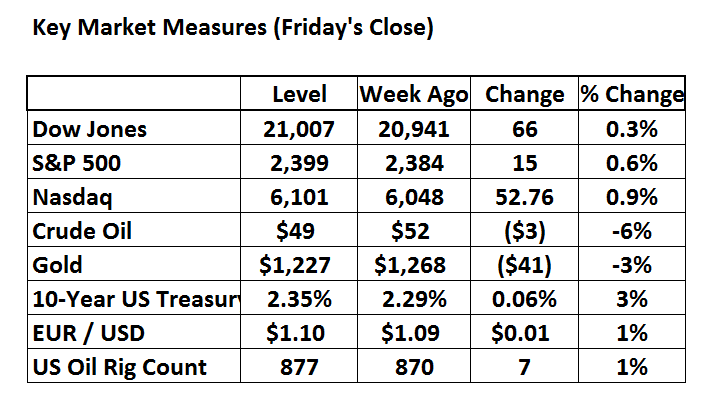
by Todd Shaver | May 7, 2017 | Weekly Newsletter 7pm Sunday
The Week Ahead
Well, it’s graduation week. Class of 2017 graduates are hitting the stage to accept their diplomas, listen to a keynote speech, make one last party, and then head out into the great big world. What will they find? GDP growth moving to 4% or stalling out around 2%. Will geopolitical tensions escalate as early as this year or find a sustainable comfort zone? Can equity prices hold? How bad will rising rates hurt the bond market? Everybody from the newest participant in the labor force to the most experienced must wrestle with these questions in the year ahead. We at The Bull Market Report hope to help you with some good insights about what to make of it all—week in and week out.
There is always a bull market here at The Bull Market Report! This week we highlight the following securities: Eli Lilly, Home Depot, Netflix, Splunk, PayPal, and VMWare. And a few others!
Highlights From The Past Week
Federal government expanding investigation of Fox News. The aggression against the media continues. Current and former Fox News employees have been interviewed, as authorities try to determine how settlement payments for sexual-harassment allegations were structured and which executives played roles in the payments. One source tells the WSJ that the investigators seem to be interested in intimidation tactics that former CEO Roger Ailes signed off on. The investigators are in the securities unit of the US attorney’s office, and no prosecution will necessarily follow. What does this all mean? You need to find trusted sources of information in this world. We strive to make The Bull Market Report a reliable and honest source of information for you to rely on.
It's the strangest thing: A hedge-fund manager apologizing for bad calls. Wellington Management Sr. VP Nick Adams isn't just apologizing for his mistakes on Silicon Valley venture deals -- which differ from the bank stocks he has a proven record with -- he's refunding fees. Adams, who has lost money two out of the past three years, put hundreds of millions of dollars into Mozido and Powa Technologies, which are both financially distressed. Adams has promised he won't ever invest in similar private deals in his flagship fund again. People familiar with the firm's finances say that after investors including Blackstone (BX) withdrew their cash, Adams's portfolio at the start of 2017 was $6 billion, down 40% from 2014. Adams has now returned to investing in traditional lenders like Bank of America and Citi, and his main fund rose 12% in Q1. We think there are lots of lessons to learn from this situation. For instance, if you ever wonder why many of The Bull Market Report’s stock picks are in household names that are often large cap stocks, well, now you know why. Traditional investing is a proven money maker and we try to take you where you can make money.
Don't assume the Healthcare industry will be fine. We think the market is right to assume that the Republican replacement for Obamacare won't be passed in its current version, but anything that hurts earnings for the sector could bring prices down, and the failure to pass any sort of healthcare reform may make a tax reform harder to achieve, which will be a negative for stocks more broadly. We all must keep an eye on this important event unfolding in Washington in the weeks ahead.
BMR Companies and Commentary
Eli Lilly (LLY: $83, +0.5% - All changes are for the week) Eli Lilly has more growth drivers than all its peers, but its continued pledge of "at least 5% annual sales growth" for 2015-20 is being called into question because a big portion of growth comes from two drugs - Jardiance and Trulicity - that have recently faced setbacks. We think Eli Lilly is a topnotch franchise in Healthcare and will overcome these hurdles.
Jardiance is a drug for type 2 diabetes. Johnson & Johnson has a competing drug called, Invokana, which is set to release new trial data in June. Everybody is saying that if Johnson & Johnson’s drug has good data, then there will be more pricing competition in 2018 for Eli Lilly’s drug. We think this risk is widely known, already factored into the numbers, and not a reason to not own Eli Lilly’s common stock.
Trulicity is also used for type 2 diabetes. It faces risks from the FDA's decision last August on Novo Victoza, specifically that this drug had problematic heart effects. Will the FDA say the same thing about Trulicity? We will find out in 2018. For now, it is overly pessimistic to assume Trulicity faces serious FDA challenges.
Note that Lilly's drug unit accounted for 83% of 2016 sales, with the balance coming from animal health, so the story is not just all about drugs. Also, Eli Lilly's operating margin trails most of its peers, except Bayer, and by leveraging new-drug launches, it aims to reduce R&D and SG&A expenses to 50% or less of sales in 2018 versus 56% in 2015. This target is achievable by Pharma standards as Jardiance's new heart label drives growth and Trulicity, an established product, continues to add to margins.
Lilly investors may be relieved by the good set of results in 1Q following recent drug setbacks. Older drugs, such as Cymbalta and Strattera, beat consensus, lifting margins and feeding through to the 2% EPS beat. Diabetes was strong with both Trulicity and Humalog beating consensus, while Jardiance missed by a little. Jardiance is a key driver of growth and while the miss raised eyebrows we say stay the course.
BMR Take: Eli Lilly is a top franchise in Healthcare boasting a market cap of $91 billion. On track to clear $5 of EPS, the stock is a good value.
Home Depot (HD: $156, flat)
A lingering debit/credit card breach has kept a lid on shares of Home Depot. The bad news is that it is so sad to see some large-scale breaches at US companies like Target and now Home Depot. The good news is Home Depot has taken strong steps to remedy the situation. In any case the stock is $1 from an all-time high, fast approaching $200 billion in market cap.
Companies hit by data breaches often face class action complaints filed by consumers. They also face lawsuits from shareholders looking to thwart future breaches and restore financial stability to companies in which they have invested. Home Depot's willingness to take meaningful but financially limited remedial mitigating action achieves a mutually beneficial resolution that companies facing any kind of data breach lawsuits, such as Yahoo, may rely on to improve their corporate data governance.
Under the proposed settlement, Home Depot will change many of its cybersecurity corporate governance policies. Home Depot agreed to document the duties and responsibilities of the chief information security officer; conduct table top exercises; monitor computer networks; maintain a “Data Security and Privacy Governance Committee;” hire a “dark web mining service;” receive reports on the company's information technology budget; join an information sharing program; and authorize the board to retain its own IT and data security professionals. Home Depot also agreed to pay $1.1 million in attorney’s fees and and $1.5 million to the shareholder representatives. They agreed to the settlement because it saw the attorneys’ fees as a minimal money issue and it believed the actions “would restore trust” in the company.
BMR Take: Home Depot is on track to deliver $10 of EPS and $100+ billion of sales. Don’t sweat the small stuff. Sorry to see the cyber breach, but the core business is doing great.
Netflix (NFLX: $157, +3%)
What could be more exciting than a Netflix merger with Apple? The world continues to talk about the prospects. Let’s break down the potential reality.
There may be as good as 40% odds that Apple acquires Netflix. The research arm of the investment bank Citi released a report with seven potential merger and acquisition targets for Apple. Tops on the list is Netflix. Elon Musk's Tesla, on the other hand, is only 5% likely. The full list of acquisition targets includes three media firms, three game developers, and, of course, one car manufacturer. Disney and Hulu are the media firms joining Netflix, while Activision, Electronic Arts, and Take-Two are the gaming companies.
Netflix makes a ton of sense, of course, as the company dominates streaming media both domestically and abroad. Disney has a strong list of properties as well, but slightly more oriented to traditional media consumption, whereas Netflix is well-positioned to take advantage of the continuing trend to cut the cord (cord-cutting has jumped 5x). Plus, Disney is worth $177 billion, whereas Netflix is worth $67 billion.
BMR Take: The future of TV consumption swings in the balance as the world moves away from traditional cable to the internet. Netflix is the powerhouse making the company a coveted asset in media. On track to do $10 of EPS by 2020 we see compelling value in the shares as a standalone entity even at current levels. A take-out could offer huge upside.
PayPal (PYPL: $49, +3%)
The PayPal network effect is working like charm. Investors in PayPal had plenty of reason to cheer last week when the company reported earnings. Nearly every metric was up by a better-than-expected percentage, surpassing expectations of all but the most bullish on the company.
More exciting to long-term investors, however, was the account growth and increase in user engagement with the company's core platform. Six million active accounts were added during the quarter, increasing the total to 203 million for the digital payments company. These active accounts now average almost 32 transactions per year, a 12% increase year over year. More customers using the company's platforms more often was a winning combination that the market liked.
PayPal's growth is beginning to fuel a powerful network effect opening a new window for the company. The beauty of this type of growth is that it drives itself. The more users that sign up for the platform the more important the service becomes for retailers to adopt it and the more places that accept it, the more attractive it becomes to new users. Get it?
At the end of March, 16 million retailers were accepting PayPal's core platform as a method of payment. Management is well aware of this virtuous cycle. During the conference call, CEO Dan Schulman stated: “Our powerful two-sided network engages both consumers and merchants, and the larger our scale, the stronger our network effect becomes. We made meaningful progress in advancing merchant adoption of PayPal in the quarter. At the end of March, the number of active merchant accounts on our platform increased to 16 million. The size of our merchant base is a formidable competitive advantage and is extraordinarily difficult for others to replicate.”
BMR Take: We think PayPal is in the middle of a decade-plus growth cycle that will deliver real value for shareholders. Stick around. They are already closing in on $3 of EPS.
Splunk (SPLK: $67, +4%)
Progress at Splunk is happening. Splunk, a provider of the leading software platform for real-time Operational Intelligence, recently announced support for SaaS Contracts in AWS Marketplace. Working with Amazon is a big deal!
The new globally available API capability* enables seamless procurement and deployment of Splunk® Cloud. The automated and accelerated purchasing process for Splunk Cloud via AWS Marketplace ensures fast time-to-value for customers leveraging Splunk solutions to gain real-time security, operational and cost management insights across their Amazon Web Services (AWS) and hybrid environment.
* Application program interface (API) is a set of routines, protocols, and tools for building software applications
The University of San Francisco is home to an innovative academic community of more than 12,000 students, faculty and staff. “As a higher education institution, USF prides itself on being at the forefront of technology, which is why we turned to Splunk and AWS,” said the vice president of information technology and chief information technology officer, University of San Francisco.
BMR Take: Working with Amazon gives Splunk big growth potential. The EPS outlook calls for great than 3x growth from $0.41 of EPS in 2017 to $1.35 of EPS in 2020. Ride this growth wave!
VMware (VMW: $94, flat)
VMware is out with some good news. The company is the first mobile application management provider to manage and secure hundreds of Oracle business applications and custom applications. As such, enterprise IT organizations can manage their Oracle application suite on a single unified platform together with their other business-critical applications and devices. Users who count on Oracle's business applications to make better decisions, reduce costs and increase performance can benefit by being able to access these applications through a simple digital workspace environment – be it from a mobile device, laptop or desktop – with VMware Workspace ONE and AirWatch.
What does that mean? VMware is continuing to make end roads in the lucrative cloud business, where growth is driving real results for stockholders.
The Chief Operating Officer, customer operations, said: "Mobilizing critical business processes is at the core of both of our organizations' DNA and this collaboration will help us advance this shared vision for our customers and their end users alike. We're proud to come together with Oracle to make it easier for IT administrators to secure and manage these critical mobile apps and help their end users seamlessly access them from any endpoint.” VMware Workspace ONE is the industry's only integrated platform for application and access management and unified endpoint management that enables simple enterprise secure access to any app from any device, accelerating adoption of digital workspaces.
BMR Take: The company is working. EPS is on track for $4.90 this year with growth upside to $6 in the next few years led by the cloud business and partnerships like the one described above serving Oracle.
Economic Outlook for the Coming Week
Monday, May 08, 2017 10:00 AM ET
United States - Labor Market Conditions
Period: APR
Actual: N/A
Consensus: N/A
Prior: 0.40
Labor market conditions index is derived from a dynamic factor model that extracts the primary common variation from 19 labor market indicators. It measures the changes of condition in the labor market. We expect to continue to see signs of a healthy labor market.
Tuesday, May 09, 2017 6:00 AM ET
United States - NFIB Small Business Index
Period: APR
Actual: N/A
Consensus: N/A
Prior: -$176B
NFIB Research Foundation has collected Small Business Economic Trends data from a sample of members from the National Federation of Independent Business (NFIB). Data from quarterly surveys since 1973 is based on 10 survey indicators. We expect to see an improving small business economy.
Tuesday, May 09, 2017 10:00 AM ET
United States - JOLTS Job Openings
Period: MAR
Actual: N/A
Consensus: 5,750K
Prior: 5,740K
Part of the US Bureau of Labor Statistics, the Job Openings and Labor Turnover Survey (JOLTS) program produces a monthly study that has been developed to address the need for data on job openings, hires, and separations. With the release of 2003 data, the JOLTS program began publishing industry estimates. We expect to see the JOLTS figures reveal a healthy labor market.
Wednesday, May 10, 2017 2:00 PM ET
United States - Treasury Budget NSA
Period: APR
Consensus: $166B
The monthly U.S. government surplus/deficit is published in the Monthly Treasury Statement (MTS). The MTS is assembled from data in the central accounting system. The major sources of data include monthly accounting reports by Federal entities and disbursing officers, and daily reports from the Federal Reserve banks. These reports detail accounting transactions affecting receipts and outlays of the Federal Government and off-budget Federal entities, and their related effect on the assets and liabilities of the U.S. Government. It is very critical what happens with Trump now negotiating the government budget and we are excited to see if he can get it under control and address the national debt.
Friday, May 12, 2017 08:30 AM ET
United States - Retail Sales ex-Auto
Period: APR
Actual: N/A
Consensus: 0.45%
Prior: 0.0%
Retail and food service sales data excluding motor vehicle are included in the Advance Monthly Sales for Retail and Food Service report, which provides an early indication of sales of retail and food service companies. We are keenly concerned about brick and mortar Retail sales declines and look to this economic release to assess the damage and potential impact.
MORE COMMENTARY ON BULL MARKET REPORT STOCKS
First Solar (FSLR: $35, up 17%) reported first-quarter earnings of 25 cents a share. The Street was looking for a loss of 13 cents.
Revenues hit $890 million in the quarter destroying the estimate of $700 million. (Who are these analysts anyway?) Revenues grew slightly from last year, up 2%. Profit was $84 million, down from $275 million a year ago. Ouch, but expected.
First Solar has $1.65 billion in cash, up from $1.35 billion at the end of the previous quarter. Long-term debt is $265 million at the end of the first quarter.
The big news is guidance. The company raised its revenue guidance to $2.9 billion from $2.85 billion. This is minuscule, but the Street liked it, pushing the stock up big. Gross margins guidance was moved to 13.5% from 12%.
Full-year earnings are now expected in the range of 25−75 cents per share, compared with the prior guidance of a breakeven to 50 cents.
We’ve said many times that this company is innovative and successful and that the turnaround will take time. This is the first positive information we have seen publicly that good things are actually happening. If you have patience, stick with First Solar. If you don’t, now is the time to take it off the table after this nice 17% run-up.
Facebook (FB: $150, flat)
Monthly active users totaled 1.94 billion while daily active users hit 1.28 billion. Expectations were for these numbers to hit 1.90 billion and 1.26 billion, respectively.
Facebook reported earnings of $2.5 billion or $1.04 per share on revenue of $8.03 billion. Expectations were for earnings of $0.87 on revenue of $7.83 billion. Huge beat. “We had a good start to 2017,” Mark Zuckerberg, Facebook founder and CEO, said. “We’re continuing to build tools to support a strong global community.”
Mobile is big at the company, as advertising revenue on mobile represented 85% of total advertising revenue, up from 82% a year ago. Ad revenue grew 51% over last year to $7.85 billion.
As of the end of the first quarter, the company had $32 billion in cash, and had almost 19,000 employees, up 38% from last year.
As Facebook nears the 5-year anniversary of its initial public offering, note this: In 2012, Facebook was the world's 10th-biggest seller of ads behind a bunch of traditional media companies such as CBS and 21st Century Fox. It has trounced almost all of them to rise to number two in the rankings, surpassed only by Alphabet, the Google parent that dominates search ads. Together, these two companies controlled 20% of the $550 billion spent on ads last year, up from 10% in 2012.
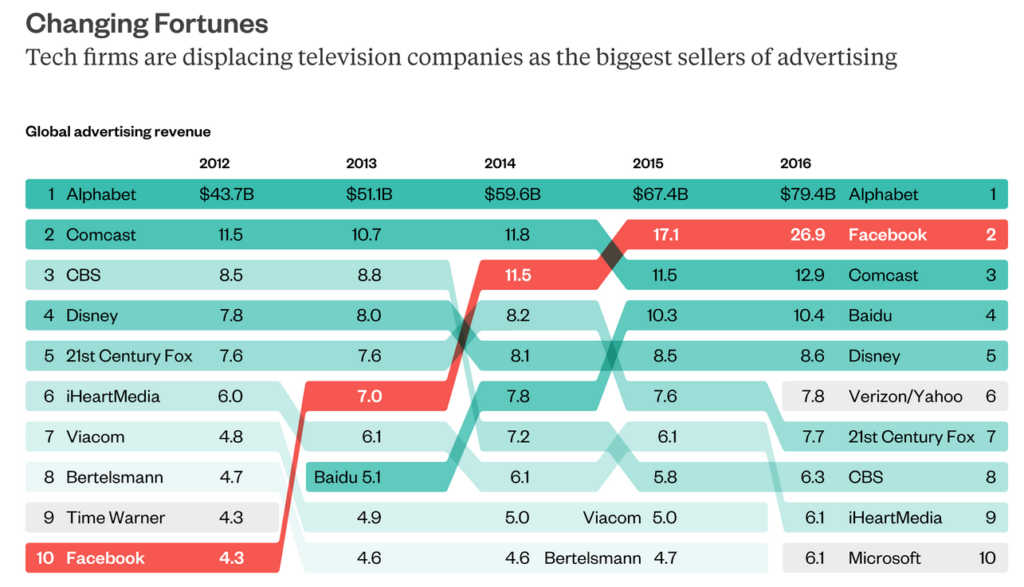
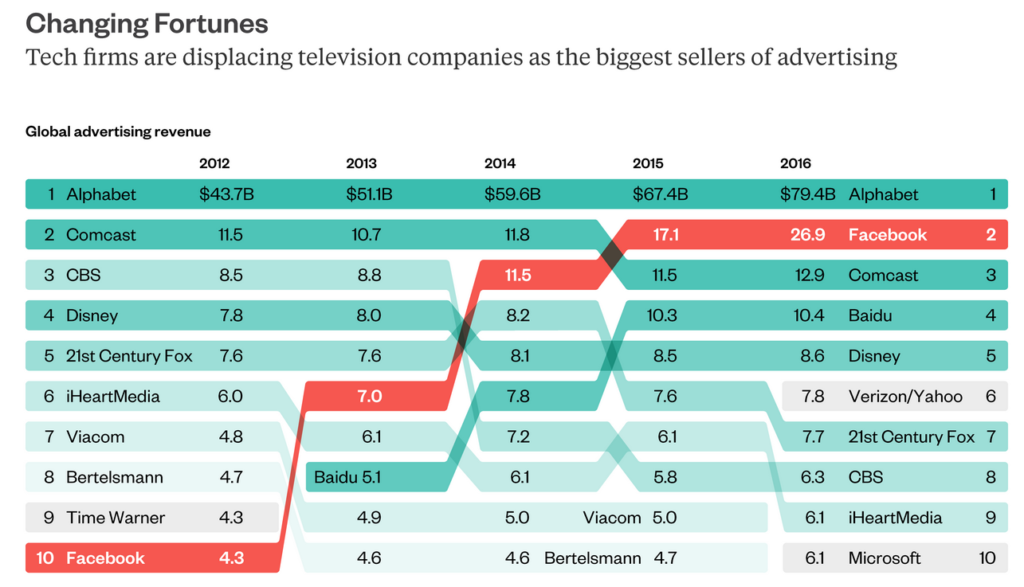
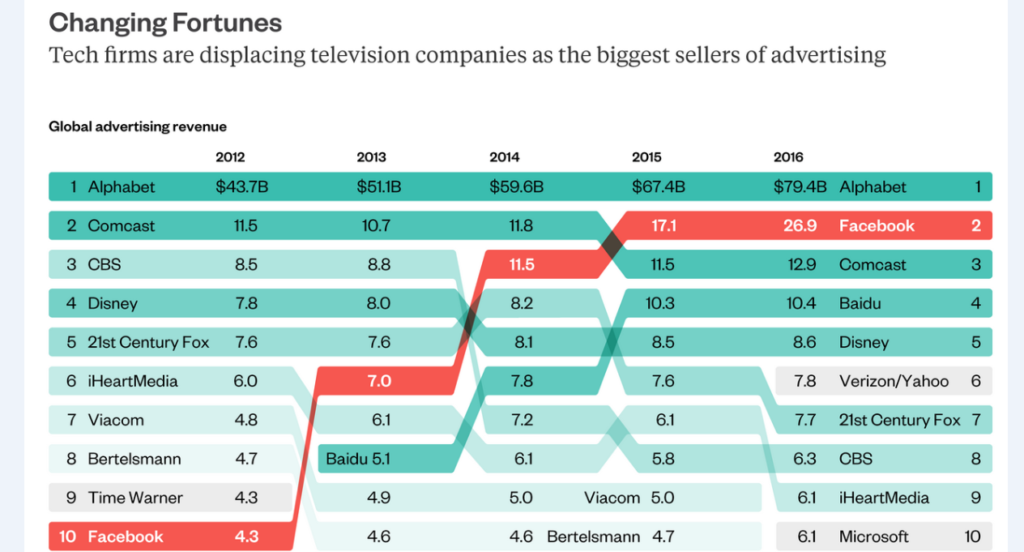
Source: Zenith Media
Jefferies hiked its price target on Facebook to $192 from $175, JPMorgan to $182 from $170, RBC Capital to $185 from $175, and Cowen to $170 from $156.
BMR Take: Our Target is in reach at $165. We would add to our positions at every opportunity. Wait until they hit 2 billion users. There will be fireworks and articles about the company galore and we just might see this as early as July. When this happens we can predict new all-time highs hit left and right.
Shopify News
We Tweeted this out on Friday:
“Shopify is on fire! All-time high at $86, up 5%. Stock was $73 a week ago. STRONG REVENUES will do it! Will eBay make an offer?” [The stock closed at $86 on Friday, up 13% for the week!]
The stock (SHOP) closed at $86 on Friday. We’re up 18% since we added the stock a little over a month ago. Our Target is $90. We can’t wait for it to hit so we can raise it to $100 or higher. And wouldn’t it be nice to see a stock split soon? What ever happened to stock splits? The markets in the 80s and 90s LOVED splits. We could see a 10-1 split for Amazon, bringing the price down to $93, and Google could split 20-1 bringing the price down to $46. Now wouldn’t THAT shake things up on Wall Street! The market would go wild.
Square (SQ: $19.78, up 8%) had a super good week. Square makes credit-card readers that plug into mobile phones and tablets and we were happy to see Square swing to a profit in the first quarter and raise full-year revenue guidance.
Led by Twitter Chief Executive Jack Dorsey, the company posted a quarterly loss of 4 cents per share on a revenue jump of 22% of $460 million. Analysts had expected a loss of 8 cents per share on revenue of $450 million, so of course the market liked what they saw. Square has predicted 2017 total revenue of $2.14 billion.
The company's gross payment volume - the total dollar amount of all credit card payments processed by sellers - jumped 33% to about $14 billion. We like numbers like this.
Another subsidiary, Square Capital, which offers loans to customers in exchange for a fixed percentage of their daily card sales, originated $250 million in loans in the first quarter of 2017, up 64% from a year earlier. We like large percentage increases like this. (We sound like a broken record…)
Square continues to move towards bigger customers. They said that 44% of the money flowing through its systems came from merchants that have over $125,000 in volume on the company’s platform, up from 39% a year ago. CFO Sarah Friar said: “That ongoing shift is good to see because those folks are not new to the payments world.”
Citigroup upped its price target on Square to $23 from $21, and Pacific Crest to $21 from $19.
BMR Take: We’re looking for $24, and hereby raise our Sell Price from $14 to $17.
Apple (AAPL: $148, up 4%) announced that it has $257 billion in cash as of the end of the quarter. They added $10 billion in the quarter which equates to about $800 million a week, or over $150 million per work day! Repeat: $150 million per work day. The company said it will return more of that to shareholders, announcing $50 billion in new stock buybacks and a 63-cent quarterly dividend. The company had already announced $175 billion in repurchases, helping maintain the stock price in lulls between new products, so the upcoming total is now $225 billion. Take a look at this chart of their cash buildup over the years:
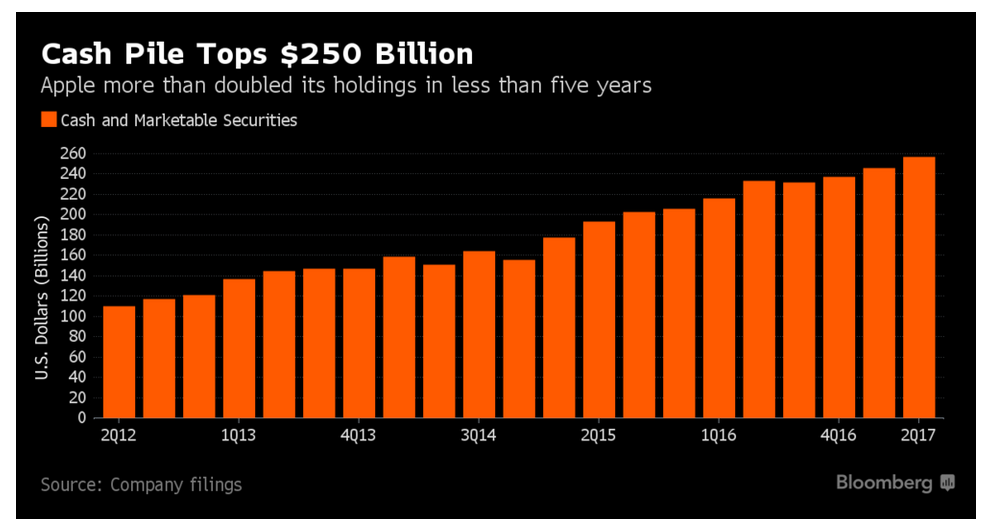
Twilio (TWLO: $24, down 27%) We reported via News Flash on Tuesday that despite strong revenues the market didn’t like the results. The biggest knockoff was the fact that one of their big customers, Uber, has decided to go it alone. Uber provides 12% of total revenue for the company, but Twilio grew revenue by 60% not including Uber. So ultimately, we are not that worried about future revenues. We believe they will continue strong. (We think they will come back to Twilio at some point.) WhatsApp, owned by Facebook is also a large customer, so some people are worried about this large concentration of revenue in one customer. We’re not. There is no word as to whether they are considering leaving. We would suggest that they are quite happy with the service they receive. And again, note that the company added 4,000 customers in the quarter – amazing really – giving them more than 41,000 customers, up from 29,000 at this time last year.
We had a letter from a reader about Twilio and we said this to him:
Bob -- Be prepared for anything that might happen. We could see $20 before we see $30. I hope this is not the case, but it could happen. Uber is slowly leaving as a customer and they had 12% of revenues. So, this will take some time to work out. They did add 4000 customers last quarter and are now over 40,000. They normally add 2800 a quarter. But unfortunately, like First Solar, this is going to take some time.
The Options Corner
We had mentioned in our News Flash about Twilio that we would do a column about options if anyone was interested. Well, we had a strong show of support for this. So here you go.
There are myriad of options strategies if you want to maintain a position in Twilio and you believe it will come back like we do. Of course, most options trades are risky except for selling covered calls, which are still risky but less so than buying options outright. The premiums on Twilio options are relatively high so that usually points to two types of options trades: doing covered calls, and selling naked puts or calls. The latter two are very dangerous.
Selling covered calls: Selling covered calls on Twilio is fairly straight forward. With the stock at $24 you can get about $1.80 for the January $30 call. If you have 1000 shares, you can sell 10 options and receive $1800 in your account that day. The downside is that you would be obligated to sell your stock at $30 if it goes higher than that. But, you can always buy back the option if the stock goes above $30. Depending on how long it takes the stock to get there will determine the price at which you have to buy back the options. If the stock goes to say $32 by January, then you could buy them back for about $2, losing about 20 cents, or $200. But with the stock at $32, you would feel good about that. The downside is that if someone buys Twilio out at $40 a share, you would be forced to sell your stock at $30. Not pretty.
If the stock stays below $30 until January, then you can turn around and sell another out-of-the-money option for a few dollars and wait for the stock to move higher and each time you do this you put cash into your account.
As you can see there are lots of scenarios that can happen so you have to watch carefully. Make sure you have the advice of your broker.
Buying options: If you think the stock can get to the $40 level or higher by say January 2019, you can buy out-of-the-money options inexpensively. But you could lose all of your money if the stock doesn’t reach the strike price that you choose. For example, you can buy 10 options, controlling 1000 shares, at a strike price of $40 expiring in January 2019 for about $2,300. If the stock goes to $45, these options would be worth at least $5,000. If it goes to $50, the options would be worth $10,000.
Or you could buy the January 2019 50s for about $1400 and if the stock goes to $55 they would be worth $5,000. BUT, if the stock doesn’t get to your strike price, they expire worthless.
Selling naked puts: YOU SHOULD ONLY DO THIS IF YOU WISH TO BUY THE STOCK and if you have the money to do so. You could sell the January 2019 $25 put for about $7, or $7,000 for 10 options. That would obligate you to buy the stock at some point between now and the expiration date at $25, BUT you got $7 per share so your net price is $18. You could do the same thing with a $20 put and get $4.30 per share, obligating you to buy the stock for a bit below $16. We like this latter strategy. Suffice it to say that selling naked puts on stocks you want to buy at a lower price, is a good thing. Again – very risky. Why? What if the stock goes to $10. You would be forced to buy the stock at $18 or $16 as described above. Not fun.
Send us your questions and comments please! Info@BullMarket.com.
Tesoro (TSO: $80, up 1%) moves in the wind with crude oil. Crude got down to $45 early Friday and bounced back to $46 by the close. We like the company but can’t be part of it if crude is headed to $40. If you know where crude is headed you’ll know what to do with your position in this fabulous refiner. Unfortunately, we don’t. If we knew, we could make $1 million trading crude oil futures. We added the stock at $85 in November and have a Sell Price of $75. But we would hate to have the stock go that low, so we are hereby raising our Sell Price to $78, which is two dollars below the current price. So, if Tesoro closes below $78 we are out.
Carlyle Group (CG: $18.10, up 2%) posted first quarter earnings that handily beat expectations on Wednesday, in line with its peers, after a strong stock market last quarter lifted investment returns. Carlyle's peer Blackstone Group (BX: $30, down 2%), a Bull Market Report favorite, reported first-quarter earnings that surpassed expectations.
Carlyle said it earned economic net income (ENI)* of $365 million after taxes, more than six times what it earned a year earlier. That translated into $1.09 EPS, well above analyst forecasts for 38 cents per share and the second-highest on record since the fourth quarter of 2013.
* ENI is a crucial performance measure for U.S. private equity firms as it accounts for unrealized gains or losses in investments.
Carlyle said its private equity investments appreciated 9% in the first three months, better than a 5% gain in the S&P 500 index in the same period. Carlyle Co-CEO William E. Conway, Jr. said, “We deployed capital at a strong pace in the first quarter, with $4.4 billion of capital invested despite a difficult environment. We believe we are well-positioned to continue this strong pace. We have already announced substantial new investments and almost $4 billion of exits that we expect to close in the coming quarters.”
BMR Take: Carlyle is still way undervalued but is paying you 4% while you wait. We’re waiting patiently for the market to recognize this situation. We are up 12% since March, but we sure would like to see our Target hit of $20.
The High Yield Corner
By Michael Foster
It’s finally started.
It’s a bit late, but we’re finally seeing a correction in the BDC world. The UBS BDC ETF (BDCS: $23, down 3%) got hammered in a week that was pretty humdrum for high yield and not bad for the stock market as a whole, despite a lot of drama. Yet BDCs are back to underperforming, as they should. Overstretched valuations and high premiums to NAV were unjustifiable before this week. Now that many companies have reported lackluster earnings, those premiums are even less justifiable.
Ironically, however, this isn’t hurting the most overvalued BDC of them all: Main Street Capital Corporation (MAIN: $40, up 1%), which closed the week strong as investors sighed relief following the company’s earnings. Net interest income rose 9% from a year ago to 61 cents per share and the company’s NAV rose nearly 2% to $22.44. There are two big implications for this: firstly, the company’s dividend coverage is 109% and there’s room for years of dividend growth to continue. We have a feeling Main Street management has the ultimate goal of becoming the first BDC Dividend Aristocrat*. We’ve still got about two decades until they can qualify, so it won’t be easy. But if that is their goal, Main Street is easily the best managed and most long-term focused BDC in the world.
* The Dividend Aristocrats are a select group of 51 S&P 500 stocks with 25+ years of consecutive dividend increases.
That doesn’t mean you should go out and buy. We at The Bull Market Report were happy with our pick and happy to see it rise. But we are not happy to pay an 80% premium to net asset value. Consider this: if you considered Main Street to be the best BDC in the world, you wouldn’t want to compare its premium valuation to the valuation of other BDCs. You’d probably want something safer, like a megabank like Bank of America, which not only lends to small and medium sized banks but also mega-corps and governments while diversifying in other banking activities like M&A advisory, retail deposits, and so on. Or at least you’d want your BDC valuation to be less than the valuation of these banks, right? But if you compare Main Street’s valuation to the price-to-book valuations of these big banks, Main Street is overvalued by 40% at a minimum. This just isn’t good enough for a very well-run but extremely undiversified asset.
The market has begun to realize just how silly BDC valuations were getting, but the market has made an exception for main Street largely due to the fact that just about every other BDC reported awful earnings. Net investment income fell for almost all BDCs that have reported so far, with Hercules Capital (HTGC: $13) seeing NII down 33% from the prior quarter. The dividend is now less than 100% covered. NAV fell a bit as well (over 1%). What happened? The market dumped shares, which fell over 16% in a week. This used to be considered one of the safest and best specialty BDCs out there, but the market can turn very quickly on this asset class. We’re not saying anything similar will happen to Main Street anytime soon, but it is a serious risk.
Then there’s Goldman Sachs’s BDC (GSBD: $24), which fell 3% this week due to a decline in net investment income and virtually flat NAV. The stock is still up 3% year-to-date so you’re paying a higher premium for shares, though. Now you’re paying 32% over what the underlying assets are worth. Of course, this BDC is up big over the past year, thanks in part to the secular bull market in BDCs and thanks in part to the Goldman brand. But, as we’ve written here previously, there is a complicated conflict of interest going on with this BDC that makes us extremely cautious. Goldman Sachs’s management is not duty bound to restrict their deal making just to this BDC, and so there’s a chance (although no evidence this is the case) that management can select better deals for the parent company and keep lesser deals for the BDC business. Without clearer governance resolutions, this makes us extremely cautious. And, at the end of the day, this demonstrates one of the structural problems with many BDCs: management and investors’ interests do not align.
Some of the BDCs in the business were loved for avoiding this trap. The big Ares Capital Corporation (ARCC: $16.60, down 6%) is a good example. But this stock tanked as well, after reporting earnings fell 50% from a quarter ago and NAV rose less than 1%. We don’t need to emphasize how bad those results are, and how they deserve a discounted valuation. But Ares is still trading at a slight premium to NAV.
Obviously, a bigger correction in the BDC market is coming, so where else can we look? REITs and municipal bonds remain our favorite corners of the high yield market. The iShares S&P National AMT-Free Municipal Bond Fund (MUB: $109, flat) remained sleepy due to the risk-on nature of the market encouraging more investors to avoid the asset class, despite the growing number of undervalued bonds and great opportunities to get low risk yield for fund managers. Bull Market Report favorites remained flat for the week, Invesco Municipal Trust (VKQ: $12.69, flat) and The Nuveen AMT-Free Fund (NVG: $14.79, flat) Buying more of either fund at this juncture would make a lot of sense.
And then as REITs go, the SPDR Dow Jones REIT ETF (RWR: $92, down 1%) fell slightly with investor apathy hitting the asset class on little news. This again is resulting in plenty of good deals among REITs, and The Bull Market Report continues to have high conviction for long-term sustainable yields from Digital Realty Trust (DLR: $114, down 1%), Omega Healthcare Investors (OHI: $32, down 2%), and Care Capital Properties (CCP: $27, flat) in particular. Looking forward, we will be looking closely at how REIT earnings results and more market responses from the BDC market causes a reset in high-yield land that offers an opportunity to rebalance the portfolio.
Good Investing,
Todd Shaver, Founder
The Bull Market Report
CEO and Editor in Chief
Founded 1998