December 30, 2019
by Todd Shaver | Dec 30, 2019 | Free Newsletter (Sent Weekly Monday at 12pm)
The Weekly Summary
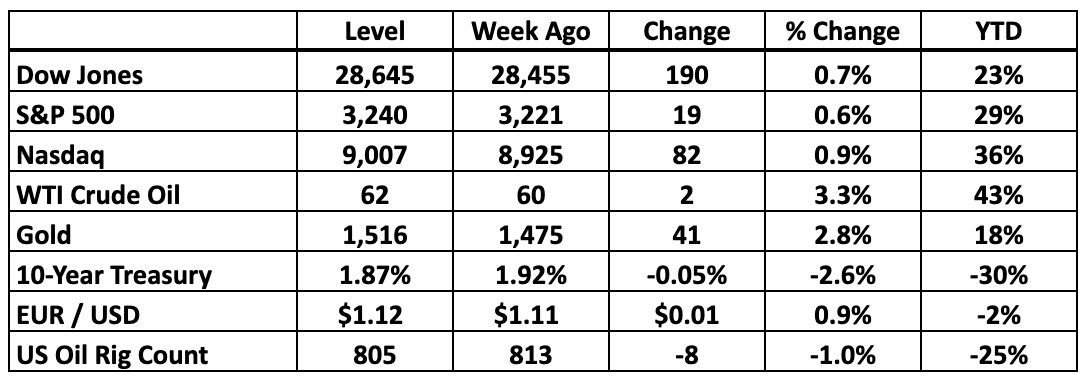
As the year winds up, the only question left for 2019 to answer is how far back you need to go to get a stronger year. The market this year is close to what we saw in 1998, and we would settle for matching that ultra-bullish dot-com boom. Beyond that, it only takes a few extra percentage points of victory lap before we need to pull out 1975 and even 1958 to find a comparable rally on the books.
Of course BMR stocks are up 41% so far this year, so we're rolling in outperformance either way. A full four of our recommendations doubled, tripled or quadrupled in 2019 and a wide range of others (including mighty Apple itself) are in the 80-95% zone. Only six BMR stocks went down. We're confident that they'll come back strong in 2020.
But then 2020 is the real question Wall Street needs to answer. In our view, the new year will start a lot like the last one, with stocks moving strong to the upside. All we need is a little relief on trade or some sunshine in the coming 4Q19 earnings season to carry the bulls into the summer, at which point the political landscape will undoubtedly get too hot for many investors to handle. That's all right. As long as we stick to our game plan, the election shouldn't hurt us one way or the other . . . and in any event, it's nearly a year down the road, so there isn't a lot of sense in worrying about the results at this stage.
There’s always a bull market here at The Bull Market Report! Gary Jefferson is back with a powerful look at what 2020 is likely to bring us, while The Big Picture focuses on the way markets can swing from dread to exuberance. The rally we're enjoying now isn't any more "irrational" than normal. As such, The High Yield Investor discusses some avenues if you're looking to lock in a little added income before the old year ends. We suggest taking a fresh look at Office Properties Income Trust and Omega Healthcare Investors.
The rest of our paid subscription newsletter is devoted to a few of our biggest winners of 2019 like Anaplan and Alphabet, along with some BMR stocks that fell hard in recent months but are already rebounding fast: Okta, Alteryx and Twitter.
Remember, the last day you can buy or sell stocks this year is Tuesday. Wednesday will be a market holiday and then we start fresh in 2020 on Thursday. As usual, our News Flashes will be a little light this week . . . if there's nothing to say, we won't bore you with filler. Instead, we'll be working behind the scenes to get you ahead of the new year.
Key Market Indicators
-----------------------------------------------------------------------------
BMR Companies and Commentary
The Big Picture: Animal Spirits In Control
Part of what won Yale economist Robert Shiller the Nobel Prize was his 2005 warning that the housing market was getting unsustainably overheated. Since then, people have come to him to tell the bulls they’ve gone too far. That’s why his recent admission that this record-breaking year on Wall Street is built on irrational factors is so illuminating. Shiller now sees “animal spirits” as the main factor driving what could easily become the best year since the 1950s.
He knows this isn’t logical. And he doesn’t mind. After all, the market isn’t always rational, but when something gets it moving away from the fundamentals, there’s no point in fighting the flow. You’ve simply got to know your own nature. If you aren’t confident enough to run with the bulls, stay on the sidelines and keep cashing 2% Treasury bond coupons. But there’s a lot of money to be made even in a frothy market. Once you let the bulls loose, they’ll run until they’re completely exhausted. Needless to say, we're excited. Even Bob Shiller seems relatively sanguine about how far this rally can continue in 2020 and beyond.
He’s far from alone. Sprawling trillion-dollar asset management complexes are sharing their 2020 outlooks now and they’re convinced bullish conditions will prevail for the foreseeable future. All we need is a mood strong enough to cut through the shocks. Wall Street isn’t climbing a wall of worry any more. We’re riding a wave of exuberance.
It really amounts to market physics. A stock in motion will remain in motion until an obstacle forces a course correction. At this point, there’s nothing big enough looming on the horizon to break the bulls’ stride. We’ve already lived through a year of trade war and earnings deterioration. That’s the status quo now, part of the background noise.
More importantly, it’s already built into the trailing year-over-year comparisons. We don’t need a big external stimulus like tax cuts or even the Fed to get the 2020 numbers going in the right direction. All we need is a little organic growth. That’s been building up behind the scenes as the Fed keeps interest rates low.
Builder confidence is at its highest level since 1999. New home sales are tracking at 2007 levels once again and there’s no ceiling in sight. This is just getting started. And even Bob Shiller, the housing bubble guy himself, has stopped fighting the mood. A year ago, he warned that the housing market reminded him of 2006, right before the crash. Conditions now look hotter than ever.
Shiller says it’s contagious. The impeachment hasn’t stopped it. The trade war hasn’t stopped it. Under normal circumstances, the bulls would have run out of breath by now. But while these aren’t normal circumstances, history shows that they aren’t absolutely unprecedented either. On Shiller’s scale, stocks are “quite high” now at a 30X inflation-adjusted earnings multiple.
Back in 1999, his metrics stretched a full 50% beyond where they are now. History didn’t end. This time around, they can go at least as far before they snap. After all, as Shiller says, we have a motivational speaker in the White House now, someone who loves to talk the market up when everyone else tries to talk it down. That's huge.
-----------------------------------------------------------------------------
Anaplan (PLAN: $53, down 1% last week )
While Anaplan was down a bit over the past week, it has doubled in the past year and BMR subscribers have captured a healthy 42% of that gain after we added it to the Aggressive portfolio back in March. The company still has significant upside since growth prospects for its decision making software remain bright.
At the forefront of “Connected Planning,” a category that it has created and is a part of the cloud computing category, the technology allows companies to make faster, and, it believes better decisions. Anaplan’s technology, which it calls Hyperblock, connects data through various company’s departments rather than centralizing decision making within the finance department. Currently aimed at large enterprises, there is still plenty of room for growth. At the start of 2019, the company had 1,100 customers and only 250 were part of the Global 2000.
Recent results demonstrate the company’s growth prospects. In the fiscal third quarter (ended October 31), Anaplan’s rapid top-line growth continues, with revenue increasing 44%, from $62 million to $89 million. Although the company has a history of expanding losses, management has slowed down the rate of expense growth. For the most recent period, Anaplan’s operating loss narrowed to $32 million compared to third-quarter 2018’s $50 million operating loss. Management boosted its fiscal 2020 guidance, including raising their revenue expectation to a 44% top-line increase ($347 million) versus their prior 42% expectation, up from $240 million in 2019.
BMR Take: With its pristine balance sheet ($50 million in debt and $310 million in cash), this major disrupter still offers exciting growth prospects as large companies continue to adopt its technology, which includes machine learning and other artificial intelligence. Our Target is $75 and our Sell Price is $45 and we would expect the stock to reach new all-time highs above $60 in the first part of 2020.

-----------------------------------------------------------------------------
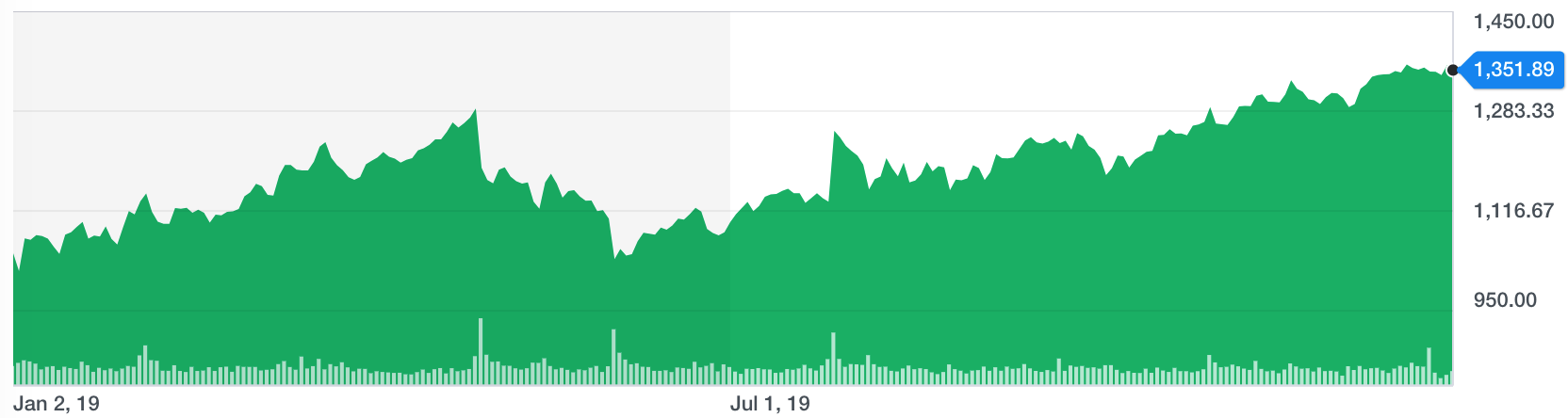
Alphabet (GOOG: $1,352, flat)
The Search giant is up 30% for the year and is within 1% of an all-time record. Not bad for a company with a near-trillion-dollar market cap ($933 billion). The big news recently is that the founders have stepped back and turned over the running of the firm to Sundar Pichai. He’s been running the core Google business since 2015 but this latest promotion gives him a clear line of authority over the entire enterprise.
The search business is solid and obscenely profitable but is not growing terribly fast. Their cloud platform business however rose more than 80% last year, albeit still small at $4.4 billion in revenues. But give this two more years at this growth rate and you have a huge business generating big cash numbers. With revenue tracking near $160 billion in 2019, up from $137 billion in 2018 and $110 billion in 2017, there is nothing but more green ahead for the company.
They are also buying stock back like no tomorrow, with almost $6 billion being spent on shares in just the 3rd quarter. With $120 billion in cash on the books, and generating over $2 billion a month, this type of buying could continue for months if not years into the future. After all, nobody talks about the M-word on the Street, but you have to admit, with 88% of the search market, this company is a monopoly. Is there a risk of the governments of the world getting involved in Google’s business? Yes, of course.
But we think this is highly unlikely and if we didn’t already own stock in the company, we would be happy to acquire shares of this fabulous firm as soon as the market opens for trading on Monday morning. Trading at its all-time high, this concerns us not a bit. After all, why oh why do you think this company is trading at an all-time high? Because it is a cash machine, now and in the future. Our Target is $1450 and our Sell Price is: We would not sell Google.
-----------------------------------------------------------------------------
Twitter (TWTR: $32.50, up 1%)
What do you do when some of your favorites are down 20-50% from their highs? We go back to the basics.
We continue to love Twitter but the stock has been flat for months now, since October when it was trading in the low 40s. But many times the stock doesn’t tell the whole story. Revenues are good, not spectacular, growing from $2.4 billion in 2017 to $3.0 billion in 2018. This year looks like they will hit the $3.5 billion level, with profits of $1.60 per share in 2018 and what looks like $2.40 in 2019. Compared to a lot of other high-tech companies with virtually no earnings, it’s a nice breath of fresh air to see Twitter actually producing profits.
They still have a ton of cash at $5.8 billion, balancing $2.6 billion of debt. The exposure the company gets from our current president and from the world-changing events that it has been involved in (Arab Spring, Hong Kong) we expect good things from the company in the coming 5-10 years. We see the upside much greater than the downside risk. Our Target of $47 is Aggressive for this $25 billion company and our Sell Price of $25 will protect you on the downside.

-----------------------------------------------------------------------------
A Word From Gary Jefferson
Jefferson Financial Group
First Vice-President, Investments
UBS Financial Services, Inc.
After digesting dozens of 2020 forecasts from leading Wall Street firms and other outside resources, we want to give you our take on what WE see for the coming year.
First, we don't expect a bear market or a recession. The economy is doing great and it simply is not going to stop on a dime. The things that matter such as consumer confidence, consumer spending, wages, full employment, low interest rates and inflation are at some of the best levels we have seen in our lifetimes.
And the strong economy, of course, is what has and we believe is what will continue to energize the market in 2020. Just look at GDP. The final Q3 GDP estimate of 2.1% puts 2019's annual growth rate on pace to beat the average annual growth rate since this bull market began. Consumer Sentiment was up as well, rising to 99.3 from last month's 96.8.
Even though we key on earnings, if all one did was monitor the following four items, you could accurately forecast the strength of the economy with uncanny precision: GDP, employment, consumer sentiment and interest rates. All are really, really doing well.
Earnings are expected to slow down the first two quarters, but the positive impact from all of the prior rate cuts should hit bottom lines around the midpoint of next year. We anticipate positive growth in the first two quarters and up to 10% earnings growth across S&P 500 stocks for the full year. Thus, if there is going to be a sell-off or "correction," we expect it might be in January or February, triggered more by political consternation than lowered earnings estimates.
If we don't see a pullback early next year, we may have a period of volatility in the June area as politics heats up again with conventions and selections of final candidates. We expect these downswings, if they occur, will be headline-driven events and will therefore result in "buy-the-dip" opportunities for investors wanting to put extra cash to work.
What worked last year: Technology was the clear outperformer in 2019 while Energy was the largest underperformer. As we move in to 2020, we favor Communication Services and Consumer Discretionary stocks (including Amazon) and are not looking for much from either Technology or Energy. However, if Big Oil bounces back, it will come roaring back . . . in that scenario, we'll add to our coverage there.
Either way, as we view the entirety of the economy, tariffs, politics and the Fed, we believe all major sectors are capable of achieving low double-digit returns in 2020, while Consumer Staples, REITs, Utilities and Financials may still be capable of somewhat lower returns.
What we don't expect is smooth sailing throughout 2020. We expect plenty of volatility because of global trade tensions, Brexit and of course politics right here at home. We don't expect the Fed to raise or lower rates next year, but in case the economy needs a safety net, they will lower rates. Oil prices, of course, have always been a wild card, but we see plenty of supply to keep markets stable. We don't expect the president to be removed from office, but rather expect his pro-business policies (less government, fewer regulations and lower taxes) will continue to foster business growth and entrepreneurism.
As a comparison to what we expect, here is the case made by the Stock Trader's Almanac for 2020:
- Worst Case: Correction but no bear in 2020. Flat to single digit loss for full year due to on-going unresolved trade deals, no improvement in earnings and growth weakens further. Trump is removed from office by the Senate, resigns or does not run and political uncertainty spikes.
- Base Case: Average election year gains. Incumbent victory, trade and growth remain muddled, modest improvement in corporate earnings and Fed stays neutral to accommodative. 5-10% gains for DJIA, S&P 500 and NASDAQ.
- Best Case: Above average gains. Incumbent victory, trade resolved, growth improves, earnings improve and Fed stays neutral and accommodative. 7-12% for DJIA, 12-17% for S&P 500 and 17-25% for NASDAQ.
We lean toward the upside.
-----------------------------------------------------------------------------
The High Yield Investor
As we look toward 2020, most investors have flipped from indulging their grimmest recession fears to a posture closer to our own bullish bias. That's ultimately a good thing. However, it also sets up volatility ahead when expectations get too far ahead of reality, even for a brief period of time. We are looking for good things from the coming year. We just know that the route is going to be far from smooth.
Our top High Yield priority for the coming year is simple: hold defensive positions and wait for money to flow out of these stocks before you expand your holdings. You should have locked in a reasonable quarter-to-quarter income stream to cushion the downswings, so chasing these stocks while yields are relatively low doesn't make a whole lot of strategic sense. The goal is to lock in the highest yields possible, which means waiting until these stocks are out of favor.
It will happen. For now, as long as the rest of the market is rallying, there isn't a whole lot of urgency in building up your defense. And if you're feeling nervous, we suggest capturing the biggest yields you can to offset the impact of negative real interest rates around the world. Remember, the Fed won't raise interest rates again before annual inflation reaches 2%, so locking in anything less for the long term means you're locking in at least a little purchasing power deterioration . . . you are guaranteed to lose money at the end of the road. Who wants that?
Most of our recommendations pay well above 5% and some carry much higher yields as the market pivots from defense to enthusiasm. We'd like to discuss two of our favorites here. The first is ............ AND THIS IS WHERE YOU WILL GET THE BEST VALUE FROM BEING A PAID SUBSCRIBER. GO HERE TO SUBSCRIBE. YOU WILL BE HAPPY YOU DID: www.BullMarket.com/subscribe
Good Investing,
Todd Shaver, Founder and CEO
The Bull Market Report
Since 1998
August 7, 2019
by Scott Martin | Aug 7, 2019 | 7am News Flash
Netflix (NFLX: $362, down 3% earlier this week) disappointed last night and the stock's precipitous overnight decline provides us with a different kind of wake-up call. Whether you're in Netflix or not, you're going to want to read this flash.
On the surface, Netflix delivered a quarter almost entirely in line with what investors told themselves they wanted to see. Revenue of $4.92 billion was only 0.1% below guidance and reflects healthy 26% year-over-year improvement. Even quarter-to-quarter, the company squeezed 9% more cash out of its subscribers than it did three months ago.
Furthermore, despite profit being a lower priority while management invests vast amounts in original content, it was nice to see that Netflix carried $0.60 per share across the bottom line, $0.04 better than we expected.
But the market found fault as Netflix missed its subscriber growth target, losing 126,000 paid U.S. accounts and only adding 2.83 million new viewers overseas. Management told us to expect the audience to grow by an even 5 million accounts, so it's a clear disappointment.
There are some compensating factors like the way revenue hit guidance. Netflix raised prices in many markets and this is apparently where the pain point is. We know that now. Furthermore, management has doubled down on its aggressive growth forecasts and now expects subscriber adds to accelerate again in the current quarter.
We've had it with Netflix. We've warned throughout that it's going to be a volatile ride. The stock is now down 20% since we started covering it this time around, after making 65% back in 2016-17. We're worried about competitors like Disney and Apple starting to crowd into the space. With a negative $3.5 billion of free cash flow this year and next, we'd rather be invested in a company that actually makes money. We hereby remove Netflix from our High Tech portfolio. We added them on July 16th last year. We're gone now on July 18th, 2019.
However, even for a volatile stock, the reaction to so-so numbers was so extreme that we now suspect that the market as a whole is getting overheated. It's not Netflix. It's Wall Street. And an overheated market can lurch lower as fast as it soars. Even counting the stocks that fizzled and left our list under a cloud, the BMR universe is up a dramatic 33% YTD. This is a great time to lock in some of that profit before a moody market can take it away.
Is It Time to Take Some Profits?
Why are we asking this question?We can’t predict the future. You may think we can, but we can’t. And we want YOU to think about where YOU are and where you are going with your investments. We have made some amazing stock picks and we’ve made you a lot of money in many of these. (We’ve had a few losers too.) Roku is now a triple since we added it last year. Shopify is up 350% in two years. Square is another quadruple play. PayPal, Twilio, Paycom, Microsoft, Apple, Visa: all strong performers.
Is it time to take some of that off the table? There are a lot of things to worry about in the world today: Trump, Chinese tariffs, Iran, immigrants, global slowdown, flat earnings for the past quarter and next; negative interest rates in Europe and Japan . . . can they happen here? If so, will the Fed run out of ammunition if short rates go to zero? What about the attacks on Big Tech by Congress and the European Union? Can Facebook, Amazon and Google survive this onslaught? Of course they will, but why sit around with someone hitting you on the head with a hammer. Maybe it’s better to step a little away from the scene.
Lots of questions. No solid answers. Irrational exuberance was proclaimed by Alan Greenspan on December 5, 1996 after an amazing bull run in the preceding few years. But the bull market continued to skyrocket until the Spring of 2000. That’s almost 3½ years after Greenspan’s call. So is it too early to start taking profits now?
Again, we don’t know, but we do know that there are things you can do. You can sell some calls against your stocks. This brings in cash and cushions you on the downside a bit. But if Roku, which was at $32 at the start of the year goes from $110 now to $90 or even lower, it’s not going to cushion you much with $5 of call option income. So perhaps you can take some profits off the table. Maybe you should put some stops in place. Sell some at $104. Sell some shares if it hits $96. Sell some more if it hits $90. Then if it goes to $70, which is a distinct possibility in a nasty bear market, you’ve protected your profits and have cash in the bank.
And don't forget, we’ve got 17 stocks in our High Yield and REIT portfolios that are paying from 3% to 11% dividends. (Be wary of Annaly and New Residential, though.) These stocks are just waiting for you to place some cash in them so that you can sleep better at night.
This content is for our beloved subscribers and anything you see on this page is just an excerpt!
Please note BullMarket.com access is available to paid subscribers only. Our Members Areas include archives of past Newsletters, News Flashes, our ten portfolios including STOCKS FOR SUCCESS, Healthcare, High Yield, High Technology, Exchange Traded Funds (ETF's), Energy, Senior Growth Opportunities, Financial, Long Term Growth, and Special Opportunities. Also, all of our in-depth research is available, and more.
Already a subscriber?
Login Here
Ready to join?
Subscribe Now!
August 5, 2019
by Scott Martin | Aug 5, 2019 | 7am News Flash
Netflix (NFLX: $362, down 3% earlier this week) disappointed last night and the stock's precipitous overnight decline provides us with a different kind of wake-up call. Whether you're in Netflix or not, you're going to want to read this flash.
On the surface, Netflix delivered a quarter almost entirely in line with what investors told themselves they wanted to see. Revenue of $4.92 billion was only 0.1% below guidance and reflects healthy 26% year-over-year improvement. Even quarter-to-quarter, the company squeezed 9% more cash out of its subscribers than it did three months ago.
Furthermore, despite profit being a lower priority while management invests vast amounts in original content, it was nice to see that Netflix carried $0.60 per share across the bottom line, $0.04 better than we expected.
But the market found fault as Netflix missed its subscriber growth target, losing 126,000 paid U.S. accounts and only adding 2.83 million new viewers overseas. Management told us to expect the audience to grow by an even 5 million accounts, so it's a clear disappointment.
There are some compensating factors like the way revenue hit guidance. Netflix raised prices in many markets and this is apparently where the pain point is. We know that now. Furthermore, management has doubled down on its aggressive growth forecasts and now expects subscriber adds to accelerate again in the current quarter.
We've had it with Netflix. We've warned throughout that it's going to be a volatile ride. The stock is now down 20% since we started covering it this time around, after making 65% back in 2016-17. We're worried about competitors like Disney and Apple starting to crowd into the space. With a negative $3.5 billion of free cash flow this year and next, we'd rather be invested in a company that actually makes money. We hereby remove Netflix from our High Tech portfolio. We added them on July 16th last year. We're gone now on July 18th, 2019.
However, even for a volatile stock, the reaction to so-so numbers was so extreme that we now suspect that the market as a whole is getting overheated. It's not Netflix. It's Wall Street. And an overheated market can lurch lower as fast as it soars. Even counting the stocks that fizzled and left our list under a cloud, the BMR universe is up a dramatic 33% YTD. This is a great time to lock in some of that profit before a moody market can take it away.
Is It Time to Take Some Profits?
Why are we asking this question?We can’t predict the future. You may think we can, but we can’t. And we want YOU to think about where YOU are and where you are going with your investments. We have made some amazing stock picks and we’ve made you a lot of money in many of these. (We’ve had a few losers too.) Roku is now a triple since we added it last year. Shopify is up 350% in two years. Square is another quadruple play. PayPal, Twilio, Paycom, Microsoft, Apple, Visa: all strong performers.
Is it time to take some of that off the table? There are a lot of things to worry about in the world today: Trump, Chinese tariffs, Iran, immigrants, global slowdown, flat earnings for the past quarter and next; negative interest rates in Europe and Japan . . . can they happen here? If so, will the Fed run out of ammunition if short rates go to zero? What about the attacks on Big Tech by Congress and the European Union? Can Facebook, Amazon and Google survive this onslaught? Of course they will, but why sit around with someone hitting you on the head with a hammer. Maybe it’s better to step a little away from the scene.
Lots of questions. No solid answers. Irrational exuberance was proclaimed by Alan Greenspan on December 5, 1996 after an amazing bull run in the preceding few years. But the bull market continued to skyrocket until the Spring of 2000. That’s almost 3½ years after Greenspan’s call. So is it too early to start taking profits now?
Again, we don’t know, but we do know that there are things you can do. You can sell some calls against your stocks. This brings in cash and cushions you on the downside a bit. But if Roku, which was at $32 at the start of the year goes from $110 now to $90 or even lower, it’s not going to cushion you much with $5 of call option income. So perhaps you can take some profits off the table. Maybe you should put some stops in place. Sell some at $104. Sell some shares if it hits $96. Sell some more if it hits $90. Then if it goes to $70, which is a distinct possibility in a nasty bear market, you’ve protected your profits and have cash in the bank.
And don't forget, we’ve got 17 stocks in our High Yield and REIT portfolios that are paying from 3% to 11% dividends. (Be wary of Annaly and New Residential, though.) These stocks are just waiting for you to place some cash in them so that you can sleep better at night.
This content is for our beloved subscribers and anything you see on this page is just an excerpt!
Please note BullMarket.com access is available to paid subscribers only. Our Members Areas include archives of past Newsletters, News Flashes, our ten portfolios including STOCKS FOR SUCCESS, Healthcare, High Yield, High Technology, Exchange Traded Funds (ETF's), Energy, Senior Growth Opportunities, Financial, Long Term Growth, and Special Opportunities. Also, all of our in-depth research is available, and more.
Already a subscriber?
Login Here
Ready to join?
Subscribe Now!
February 18, 2018

by Todd Shaver | Feb 18, 2018 | Weekly Newsletter 7pm Sunday
The Weekly Summary
US stocks rebounded to have the best weekly gain since 2011 - how do you like that for a turnaround? So it turns out the bull is still running after a quick breather. Now all the talk on TV is “don’t worry about volatility. That markets had been abnormally calm for years. That we should now just expect more noise.” We concur. We adhere to the old adage: “Bull markets are born on pessimism, grow on skepticism, mature on optimism, and die on euphoria.” This means that bear markets are born on euphoria and grow on pessimism. Frankly we just don’t see that much euphoria in the markets. For example, while bank stocks are up 50% since the election, profits are up more, which suggests gains in bank stocks are honestly tied to the realities of profit levels. As another example, GDPnow suggests first quarter GDP is above 3.0%, again meeting the growth targets underpinning recent stock market gains. All in all, wake us up when you see broad-based euphoria, because until then this bull market is on cruise control, the ride might be a bit more bumpy going forward.
No matter what is happening out there, there is always a bull market here at The Bull Market Report! This week we highlight: Twilio, Shopify, Square, Splunk, Amazon, and AstraZeneca.
Key Market Measures (Friday’s Close)
----------------------------------------------------------------------------------------
BMR Companies & Commentary
Twilio (TWLO: $33, up 35%)
Twilio crushed the quarter. We mean absolutely crushed it. Revenue was $115 million up 41% from a year ago. EPS was a loss of $0.03 versus breakeven a year ago. There were so many good things that happened we can’t cover them all, but we will share a few.
The tone of business at Twilio continues to be exceptional. Founder/Chairman/CEO Jeff Lawson commented, “We feel we are poised for a great year ahead.”
The big focus for investors was on Twilio’s gross margins. Specifically, after Twilio’s gross margin declined for three consecutive quarters from a peak of 59% in 4Q16, investors were concerned it might continue to trend downwards into the 40s. Twilio’s 4Q17 gross margin of 53.5% was up sequentially from 3Q17. In addition, CFO Lee Kirkpatrick said, “For 2018, you should expect gross margins around this level or better.” That’s a relief!
Uber has been the biggest area of concern for investors. After peaking at $14 million in 4Q16, revenue from Uber declined sequentially three quarters in a row to $5.0 million in 3Q17, but ticked back up to $5.8 million in 4Q17. Despite the drop off in Uber revenue, the company continues to grow the top line greater than 40% and we haven’t seen any other big customers leave, which is a major reassurance.
BMR Take: Founded in 2008, Twilio is the leading cloud platform for communications. Similar to Amazon Web Services, Twilio plays a critical role for software developers by allowing them to easily and securely build communications services, such as voice, messaging, video, and authentication into their software applications and then scale those services elastically and globally. This stock has a bright future and the current valuation of 5x sales is still at an unwarranted discount to the peer group of high-growth cloud communication companies trading for 7x.
----------------------------------------------------------------------------------------
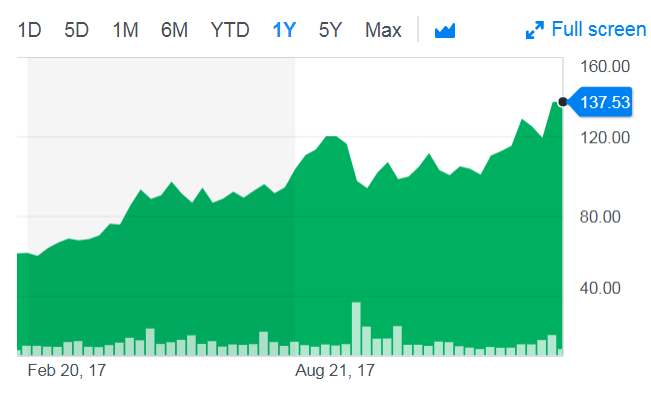
Shopify (SHOP: $138, up 15%)
Another stock crushed earnings for us this week. Shopify. Revenue of $223 million was up 71% from a year ago. EPS was a loss of $0.16 versus a loss of $0.12 a year ago.
2017 was undoubtedly the company’s best year yet. There was exceptional top line growth, but also immense learnings that will drive meaningful progress in terms of product and geographic expansion in the future.
The proof is in the pudding. Fourth quarter is the seasonally strongest of the year with the holidays. Shopify’s merchants sold more in this fourth quarter than in all of 2015, in fact doing $1 billion of sales over just a 4-day period.
For all of 4Q, Shopify’s merchants sold $9.1 billion, an increase of 65% or $3.6 billion from a year ago. This is the definition of sales flying off the shelf. The more Shopify’s merchants sell, the more opportunity there is for Shopify shareholders to make money.
BMR Take: Shopify is a clear leader in commerce, that is building scale, realizing strong growth consistently, and the firm is now considering additional product and geographic expansion to sustain these explosive growth rates for a long time. Revenue is set to double from $675 million in 2017 to $1.4 billion in 2019.
Our Target has been $125 and we wanted to make sure it smashed this target before we raised. Well, “smashed” is the right word here, as the stock shot higher to $140, before dropping a tad on Friday. Yup – an all-time high – never been higher. The company is now worth $14 billion and anyone buying the firm would have to pay $20 billion and we think that management would probably fight any buyout at that level. Why? Because they feel like we do that the company will be worth $30 billion someday. What? Yes. You heard it here first - $250 a share. (We didn’t say when!)
We hereby raise the Target to $160 and the Sell Price from $105 to $122.
----------------------------------------------------------------------------------------
Square (SQ: $44, up 11%)
The one and only CEO of two publicly traded companies at the same time, Mr. Jack (Billionaire) Dorsey tweeted this week that Square’s Cash App is now up and running for instant buying and selling of bitcoin. We’ll cover the product below, but first the most important point needs to be made.
CEO’s like JP Morgan Jamie Dimon called bitcoin a fraud. Countless more expressed dissent or caution about the new sector. Regardless of what is the truth and what you or we think, the question to ask is what did Jack do? Well, he is already out with a product. It is undeniable that wherever the world is going in payments, Jack and Square are the NextGen warriors that are moving … and moving fast. The innovation is impressive.
According to Square’s Cash App, you can buy and sell bitcoin right from your Square Cash App. You have to fund it with a cash balance and have to read and agree to Square’s virtual currency terms of service, prior to proceeding. Interestingly, the terms of agreement are very onerous giving Square the right to withhold payments if fraud is suspected, for example.
BMR Take: We see Square growing revenue from just under $1 billion 2017 to $1.3 billion in 2018 driving EPS growth from $0.25 to $0.45 over the period. To be honest, we care a lot more about the long run revenue growth than the EPS picture. Visa’s market cap is $275 billion. MasterCard’s is $185 billion. Square is only worth $17 billion today and we believe the company can easily chip away at these giants to find strong growth over the next 10 years.
----------------------------------------------------------------------------------------
Splunk (SPLK: $93, up 7%)
Splunk was up but did not participate in the broad equity market rally as much as it should have. What’s the deal?
The big news was selling by key stakeholders. Activist Jana Partners was a large 5% holder. They exited completely. It was also reported that a Senior VP sold a big block of his stock. Several other prominent investors sold out, like Sands Capital, Clearbridge, and Winslow Capital.
You just have to take note of insider selling. There is no reason to fall in love with any stock. When money has been made, recycle it into the next idea when the time comes.
BMR Take: Splunk is covered by 43 Wall Street analysts. 80% rate the stock a buy. However, the average price target is only $92. (Our Target is $95 which it just hit this week.) With the stock up about 50% over the last year, we are taking a closer look at rotating into a new idea. The risk we see is that with big owners selling, and analysts not raising target valuations higher, we could be in a big correction in sentiment.
So, with that said, we are hereby raising our Sell Price from $83 to $88. If it falls to this level, we are out. Having added the stock at $46 in 2016, we are up exactly 100%. We want to make sure we don’t lose these gains.
----------------------------------------------------------------------------------------
Amazon (AMZN: $1,449, up 8%)
Amazon seems to announce a new disruptive business idea every week. This week Amazon is looking to expand its medical supplies Amazon Business marketplace offering to serve the Healthcare industry. Amazon is pushing to turn its nascent medical-supplies business into a major supplier to U.S. hospitals and outpatient clinics that could compete with incumbent distributors of items from gauze to hip implants.
Amazon has been making moves and dramatically disrupting the Healthcare industry over the last year. In October, analysts and the media noticed that Amazon was granted wholesale distribution licenses for medical devices in several states. CVS Health announced in December it will acquire Aetna for about $69 billion in cash and stock. Many Wall Street analysts said the merger was triggered by concerns Amazon will enter the drug business. Last month, Amazon, Berkshire Hathaway and J.P. Morgan Chase announced a partnership to cut health costs and improve services for employees. The announcement was light on details, but said three top executives from each company will take the lead on the project.
BMR Take: The stock was up $110 this week to another new all-time high! It’s leader is the richest man in the world by far, at $121 billion. Amazon just won’t stop. The company is an innovation machine. They are disrupting new industries seemingly every week. Essentially the company is the world's biggest start-up. There could be $50 billion or more of revenue down the road to come from Healthcare. We say you just have to have Amazon in your portfolio. We know it can look expensive on current revenue and earnings, but we don't know who Amazon will grow up to be yet. It's all still developing.
----------------------------------------------------------------------------------------
AstraZeneca (AZN: $34, up 4%)
There was a big drug development this week. According to the FDA, AstraZeneca has been granted Orphan drug designation for selumetinib (MK-2206 & AZD6244) for the treatment of Neurofibromatosis Type 1 (a disease causing tumors on nerve tissue). AstraZeneca and Merck collaborated to investigate the combination of the two compounds. All development costs are shared jointly. FDA orphan drug designation is primarily a function of the disease not the drug - drugs that target diseases with fewer than 200,000 US patients will be granted orphan designation, and in some cases drugs targeting more than 200,000 patients can be granted the designation when the FDA judges that costs could not otherwise be recovered.
The bigger driver right now is the oncology business. While the company has gone all-out in immuno-oncology, there is more work to be done. The potential of the broader cancer portfolio should see growth in 2018, in part by acquisition. We are excited to see new data and potential acquisitions related to immune-oncology this year. Remember, we are in a new era of fighting cancer that is honestly more exciting to think about than just simply what it means for stocks. It’s a big deal for the world.
BMR Take: We feel AstraZeneca is a strong value here. Revenues are steadily running around $16-17 billion annually. EPS is closing in on $3. Many argue the stock could be worth 20x EPS or more. And you get a 4% dividend yield while you wait. This feels like a profitable situation to us. And if we are wrong, it is hard to see the stock trading too much lower as the dividend yield should hold the stock up.
----------------------------------------------------------------------------------------
----------------------------------------------------------------------------------------
Economic Calendar
Existing Home Sales
Wednesday, February 21st, 10:00 AM
Period: January
Consensus: 5,600,000
Prior: 5,570,000
Initial Claims
Thursday, February 22nd, 8:30 AM
Period: 2/17
Consensus: 230,000
Prior: 230,000
Leading Indicators
Thursday, February 22nd, 10:00 AM
Period: January
Consensus: 0.65%
Prior: 0.60%
----------------------------------------------------------------------------------------
----------------------------------------------------------------------------------------
A Word from Gary Jefferson
Jefferson Financial Group
First Vice-President, Investments
UBS Financial Services, Inc.
Let’s talk about the recent volatility and what happened, why and what's next, and put it all in a historical perspective. The bottom line is that, from peak to trough, the S&P 500 fell 10.2% this month, while the VIX volatility index (^VIX: 19, down 33%) spiked to multi-year highs. We believe that the selloff itself was largely technical in nature, driven by forced selling among investors employing systematic strategies. These strategies are compounded (negatively, in our opinion) by the fact that there are now 5,025 exchange-traded funds (ETFs) trading globally and 9,510 publicly traded mutual funds that are all tied to computerized systems causing redemptions and liquidations of stocks during a market free fall. Yet, there are only about 4,000 companies that are actively traded on the NYSE or Nasdaq. Thus, ETF's and mutual funds outnumber available domestic stocks to own by nearly 4 to 1.
Whether the lows of this correction are in or not, volatility is baked into the cake – the numbers simply won't allow anything less than extreme moves whenever these "systems" are triggered. This brings to mind a quote from Peter Lynch, made nearly 30 years ago: "Everyone has the brainpower to make money in stocks. Not everyone has the stomach." Keeping emotions in check and sticking to the philosophy of being a "long-term" investor are more important today than ever before.
That said, from here, provided the fundamental economic and earnings growth picture remains unchanged (UBS forecasts 4.1% global GDP growth and 16% US earnings growth), we should still be confident that the market will eventually regain its footing.
----------------------------------------------------------------------------------------
Square is Upgraded on the Street
Nomura Instinet reiterated its buy rating for Square (SQ: $44, up 11%) and raised its price target to $64 from $48. This represents a substantial upside potential.
According to Nomura, Square is like Amazon and Google in their early days, meaning that it’s difficult to decode the company’s true potential using traditional valuation methods. Using a discounted cash flow model to value Square, Nomura gave it the highest price target on Wall Street. Amazon and Google have disrupted their industries of course, so this type of pronouncement carried some serious weight in our book.
Square is a financial technology company whose services span payment processing, cash transfer, investing, and lending, an area where it competes with PayPal and Amazon. Square has supplied more than $1.8 billion in loans since launching its credit service in 2014. PayPal and Amazon have loaned about $3.0 billion each.
Over $17 billion in payments processed
Nomura sees Square taking market share from its competitors, which could transform the company’s fortunes in the coming decade. Square processed $17.4 billion in payments in 3Q17, an increase of 31% from 3Q16.
BMR Take: If you’ve been reading The Bull Market Report you’ll know that we love this company and think a lot of its future potential. Our Target is $45 which it reached in November, a bit ahead of schedule. After a pullback at the end of last year which washed out a lot of non-believers, the stock has moved back nicely in the first six weeks of the new year. We can’t WAIT to move our Target up to $53! We are moving up the Sell Price from $32 to $38.

----------------------------------------------------------------------------------------
----------------------------------------------------------------------------------------
The High Yield Investor
By Michael Foster
VP, High Yield
The Bull Market Report
For the Bull Market Report portfolios, the story of the week was the multitude of earnings reports. Two reports came from our High Yield portfolio while the other two came from the REIT portfolio. The recap and analysis of these reports will be covered below, after a brief discussion of the broad market action over the past week. As we noted in last week’s summary, the quick drop in the S&P 500 Index was not a worrisome event. Fear might have taken control of your mind if you paid attention to the general financial media. If you didn’t, you probably saw many opportunities to add more to the positions in your portfolio. One prime example of this, which we’ll talk about in more detail below, is the situation with Apollo Commercial Real Estate Finance (ARI: $18.70, up 6%). The overall market drop pulled Apollo down by approximately 5% since the beginning of February, offering a fantastic price area to pick up shares before their earnings report.
With that said, it’s also true that short term price movements to the upside should not be immediately praised, just as one should not immediately become fearful when a drawdown occurs. While volatility may maintain a presence for the next few weeks, it should die down as the earnings season wraps up and investors realize how positive the 4th quarter was for most companies. Along with that note, inflation fears were slightly quelled after CPI (inflation) numbers were reported under the 2% mark at 1.8% for the month of January.
In relation to our portfolios, all signs are bullish. High Yield and REITs both lagged behind the market bounce last week, indicating slight caution among investors.
AllianzGI Equity & Convertible Income Fund (NIE: $21.53, up 4.5%) has been in line with the S&P’s rebound over the past week. Much of the increase can be attributed to the broad market. The fund’s investment in Tech stocks, in which it holds Microsoft, Alphabet, and Amazon, led to the strong performance for the fund, which comes during the best weekly gain for the Nasdaq since 2011.
Let’s dive deeper into Apollo’s report. As stated above, the dip prior to earnings ended up being a great opportunity and we should be content with this position. The Q4 results were stellar. While the company posted a 29% YoY growth in NII of $69 million, beating the consensus estimates of $68 million, it firm also posted an EPS of $0.12 against the consensus estimate of $0.10. Full-year operating earnings (backing out the CMBS sale – see below) of $191 million or $1.89 per share vs. $137 million in 2016 also helps maintain the bullish thesis. The total loan portfolio at the end of the year was about $3.7 billion, with a weighted average remaining term of 2.8 years and all-in yield of 9%. The company announced dividends of $0.46 per share, which translates to a dividend yield of 10%. The ending book value per share was $16.30 with a P/B ratio of 1.1x. The company also got rid of its loss-creating CMBS portfolio, which had become a lesser focus for ARI. Although the sale of CMBS portfolio resulted in one-time losses, the event was viewed positively by analysts.
Digital Realty Trust (DLR: $102, flat), the second earnings report within the High Yield portfolio, had relatively poor performance compared with the broader market, based on poor Q4 results. It dropped over 3% after the announcement. While the company showed a 27% YoY growth in Q4 revenues to $730 million, the company reported FFO of $1.48, down 6% from the year ago period of $1.58. These numbers led to a small drop in share price. Guidance is generally more important and this area left us reassured: the company reiterated a 2018 outlook for core FFO/share of $6.50 and EPS of $1.50. These numbers were based on assumptions of total revenues equaling $3.1 billion, and adjusted EBITDA margins of 59%.
Invesco Municipal Trust (VKQ: $11.90, up 2%) lagged slightly behind the broader market for the week, with no significant news to note. Nuveen Municipal (NVG: $14.45, up 2%), another fund with major investments in US investment grade municipal bonds, also ended up a bit for the week. We’ll take it. Little by little.
As we move on to the REIT portfolio, one should keep the CPI data that we noted above in mind. Annaly Capital Management (NLY: $10.68, up 5%) had a GREAT week. The company reported Q4 earnings, which was in-line with the consensus estimates. The interest income was down 7% YoY to $745 million in Q4, while core EPS was at $0.31 per share vs $0.30 per share in Q3. The ending book value per share, $11.34, was up from $11.16 in 2016. This represents the stock trading at a significant discount to its book value, so we are in no way paying a premium for this company with an 11.3% dividend yield. In fact, Annaly was another example of the general market in the large February drawdown pulling down a solid company, falling to $10.03 a week ago Friday when the S&P hit its lows. This drop provided prudent investors with bargain prices.
Government Properties (GOV: $16.10, down 2%) underperformed the market. The company posted a 52-week low of $15.63, although it recovered 3% at the close of the week with a sudden spike in volume during the last trading day. The spike should be viewed favorably, as it was the highest level of volume since mid-2017. When selling or buying occurs on small amounts of volume, the movement shouldn’t be taken as seriously as when large volume appears. Since this spike in volume corresponded with buy orders, we remain confident about the position.
Omega Healthcare Investors (OHI: $26.74, up 2%) didn’t fare especially well after posting its Q4 results and 2018 guidance, although the drop was a meager 2%. The company posted Q4 FFO per share at $0.77, in-line with estimates and slightly worse than the $0.84 per share one year ago. Rental revenue was flat at $194 million and missed the consensus of $220 million. The company guided full year FFO for 2018 at $3.00, much lower than the $3.60 reported in the current year. The company stated that 2018 would not be a growth year due to its strategic re-positioning of assets, with an estimated $300 million worth of assets to be sold in 2018. The company increased the dividend to $0.66, leaving the annual yield at close to 10%. However, the company highlighted challenges in increasing the dividend in 2018.
Owning this company requires patience. In past newsletters we’ve highlighted the events occurring within the company, from missed payments by Signature HealthCARE to the Orianna developments. During the earnings conference call, executives made sure to note considerable progress being made with Signature. The firm is in good hands and we can sit tight knowing the attractive dividend yield is being covered nicely by cash flow.
Good Investing,
Todd Shaver, Founder and CEO
The Bull Market Report
Since 1998
February 13, 2018
by Todd Shaver | Feb 13, 2018 | Earnings Preview 6 AM, Earnings Preview 6 PM
Twilio (TWLO: $26)
Bull Market Report Target Price: $47
Bull Market Report Sell Price: $29
Earnings Date: Tuesday, 5:00 PM ET
Consensus: 4Q17
Revenues: $103 million
EPS: -$0.06
Year Ago Quarter Results
Revenues: $82 million
EPS: $0.00
Key Things to Watch For in the Quarter
Analysts expect Twilio to report a 25% increase in revenues with a small earnings deficit for 4Q17. Despite beating analyst estimates in each of the past four quarters, the stock is down 25% since this time last year. We believe this sell-off has provided investors with an even better opportunity for entry as we are still very confident in the firm’s ability to provide value to both its customers and its shareholders.
We are continuing to be very patient with this company as it continues to grow revenues in the 25% range. We are lowering our Target from $72 to $47, a double from where it is now. We still think it is possible for the stock to hit this number this year. And the Sell Price of $29 is above where the stock is. This price is here for you to decide what to do. We're sticking with Twilio. We're going to be right in the end. Big time.
-----------------------------------------------------------------------------------------
Omega Healthcare Investors (OHI: $26)
Bull Market Report Target Price: $45
Bull Market Report Sell Price: $28
Earnings Date: Tuesday, After market close
Consensus: 4Q17
Revenues: $223 million
EPS: $0.42
Year Ago Quarter Results
Revenues: $195 million
EPS: $0.63
Key Things to Watch For in the Quarter
Omega is expected to report a 14% increase in revenues and a 33% decrease in earnings per share for 4Q17. The stock currently trades down 17% since this time last year, which was partly caused by the firm’s inability to beat analyst estimates in two of the past four quarters. Omega trades at a PE of 34 and has a 10% dividend yield making it one of the more attractive stocks in our REIT portfolio. The economy continues to hold strong, and we expect that a firm with management like Omega will be able to turn around its performance in 2018.
-----------------------------------------------------------------------------------------
Annaly Capital Management (NLY: $10.30)
Bull Market Report Target Price: $12
Bull Market Report Sell Price: $11
Earnings Date: Wednesday, After market close
Consensus: 4Q17
Revenues: $675 million
EPS: $0.29
Year Ago Quarter Results
Revenues: $805 million
EPS: $0.30
Key Things to Watch For in the Quarter
Analysts expect Annaly to report a 16% decrease in revenues and a 3% decrease in earnings per share for 4Q17. The stock is down 5% over the past year. Although analysts are predicting a slowdown in the growth and earnings of the firm, we still believe the stock is undervalued. The stock yields 11.7% which is a great return in this volatile market.
The stock is down from its highs in August and then again in December, as the volatile interest rates have taken their toll. But we are strong believers in the ability for management to weather any move in the interest rate environment. In fact, at this lower price, we only see the stock moving higher from here this year.
-----------------------------------------------------------------------------------------
Andeavor (ANDV: $98)
Bull Market Report Target Price: $120
Bull Market Report Sell Price: $95
Earnings Date: Friday, 8:30 AM ET
Consensus: 4Q17
Revenues: $11 billion
EPS: $1.13
Year Ago Quarter Results
Revenues: $6.5 billion
EPS: $0.03
Key Things to Watch For in the Quarter
Andeavor is expected to report a 70% increase in its revenues and a $1.10 increase in earnings per share for 4Q17, after a very poor earnings quarter last year. The stock has beaten estimates in three of the past four quarters and is trading up 10% over the past year. 2018 has been a rough year thus far for Andeavor, as the stock has fallen 19% since the beginning of the year. However, we see this as a great entry point especially ahead of earnings on Friday, as we believe the firm is poised to beat estimates and regain some of its losses from this year.
