
The Weekly Summary
Have equity markets come too far too fast this year? Year-to-date the S&P 500 is up 12%. We are certainly not ringing any alarm bells. Rather we note that the market can’t just go up in a straight line for extended periods. While stock indexes ended the week higher, the underlining story is we are seeing the steadiest outflows of cash since 2009. Even as the S&P 500 clawed its way to a fresh record and squeezed out a third consecutive weekly gain, signs of fading enthusiasm in U.S. stocks have become increasingly difficult to ignore. The latest can be seen in the SPDR S&P 500 Trust, the biggest exchange-traded fund tracking the U.S. equity benchmark. As of Thursday, investors had pulled $3.8 billion out of it in July. That puts the fund on pace for a fourth consecutive monthly outflow, which would be the longest streak since the start of the bull rally in 2009. This push and pull will continue of course. The S&P 500 touched new highs this week before retreating as an intensifying investigation into President Donald Trump stoked concern that his economic agenda may stall. We expect more of the same in the week ahead.
However, there is always a bull market here at The Bull Market Report! This week we highlight some of our favorite stocks: Microsoft, Visa, Athenahealth, Netflix, and Blackstone. We believe in these companies.
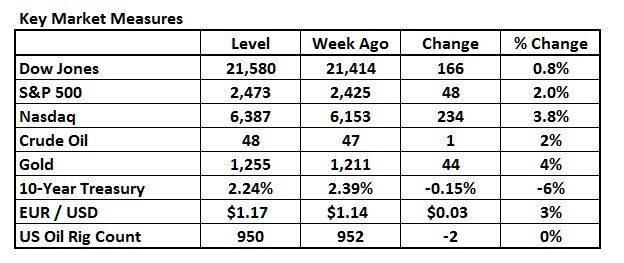
Highlights From The Past Week
Tech Index Eclipses Record From Dot-Com Era. Tech stocks broke a nearly two-decade-old record this past week. The S&P 500's Information-Technology sector ended the day on Wednesday at 992.29, closing above its previous all-time high of 988.49 set in March 2000 at the peak of the dot-com bubble. Tech stocks are by far the best-performing among the index's 11 sectors this year, up 23% after posting their ninth consecutive day of gains Wednesday.
Bank of America Chooses Dublin for Main EU Hub After Brexit. Bank of America has picked Dublin to locate its main European Union hub in preparation for Britain quitting the bloc in 2019, the latest global bank to finalize its contingency arrangements after Brexit. The bank will move some roles from London to the Irish capital and other cities across the EU. Bank of America already has a fully licensed operation in Dublin, and employs more than 700 people in the country. London has flourished as a hub for global finance in part because firms based in the capital have the right to do business across the 28-nation EU. British banks, as well as firms from the U.S., Japan and other non-EU countries with a base in London, stand to lose this “passport” after Brexit and may need to channel business throughout other locations in the bloc.
Dublin is the second most popular destination, after Frankfurt, for Financial Services companies seeking uninterrupted EU access post-Brexit. The city provides a low-tax English-speaking location and has similar laws and regulations to its U.K. neighbor. It is fascinating to watch the evolution of the European Union and what it means for business. There are certainly major changes ahead for companies.
Draghi Says ECB Isn't There Yet as Inflation Lag Takes Time. Mario Draghi said policy makers are still waiting for inflation to catch up with the economy’s recovery, as they put off any discussion on winding back stimulus until after the summer. Specifically, he said the EU is finally experiencing a robust recovery where one only has to wait for wages and prices to follow course. “We need to be persistent and patient and prudent, because we’re not there yet.” While the ongoing economic expansion provides confidence that inflation will gradually glide toward levels in line with the inflation aim, it has yet to translate into stronger inflation dynamics. A very substantial degree of monetary accommodation is still needed for underlying inflation pressures to gradually build up. What does this all mean? Continued easy money policy from Europe’s central bank is a big benefit for global equity markets including the US. Good for the US stock markets.
Congress Must Avoid Spooking Markets on Debt Limit. The U.S. debt limit needs to be raised in a calm, thoughtful manner that steers clear of political uncertainty that would spook markets. But will they do it? Congress must avoid any political standoff that could set in motion disruptive activities such as a need to choose which bills to pay and which to delay. The government will reach its statutory limit on borrowing in early October. President Donald Trump’s administration has asked Congress to raise the ceiling before then. Concerns have surfaced in the Treasuries market, with traders willing to pay more for bills maturing after October 19th to avoid being caught holding securities vulnerable to a technical default. Watch for the upcoming political discussion over the debt and let’s hope it doesn’t get contentious.
BMR Companies & Commentary
Microsoft (MSFT: $74, up 1% - all prices in the newsletter are for the week)
The company reported earnings this week. Revenue of $25 billion beat the consensus by 2% while EPS of 98 cents beat by a big 27 cents. Analysts were positive on the quarter itself, especially around commercial cloud and commercial bookings which both came in nicely above Street expectations. Commercial cloud growth accelerated and is also experiencing margin expansion which is helping increase both operating income and free cash flow generation. Some went further and talked on how Microsoft looks to be taking share from Amazon Web Services (AWS) and is becoming a larger force in the space.
Despite the strong revenue quarter, operating expenses came in higher than expected and the company is also seen to have a higher tax rate than estimated. On top of this, some wanted to see the “billings beat” seen in the quarter to flow into greater revenue guidance for Q1.
The cloud business – Azure - was the main story from the quarter due to 30% growth in commercial bookings. Office 365 and servers were both healthy, and execution on renewals was strong.
BMR Take: All in all a very solid quarter from Microsoft. The stock hit NATHs* this week and we see NATHs ahead. We believe the stock will hit $80 in the coming months, which represents 20x EPS. The market cap is now $570 billion, only topped by Apple at $780 billion and Google at $680 billion.
*NATH – New All-Time High
Visa (V: $100, up 3%)
Visa reported strong earnings. EPS beat on stronger revenue and the company raised expectations for the forward outlook.
Visa reported EPS of $0.86, $0.05 ahead of the Street. Visa is now guiding to approximately 20% EPS growth, which compares to the "high end of mid-teens" growth which was issued previously.
From management at the earnings announcement: “Results reflect strong growth in payments volume, cross-border volume, and processed transactions, which were powered by economic tailwinds in the U.S. and globally. Results and growth reflect the company’s strategy to pursue the conversion of cash and checks to electronic payments in partnership with our clients around the world.”
The story at Visa has been strong for decades and not much has changed. And that’s a good thing. Visa is a global payments technology company working to enable consumers, businesses, banks and governments to use digital currency. Visa connects billions of consumers, businesses, banks and governments in more than 200 countries and territories worldwide. The company is as close to an unstoppable machine as can be at this point.
Take a look at this chart of Visa for the past nine years:
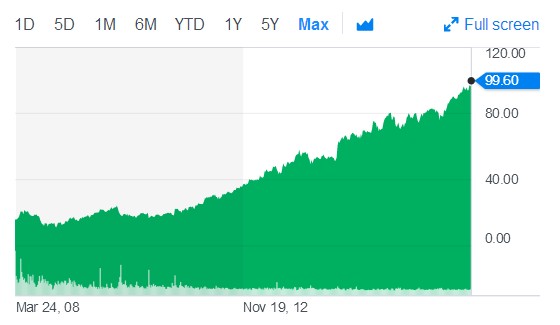
With a market cap of $230 billion, it is one of the greatest companies in the world. We would highly suggest you own some.
BMR Take: Consensus now sees EPS closing in on $5.00 in the next 1-2 years. With EPS growth running 20%, valuation looks awfully compelling to us still. We added the stock in early 2016 at $70. Our current Target is $95 which it has blown through this month, so we hereby raise our Price Target to $110. Our Sell Price remains “We would not sell Visa.”
Athenahealth (ATHN: $156, up 9%)
Athenahealth delivered an exciting quarter. The company believes it is at a key inflection point in its history and that 2017 will be a productive year for building out what differentiates them in the market. The company is demonstrating the power of its co-source model by simplifying and reducing client work. It’s building a new hospital service. It’s re-platforming AthenaNet. It’s grown its network to 100,000 providers, 98 million unique patient records, and 2.8 million covered lives, and is now positioned to be healthcare’s first true technology company. Stellar!
So many highlights from the quarter to discuss. Revenue increased 15% from last year to $293 million beating the consensus by $2 million. EPS of $0.51 crushed the consensus estimate of $0.39.
Moreover, the company continued the implementation waves at New York-Presbyterian Medical Groups, Adventist Health, and Tenet Health. The company gained access to the Centers of Medicare and Medicaid Services (“CMS”) claims data in certain states as a CMS Certified Qualified Entity. The company acquired Praxify Technologies to advance its platform strategy and mobile capabilities and accelerate its research and development initiatives by leveraging Praxify’s powerful app development platform. We could go on and on…
BMR Take: Athenahealth is a sleepy, off-the-radar company that is now firing on all cylinders. There is real upside potential ahead. Recall, big time activist investor Elliot Management has taken a stake in the company. Could we see all-time highs ahead which would be near $200? We feel this is a more than small probability.
Netflix (NFLX: $189, up 17%)
Netflix just does what it always does: Crushes expectations and the naysayers. The company delivered EPS of $0.15 just missing the consensus by a penny. But revenue of $2.8 billion was on the mark. The big story was the strength of subscriber growth and that was enough to send the stock soaring.
Netflix added 5.2 million net new subscribers in the June quarter vs. Wall Street's consensus estimate of 3.2 million. It also guided higher for the current quarter, with a forecast of 4.4 million net new subscribers, topping the consensus view for 4.0 million. This is huge subscriber growth. The company ended Q2 with 104 million subscribers worldwide, including 52 million in the U.S. and 52 million in foreign markets. Netflix's international streaming subscribers topped those in the U.S. for the first time.
Domestic net additions of 1.1 million represented the highest level of Q2 net adds since the second quarter of 2011. Better yet, Q3 guidance assumed much of this momentum will continue with the caveat that management is cognizant of the lessons of prior quarters when its over-forecasted.
The underlining fundamental story remains rock solid. With its content strategy paying off in strong member, revenue and profit growth. Management continues to believe that it is wise to continue to invest. In continued success, Netflix will deploy increased capital in content, particularly in owned originals, and, as management has said before, the business is likely to remain free cash flow negative for many years. That’s what it takes to build greatness!
The entertainment market is so broad that Netflix has now grown from zero to over 50 million streaming households in the US over the last 10 years. Netflix is growing with an expanding market, being co-pioneers of internet TV. The future is quite exciting.
BMR Take: Netflix is a premier growth story. The long term potential opportunity is quite big and we are still so early. This is one stock you just have to figure out how to own and hold onto.
The Blackstone Group (BX: $34, flat)
Blackstone delivered a decent quarter. EPS of $0.59 was just light of the $0.62 consensus. But revenue of $1.55 billion beat the $1.50 billion consensus. Total assets-under-management (AUM) was a ridiculous $370 billion. The $0.54 dividend was paid, giving the stock a dividend run-rate of 6.5%.
Management noted that it is continuing to see the benefits of its sustained large-scale capital deployment around the world, a patient focus on value creation in those investments, and then being able to choose the right moment to exit. They expect this momentum to continue. With pending realizations, including the historic sale of its European logistics portfolio, the company is on track for one of the best years for cash distributions to shareholders in its history. Wow!
In particular, the CEO said, the company’s distribution should not be viewed as one-off special dividends. They have demonstrated an ability to deliver consistently high payouts over time. Over the past three years for example, the company has distributed an average of nearly $2.50 per year, driven by over $130 billion of gains on investments.
BMR Take: EPS is running around $3.00 so the PE multiple is just over 10. The dividend yield strong and management is saying they can deliver you this dividend in the future as they have now done it now consistently for many years. We see compelling value here.
Upcoming Economic News
Existing Home Sales
Monday, July 24th, 10:00 AM
Period: June
Consensus: 5,560,000
Prior: 5,620,000
Consumer Confidence
Tuesday, July 25th, 10:00 AM
Period: July
Consensus: 116.0
Prior: 118.9
Note: The Conference Board's Consumer Confidence Survey is a monthly measure of the public's confidence in the health of the U.S. economy.
New Home Sales
Wednesday, July 26th, 10:00 AM
Period: June
Consensus: 615,000
Prior: 610,000
GDP
Friday, July 28th, 8:30 AM
Period: Q2
Consensus: +2.5%
Prior: +2.1%
Wall Street Consensus for Apple (AAPL: $150, up 1%)
Ratings Breakdown: 9 Hold Ratings, 39 Buy Ratings, No Sells
Targets
Wall Street Consensus Price Target: $16
7/22/2017 Wells Fargo $140
7/21/2017 Guggenheim $180
7/17/2017 Morgan Stanley $182
7/12/2017 Goldman Sachs Group $170
7/12/2017 Merrill Lynch $180
7/10/2017 Canaccord Genuity $180
7/9/2017 Credit Suisse Group $170
7/6/2017 Drexel Hamilton $202
BMR Take: Buy.
Wall Street Consensus for Opko Health (OPK: $6.59, up 8%)
Ratings Breakdown: 2 Hold Ratings, 6 Buy Ratings
Targets
Wall Street Consensus Price Target: $16
7/18/2017 Barrington Research $11
6/16/2017 Ladenburg Thalmann $19.50
6/12/2017 Jefferies Group $8
3/14/2017 Guggenheim $25
3/5/2017 Standpoint Research $14
1/3/2017 Laidlaw $19
BMR Take: We’re sticking with this one and are looking for a BIG upside. Look at what the brains of Wall Street think about the stock. We remain astounded that the stock has stayed down here for all this time. And the CEO and Founder just keeps buying shares.
Nutanix Insider Trading
We generally love it when insiders in a company are buying stock. Conversely, we get a little crazy when insiders are selling. Check this out about Nutanix (NTNX: $24), which had another great week, up 7%.
--- Director Jeffrey T. Parks sold 1,235,000 shares of the firm's stock in a transaction that occurred on July 14th. The stock was sold at an average price of $21.97, for a total transaction of $27,100,000.
--- Sr. VP Rajiv Mirani sold 20,000 shares of the firm's stock in a transaction that occurred on July 13th. The stock was sold at an average price of $19.63, for a total transaction of $400,000. Following the transaction, the senior vice president now directly owns 271,000 shares in the company, valued at $5,300,000. The sale was disclosed in a document filed with the Securities & Exchange Commission.
--- VP Kenneth W. Long III sold 30,000 shares of the firm's stock in a transaction that occurred on July 19th. The stock was sold at an average price of $24.00, for a total transaction of $720,000. Following the transaction, the vice president now directly owns 240,000 shares in the company, valued at $5,765,000. The sale was disclosed in a document filed with the Securities & Exchange Commission.
BMR Take: We are not happy about this. We want them to be buying the stock because as insiders, they know that the company is killing them and that the stock is going to go higher. This selling by insiders makes us very wary. We love this company and after adding the stock at $17.45 in late May, two months later we are up 36% and have high hopes for more gains. But our antennas are out do to these insider transactions and if the stock falls to the $22 level, we are out.
Amazon – A Discussion
People say Amazon (AMZN: $1,025, up 2.5%) is not making any money. The stock set a NATH this week and many see the stock peaking here, believing the stock is way over-valued since they are not making any money. We beg to differ.
The facts:
Profits the last five quarters, latest first:
$724,000,000
$749,000,000
$252,000,000
$857,000,000
$513,000,000
Revenues the past four years:
$136,000,000,000
$107,000,000,000
$89,000,000,000
$74,000,000,000
Check out this story about a new business to business website and operation in the UK and the US. This could be BIG:
http://www.businessinsider.com/interview-amazon-business-bill-burkland-017-7
A little survey on Amazon:
a) I have enough Amazon
b) I am thinking of buying more
c) I am going to buy more now
d) The stock price is too high – if they split I would buy some
e) The stock is way overvalued – their profits are too low and the PE at 190 is insanely too high.
Send your thoughts to us at Info@BullMarket.com
Home Depot, Best Buy Hit as Amazon Teams Up With Sears
Sears will sell Alexa-enabled Kenmore appliances via Amazon. But Whirlpool (WHR) and major sellers of appliances Home Depot (HD: $147, down 3%), Lowe's (LOW) and Best Buy (BBY) were hit. Home improvement chains Home Depot and Lowe's had been seen as Amazon-proof, or at least Amazon-resistant.
BMR Take: We are not ready to throw in the towel because of this one announcement, but we have to watch this development from Amazon. We added the stock to our Stocks for Success portfolio in early 2016 at $121 and are up 21%, so we don’t want to give up any of these gains. The market cap is $175 billion, they have $3.6 billion in cash supporting a sizeable debt load of $23 billion.
BMR Take: They are not going away anytime soon, but as noted above, Amazon is a monster that one needs to keep an eye on.
Google (GOOG: $973, up 2%)
July 3rd - $898. Today - $973. That’s an 8% move in three weeks.
BMR Take: Yes, they got fined big-time in Europe, but the $2.7 billion fine is peanuts to the company that has $92 billion in cash and virtually no debt, and makes over $20 billion a year. Yes, we have to watch the EU to see if there are any sanctions they will be putting on the company. But we believe the company will weather the storm and thrive. We await the break-through to NATHs of $988+ and raising our own Price Target from $1000 to $1100 or higher. Stay tuned. This just might happen sooner than you think.
Apollo Global Is Getting Ready to Take Security Firm ADT Public
Private-equity firm Apollo Global Management (APO: $28, up 2.5%) is preparing an initial public offering for ADT, just a year after it bought the home-security company.
The offering could value ADT at well over $15 billion, according to people familiar with the matter, making it one of the largest IPOs of the year. They paid $7 billion for the firm a little over a year ago. An offering would mark a quick turnaround for the private-equity firm, which began consolidating home-security providers two years ago.
BMR Take: This is just one example of the power of this firm. Apollo is way undervalued. With a 7% dividend, it's a joy waiting for a higher stock price.
The High Yield Corner
By Michael Foster
Special to The Bull Market Report
This week, we saw the AGIC Equity and Convertible Income Fund (NIE: $20) rise over 1% in the week thanks in no small part to a strong gain in the fund’s NAV. That increase was attributable to a solid week for the stocks in its portfolio, like Priceline (its second highest convertible holding) rising over 2% in the week. We’ve seen AGIC raise its equity exposure while using convertible bonds to provide a strong income stream throughout 2017, and that has resulted in two positives for investors. First, the dividend remains well-covered by investments; second, the fund has benefitted from this year’s bull market, despite how much many on the sidelines seem to hate this bull market. [That’s not us by the way. We like this bull market.]
The strong performance in the fund has helped its discount to NAV fall. This is the result of intense demand from investors for the fund, which is why the market price for the fund has risen over 11% YTD while its NAV has risen 6% over the same time period. We’re now seeing a discount of less than 10%, which is the fund’s highest since 2015. The AGIC fund has seen its discount shrink considerably from reaching a near 15% low in late 2016, which itself was an improvement from the near 20% discount at the start of 2016. This demonstrates continued interest in the fund from market participants, who see its 7.5% dividend yield as an attractive income stream, especially considering how sustainable it is.
Another Bull Market Report pick saw a similar gain this week. The Pimco Dynamic Income Fund (PDI: $30) rose nearly 1% for the week and is up 10% year-to-date. That’s not including the fund’s massive income stream, however. With an 8% yield from common dividends alone, Pimco Dynamic Income has already given an annualized return of 30%. Add in the special dividend and that number gets absolutely astronomic. This fund offered a similar return in 2016, thanks in part to its higher NAV but also thanks to investor demand. The fund has gone from a discount in 2016 to its current 7.4% premium to NAV, again indicating sustained demand for the fund from a variety of investors.
While diversified funds had a strong week, REITs were a bit less impressive. One of Bull Market Report’s top picks, Digital Realty Trust (DLR: $112), was flat for the week with little volatility. This is unusual; Digital Realty tends to bounce around a lot. But the fund has gone from a 6% yield in the past to now a 3% yield, thanks almost exclusively to its meteoric price appreciation. We’ve seen the stock jump 14% in 2017 alone, with 53% total capital gains in the last five years. It’s pretty obvious that, at this juncture, Digital Realty is no longer seen as a “high yield” risky opportunity, but is rather a low yielding REIT with long-term staying power. This makes sense; Digital Realty’s business of renting server space, is in no danger of shrinking anytime soon. This industry is also too new for us to determine whether it is cyclical or counter-cyclical. If it turns out that server space demand doesn’t go down during recessions in a cloud-computing world, then Digital Realty could quickly be perceived as one of the safest long term investments out there. For that reason, holding Digital Realty makes sense no matter what your investment profile or goals are, although the 3% yield is of course lower compared to many other REITs.
For instance, there’s Omega Healthcare Investors (OHI: $33), which also had a flat week with little volatility. Volume was much lower than average (nearly 50% of average daily shares traded). Omega has gone from a mid-8% yield to a mid-7% yield over the last couple of years, as investors have become much more aware of this stock. We’ve also seen the penny-per-quarter dividend jump continue, with dividend coverage ratios that demand respect.
There is much reason to believe this company is on solid ground, although the long-term and countercyclical sustainability of its business model (focusing on skilled nursing facilities - SNF) has been brought into question. Counterintuitively, we’ve seen an aging U.S. population be bad for SNFs for a variety of reasons. The relative wealth of aging baby boomers and the stigma associated with these facilities has made them much less popular than previous expectations. That, in turn, has put Omega and many of its peers under the spotlight, with mounting worries keeping stock prices muted (Omega is flat from a year ago and remains in the same range seen in late 2013). Five years ago and before, a lot of excitement around SNF-focused REITs drove price gains up a lot. The new perspective, and data from the industry, has kept investors more cautious.
Does this mean it’s time to sell Omega? Absolutely not. While the market is more competitive because demand is not as strong as previously expected, Omega Healthcare’s management has proven several times that they have the skill and acumen to identify and capitalize on those available opportunities in this tight market. The market, focused on the macro sentiment, has not priced in the premium that Omega Healthcare’s management should command. That makes them a buy, especially when the yield remains above 7%.
Looking ahead, investors should keep a close eye on the upcoming reports - Jobs, GDP, and Federal Reserve actions to come in late July and mid-August. This data is going to have a pretty significant impact on the future price trends for REITs and diversified funds. For now, however, The Bull Market Report’s High Yield stock picks look like solid holds, thanks to the high income stream and capital gains potential of a few of its constituents.
Good Investing,
Todd Shaver, CEO, Founder and Editor in Chief
The Bull Market Report
Since 1998