
The Weekly Summary
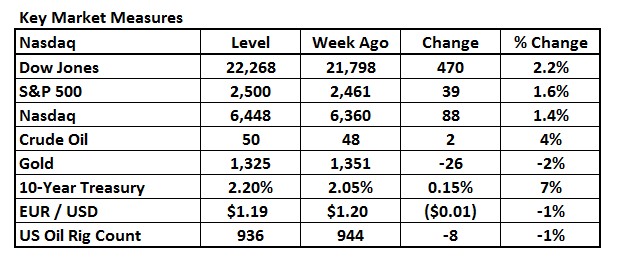
Equity markets ended the week up, again! New all-time highs were set Friday (again) with all three indices. The threat of conflict with North Korea can’t stop the bull market. Gridlock in DC isn’t shaking confidence. The unemployment rate is low. GDP growth is fair though under pressure from severe weather. It’s really a “Goldilocks” economy and a market backdrop of not too hot and not too cold. The biggest threat might simply be the Fed’s Janet Yellen who must unwind a $4.5 trillion balance sheet. The September Fed meeting is upon us and nobody is expecting a rate hike because of the pressures on GDP growth from weather. Though pay attention to plans for the Fed balance sheet as these moves could be worth as much as three rate hikes depending on the pace of unwinding. We are as eager as you to see what happens.
No matter what is happening out there, there is always a bull market here at The Bull Market Report! This week we highlight some of our favorite stocks where we think you can still make good money, including: First Solar, Apple, Twilio, Bristol-Myers, Amazon, Google, and Square.
BMR Companies & Commentary
First Solar (FSLR: $51, up 8%)
First Solar caught a lot of press this week as Deutsche Bank upgraded the stock to a Buy and said the stock is heading to the mid-60s.
What is there not to like? First, US demand is so strong it is driving pricing higher. Beyond the typical demand there is something else happening. Customers are flocking to make purchases ahead of the ruling on the section 201 tariff.
What is this? There is a high likelihood of the International Trade Commission finding injury in the section 201 case. This case basically makes a determination on the safety of the product. A favorable decision is expected to result in 2018 margins between 20 and 30%, against a 2017 rate of 17.5%. This regulatory relief for First Solar is welcomed!
Lastly, monetization of the phase 1 California Flats Solar Project coupled with the anticipated sale of the company’s stake in 8Point3 Energy Partners (CAFD: $14.49) could result in upward revisions to EPS estimate.
BMR Take: Putting it all together, First Solar is in the right spot at the right time. We recognized it early. Now we see a big Wall Street investment bank get behind the name. Yea! With EPS running around $2.50, the stock is not expensive here considering the quality and future of the franchise.
Apple (AAPL: $160, up 1%)
Apple unveiled its latest slate of new products on Tuesday including a new $1,000 iPhone that is sure to bring out aficionados of the company's devices when they arrive in local stores later this month and again in early November.
In a live-streaming event, Apple introduced a new version of its Apple Watch and Apple TV set-top box, plus two new phones, the iPhone 8 ($700) and a larger iPhone 8 Plus ($800) version. But the highlight was the iPhone X (pronounced “10”), a thin, sleek phone that has 3D face-recognition technology, a state-of-the-art camera, and a $1000 price tag -- double the price of the first iPhone that Apple introduced 10 years ago.
The other products will be available for pre-order starting Friday and should hit stores a week later.
The $1,000 price tag is causing all sorts of buzz. Will consumers pay that much? Well, most think so because you just make monthly payments through a plan and not a lump sum. Is there new technology that is exciting? Yes, from face recognition for security to the largest screen yet. All in all, the timing of the launch could push sales from 4Q to 1Q, but we expect Apple to sell a lot of phones.
BMR Take: Apple is going to do over $250 billion of sales this year. This is a staggering amount of money pouring into the company’s bank accounts from consumers who love Apple. Remember, as long as Apple continues to be a fan-favorite for customers, we think there is a huge opportunity for the company to do more and more services on top of selling hardware. The future is bright!
Remember, 65% of Apple is now the iPhone. And every new user is going right to the App Store to buy apps, increasing the Services business incrementally. Recurring income, baby. That’s what it’s all about.
We have a few notes we made from a research report from UBS Securities.
Apple Price Target - $180 (We are at $170) with a $195 potential upside.
iPhone growth in F18/19 – UBS expects double-digit unit growth in F18 and single-digit growth in F19 driven by a growing installed base and high retention rate. They expect a bulge of F15 iPhone 6 owners to upgrade in F18, creating a strong year if not a "supercycle." Supply and pricing could affect the degree of growth.
“Apple innovation to drive long-term revenue growth?
“Augmented reality (AR) is an area where Apple could leapfrog competition in offering a superior user experience. Features will take time to be released as the technology must reach a level of maturity suitable for Apple's brand. Other products like the Watch and AirPods are slowly
becoming material to the business and represent another way to monetize a loyal base of customers.
“The installed base continues to grow double digits and retention rates remain high. The retention rate for Apple above 80%, at a seven point premium to the Android retention rate. There is pent-up demand for the iPhone 8, with over a third of the base consisting of handsets older than two years old, the highest ever.
“Around the world Apple is gaining share everywhere except China. China remains a wildcard. Encouragingly, shipments to Mainland China stabilized in June. Our survey indicates interest in the next iPhone is similar to last year.
“At a P/E of 15x, Apple is trading at near an all-time high valuation. This suggests the market is pricing in a strong product cycle in F18 with double-digit EPS growth. It's also possible investors are gradually re-rating the multiple to recognize the strength and stability of the brand.”
Twilio (TWLO: $31, up 4%)
Twilio is one of the most exciting growth stories out there. And the CEO’s recent Bloomberg TV interview re-ignited our conviction in the story.
As you have been following the growth of Twilio lately, you’ll know it’s an exciting addition to the communications space. Twilio is a developer platform that powers communications for more than 40,000 global companies, including Netflix, Airbnb, and Lyft.
Twilio has emerged as a simple way for companies and software teams to begin adding communications capabilities to their applications in the form of text, video, and voice, providing companies with the flexibility that they need to implement more engaging customer experiences into their daily operations.
Twilio was built around the growing desire to provide a better customer experience for end-users and companies alike. Across numerous industries, enterprises have begun to recognize that the only way to truly differentiate their businesses from other competitors in the marketplace, is to give their customers an experience that is seamless, integrated, and engaging. Unfortunately, it’s difficult to achieve that level of service when your communication technology is not all run from one central place.
BMR Take: Sometimes the daily news is just noise. You have to step back and do a simple fundamental analysis. What does this company do? Why is the value proposition a winner? What is the big picture story? Twilio has this nailed in spades and the CEO provided a great reminder of that to the equity markets this week talking on Bloomberg.
Look at revenues for the past three years. $89 million in 2014. $167 million in 2015. $277 million in 2016. (Note: they’ve already done $180 million in the first six months of 2017.) With revenue growing greater than 30% and nearing $500 million, the momentum is there and we are still early. Repeat, we are still VERY EARLY on this company. Where is this company’s growth going to stop? (Hint: it isn’t.) Take a hard look at owning this company.
Bristol-Myers Squibb (BMY: $62, flat)
At Bristol-Myers, patients are at the center of the universe. The company’s vision for the future of cancer care is focused on researching and developing transformational Immuno-Oncology (I-O) medicines for hard-to-treat cancers that could improve outcomes for these patients. The I-O opportunity is a breakthrough for cancer, and Bristol is a key player.
Bristol is in fact leading the scientific understanding of I-O through its extensive portfolio of investigational compounds and approved agents. The company’s differentiated clinical development program is studying broad patient populations across more than 50 types of cancers with 14 clinical-stage molecules designed to target different immune system pathways. Bristol continues to pioneer research that will help facilitate a deeper understanding of the role of immune biomarkers and how patients’ tumor biology can be used as a guide for treatment decisions throughout their journey.
This week Bristol announced some good data on I-O drugs. This reaffirmed the market’s confidence is Bristol’s ability to execute on the important I-O market opportunity.
BMR Take: Bristol is a top franchise is the Drug industry. The stock has been badly beaten down for about a year but now is coming back, as top franchises always do. With nearly $4 of EPS potential, this drugmaker is a screaming deal in our view.
Amazon (AMZN: $987, up 2%)
The future is here and guess what? Amazon created it! Alexa, Amazon's voice-activated digital assistant for the home, has learned a new skill -- dispensing medical information about first aid from one of the best-known names in medicine, Minnesota's Mayo Clinic.
The information is accessible by speaking to the Amazon device, which users appreciate if they're busy doing something with their hands, like putting aloe on a burn or examining someone who has stopped breathing.
The device advises in its robotic-female voice to begin cardiopulmonary resuscitation for one minute and then call 911 if the person is unresponsive from suffocation. If the user asks for it, the device will go on to discuss specific techniques for doing CPR on an adult, child, or baby.
BMR Take: Amazon is the innovation machine and to see Echo break through into the medical field is a just another key data point about the possibilities of the future. With over $20 of future EPS power or more, Amazon is unlike any stock ever in the history of the world. We are strong believers in the future of Amazon.
Google (GOOG: $920, down 1%)
There is talk that Google is considering making a $1 billion investment in Lyft to take on Uber. This could be exciting!
Google and Lyft can really help each other. With the possibility of autonomous driving being central to its future, Lyft badly needs a solution. Google is considering putting up to $1 billion into Lyft in a move that would see it become one of Lyft’s biggest shareholders at a crucial time.
Lyft is far smaller than Uber and when it comes to market places that can be fatal. For money to be made, generally, one player needs to have 60% share or be twice the size of its nearest competitor. In the US, Uber has already achieved this hallowed status and in theory should be able to crush Lyft simply by applying sustained competitive pressure until Lyft runs out of money.
Google could be the solution for Lyft to emerge as a fierce Uber competitor.
BMR Take: Google is a tech giant, a robust franchise, and reasonably priced versus EPS of $40. The all-time high is $988, set in early June, so it is off 7% from that high. With driverless cars a key part of the future economy, and Google paving the way, we are excited about what a Lyft investment could mean and think the general market will be too if the deal is announced. UBS Securities has a $1,080 Price Target with a $1,410 upside. We have $1000 as our Target, but will raise it when it hits.
Square (SQ: $28.50, up 7%)
Square is at all-time highs. Last week we talked about Square getting into banking. That was all the buzz. This week Jack Dorsey, CEO, is talking a hard look at blockchain technology and what it could mean for Square. This company is on the leading edge of innovation all the time.
You’ve been hearing or reading a lot about blockchain but you probably still aren’t entirely certain how to define it. You’re not alone. It’s something that Jack Dorsey, the CEO of Square (and CEO of Twitter), describes as the “next big unlock”.
Blockchain is often defined as a ledger that enables secure, encrypted transactions. Some financial and technical experts have described it as analogous to the early days of the internet: it’s a framework or backbone for transactions.
But Dorsey also went beyond that interpretation of it, adding that the ability to “distribute and decentralize the ledger enables proof of work, and proof of one entity, in an untrusted network.” “Even if there’s a hostile entity or a mistrust in the network,” Dorsey continued, “we can still account for value creation and the transfer of values as well.”
BMR Take: If Square can get blockchain right, the company could take on the likes of Visa and/or MasterCard to change the world of payments how we know it. How exciting. This is sending the stock to new all-time highs and we are only at the beginning stages of Square’s life as a publicly traded company. Note that JP Morgan and Bank of America as well as Goldman Sachs are experimenting with blockchain. With a market cap of just $11 billion we see very big times ahead for this innovative company. And they could be bought out for $15-18 billion in a whisker by one of the big boys.
Upcoming Economic News
Housing Starts
Tuesday, September 19th, 8:30 AM ET
Period: August
Consensus: 1,175,000
Prior: 1,155,000
Fed Funds Target Upper Bound
Wednesday, September 20th, 2:00 PM
Consensus: 1.3%
Prior: 1.3%
Leading Indicators
Thursday, September 21st, 10:00 AM
Period: August
Consensus: 0.20%
Prior: 0.30%
BlackRock Consensus Ratings on the Street
(BLK: $429, up 3%)
4 Hold Ratings, 8 Buy Ratings
Consensus Price Target: $448
9/08/2017 Barclays $475
8/18/2017 Jefferies Group $440
7/18/2017 Morgan Stanley $476.
7/18/2017 Deutsche Bank $455
7/14/2017 Keefe, Bruyette & Woods $440
6/19/2017 Bank of America Corporation $450
BMR Take: Market cap is $69 billion. Huge. They manage over $5.7 trillion of assets. HUGE. All-time high is $443 set in July. We think this is easily breakable. The Street likes this stock. We like this stock.
Cloudera Consensus Ratings on the Street
(CLDR: $18.38, down 12%)
4 Hold Ratings, 4 Buy Ratings
Consensus Price Target: $23
9/8/2017 J P Morgan Chase $24
9/8/2017 Morgan Stanley $19
9/8/2017 Stifel Nicolaus $24
5/24/2017 Bank of America $23
5/23/2017 Raymond James $23
5/23/2017 Deutsche Bank $25
BMR Take: Bad week for Cloudera. The stock got hammered. They announced a follow-on offering of shares from the IPO they did in April. This is normal stuff – some shares will be sold by insiders and some by the company. No details yet. We are not concerned, although it would be nice to see the stock at $25 where it ought to be. Remember, this is a tiny company. Market cap is $2.4 billion – a puppy. Very speculative. But we are believers.
Andeavor (ANDV: $102, up 1%)
We have a note we made from a research report from UBS Securities.
“The recent Western Refining merger is expected to generate $350-
$425 million in synergies.”
Their Price Target is $116, with an upside to $125. Ours is $110, but if it hits that we would consider raising it.
Cryptocurrencies Update
Bitcoin had a wild week, closing at around $3500 on Friday. Bitcoin doesn’t really “close” as it trades 24-7. Bitcoin began a colossal price reversal on Tuesday that finally culminated with the latest $2,972 weekly low, which ended up becoming the new monthly low as well. The massive 32% reduction, was followed by a flurry of negative news coverage with China shutting down the biggest bitcoin exchange in the country and Jamie Dimon of JP Morgan saying that this is the biggest bubble since tulip bulbs in 1637. He said that the cryptocurrency "won't end well." Dimon was speak at a conference presented by CNBC and Institutional Investor.
Bitcoin hit $4,980 all-time high on September 1st. It plunged about 13% Thursday after one of the biggest exchanges in China said it will shut down its operation. Bitcoin surged more than 10% on Friday, but was still on track for a big weekly loss during a tumultuous period of trading.
JPMorgan's global head of quantitative and derivatives strategy, said in a note on Wednesday that in addition to being volatile and difficult to value, "another worrying aspect of cryptocurrencies are some parallels to fraudulent pyramid schemes."
But to be sure, many see bitcoin as a huge opportunity.
Former JPMorgan strategist Tom Lee said the cryptocurrency could surge another 600% in five years. "It's not worth it to look at bitcoin two months, two weeks ahead," Lee argued, saying he still believes each bitcoin will be worth $25,000 in five years.
We at The Bull Market Report find this whole story fascinating and have been following bitcoin and Ethereum closely. If you would like to know more about it, please write us here: Info@BullMarket.com.
Opko Health Update
Opko (OPK: $5.97) had a wild week. It rallied the first three days of the week, closing at $6.47 on Wednesday. Then it got hammered on Thursday and was flat on Friday. We have seen no news to account for this, but please note that this one is quite speculative. Opko has had to deal with disappointment on multiple fronts, including less-than-encouraging results in clinical studies and slow starts for approved drugs. Yet even though several institutional investors have thrown in the towel and given up on the company, Opko has strong potential for sales of its chronic kidney disease treatment Rayaldee to pick up. Moreover, Opko's diagnostic testing business has good prospects as well. Although the company hasn't executed well yet, some are optimistic. We have high hopes for the company but it is testing our patience.
The High Yield Investor
By Michael Foster
After a lot of good weeks, we’ve had a week that was - well, slow.
Almost everything in the Bull Market Report high yield portfolio ended the week flat, as investors focused on the big headlines (North Korea, Irma, etc.), which actually had minimal impact on any high yield investment.
This might be surprising, so let’s talk a little bit about why the big macro events aren’t moving the needle. You’d be right to wonder why municipal bonds, especially bonds in Texas, Florida, and nearby weren’t negatively affected by the hurricanes that have caused still undetermined billions of dollars of damage and human misery. In light of that tremendous destruction, municipal bonds barely budged. Even bonds issued in the hardest hit areas were unaffected. To take one example, Miami’s transit authority issues bonds are backed by the revenue received from toll roads, parking lots, and so on. Surely less travel to the city and less use of parking lots by tourists due to the storm will hit revenue and thus put these bonds at risk - yet their prices barely budged.
The reality is that municipal bond issues use a combination of insurance and risk management to plan for major catastrophes, especially in catastrophe-prone areas like southern Florida. The storms were severe, but Florida financiers and civil servants plan for these things as part of their regular work. So while the timing of the storms was a bit of a surprise, the reality of hurricanes hitting Florida every once in a while is priced into the municipal bond market.
Thus muni funds continue to have a strong year after last week’s relatively small price movements. Nuveen AMT-Free Municipal Credit Fund (NVG: $15.70, down -1%) took a very slight hit, but that was counterbalanced by the small rise in Invesco Municipal Trust (VKQ: $12.96, up 1%). The most important lesson to learn, by far, is that big catastrophic events don’t really hurt muni bonds - at least, not in the way that the mainstream financial press would like you to believe (since, after all, they’re desperate for controversy and know fear-mongering headlines get clicks and pageviews).
Moving on to taxable income funds, we saw more quietness among AllianzGI Equity & Convertible Fund (NIE: $20, up 1%) and PIMCO Dynamic Income Fund (PDI: $30, up 0%). There are a couple of things to note about both of these funds with regards to their pricing. The income stream for both remains somewhat reliable, although the Pimco fund’s net investment income has dropped significantly in 2017 (this, however, is being counterbalanced by an increase in NAV growth). What investors should focus more of their time on is the pricing. The Pimco fund is now priced at a 4.8% premium to NAV, which is significantly lower than the 10% premium that it reached earlier this year. A big drop-off in the premium this summer has caused that pricing to go closer to its historical norm, and a small premium to NAV is a lot more tolerable than 10%. For that reason, investors who like the Pimco fund and have been waiting to buy more are finally in a position where they can seriously consider adding to their positions. However, if you can wait for a discount to show up, you might be wise to wait for a bigger market sell-off to provide that opportunity.
As for the AllianzGI fund - its discount to NAV has been steadily disappearing throughout 2017, and we’re now at slightly less than a 9% discount, which is a relatively high price for the fund relative to its historical average. That means investors should be a tad more cautious about adding to their position right now, but the fund is far from a sell. We’ll need to see discounts of 5% before offloading this fund makes any sense at all. In reality, the fund’s continued NAV appreciation (NAV is up 6% even after paying its 7.5% dividend consistently over the last year, giving a total NAV return of over 13%) demonstrates that the fund’s management knows what they’re doing and are able to provide a stable, reliable income by picking the right stocks and convertible bonds and handing profits to shareholders. At the end of the day, we can’t really ask more from a fund.
So with all of the humdrum, low level action of the last week, let’s discuss the two stocks that actually had pretty big moves. The first is Digital Realty Trust, Inc. (DLR: $118, down -3%), which closed its DuPont merger and proceeded to fall significantly thereafter. We’re pretty much off the 52-week high hit on Monday, so it’s hard to say whether the decline is a result of profit taking or a lack of faith in the value of the merger. We see no reason to be skeptical of the merger, so we are not changing our view on the stock.
There is, however, one other issue with cloud-based REITs like Digital Realty - earlier this week, a Silicon Valley venture capitalist gave a presentation arguing that server size was about to decline significantly due to semiconductor and other technological innovations. Obviously, this will be bad for datacenter stocks - or is it? Considering the explosive growth in data storage and users’ tendency to fill up datacenters faster than the space needed to store data shrinks, demonstrates that this is a pretty specious reason to be bearish on datacenter stocks.
Finally, AstraZeneca (AZN: $32.50, 1%) took a bit of a hit earlier this week on little news. Again, this seems to be a bit of profit taking, considering the significant rise in the stock from a month ago. There’s little news about the company’s product pipeline or balance sheet to indicate caution, so we’ll wait and see how the stock performs next week before concluding this price movement is anything more than noise.
Good Investing,
Todd Shaver, CEO, Editor and Founder
The Bull Market Report
Since 1998