by Todd Shaver | Dec 27, 2017 | 11am News Flash
December 27, 2017
Welcome to the slowest week of the year. Four days of trading with half of Wall Street in the mountains of NY State, Vermont, Colorado or Utah. Or the flats of Florida. (We’ll take the mountains of Aspen any day.)
Some thoughts on Apple and Square as we head into 2018.
Apple (AAPL: $170) got hit this week due to a guess that a Wall Street firm made as to iPhone X orders. In fact, with news just out, Apple devices accounted for 44% of smartphone and tablet activations over the holidays, with nearly a third of those coming from new devices including the iPhone 8, 8 Plus and X. We think this is just stellar. And what Wall Street seems to be forgetting is that the iPhone X was being sold for just a short period of time during this quarter. Wait until the results come out from the quarter we are in! With the stock down 5 points over this “news,” we would be buyers here for sure.
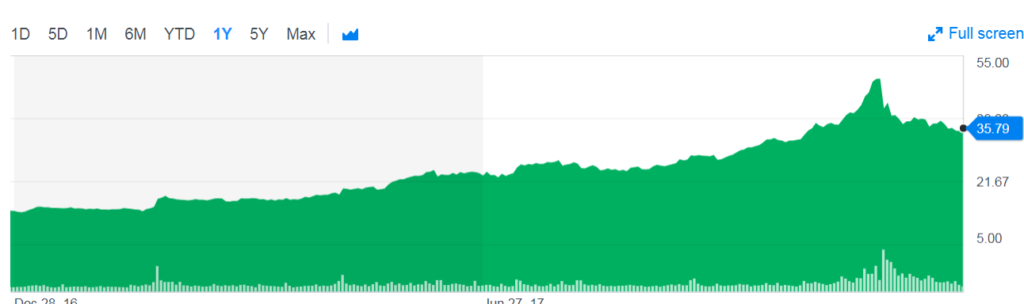
Square (SQ: $36) is down from its high a month ago when it hit $49, but if you look at this chart for the past 12 months, you can sit back and smile. The stock is strong today as we write this. We would be buyers here at this level and we think we will be smiling even more next Christmas.
We didn’t do a newsletter on Christmas Eve, but plan on doing one this weekend on New Year’s Eve. So go out and celebrate and think of us, as we’ll be hammering out the letter in our cozy little VRBO condo in Georgetown, DC, as we visit the kids and grandkids.
Good Investing this week and on into 2018!
Todd Shaver
by Todd Shaver | Oct 26, 2017 | 11am News Flash
Celgene (CELG: $97, down $22) reduced its 2020 sales guidance to range of $19 billion to $20 billion from its previous forecast of more than $21 billion. They also lowered their 2020 earnings-per-share guidance to more than $12.50 from more than $13.00. "In consideration of certain market dynamics and recent pipeline events, we are updating our 2020 outlook, and remain confident in our ability to deliver industry leading growth," Celgene CEO Mark Alles said in a company press release Thursday.
Celgene's profit did beat expectations, as income was $1.91 per share on sales of $3.3 billion, compared with $1.58 and $3.0 billion in the year-earlier period. Expectations were for $1.75 to $1.85 a share. But sales were light of the $3.42 billion expected.
Celgene expects full-year earnings in the range of $7.30 to $7.35 per share, with revenue expected to be $13 billion.
BMR Take: All of this sounds good, but Wall Street sure doesn’t like it and investors sold the stock heavily this morning. These kinds of things make us crazy. We added the stock last summer at $95 and it went to $147 just last month. And now we see this free-fall. Sometimes we think that investing in Healthcare is just too much trouble. Here we have a company that beat expectations, but says that things will slow down just a little in the future and the stock takes a dive. Very frustrating.
What should you do? We said this just three days ago in our weekly newsletter: We continue to believe in Celgene. But if you are worried, then get out of the kitchen. There are lots of other choices for your money.
But now we are $23 lower in price – very unfortunate, so if you don’t own it you can certainly get in here now, or if you do, you can punt, buy more or sit tight. The company still remains a powerhouse, is very profitable and a year from now when things settle down, the stock will probably have rebounded a bit. Not very comforting, as sometimes reality hurts.
by Todd Shaver | Oct 25, 2017 | 11am News Flash
October 25, 2017
Nutanix (NTNX: $27.40) has been on fire lately, moving up from $23 two weeks ago to $28 yesterday. It has fallen 50 cents today as the market is getting hit hard. We wondered why the stock was doing so well and then found out that Fidelity Management & Research loves the company. They have disclosed ownership of 20.3 million shares of Nutanix, representing 19.65% ownership of the company. In May they had 14.8 million shares, showing an increase of 37% in 3-4 months. Wow.
In our many years on the Street we haven’t seen anything quite like this. We’ve seen these big mutual fund companies owning 2% of a company and even 5%, but 20%? We just can’t remember anything like this.
Our Take – two things: 1) They must be reading The Bull Market Report. Smile. And 2) This is really good news. Listen, we love this company and expect big things ahead. Revenues last quarter were up 61% from the previous year - $226 million vs. $140 million, and that was up 18% sequentially from the previous quarter. This is just stellar in our book. But their Selling/General/Admin expenses are way too high, causing them to be in the negative profit-wise, but remember, this is a company banking on the future. With $350 million in cash and no debt, we’re not worried. We’re willing to give them a year to bring profits to the bottom line to go along with this company that is shooting for $1 billion in revenue for their fiscal year ending July 31st, 2018. That’s right around the corner.
But because of the no-profit situation, expect the naysayers and sellers to cause volatility in the stock before it reaches our Target of $30 and our ultimate Target of $50 or higher.
by Todd Shaver | Oct 11, 2017 | 11am News Flash
October 11, 2017
We hope you have some Nutanix (NTNX: $26.50, up 4% today.) We’ve been beating the drums on this one for months and now it has finally begun to stir. The stock was at $22 on September 28th and it has had a stellar rally since then. It is up again today. It’s not a new all-time high as the stock went wild after its IPO in 2016, but that $44 level is not out of reach. The market cap is only $4 billion, so it has a long way to go higher.
As you know, we believe revenues are key. Look at these numbers for the last three years: $240 million in fiscal 2015 (ended in July), $445 million in 2016, and $765 million in 2017. That’s powerful growth in our book. In fact, last quarter saw $225 million in revenues, so that equates to a $900 million+ run rate for the coming year. $1 billion is not out of question. They spent $70 million on R&D so that huge number is holding them back from profitability, but profits will come in time. Have faith.
What do they do that is so good? They provide an enterprise cloud operating system. They address a range of workloads such as enterprise applications, databases, virtual desktop infrastructure, unified communications, and big data analytics. They serve customers in a range of industries comprising automotive, consumer goods, education, energy, financial services, healthcare, manufacturing, media, public sector, retail, technology, and telecommunications.
Wow, that’s a mouthful. But with revenues growing 70% a year, and Amazon and Microsoft and Apple and others killing them in the cloud, we want to be owning some of this tiny little company and hold on and watch it grow in the coming years.
by Todd Shaver | Oct 3, 2017 | 11am News Flash
Yesterday evening Goldman Sachs reaffirmed its sell rating for Tesla (TSLA: $335, flat yesterday and down $6 today), predicting Model 3 production will be slower than expected. In the third quarter, Tesla delivered 26,100 total vehicles and 220 Model 3 cars versus the Street estimate of 25,850 and 1,250 respectively. Goldman went on to make a big deal about the miss on the Model 3, and ignoring the beat on the total number of cars delivered.
Tesla had previously said it wanted to produce 1,500 Model 3s in September and 20,000 a month by the end of the year. The company has around 450,000 pre-orders for the vehicle, and because of this unprecedented back order, ordering a new Model 3 today would be delivered in 2018 or 2019. The Street doesn’t think this 20,000-a-month number will be met by the end of the year and we agree.
Goldman increased its six-month price target for the stock to $210 from $200. (This is not a misprint.) Are you serious?
The stock is up 59% this year versus the S&P 500's 13% return.
BMR Take: Are you serious Goldman? Oh – we said that above. Hmmmm. Listen, we have said over and over that this is a very speculative investment and it can either drop to $200 or shoot to $500. But give the company a little slack, please. They are just getting going. And have you ever talked to a Tesla owner? They are all ecstatic. They LOVE their cars. Kind of like the Apple iPhone when it was first delivered 10 years ago. And look what happened to Apple. Need we say more?

by Todd Shaver | Sep 8, 2017 | 11am News Flash
September 8, 2017
Regulatory Healthcare Quirks Create A Huge Opportunity For WageWorks
WageWorks (WAGE: down 18% YTD)
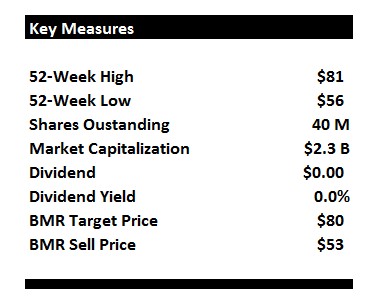
Company Overview
WageWorks is a leading on-demand provider of tax-advantaged programs for health and other employee spending account benefits, known as Consumer-Directed Benefits, in the United States. Plain and simple, go look up who is running your Health Savings Account, Flexible Spending Account and another benefits programs at your place of work. It’s probably WageWorks. If not, it probably will soon be. Why does the everyday working man love WageWorks? The Consumer-Directed Benefits programs enable employees and their families to save money by using pre-tax dollars! Who doesn’t love to save on taxes? Employers financially benefit from the programs through reduced payroll taxes, even after factoring in fees. WageWorks is the provider of choice to many of the nation's largest and most innovative companies including: 68% of the Fortune 100 and 55% of the Fortune 500. They must be, no wait: they ARE doing something right. As of January 31, 2017, the company had 6.5 million employee participants from approximately 100,000 employer clients.
The company’s early stage penetration of the health savings account (HSA) market represents one of the most visible growth drivers over the next three years. HSAs represent between 20% and 25% of WAGE’s health care accounts and are growing organically over 30% a year compared to mid-single digits for flexible spending accounts (FSAs)*. HSAs also offer incremental revenue streams in the form of custodial fees that should ultimately lead to revenue per account that is comparable to those of FSAs.
* A Flexible Spending Account is a special account you put money into that you use to pay for certain out-of-pocket health care costs. You don't pay taxes on this money. They are very popular, due to the tax-saving nature of the product.
In addition to the secular growth and adoption of high deductible health plans and HSAs, and a healthy new business pipeline, we note four other distinct potential catalysts for growth, with various degrees of probability: i) portfolio acquisitions; ii) penetrating individual Federal agencies; iii) a legislative boost in the form of H.R. 1270 (although the current administration has threatened a veto); and iv) rising interest rates.
Potential catalyst #1: HSA portfolio acquisitions. There has been stepped up consolidation over the past 12 months as several regional and national banks have sold their HSA portfolios to administrators focused primarily on consumer-directed benefits. Recent transactions include: Wells Fargo’s sale in May of its HSA portfolio to Optum Bank (estimates of $1.9 billion of assets among 650,000 participants); U.S. Bancorp’s sale to Optum last year; Huntington’s sale to Optum in 2015; JP Morgan Chase’s sale to Webster Bank (Webster’s HSA Bank now administers $4.1 billion of deposit assets and 2 million accounts); M&T Bank’s sale to HealthEquity earlier this year ($63 million of assets); and The Bancorp Bank’s sale to HealthEquity last December ($390 million of deposits). WageWorks views its consolidation opportunity to now include HSA bank portfolio acquisitions, and any transaction contemplated would include its custodial partner BNY Mellon. HSA deposits are still scattered among many regional and national institutions, much like the early days of other consumer-directed accounts, and deposit assets reached $30 billion last year, with over $4 billion of investment assets. Some large institutions, like Fidelity and Bank of America appear to remain committed to asset gathering, but the pace of consolidation seems headed towards seven to ten large custodians.
Potential catalyst #2: The HSA opportunity within Federal agencies covered under the OPM contract. The Office of Personnel Management (OPM) provides HR functions for approximately 160 separate agencies of the federal government. While the flexible spending offering to employees and the processing contract is centralized with the OPM, health coverage enrollment is conducted by each of the individual agencies separately. The HSAs that accompany high deductible health insurance plans are also administered on an agency-by-agency basis, and in order to capture HSA processing business, WageWorks must sign each agency individually. Our reading of the Federal Employees Health Benefits (FEHB) Program suggests that most federal employees have the option of enrolling in a high deductible plan. According to the OPM, “The FEHB Program can help you and your family meet your health care needs. Federal employees, retirees and their survivors enjoy the widest selection of health plans in the country.” WageWorks recently won the OPM contract (takeaway from ADP previously) and now can potentially generate a great deal of new business from all 160 agencies.
Potential catalyst #3: Legislative proposals. The most visible proposal lately is H.R. 1270, the Restoring Access to Medication Act of 2015, first proposed by Reps. Jenkins of Kansas and Paulsen of Minnesota. The proposed bill would roughly double the annual contribution limit on HSAs so they could match out-of-pocket maximums, as well as repeal the Affordable Care Act’s restriction on using HSA assets to purchase over-the-counter medications. The House has agreed to take up consideration of the bill again but we are quick to dampen any expectations, as the current Administration has promised to veto the bill if passed. Why? Despite general bi-partisan support for expanding consumer directed benefits (there are four Democratic co-sponsors), the Administration claims that there are no offsets in the bill to pay for it. While we are hopeful for something significant being passed and signed during this congressional season, the good news is that there is increasing support for expanding HSA usage.
Potential catalyst #4: Interest rates and custodial fees. Management has noted that the average per-employee per-month fee on FSA accounts remains steady around $3.75, while HSA accounts garner between $2.25 and $2.50. Moving forward, the company will now receive the majority of float on HSA assets. With assets between $400 and $500 million and interest accruing, we see an incremental $2 million of revenue this year. With assets potentially growing another 30% heading into the end of 2017 and possibility of more rate hikes, we see a possibility for the float contribution to double next year and add a point to organic growth. Rising rates, which contribute 100% incremental dollars, remain a longer-term catalyst, and one we are very excited about.
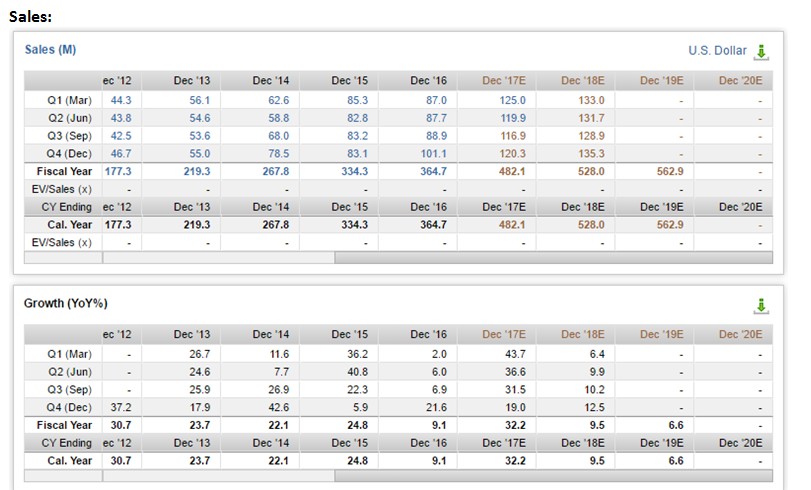
Sales:
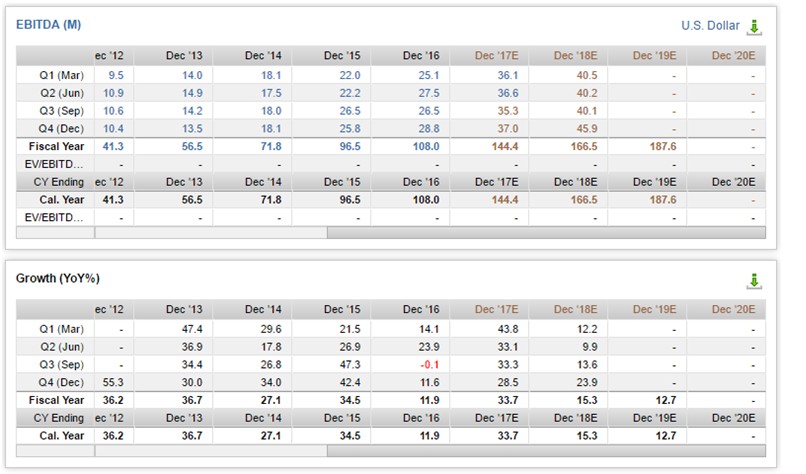
EBITDA:
EPS:
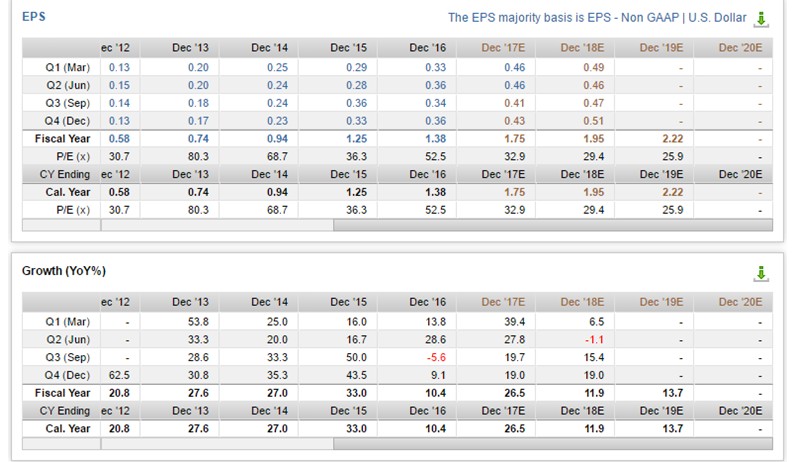
BMR Take: We recommend WageWorks based on trends favoring consumer-directed benefits and increasing participation rates, the likelihood of accretive acquisitions, new channel partnerships, opportunities presented by private and public health care exchanges, and the company’s unusual high degree of revenue visibility. By revenue visibility we mean that over 80% next year sales are booked at the beginning of the year due to the nature of contracts with employers so the company's revenue outlook is far less surprising than most companies. We love this.
The company’s early stage penetration of the health savings account market is a lucrative opportunity we are excited about. There is so much potential here from secular growth in HSAs, to accretive acquisitions, or to even a take-out. The company has more room to go until it captures greater than an 80% share of the Fortune 100 and Fortune 500. We think this company ultimately gets bought for a big valuation. With EPS closing in on $2, valuation is not cheap but that is not a problem for us as we see the stellar growth opportunity to be worth paying up for.

