by Todd Shaver | Jun 21, 2016 | 7am News Flash
Mazor Robotics (MZOR)
Key Measures:
Recent Price: $15.80
52 Week Price Range: $8.30-$17.35
EPS: (-$0.36)
Shares Outstanding: 42 million
Market Capitalization: $355 million
Target Price: $25
Sell Price: $14
Robotic Surgery: The Spine Is Next
Minimally invasive surgery has been around for a while. Intuitive Surgical (ISRG) pioneered the wave with its da Vinci robotic suite designed for urological procedures like prostatectomies and hysterectomies. We tracked Intuitive back 15 years to 2001 when it was $11 per share. Today the shares sell for $648. To say that Intuitive Surgical investors are happy is an understatement.
New innovations in medical technology can be tricky and their stocks can be volatile. So if you waited until just 10 years ago when the da Vinci system was well accepted, your investment return would still have been a tidy 600%. Not too shabby.
Well, we have found what could be the next Intuitive Surgical. The name is Mazor Robotics. This company, founded in 2000 is focused on minimally invasive robotic surgery for the spine and the brain. Their Renaissance System has regulatory approval for use in the United States and most everywhere else in the world. There are already 110 units in place worldwide with 65 in the United States.
The company makes money from three sources. The Renaissance Surgical suite sells for $850,000. With the sale, Mazor offers maintenance and service under contract. This is like an annuity income that is highly profitable. The third source is Disposables. At a cost of $1,500 per operation, this is the second most important revenue stream to Mazor. The gross profit on these items is over 80%.
Why should Mazor be successful? First off, they are already successful in pioneering a better product. This gives them valuable time for marketing without serious competitors. In the medical equipment business, this is especially important. Once a surgical team has been trained on a new procedure, it practically takes an Act of Congress to get them to change. Next, the Renaissance System simplifies the complicated nature of spinal surgery. The system is 98-99% accurate, reduces complications by more than two-thirds and reduces exposure to harmful radiation by 35-50%. Finally, it reduces recovery time which makes for happy patients. When it comes to alleviating back pain a satisfied customer is a walking endorsement for the Renaissance System.
We referenced Intuitive Surgical above for more reasons than its spectacular stock performance. Both Mazor and Intuitive Surgical use the same “razor and blades” business model that makes these two comparable. Mazor has one advantage at this early stage, which Intuitive did not. In May, Mazor signed an agreement with healthcare powerhouse, Medtronic (MDT) to accelerate their marketing in the United States. As a research- and technology-centric company based in Israel, Mazor will benefit enormously from this arrangement.
Potential for Robotic Spinal Surgery is Staggering
In the United States alone, over 500,000 spinal surgeries are conducted each year. Globally, we estimate the figure is in excess of 1,000,000. The North American spine surgery devices market is expected to grow at a 7% compound annual growth rate by 2019, according to a Research and Markets. Figuring out the number of machines to service this market; how long it will take to reach maximum potential; the number of service contracts; and the quantity of disposables is the puzzle to solve in placing a value on Mazor. Here is where Intuitive’s experience is a real help.
The most recent data shows da Vinci was used in over 650,000 procedures last year employing 3,600 machines. That works out to one surgery suite for every 180 procedures. If we use this as a proxy, Mazor will need to sell roughly 2,800 Renaissance Systems to service 500,000, and that is just half the global market. This translates into equipment revenues of $2.4 billion. Add to that $750 million in disposables and another $300 million in service contracts and the revenue potential hits $3.4 billion. If Mazor matches Intuitive’s scale and efficiencies, their after tax earnings will reach over $650 million. Valuing these earnings at a market multiple of 20 times works out to $13 billion. (Just so you don’t think we are crazy, Intuitive’s market cap today is $25 billion). Mazor is presently valued at $355 million – a third of a billion dollars.
Please note with all our work on the Renaissance Spinal System, we are leaving out Mazor’s suite of neurosurgery opportunities. But you get the idea: Even though the stock has rebounded off it 52 week low of $8.30 a share, it is just getting started and there is a lot more to the Mazor story.
Recent Results: Lots of Growth Now, Profits Will Follow
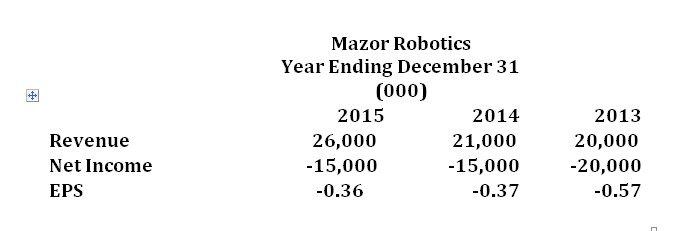
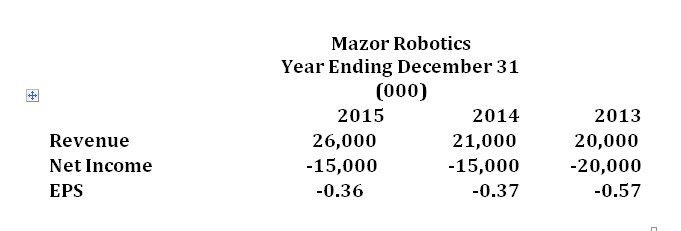
Our enthusiasm is based in reality; the business is taking off. As the table below shows, after a meager 6% revenue growth in 2014, the pace picked up to 23% in 2015 as more systems were placed in service. The acceleration continued in 1Q16 with revenues gaining 42% to $6.4 million. It is noteworthy that disposable sales increased at the same pace. That tells us that surgeons are willingly converting to the Renaissance System in their Operating Rooms.
The Medtronics Deal is a Winner
On May 18, Mazor signed a major agreement whereby giant Medtronics will buy 15 Mazor spinal systems and will purchase 4% of Mazor’s stock. Medtronic agreed to promote the Renaissance System and even took an option to buy as much as 15% of the company. This deal is beneficial to both sides. It aids the placement of Renaissance Systems and enhances the existing spinal surgery business of Medtronics.
The implication of the Medtronics deal goes beyond money and marketing benefits. It creates a more valuable company from the standpoint of a potential acquisition. Is it possible that Intuitive Surgical would want to get into the spinal surgery business and look to Mazor to get them started? Is there a possibility of a bidding war developing between Medtronics and Intuitive Surgical? Any answer would be mere speculation but having two strong players standing nearby is great news.
Balance Sheet: The Company Has Ample Liquidity To Grow
For a young company on the verge of breakout growth, Mazor’s balance sheet shows good liquidity. Cash amounts to $33 million with virtually no long-term debt. The stock purchase agreement with Medtronic will add a further $12 million in cash to the balance sheet. Under the agreement, if Medtronic acquires fully 15% of Mazor, it will add a further $40 million in cash. This is an important safety blanket. Mazor has been operating at a cash flow deficit until now and that is only likely to continue as it growth rate accelerates.
BMR TAKE:
Investing in high growth companies typically demands overpaying in the beginning with the hopes that earnings will grow into the valuation. Just look at names like Facebook and Google. With Mazor, we have an exception. Way back in January 2014, investors valued the company at the same $25 price tag that we place on the company today. Since then the number of Renaissance Systems in service has nearly doubled. In the past 2½ years, the value of the company has only increased while the price of the stock has dropped by more than one third. Now is time to get on the Mazor horse. It is going to be an interesting and profitable ride.
by Todd Shaver | Jun 14, 2016 | 7am News Flash
June 14, 2016:
We are committed to bringing great investment ideas to you. With this guiding our strategy, we are excited to begin a new portfolio covering the best opportunities in Healthcare. To start things off, we are moving three companies: Gilead Sciences (GILD: $84), Adeptus Health (ADPT: $53) and AmerisourceBergen (ABC: $75) into the new portfolio. In the weeks and months ahead, we will selectively add another 6-10 stocks.
This is a great time to create a portfolio of great companies in Healthcare. Why? The stock market is near record levels having left Healthcare stocks in the dust. Overall the group has been one of the market’s worst performers over the past year: down 31%.
The sheer size and importance of Healthcare makes it a must-own in any portfolio.
More than 17% of the total output of the US economy is made up of Healthcare. Putting this into perspective, that is three times what our government spends on Defense. In human terms, this is $3.3 trillion market, roughly $10,000 per person each year.
Just because stocks have tumbled this year, demand for Healthcare hasn’t diminished - it has only continued to grow, as the population ages. Next to Technology, it is the fastest growing industry in America. Over the past decade, the cost of healthcare has risen on average 4.2% annually, nearly double the overall US growth rate of 2.2%. Uncertainties over the effects of The Affordable Care Act hurt stocks, but there are genuine values being created in the process. On behalf of you and all our subscribers we plan to find some hidden nuggets.
We are really excited about the opportunities for Adeptus Health, Gilead Sciences and AmerisourceBergen. As new names are considered, we will give you plenty of notice. And if you have a favorite Healthcare concept but still need to find the best company, we invite you to send your questions along to us at Info@BullMarkiet.com. We look forward to bringing you our new Opportunities in Healthcare.
And look for a new entry in Opportunities in Healthcare this week!
by Todd Shaver | Jun 9, 2016 | 7am News Flash
ADEPTUS DROPS SHARPLY in the last two weeks.
We received a few letters via email recently about Adeptus (ADPT: $54, down $3). We added the stock on April 1st at $54 and it closed today at $54, but in the meantime it went to $70 on April 27th, down to $58 on May 9th, to $73 on May 24th and 27th, and now down to $54.
We know the stock is highly volatile. The last company news was on May 31st and we covered that in our last News Flash. In that News Flash guidance from management was raised and we stated the company was registering 2.7 million shares of insider stock (original investors and some other later stage investors as well). The stock has been under pressure since then. The worst day was June 1st. The deal was priced on June 2nd at $62.00. However, that is a fairly large amount of stock to be absorbed (Goldman Sachs as the lead underwriter did a poor job supporting the aftermarket).
We liked this stock at this price when we added it to the Special Opportunities Portfolio in April. Since then revenues and earnings have exceeded estimates and management has raised guidance for 2016 and 2017. Analysts are becoming a bit more bullish on the firm’s prospects in both the short and long term. In fact, over the past month, current quarterly estimates have risen from 56 cents/share to 57 cents/share, while current year estimates have risen from $2.61/share to $2.69/share.
The fundamentals are good and if we learn any information to the contrary we will ring the alarm bell immediately. We like the company and believe the stock will move much higher over time. But if the volatility is too much for you, get out of the kitchen.
by Todd Shaver | Jun 6, 2016 | 7am News Flash
Solar City ($24, up $2.33) has unveiled a new solar loan program, available in 14 states , that will allow many customers to immediately pay less for solar each month than they previously paid for utility bills and pocket thousands in additional dollars from applicable tax credits. We would like to bring you some of the Press Release that company put out yesterday. Note that according to the company, SolarCity installed more residential solar in 2015 than the next 50 competitors combined.
"We can now offer a loan that makes it possible for many customers to pay less for solar from day one, and still receive thousands back in tax credits on top of that," said SolarCity CEO Lyndon Rive. "This program will allow thousands of additional customers across the U.S. to install solar this year and start saving money immediately, and we expect to work with multiple lenders that will allow us to expand to several new states by the end of the month with the same great terms for our customers."
SolarCity's new loans have new options that include fixed payments and shorter terms. The new loans offer a range of features:
10-year loan with annual percentage rate as low as 3%.
20-year loan with annual percentage rate as low as 5%.
SolarCity's loans include the industry's best service package, including a 20-year warranty, production guarantee, and continuous monitoring.
SolarCity provides the industry's best mounting system and installation aesthetics, and backs up its agreements with the largest in-house service footprint in the industry, with 90 local operations centers.
SolarCity will provide and install a Nest Thermostat at no additional cost for qualifying customers.
SolarCity's new solar loans are available today in Arizona, California, Colorado, Connecticut, Delaware, Maryland, Massachusetts, New Hampshire, New Mexico, New Jersey, New York, Oregon, Rhode Island, Texas and Washington, D.C., and the company expects to announce new locations soon. Interested homeowners can contact SolarCity directly at 1-888-765-2489 for a free, no-obligation solar consultation or visit the company online at http://www.solarcity.com/residential.
BMR Take: OK, how about that? The stock jumped 11% today on the news. Our take is this: When we added the stock in January at $31 we expected the stock to move towards the $40 level and higher within the year. But we got side-swiped, with the stock falling like a stone to the low 20s and in fact hit $16 in February. Most newsletter companies would have sold at $25 or $20 and taken a huge hit. But WE BELIEVE in this company. So we are STAYING WITH this company. And we can see that $40 number down the road in the not too distant future. This year? Not sure, but certainly next year. With the stock at $23 that’s a nice return in our book.
by Todd Shaver | Jun 2, 2016 | 7am News Flash
UNDER ARMOUR
Sports Authority Bankruptcy: Under Armour Keeps Its Stride
Under Armour (US: $37) reached a 2016 high of $48 on the day it announced great 1Q16 results on April 21st. Since then the stock has undergone a serious correction, falling 23%. Yes, Under Armour is a high valuation stock and that means greater volatility. News of any kind can send the stock moving. Wall Street’s focus is squarely on the recent bankruptcy Sports Authority, one of Under Armour’s large customers. Yesterday, management issued their assessment of the situation. We really like what we read and heard. This is a great opportunity to buy the stock. Here is why:
The bankruptcy of Sports Authority, will result in a loss to 2016 revenues of $120 million. Thus far the company has taken an impairment charge of $23 million as a result. This is the estimated value of what Sports Authority owes the company. Over time, this number could change depending on how much money is recovered by Under Armour.
Beneath the doom of the bankruptcy news was some very positive information that requires only a little “between the lines” reading. Management issued guidance for the current 2Q16 that is unchanged with revenues growing in the high 20% range. Because of the impairment charge, net income will increase to only $17-$19 million.
Putting on out analyst caps for a moment, here is what their announcement reveals. First, Under Armour stopped shipping to one of their largest customers half way through the second quarter but still hit the revenue target. Obviously this means business elsewhere is way above budget. Even with the impairment charge, net income for 2Q16 will increase between 16%-29%. But, since impairment charges are not tax deductible, the 2Q16 tax rate will jump to a whopping 70%.
Back to the most important point: Excluding the Sports Authority bankruptcy, 2Q16 revenues and net income will show a 25%-30% increase. This is pretty amazing. How many other companies could lose a major customer at midyear and still stay in stride this way? We don’t know of any.
Looking beyond this, the company’s key consumer franchise has not been harmed. Temporarily, there will be more supply available at discounted outlets like T.J.Maxx until the inventory is absorbed, but this is not a huge issue. Like everything else, athletic wear is increasingly being sold online. Under Armour is in great shape to handle the change. Once Wall Street appreciates what we shared with you here, the stock will be on the move again. Now is the time to own this stock and buy more to average down your cost.
by Todd Shaver | May 11, 2016 | 7am News Flash
Sprouts Farmers Market (SFM)
A New Addition: Special Opportunities Portfolio
Key Measures:
Recent Price: $26
52 Week Price Range: $16-$31
EPS FY 2016: $1.00
Shares Outstanding: 150 million
Market Cap: $4 billion
Cash Flow Per Share: $0.91
Price as we publish: $26
Organic Food For The Masses
If you are seeking a transformative experience in organic grocery shopping, there is no better place than Whole Foods Market (WFM: $30). However, if $2 for an organic apple leaves you financially challenged, you need to look no further than Sprouts Farmers Market. That organic apple is still going to cost $1.25, but that is simply the cost of healthy living. Pour votre santé!
Looking for a Sprouts Farmers Market, for many people, presents a bit of a challenge. A majority of the stores are concentrated in California and four other western states. The first store was opened in Phoenix in 2002 and since has grown to 245 stores in 13 states. (Whole Foods has more than 435 stores nationwide)
While both Whole Foods and Sprouts specialize in organics, healthy lifestyles and great service, this is about where the comparison ends. The average Sprouts is 30,000 square feet, far smaller than Whole Foods or for that matter, the average Kroger store. Sprouts’ focus is more limited, concentrating on fresh foods, produce, meat and seafood, grocery, vitamins and body care. The emphasis is on products where inventory turnover is high.
Sprouts stores are well located, merchandised like an open-air farmer’s market, and offer middle of the road pricing on organic products. Sales of bulk items also add to the value perception. With a value-oriented pricing structure, stores are jammed with a growing legion of repeat customers purchasing everyday items. As the table below illustrates, the formula works. Sprouts is the most profitable of the three leading grocery chains.
|
Leading Grocery Chains |
|
Whole Foods |
Sprouts |
Kroger’s |
| Sales |
100% |
100% |
100% |
| Cost of Sales |
66% |
71% |
79% |
| Gross Margin |
34% |
29% |
21% |
| SG&A |
29% |
22% |
17% |
| Operating Margin |
5% |
7% |
4% |
Industry Background: Organic Foods Are Now Mainstream
The world is no longer going organic; it has arrived. Sales of organic food and non-food products in the United States totaled an impressive $44 billion in 2015, up 11% from the previous year. Organic sales now equal some 5% of the total food market. The Organic Trade Association forecasts that these trends will continue at a double-digit pace through 2018. Organics are good for the health of the consumer and just as good for purveyors of these wholesome goodies.
The Market Is Evolving into Price Segments
Customers expect to pay premium prices for farm fresh and organic products. A $2 chicken that is released from a cage and allowed to run around the barnyard can fetch a price of $15. Everyone can agree on the merits of good health, but not everyone can afford a barnyard chicken.
The market is evolving into different price segments similar to other consumer products like autos and general merchandise retailers. While Wall Street may think in terms of there being intense competition between Whole Foods and Sprouts, we see things differently. Just like other consumer markets, organic foods are evolving into different price categories. A car is just a car, but Mercedes Benz sells to a different demographic and income profile than Ford. Whole Foods is on top but there are a lot more potential customers driving Mustangs.
Well-Executed Growth Strategy
Things are happening at Sprouts. Over the past three years, revenues have grown an average of 21% annually while per share profits increased from $0.37 to $0.83. With 70 new stores being added, a gain to the base of nearly 50%, this has driven this impressive performance. But there is more to the story. Same store sales increased an average of 9% showing the world that the Sprouts formula is creating loads of repeat business and lots of raves on social media.
Sprouts Farmers Market
|
2015 |
2014 |
2013 |
| Revenue |
$3,600,000 |
$3,000,000 |
$2,400,000 |
| Net Income |
$130,000 |
$108,000 |
$51,000 |
| EPS |
$0.83 |
$0.70 |
$0.37 |
Solid Outlook
In parts of the United States it may not be easy to find a Sprouts Farmers Market, but Wall Street is rapidly getting acquainted. The consensus of 18 followers is for the company to grow an average of 15% a year over the next five years. That places Sprouts at the top of the heap by any comparison.
Management guidance for 2016 is for revenue growth of 18% and profits up 20% to $1.00. Once again, growth is coming from a balance of 5% same store sales growth and new store openings. Many of these will be in states where clustering near existing stores will lower costs. Skeptics will point to the slowing in projected same store growth. They are quite right up to a point. But at 5% same store growth, Sprouts will lead the industry in this measure.
The Sprouts Farmers Market concept enjoys a broad audience and a loyal following. The challenge is for management to replicate its successful formula in other parts of the US as well as Canada. This involves major investments in hiring and training of personal. Sprouts is on the case, spending wisely to develop future store managers.
Financial Performance Is Exemplary
The balance sheet sports $145 million in cash against long-term debt of $160 million. Cash flow from operations generates over $100 million. The balance sheet has improved, owing in part to the 2013 IPO that raised $350 million that was used to pay down debt. For a company of its size, growth and history, this is an A+ situation.
More impressive is the level of management’s attention to detail. During a period of extremely rapid new store openings, inventory turnover, the key to grocery store profitability, remained at high levels throughout. The other standout item: Following the rush of liquidity from the 2013 IPO, the company’s game plan remained consistent. You have to respect their management, as they kept a level head after receiving a check for $350 million. It would have been easy to go on an accelerated spending spree.
BMR TAKE
We love to find companies with great long-term growth potential and Sprouts fits the bill. Now in only 13 states with a proven formula for success, there is no limit to the future that realistically includes three times the number of stores in twice the number of states. This is a conservative projection. The stock is selling a 25 times 2016 profit forecasts compared with the overall stock market valuation of 23. This is the best level of value that the company has ever had in their short history of public ownership.