by Todd Shaver | Oct 10, 2016 | 7am News Flash
Bristol-Myers Squibb: (BMY: $50, down 10% yesterday)
Trial Data Disappoints Again; Double Down On This Blue Chip
The stock dropped to its lowest level in almost two years after presentations at the European Society for Medical Oncology, also known as ESMO. The presentations revealed data that was a worst case scenario for Bristol and a major win for competitor Merck.
Both companies have been battling head to head over who will win an emerging opportunity in lung cancer treatment. Back in early August, Bristol announced failed trials, which sent the stock from $75 to $60. While the stock drop back then was substantial, it more so reflected a delayed timeline for participating in the lung cancer opportunity, not the business running off the tracks of eventually getting there.
At the ESMO conference, the specific details of the failed trial data were released. It now comes to light that the Checkmate-026 trail represented a worst case scenario for Bristol’s lung cancer drug Opdivo. While it was known that the trial failed, most investors at least expected to see a trend towards efficacy. Investors didn’t expect Opdivo to be a complete failure or facing setbacks. However, what we now learn is that the drug was not effective at all. There are all sorts of theoretical explanations circulating to explain the variance between the Bristol and Merck trials, but the only hard evidence at this point is that Bristol has a completely ineffective lung cancer drug in contrast to Merck’s successful drug.
What does this mean? Investors now expect Merck to completely own the segment of lung cancer patients, leaving Bristol with no part of the lung cancer opportunity whatsoever. Very disappointing. While this was a smaller part of the earnings built into expectations for Bristol, the contribution accounted for most of the assumed growth. Ouch.
This was a painful turn of events for us. We too were expecting Bristol to recover in the lung cancer opportunity. However, we believe the market is overly punishing Bristol for the hiccup, in turn creating a buying opportunity. This is a blue chip name in Healthcare with a diverse lineup of drugs. Opdivo may not be available to meet the lung cancer opportunity, but analysts still see revenue for this drug alone of $3.4 billion this year, $5.0 billion next year, and $7.6 billion by 2020, as the drug can still be used in multiple other types of tumors just not lung cancer. Plus, there is still the slight chance that Opdivo does end up working for lung cancer, as the theoretical explanations circulating about the recent disappointment do include some credible opinions.
BMR Take: We see absolutely no risk to the dividend due to this event, which is running at $1.52 annually or comfortably below EPS of nearly $3.00. The current dividend yield is a very attractive 3%. We think this is an excellent opportunity to buy more of this blue chip name in Healthcare, for a patient investor who can wait for the breadth and depth of this best-in-class franchise to work its way out of the near term hole.
Mazor Robotics (MZOR: $26, up 16% yesterday), a pioneer and a leader in the field of surgical guidance systems, today announced that it received purchase orders for 25 systems during the third quarter ended September 30th including pre-launch orders for the recently unveiled Mazor X, a transformative guidance platform for spine surgeries. The Mazor X will be commercially launched at the North American Spine Society annual meeting in Boston, October 26-29.
“The market’s response to the Mazor X is exceptional, exceeding our early expectations,” commented Ori Hadomi, Chief Executive Officer. “Customers who first experience the Mazor X at our training centers are quickly realizing the increased benefits of the system and they have already placed pre-launch orders. Mazor’s expanded portfolio of products, which now includes both the Mazor X and Renaissance systems, is responsible for the record number of purchase orders we received in the third quarter. As we move into the fourth quarter, we expect to build our momentum in the market as the Mazor X is launched, maximize our presence at the North American Spine Society, and our strategic partnership with Medtronic continues to be implemented.”
Mazor Robotics ended the third quarter with an installed base of 130 Renaissance systems globally, including 80 in the U.S., the Company’s primary growth market. The Company currently intends to report its complete financial results for 3Q16 in November and will issue a press release with the date, time and dial in and webcast details soon.
BMR Take: The company spoke; the markets listened. We maintain our Target of $29 and expect to raise it before long.
by Todd Shaver | Sep 28, 2016 | 7am News Flash
Ferrellgas Partners: (FGP: $13.00)
Quarterly results blindsided investors sending the stock down more than 20%. It was so bad President & CEO Stephen Wambold was fired and the company’s founder James Ferrell was appointed Interim President & CEO.
The net loss incurred this quarter reflected one-time non-cash impairment charges of about $660 million spanning Midstream operations, which reflect low oil prices. Moreover, record temperatures across the nation continue to have an adverse impact on the propane business.
Because of the increase in debt incurred to fund the Bridger acquisition, the recently announced Jamex settlement, and the effects of the record warm temperatures in fiscal 2016, the company’s leverage ratio has increased to levels approaching the 5.5x limit provided in its secured credit facility and accounts receivable securitization facility. Fortunately, the upper limit has been increased to a range of 6x for the next six quarters.
Considering all of the above, the company discussed a high likelihood of cutting the annual distribution, likely from $2.05 to $1.00. The action would be invoked until leverage was stabilized and business momentum regained. The stock price proceeded to trade to a 7.7% yield on the assumption of an ultimate $1.00 payout, which is more closely in line with peers.
While we are badly bruised by our investment losses due to these events, we see reason to accumulate more shares at currently depressed levels. First, it is good to have the founder back at the helm. Second, the company is taking aggressive actions to weather the storm in terms of preserving capital. Third, see the unusually warm weather and low oil prices changing in the future, meaning the reduced $1.00 dividend could in time find its way back to $2.05.
BMR Take: The stock was under pressure yesterday and we have now seen the cards, where current prices reflect a 7.7% yield on the reduced dividend. We believe the bar has been sufficiently reset. We would accumulate shares for the long haul as the business is still a market leader. We suspect the company can get through this tough period and ultimately recover back to the long term trend line of $17-20.

by Todd Shaver | Sep 21, 2016 | 7am News Flash
Ferrellgas Partners (FGP)
Investment Research Report
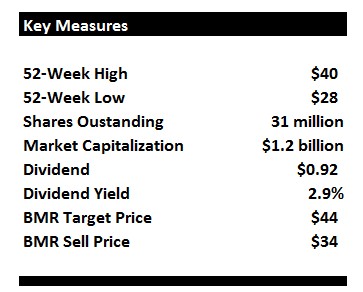
<div class="smw smw-leaderboard smw-color-frame smw-ct-blue smw-visible" data-symbol="FGP" data-type="leaderboard" data-source="live"><div class="smw-header-left"><div class="smw-market-data-field" data-field="virtual.name"></div><div class="smw-quote"> <span class="smw-market-data-field" data-field="virtual.symbol"></span> <sup><span class="smw-market-data-field" data-field="virtual.currencyCode"></span></sup><span class="smw-market-data-field" data-field="financialData.currentPrice"></span> <span class="smw-change-indicator"> <i class="fa fa-long-arrow-down smw-arrow-icon smw-arrow-drop"></i> <i class="fa fa-long-arrow-up smw-arrow-icon smw-arrow-rise"></i> </span></div><div class="smw-change-quote"> <span class="smw-market-data-field smw-change-indicator" data-field="virtual.currentAbsoluteChange"></span> <span> / </span> <span class="smw-market-data-field smw-change-indicator" data-field="virtual.currentPercentChange"></span></div></div><div class="smw-header-right"><table><tr><td>52-Week High</td><td id="week_high"><span class="smw-market-data-field" data-field="summaryDetail.fiftyTwoWeekHigh"></span></td></tr><tr><td>52-Week Low</td><td id="week_low"><span class="smw-market-data-field" data-field="summaryDetail.fiftyTwoWeekLow"></span></td></tr><tr><td>Shares Outstanding</td><td id="shares_outstanding"><span class="smw-market-data-field" data-field="defaultKeyStatistics.sharesOutstanding"></span></td></tr><tr><td>Market Capitalization</td><td id="market_capitalization"><span class="smw-market-data-field" data-field="summaryDetail.marketCap"></span></td></tr><tr><td>Dividend</td><td id="dividend_rate"><span class="smw-market-data-field" data-field="summaryDetail.dividendRate"></span></td></tr><tr><td>Yield</td><td id="dividend_yield"><span class="smw-market-data-field" data-field="summaryDetail.dividendYield"></span></td></tr><tr><td>BMR Target Price</td><td>N/A No longer in portfolio</td></tr><tr><td>BMR Sell Price</td><td>N/A No longer in portfolio</td></tr></table></div></div>
Ferrellgas Partners (FGP) is a multi-billion publicly-traded Master Limited Partnership. Ferrellgas is a leading national provider of wholesale propane, the second largest retail marketer of propane in the US, and an integrated midstream logistics provider of crude oil. Founded in 1939, the company went public in the 1990s, issued their first dividend and has been able to maintain the dividend ever since. In fact, just recently, the company increased the dividend, demonstrating cash flow strength.
The business is undergoing a transformational mix shift to become increasingly less reliant on propane. As of January 2014, 100% of the company’s EBITDA came from the propane segment. So far through 2016, the EBITDA mix is tracking to be 75% propane and 25% midstream. The company has a target of 50% propane and 50% midstream by 2018. The shift to midstream is viewed very favorably as it diversifies the business and opens up new growth opportunities.
In the propane business, Ferrellgas is one of the most trusted providers of propane to America. The company has a fleet of over 1,450 bulk delivery trucks, a fleet of 150 transport tractors, and significant common carrier relationships. Distribution spans 46,000 tank exchange selling locations that record over 20 million annual transactions. The infrastructure includes over 50 service center storefronts and over 50 million gallons of propane storage capacity. When you buy propane from Menards, Lowes, Walmart, Safeway, Kroger, Rite Aid, and so many other leading brands, you are buying propane from Ferrellgas.
In the midstream business, the recent acquisition of Bridger Logistics* is helping boost growth. Midstream is all about building out the distribution chain for crude to move from the well to the refinery either 1) through trucks, rail loading terminals, rail, rail unloading terminals, and barges, or (2 trucks, pipeline loading terminals, storage tanks, and pipelines. Ferrellgas is making headway building a deep network. The network now comprises the largest US for-hire crude oil carrier fleet with 555+ trucks. The rail component is 1,260 fully contracted newly built cars. There is 118,000-barrel capacity in maritime. There are 19 strategically located pipeline terminals. Shell, BP, EOG, Marathon, Philips 66, Anadarko, and many others use the Ferrellgas midstream infrastructure.
* Founded in 2010, Bridger Logistics owns and operates assets across the midstream value chain and provides end-to-end crude oil logistics, including trucking, terminaling, pipeline, rail, and maritime, from the wellhead to end markets across North America. Bridger has operations in 14 states and virtually all major U.S. crude oil production regions, including the Permian, Bakken, Rockies, Niobrara, Mid-Continent, Gulf Coast, and Eagle Ford.
So, what is the story? Why have shares languished recently up just +2% YTD versus the S&P 500 up 5%?
Like many of its peers, the balance sheet is heavy with debt. The company has $2.1 billion of long-term debt. The senior unsecured bonds are rated B- by Standard & Poor’s.
But there is a bright side!
First of all, Ferrellgas not long ago raised new equity and debt to fund the acquisition of Bridger. Specifically, in addition to the $275 million of equity taken by the seller, Ferrellgas issued $145 million of equity and $500 million of senior notes to cover the balance of the purchase price and boost liquidity. Bottom line, Ferrellgas has proven access to both debt and equity capital markets even in the midst of current challenges.
Second, one of the most difficult hurdles right now for Ferrellgas is warm weather; not fundamentals. Ferrellgas has been experiencing reduced propane volume sales resulting from the warmer-than-normal weather. Could this headwind continue for a while? Sure, though it is outside of the company’s control. Whenever it does turn as it eventually will, Ferrellgas is well positioned to make a lot of money.
Third, what a lot of people do not realize is that just because oil prices are down does not mean the entire Energy industry is suffering. Margins on certain spread business models have expanded materially, which is what we see at Ferrellgas. Recently helping offset the decline in gallons sold is the company’s ability to maintain unusually high profit margins. Even Standard & Poor’s admits that the bonds could be upgraded if the current lucrative margins remain, in addition to other scenarios such as a retail propane volume recovery or the midstream outperforming.
Fourth, the Bridger acquisition represents a transformation inflection point and is underappreciated. Bridger both increases EBITDA by almost a third to over $400 million, and significantly diversifies Ferrellgas into midstream, which will now account for roughly a quarter of the next 12-month EBITDA outlook. As a substantially fee-based business with 60% of EBITDA under long term take or pay contracts, Bridger introduces attractive stability to the business. Moreover, as a young company with leverage to top basins including the Bakken, Permian and Eagle Ford, Bridger has exhibited robust growth which will enhance Ferrellgas’s distribution network.
BMR TAKE:
We believe that the Bridger acquisition and mix shift to midstream diversifies the company and provides a platform for longer term growth. The huge dividend yield, proven ability to tap both equity and debt markets, and a market leading position in several markets, we view the risk/reward as favorably skewed for buying Ferrellgas at these levels.
Stock Price, Historical Chart
by Todd Shaver | Sep 19, 2016 | 7am News Flash
Time To Place A Broad Sector Bet On The Energy Recovery
iShares US Energy ETF
With a single trade, buying the iShares US Energy ETF* (IYE: $37) will round out your portfolio with nearly 80 North American Energy stocks. This trade is less volatile than buying the commodity, faces far less company-specific risk, and yet still allows you to participate in what is shaping up to be an equalizing of supply/demand imbalances driving the recovery of oil prices. And the US Energy ETF pays a solid 2.9% dividend yield while you wait.
*Exchange-Traded Fund
The severity of the recent downturn has necessitated a robust efficiency drive across the Energy industry. Companies have had to improve capital efficiency, clean-up balance sheets, address cost structures, and improve operations. The intense push to keep improving on each of these issues will remain until the “return to a normal” operating environment is achieved. When we finally get there, what will remain is an industry comprised of the strongest survivors.
There is now talk circulating of a V-shaped recovery for total rig count in the US. Some argue it may be a bit slower. Regardless, when looking off into the horizon, you can now start to see a path forward. We were running at 1800+ rigs in 2014, we were at 980 rigs at year end 2015, and we are on track to close out this year at 500. Friday’s rig count was 506, down 2 from week ago. However, expectations now call for nearly 700 rigs by 2017 and over 900 rigs by 2018. Improvement is ahead!
With the intermediate term outlook for rig count residing well below 2014, the US Energy industry won’t exit the biggest downturn in 30 years without a few scars, but the good news is that the survivors are positioned to capture any market share void. Moreover, whatever the size of industry, the robust efficiency drive is going to mean higher profit margins going forward across the industry.
In fact, the downturn has forced upstream operators to focus on maximizing returns and conserving capital. As a matter of fact, some are now saying that North America Energy has gotten so lean that it has cemented a new advantage as the low cost producer on the global cost curve.
To expand on the last point, in the next era of North American Energy, the focus will be bigger wells and fewer rigs. In other words, companies will now be focused on only drilling their best wells, as opposed to conducting projects that may have not met reasonable profit hurdles. It’s a paradigm shift. Companies will be onerously refining drilling and completing techniques first, and then extending to nearby lateral projects, resulting in less frequently pushing the envelope to expand to entirely new geographies.
To be specific, Pioneer Natural Resources (PXD: $176) is showing a 25% average productivity improvement, having moved onto Version 2.0 of production procedures. In fact, Pioneer is so pleased with the new strategy, Version 3.0 is already in the works with early signs of further improvement.
What Pioneer Natural Resources is doing is happening broad-based across the industry. Commentary from several energy companies suggests efficiency focus will continue. We’d like to call out a few comments in particular as proof. Chesapeake Energy (CHK: $6.81) says it expanded almost two miles laterally in Eagle Ford in the 2nd quarter, which reveals the trend of using fracking technology to increase production and reduce costs. EOG Resources (EOG: $90) has recently said that 120-day production per lateral foot is 95% higher than it was in 2014, the percent of work focused on top tier wells is expected to rise from 60% in 2016 to 98% by 2018. We could go on and on with similar production statistics occurring at other companies, like Apache, Diamondback Energy, and Whiting Petroleum to name a few.
One last point. There is a possible tailwind on the horizon already. North America Energy companies have cut foreign capital expenditures in the downturn, which over time could provide a path toward upside pressures on the need for North America supply. We will be keeping a close eye out for positive developments here. Many industry experts have said that often in such severe downturns, oil supply is cut so deep that when the upturn occurs the industry is unprepared, causing a sharp reversal higher for oil prices when the inflection point does finally hit. We suspect the foreign capital expenditure cuts plays right into this.
BMR Take: The top three holdings of US Energy ETF are Exxon (25%), Chevron (13%), and Schlumberger (7%), a total of $640 billion of market cap. The ETF then rounds out the remaining 55% with 75 other holdings. We see signs of the North American Energy industry stabilizing and recovering. We think this sector offers one of the more compelling values in the market today. However, much of the returns in Energy are dependent on the price of crude, $44 a barrel as we write this. If crude heads to $30 again, all bets are off. If crude stays in the 40s, moves into the 50s and higher, then a rising tide will lift all boats.
by Todd Shaver | Sep 14, 2016 | 7am News Flash
Netflix: (NFLX: $97, up 1% yesterday)
Research firm Macquarie downgraded shares of Netflix to Sell calling for weaker international subscriber growth than consensus. You should not be concerned.
The international opportunity for Netflix remains massive. We’re not concerned that growth is a bit slower than what Wall Street analysts have plugged into their forecasts. Sure, we may see some near-term pressures from the expectations reset. Though this will soon pass and the focus will return to the fundamentals where Netflix has a massive long term opportunity internationally. It is just a question of how large.
We see three reasons to continue to like streaming giant Netflix. First, there is an abating of the churn challenges, as one research shop recently found improvement in customer attrition due to the platform’s improving content. Second, Amazon Prime is less of a threat than feared. Again, improving content is working wonders. Third, financial markets are underappreciating Netflix's potential outside the US.
Netflix is spending $5-6 billion this year on investments, of which about $1 billion is on original content. This spend is building out an unrivaled value proposition and making the platform a formidable competitor, even for Amazon.
While there is worry about future pricing pressures that Netflix will face as streaming competition ramps up, the company already has the solution: Original content. As Netflix continues to build out more original content they will enhance the service for its users, thus driving future growth to their subscriber base. The strength of the Netflix platform will command long term pricing power. As proof, they just recently implemented a 25% price increase and grew subscribers at the same time. Not too many companies can do that. Think about what this foreshadows down the road.
BMR Take: If you're willing to look out 3+ years, we think this is one of the very few names in the large cap Internet universe that can be a double. Analysts are calling for EPS of $10 by 2020. A 20x multiple would get you to a $200 share price. We are staying long.
by Todd Shaver | Sep 13, 2016 | 7am News Flash
Apple: (AAPL: $108, up 2.4%) US wireless carriers Sprint and T-Mobile US announced that Apple iPhone 7 pre-orders are off to a strong start, countering earlier reports that indicated weak demand for the new smartphones, and controversy that Apple’s decision to not release sales figures was an effort to hide weakness.
Sprint reported that preorders of iPhone 7 and 7 Plus are up more than 375% (!) in the first three days versus the same period for the iPhone 6S series two years ago. The strength was attributed to the advanced features of the iPhone 7.
T-Mobile reported that preorders of the iPhone 7 series phones have crushed all previous iPhone preorder records at T-Mobile. Specifically, preorders from Friday through Monday were up nearly 4x compared to the next most popular iPhone. Moreover, Friday set a single day sales record for any smartphone ever in T-Mobile US history.
Analysts say that given Apple will not be releasing early sales figures for the iPhone 7 and 7 Plus, investors will be hanging onto any incremental information that provides color around the strength of this cycle.
The early enthusiasm for the iPhone 7 is a healthy sign for Apple, particularly after two quarters of declining sales for its flagship device. In fact, some investors were assuming that the upgrade rate was going to be lower than the iPhone 6, and now have to revise their forecasts higher. Perhaps most importantly, the good early data confirms there remains excitement around Apple products and that the customer base remains loyal.
BMR Take: The Apple brand is alive and well. Apple shares were up sharply today on a down tape with the S&P down 1.5%. That says it all. Can you imagine what Apple would have been up if the market was up 1.5% today? Yikes. We’d be looking at $113 again. The early data on the new phone is very positive and bodes well for the Christmas season fast approaching. (We saw Christmas decorations in K-Mart just yesterday. Just kidding!) We continue to see compelling value in the stock.

