by Todd Shaver | Mar 29, 2017 | 7am News Flash, High Technology
March 29, 2017
Company Description:
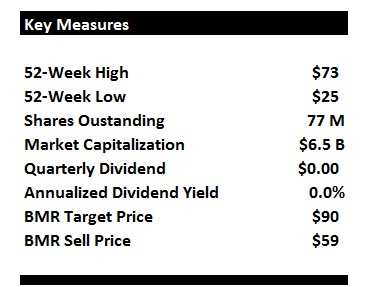
Shopify (SHOP: $72) is a technology platform company offering turn‐key end‐to-end e‐Commerce solutions. Shopify has almost 400,000 merchants using its technology platform. Shopify offers a comprehensive set of solutions that range anywhere from registering a domain name, to a set of templates and tools to create virtual storefronts, all the way to payment processing of credit card transactions. The Shopify platform includes a mobile-optimized checkout system, which is designed to enable merchants' consumers to buy products over mobile websites. Its merchants can offer their customers the ability to check out by using Apple Pay. Launched in 2006, Shopify debuted as a public company in 2015 at $17.
Investment Thesis
We see compelling value in Shopify shares. With the stock up significantly since the IPO, the obvious question is – where to from here and have we missed it? In our opinion, there’s still a lot of upside. We list a few reasons why below.
We’re still early in the e-Commerce growth cycle. While we all know that e-Commerce has been around for what seems like many years, we believe that it’s still the early days. Today, e-Commerce represents only 8% of total retail sales worldwide, implying there’s a significant runway left in this market. And while there’s plenty of room left for growth, we also see a fragmented market for technology sold into the purveyors of e-Commerce. That fragmentation is an opportunity for Shopify.
We see outsized relative growth for Shopify over the next three to five years, with Shopify growing revenue at +40% over the next four years.
We believe Shopify is the technology platform leader in e-Commerce today. Similar to other technology markets where companies old and new were able to develop new platforms without the baggage of legacy technology (like Google with Android), Shopify has followed a similar path in e-Commerce. In our view, that’s allowed Shopify to architect a sustainable and arguably future-proof platform.
Shopify is without question a high probability buyout candidate. Like we’ve seen countless times for leading vendors in new market segments in technology (NetSuite, Demandware, LinkedIn), they are often candidates for our large technology companies looking for growth – Google, Apple, Oracle, Cisco, etc.
There is a gigantic addressable market opportunity. Estimates say the total pie for Shopify’s industry is about $14 billion of revenue. Shopify currently has less than a 5% share of this pie. So while Shopify may be viewed as an expensive stock on next year’s estimates, the stock is without question compelling given the big picture opportunity.
Who Is Shopify?
By now, we’re guessing you know who Shopify is – if not, here’s a quick rundown. Shopify is a technology platform company offering turnkey end-to-end e-Commerce solutions. As noted above, the company has almost 400,000 merchants using its platform – growing at a compound annual growth rate of over 70% in the last four years. The Shopify platform employs an omni-channel strategy which means its solutions are designed to offer a similar experience whether shoppers are buying on-line or in a brick and mortar environment.
Shopify’s solutions are comprehensive and range from registering a domain name, to a set of templates and tools to create virtual store fronts, all the way to payment processing of credit card transactions across desktop and mobile. What’s most powerful is that the platform has a multiplier potential from an increasingly expanding set of solutions - not to mention more than 1,400 applications available through Shopify’s App Store. In short, Shopify is a “one-stop-shop” for anyone looking to set up an e-Commerce store.
Today, Shopify targets largely small medium enterprises, which represent 80% of revenue. That said, Shopify’s robust platform has signed up progressive brands like Tesla who uses the platform for its on-line store. If that weren’t enough validation, Shopify is Amazon’s preferred partner for Amazon Webstore owners. What’s even more compelling is that Shopify is readying itself to aggressively target larger enterprises.
Shopify Is The Technology Platform Leader In E-Commerce Today, Really!
Similar to other technology markets where companies, old and new, were able to develop new platforms without the baggage of legacy technology (like Google with Android), Shopify has followed a similar path in e-Commerce. That’s allowed Shopify to architect a sustainable platform. That’s likely also why Shopify has garnered an increasing level of interest in the marketplace as evidenced by how often it’s begun to show up among web searches.
If the breadth of capabilities wasn’t enough, the underlying technology should provide some further emphasis from a scalability standpoint where Shopify’s platform has been tested to handle +1 million requests per minute with response times of sub 100 milliseconds, which is considerably lower than the 2-second industry threshold recommended by Google. Entrepreneurs take this seriously, as Amazon has suggested in its research that every one second delay reduces conversion rates by 7%.
We Are Still Early In The e-Commerce Growth Cycle
The reality is that e-Commerce has been well-adopted across big retailers. According to a study by Deloitte, of the Top 250 Global Retailers, 70% of those companies have an e-Commerce presence when it comes to marketing material, and of those companies about 80% have transactional websites. In fact, most big-box retailers have accelerated their investments into e-Commerce. One of the most notable examples of this comes from one of the giants in main-line retailing, Walmart. The company has doubled the number of warehouses dedicated to supporting e-Commerce sales.
Yet, as widely adopted as e-Commerce may appear to be, it’s still early when it comes to the proportion of sales where less than 10% of overall retail sales comes from the on-line channel. In the United States specifically, retail e-Commerce sales only represents 8% of total sales; yet, it’s generally viewed as one of the main channels of growth across retailers.
When it comes to the overall market growth – the forecasts remain equally compelling. For example, according to eMarketer, the global market for e-Commerce is growing at a 16% compound annual growth rate (2011-2018 est.) Bottom line, even with those robust growth rates, retail e-Commerce’s penetration is expected to go from 8% today to 15% by 2020 – suggesting lots of opportunity going forward.
As compelling as the data may be to support the opportunity from the online e-Commerce channel, the potential goes beyond that into the omni-channel that connects physical stores, e-Commerce, mobile apps and social media (buy-buttons). In short, platforms like Shopify offer the opportunity to manage multiple channels on a single platform with a range of solutions from order management, inventory control, fulfillment, payment and customer service among others. That is a silent opportunity for Shopify.

BMR Take: We see a major bull market in e-Commerce. You have companies like Macy’s, Sears, and so many other traditional retailers under severe pressure. It’s such an obvious big picture trend. We think Shopify is a compelling investment opportunity on the right side of the equation. Put this one in your shopping cart!

by Todd Shaver | Mar 19, 2017 | High Technology
A Top Innovator In Payments
Square: (SQ: $17.30)
March 20, 2017
Company Description
Square provides mobile payment solutions. The company develops point-of-sale software that helps in digital receipts, inventory, and sales reports, as well as offering analytics and feedback. Square also provides financial and marketing services.
If your neighborhood bakery now accepts credit cards as well as cash, you might have Square to thank for the convenience. Square provides hardware (a square-shaped card reader) and software to merchants and other service providers that enable them to accept credit card payments. The card readers attach to smartphones and tablets, providing a business with a low-cost point of sale system. Square's software handles the backend of the transaction, making sure accounts square up between the merchant, the card company, the bank, and the consumer. Square charges a per-transaction fee (its standard rate is 2.75%). An early provider of mobile payment equipment and software, Square faces competition from established financial and technology companies.
Investment Thesis
We believe Square - by virtue of its strong brand and cohesive payment and business software platform that addresses the major challenges small merchants face to start, run, and manage their businesses - is well-positioned to capture a significant piece of a large market opportunity. We see potential for strong multi-year growth and improved EBITDA profitability as the business scales.
The large, underserved market opportunity presents a long growth runway. We believe Square offers the most complete and cohesive payments and business software platform for small and mid-market merchants, which addresses many challenges facing small businesses including hardware, software, and payment services from different vendors and pricing that is often complex and opaque. We believe the market is large and underserved with an addressable market opportunity of 30 million merchants in the U.S., representing a “greenfield” opportunity, as 20 million of these merchants currently do not accept electronic payments.
Square’s products offer a cohesive payments platform for merchants. We believe Square has evolved from a payments company to one that offers a full range of products and services to sellers to help them start, run, and grow their businesses. In addition to processing payments on its sellers’ behalf, Square provides analytics, capital, invoicing capabilities, customer engagement services, and payroll services, among other offerings. As sellers grow, Square's business with those customers grows in parallel, both through increased processing volume, complementary services, and the incremental payment volume that those services can generate.
Consensus expectations are modeling 30% and 28% growth in revenue over 2017 and 2018. While the story will evolve, we see Square driving strong revenue growth of 20-25% long-term while balancing improved profitability. Not many people have caught on to just how strong the long term growth tailwinds could be, we believe. We anticipate Square will continue to invest in its platform, but we do not believe it is a “grow at all costs” story. We believe Square is committed to improving profitability
IPO
Square raised $240 million in its initial public offering late in 2015. The company's offering price was $9 a share, which was less than investors had expected. The stock closed out 2015 at around $14.
Operations
Square extends its platform by offering products and services such as Square Cash, a peer-to-peer payment service using debit cards for businesses and consumers; Square Payroll, which helps merchants track employees' hours and wages; and Square Capital, which extends credit to Square customers. Square also has services that help its customers engage with their customers.
Square generates 85% of its revenue from transactions fees charged to its general customers. Transaction fees for Starbucks accounted for as much as 10%. Some 5% of revenue comes from software and data products and hardware.
Geographic Reach
Square began generating revenue outside the US in 2014 and international sales, in Canada and Japan, accounted for 10%% of revenue in 2016.
Sales and Marketing
Square has pitched itself as the company that enables small businesses to accept almost any kind of payment and that seems to work. Small businesses account for most of its sales. Its customers with less than $125,000 in annual revenue account for 62% of sales. Those with revenue between $125,000 and $500,000 generate 27% while those with more than $500,000 account for 11%. The mix has changed over Square's history with the less than $125,000 segment declining from 88% of Square's revenue in 2011; a good thing.
The company advertises through channels that include online, mobile, email, direct mail, and direct response TV. Square's sales and marketing expenses include the costs of making and distributing the Square Reader for magnetic stripe cards. The company offers the reader free on its website. Customers who buy card readers can get a full rebate on the price.
Strategy
From the foundation of its mobile payments customers (which Square calls “sellers”), Square is building an ecosystem of financial and management systems directed mostly at small businesses, the ones who have neither the time, money, nor inclination to install and learn big software systems. The company has added products that help analyze sales, manage a business, track payroll, make appointments, and engage with customers. Square's products work with payment options such as Apple Pay and Android Pay as with near-field communications and card chip systems. It also encourages the creation of apps for its platform by third-party developers.
Since it was founded in 2009 Square has attracted millions of small businesses to its platform, which underscores the value of its brand.
While the company has grown quickly, it has drawn several competitors as the market for mobile payments has grown. Some of them such as Visa, MasterCard, Google (with Google Wallet), Intuit and PayPal are more established companies with deeper resources. Amazon, which launched a Square competitor in 2014, pulled the plug on the service in 2015.
Starbucks transactions accounted for 14% of Square's revenue in 2014. But Square's agreement to provide point-of-sale services for Starbucks came to an end in late 2015, taking a chunk out of Square's revenue. On the other hand, the Starbucks deal was a money loser for Square. Overall, Starbucks was a good deal for Square by boosting brand awareness.
Another widely cited issue for Square is that its CEO, Jack Dorsey also is the CEO of Twitter. He was a co-founder of Twitter and had previously served as its CEO. He founded Square and has been its only CEO. It remains to be seen how the arrangement will affect each company. We don’t think it matters too much at this point.
BMR Take: We see a major bull market in mobile payments and identify Square to be front and center in shaping the future of the industry. The company has a track record of outstanding innovation and a brand that is challenging the likes of big names like Visa, MasterCard, and American Express (what great company to be in!). You know we like PayPal which now has a market cap of over $50 billion. Square at bit of $6 billion has the potential to grow to PayPal size. Now wouldn’t that be nice! We are placing a Price Target of $24 on the stock, an upside of 40%, and a Sell Price of $14.
Consensus Ratings for Square
Ratings Breakdown: 9 Hold Ratings, 20 Buy Ratings
3/06/2017 Instinet Price Target: $21
2/24/2017 Susquehanna Bancshares Target: $20
2/23/2017 Royal Bank of Canada Target: $18
2/23/2017 Wedbush Target: $19
2/23/2017 Goldman Sachs Group Target: $17
2/23/2017 Mizuho Target: $19
by admin | Mar 5, 2016 | High Technology, Research Report
Imagine your title is Chief of Cyber Security for The United States Department of State. Everyone in the world is trying to break into your highly classified severs 24/7 using world-class hackers and their most devious schemes. Your job is not just to patch security breaches but also to prevent them from gaining entry.
This content is for our beloved subscribers and anything you see on this page is just an excerpt!
Please note BullMarket.com access is available to paid subscribers only. Our Members Areas include archives of past Newsletters, News Flashes, our ten portfolios including STOCKS FOR SUCCESS, Healthcare, High Yield, High Technology, Exchange Traded Funds (ETF's), Energy, Senior Growth Opportunities, Financial, Long Term Growth, and Special Opportunities. Also, all of our in-depth research is available, and more.
Already a subscriber?
Login Here
Ready to join?
Subscribe Now!
