May 29, 2017

by Todd Shaver | May 29, 2017 | Weekly Newsletter 7pm Sunday
The Week Ahead
Is the bull market long in the tooth? Nah. In the past year, many fundamental and technical arguments have been offered to explain why the now eight-year-old bull market in U.S. stocks is due for at least a solid correction. And yet the stock market has gained ground in recent months, casting some doubt on these metrics but again suggesting the market is long in the tooth. Even news events that pro-market measures such as tax reform might be imperiled – or at least delayed – haven’t hurt stocks at all. So stay invested!
There is always a bull market here at The Bull Market Report! This week we highlight the following stocks: Nutanix, Twilio, The Blackstone Group, Splunk, and Tesoro. And a special report on Tesla.
Highlights From The Past Week
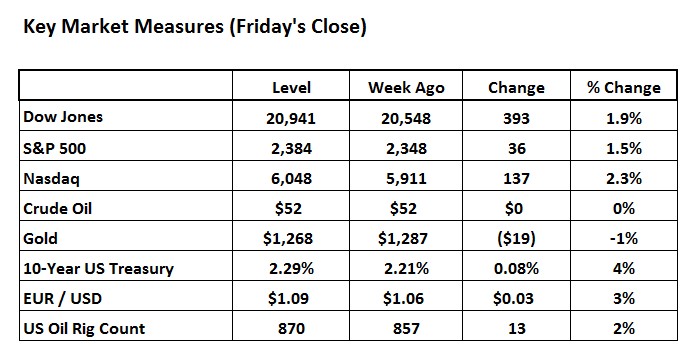
Short Sellers Resist Covering as S&P 500 Retakes Record Last Week It usually doesn’t work this way: Stocks vaulting to records, and bearish traders getting more aggressive. Lately, it has. The S&P 500 Index has climbed 8% since January, including its biggest gain since April in the just-completed week. Just one week ago, stocks suffered their worst rout in eight months as concerns over Trump’s presidency surfaced. Yet the loss was quickly erased and the S&P 500 rose seven straight days to reach a record high. It rose 1.4% to 2,416 last week, finishing with the best gain in a month. The Dow Jones Industrial Average added 279 points, or 1.3%, to 21,080, and closed just 3 points from its record high set Thursday. Technology shares continued to outperform as the Nasdaq 100 Index jumped 2.0% to close at a record high.
Short interest as a proportion of total shares outstanding has expanded, rising by 0.3 percentage point to 3.9%. Not since 2008 has an equity advance as big as this year’s occurred simultaneously with more short sales. It’s not hard to see why bears are standing firm, when any mishap from President Donald Trump could wreak havoc in a market where valuations sit at levels not seen since the dotcom era.
Fed's Williams doubtful of 3% economic growth. San Francisco Fed President John Williams said fiscal policy will not matter much to monetary policy over the next several months. He expressed doubt economic growth will rise sustainably to 3%, as assumed in President Donald Trump's budget proposal, because of certain possible changes in tax rates or policies. A giant jump in productivity growth is required to reach growth that much above the 1.50-1.75% range he thinks is currently sustainable. Williams supported gradual rate hikes and sees no pressure to do more than the two further hikes this year expected by most Fed officials, citing softer inflation readings. You may recall that Williams previously advocated 3-4 rate hikes this year. As to the Fed's balance sheet normalization*, Williams said details have yet to be decided, but promised a blueprint in coming months. Once the trimming begins, the Fed will not tinker with the plan unless there is a significant shock to the economy, emphasizing the process should be gradual and fundamentally on autopilot. In previous statements, Williams suggested the time horizon could be about five years.
* Normalization is the reducing of the size of the Fed's balance sheet. They bought a lot of assets in the Financial Crisis. Now it’s time to unwind that.
BMR Companies & Commentary
Nutanix (NTNX: $19.59, +22%, all changes in this newsletter are for the week)
Nutanix is a United States-based company that markets an enterprise cloud platform that converges silos* of server, virtualization, and storage into an integrated solution.
*An information management system that is unable to freely communicate with other information management systems. Communication within an information silo is always vertical, making it difficult or impossible for the system to work with unrelated systems. It occurs when departments or management groups do not share information, goals, tools, priorities and processes with other departments. The silo mentality is believed to impact operations, reduce employee morale and may contribute to the overall failure of a company or its products and culture.
The company delivered a great quarter highlighted by large-deal momentum. Nutanix reported fiscal 3Q17 EPS of -$0.42 versus the consensus -$0.45 on revenues 67% higher, year over year, of $192 million versus the $187 million expected. Management indicated Nutanix built up a significant backlog of deals that booked but did not ship in the quarter. Nutanix revenue topped analysts’ expectations, and produced a smaller-than-expected loss, and beat comfortably with its outlook for this quarter’s revenue. For the current quarter, the company sees revenue of $215 million to $220 million, and a net loss of 38 cents, better than consensus for $205 million and a 39-cent loss
There were three key takeaways from the quarter: (1) the sales transition toward large enterprise is progressing nicely (2) management's F4Q17 guidance implies billings growth of 32% Y/Y, compared to consensus of 24%, driven by continued confidence in the North American sales organization, large deal momentum, and a significant backlog buildup; and (3) we believe the momentum in large deals, combined with adoption of new technology (shipped on 23% of nodes compared to 9% in year-ago quarter), support the favorable thesis that Nutanix is becoming the preferred next-gen data center platform for enterprises.
The most exciting thing happening is that the shift to larger accounts is bearing fruit. As management indicated on its January-quarter earnings call, Nutanix is undergoing a transition to build a named account sales organization that targets larger enterprises. We think results in the April quarter demonstrate that the transition is now on a positive track and is generating noticeable returns. Management indicated its North American sales organization, which experienced sales execution issues last quarter, snapped back, with the region posting the best sales productivity since F4Q16, a period in which billings accelerated to 120% Y/Y growth.
We believe the better productivity was, in large part, driven by strong momentum in the large enterprise, where Nutanix has increasingly focused its sales efforts. Management indicated business from the world’s largest customers reached record levels in F3Q17, as they were 50% greater than any quarter in the company’s history. Nutanix landed 13 deals that were greater than $2 million in bookings in the quarter for a total of $45 million, compared to only four deals in F2Q17 over $2 million. We believe it has been an ongoing goal to move upmarket and we view the strong performance in the quarter as clear validation of the opportunity for Nutanix in that market.
CEO Deeraj Pandey said the results “reflect our continued focus on the global 2000, as well as a measurable improvement in the number of larger deals in the quarter, particularly in North America."
They ended the quarter with 6,200 customers, adding 800 new customers in the quarter, and ended the quarter with $350 million in cash and equivalents with no debt.
Nutanix shares still have 'significant upside,' says Piper Jaffray. They believe Nutanix has a strong competitive advantage and kept an Overweight rating on the name.
BMR Take: We feel Nutanix is undervalued, trading at 2.6x the consensus 2018 sales forecast, with sales growth of 70% this year and 35% next year.
Twilio (TWLO: $25, flat)
Founded in 2008, Twilio is the leading cloud platform for communications. Similar to Amazon Web Services, Twilio plays a critical role for software developers by allowing them to easily and securely build services such as voice, messaging, video, and authentication into their software applications and then scale those services globally.
We have a mix of good news and bad news to report from a major industry conference called SIGNAL 2017 that Twilio attended this week. The good news is that Twilio is doing the right things to win in the company’s addressable market, including: (1) building high quality, reliable technology services that have 99.99% availability that customers love; (2) introducing new features and products at a rate of one every 3.5 days, a rate competitors are hard-pressed to match; and (3) rapidly adding developers to its community, including 600,000 in the last 12 months, double the amount added in the prior 12 months, resulting in a total of 1.6 million developers on Twilio’s platform. (We find this hard to believe, but we have verified these numbers. Astounding.)
The bad news came from Airbnb, which indicated in its presentation that it is pursuing the same kind of multi-sourcing strategy that led to Uber significantly reducing its spending on Twilio in 1Q17.
BMR Take: Consensus estimates call for 2017 EPS of -$0.29 on revenue growth of 30% and for 2018 EPS of -$0.09 on revenue growth of 27%. Twilio currently trades at a 2018 price to sales multiple of 5x, which is cheaper than many other high growth internet companies. We hope Airbnb sticks around as a customer, but if they don’t, some part of the negative impact is already factored into the current lower valuation.
The Blackstone Group (BX: $33, +9%)
What a great week Blackstone had. Finally! Founded in 1985 as an M&A boutique, Blackstone has grown to become one of the largest and most broadly diversified global alternative asset manager in the world. Blackstone manages $370 billion of assets, roughly equally divided across four segments: Private Equity, Real Estate, Credit, and Hedge Fund Solutions.
This week Blackstone Group announced an investment management agreement in conjunction with CF Corporation’s acquisition of Fidelity & Guaranty Life (FGL), which we believe could represent an interesting longer-term opportunity. In addition to the agreement, Blackstone’s Tactical Opportunities and GSO businesses are investing capital alongside CF Corp. in the deal.
Upon the closing of the transaction, which is expected in 4Q17, Blackstone will earn roughly 20 bps on total assets ($28 billion today), which equates to $55 million of fees (around 1% of 2018E EPS). Not a bad little boost to the bottom line!
Over time, we believe the bigger opportunity for Blackstone will revolve around FGL’s ability to grow within CF Corp. (which we suspect is a big focus), which will drive incremental fees to Blackstone. While the near-term financial impact is small under conservative assumptions, we view the announcement as a positive, given the long-term strategic implications.
BMR Take: Blackstone has made some exciting announcements recently between FGL and the $40 billion infrastructure deal. Plus, the stock is inexpensive, trading under 11x 2018 EPS estimates with a juicy 7% dividend yield.
More Blackstone News
Saudi Arabia joined the parade of investors into U.S. public works by pledging a record investment with Blackstone Group. The country’s Public Investment Fund agreed to commit $20 billion to Blackstone’s new infrastructure fund in the latest push around the world by large investors to buy up airports, pipelines and other public projects, particularly in the U.S. Blackstone said the kingdom’s money would seed an investment fund that whose goal is to reach $40 billion and reach $100 billion with added debt, and by raising money from investors like sovereign-wealth funds, public pensions and rich families. With assets of $370 billion as of March 31, Blackstone manages nearly twice as much as its closest competitor, Apollo Global Management. Each of Blackstone’s four platforms - real estate, private-equity, hedge funds and credit - are among the largest investing businesses of their kind.
Our Thoughts on Things Going on in the World as it Relates to Our Stocks
We don’t talk much about world politics and the US administration here at The Bull Market Report. We watch it closely, but we understand that you are coming to The Bull Market Report for financial news, not mass murders, or the upsetting changes in the status quo in Washington DC. We know that that Trump does have an effect on the markets – we are not stupid or naïve. But the stock market is concerned with revenues and profits, and companies will do everything in their power to produce same, despite what Trump does. As we have seen, he has little effect on most of the things he campaigned about, and the S&P 500 and all the small companies in this country are focused on growing revenues and earnings. We like it that way. We believe in the financial health of America.
Splunk (SPLK: $63, -5%)
Splunk provides software solutions that enable organizations to gain real-time operational intelligence in the United States and internationally. By leveraging a proprietary technology to turn machine data into real-time operational intelligence, Splunk is benefitting from its position as a pioneer and leader in the world of machine data with its core software platform, Splunk Enterprise.
Starting off FY:2018 on the right foot, Splunk reported 1Q:FY18 revenue of $242 million (up 30% YoY) that exceeded the Street’s estimates at $234 million, and a loss per share of a penny that beat the Street at a loss of 4 cents. The company added more than 500 new enterprise customers during Q1. They lifted its revenue outlook for the fiscal year to $1.2 billion. Revenues for the past three years are $450 million, $670 million and $950 million. We’d say they are the right track. They have $1 billion in cash and no debt.
The tone of the call was positive for the seasonally weakest quarter of the year. We continue to believe that Splunk is very well-positioned to benefit from the Big Data wave in the coming years. Splunk is chasing down a big market opportunity and the company raised its total available market opportunity at its analyst meeting in January to $55 billion from the $45 billion.
BMR Take: After a strong performance in the seasonally weakest quarter of the year, we would be buyers of Splunk on any weakness. Despite Splunk more than tripling its revenue between FY:2014 to FY:2017 and consistently beating analyst expectations, the stock is 37% below the peak made in 2014. Now is a great time to take a closer look if you have not already!
Tesoro (TSO: $83, flat)
Tesoro is an independent refiner and marketer of petroleum products. Tesoro, through its subsidiaries, operates seven refineries in the western United States with a combined capacity of 900,000 barrels per day.
We are pleased that Tesoro announced that the waiting period applicable to its proposed acquisition of Western Refining has terminated. This satisfies one of the final conditions to the closing of the pending acquisition. Tesoro therefore expects the closing of the acquisition to occur on June 1, 2017. This news means the deal is highly likely to now close!
As a reminder, why do we like the Western Refining deal? The synergies of putting the two companies together are big. At first glance, we think the originally announced target synergies for the merger – including savings of $350-$425 million – look overly conservative. We believe there is opportunity to reach further into Tesoro’s legacy operations to optimize the retail business, and we believe the overall footprint in the Bakken could be sold for a lot. This is all just the low hanging fruit. Opportunities to optimize logistics in the Permian region could be another leg of upside over time. In summary, not only does Tesoro become an even larger franchise in the sector, but EPS is expected to go from $4 to $7 over the next few years.
BMR Take: We continue to see compelling value in Tesoro shares. The stock trades at a massive discount to post-merger net asset value estimates of $120-140 per share. In comparison, Berkshire Hathaway owns a 15% stake in Tesoro’s competitor Philllips66, which the market values at a premium to net asset value. With several big name institutional investors recently taking large positions in Tesoro, we can’t help but be excited about the prospects for this investment.
Note to our Readers:
We are well aware of the problems on our website getting current prices and data. We get our data feed from Yahoo and they have just informed us that they are discontinuing that service. Needless to say we are not pleased and we are working on the issue. We should be up and running with a solution this week.
Note: Just after we wrote this, we have a solution. Everything should be up and running perfectly Tuesday morning. Yea!
Upcoming Economic News
Consumer Confidence
Tuesday, May 30 10:00 AM
Period: MAY
Actual: N/A
Consensus: 119.5
Prior: 120.3
Note: The Conference Board's Consumer Confidence Survey is a monthly measure of the public's confidence in the health of the U.S. economy.
Personal Income
Tuesday, May 30, 8:30 AM
Period: APR
Actual: N/A
Consensus: 0.4% over last year
Prior: 0.2%
Note: Monthly Personal Income data are published by the U.S. Bureau of Economic Analysis. Personal income measures total pretax income earned by individuals, non-profit organizations, and private trust funds. Wages and salaries are the largest component of personal income.
Chicago PMI
Wednesday, May 31, 9:45 AM
Period: MAY
Actual: N/A
Consensus: 57.9
Prior: 58.3
Note: The Chicago Business Barometer provides an overall gauge of business activity as published in the NAPM - Chicago monthly Business Report. An index reading above 50% indicates that economic activity is generally expanding; below 50%, generally declining.
Pending Home Sales M/M
Wednesday, May 31, 10:00 AM
Period: APR
Actual: N/A
Consensus: 0.6% over last year
Prior: -0.8%
Note: The National Association of Realtor's Pending Home Sales Index is designed to be a leading indicator of housing activity. This indicator measures housing contract activity. It is based on signed real estate contracts for existing single-family homes, condos and co-ops. A signed contract is not counted as a sale until the transaction closes.
ISM Manufacturing
Thursday, June 1, 10:00 AM
Period: MAY
Actual: N/A
Consensus: 54.7
Prior: 54.8
Note: The Manufacturing ISM Report on Business is based on data compiled from monthly replies to questions asked of purchasing and supply executives in over 400 industrial companies. The PMI is a composite index based on the seasonally adjusted indices for five of the indicators with varying weights: New Orders; Production; Employment; Supplier Deliveries; and Inventories. An index reading above 50% indicates that economic activity is generally expanding; below 50%, that it is generally declining.
Nonfarm Payrolls
Friday, June 2, 8:30 AM
Period: MAY
Actual: N/A
Consensus: 175,000
Prior: 211,000
Note: This is survey data measuring nonfarm payroll employment. Employees on nonfarm payrolls are those who received pay for any part of the reference pay period, including persons on paid leave.
Average Workweek
Friday, June 2, 8:30 AM
Period: MAY
Actual: N/A
Consensus: 34.4
Prior: 34.4
Note: This is survey data measuring the average workweek for production or nonsupervisory workers on private nonfarm payrolls.
Is Tesla Where Apple Was 10 years Ago?
We read a great article in Business Insider about comparing Tesla and Apple which was written by Gene Munster of Loup Ventures. Formerly he was a senior research analyst at Piper Jaffray. Some excerpts:
Apple (AAPL: $153, flat) is the world’s largest company with a market cap of $800 billion. Tesla (TSLA: $325, up 5%) s an automaker with a market cap of $53 billion. There are many parallels between Apple about a decade ago and Tesla today, market cap being one of them. In 2005, Apple’s market cap was close to where Tesla’s is today. A decade from now, we think we’ll look back at Tesla and realize it was the next Apple. After all, the Tesla story is just getting started.
There are five major similarities to Tesla today and Apple in the mid-2000s:
1. Brand
2. Visionary leadership
3. Integrated hardware and software
4. Halo effect
5. Reshaping a market
Brand
Tesla has a great brand so far. Tesla owners love their Teslas, just as Apple users love their iPhones and Macs. 90% of Tesla owners state they would “definitely” buy their cars again, the highest rating of any automaker. The next two closest automakers are Porsche at 84% and Audi at 77%. By comparison, Tim Cook stated last year that the iPhone had a 97% satisfaction rate.
Tesla has built a brand around being a different kind of automaker. Not only because its vehicles are powered entirely by electric, but also because they don’t use model year numbers, and treat software updates more similar to updating an iPhone app than a car. The company has done this all while squarely placing itself in the conversation with BMW as one of the best-engineered cars in the world. Tesla is taking a new approach to the car market.
Visionary Leader
Elon Musk and Steve Jobs share similarities in that they are visionary entrepreneurs that simultaneously operated multiple groundbreaking companies. Musk with Tesla and SpaceX and Jobs with Apple and Pixar. However, both seem to have different guiding lights.
Where Jobs seemed to be singularly focused on developing the absolute best products he could to delight customers, Musk appears to be driven to save the world, from developing alternative energy products, to exploring space, to protecting humanity from AI. They both recognize the importance of quality to be successful.
Musk may be the biggest wild card in the comparison between the two companies. The drive to create great products is eternal from a business standpoint.
Obviously, the move to sustainable energy is a multi-decade opportunity. From an investment standpoint this may not matter, but from a philosophical standpoint it’s apparent that the world needs many things and Musk is convinced he can affect positive change.
He's already involved in Tesla and SpaceX as CEO. It was recently announced that he would also be CEO of Neuralink, a brain-computer interface company that creates a neural lace to enhance the human brain. Musk is also involved with The Boring Company, which is currently experimenting with tunneling under Los Angeles to reduce the traffic burden. Finally, Musk is involved with OpenAI, which is dedicated to creating open IP in artificial intelligence.
There will always be those capable of breaking conventional rules, in this case the importance of a laser focus. Musk is obviously one of those people. The only question may be if his desire to save humanity ultimately pulls him in too many directions. Musk has shown an ability to surround himself with great talent, enabling him to better leverage his own time.
Integrated Hardware and Software
Tesla, like Apple, produces its own hardware (cars) and its own software. Their integrated approach allows them to have complete control over the product experience, which is important because a car is a constant user experience when you’re in it.
Perhaps more importantly, Tesla has a multi-year head start over other automakers in terms of features like over-the-air updates and autonomous driving. As autonomous driving functionality becomes a requirement for modern auto buyers, Tesla holds an advantage in that its constantly improving self-driving software is an update away. Tesla's cars get wireless software updates that add new features to the car.
Looking at product categories beyond transportation, Tesla’s proven ability to integrate hardware and software will continue to set it apart from competitors looking to introduce real innovation. Their ability to control the product experience from end-to-end is an innovator’s advantage over the incumbents in industries that Tesla will address in the future.
Halo Effect
Perhaps more than any company in history, Apple has used the halo effect to its advantage. The company’s iPod represented a product that appealed to the masses, where the Mac computer line did not. Once customers adopted iPods and experienced Apple’s attention to detail in design and simplicity of use, it convinced customers to buy Macs.
The iPod also laid the groundwork for the iPhone. Combining the iPod with a phone had long been a topic of discussion, and those two features, combined with an Internet connection, were the iPhone’s features at launch. Now we see the halo effect in full with many iPhone owners also owning Macs, iPads, Apple Watches, and AirPods.
Tesla has a similar opportunity to create a halo effect through its cars. With the Model 3 starting at $35,000, a large audience of entry level luxury car owners are going to experience Tesla for the first time, and at a 90% satisfaction rate, they will be happy to join the club.
Aside from cars, Tesla also offers the Powerwall energy storage product ($5,500), as well as the Solar Roof and solar panels. We believe that Tesla owners will want to add other Tesla products to further reduce their dependence on traditional energy.
Tesla has taken over 400,000 pre-orders for the Model 3. For context, if you assume another 100,000 Tesla owners of Model S and Model X for a total of 500,000 Tesla owners in total by 2018-19, a 10% attach rate of Tesla owners buying the company’s Powerwall or solar products, and $30,000 in revenue from those products, there is an incremental $1.2 billion business opportunity in the near term due to the halo effect.
Reshaping A Market
Tesla’s stated mission is to accelerate the world’s transition to sustainable energy. The company is attacking two major industries - automotive ($1 trillion in US new vehicle sales in 2016) and electric utilities ($400 billion in US revenue in 2015). These industries make sense. Transportation accounts for 70% of total US oil consumption. 65% of electricity in the US is still produced by coal or natural gas. Tesla is creating a platform for sustainable energy from your vehicle to your home. Just as Apple captured significant value from the chain of industries it disrupted, we think Tesla can do the same.
As Tesla pursues its mission, it has a path to be one of the most valuable companies in the world. For the past 10 years, the largest company in the world as measured by market cap has been either Apple, Exxon Mobil, or Petrochina. Going back 20 years, the only other additions are Microsoft and General Electric. Therefore, either a consumer electronics company, an energy company, or a conglomerate represented the biggest company in the world. Tesla is all three.
Tesla’s cars are effectively consumer electronics, albeit expensive ones, that reduce our dependence on oil. Tesla’s acquisition of Solar City and introduction of the Powerwall and Powerpack are next-generation energy plays driving toward the replacement of coal and gas. Doing both makes it a conglomerate.
Tesla is not a car company. It's an operating system for sustainable energy that combines a powerful brand, a visionary founder, integrated hardware and software, and a halo effect all with the purpose of transforming a combination of large markets. Tesla might be the next Apple, as Tesla will forge its own path and the world will be better for it.
BMR Take: Wow. What a story. If this bullish scenario plays out and becomes reality, Tesla is a screaming buy - $1000 a share? $2000? If they run out of capital and have to be bailed out by a GM, Ford or Toyota, the stock is headed towards $100 and lower. But isn’t this the case with any new venture? Risk and reward. The stock market thrives on this.
We are in the bullish camp. We are Elon Musk believers and when the company starts producing cars in quantity in 2018 and 2019 and the world sees how great they are, then revenues and profits will accrue. What a story. We want to be a part of it.
Mazor Robotics (MZOR: $41, down 4.5%)
We are well aware of the price of the stock these past few days. The stock has been downgraded by a few firms due to valuation. Hmmm. What does that mean? It means the stock has gone up, perhaps higher than they ever thought. And yes, we know the stock has gone up. We are way up on the stock since we added it in the teens last year.
Needham restated a hold rating in a research report on May 11th. First Analysis downgraded shares from an overweight rating to an equal weight rating and boosted their target price for the company from $28 to $38 in a research report on the same day. Wells Fargo downgraded shares from an outperform rating to a market perform rating in a research report on May 11th as well. These aren’t stellar reports but they aren’t that bad either. As is common on Wall Street, they are just protecting themselves.
The recent downgrade was May 17th, 10-11 days ago, with nothing new since then. The stock is volatile and traded as high as almost $46 on the 18th, $45 on the 19th, and $43 on Monday of this week. It wasn’t until Tuesday that the stock sold off a bit. But it came right back later in the week. Note that the stock was at $35 a month ago. The point is that it’s not the end of the world. HOWEVER, we don’t know where the stock is going. We know where the COMPANY is going, but not the stock. We believe the COMPANY is doing well. Super well. But maybe the market will drop the stock to $35 or $30 and that would be devastating.
So what to do from here is up to you. We are going to stick with it a little bit longer and watch for it to get back on track. If it doesn’t we will exit with well over 100% gains.
The High Yield Report
By Michael Foster
One of the biggest events of the week was the big drawdown on Thursday of Omega Healthcare Investors (OHI: $32, down 6%), which is causing quite a bit of panic among high yield investors. The panic is in some ways compounded by the fact that this decline came on no news. Omega released their earnings back on May 3rd, with a slight miss on revenues that grew 9% year over year and in-line FFO, with reaffirmed full-year earnings guidance. This means that Omega’s dividend is covered by 135% - a very big number and unquestionably enough to not only support the current payouts but to even boost them higher. Since Omega has increased dividends every quarter since 2011, higher payouts aren’t too shocking.
That doesn’t mean Omega gets much love from markets. The stock has been range bound since shooting up in 2013, meaning its yield has gotten steadily higher thanks to those continual dividend hikes. But shares have remained below their all-time high in early 2015, and are now trading 16% below their 52-week high. Those metrics, combined with the recent sudden selloff, could cause panic in some investors’ eyes.
However, panic is unwarranted. The cause of the selloff is unknown (most likely one big institutional investor exited), but there’s no evidence that the long-term income growth behind this company is impeded by anything at all. What’s more, Omega shares are now at the upper end of their historical range, and will yield over 8% soon enough thanks to the company’s continual payout increases. This makes Omega a pretty good contrarian REIT play right now.
There’s just one problem: this company's been a good contrarian play for a few years now. Will Omega ever break out of this range and start to deliver capital gains?
There are a few reasons to think so, but let’s not get into that now. Instead, let’s think a bit about why you would want to buy Omega now or over the last six years. With increased dividends and ample dividend coverage, Omega has been a strong investment for anyone who wants capital preservation and a reliable income stream. Omega is a stock that reliably delivers about $65 per month in income for every $10,000 invested - and without loss of capital. It’s been doing that for years, which makes it a reliable play in a broader high yield portfolio.
So instead of asking whether Omega will earn us capital gains now or in the future, we should instead focus on the income stream. Is it in danger? Is there any reason to believe the dividend hikes won’t keep coming? Right now the answer to both questions is “no.” And for as long as it remains “no,” this is a stock worth considering for any high yield-focused investor.
Elsewhere in the high-yield world, the markets have been relatively quiet. The UBS BDC ETF (BDCS: $23, up 1%) and the SPDR Barclays High Yield Bond ETF (JNK: $37, flat) saw a modestly strong but mostly uneventful week. This is largely a result of a continually complacent credit market. Defaults are not spiking (despite harried tales of dying shopping malls and the end of retail commerce as we know it - this isn’t impacting corporate bonds to any significant scale.) And the future pace of Federal Reserve interest hikes is modest enough to not cause companies any big problems in repaying their debts. Also, as we have mentioned over the last few weeks, corporate profits are rising at large firms, which is making solvency more common and even encouraging more companies to take out more debt. In short, the corporate lending world is doing fine.
And beyond Omega Healthcare, REITs are fine too. The SPDR Dow Jones REIT ETF (RWR: $93, flat) had a decent showing this week thanks to the relative calm in many REITs, including the triple-net lease firms whose retail shopping focus was a cause for concern over the last couple of weeks. We’re also seeing a continual run-up in the tech-focused REIT world, a once sleepy and high-caution sector that is quickly turning into a market favorite. Digital Realty Trust (DLR: $118, up 3%) had yet another stellar week, bringing its yield even lower. We aren’t yet at a point where the tech REIT world is an overly crowded trade, but we are definitely inching in that direction every week.
Another big theme of the week has been OPEC, with the Saudis again doing all they can to put a floor on oil prices. They tried this back in November last year and failed miserably; oil prices fell after their oil production freeze, although that agreement spanned far beyond OPEC and reportedly had unusually high compliance. The high compliance and the multinational signatories indicates there is a lot of desperation among oil producers to do all they can to fight American shale. While it’s easy to interpret OPEC’s panic as a sign that oil prices will crash, that’d be overkill.
In reality, it looks like the range we’ve seen for crude oil futures will remain. That means oil companies who have gotten accustomed to this new price environment should be okay, and it also means companies that rely on energy to operate (i.e., just about everyone) won’t see input costs balloon. For high yield, this again is a good sign for seeing lower corporate defaults, but it also means MLPs aren’t as risky as they were in 2014 or 2015. The Alerian MLP ETF (AMLP: $12.16, flat) had a quiet week as a result, and MLPs haven’t seen either a panic selloff or an exuberant buy in the last year.
A quick word on Bull Market Report's diversified fund picks: The AGIC Equity and Convertible Income Fund (NIE: $20, up 1%) and the PIMCO Dynamic Income Fund (PDI: $30, up 1%) had a solid week thanks to NAV increases and higher demand for closed-end funds in general, while a sleepy municipal bond market meant Invesco Municipal Trust (VKQ: $12.70) and The Nuveen AMT-Free Fund (NVG: $15) saw little change. We are still waiting for more investors to realize the value in muni bonds, but with low volatility and market complacency, it may take a while for more investors to rotate back into munis and out of riskier stocks and corporate bonds. But it will happen - it’s just a question of when.
Good Investing,
Todd Shaver
Editor in Chief and CEO
The Bull Market Report
Since 1998
April 30, 2017
by Todd Shaver | Apr 30, 2017 | Weekly Newsletter 7pm Sunday
The Week Ahead
Tax season came to a close two weeks ago. We filed an extension of course. Now Tax Reform is front and center. A new plan released by the Trump Administration got the market excited about the prospects. The bull in us hopes to see the corporate tax rate dropped to 15% from 35% and tax repatriation bring home the bacon from overseas – they are talking 10% for this cash that totals $2.6 trillion. We personally are excited about that prospect. We look for more progress in the weeks ahead to drive continued improvement in sentiment and higher stock market prices.
There is always a bull market here at The Bull Market Report! This week we highlight the following securities: Amazon, PayPal, CBRE Group, UPS, Google, Celgene and Athenahealth.
Highlights From The Past Week
The biggest tax cut in US history? The announcement outlined the general principles of proposed US tax cuts and reform. The proposals outline the lowering of the marginal corporate tax rate to 15% from 35%. This rate will be applied to a simplified tax code. Border tax adjustments have been said not to work in their current form but discussions are continuing. Overseas cash will be repatriated at a one-time lower tax rate, although this rate is yet to be determined. The timeline for US tax reform is still unclear. The budget neutrality of these proposals has not been outlined in detail. Secretary Mnuchin stated that the reform would pay for itself with economic growth. But we know this is just impossible. Arthur Laffer would be laughing from the grave. Oh wait – he is still around – a healthy 76 years old.
Remember the Laffer Curve? Google it. It has come to be remembered as the concept of lowering taxes (thus cutting tax revenue to the government) causing so much growth that the increased tax revenues pays for the tax cut. Again – this has been completely debunked over the past four decades.
Cash repatriation a big deal for the Technology sector. In recent years, US companies have accumulated estimated overseas cash balances of $2.6 trillion on their balance sheets. Overseas cash holdings are dominated by the Information Technology sector. Companies such as Apple ($255 billion), Microsoft ($110 billion) and Google ($75 billion) have significant cash holdings well in excess of their working capital requirement. If this cash starts coming back we think it will be a boost to the economy and the stock market.
No healthcare vote this past week. The latest House attempt to pass a revised Obamacare replacement bill seems to have stalled. Despite continued pressure from the White House and recent speculation that a vote could take place over the weekend, House Speaker Ryan and his top lieutenants decided during a late-night meeting on Thursday that they still do not have the votes to pass the legislation. Note that at least 15 House Republicans remain firmly opposed to the bill, while at least another 20 are leaning towards no or are still undecided. Recall that Republicans can lose only 22 votes. The Hill recently reported that at least 21 Republicans have said they would vote no on the bill.
Big inflows to equities. Dampened risk aversion surrounding the French election, tax reform back in the headlines, and better earnings sentiment all are reflected in the latest flow data. Equities saw $21 billion of inflows this week, the largest since the US election. US equities saw inflows of $14 billion, the largest in 19 weeks. Inflows to European equities were $2.4 billion, the most since December 2015. Emerging market equities saw its sixth straight week of inflows. US value has now seen outflows in five of the last six weeks. At the same time, we saw the biggest inflows to small caps in 23 weeks, the biggest inflows to Financials in seven weeks and outflows from bond proxies like real estate, utilities and telecom. Investment grade bond funds attracted funds for an 18th straight week. At the same time, the biggest inflows to Treasury/government bond funds in 13 weeks occurred.
BMR Companies and Commentary
Amazon (AMZN: $925, up 3% - but being up $27 sounds better!)
Amazon reported better than expected 1Q17 results, whereby revenue came in 1% above consensus and operating income was 10% above consensus despite a continued ramp in investments globally. All around it was a great quarter. Check out the News Flash from Thursday.
While Amazon continues to invest globally with a focus on content and fulfillment center expansion, in addition to starting up newer markets, like India, and services such as Prime in Mexico, we believe it is increasingly attracting a greater share of consumer wallets globally as a result of these investments and is focused on cost discipline and efficiency where possible. It’s a great strategy – one that is working and working well.
Amazon remains in investment mode globally, and we believe margins can be sustained as the company continues to focus on cost discipline, as earlier projects become increasingly efficient. As an example, most fulfillment centers typically need to go through three peak periods before reaching sustained efficiency levels. To this end, the maturing of existing fulfillment centers helped Amazon’s operating margin of 5.2% in 1Q17 beat projections. This is great news. Recall, a few quarters ago the stock sank on weak operating margin.
Internationally, Amazon is investing in newer markets and is rolling out many of its products and Prime benefits globally sooner than prior, pressuring profitability in the short term as international losses reached $1.5 billion over the prior three quarters alone. We note that Prime recently launched in Mexico with 20 million eligible items. We believe these member benefits should result in greater adoption of Amazon’s services globally.
Amazon Web Services (AWS) revenue of $3.7 billion increased 44% from last year and was largely in line with projections. AWS continues to launch newer products and we note recent customer additions, Snap, Dunkin Brands, and Liberty Mutual, among others.
BMR Take: Our $1,000 price target is quickly approaching. We expect around $19 of EPS in 2018 versus the $13 in 2017. We believe Bezos will be focusing on earnings as the company moves forward and with nearly 50% EPS growth in the cards, Amazon moving to $1,000 is not a stretch at all.
PayPal (PYPL: $48, up 9%)
PayPal delivered a solid set of results and raised its revenue and earnings outlook modestly by around 3%. The metrics were quite robust all around, starting with acceleration in active accounts (partly helped by consumer choice), robust transaction growth, healthy growth in total payment volume, a lower deceleration in take rate and numerous partnership announcements in the quarter highlighting business momentum.
In particular, we love to see big growth as that confirms a bull market is alive and well. On this front, PayPal delivered through mobile. Mobile volume growth was +50% overall with Venmo doing +115%.
First-quarter revenue of $3.0 billion (up 17% annually) and EPS of $0.44 (up from $0.37), beat estimates of $2.94 billion and $0.41. PayPal expects second quarter revenue of $3.1 billion and EPS of $0.42; and full-year revenue of $12.6 billion (up 16%) and EPS of $1.76. Over $2.7 billion in free cash flow is expected this year. Wow.
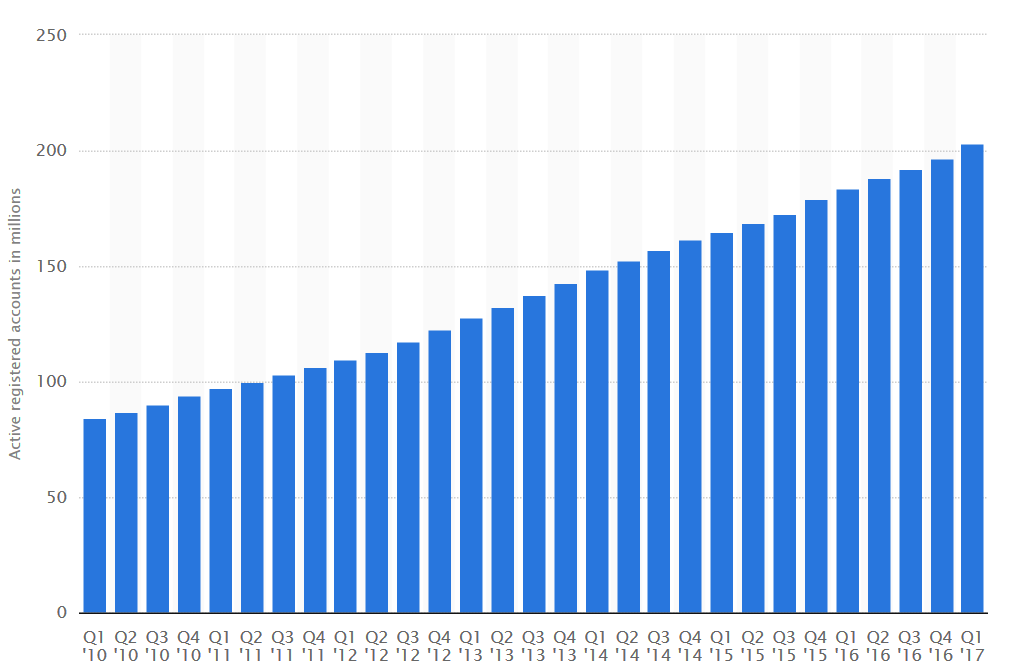
Number of PayPal's total active registered user accounts from 1Q10 to 1Q17 (in millions)
And check this out:
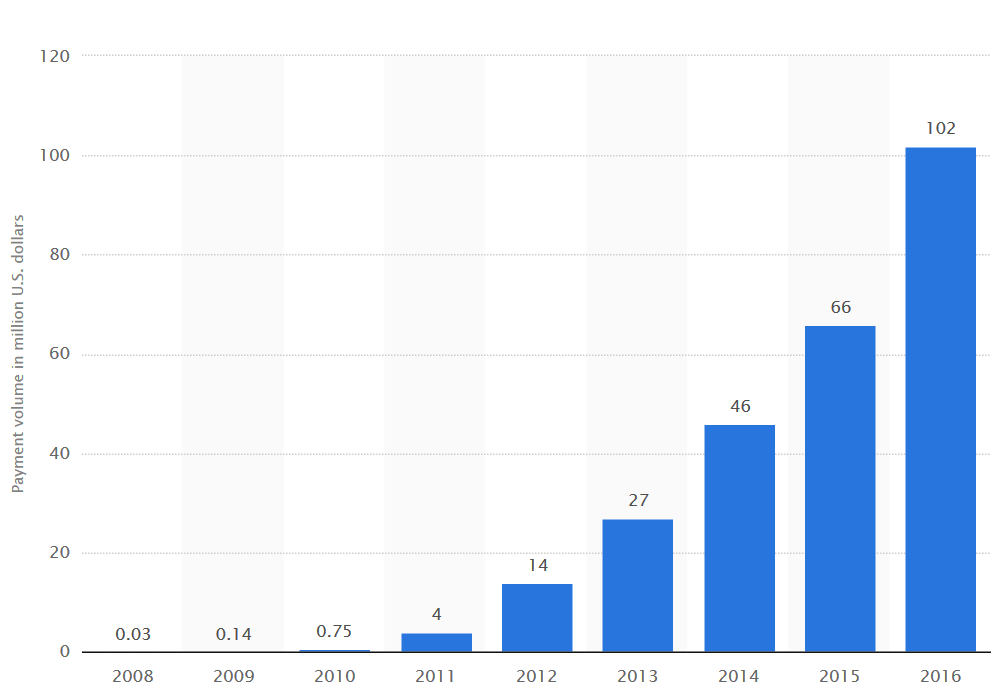
PayPal's annual mobile payment volume from 2008 to 2016 (in $billions)
PayPal announced a new $5 billion stock repurchase authorization. This news caught investor’s attention and was one of the key drivers to send the shares up 7% in the trading session the day after posting results.
One noteworthy ongoing debate is the option to move to more of an “asset light” model, which should increase the valuation the business receives from the market. This strategy would require selling PayPal Credit so the company doesn’t do any lending but only runs technology and processing operations. We would be pleased to see this catalyst occur.
BMR Take: EPS estimates call for around 15% growth to upwards of $2.50 in 2019. With all fundamentals looking great, this freight train is rolling, baby! Our Price Target is $48. Since it hit this price on Thursday, we hereby raise our Target to $56. With a market cap of $57 billion now, if it reaches this new target we will see the cap reach $67 billion. Now THAT’S a story.
Oh – our Sell Price? It remains the same: We would not sell PayPal.
Google (GOOG: $906, +8%, or $63 a share)
Results were better than expected in 1Q17. Gross revenue of $24.8 billion grew a nice 24% from a year ago and was 2% above consensus. The results reflected continued strength from mobile search, YouTube, and programmatic ads as paid clicks growth accelerated 53% from a year ago.
What is really exciting? There is a belief that it remains relatively early days for “mobile search monetization”. To this end, we saw local shopping queries increase by 45% from a year ago and the company achieved 2 billion app installs since September 2016. What does this all mean? More and more people are on their phones searching for stuff as they walk through malls, sit in their cars, and do whatever they do every day. This trend is unlocking “mobile search monetization” we described above. Bottom line, mobile search continues to lead to good results for Google for the foreseeable future.
YouTube did great. YouTube usage was 1+ billion hours of video watched daily in February. Holy cow! This might be the best asset in all of video media. During the quarter, we saw large brand advertisers increasingly come back to the platform after some recent mishaps around inappropriate video uploads being attached to the marketing campaigns of some advertisers on the platform. Very nice to see the recovery unfold here.
BMR Take: We continue to believe Google is among the best-positioned Internet companies due to its leadership position in artificial intelligence, mobile, search, video, and programming, all of which are core Internet growth drivers. With EPS on track to do over $50 in 2018, you just have to own this one.
CBRE Group (CBG: $36, up 4%)
Another Bull Market Report stock delivered a good quarter. It was a clean beat for CBRE. EPS of $0.43 came in well-ahead of the $0.33 consensus, as expenses trended materially below expectations.
CBRE Group’s resilient first quarter result validated the persistent strength of the commercial real estate cycle and the company’s first-rate global platform.
EMEA* and Asia stood out for the company. Asia posted 10% revenue growth.
*Europe, Middle East and Africa
The company has a strong outlook. Management commented that it was not making any adjustments to its 2017 earnings outlook of $2.40. The backdrop remains favorable as rates have retreated, the election fallout has stabilized, global economies are growing and new construction remains strong.
M&A is emerging again. This could be a big boost for the company. The company closed two investments in the quarter, and an additional one at quarter end. Management suggested that after a year of remaining mostly absent from the acquisition markets, pricing was becoming more rational again, suggesting we could see slightly more activity from the company. With a balance sheet that remains healthy, with in excess of $3 billion of dry powder on hand, management could step on the gas if they choose to.
BMR Take: CBRE Group is the Rolls Royce of real estate. With nearly $3.00 in EPS due in 2018 with upside from possible M&A, the current price in the mid $30s sure looks like a cheap value to us.
Celgene (CELG: $124, up 1%)
Celgene reported 1Q17 light on revenues, but modestly ahead of Street consensus on lower spending, and provided positive 2017 guidance. EPS of $1.68 was above Street consensus of $1.64. Revenues of $2.95 billion were slightly below consensus of $3.05 billion.
The modest revenue softness was largely due to weakness in sales of Otezla, which were negatively affected by a greater than anticipated contraction in U.S. prescriptions for psoriasis/psoriatic arthritis, and a modest inventory draw-down through 1Q17. Other products - namely Revlimid and Pomalyst - were also negatively affected by Medicare prescription problems.
We note that previous guidance of $1.5-$1.7 billion in net Otezla sales for 2017 remains intact despite this soft quarter. Further, the contracts negotiated with large payers have significantly broadened access to Otezla for up to 100 million covered lives, intimating future tailwinds for the asset.
BMR Take: We remain bullish on Celgene and forecast total revenues to rise strongly. We expect Celgene’s four drugs (Revlimid, Abraxane, Otezla, and Pomalyst) to drive revenues to over $13 billion by 2017, and over $21 billion by 2020. Note that revenues were $7.7 billion in 2014, $9.3 billion in 2015, and $11.2 billion 2016. Now that’s growth. Recent acquisitions of Receptos and Delinia along with investments in collaborators such as Acceleron, Epizyme, Agios, and others likely ensure growth from 2017 and beyond. We continue to view Celgene as a top large cap pick in healthcare. The market cap is at $96 billion now.
United Parcel Services (UPS: $107, +2%)
UPS pleased investors with earnings results too, mainly on the top line. Total revenue climbed 6.2%. Revenue grew in all segments and in all major product categories, as balanced market demand occurred across the company’s broad product portfolio.
There was a wave of other good news to report. Total fuel expense increased $187 million or 43% over Q1 2016. The fuel surcharge revenue lagged expense, however a February 2017 surcharge change mitigates this variance for future periods. Capital expenditures to support network enhancements were $938 million during the quarter, demonstrating a run-rate at the annualized guidance level.
UPS paid dividends of $775 million, an increase of 6% per share over the prior year, rewarding shareowners with continued strong dividend yield. The company repurchased 4.2 million shares for approximately $450 million in line with the company’s capital allocation policy.
What is exciting? The company is accelerating investments to create the industry's leading smart global logistics network and value-creating portfolio. UPS customers are benefiting from expanded capacity, choice and improved time-in-transit, while technology solutions continue to deliver efficiencies. One example of expanded service is the company's new Saturday delivery program, which began rolling out this year. While the roll-out cost the company $35 million this quarter, UPS is hoping it will give the company a leg up on competitors. The service is now in 15 metro areas. By the holiday season, the company hopes to have Saturday delivery capability in 4,700 cities.
BMR Take: UPS is without question a top logistics franchise globally. With projections pushing towards strong EPS growth and nearly $8 of EPS potential in a few years, we expect the company to deliver. The stock is slowly making a comeback from the sharp drop we saw from $117 to $103 in early February. We wouldn’t be surprised to see $110 soon and $115 again in a month or so. This $93 billion market cap company is a well-oiled machine and with more and more people buying online instead in malls, their business is assure of growth in the future.
US Economic Outlook
The first quarter can be full of surprises. During the existing expansion, first quarter GDP growth has come in short of consensus expectations every time, with an average absolute forecast error of 0.5%. Initially, disappointing first quarter GDP growth led some to question the durability of the expansion, but that should fade now that the issue of residual seasonality has come to the forefront.
Residual seasonality in GDP implies that there is a predictable seasonal pattern. This is clear in the first quarter, as GDP tends to be noticeably weaker than in the subsequent three quarters. The differences are frequent and large enough that they are unlikely a fluke. Also, residual seasonality is evident across many of the major components of GDP, including parts of services spending, exports, federal and state and local government expenditures, and nonresidential structures.
The Bureau of Economic Analysis has made adjustments to correct some of the issues related to residual seasonality, but it likely remains a sizable weight on GDP growth. GDP came in weak in the first quarter, rising 0.7% at an annualized rate. Residual seasonality appears to be shaving 0.5% off first quarter GDP growth. There are other reasons for the weakness in the first quarter, including weather and possibly the delay in tax refunds.

We believe the Fed will look through the poor start of the year, as GDP is inconsistent with other hard data, including employment. Still, sub-1% GDP growth could create a challenge for the Fed, since we still expect it to raise rates in June. Though GDP is heavily scrutinized, the employment cost index for the first quarter could have greater influence on monetary policy. The Fed is worried that the tight job market will lead to a sudden acceleration in wages that would then boost inflation.
Federal Reserve policy makers are set to meet next week, and while there is little expectation that an interest-rate increase will be announced when the meeting ends on Wednesday, the latest economic reading could sway the Fed’s outlook. The monthly report on job creation is due next Friday, and a strong showing could ease some of the concern over the lack of vigor in the first quarter.
Reaffirming its recent findings, the University of Michigan said its consumer sentiment index finished April with a decidedly bullish reading of 97, up from 87 just before the election.
A Word from Gary Jefferson
Jefferson Financial Group
First Vice-President, Investments
UBS Financial Services, Inc.
Viva Le Pen! Laissez les bon temps roulez! But wait a minute……..the market wants Macron to win and therefore is acting as though his election is a foregone conclusion. Does that ring a bell? Remember how Clinton was a "foregone conclusion" and how that night the market absolutely crashed……but made a miraculous recovery after the Trump victory. As far as we can tell, US stocks shouldn't be materially affected one way or the other and we view this as a "sideshow" to the earnings season that is under way here at home. Or, as Alfred E. Neuman might comment on the whole French thing, "What, me worry?"
President Trump announced a new tax plan which he called "bigger, I believe, than any tax cut ever". This news is, in our humble opinion, of much greater interest to the US investor than the French election. We are seeing a plan that is pro-growth and nothing but pro-growth, and which has a realistic chance of garnering enough support to get passed. If that happens, we expect a nice rally. If it doesn't, then we would expect the market to react with some sort of displeasure.
Earnings update: Thomson Reuters is reporting that earnings are expected to grow by more than 11% in the first quarter. 76% of the earnings reports have already come in above estimates. 62% of companies have beat revenue forecasts, and revenues are expected to be up just under 7% on the quarter. These are good, solid numbers. Numbers like these should provide durable support for the market.
Blackstone (BX: $31) killed in the first quarter of 2017. They earned 82 cents a share on revenue that rose 108% year over year to $1.94 billion. Analysts were looking for 68 cents on revenue of $1.6 billion. Total assets under management climbed to a record $368 billion. The company said that realizations totaled $16.6 billion, a company record. The bulk of the realizations came from the firm’s flagship private equity and real estate strategies, with an average multiple on invested capital of 2.6 times.
Underlying portfolio company fundamentals appear strong. Management noted its private equity portfolio companies are experiencing high single-digit EBITDA growth and in real estate, both rents and occupancy continue to improve.
BMR Take: And the stock took off this week. It was up 5%, counting the fabulous 87 cent dividend that it paid a few days ago. You know, we are always looking for new companies to invest in that will give you above-average gains. We will tell you this: There is going to come a time when this stock will skyrocket. We can see it hitting $40 down the road and it just might come sooner rather than later. Why? Because this stock has been undervalued so long that investors have given up on it. But don’t forget that Stephen Allen Schwarzman has NOT given up on it. From what we can gather he has 230 million shares. WOW. That’s 45% of the company, worth north of $15 billion. He thinks the stock is WAY undervalued and is working on a million ways to get the stock higher. We’re going with Steve on this one. We’re up 25% on Blackstone since early 2016, but our Target is $36 and we think hitting this is quite possible in the next few months.
Athenahealth (ATHN: $98) got hammered on Friday, dropping $23, all of our gains since we added the stock in November at $103. We’re down 5% now, not pretty, but not bad in the whole scheme of things. We just hate to see these overreactions. Look at this: revenues for the past three years are $750 million in 2014, $925 million in 2015, and $1.1 billion for 2016. The company reported revenue of $285 million in the quarter up from $255 million in the year ago quarter. And the company stated last week that they expect full-year revenue of $1.23 billion. So really, if you look at the numbers, everything is still solid. Earnings were $22 million, down from $24 million. Yes, earnings were a bit weaker, but revenue growth is key in our book.
We are going to stick with this company for now. We can see the overreaction continuing a bit, taking the stock down to $95 or even a little lower, so you have to make a decision – stick with it or bail. These are always tough decisions and of course, it is impossible to predict what will happen. Many investors say to cut your losses and move on. Others say, like we are saying here, that this great company is being punished by the market for a silly little miss on the earnings front.
Trump’s Repatriation Initiative
Credit Suisse told investors to buy high tech shares because the companies will thrive under President Donald Trump's tax reform, saying it will enable an increase to its shareholder return program and allow for more strategic acquisitions.
The firm raised its rating on one of the giant tech companies two notches, to outperform from underperform, a rare "double upgrade."
"We believe the possibility of an upcoming repatriation and balanced approach towards M&A [mergers and acquisitions] and capital return could drive long term earnings power," they said.
There is over $2.6 trillion of cash offshore, which can be "unleashed" under tax repatriation reform, at least half of which is controlled by Tech firms. If Trump's tax plan is passed, Credit Suisse estimated that about half of this ($650 billion) can return to shareholders during the next five years and another $500 billion could be used for mergers and acquisitions.
"The combination of a potential buyback combined with accretion from M&A, has the capacity to drive these firms’ earnings materially higher in the coming years," they wrote.
BMR Take: The firms with the largest hordes of cash are Apple with over $255 billion, Facebook, Google and Oracle, so we expect them to be the biggest beneficiaries of this tax cut if it every happens.
AstraZeneca (AZN: $30, flat) went up and down after reporting earnings. Revenue of $5.4 billion fell 12% from a year ago and EPS of 99 cents was 4 cents up from a year ago. The company’s ability to grow earnings with falling sales is impressive, and partly justifies the 24 P/E ratio. Most impressive was the company’s ability to lower core SG&A costs by 14% - greater than the sales decline, suggesting greater operational efficiency.
Why were sales down so much? Really this is a one-story issue: Crestor. This drug lost its patent in the U.S. and is a big hit to sales. The company still has plenty of cancer and diabetes drugs in the pipeline, indicating upside is still possible. We will be paying close attention to the company’s pipeline in the months ahead.
Shopify (SHOP: $76) hit an all-time high on Monday. Two weeks ago the stock surged from the $70 level to the $76 level and last week the gains were sustained. The market cap is still a tiny $7 billion and we continue to maintain that a firm could come in a make a $90 or $100 offer for them and it wouldn’t make a dent on the acquirer’s balance sheet. Apple with $255 billion in cash, or Oracle (ORCL: $45) worth $185 billion with $60 billion in cash are just two possible buyers. Don’t get me started on Google or Facebook or Amazon! With over 300,000 websites using Shopify software we expect great things for this company in the future.
The High Yield Corner
By Michael Foster
Special to The Bull Market Report
Of all the high yield sectors as a whole, junk bonds performed the best. The SPDR Barclays High Yield Bond ETF (JNK: $37, up 1%) closed the week stronger despite slightly disappointing GDP news, with the trend starting last Monday at its strongest and continuing throughout the week. The asset class did far better than U.S. Treasuries, especially on the long-term end of the curve, where yields slipped this week, although that slip began before the GDP data. This trend is not sustainable in the long term; junk bond yields cannot keep falling and U.S. Treasury yields cannot keep rising at the same time. At one point or another the gap between the two would narrow and there would be no risk premium for investing in assets that can and do default a lot (junk bonds), versus an asset that cannot default, outside of a major apocalyptic event (U.S. Treasury).
While junk had a good week, BDCs have had a good year so far. The UBS BDC ETF (BDCS: $24, up 1%) is up over 4% year-to-date versus junk bonds’ 1%, with the more popular BDCs becoming an increasingly popular trade. Main Street Capital Corporation (MAIN: $40) is now up 9% year-to-date after another 1% gain this week. But note that Friday was a peak that very swiftly and steeply fell, causing the stock to lose 1% in a day. With a premium to net asset value of 80% by the end of the week, we cannot expect this trend to continue. Of course, we have been saying this ever since we removed Main Street from the high yield portfolio and while we haven’t seen a correction, we have seen the stock’s run up stalling slightly. Timing a top exactly is impossible, but recognizing that we’re at or near a top is easy. This is the case with Main Street as well as several other popular BDCs. While we suspect a correction in the junk bond market to be uncomfortable, we expect a similar trend in BDCs to be much more severe. That may come next week or next year, but these 80% premium valuations cannot last forever.
We’ve given a similar word of caution regarding REITs. Last year, especially the start of the year, was a stellar time for the asset class, with post-August proving much more challenging and post-Trump proving even more difficult. The SPDR Dow Jones REIT ETF (RWR: $92, down 2%) had yet another rough week. Despite the problems surrounding REITs, we have not recommended exiting the sector entirely as we found most prudent with BDCs. The reason for that was simple: REIT valuations remained modest and much less efficient than in BDCs. Part of this is due to the greater ease of valuing BDCs in terms of the market value of their debt portfolio. Due to the strategy of accounting for depreciation with REITs, this sector is much more complicated. As a result, valuing these assets in terms of their book value is largely useless or must be done with extreme care. For this reason, many investors prefer to focus on price to FFO as a ratio - in other words, determining how much you’re paying for income instead of paying for the underlying assets producing this income. This of course is unwise because FFO and asset values can be extremely divorced from each other as a result of a variety of market factors.
Ultimately, this means a closer analysis of the underlying business is necessary when analyzing REITs, and in doing so investors can find amazing deals. This is the back story of our REIT picks, and is why Digital Realty Trust (DLR: $115, up 3%) has remained a major pick for a long time. This income stock is now up over 33% in the last year and the dividend has grown 6%, with more dividend hikes inevitable thanks to its strong and growing FFO. The market has no qualms giving this REIT a high valuation, so it’s no surprise that it jumped this week despite weakness in REITs elsewhere.
That weakness, however, impacted several other Bull Market Report picks. Omega Healthcare Investors (OHI: $33, down 4%), Kimco Realty (KIM: $20, down 6%), Government Properties Trust (GOV: $21, down 2%), and Care Capital Properties (CCP: $27, down 4%) fell with the broader market. These are extremely big movements, largely a result of market panic in the sector. It has also created tremendous opportunities, especially with the very safe Kimco Realty, which has an amazing track record and solid dividend coverage. This is a “buy the dip” opportunity.
A Note on Facebook’s Growth:
Facebook (FB: $150) has four operations that have over one billion users. There is Facebook itself with 1.9 billion. Messenger is at 1.2 billion, as is WhatsApp at 1.2 billion. Then there is Instagram. Listen to this: Since inception, the company has been adding 100 million users about every nine months. But something happened when they hit 500 million. Going from 500 million to 600 million took just six months. And getting to 700 million took just FOUR months. This is unreal growth. When will Instagram reach 1 billion? Good question, but at this rate it just might be in early 2018. And people wonder why the stock hit $150 this week, up 5%. Repeat – Facebook has FOUR operations with over 1 billion users. One billion. That’s 1000 millions. We are just in shock.
OK – the stock hit our Target of $150 Friday and we are now up 55% since we added it in January last year. The stock is going a lot higher folks, so we hereby raise our Price Target to $165 and our Sell Price from $125 to $140.
Good Investing,
Todd Shaver, CEO and Editor
The Bull Market Report
Since 1998
April 17, 2017
by Todd Shaver | Apr 17, 2017 | Monthly Newsletter Daily 6am if new
The Week Ahead
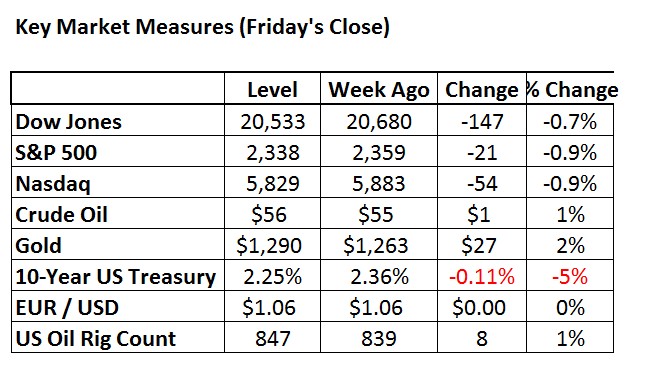
What did the Easter Bunny bring this April to the markets? Much lower interest rates! The 10-year dropped 11 bp to 2.25%. Who says interest rates are going up this year? Not us, for sure. Geopolitical worries are the primary culprit. North Korea, Syria, the Middle East, all the regular actors are to blame. The 10-year Treasury now rests around 5 month lows. Everyone will look to the Fed for guidance about where the markets are going. Interestingly, Trump is now praising Yellen in a public call for Fed consistency, which contradicts his accusations on the campaign trail that she was artificially manipulating the economy in a detrimental way. Hmmm…does Trump see an opportunity to take advantage of low borrowing costs for his $1 trillion infrastructure plan? His Treasury Secretary Steven Mnuchin has publicly expressed interest in doing big time deals for 100 year bonds. And we applaud this. We’ll have to wait and see.
There is always a bull market right here at The Bull Market Report! This week we highlight the following securities: Shopify, VMware, Amazon, Annaly, Apple, and Tesla.
Highlights From The Past Week
Watchful Eye On North Korea. US officials are saying the Trump administration is focusing its North Korea strategy on tougher economic sanctions, possibly including and oil embargo, banning its airline, intercepting cargo ships, and punishing Chinese banks doing business with Pyongyang. According to one official, US President Donald Trump has approved a preliminary broad approach on North Korea and asked his national security team to craft a more detailed framework for new international sanctions and other actions. The official said the administration is considering an array of stiffer sanctions that could be applied on a "sliding scale," proportionate to North Korean actions. Some steps could be applied unilaterally, with others through the United Nations.
Business Returning to the Center Stage in the USA. Business leaders are gaining more and more influence in Trump's White House. Most recently, Jared Kushner, the president's son-in-law, is trying to orchestrate more power for National Economic Council Director Gary Cohn while dampening the influence of chief strategist Steve Bannon. It is quiet the change in scenery to see Washington acting as a friend to business led by accomplished business people. All good news for the markets.
Infrastructure Bill On The Horizon. One of Trump's top policy advisers said the timing of the President's $1 trillion infrastructure package is still up in the air as the administration considers its best path forward. D.J. Gribbin, special assistant to the president for infrastructure policy, said the timeline will hinge on whether it moves as a standalone measure or if it is attached to another legislative priority. It adds that they are still crafting the infrastructure measure. Transportation Secretary Chao said the package could be unveiled as soon as next month. We can’t wait.
BMR Companies and Commentary
Shopify (SHOP: $71, +4%, all price changes in this report are for the past week)
Shopify had a solid week as talks of a takeover swirled. If true, we could see some very nice upside in the near-term. If not, that’s fine with us, as we still like the company’s fundamentals and prospects. Bottom line, Shopify still has room to run whether there is a takeover. Let’s re-visit why.
One can hardly kick back on the couch and watch CNBC or browse through your favorite financial publication these days for more than a few minutes before you come across a discussion of Amazon, as the online Retail juggernaut has skyrocketed to become an American business behemoth. And rightfully so.
For investors who want to capitalize on the undeniable secular growth trend of eCommerce, but who either missed the boat on Amazon or are wary of its nosebleed valuation, is there another road less traveled that they could embark on to get exposure to the eCommerce tidal wave? One that has impressive momentum and an ascendant stock price, but just not as frothy of a gain as Amazon? Yes there is. That’s Shopify.
Shopify not long ago announced its full-year financial results for 2016, and boasted 90% revenue growth and 99% growth in gross merchandise volume, (a term used in online retailing to indicate a total sales dollar value for merchandise sold through a particular marketplace over a certain time frame.) As an added bonus, Shopify's “Sell on Amazon” integration was made generally available to merchants in December. This mean Shopify now seamlessly connects store owners to the millions of customers searching for products to buy on Amazon, and merchants can now conveniently manage their product catalog for their eCommerce website, retail store, Amazon store, and other sales channels all in one place. This is big time! Since this integration just took place in December, we are only at the tip of the iceberg in terms of benefits and synergies from the move for Shopify.
BMR Take: The consensus calls for Shopify to more than double revenue from $600 million this year to $1.4 billion by 2020. This kind of explosive growth could cause the stock to double over the same period.
Amazon (AMZN: $884, down 1%)
A new week; Another big move brewing for Amazon. It is said that the eCommerce giant considered internally whether Whole Foods would help invigorate its nearly decade-long push into groceries. That is, Amazon kicked around the idea of buying the grocery chain!
Whole Foods has long been seen as a buyout target. Activist investor Jana Partners set off a new wave of speculation this week when it acquired a stake and urged the company to evaluate a sale. With a market valuation of $11 billion, the ailing organic-food retailer would be a powerful acquisition for Amazon -- dwarfing its 2009 purchase of online shoe retailer Zappos for about $1.2 billion. But the deal would turn Amazon into a grocery giant overnight and help it sideline Instacart, a startup that delivers grocery orders from Whole Foods stores in more than 20 states.
Jana has called for Whole Foods to overhaul its operations and brought in retail and food experts to help foster a turnaround. It also urged the company to consider a sale. A list of potential bidders includes Amazon, as well as traditional grocery chains such as Kroger and Albertsons. Whole Foods remains an attractive asset, even after a sales slump and the loss of market share to mainstream supermarkets, because the brand is strong and could be leveraged into something big.
BMR Take: Amazon and CEO Jeff Bezos are winning at everything. Why not grocery? Current Street earnings estimates call for $27 per share by 2020. With so much growth and strong earnings potential, the shares are compelling here.
Annaly Capital Management (NLY: $11.63, +5%)
Looking for yield in this market? Look here! Annaly Capital Management is a top pick in the Mortgage REIT sector.
Let’s review some of the reasons to like Annaly. Home price gains were up 6% in latest report from Case-Shiller, showing acceleration in home price increases. Tight supplies and rising prices may be deterring some people from trading up to a larger house, further aggravating supplies because fewer people are selling their homes. This is a good trend for Annaly. Annaly owns mortgages so rising home prices means the credit risk of owning the bonds is safer.
Annaly has a broad exposure across the US unlike other competitors more narrowly focused on only a particular market like New York. Yet another reason to like Annaly.
BMR Take: With a yield of 10.6% and a track record of over 20 years doing this, we continue to pound the table on Annaly. Look at this stock – up from $10.12 in mid-January in the midst of a strong interest rate rise with EVERY pundit saying that Annaly will be impacted sharply with the higher rates. Boy oh boy where they ever wrong. And boy oh boy were we ever right. Of course we’ve been saying this since we founded The Bull Market Report in 1998!
Apple (AAPL: $141, -2%)
Apple to buy Disney? Now that’s exciting! It could be more realistic than you think. Apple has the cash to pull off a $200 billion-plus takeover of Disney — creating a company worth $1 trillion with “almost limitless opportunities in content and technology.
A combined Apple-Disney would create an instant competitor to Netflix that would take advantage of the Mouse House’s content and Apple’s user base. Other benefits include: integrating Apple consumer tech as experiences in Disney’s theme parks; and landing global streaming sports rights for ESPN via Disney and Apple distribution and a strong balance sheet. Content is a major focus for Apple, target size is not an issue, and Disney offers an avenue to diversify away from hardware without diluting the strong Apple brand.
The M&A rumor mill got new grist last fall, when Apple chief Tim Cook told analysts that he was “open to acquisitions of any size.” In addition, Apple execs met with Time Warner honchos in 2015 in a discussion that raised the possibility of a merger - before AT&T moved on its $85 billion bid for Time Warner,
Per one analyst’s estimates, the merger of Apple and Disney would be highly accretive to earnings, to the tune of a 15%-20% increase in earnings per share based on the presumed 40% premium deal price and Disney’s low debt load. Nice!
BMR Take: We say it every week and we’ll say it again. Apple is really cheap compared to the current EPS outlook for this year of nearly $9. And all that cash put to good use through buying a storied franchise like Disney could be an exciting catalyst/prospect for the company.
Tesla (TSLA: $306, flat)
Tesla is a new entrant into the automobile, solar and battery storage businesses. Since Tesla’s current revenue is roughly 99% automobile related and, due to the Model 3 introduction and projected sales, this ratio will likely remain similar for quite some time. Thus, Tesla is an auto manufacturer, plain and simple. Panasonic supplies Tesla with batteries. Other companies provide Tesla with electric motors, tires, wheels, etc. Thus, with a few extraneous business lines, Tesla designs and assembles cars. Until Tesla’s battery storage business and solar equipment business become majority contributors, it will remain viewed as an auto company.
The good news is that’s okay!
Tesla CEO Elon Musk says his company will unveil its electric tractor-trailer truck this September, calling the vehicle “seriously next level” and praising the Tesla team for doing “an amazing job.” He also revealed that Tesla will show off an electric pickup truck in 18 to 24 months. Awesome innovation.
BMR Take: Street estimates call for sales growth from $7 billion last year to $11 billion this year to $33 billion in 2020. This is an exciting time for the business and the stock.
Note that Tesla was upgraded by Piper Jaffray from a "neutral" rating to an "overweight" rating last week. They now have a $368 price target on the stock, up previously from $223. We have a $325 Price Target on the stock.
Netflix (NFLX:$143, flat) had its price objective hoisted by Cowen from $165 to $170 in a research note released on Tuesday. Our Price Target is $165.
Upcoming Economic News
FRIDAY, APRIL 14 (Yes, this was on Friday – Good Friday)
Consumer Price Index
For March
Forecast: -0.1%
Actual: -0.1%
The Consumer Price Index was forecast to fall 0.1% in March following a 0.1% gain in February and 0.6% increase in January. It did. This was the first decline in the CPI since February 2016. Energy prices were a net drag on the CPI in March. The CPI for food and beverages rose 0.2% in February, the strongest since September 2013.
Retail Sales (This too was announced on Friday the 14th.)
For March
Forecast: -0.3%
Actual: -0.2%
Consensus expected retail sales to have dropped 0.3% in March following a 0.1% gain in February and 0.6% increase in January. Results were slightly better than expected. We believe weather was likely a small negative for sales. Non-store sales (online) have been contributing more to growth in retail sales recently. Already released data showed that unit vehicle sales dropped 5.5% in March and shaved 0.4% off total retail sales growth.
Tuesday, April 18th
Housing Starts
Period: March
8:30 AM
Consensus: 1,245,000
Prior: 1,288,000
Housing starts should continue to signal a healthy economy. The data reveals the number of housing units started in the United States. The U.S. Census Bureau's New Residential Construction release provides statistics on the construction of new privately-owned residential structures in the United States.
Thursday, April 20th
Leading Indicators
Period: March
10:00 AM
Consensus: 0.3%
Prior: 0.6%
This one is interesting to watch. Everybody is so focused on trying to figure out what direction the markets are heading. This is one of the key metrics that tells us. Leading indicators are economic series that tend to change direction ahead of shifts in the business cycle. There are 10 components of the U.S. Leading Composite Indicator published by The Conference Board. The index is constructed by averaging the individual components in order to smooth out a good part of the volatility of the individual series. Historically, the cyclical turning points in the leading index have occurred before those in actual economic activity.
Facebook Adds a Million Advertisers in 7 Months
There is a big move going on in the digital marketing world that many are not aware of. More than 5 million businesses are advertising on Facebook each month, Reuters reports. That is up from 4 million monthly advertisers in September 2016, and the 3 million monthly advertisers it had in March 2016. Significant upside remains as Facebook’s 5 million advertisers are less than 10% of the 65 million businesses that are active on the network.
Facebook is one of two undisputed leaders in digital advertising. Alongside Google, the company is expected to generate about half of online ad spend in 2018. Facebook generated close to $27 billion, and Google close to $80 billion, in ad revenue last year.
Small and midsize brands are flocking to advertise on Facebook. Big brands may drive the bulk of revenue in advertising markets, but there is still ample opportunity for growth with the smaller brand advertisers. The sheer volume of advertisers on Facebook reflects the company’s success in attracting these smaller firms its platform.
A few industries are generating the bulk of Facebook ad spend. E-commerce and Retail, and Entertainment and Media are the biggest industries represented in Facebook's advertiser base.
Facebook is doing a great job at building its advertising base overseas - over 75% of advertisers are outside of the US. India, Thailand, Brazil, Mexico and Argentina are the fastest-growing markets.
Mobile is big, as you know. Almost 50% of advertisers create ads on mobile devices. More than 90% of Facebook users access the network via mobile. And mobile advertising accounts for 85% of ad revenue. Creating mobile-first experiences is particularly key in emerging markets.
The biggest users of Facebook are the US at 220 million; India at 210 million; Brazil at 120 million; Indonesia at 75 million and Mexico at 65 million.
Our Take on SNAP
Snap (SNAP: $20) went public at $17 in early March and promptly opened at $24. They raised $3.4 billion making it the largest IPO since Alibaba went public in 2014, raising $20 billion. The market cap is now $23 billion and all of this for a company with no revenue in 2015, $400 million in 2016 and losses of $500 million in 2016. Ouch. More losses than revenues. Not a good business model.
Snapchat has grabbed the attention of a generation of younger smartphone users, who post and share photos and videos on the app that can disappear after a set amount of time. The app - developed by Stanford University students, two of whom are still executives at Snap had 160 million daily active users as of December 2016,
BMR Take: We are steering clear of this one. One might compare this a bit to Facebook, but Facebook had huge revenues and real earnings when it went public, and the growth since then has been phenomenal as you know. The Snap IPO has invigorated the IPO market and Wall Street is generally pleased, but for this company to get to $40 or $50 a share, we will have to see revenues of 10-20 times current levels, and big profitability, both of which may never materialize. We are steering clear.
The High Yield Report
By Michael Foster
Special to The Bull Market Report
It was a short week, but an eventful one. Already we’re seeing tons of articles about how the stock market is in crisis. Looking at volatility, there seems to be reason to think this; we went from a VIX of about 10 to nearly 16 in days. This means there is more caution in the market, and expectations of a short-term downturn. However, those expectations will disappear as they always do and the bull market will return as it always does.
We can already see pockets of optimism in the high yield world. In fact, We’d go so far as to say we’re beginning to see a sector rotation among investors that is benefitting parts of the high yield universe.
Before we get into that, though, let’s look at who is not winning. The UBS BDC ETF (BDCS: $23, down 1%) saw a soft week that was no worse than the broader market, but definitely was not good. This move is actually not that bad, considering that BDCs have had a massive run-up for months and has driven the entire sector higher. One well-known BDC analyst recently pointed out that the sector has beaten the S&P 500 since the start of 2014. This kind of cherry-picking time series doesn’t tell us much, but it does remind us that BDCs had an extremely vicious decline in 2013 and have been recovering for years since then as the market readjusts its understanding of what a rising rate environment means for these assets. It also means that the bargains in this odd corner of the business lending universe have dried up. That’s a shame, because The Bull Market Report is eagerly awaiting adding a BDC to the high yield portfolio, but this week’s 1% decline isn’t enough for us to do it. In fact, the recent decline may indicate that weaker prices might be just on the horizon, indicating a need to buy some BDCs when the price is right. Stay tuned as we keep focusing on this story.
So if BDCs aren’t benefiting from the fall in stocks this week, who is?
The answer is obvious: REITs. The SPDR Dow Jones REIT ETF (RWR: $94) was mostly flat for the last four days but is up 1% from last Friday - and comparing REITs to a week ago is really key here, because the momentum in REITs really started to kick off on Monday and has stayed strong with the many REITs in the Bull Market Report portfolio.
Let’s start with Kimco Realty (KIM: $22, up 4%), which shot up at the start of the week and has maintained its higher price level. Kimco is expected to report earnings by the end of this month, and analysts’ expectations are strong. Despite expectations of a 1% revenue decline, FFO expectations put Kimco’s dividend coverage in the 140% range. This means that Kimco is expected to far cover its dividend and have room to increase payouts. That should mean the company should be a low yielder, but this company’s 5% dividend yield indicates market expectations of risk are growing. Why the disconnect?
Simple: the decline in Retail.
Long story short, shopping malls are collapsing. The high-profile news of bankruptcies at Sears and JCPenny are making investors grow increasingly confident that the Retail sector is an apocalypse that no investor should come near. Of course these people are forgetting just how strong things are for Whole Foods, upscale outlet malls, Apple stores, and several other corners of the retail market that Kimco just happens to be focused on. In fact, Kimco’s tenants tend to be the most well-heeled and revenue-safe firms in the Retail landscape, so this collapse has little impact on them. Their occupancy rates have remained near 99% throughout. And although these issues are now high profile, they’ve been top of mind for Kimco management for a decade - and management has addressed these issues both in their strategic decisions and in their earnings calls.
In short, Kimco is not affected by the slowdown of the suburban American shopping mall.
Investors don’t know this, of course, so they’re throwing out the baby with the bathwater. That means now is a buying opportunity unlike no other. In fact, Kimco looks like one of the most attractive options for high yield investors. Of all our picks, Kimco looks like one of the most undervalued.
A similar story hit Government Properties Trust (GOV: $22, up 3%) over the past week, making it one of the top performers in a well-performing sector. Government Properties is heavily exposed to federal government tenants, and lower government spending has been seen as a real risk for the company. As a result of this fear, the company has looked to diversify by investing in office space that would be more insulated from the expected weaker demand in government properties. That has created a swiftly diversified portfolio that also has firm dividend coverage, but the market never really saw it that way. Instead, Government Properties is always seen as a risky option, which is why it often traded at an 11% yield. That’s what the stock was yielding when we first recommended it, and now it’s trading at less than an 8% yield, thanks entirely to capital gains. Sadly, that means buying more of Government Properties isn’t the greatest idea right now, but it does remain a solid hold thanks to its capital gains. The last week’s recent 3% jump is likely just the beginning; this company has a much safer income stream than its yield would indicate, meaning price gains are likely to come. We recommend staying in the stock to enjoy those gains as demand for REITs continues to rise.
Our other REITs did well this week too. Digital Realty Trust (DLR: $110, up 1%), Omega Healthcare Investors (OHI: $34, up 1%), and Care Capital Properties (CCP: $27, up 1%) all saw modest gains largely as a result of the continuation of a recent trend. CCP and OHI have been recovering recently from an oversold situation in healthcare REITs - in short, the market sold way too many of these because they thought a variety of risks (interest rates, cuts to Medicaid and Obamacare, etc.) would damage these firms permanently. These were considered long-tail risks not priced into the stocks, and yet these companies are doing fine and the risks the market has perceived are not materializing. In fact, they may never be real concerns for the companies. As a result, the stocks have no place to go but up. While we’re sitting on double-digit gains for Care Capital, we see more room to grow and thus recommend holding tight on these firms.
Finally, a word on municipal bonds. The iShares S&P National AMT-Free Municipal Bond Fund (MUB: $110, flat) didn’t move much this week although our muni bond picks did. Invesco Municipal Trust (VKQ: $13, up 1%) and the Nuveen AMT-Free Fund (NVG: $15, up 1%) outpaced the market, and we expect further gains in the municipal bond market to drive both of these funds higher. What’s going on is quite simply secular demand for munis returning to the market, largely a result of the higher uncertainty and fear that is driving stocks lower. In short, many retail investors are getting skittish and feel a need to pull out of risk and get lower risk assets.
This is driving a broad base of investors to demand more municipal bonds, driving up their value and in turn driving up the net asset values of these and other municipal bond funds. Since munis are far undervalued again due to risks that were feared but are not materializing, there is a lot more room for these funds to rise in price before they’re fairly valued. Thus muni fund holders should enjoy the gains they’re getting now but shouldn’t sell yet; if the market stays afraid these funds are destined to rise considerably. If the market gets more courageous, these funds are still destined to rise (although perhaps at a slower pace) because they have been massively undervalued due to ridiculous fears about muni bonds that aren’t materializing. Either way, the direction is clear: Keep and hold these funds and wait for their pricing to better match their real value.
Good Investing,
Todd Shaver
Editor, Founder and CEO
The Bull Market Report
Since 1998
April 16, 2017
by Todd Shaver | Apr 16, 2017 | Weekly Newsletter 7pm Sunday
The Week Ahead
What did the Easter Bunny bring this April to the markets? Much lower interest rates! The 10-year dropped 11 bp to 2.25%. Who says interest rates are going up this year? Not us, for sure. Geopolitical worries are the primary culprit. North Korea, Syria, the Middle East, all the regular actors are to blame. The 10-year Treasury now rests around 5 month lows. Everyone will look to the Fed for guidance about where the markets are going. Interestingly, Trump is now praising Yellen in a public call for Fed consistency, which contradicts his accusations on the campaign trail that she was artificially manipulating the economy in a detrimental way. Hmmm…does Trump see an opportunity to take advantage of low borrowing costs for his $1 trillion infrastructure plan? His Treasury Secretary Steven Mnuchin has publicly expressed interest in doing big time deals for 100 year bonds. And we applaud this. We’ll have to wait and see.
There is always a bull market right here at The Bull Market Report! This week we highlight the following securities: Shopify, VMware, Amazon, Annaly, Apple, and Tesla.
Highlights From The Past Week
Watchful Eye On North Korea. US officials are saying the Trump administration is focusing its North Korea strategy on tougher economic sanctions, possibly including and oil embargo, banning its airline, intercepting cargo ships, and punishing Chinese banks doing business with Pyongyang. According to one official, US President Donald Trump has approved a preliminary broad approach on North Korea and asked his national security team to craft a more detailed framework for new international sanctions and other actions. The official said the administration is considering an array of stiffer sanctions that could be applied on a "sliding scale," proportionate to North Korean actions. Some steps could be applied unilaterally, with others through the United Nations.
Business Returning to the Center Stage in the USA. Business leaders are gaining more and more influence in Trump's White House. Most recently, Jared Kushner, the president's son-in-law, is trying to orchestrate more power for National Economic Council Director Gary Cohn while dampening the influence of chief strategist Steve Bannon. It is quiet the change in scenery to see Washington acting as a friend to business led by accomplished business people. All good news for the markets.
Infrastructure Bill On The Horizon. One of Trump's top policy advisers said the timing of the President's $1 trillion infrastructure package is still up in the air as the administration considers its best path forward. D.J. Gribbin, special assistant to the president for infrastructure policy, said the timeline will hinge on whether it moves as a standalone measure or if it is attached to another legislative priority. It adds that they are still crafting the infrastructure measure. Transportation Secretary Chao said the package could be unveiled as soon as next month. We can’t wait.
BMR Companies and Commentary
Shopify (SHOP: $71, +4%, all price changes in this report are for the week)
Shopify had a solid week as talks of a takeover swirled. If true, we could see some very nice upside in the near-term. If not, that’s fine with us, as we still like the company’s fundamentals and prospects. Bottom line, Shopify still has room to run whether there is a takeover. Let’s re-visit why.
One can hardly kick back on the couch and watch CNBC or browse through your favorite financial publication these days for more than a few minutes before you come across a discussion of Amazon, as the online Retail juggernaut has skyrocketed to become an American business behemoth. And rightfully so.
For investors who want to capitalize on the undeniable secular growth trend of eCommerce, but who either missed the boat on Amazon or are wary of its nosebleed valuation, is there another road less traveled that they could embark on to get exposure to the eCommerce tidal wave? One that has impressive momentum and an ascendant stock price, but just not as frothy of a gain as Amazon? Yes there is. That’s Shopify.
Shopify not long ago announced its full-year financial results for 2016, and boasted 90% revenue growth and 99% growth in gross merchandise volume, (a term used in online retailing to indicate a total sales dollar value for merchandise sold through a particular marketplace over a certain time frame.) As an added bonus, Shopify's “Sell on Amazon” integration was made generally available to merchants in December. This mean Shopify now seamlessly connects store owners to the millions of customers searching for products to buy on Amazon, and merchants can now conveniently manage their product catalog for their eCommerce website, retail store, Amazon store, and other sales channels all in one place. This is big time! Since this integration just took place in December, we are only at the tip of the iceberg in terms of benefits and synergies from the move for Shopify.
BMR Take: The consensus calls for Shopify to more than double revenue from $600 million this year to $1.4 billion by 2020. This kind of explosive growth could cause the stock to double over the same period.
VMware (VMW: $91, -1.6%)
VMware made some waves this week announcing intentions to acquire Wavefront, the leading metrics monitoring service for cloud and modern application environments. Terms were not disclosed. The transaction is expected to close in calendar Q217. VMware does not expect this transaction to have a material impact on its 2017 operating results. But don’t write off the deal as not important just because the financial impact isn’t going to be seen in the near-term.
Digital enterprises face challenges of a new order of magnitude when monitoring modern applications -- consisting of hundreds of microservices in containers with lifespans of seconds -- spread across private and public clouds. To identify and fix operational issues in these dynamic cross-cloud environments, developers need new instrumentation for their applications, and teams require sophisticated real-time analytics on their high-scale distributed systems to adapt to problems before they impact the business.
Wavefront provides metrics to optimize clouds and modern applications by delivering operational insights using millions of data points per second in real-time. Operators and developers can interrogate real-time data streams to discover new ways to address problems, identify bottlenecks, and test algorithms and hypotheses. A cloud-hosted service, Wavefront ingests, stores, visualizes, and alerts on streaming data from clouds and modern applications enabling superior operational performance. The service can measure, correlate, and analyze data across servers, devices, applications, end-user behavior, multiple public cloud and data center attributes, and business metrics. (Now that’s a mouthful.)
This is big news for the underlying story at VMware, which is most exciting given the company’s increasing presence in the cloud marketplace. For seven-plus years, VMware has invested in solutions featuring advanced metrics and analytics to help customers simplify and automate how they manage, monitor and troubleshoot services in dynamic virtual and cloud environments. As all these investment start paying off, we see VMware as a top pick for Technology investors.
BMR Take: The company is currently generating $5-6 of EPS annually. The current valuation seems like a bargain considering all the progress with the cloud business. Our Price Target is $95 which would be a 2-year high and a more than double from the $44 low it hit in February last year. If the stock hits $95, we are moving our Price Target up into triple-digits, especially if revenues continue to soar. You know what we say about revenues and earnings: Revenues first, then earnings.
Amazon (AMZN: $884, down 1%)
A new week; Another big move brewing for Amazon. It is said that the eCommerce giant considered internally whether Whole Foods would help invigorate its nearly decade-long push into groceries. That is, Amazon kicked around the idea of buying the grocery chain!
Whole Foods has long been seen as a buyout target. Activist investor Jana Partners set off a new wave of speculation this week when it acquired a stake and urged the company to evaluate a sale. With a market valuation of $11 billion, the ailing organic-food retailer would be a powerful acquisition for Amazon -- dwarfing its 2009 purchase of online shoe retailer Zappos for about $1.2 billion. But the deal would turn Amazon into a grocery giant overnight and help it sideline Instacart, a startup that delivers grocery orders from Whole Foods stores in more than 20 states.
Jana has called for Whole Foods to overhaul its operations and brought in retail and food experts to help foster a turnaround. It also urged the company to consider a sale. A list of potential bidders includes Amazon, as well as traditional grocery chains such as Kroger and Albertsons. Whole Foods remains an attractive asset, even after a sales slump and the loss of market share to mainstream supermarkets, because the brand is strong and could be leveraged into something big.
BMR Take: Amazon and CEO Jeff Bezos are winning at everything. Why not grocery? Current Street earnings estimates call for $27 per share by 2020. With so much growth and strong earnings potential, the shares are compelling here.
Annaly Capital Management (NLY: $11.63, +5%)
Looking for yield in this market? Look here! Annaly Capital Management is a top pick in the Mortgage REIT sector.
Let’s review some of the reasons to like Annaly. Home price gains were up 6% in latest report from Case-Shiller, showing acceleration in home price increases. Tight supplies and rising prices may be deterring some people from trading up to a larger house, further aggravating supplies because fewer people are selling their homes. This is a good trend for Annaly. Annaly owns mortgages so rising home prices means the credit risk of owning the bonds is safer.
Annaly has a broad exposure across the US unlike other competitors more narrowly focused on only a particular market like New York. Yet another reason to like Annaly.
BMR Take: With a yield of 10.6% and a track record of over 20 years doing this, we continue to pound the table on Annaly. Look at this stock – up from $10.12 in mid-January in the midst of a strong interest rate rise with EVERY pundit saying that Annaly will be impacted sharply with the higher rates. Boy oh boy where they ever wrong. And boy oh boy were we ever right. Of course we’ve been saying this since we founded The Bull Market Report in 1998!
Apple (AAPL: $141, -2%)
Apple to buy Disney? Now that’s exciting! It could be more realistic than you think. Apple has the cash to pull off a $200 billion-plus takeover of Disney — creating a company worth $1 trillion with “almost limitless opportunities in content and technology.
A combined Apple-Disney would create an instant competitor to Netflix that would take advantage of the Mouse House’s content and Apple’s user base. Other benefits include: integrating Apple consumer tech as experiences in Disney’s theme parks; and landing global streaming sports rights for ESPN via Disney and Apple distribution and a strong balance sheet. Content is a major focus for Apple, target size is not an issue, and Disney offers an avenue to diversify away from hardware without diluting the strong Apple brand.
The M&A rumor mill got new grist last fall, when Apple chief Tim Cook told analysts that he was “open to acquisitions of any size.” In addition, Apple execs met with Time Warner honchos in 2015 in a discussion that raised the possibility of a merger - before AT&T moved on its $85 billion bid for Time Warner,
Per one analyst’s estimates, the merger of Apple and Disney would be highly accretive to earnings, to the tune of a 15%-20% increase in earnings per share based on the presumed 40% premium deal price and Disney’s low debt load. Nice!
BMR Take: We say it every week and we’ll say it again. Apple is really cheap compared to the current EPS outlook for this year of nearly $9. And all that cash put to good use through buying a storied franchise like Disney could be an exciting catalyst/prospect for the company.
Tesla (TSLA: $306, flat)
Tesla is a new entrant into the automobile, solar and battery storage businesses. Since Tesla’s current revenue is roughly 99% automobile related and, due to the Model 3 introduction and projected sales, this ratio will likely remain similar for quite some time. Thus, Tesla is an auto manufacturer, plain and simple. Panasonic supplies Tesla with batteries. Other companies provide Tesla with electric motors, tires, wheels, etc. Thus, with a few extraneous business lines, Tesla designs and assembles cars. Until Tesla’s battery storage business and solar equipment business become majority contributors, it will remain viewed as an auto company.
The good news is that’s okay!
Tesla CEO Elon Musk says his company will unveil its electric tractor-trailer truck this September, calling the vehicle “seriously next level” and praising the Tesla team for doing “an amazing job.” He also revealed that Tesla will show off an electric pickup truck in 18 to 24 months. Awesome innovation.
BMR Take: Street estimates call for sales growth from $7 billion last year to $11 billion this year to $33 billion in 2020. This is an exciting time for the business and the stock.
Note that Tesla was upgraded by Piper Jaffray from a "neutral" rating to an "overweight" rating last week. They now have a $368 price target on the stock, up previously from $223. We have a $325 Price Target on the stock.
Netflix (NFLX:$143, flat) had its price objective hoisted by Cowen from $165 to $170 in a research note released on Tuesday. Our Price Target is $165.
Upcoming Economic News
FRIDAY, APRIL 14 (Yes, this was on Friday – Good Friday)
Consumer Price Index
For March
Forecast: -0.1%
Actual: -0.1%
The Consumer Price Index was forecast to fall 0.1% in March following a 0.1% gain in February and 0.6% increase in January. It did. This was the first decline in the CPI since February 2016. Energy prices were a net drag on the CPI in March. The CPI for food and beverages rose 0.2% in February, the strongest since September 2013.
Retail Sales (This too was announced on Friday the 14th.)
For March
Forecast: -0.3%
Actual: -0.2%
Consensus expected retail sales to have dropped 0.3% in March following a 0.1% gain in February and 0.6% increase in January. Results were slightly better than expected. We believe weather was likely a small negative for sales. Non-store sales (online) have been contributing more to growth in retail sales recently. Already released data showed that unit vehicle sales dropped 5.5% in March and shaved 0.4% off total retail sales growth.
Tuesday, April 18th
Housing Starts
Period: March
8:30 AM
Consensus: 1,245,000
Prior: 1,288,000
Housing starts should continue to signal a healthy economy. The data reveals the number of housing units started in the United States. The U.S. Census Bureau's New Residential Construction release provides statistics on the construction of new privately-owned residential structures in the United States.
Thursday, April 20th
Leading Indicators
Period: March
10:00 AM
Consensus: 0.3%
Prior: 0.6%
This one is interesting to watch. Everybody is so focused on trying to figure out what direction the markets are heading. This is one of the key metrics that tells us. Leading indicators are economic series that tend to change direction ahead of shifts in the business cycle. There are 10 components of the U.S. Leading Composite Indicator published by The Conference Board. The index is constructed by averaging the individual components in order to smooth out a good part of the volatility of the individual series. Historically, the cyclical turning points in the leading index have occurred before those in actual economic activity.
Notes at the Margin
By Phil K. Verleger, Jr.
Former Director of the Office of Energy Policy
at the United States Department of Treasury
This item published by Platts Global Alert first caught my eye: “The Permian Basin [in Texas] is going to become the largest oil field in the world, surpassing the legendary Ghawar field of Saudi Arabia,” Bill Marko, managing director of Jefferies, said on the sidelines of the conference.
The basin holds an estimated 210 billion barrels of oil that will become economically recoverable in the future, or 325 billion barrels of oil equivalent when oil and natural gas liquids are counted, he said.
The 210 billion barrel estimate caught my attention. After all, Saudi Arabia’s reserves are put at “only” 260 billion barrels per the BP Statistical Review of World Energy. It is hard to believe that one US field has oil reserves equal to 80% of Saudi reserves.
The US Energy Information Administration recently published a short-term outlook predicting an 8% increase in US production from 8.8 million barrels per day in December 2016 to 9.5 million barrels per day in December 2017. Given recent trends, the estimate will likely need to be revised again, perhaps to 10 million barrels per day or more.
BMR Take: Phil – Knowing you the way I do, this is your way of jumping up and down and waving your arms like a madman. This is certainly big news. We have seen it coming to a certain extent but when you put it in writing the way you do, this is making us stand up and take notice. There are big changes afoot in the energy world. We would venture to say that $100 oil is not going to be seen for a long, long time to come. Prepare accordingly.
A Word from Gary Jefferson
Jefferson Financial Group
First Vice-President, Investments
UBS Financial Services, Inc.
They honored Arnold Palmer this past weekend at the Masters Golf Tournament. He was one of the few greats who turned the game into a hugely popular spectator's sport. One of his best known quotes is: "Golf is deceptively simple and endlessly complicated."
As words of wisdom go, we can't think of a quote that could be any more applicable to the stock market. As simple as "buy low, sell high," to as complicated as the blackboard full of equations in Einstein's office. Our formula for investment success has always been "Success = preparation, recognition of value and proper seizing of opportunity." Preparation is fairly simple in the sense that it's mostly reading. But it takes a lot of reading and research on an endless basis. The complicated part is filtering out all the "noise" and learning what resources you can rely on and trust. Overall, we are believers in the KISS principle when applying our formula because we have learned over the years that the more complicated the investment process becomes, the harder it is to stay on track.
If you want to keep it as simple as possible, just think of one word - earnings. Good earnings signal a rising stock market. Weak earnings are normally a forecast of a weak or falling market.
That's where we are today. First quarter earnings season kicked off last week with several big banks reporting. First quarter earnings growth is expected to be 10%, the best since 2014. Sales growth, a laggard in the financial recovery, is expected to grow by 7.5% - its best pace since 2011! (Source: Thomson Reuters)
In addition to corporate earnings, investors will also likely monitor the economic calendar to be sure there is no unexpected deterioration in important statistical areas. And if you want to complicate it just a bit, throw in the fact that investors will probably just continue to wait for word from Washington on their pro-growth agenda. When that will actually be announced, and how long it takes to pass, are currently unknown and unknowable. So, while we may be stuck in a trading range pending the agenda results, earnings should provide a simple-to-understand reason to expect that the market will eventually work its way to a higher level.
Facebook Adds a Million Advertisers in 7 Months
There is a big move going on in the digital marketing world that many are not aware of. More than 5 million businesses are advertising on Facebook each month, Reuters reports. That is up from 4 million monthly advertisers in September 2016, and the 3 million monthly advertisers it had in March 2016. Significant upside remains as Facebook’s 5 million advertisers are less than 10% of the 65 million businesses that are active on the network.
Facebook is one of two undisputed leaders in digital advertising. Alongside Google, the company is expected to generate about half of online ad spend in 2018. Facebook generated close to $27 billion, and Google close to $80 billion, in ad revenue last year.
Small and midsize brands are flocking to advertise on Facebook. Big brands may drive the bulk of revenue in advertising markets, but there is still ample opportunity for growth with the smaller brand advertisers. The sheer volume of advertisers on Facebook reflects the company’s success in attracting these smaller firms its platform.
A few industries are generating the bulk of Facebook ad spend. E-commerce and Retail, and Entertainment and Media are the biggest industries represented in Facebook's advertiser base.
Facebook is doing a great job at building its advertising base overseas - over 75% of advertisers are outside of the US. India, Thailand, Brazil, Mexico and Argentina are the fastest-growing markets.
Mobile is big, as you know. Almost 50% of advertisers create ads on mobile devices. More than 90% of Facebook users access the network via mobile. And mobile advertising accounts for 85% of ad revenue. Creating mobile-first experiences is particularly key in emerging markets.
The biggest users of Facebook are the US at 220 million; India at 210 million; Brazil at 120 million; Indonesia at 75 million and Mexico at 65 million.
Our Take on SNAP
Snap (SNAP: $20) went public at $17 in early March and promptly opened at $24. They raised $3.4 billion making it the largest IPO since Alibaba went public in 2014, raising $20 billion. The market cap is now $23 billion and all of this for a company with no revenue in 2015, $400 million in 2016 and losses of $500 million in 2016. Ouch. More losses than revenues. Not a good business model.
Snapchat has grabbed the attention of a generation of younger smartphone users, who post and share photos and videos on the app that can disappear after a set amount of time. The app - developed by Stanford University students, two of whom are still executives at Snap had 160 million daily active users as of December 2016,
BMR Take: We are steering clear of this one. One might compare this a bit to Facebook, but Facebook had huge revenues and real earnings when it went public, and the growth since then has been phenomenal as you know. The Snap IPO has invigorated the IPO market and Wall Street is generally pleased, but for this company to get to $40 or $50 a share, we will have to see revenues of 10-20 times current levels, and big profitability, both of which may never materialize. We are steering clear.
The High Yield Report
By Michael Foster
Special to The Bull Market Report
It was a short week, but an eventful one. Already we’re seeing tons of articles about how the stock market is in crisis. Looking at volatility, there seems to be reason to think this; we went from a VIX of about 10 to nearly 16 in days. This means there is more caution in the market, and expectations of a short-term downturn. However, those expectations will disappear as they always do and the bull market will return as it always does.
We can already see pockets of optimism in the high yield world. In fact, We’d go so far as to say we’re beginning to see a sector rotation among investors that is benefitting parts of the high yield universe.
Before we get into that, though, let’s look at who is not winning. The UBS BDC ETF (BDCS: $23, down 1%) saw a soft week that was no worse than the broader market, but definitely was not good. This move is actually not that bad, considering that BDCs have had a massive run-up for months and has driven the entire sector higher. One well-known BDC analyst recently pointed out that the sector has beaten the S&P 500 since the start of 2014. This kind of cherry-picking time series doesn’t tell us much, but it does remind us that BDCs had an extremely vicious decline in 2013 and have been recovering for years since then as the market readjusts its understanding of what a rising rate environment means for these assets. It also means that the bargains in this odd corner of the business lending universe have dried up. That’s a shame, because The Bull Market Report is eagerly awaiting adding a BDC to the high yield portfolio, but this week’s 1% decline isn’t enough for us to do it. In fact, the recent decline may indicate that weaker prices might be just on the horizon, indicating a need to buy some BDCs when the price is right. Stay tuned as we keep focusing on this story.
So if BDCs aren’t benefiting from the fall in stocks this week, who is?
The answer is obvious: REITs. The SPDR Dow Jones REIT ETF (RWR: $94) was mostly flat for the last four days but is up 1% from last Friday - and comparing REITs to a week ago is really key here, because the momentum in REITs really started to kick off on Monday and has stayed strong with the many REITs in the Bull Market Report portfolio.
Let’s start with Kimco Realty (KIM: $22, up 4%), which shot up at the start of the week and has maintained its higher price level. Kimco is expected to report earnings by the end of this month, and analysts’ expectations are strong. Despite expectations of a 1% revenue decline, FFO expectations put Kimco’s dividend coverage in the 140% range. This means that Kimco is expected to far cover its dividend and have room to increase payouts. That should mean the company should be a low yielder, but this company’s 5% dividend yield indicates market expectations of risk are growing. Why the disconnect?
Simple: the decline in Retail.
Long story short, shopping malls are collapsing. The high-profile news of bankruptcies at Sears and JCPenny are making investors grow increasingly confident that the Retail sector is an apocalypse that no investor should come near. Of course these people are forgetting just how strong things are for Whole Foods, upscale outlet malls, Apple stores, and several other corners of the retail market that Kimco just happens to be focused on. In fact, Kimco’s tenants tend to be the most well-heeled and revenue-safe firms in the Retail landscape, so this collapse has little impact on them. Their occupancy rates have remained near 99% throughout. And although these issues are now high profile, they’ve been top of mind for Kimco management for a decade - and management has addressed these issues both in their strategic decisions and in their earnings calls.
In short, Kimco is not affected by the slowdown of the suburban American shopping mall.
Investors don’t know this, of course, so they’re throwing out the baby with the bathwater. That means now is a buying opportunity unlike no other. In fact, Kimco looks like one of the most attractive options for high yield investors. Of all our picks, Kimco looks like one of the most undervalued.
A similar story hit Government Properties Trust (GOV: $22, up 3%) over the past week, making it one of the top performers in a well-performing sector. Government Properties is heavily exposed to federal government tenants, and lower government spending has been seen as a real risk for the company. As a result of this fear, the company has looked to diversify by investing in office space that would be more insulated from the expected weaker demand in government properties. That has created a swiftly diversified portfolio that also has firm dividend coverage, but the market never really saw it that way. Instead, Government Properties is always seen as a risky option, which is why it often traded at an 11% yield. That’s what the stock was yielding when we first recommended it, and now it’s trading at less than an 8% yield, thanks entirely to capital gains. Sadly, that means buying more of Government Properties isn’t the greatest idea right now, but it does remain a solid hold thanks to its capital gains. The last week’s recent 3% jump is likely just the beginning; this company has a much safer income stream than its yield would indicate, meaning price gains are likely to come. We recommend staying in the stock to enjoy those gains as demand for REITs continues to rise.
Our other REITs did well this week too. Digital Realty Trust (DLR: $110, up 1%), Omega Healthcare Investors (OHI: $34, up 1%), and Care Capital Properties (CCP: $27, up 1%) all saw modest gains largely as a result of the continuation of a recent trend. CCP and OHI have been recovering recently from an oversold situation in healthcare REITs - in short, the market sold way too many of these because they thought a variety of risks (interest rates, cuts to Medicaid and Obamacare, etc.) would damage these firms permanently. These were considered long-tail risks not priced into the stocks, and yet these companies are doing fine and the risks the market has perceived are not materializing. In fact, they may never be real concerns for the companies. As a result, the stocks have no place to go but up. While we’re sitting on double-digit gains for Care Capital, we see more room to grow and thus recommend holding tight on these firms.
Finally, a word on municipal bonds. The iShares S&P National AMT-Free Municipal Bond Fund (MUB: $110, flat) didn’t move much this week although our muni bond picks did. Invesco Municipal Trust (VKQ: $13, up 1%) and the Nuveen AMT-Free Fund (NVG: $15, up 1%) outpaced the market, and we expect further gains in the municipal bond market to drive both of these funds higher. What’s going on is quite simply secular demand for munis returning to the market, largely a result of the higher uncertainty and fear that is driving stocks lower. In short, many retail investors are getting skittish and feel a need to pull out of risk and get lower risk assets.
This is driving a broad base of investors to demand more municipal bonds, driving up their value and in turn driving up the net asset values of these and other municipal bond funds. Since munis are far undervalued again due to risks that were feared but are not materializing, there is a lot more room for these funds to rise in price before they’re fairly valued. Thus muni fund holders should enjoy the gains they’re getting now but shouldn’t sell yet; if the market stays afraid these funds are destined to rise considerably. If the market gets more courageous, these funds are still destined to rise (although perhaps at a slower pace) because they have been massively undervalued due to ridiculous fears about muni bonds that aren’t materializing. Either way, the direction is clear: Keep and hold these funds and wait for their pricing to better match their real value.
Good Investing,
Todd Shaver
Editor, Founder and CEO
The Bull Market Report
Since 1998
April 2, 2017
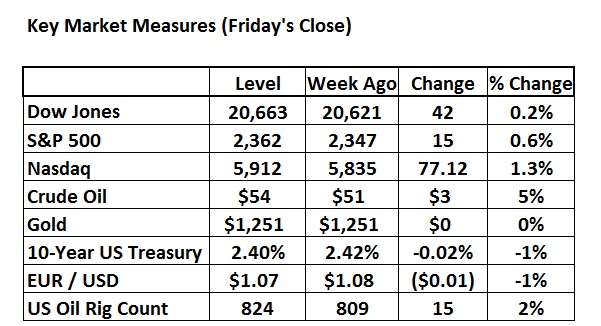
by Todd Shaver | Apr 2, 2017 | Weekly Newsletter 7pm Sunday
The Week Ahead
This past week was more of the same calm and collected march higher for the stock market. Optimism is at record highs for business and consumers. There are pockets of softness in the economy, like historically low labor force participation and declining commercial and industrial loan activity at banks, but with the credit market dealing with the stresses of low interest rates the stock market just keeps drawing interest from investors. We now head into April after what was a strong 1Q 2017. The consensus estimate for 2017 S&P 500 EPS is currently $129 revealing a reasonable 18x P/E multiple for today’s overall stock market.
The first quarter closed Friday with the S&P 500 notching its best quarter since 2015, up 5.5%. The Nasdaq had its best quarter since 2013, up 10%. The Volatility Index (^VIX), the fear gauge, posted its second lowest quarterly average in history at 12.37. And listen to this, the average daily percentage change for the Dow Jones during the quarter was the lowest since 1965. Things are CALM out there!
Apple (AAPL: $144, up 2%. All changes in this report are for the WEEK), a component in all three major indexes, jumped 24% during the quarter, nestled next to an all-time high set again this week. The company added $145 billion to its market cap in the quarter, besting its own record set in 2012 of adding more market cap in a quarter than any other company. It was the biggest gainer in the Dow Jones 30. Facebook, Amazon and Netflix all added 18%.
There is always a bull market right here at The Bull Market Report! This week we highlight the following securities: Visa, Amazon, Microsoft, Tesla, Splunk, and Shopify.
Highlights From The Past Week
Trump Talks Tough on U.S.-China Trade. President Trump appeared to follow through Friday on his promises to get tough on trade with China, less than a week before he is to meet with President Xi Jinping of China. In two executive orders, Mr. Trump called for tighter enforcement of tariffs imposed in anti-dumping and anti-subsidy trade cases, as well as a comprehensive review of the United States trade deficits - measures that reflect America’s economic tensions with China. Straightening out the US trade balance with China would be a major positive for US GDP growth, if Trump can accomplish the goal.
Why the Urge to Merge Could Return to Wall Street. Nothing appears to be off the table for the Trump administration as it seeks to pare back the regulations imposed on Wall Street and banks after the financial crisis. There has already been considerable talk about rolling back much of the Dodd-Frank Act of 2010, as well as the Volcker Rule that is intended to prevent Wall Street firms from engaging in proprietary trading. Already, the acting chairman of the Securities and Exchange Commission, Michael Piwowar, says his agency has stopped writing the rules and regulations mandated by Dodd-Frank - more than 20,000 pages so far - in anticipation of the confirmation of Jay Clayton as the commission’s new chairman. There is little doubt change is coming. But no one seems to be talking about whether Wall Street banks will again be able to engage in what has historically been one of their favorite pastimes: getting bigger through mergers and acquisitions. We could be in for an M&A boom across sectors not just Financials.
"Valeant Bet Was a ‘Huge Mistake," Hedge Fund Chief Ackman Says. It is rare that William Ackman, the brash activist investor, apologizes for anything. As a successful hedge fund manager, Mr. Ackman has made billions of dollars for himself and his investors with bold and counterintuitive bets. But this week he conceded that his firm’s biggest wager yet - on Valeant Pharmaceuticals International - was “a huge mistake” that has cost his hedge fund firm, Pershing Square Capital Management, “a tremendous amount.” “I deeply and profoundly apologize,” Mr. Ackman added in an annual letter to investors. It was an unusual moment of contrition for Mr. Ackman and a stark contrast to his emphatic support of Valeant in recent years. In the bigger picture, this event is just the latest of many recent developments pointing to troubling times for hedge fund managers as more and more investors turn to do-it-yourself and/or ETF investing.
BMR Companies and Commentary
Visa (V: $89, flat)
Samsung Electronics announced a strategic partnership with Visa to help bring Samsung Pay to online merchants. Starting later this year, Samsung Pay users will be able to shop online at hundreds of thousands of merchants around the world where Visa Checkout is accepted. The partnership just goes to show everybody in payments relies heavily on Visa.
Samsung Pay’s simple, secure checkout experience using fingerprint authentication gives users a more streamlined online shopping experience, eliminating the lengthy process of adding their payment card data, billing or shipping details each time they shop. Users with fingerprint authentication-enabled Samsung devices will be able to click the Visa Checkout/Samsung Pay co-branded button and touch the fingerprint sensor and the payment will proceed instantly, without needing to enter a user name and password for each purchase.
How cool! The days of filling out long forms or remembering usernames and passwords to make online purchases are continuing to wind down, as options like Visa Checkout’s open platform become accessible on hundreds of thousands of merchant sites, and companies like Samsung see the value in simplifying the process for both consumers and merchants.
BMR Take: Visa trades at 26x the consensus estimate for this year’s fiscal EPS of $3.45. Take a look at this 5-year chart from Yahoo. Where do you think they are headed in 2017/8 and beyond?
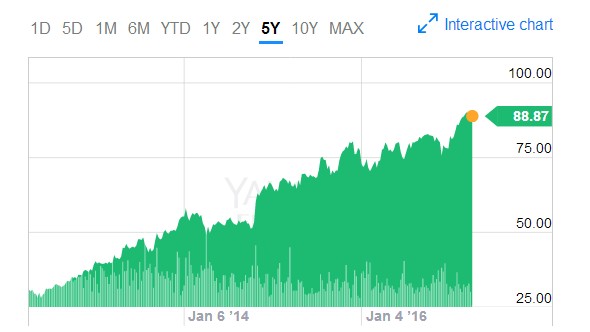
Amazon (AMZN: $887, +5%)
Amazon is expected to enter the Australian market soon. Estimates call for this region to eventually contribute upward to $15 billion of sales to Amazon’s top line, which compares to this year’s sales tracking to be around $165 billion for the company.
What is great about Australia for Amazon? Online sales will account for just 12.5% of Australian retail sales by 2025, up from only 7% in 2016. In other words, Australia is just barely into the online sales phenomenon. We are likely heading to online sales being greater than 25% so there is just much growth runway ahead for Amazon in Australia.
What will be interesting to watch is what Amazon’s entry into Australia means for local retailers. Could it be an imminent disaster? Certainly, many local players will have to adjust to smaller store footprints, change pricing, and improve their customer engagement.
BMR Take: Amazon trades at 125x the consensus estimate for this year’s fiscal EPS of $7.09. It’s a big valuation, but growth is exceptional. EPS was a loss in 2014, $1.25 in 2015, and $4.90 in 2016 and now we see estimates for $7.10 in 2017, $12.35 in 2018, and almost $20 in 2019.
Consensus Ratings for Amazon
4 Hold Ratings, 45 Buy Ratings
Targets:
3/30/2017 Loop Capital $1,100
3/29/2017 Cantor Fitzgerald $970
3/28/2017 Stifel Nicolaus $1,025
3/17/2017 Pacific Crest $895
Apple (AAPL: $144, +2%)
In January, Forbes reported that a White House advisory panel issued a report recommending that the U.S. strengthen protection of the Semiconductor industry, especially against threats posed by Chinese policies to dominate the sector.
Then in March, Apple discussed publicly that the Japanese government is likely to ensure Toshiba is acquired. Prime Minister Shinzo Abe recently met with President Trump to discuss among other topics this one. There are now swirling talks that Apple is going to buy part of Toshiba. The deal could be executed for as much as $18 billion.
What does it all mean? Apple farms out their production for Macs, iDevices and accessories so that they can focus the bulk of their investments on software and engineering companies, setting up R&D centers around the world and building out new flagship Apple stores. We very well might be looking at the early signs of Apple soon making many of their products in the United States. Exciting.
BMR Take: Apple is again setting new all-time highs this week. The stock trades for just 15.5x this year’s consensus EPS estimate of $9.25. We are still seeing healthy EPS growth from Apple, as seen in the consensus forecast for EPS of $10.35 in 2018 and almost $11 in 2019.
Microsoft (MSFT: $66, +1%)
Last October Microsoft released the preview of Azure Analysis Services, which is built on the proven analytics engine in Microsoft SQL Server Analysis Services. With Azure Analysis Services, you can host data in the cloud. Users in your organization can then connect to your data models using tools like Excel, Power BI, and many others to create reports and perform ad-hoc data analysis. This is exciting stuff for the business community. You no longer need to run a big back office. You have Microsoft Azure!
Well, just this week, Microsoft announced that Azure Analysis Services is now available in two additional regions: Japan and the UK. This means that Azure Analysis Services is now available in the following regions: Australia, Canada, Brazil, Southeast Asia, North Europe, West Europe, the US, Japan and the UK.
BMR Take: Again a new all-time high for Microsoft this week as the cloud is taking over and Microsoft Azure is one of the top players. The stock trades at 21x this year’s EPS estimate of $3.10 though estimates call for EPS of $3.50 in 2018 and $4 in 2019.
Tesla (TSLA: $278, +6%)
Earlier this week, Tesla announced that Chinese Internet firm Tencent had acquired a 5% stake in the company for $1.8 billion. The cash infusion is good news for Tesla’s financial health, and the company’s growth prospects in the region.
In a recent filing, Tesla said that 2016 sales in China were $1.06 billion. That’s roughly a quarter of what the company made in the U.S. last year. And while the China figures represent significant growth from 2015, it’s still well below what CEO Elon Musk once imagined. In a 2014 interview with Bloomberg, Musk projected that China could eventually become the electric-car maker’s largest market. Admittedly, that day is a long way off, but we are moving closer and closer.
One big hurdle left to clear in China for Tesla is market share. According to CleanTechnica, 352,000 electric car sales were registered in China last year, which is nearly half of all plug-ins sold worldwide. Tesla, however, is the underdog. Despite being the best-selling foreign electric vehicle manufacturer to crack the Chinese market, the company only had a 3% share in 2016. Plenty of room left for improvement to drive more growth.
BMR Take: Tesla is selling cars in China like hotcakes. China LOVES Tesla and Elon Musk. We are excited to see the company make some progress in the attractive China market. The company is still losing money, basically because they are not making cars in mass quantities yet, so the extra money raised from the 5% stake sold is a welcomed boost of cash on the balance sheet. Tesla ended last quarter with over $8 billion in debt on total assets of $23 billion, a definitely elevated level.
Splunk (SPLK: $62, +2%)
An activist may have just shown up at the Splunk table. A notable language change in Splunk’s 10k filing was noticed this week. The new disclosure alerted investors to possible activist involvement in company operations.
The 2017 10-K included following phrasing absent from the previous year’s filing: "From time to time, public companies are subject to campaigns by investors seeking to increase short-term stockholder value through actions such as financial restructuring, increased debt, special dividends, stock repurchases or sales of assets or the entire company. If stockholders attempt to effect such changes or acquire control over us, responding to such actions would be costly, time-consuming and disruptive, which could adversely affect our results of operations, financial results and the value of our common stock. These factors could also make it more difficult for us to attract and retain qualified employees, executive officers and members of our board of directors."
BMR Take: The added language essentially fulfills the company’s legal obligation to warn investors of activist interference. So we would be in a for a nice catalyst here. We really like Splunk. All anybody ever talks about now is cybersecurity. The company has $1 billion in cash and just $100 million in debt. Consensus estimates call for meaningful growth from $0.40 of EPS last year to $0.60 this year and $0.90 next year.
Shopify (SHOP: $68, -1%)
There was a whirlwind of poor press circulating on the company this week. First of all, a research firm downgraded Shopify to a strong sell to reflect negative estimate revisions following an unimpressive full-year 2017 outlook and growing near-term headwinds. This is just near-term noise. We are focused on the longer term big picture, which is very attractive for Shopify. In particular, many investors are asking the question if it would make sense for Amazon to acquire Shopify. After all, the market cap is only $6 billion. This would be a rounding error on Amazon’s balance sheet.
Shopify offers an easy-to-use multi-channel commerce platform that targets small and medium-sized businesses. Its 2016 revenue was $390 million. This would be a bolt-on acquisition for the Amazon Web Services (AWS) business if the rumor is true. As far as what Amazon or another buyer might get for a bid of $7-8 billion or so, the Shopify website showed that more than 380,000 people have sold over $29 billion using Shopify. The service allows small and mid-sized businesses to fully customize their online stores and to add new sales channels, while managing unlimited products and inventory and tracking sales.
BMR Take: We are not worried that the stock took a few points of pullback this past week. This is a long-term investment that will pay off big in five years. EPS is expected to go from a slight loss this year of $0.18 to something like $1.25 by 2020. Given all the potential of Shopify’s technology and the earnings ramp set to occur, we remain excited about the future for this company.
Upcoming Economic News
It is a very quiet week ahead for economics news. Stay tuned for more economic news next week.
A Letter from a Reader
To: The Bull Market Report
From: Arthur Weed
Twilio, First Solar and Ferrellgas were all recommended at the high end of the price range. Shopify also is at the high end of the range in this market. Sometimes riding the market out for lower prices is a good option. I just prefer to watch for weakness and then go for it.
Hi Art –
OK, I understand. We all have our personal philosophies. I like to shoot for the fences with some of my assets. I missed Microsoft at 3 cents. And Apple at 11 cents . But I got AOL at $1 in the 90s and it went to $71. And I got Iomega at $17 even though the low was $3 for the year and it went to $330.
The facts:
Twilio was added after it dropped from its high of $71, and in fact, it had a fairly sharp drop from that level to $52 where we added it.
First Solar was added at $63 and a month later was $73. Revenues have fallen sharply.
The average price of Ferrellgas for the last 23 years is around $20. At $17 we thought we had a nice discount and an opportunity for it to go to $20 and then $25.
Our thoughts:
--- We believe Twilio will be a huge player in the internet communications marketplace. And we believe the stock can triple or more from $50.
--- First Solar has been a leader in this business for decades and until recently has the revenue to go with it. Unfortunately, we have to wait until 2019 for this one to play out. And that is not guaranteed, but we believe management can do it.
Note: First Solar was given a hold rating at JPMorgan Chase. They now have a $38.00 price target on the stock.
--- Ferrellgas has been a leader in the natural gas business forever. We didn’t know their big acquisition would go down as one of the worst in Wall Street history.
--- Shopify is the leader in e-Commerce by a wide margin and has big growth ahead of it. It is a potential Microsoft-like opportunity as the world is moving to mobile every single day, every week, every month, every year. We wish we had discovered it at $25 or $50. But if the stock goes to $100 and then $150-200 we won’t mind too much. We think this is quite possible over time.
Todd Shaver
A Letter from a Reader
From: Chet Malek
Sent: Thursday, March 30, 2017 9:07 AM
To: info@bullmarket.com
Subject: SNAP and Twitter
Todd – Do you have any thoughts on SNAP? Do you like Twitter better (I assume you do)?
Hi Chet –
We do not like Snap. They may surprise me and go to $50 and $100 but at the moment they are WAY behind where Facebook was when Facebook went public. And if you remember, they went public at $37, hit $43 that day, closed at $37 and then proceeded to go down to $16 in the next few months. Now the stock is at $142. BUT Facebook had big revenues and big profits at that time. Snap has good revenues but super negative earnings – They lost $515 million last year and $380 million in 2015! And they are a niche business unlike Facebook which covers it all.
We do like Twitter. One day they will figure it out. And one day someone will buy them at a 40% premium. If I were a gambling man I would buy 2-year LEAP options with a strike price of $25 or $30, cheap. [This is not for all. Consult your broker. High risk here.]
We really like Twilio – good business concept; strong revenues last quarter. No profits yet. But profits will come if the revenue is there, and it is.
Todd Shaver, Founder and Editor in Chief
Twilio Extends Relationship with Amazon
Twilio (TWLO: $29, flat) announced a further step in their relationship with Amazon. They said: Amazon Connect will use Twilio's programmable APIs to provide enhanced capabilities for customers.
(What are APIs? An Application Programming Interface is a set of subroutine definitions, protocols, and tools for building application software. In general terms, it is a set of clearly defined methods of communication between various software components. A good API makes it easier to develop a computer program by providing all the building blocks, which are then put together by the programmer. An API may be for a web-based system, operating system, database system, computer hardware or software library.)
From their public announcement Tuesday: Twilio, the leading cloud communications platform company, today announced support for Amazon Connect, the newly announced cloud-based contact center service from Amazon Web Services (AWS). Twilio's Programmable APIs will enable a range of new capabilities, including integrating phone intelligence lookup to personalize Amazon Connect contact flows, enhance customer contact details, and follow up with post-call surveys via text.
"We're pleased to further extend our work with Amazon Web Services by helping to power and further enhancing the capabilities of Amazon Connect," said Twilio CEO and co-founder Jeff Lawson. "Supporting the continued advancement of the contact center to its more agile future in software, frees developers and businesses from the legacy approach to contact centers -- an approach that simply can't keep pace with customer expectations today."
The announcement furthers the long-standing relationship between the two companies. Note that Twilio is built and globally deployed on the highly scalable AWS Cloud. Some say that Amazon can do what Twilio does and that all this hype is bad news for Twilio. We say the opposite. We think there is a symbiotic relationship here that appears to grow stronger and stronger each month.
Here’s what the company includes in their press releases:
About Twilio
Twilio's mission is to fuel the future of communications. Developers and businesses use Twilio to make communications relevant and contextual by embedding messaging, voice and video capabilities directly into their software applications. Founded in 2008, Twilio has over 650 employees, with headquarters in San Francisco and other offices in Bogotá, Dublin, Hong Kong, London, Madrid, Mountain View, Munich, Sweden, New York City, Singapore, and Tallinn [the capital of Estonia.]
Alphabet (GOOG: $830) is now covered by Barclays. They set an "overweight" rating and a target of $1,065. Our target is $900 but when that level is hit we fully expect to raise it to at least $1100. The only question is when.
The High Yield Corner
By Michael Foster, Special to The Bull Market Report
We start this week’s high yield summary with the GDP report. The headline news looks good: GDP grew at 2.1% versus 2% in the fourth quarter. Politically-minded Americans may want to dismiss this (and who isn’t politically minded these days?), arguing either things will get better or worse under Trump, depending on the flag they bear. We would suggest resisting the urge to devolve the topic to partisan bickering, because the details under this report are very important because they signal where exactly we are in the credit cycle. This, in turn, is important for one of the world’s biggest credit markets: U.S. corporate bonds.
The mainstream press focused on a couple of dynamics under the headline number, although both are relatively unimportant. A big theme, according to journalists, was consumer spending. This rose 3.5%, a sharp upwards revision from 3% previously. Since consumer consumption is the biggest driver of demand in the U.S., which in turn drives demand for the big industries abroad (manufacturing in China and Germany, exporting in Hong Kong and Singapore, commodities in Latin America, and so on), this is good news.
But it’s actually not the most important bit of good news from the report. The National Income and Product Accounts (NIPA) data, which makes up part of the GDP, gave significant and good surprises that have much more predictive power than consumer activity. According to the NIPA release, corporate profits rose after declining for three years. The “corporate profits” metric, jumped over 9% on a year-over-year basis in the 4th quarter of 2016, a sharp acceleration from the 2% increase seen in the 3rd quarter. Some economists have already said the so-called “corporate profit recession” has ended.
This decline, which was partly a result of the crash in commodity prices and partly the result of cash-strapped consumers pulling back, was a primary reason why the S&P 500 got more expensive. Because stock values are measured by dividing their current price by their earnings over a one-year period (the “price-to-earnings” ratio), stock values climbed higher and higher because profits were falling lower even as stock prices were going up. This caused the S&P 500 P/E ratio to shoot up to over 26 by the end of March, about 50% higher than its historical average. That definitely looked and smelled like an overbought market, but investors held their noses and bought stocks anyway.
We’re here to tell you that you can stop holding your nose. While the corporate profits measurement is not identical to the way S&P 500 companies report their earnings, they’re close enough. And with a 9% jump, that means the S&P 500’s one-year forward P/E ratio is less than 20, a very reasonable level.
At the same time, this increase in earnings is extremely good for corporate bonds, BDCs, and REITs for similar reasons. Let us go through these one by one to explain why.
Firstly, corporate bonds. The SPDR Barclays High Yield Bond ETF (JNK: $37) had a good week (up 1%) thanks in no small part to the GDP data, although investors are continuing to recognize what we have been saying for a long time: the default risks are over and will decline significantly because corporate profits are going up, meaning firms will have enough cash to pay their debts. What does this mean? All the risks that were priced into junk bonds back in 2015 are evaporating but the price hasn’t fully recovered on a real adjusted basis. Great news - this means we can buy junk bonds. But we can’t be indiscriminate about it. Well-managed funds like the PIMCO Dynamic Income Fund (PDI: $29) are ideally positioned to outperform. Last year PDI paid out a special dividend well over 4% of the fund’s value, bringing the annualized yield to over 13%. With the strength in junk bonds this type of return will be even easier for this fund to do this year, making it an obvious strong hold even though it is priced at a premium.
A similar rationale exists for why BDCs shot up this week: more corporate profits mean less concern companies will default on their debts. The UBS BDC ETF (BDCS: $24, up 2%) had an incredibly strong week as a result. However, we do not see this as a good enough reason to buy BDCs, especially the larger cap ones that are facing growing competition from banks that are increasing their middle market business lending practices. The market is cheering the macro conditions for BDCs, which are clearly much better than a year or two ago. However, the market is not taking into account the industry conditions for BDCs, which is more competitive and thus will force some BDCs to look for lower yielding or higher risk loans. This makes us cautious on BDCs just as we are more positive about their lower yielding competitors - namely, financial stocks.
Finally, let’s talk REITs. In the simplest sense, higher corporate profits mean more room to raise rents for industrial, commercial, and infrastructural tenants. Retail and commercial REITs make up a healthy chunk of the SPDR Dow Jones REIT ETF (RWR: $92, up 1%), but it also plays into the wheelhouse of The Bull Market Report’s favorite REITs.
Digital Realty Trust (DLR: $105, up 2.5%), Omega Healthcare Investors (OHI: $33, up 2%), Kimco Realty (KIM: $22, down 2%), Government Properties Trust (GOV: $21, up 2%), and Care Capital Properties (CCP: $27, up 6%) are all exposed to corporate and government tenants whose ability to tolerate raising rents is going up as corporate profits rise. This doesn’t mean the market is irrationally exuberant about the sector like they were in mid-2016, which again makes this a good sector to be into, especially if you’re choosing firms relying on commercial rents.
The market is stronger than the fearmongers would have you expect, and that strength is particularly acute in the high yield universe. It’s a great time to buy income.
Funny – as we write this last sentence above we think of all the folks out there who are thinking: How can I buy yield when interest rates are going to go up which means prices will go down? Well, we at The Bull Market Report don’t believe rates are going that much higher. In fact, if anything, we think rates could go lower, despite the Fed’s best wishes. Besides, as noted above and every week that we write this report, you surely notice that we are writing about strong companies with strong management who are well-aware of the world of interest rate risk. We believe in management of the companies we follow. Look at Annaly (NLY:$11.11). They paid a 30 cent divided this week (11% annualized), and the stock was flat. That’s a 2.7% gain for the week in our book. The stock is up over 10% from its low in December! And they’ve been doing this for 20 years.
Good Investing,
Todd Shaver
Founder and Editor in Chief
The Bull Market Report
Since 1998
