by Todd Shaver | Dec 21, 2017 | Monthly Newsletter Daily 12pm if new
The Weekly Summary
Star Wars ‘The Last Jedi’ topped $100 million on opening weekend, only the second film to do it, the first being Star Wars ‘The Force Awakens’. Americans are feeling good right now watching movies and buying Christmas gifts, as all-time high equity markets have their portfolios in great shape. Mergers and acquisitions are popping off with Disney buying assets from Fox and several other big-name deals announced this week. These are great times. It has been an incredible bull market. In fact, they say this past year was the least volatile on record in a hundred years. From the depths of the Financial Crisis to today marks an amazing journey for the markets. We can’t help but keep stressing that it won’t always be this good.
We’re not worried – just watching. We heard a presentation from a research specialist from Citibank on Thursday and he talked about and gave us charts on where the market is historically. He said the PE of the market (S&P 500) is 26, way above the historical average of 16. He said the VIX (^VIX) is sitting at about 10, way below the historical average of 14 or so. And he said the market ALWAYS REVERTS TO THE HISTORICAL MEAN. We took this all in, have thought about it for days and much before that and we must say that we effectively agree with this analysis. Remember the phrase “the new normal”? They said this about Internet stocks in 1999-2000 – remember what happened. They said that about the bull market leading up to 2008. Remember what happened. And they are saying that about this bull market and the low interest rate environment that we have seen for decades, with the 10-year Treasury still at historic lows of 2.35%.
Again, we’re not worried – but we are watching. We think this bull can run for another two years at a minimum.
No matter what is happening out there, there is always a bull market here at The Bull Market Report! This week we highlight some of our favorite stocks where we think you can still make good money, including: Bristol-Myers Squibb, Nutanix, Annaly, Tesla, Twilio and asset managers (Blackstone, BlackRock, and Carlyle Group).
SPECIAL HOLIDAY OFFERING
Get The Bull Market Report for just $199 for the entire year. It is published Weekly on Sunday evenings and we send you News Flashes during the week. We have six portfolios with over 40 stocks that we follow. Some are up 25%; some are up 50%; a few are up over 100%. And in our High Yield Portfolio we have stocks paying 6%, 8% and 10%.
Give a GIFT TO YOURSELF or a loved one or a good friend. It will be the best Christmas present EVER.
Go here now:
https://www.bullmarket.com/subscription/
BMR Companies & Commentary
Asset Managers:
Blackstone (BX: $33)
BlackRock (BLK: $517)
The Carlyle Group (CG: $22)
Asset managers sure look like a compelling place to put money to work. We highlight some of the key data points about current market conditions. The strong fundamentals point to more and more money being made on Wall Street, which means more money for asset managers, and in turn more money for the investors in asset managers, meaning you of course.
Investment banking data were mixed in the week. Equity underwriting volume was 12% above the 4Q17 weekly average, and announced M&A volume was 67% above the 4Q17 weekly average, while completed M&A and debt underwriting were 45% and 20% below the 4Q17 weekly average, respectively; debt underwriting is steady.
Equity trading volume was 8% above the 4Q17 weekly average level, while equity option volume was 10% below the 4Q17 weekly average.
Corporate bond trading volume was steady. The 10-year Treasury yield increased 1 bp to 2.38% (up 4 bps quarter to date (QTD)), the Bank of America U.S. High yield increased 3 bps (up 32 bps QTD), and MBS securities yields (15-year and 30-year) declined 3 bps and 0 bps, respectively (up 14 bps and up 4 bps QTD, respectively).
Equity fund outflows (on a one-week lag) persisted, totaling $3.6B ($36B QTD), while bond fund inflows (also on a one-week lag) continued, totaling $4.3B ($52.0B QTD). This is certainly not good and amazing that the stock market has been able to absorb this negative news and rally like it has.
BMR Take: Take your pick between Blackstone, BlackRock, and The Carlyle Group, or own them all. These companies make money from all of the fees, deals, and rising asset prices. They are a center of profits. We see opportunity for meaningful stock price appreciation if current fundamental trends persist, as we believe it will. They are WAY UNDERVALUED in our opinion.
-------------------------------------------------------------------
Bristol-Myers Squibb (BMY: $61)
Bristol-Myers Squibb has licensed a phase 1 immuno-oncology drug from Japan’s Ono in a $40 million upfront pact. This geographically complex deal, which builds on a collaboration the pair have had for a number of years now, sees Bristol-Myers solely responsible for the development, manufacturing and commercialization of Ono’s selective Prostaglandin E2 receptor 4 antagonist. This program is aimed at targeting immuno-suppressive factors in the tumor microenvironment.
To improve long-term outcomes for more patients with cancer, Bristol believes more immuno-oncology-based combinations may be required, and they are pleased to continue the long-standing collaboration with Ono with this focus in mind. This new program offers the potential to develop targeted therapies that counteract the effects of an immunosuppressive tumor microenvironment. Researching Prostaglandin E2 receptor antagonists in combination with the oncology portfolio has the potential to result in an enhanced response in a broad range of tumors.
BMR Take: Bristol is going to generate $3.00 of EPS this year and around $3.25 next year, then growing toward $4.50 by 2020 as the immune-oncology drugs gain traction. That means the stock is dirt cheap and now is a great entry point. Remember, activist investor Carl Icahn is in the stock and we could see him push for a sale of the company resulting in a huge M&A premium some day in the future.
-------------------------------------------------------------------
Nutanix (NTNX: $35, up 3% last week)
Wow, Nutanix has doubled in recent months. Got your attention now? Let’s review what’s happening.
Nutanix started out as a hyperconverged (HCI) vendor. Starting in 2009, they created the market for HCI. They thought that HCI was a step in the journey to where organizations were headed, which was around becoming truly enterprise cloud software companies. This is what you hear and see Nutanix focusing all their energy on. Nutanix customers are looking at HCI as a critical step in this new era journey. They're looking at Nutanix as a full stack offering that allows them to build this platform, above, that's beyond storage and compute and includes virtualization. It helps them with networking, security, but most importantly now helps them with the transition that's happening in the market around the world of multiple clouds, where customers are trying to figure out how to handle a hybrid cloud environment, where customers want to put some of their workloads in the public cloud, but they also have a private cloud infrastructure that gives them the security that actually is probably even more cost effective for their enterprise apps like SAP, Microsoft and Splunk.
BMR Take: Look, we can’t explain all the finer details around the inner workings of HCI. However, we know that tech-savvy people are thrilled about what is going on at Nutanix. The company is on track to swing from losses to over $1 of EPS in 2021. The company’s customer base has doubled. The stock has doubled. We see all the elements of success and continue to like the stock at this level.
-------------------------------------------------------------------
Annaly Capital Mortgage (NLY: $12.01, up 2%)
The Fed raised rates and guess what, Annaly’s stock went up. What? The company is going to be able to navigate the interest-rate environment just fine. In fact, the Chairman of the Board just bought 125,000 shares this week at $12. At the end of the day, it’s been proven by numerous studies, that following insider buying from key business leaders is a way to make money in the markets. People sell stocks for all sorts of reasons, but they only buy stocks with one thought in mind, “I am going to make money on this purchase.” When that buyer is the Chairman of the Board with all that insight and industry expertise, you have to assume either this guy is a reckless idiot with his money or he is on to something.
Who is Denahan J. Wellington? She is Chairman of the Board of Directors and Executive Chairman of Annaly. Ms. Denahan is a co-founder of Annaly and has over 20 years of financial services experience. She was one of the co-founders of Annaly in 1994 and has been with the firm all this time. Ms. Denahan holds a B.A. in Finance from Florida State University and is the third-highest paid female CEO making over $26 million a year.
BMR Take: We see value in Annaly shares which are trading just above book value of $11.20 with a dividend yield of 10%. We think placing your capital alongside Ms. Denahan is a smart move. We have to say we love this company. We’ve loved them for about 20 years through high interest rate environments, through bull and bear equity markets, through negative naysayers both personally and on the Street, and they just keep coming through year after year. Sorry for gushing!
-------------------------------------------------------------------
Tesla (TSLA: $329, up 9%)
Tesla looks to be catching a break in Congress, as electric vehicle tax breaks appear to be maintained in the current legislation.
House and Senate negotiators have agreed to spare the electric-vehicle tax credit and wind production tax credit in their compromise package, according to a Republican familiar with the process. As part of the $1.5 trillion House tax bill, the $7,500 electric-vehicle tax credit would have been eliminated and the wind production tax credit would have been curtailed. The Senate bill didn’t do either, and that is part of the package set for release.
The vehicle tax credit, adopted as part of the 2009 stimulus bill, helps automakers from Detroit to Yokohama bet big on an electric future with plans to spend billions of dollars on new pure-electric models to be rolled-out in the coming years despite limited sales of the vehicles to-date. Availability of the credit has been capped at the first 200,000 qualifying vehicles sold by each manufacturer. No automaker has reached that cap yet. Tesla sold about 127,000 Model S sedans and Model X sport utility vehicles through August.
BMR Take: The tax credit is a nice incentive for sales of Tesla vehicles. More sales means more cash flow. More cash flow means a greater franchise value on the stock. We like what we see happening with Tesla, from innovation to DC policies. Keep this stock tucked away in your portfolio (but know that is one of your most speculative holdings.)
-------------------------------------------------------------------
-------------------------------------------------------------------
Economic Calendar
Initial Claims
Thursday, December 21st, 10 AM
Period: 12/16
Actual: N/A
Consensus: 235,000
Prior: 225,000
New Home Sales
Friday, December 22nd, 10 AM
Period: November
Actual: N/A
Consensus: 655,000
Prior: 685,000
-------------------------------------------------------------------
Update on Twilio (TWLO: $25, up 3%)
Twilio hosted its first-ever investor day two weeks ago. Despite many quarters of strong results, the stock has remained under pressure.
Twilio aims to be the "future of communications," the way other cloud platforms like AWS has reshaped compute infrastructure and Stripe has revolutionized payments.
Twilio addresses a huge marketplace and has the potential to scale into a much larger company than it is today. The company continues to grow at a 40% rate, even as it approaches a $500 million run-rate.
Twilio's gross margin is much lower than most software companies due to its position of being a "middleman" between developers and telecom networks. The rise of possible competition from services like AWS is a concern.
Based on research from Gartner, the leading software industry analyst, Twilio believes its opportunity in communications to be 40% of the global IT market ($3.6 trillion).
Twilio also reminded investors that its sales model is unique among enterprise software companies by focusing on software developers rather than enterprise CIOs, attributing to its lower spending on sales and marketing. In its most recent quarter, it spent just 23% of its revenues on sales and marketing. This is low compared to the majority of high-growth software companies, that can typically spend upwards of 50% of revenues on sales and marketing.
Twilio also plans to greatly expand its count of quota-carrying reps (QCRs). At the end of 2016, Twilio's sales organization only had 23% of its headcount as QCRs - indicating that the bulk of the company's new sales hires weren't fully ramped yet to the $1.5-$2 million in revenue that the typical QCR brings in. At the end of 2017, however, Twilio estimates that 46% of its sales organization will be QCRs. This will drive further growth in the company.
Revenue guidance calls for $104 million, a strong 25% growth rate. More good news is that active developer accounts are up 35% over last year, and customer retention rate is literally close to 100%.
The company has generated 56% in gross margins year-to-date, the company believes it can attain gross margins of up to 65% in the long term. Twilio is operating at near-breakeven now, but the company expects to attain an operating margin of at least 20% in the future.
BMR Take: We are hanging tough with this great company. Patience will win out in the end, as revenues drive all.
-------------------------------------------------------------------
-------------------------------------------------------------------
Cryptocurrency Update
Bitcoin (BTC-USD, $15,100 – prices change by the minute and trade 24-7)
The bitcoin boom is raging. It’s being discussed on every news network, in every paper, and even in questions asked to the Chairman of the Federal Reserve. The bitcoin rage is best exemplified by the following tale, which is a true story. Erik Finman invested a $1,000 cash gift from his grandmother into bitcoin six years ago. He was 12 years old. Erik is now a millionaire at 18. There are dozens and dozens of these situations being reported. Bitcoin has turned into a full-blown frenzy. It is said that the wealth created in bitcoin has served as an economic stimulus for millennials. Many feel that it going much higher The future of digital gold is here. The end of government controlled fiat money manipulation is upon us. That is what they are saying. But some more cautious investors are saying we will look back and call this the obvious bitcoin bubble. Will we? Only time will tell. Either way the frenzy is an exciting dynamic rarely seen in the markets. Place your bets wisely on the future of cryptocurrencies.
If you wish to learn more about bitcoin and other cryptocurrencies, go to www.Bitcoin.com and sign up for their daily newsletter. Also, www.CoinTelegraph.com has a great one. For info on the 1300 ICOs – Initial Coin Offerings – go to www.CoinMarketCap.com.
-------------------------------------------------------------------
A Word from Gary Jefferson
Jefferson Financial Group
First Vice-President, Investments
UBS Financial Services, Inc.
The year is basically over and we will leave it with the following comments on what may lie ahead. The only thing we can be sure of next year is that the vast majority of predictions or forecasts will end up missing the mark to one degree or another, as the market never follows a predictable pattern or does what everyone, especially the experts, expect. The bottom line to all the following information is simply this - Investors should not get all worked up about the numbers or economic forecasts for 2018. We believe the single most important economic fact that investors need to know is that the world is doing OK.
The current UBS "technical" forecast:
[Be prepared for some serious technical jargon.]
“It is remains our contention that the confusion within the US equity markets, pitting the bulls against the bears, lies in the lack of understanding by investors and traders about the significance of the two current powerful but competing market trends. That is, there is a maturing/aging cyclical bull trend (March 2009) operating within a newly confirmed structural bull trend (secular bull markets last an average of 8 to 20 years in length) that began in earnest in May 2013 via a breakout above 1,576/1,600, which was further validated in 2016 by a positive outside year. As with all cyclical trends, the current 9-year cyclical bull will likely end as early as the second half of 2018 and possibly into early 2019. This will be followed by either a deep correction (10–20%) or by a cyclical bear decline (20–30%) rather than by another structural bear decline (30%-plus). Since the current structural bull trend is only four years old, this long-term trend can sustain for another four years (2021) and possibly extend for another 16 years under ideal conditions. This would imply that the S&P 500 may quickly achieve our technical target of 2,850 as early as the first half of 2018 and possibly overshooting to 3,000 before sustaining a major drawdown. Under the backdrop of a structural bull trend, the S&P 500 can reach an optimistic technical target as high as 3,685 in the years ahead."
Thus, under a worst-case scenario where this new secular bull market which began in 2013 only lasts the minimum 8 years instead of the maximum 20 years - therefore lasting another four years - the technicians are forecasting the S&P 500 could reach 3685 over that 4 year period. This would equate to about 40% upside or 10% annually. However, trying to time this projected correction or cyclical bear decline in later 2018 or the first half of 2019 (or reaching the level of 2994-3045) will be nearly impossible, and could cause timers to miss an important move higher.
Keep in mind that this is a "technical" forecast based on charting and technical historical patterns. It is one of many tools used by money managers in reaching their final investment strategy and asset allocation decisions.
The UBS "fundamental" forecast also offers a positive outlook:
“US stocks rarely experience a sustained downturn outside of economic recessions. In fact, since 1960, the median S&P 500 calendar year total return is 15% in non-recession years. While gains in 2018 are unlikely to match the advance of this past year, US equities should continue to rise and outperform bonds as the US and global economic expansion continues. Historically, stocks rise 88% of the time in non-recession years.
2017 review: Solid S&P 500 EPS growth of 10% underpinned US equities in 2017. Market gains were amplified by higher valuations driven by strengthening and synchronized global growth and inflation generally undershooting market expectations.
2018 outlook. We forecast 2018 S&P 500 EPS to rise another 8% to $141 if tax reform is not passed. With expected tax reform benefits, profits could get an additional 6-10% boost. Solid and steady economic growth and still-low interest rates should continue to support above-average market valuations, although we are not assuming further multiple expansions. Putting it all together, we expect that the S&P 500 will end 2018 between 2,850 and 2,950 if tax reform legislation is enacted. Should tax reform efforts fail, 2,600-2,700 is a more likely base case."
At this point we are going to assume that tax reform happens. Thus, the read we get on the economy is overwhelmingly positive. Maybe it's the Christmas Spirit, but it seems there’s so much going on right now that investors should celebrate. We just had two consecutive quarters of 3%+ GDP growth. We have historically low interest rates which make it cheaper for consumers and businesses and the government to borrow and spend. Inflation, which is a great enemy of both bond and stock investors, has been kept in check through many things such as demographics and technology innovation. We have cheap energy thanks to the technological revolution in fracking and horizontal drilling, and, most importantly, we have rising corporate profits. Ultimately, as they have for all of history, share prices will follow earnings.
So, if you look at this confluence of events: strong economic growth, strong corporate profit growth, low inflation, low interest rates, cheap energy – it’s almost ideal. Several noted stock "gurus" even refer to it as a “Goldilocks economy” where things could hardly be much better. We remain positive about 2018.
-------------------------------------------------------------------
The High Yield Corner
By Michael Foster
We need to spend this week discussing one our favorites - Pimco.
For nearly two years, The Bull Market Report has recommended PIMCO Dynamic Income Fund (PDI: $30, down -3%) for two reasons. The first and most important is the income. The Dynamic Fund has a sustainable 8.9% dividend yield, and it has earned that dividend solidly for as long as the fund has been around. Such a high-income stream is hard to find anywhere - but finding one that is as sustainable and high as this is near impossible. So there has always been good reason to buy and hold the fund.
The second reason to hold this fund is the underlying trends that are good for the main asset class in this fund: mortgage-backed securities. Without getting into a slew of data, the U.S. economy is improving and Americans are paying their mortgages on time more frequently than they did a decade ago. That has translated into a solid run-up for MBSs, many of which were bid down to absurdly cheap levels shortly after the housing crisis in 2007-2009. That, by the way, is what caused Pimco to start the Dynamic fund in the first place; they saw a ton of attractive assets in the mortgage market that were discounted to as little as pennies on the dollar, and they knew those mortgages were a lot safer than the market expected. So they launched the fund to capitalize on that unusual inefficiency in the market, and the Dynamic fund has benefitted healthily since then. It’s up 18% per year on average since its IPO nearly 6 years ago.
That massive run-up is the result of two things: strong income from the portfolio and capital gains from the value of the bonds in the portfolio. In years past, one or the other caused extra upside. In 2017, the upside was from capital gains: the value of the bonds went up. Income, on the other hand, did not exceed expectations. The reasons for that are complicated, but it largely is the result of the MBS market getting crowded. Back in 2011-2013, many people were so terrified of the MBS market that they wouldn’t touch it with a 10-foot pole. Yet it was the absolute bottom of the market. Pimco realized this, and bought when the assets were cheap. They were cheap because the market was expecting net investment income (NII) to be a lot lower on those bonds, but in reality, the income turned out to be higher because defaults were going down. Pimco benefitted handsomely in excess NII.
Closed End Funds tend to return excess NII to investors in the form of a year-end dividend. That’s why at the end of 2016 there was a special $1.45 dividend payout. The fund paid an extra $1.00 in 2015. In 2013? An eye-watering $5.00 in extra income! The special payout in 2013 was so high because the market just wasn’t expecting MBSs to be as safe as they were, so the yield on those bond prices was extremely high. Over time, MBSs in the fund’s portfolio have matured, and Pimco has been buying MBSs at a higher price and lower yield. So NII has declined - but there is still less demand in the MBS market than an equilibrium would assume, so there are still NAV gains in the Pimco fund.
It’s a little complicated, but the moral of the story is this: 2017 saw the Dynamic Fund's NAV total return at 21% and an 18% total price return. PDI’s fundamentals are still outperforming the stock, which is very good. It also means PDI’s NAV is going up. NAV started 2017 at $25.90 and it’s now at $28.70 (11%). The Dynamic Fund is both an appreciating asset and a sustainable high yield asset - both things that The Bull Market Report looks for in its high yield portfolio.
There is just one problem: The lower NII means there isn’t extra income to pass out to investors in the form of a special dividend. We had been saying earlier this year that we did not expect PDI to pay out a special dividend, and it looks like we’re right. Last week on Friday, the company announced that one of its other funds would issue a small special dividend, and the Dynamic Fund would issue no extra dividend at all. This means its yield is going to stay at 8.9% instead of the huge double-digit yields we’ve seen in the past. But the normal dividend is going to remain, and NAV gains could continue throughout 2018 and beyond.
Is it time to sell? No. Although the fund’s special dividends may have come to an end, and with it the near 18% annualized returns, this fund is still good for 10% or more annualized for at least a few years. There will come a day when the MBS market is overbought and it’s time to sell this fund. That day has not come yet. The lack of a special dividend might be a slight disappointment now, but the long-term gains this fund has provided are not going to stop. Enjoy the 8.9% yield and sleep well at night knowing it’s not going to get cut anytime soon.
Good Investing,
Todd Shaver
Founder and CEO
The Bull Market Report
Since 1998
by Todd Shaver | Oct 16, 2017 | Monthly Newsletter Daily 12pm if new
The Weekly Summary
Tulip Mania was a period in the Dutch Golden Age when the price of bulbs reach ridiculously high levels in a craze only to eventually have the price crash badly in 1637. While we are not seeing broad-based craze in today’s markets, we must be mindful that there are pockets of risk out there, and that while market prices today haven’t reached “ridiculously high levels” they have still come a long way, raising the bar for how much risk lingers around out there. For example, this week the mainstream news media extensively covered Wall Street’s junk market bond binge. Junk rated companies are raising debt at the fastest pace since 2012. Not just is the issuance up a lot, but the terms of the deals (i.e. the debt covenants) are getting looser and looser, and thus easier to borrow money. We only raise these points to say, please be mindful of the risks, but there remains plenty of opportunity for future profits!
No matter what is happening out there, there is always a bull market here at The Bull Market Report! This week we highlight some of our favorite stocks/funds where we think you can still make good money, including: Nutanix, Opko, Apple, Annaly and BlackRock.
BMR Companies & Commentary
Another week, another all-time record high. Does this scare you? Not us. Why should it scare you? The economy is strong. We have 325 million people who are trying to better themselves by starting companies, by investing in real estate, by buying equities and bonds. No one thing or no one event can bring down the entrepreneurial nature of this country. The market is climbing a wall of worry. Trump, North Korea, breaking the Iran deal, the Taliban, our war in Afghanistan (that Trump is escalating now – ouch), Trump – oh wait, we just said that above. Yes, climbing a wall of worry. But the stock market has been doing this for over 100 years. Seriously. Look what it has been through and look where it is now. Look where our economy is now. Amazing. So Dow 23,000 look out and who knows, maybe in a year or two we will be saying “Dow 30,000 look out.”
If you really are worried and/or if things do get worse, sell your growth stocks and buy some income producing stocks from our REIT portfolio or our High Yield portfolio. Annaly Capital Mortgage (NLY: $12.22, up 1%) has been paying over 10% for over 20 years. I am going to repeat this for you here: Annaly Capital Mortgage has been paying over 10% for over 20 years. Since 1997 they have operated through bull and bear markets in stocks and bonds and they have survived and thrived. You’re worried about the stock market? Buy some Annaly – it is non-correlated with the market.*
*It has a beta of 0.30. A beta of 1 means it follows the overall stock market equally – if the market is up 1%, Annaly is up 1%. But no, Annaly has a beta of 0.30% meaning little to no correlation. The beta of an investment indicates whether the investment is more or less volatile than the market as a whole. In general, a beta less than 1 indicates that the investment is less volatile than the market, while a beta more than 1 indicates that the investment is more volatile than the market Beta can be zero. Some zero-beta assets are risk-free, such as treasury bonds and cash.
You want diversification? There are many other stocks in those two portfolios that pay from 4% to 9% dividends. Buy a basket of them and sit back and sleep like a baby at night!
Nutanix (NTNX: $27, up 15%)
Goldman Sachs called Nutanix the investment opportunity of a decade. Why?
The demand pendulum appears to be swinging toward emerging, best-of-breed vendors with more modern approaches, and away from traditional, one-stop shop vendors that are often viewed to be out-of-step with the latest trends.
The proof is in the success or failure of new clients. Just this past quarter Nutanix had a strong quarter for large deals, including multiple deals in the high seven-figure range (several of these in the public sector). Nutanix is now working with a big chunk of the Fortune 500.
The big exciting part about Nutanix is that the company has doubled the number of clients in the past year. The typical client starts with a small contract, but then increases the amount of business they do, often 3x, 5x, or even 10x within a few years. So if Nutanix does nothing else but take care of the clients it already has, we should see strong growth in the years ahead.
BMR Take: We think Nutanix is a must-buy at current levels. Don't be worried about the current valuation. Let's look at why. This year the consensus is for EPS of $0.07, which is nothing much. However, the company is plowing money into sales and marketing to grow the business. Did you know they could save a few hundred million dollars tomorrow generating $1.50+ of EPS if they wanted to stop investing for growth? You see this analysis reveals the serious earnings power embedded in the business model, which is why we like the company so much.
Opko Health (OPK: $6.95, flat)
Opko is a diversified healthcare company that seeks to establish industry leading positions in large, rapidly growing markets. The diagnostics business includes BioReference Laboratories, the nation's third largest clinical laboratory with a core genetic testing business and a 400 person sales and marketing team to drive growth and leverage new products, including the 4Kscore® prostate cancer test and the Claros® 1 in-office immunoassay platform. The pharmaceutical business features Rayaldee, an FDA approved treatment for Secondary hyperparathyroidism in stage 3-4 chronic kidney disease (CKD) patients with vitamin D insufficiency.
Opko recently announced that it has entered into an exclusive agreement with Japan Tobacco (JT) for the development and commercialization in Japan of Rayaldee for the treatment of SHPT in dialysis patients with chronic kidney disease. This is great news for growth!
Under the terms of the agreement, JT will make an upfront payment to Opko of $6 million with another $6 million payment to be made upon initiation of Opko’s planned phase 2 study of Rayaldee in US dialysis patients. In addition, Opko will be eligible to receive up to an additional $31 million in development and regulatory milestones and $75 million in sales-based milestones. JT will also pay Opko tiered, double digit royalties on net product sales. Wow!
BMR Take: Consensus calls for about $1.2 billion of revenue for the company this year heading to $2 billion in a few years. We could be in for some major upside to estimates. Now wouldn’t that be nice, after being so patient with this little $3.9 billion company.
Apple (AAPL: $157, up 1%)
Apple could be disrupting more industries soon.
Barclays, the British bank, will need to defend its advantages in the payments business from encroachment by technology companies including Amazon and Apple, according to Barclay’s CEO Jes Staley.
There are some tectonic shifts going on, driven by tech and the geopolitical environment. The banks are very focused on the payments space and that may be where the battleground of finance is fought over the next 15 years. Could you imagine if Apple started taking share of the banking business from the world’s largest banks (like Barclays, JP Morgan, and Wells Fargo) as well as the world’s largest payments companies (like Visa and MasterCard). This would be another huge long-term growth driver.
BMR Take: Note that Apple has $260 billion in cash now, and with a market cap of $810 billion cash is 32% of the stock price. So more than $50 of the stock price is in cash. This is UNPRECEDENTED in the history of Wall Street. Apple remains an exciting investment opportunity. The services business is projected to double in revenue to $50 billion over the next several years. The Services business is much more profitable than hardware so the impact to earnings is even better. Don’t sell a share. We believe Apple has a lot more room to go on the upside.
BlackRock (BLK: $475, up 3%)
BlackRock, the world's largest money manager with $5.7 trillion in assets under management, reported better-than-expected earnings on Wednesday, which sent its stock to a record high.
And shares could go even higher, according to Credit Suisse (and us!) Following 3Q17 results, BlackRock remains the best-positioned traditional asset manager in the world with EPS growth expected to run 15-20% through 2019.
Most of the company's growth has come from its wildly successful exchange-traded fund business, known as iShares, which now accounts for half of all US investments in the products. There continues to be strong demand for iShares's ETFs driven by the evolution of the US retail channel (from commission-based to fee-based) and increased adoption by institutional clients and pricing reductions in its core series. Year to date, iShares accounted for about 50% of total ETF flows in the US.
Passive investments, like ETFs and other products that track a weighted index rather than a single equity, have steadily eaten away at active managers' portfolios in recent years.
BMR Take: BlackRock is among the best-positioned companies in investment management owning the top ETF franchise that is growing rapidly due to passive investing, as well as an increasing product portfolio of technology. Recall, there are several top hedge funds on the list of shareholders in BlackRock. With EPS set to approach $30 over the next 3 years, this stock pick is among our favorites.
Upcoming Economic News
Industrial Production
Tuesday, October 17, 2017 09:15 AM
Period: September
Consensus: 0.30%
Prior: -0.90%
Housing Starts
Wednesday, October 18th, 8:30 AM
Period: September
Consensus: 1,180,000
Prior: 1,180,000
Continuing Jobless Claims
Thursday, October 19th, 8:30 AM
Period: October
Consensus: 1,895,000
Prior: 1,889,000
A Word from Gary Jefferson
Jefferson Financial Group
First Vice-President, Investments
UBS Financial Services, Inc.
The 4th quarter is off and running strongly, which is not uncommon. Even though it includes October (Octoberphobia), Q4 has historically been the strongest quarter of the year for the S&P 500. Since 1950, the S&P 500 has gained 4% on average in the fourth quarter, advancing 79% of the time. Oil dipped back under $50 per barrel and gold has fallen over 7% in just the last month because the US Dollar has strengthened due to the belief that the Fed will hike rates again in December. Maybe or maybe not. We still think tax reform is a bigger wild card than another Fed hike. The expectation of tax reform has resulted in just about everything with the exception of energy being up for the year, but even energy has some building tailwinds.
According to Boone Pickens Advisors, worldwide demand is soaring and set to hit 100 million barrels per day next year – a feat that was only expected around 2025 by most long-term forecasts including those from OPEC and Exxon. Growing energy demand is normally associated with growing economies, so this continues to be good news for future market gains based on earnings growth. The point being made is that if the market suffers a setback due to the failure of tax reform, it should not develop into a real bear market because of the support to be found in continued earnings growth. If Boone Pickens Advisors is right about soaring demand for energy, there is plenty of upside left in this bull.
General Electric (GE: $23, down 10% this week, and down from $32 in December - wow)
The drop in the stock in the last 10 months is almost 30%. With a market cap of $200 billion GE is not going away. But they are the Dog of the Dow. You know what the Dogs of the Dow are, right? They are the five worst performing stocks of the 30 Dow stocks. GE is gunning for THE DOG of the Dow this year. Many value money managers love this stuff. They buy the Dogs and historically, they have been big winners the following year and years.
We are thinking of adding GE to our Stocks For Success portfolio, not just because of the thinking in the above paragraph but for a host of other reasons. It has just had a shakeup in management, which will continue for the next few months. Old CEO out (Immelt), new CEO in (John Flannery). Lots of executives leaving or getting pushed out. Dividend is 4% which is pretty darn good for a Dow stock. 100+ year history of success as a global business leader. Lots going on with this huge company.
A note about the dividend. Some analysts think the dividend could get cut in order to conserve cash. This would be bad and good news. The stock would probably get nailed by another 10% down to $21 or even lower, but that would most likely mark the bottom. So if you are thinking of taking a position, keep this in mind. In other words, keep some cash around (keep your powder dry) in order to buy more at a lower price. If this dividend cut doesn’t happen, then buy some more as the stock moves up over the coming 24 months as it gets back into the $30s. The all-time high is about $58 back in 2000, right after the bubble started bursting in the dotcoms. It dropped to $24 in 2002 and then rallied to $41 in 2007. It got whacked to $12 in 2009 in the financial crisis and has moved straight up for eight years to $32 in 2016. We think there is a good possibility of seeing $30 and $40 in this great franchise as we move into the latter stages of the twenty teens.
Again, we are thinking of writing a research piece on GE soon. We believe it is a long term winner for the super conservative investor.
Update on Shopify
As you know, we love Shopify (SHOP: $94, down 4%) but along came Andrew Left and his firm Citron announcing that he was short the stock, that it was going way down, and that the company was fraudulent, among other silly claims. Many analysts jumped in this past week on the story. Here’s what one of them said:
"Citron’s Argument is Weak
"Let’s call a spade a spade - Shopify is selling a dream.
"So, is the Shopify stock news on-point? Is Shopify using illegal marketing tactics in selling that dream? That’s a gray area to be sure, but is the marketing message remarkably more misleading than the TV commercials inviting consumers to participate in class action lawsuits that mostly enrich attorneys, but rarely pan out as well as expected for the actual plaintiffs?
"Is a vision of a healthy cancer patient within a television commercial for a cancer drug some sort of unspoken guarantee of long-term survival? Does a young man that uses the Axe brand of personal-hygiene products actually expect to be besieged by young women, as depicted in Axe’s television commercials?
"The answer to all these questions is, of course, no. The FTC tolerates the imagery simply because it knows it has to give consumers at least a modicum of credit in distinguishing the difference between a contract and a commercial.
"And as for Shopify’s lack of profits, Shopify is in good company. Most young companies don’t turn a profit until after they’ve matured, but savvy investors know the time to get into some of them is before, not after, that fact. Look at Amazon, the most prominent of the rags-to-riches stories. It’s been one of the best long-term investments anyone could have made over the course of the past couple of decades. Investors don’t care where a company is, they care about where it’s going.
"Looking Ahead for SHOP Stock
"Don’t misread the message. The FTC might crack down on Shopify’s advertising. The company might never turn a profit. The market might not care if Shopify does eventually turn a profit. Nobody really knows the future. That’s the speculative nature of stock-picking.
"Andrew Left, however, seems to be grasping at straws with this one. Though he certainly rattled shareholders by generating some rather alarming Shopify stock news headlines, this time his claims are more bark than bite.
"If your gut is telling you this may be a time to scoop up shares at bargain prices, you may want to trust your gut."
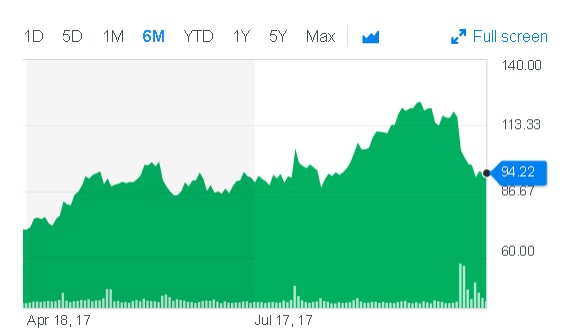
BMR Take: Again, this was an opinion of a consensus of Wall Street analysts. But we certainly concur. We think this guy Left is out in left field. Here’s a chart of the last six months. You can see that the stock is where it was in August, just two short months ago. In April it was $71. We think there is tremendous value here with this company and believe Andrew Left will be left high and dry.
The High Yield Corner
By Michael Foster
Remember the slight volatility we recently saw in REITs? That’s gone. Instead, 4 of the 6 REITs in the High Yield portfolio were up this week, while two were flat. While not rising the most, Omega Healthcare Investors, Inc (OHI: $32, up 1%) is the most important and interesting story of the week. Extremely cautious, risk-averse investors dislike this stock because of its high yield (8%) and relative youth. Having been around since the late 1990s, it lacks the history of many dividend growth stocks. It also had a pretty disastrous collapse in its dividend back in 2000. However, that’s all long history by now. More recently, Omega Healthcare has devoted itself to a penny-per-quarter dividend hike that makes it a uniquely high yielding dividend growth stock. Some will warn that these dividend increases are unsustainable, and that may be true. But if the hikes last 10 years instead of 2 quarters and you avoid it because it won’t last forever, you’re giving up some extreme gains over a decade. This is how risk averse behavior cuts into returns.
The more aggressive investors who own Omega realize this, which is why they look at both the firm’s FFO and its dividend growth rate like a hawk. Last week, Omega yet again gave investors a penny-per-share raise. At the new payout, FFO covers the dividend pretty well - at a 125% rate. Bear in mind that that’s below the 130% threshold that we frequently write about here, which makes us cautious about the longevity of the rate hikes. We need to see FFO per share slow significantly before that dividend coverage ratio gets hurt and a cut becomes a mathematical necessity.
But how long could that take? Our best guess is that we have at least three years until a cut becomes necessary, but there are two factors that could grossly change that estimate. For one, shares outstanding growth. The more shares Omega releases, the more dividends it has to pay, which makes its FFO less powerful in covering payouts. Total shares outstanding have risen to 197 million from 196 million in the last year - a pretty small jump. But shares were just 68 million a decade ago, meaning an 11% annualized growth rate in total shares outstanding. That brings us to our second factor: FFO - funds from operations. During that same decade, FFO has risen 22% annualized over the same period. So you can see how Omega has been able to grow far beyond its obligations to shareholders and keep that growth rate going!
Can Omega continue? The real answer is no one knows, but there is reason to be concerned. The growth rate has slowed significantly in recent years, especially since Omega was smart to expand during the post-2009 years when all real estate was on sale. Deals are harder to find now, making growth a lot harder.
There’s another lever Omega can pull, though: Getting strong rent hikes. Keep in mind that Omega’s wheelhouse is a customer base that struggles with inflation, which makes rent hikes particularly challenging. For that reason, we think the long term trend of strong growth at Omega is definitely a thing of the past, and the penny-per-quarter hike cannot continue forever. But selling now and missing out on years of high yield dividend growth would be folly. Instead, we need to keep our positions and look closely at the numbers before jumping out. Now is not the time.
Our strongest REIT of the week is in many ways the exact opposite of Omega. Digital Realty Trust (DLR: $122, up 3%) saw a really strong week without too much relevant news. Last week the firm announced it would expand its Silicon Valley Connected Campus, with a new six-megawatt facility planned for 1Q18 delivery. This is a really small part of Digital Realty’s portfolio, comprising just a $75 million investment, so it isn’t enough to move the needle. Also, as counterintuitive as it sounds, Digital Realty’s strength isn’t in the Valley but in its distributed presence around the country. The company has many retail-facing clients, as well as the U.S. government, where the need is to have many hubs where human beings who use the Valley’s services are located.
Digital Realty is on track to grow that business, but the real story of last week’s price movement is more technical than fundamental. The stock has retreated from its 52-week high hit last month ($127), and after this week’s gains is approaching it yet again. The dividend yield is also nearing the sub-3% level, which it hit in September briefly before rising. We fear we may have a repeat of that in the short term - but that’s hardly a cause for concern. It simply means that Digital Realty is for the most part range bound right now, and we need to content ourselves with that while we wait for the company to aggressively ramp up its dividend. The last rate hike was in March, and another one by the end of the year would be nice. In reality, this company’s management has settled itself into a predictable pattern of one-per-year dividend hikes despite a rapid acceleration in FFO growth. FFO per share is now over double payouts - an absurd ratio to say the least! We would like to see Digital Realty aggressively ramp up its dividend hike schedule.
We doubt we’ll see it anytime soon, but we do think it’s an inevitability with this company. Simply put, it cannot stop making money, and its business is growing too rapidly for it to be at risk anytime soon. Eventually, Digital Realty will need to start increasing its dividend more frequently or doing much more aggressive dividend hikes. Either way, its 3% yield at current prices is destined to turn into more of a 5% yield in the next 3-5 years. For that reason, investors long the stock should stay tight even if you’ve been in it for the past year and are sitting on some attractive capital gains.

Good Investing,
Todd Shaver, CEO, Founder and Editor
The Bull Market Report
Since 1998
Now wouldn't you want to get this newsletter every week? You bet you would! Just click here or go to BullMarket.com/subscription. You'll be glad you did!

by Todd Shaver | Aug 21, 2017 | Monthly Newsletter Daily 12pm if new
The Weekly Summary
It was rough week with lots of domestic and international issues popping up, producing anguish. In particular, nine CEOs turned their back on Trump. It all started when first Merck’s Kenneth Frazier, then Under Armour’s Kevin Plank and Intel’s Brian Krzanich stepped down from a White House business group set up to advise Donald Trump. While none mentioned the president, Frazier, one of the country’s most-prominent black chief executive officers, quit the council as Trump was being assailed for failing to quickly condemn white supremacists for deadly violence at a rally Saturday in Charlottesville. Frazier said he was acting on a “matter of personal conscience.” Trump shot back on Twitter Tuesday morning, saying, “For every CEO that drops out of the Manufacturing Council, I have many to take their place.
Then on Wednesday President Trump rushed to announce that he was shutting down the two advisory councils of business leaders, after the members had decided on their own to disband in the wake of the president’s comments on the events in Charlottesville. Of course, these kinds of advisory councils seldom accomplish much of anything.
Look, all this drama will pass. The market will move on. But there is definitely an unsettled feeling out there. It is good that the market showed signs of turning around at week’s end, but we did see a few glimpses of nasty selloffs in a few trading sessions this week. It was a rough week. If you are super worried, then we suggest you take some profits off the table. There are many choices for you to move your money to in the High Yield and the REIT portfolios. These are much more secure, stable stocks with very nice dividends that you can enjoy and sleep better with.
No matter what is happening out there, there is always a bull market here at The Bull Market Report! This week we highlight some of our favorite stocks/funds where we think you can still make good money, including: high yield equities like Annaly and larger caps like Apple, Google, Microsoft, Home Depot, and Visa,
BMR Companies & Commentary
Annaly Capital Management (NLY: $12.34, up 1%)
Annaly recently reported respectable earnings at the beginning of the month. Here are our thoughts on the outlook for the rest of the year and what to watch. Many people are cautious given Annaly’s fixed-rate agency exposure and the current valuation. We know that the company has a set yield on government guaranteed paper. So while there is no credit risk other than the full faith and credit of the United States, there is interest rate risk – we know this and accept this. The newer investments are coming on at lower rates with higher yielding holdings rolling off. And we know that if short term rates rise the current portfolio valuation will be sensitive to the movements. We are likely to see some pressure on Annaly’s business model.
But what can the company do? They can rotate into higher yielding MBS* investments. They can increase leverage. They can do a number of things to cover the dividend. Look, if you think a business model is flawless without risk then you don’t know it well enough. Annaly has rsk to higher rates, but higher rates are ultimately good for the company. And investors are missing all the offsetting possible moves management can take. Remember, this is a company that is 18x the size of the median mortgage REIT by market cap, has outperformed the S&P 500 by 3x since its IPO for total return, and has successfully raised $1.5 billion in new capital this year. They know the world they live in and have survived and thrived for 20 years.
* Mortgage-backed Securities
BMR Take: A Director at the company just bought 13,500 shares. Another one just bought 17,700 shares. We love love love to see that! We are looking at a $0.30 dividend paid quarterly for the time being which is good. The stock looks compelling based on this income stream, producing a dividend over 10%.
Apple (AAPL: $158, flat) is Getting into Programming
Apple has set a 12-month budget of $1 billion to develop original programming. Apple could buy and produce as many as 10 TV shows. Apple's first two efforts -- Planet of the Apps and Carpool Karaoke -- have not been warmly received by critics. Apple executives are talking with Hollywood agents about shows that Apple can buy.
BMR Take: Note that Apple has $260 billion in cash now, and with a market cap of $813 billion cash is 32% of the stock price. So $50 of the stock price is in cash. This is UNPRECEDENTED in the history of Wall Street. Apple remains an exciting investment opportunity. The services business is projected to double in revenue to $50 billion over the next several years. The Services business is much more profitable than hardware so the impact to earnings is even better. Don’t sell a share. We believe Apple has a lot more room to go on the upside.
And how about Apple's performance last week in a very tough week for equities.
Google (GOOG: $911, flat)
The Cloud is a huge opportunity in technology and all the industry giants are fighting to grab their fair share. Let's stipulate up front that Amazon Web Services (AWS) remains the top choice for most companies that are thinking about moving their data and software into cloud data centers. Having said that, however, Amazon's cloud is no longer the only option that companies consider. For example, those companies wanting extensive analytics are taking a good hard look at the Google Cloud Platform. And many firms are hedging their bets by using multiple cloud providers to avoid being stuck with one down the road.
While AWS is still the largest cloud provider by far, Microsoft and Google are coming on strong. AWS's revenue growth appears to be slowing, in part because it's hard for such a huge business - AWS is expected to produce $16 billion in revenue this year - to grow as fast as its younger, smaller incarnations. Startups are considering alternatives now for several reasons: standard cloud computing and storage services from the three top players are all seen as competitive, and no one thinks any of the three major cloud contenders is going away. Basically, AWS, Microsoft, and Google are seen as safe bets.
BMR Take: Google took a hit on the recent earnings report. Buy the dip. This company will generate over $40 of EPS in 2018. The stock is far from a stretched valuation.
Microsoft (MSFT: $72, up 1%)
As Internet-of-Things (IoT), artificial intelligence (AI), smart factories and intelligent applications continue to advance, businesses are increasingly turning to these technologies to create new business solutions with greater agility in order to drive competitive advantages. Microsoft launched its IoT Innovation Center in Taiwan last October to spur development between IoT partners and international enterprises and organizations. In September, Microsoft will hold its second IoT Expo in conjunction with the World Congress on Information Technology. Jason Zander, Corporate Vice President, Microsoft Azure, will deliver a keynote on "Leading Digital Transformation and Landing IOT Value with a Strong IoT Partner." Zander oversees the development and global deployment of cloud infrastructure and technology, including Microsoft Azure IoT. In addition to sharing the success of Microsoft's IoT Innovation Center and its partners, Mr. Zander will also provide Microsoft's vision of the development of IoT and in-depth analysis on the integrated application solutions of the world's leading IoT partners.
BMR Take: The Internet of Things is a megatrend. We are going from 10 billion devices connected to the internet to 30 billion. Your hair dryer will be connected to the internet someday. All of this is going to be a huge opportunity for Microsoft. The company is on track to generate $4 of EPS in 2018. The valuation remains compelling.
And note how strong Microsoft was last week in the very rough week on Wall Street. This company is solid.
Upcoming Economic News
Richmond Fed Index
August 22th, 10:00 AM
Period: August
Consensus: 12.0
Prior: 14.0
New Home Sales
August 23th, 10:00 AM
Period: July
Consensus: 614,000
Prior: 610,000
Building Permits
August 24th, 8:00 AM
Period: July
Consensus: 1,223,000
Prior: 1,223,000
Blackstone Entity Merging with Starwood Homes
Invitation Homes (INVH, $23), a portfolio company of The Blackstone Group (BX: $32, down 1%) , is merging with Starwood Waypoint Homes. The combined company, to be called Invitation Homes, will have 82,000 homes. Once the deal closes Invitation Homes stockholders will own about 59% of the combined company. The total enterprise value of the deal is $20 billion.
Invitation Homes, a U.S. home rental company, went public in February. Blackstone will own about 40% of Invitation.
--- The portfolio of homes will be focused on high-growth markets, with nearly 70% of revenue coming from the Western US and Florida.
--- The merger is expected to drive $50 million in annual synergies.
--- Continued strong performance with the combined company experiencing 7% same-store NOI growth in Q217 with over 95% occupancy.
--- The two companies have invested nearly $2 billion, an average of approximately $22,000 per home, in renovations and maintenance, improving resident experience and driving economic growth and job creation in local communities.
BMR Take: Just one more example of the innovation that Blackstone is involved with day in and day out. With a dividend of 7% and a leader (Schwarzman) dedicated 24-7 to moving the stock higher, what is there not to like. $38 billion market cap. Reaching the all-time high of $44 set in 2012 is surely on the horizon.
Tesla Near to Completion of Gigafactory
Tesla ($348, down 3%) has released some interesting pictures and a video of their gigafactory in Nevada, 95 times bigger (sic) than a football field. New drone footage shows how massive Tesla's Gigafactory is.
http://www.businessinsider.com/tesla-gigafactory-pictures-facts-2017-8
In other news, Tesla raised $1.8 billion in a bond sale on Friday, boosting the amount by $300 million to meet demand. The 8-year bonds were priced at a record-low yield of 5.3%. The 5.3% coupon is a record low for a bond of its rating and maturity, according to data compiled by Bloomberg. The sale was managed by Goldman Sachs Group and Morgan Stanley.
BMR Take: The bond market loves this company. We do too. But we know the risk involved here is on the high end of the scale. Tesla is either headed to $400 a share or $300. And one could make an argument for either. If it hits $400 and they continue to ramp up production as promised, then $500 is a great possibility. But if it goes to $300, $200 would be in range. You want a risky stock? Then Tesla is your baby.
Amazon Sells Bonds for Whole Foods Acquisition
Speaking of bond sales, Amazon (AMZN: $958, down 1%) went to the markets for money last week and sold $16 billion of unsecured bonds to fund its $14 billion acquisition of Whole Foods Market. And in a sign of market interest, the longest portion of the offering, a 40-year security, was sold at a yield of 1.45 percentage points above Treasuries.
BMR Take: Now that is just unreal low. The company has $21 billion in cash so they didn’t need to go to the bond market but did because rates are so low. Smart thinking, Jeff. The deal is the 4th largest this year, behind ATT and Microsoft.
Apple Goes to the Debt Market in Canada
Apple raised $2.5 billion at a rate of 2.51% in a 7-year note sale in Canada on Tuesday. At $2.5 billion the financing is the largest corporate non-financial borrowing in Canadian history.
Stocks Cheap Compared to Bonds
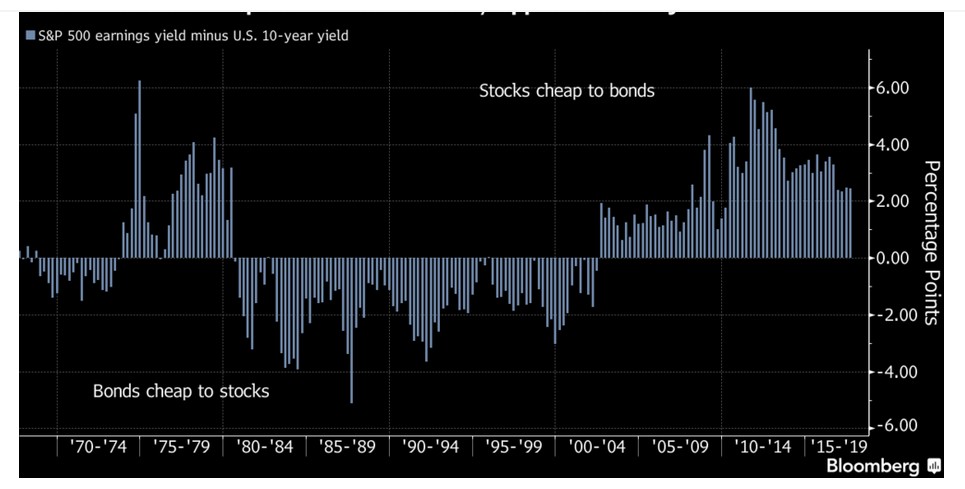 We’re Just Sayin’
The High Yield Report
By Michael Foster
We’re continuing to see market chaos and a lot of selling of high quality assets although the macro risks from political uncertainty are dwindling. But the current selloff is very different from the previous week’s in one very telling, interesting way: Not all assets are falling at the same rate, and some are actually doing very well.
To wit, take a look at The Bull Market Report’s Healthcare REIT pick Omega Healthcare Investors (OHI: $31) which had a strong showing this week after some initial weakness, helping Omega Healthcare end the week up 2%.
We’re seeing a lot of reshuffling in the markets, with investors rotating in and out of funds, stocks, and assets as they rise or fall due to market demand. This is the real “random walk” of Wall Street, and it’s a dynamic that makes short term trends for any individual asset to be unpredictable. In reality, we’re seeing a lot of individual investors making choices to buy on the dip - and they’re pulling money from other assets to do so.
What can an investor do in such an environment? Simple: sit tight. If you have extra cash on the sidelines, now is the time to deploy into the high yield picks that The Bull Market Report has been recommending for a long time. Last week we suggested buying more of Omega Healthcare shares; it’s up 2% since then. Now is the time to do the same with other REITs seeing irrational weakness like Sabra.
You can also consider adding Kimco Realty Corporation (KIM: $19.34) and Apollo Commercial Real Estate (ARI: $17.92) to your shopping list after Kimco fell over 3% in the last week and Apollo remained flat. There is no change in these companies FFO to justify the decline, and Kimco’s year-long weakness on the often-touted (and always inaccurate) “death of retail” has made it just that much more compelling. We have discussed at length here why Retail isn’t dead, and how Amazon’s recent purchase of Whole Foods indicates that the shift from pre-dotcom retail to mobile “bricks and clicks” commerce is far more complicated than the simple narrative of dying malls. In any case, Kimco doesn’t buy enclosed malls! It’s a high-quality strip mall-focused REIT, and Whole Foods (and thus soon Amazon) is one of its biggest tenants.
There are more buying opportunities beyond REITs, and investors are keen to lighten up their cash allocation to consider the other funds and stocks in the High Yield portfolio. However, there is one word of caution to consider when it comes to one of our best performing picks, the PIMCO Dynamic Income Fund (PDI: $29). This fund was flat last week.
What’s going on here is a pretty basic misunderstanding of the fund’s future income potential. You see, Pimco releases a monthly scorecard of net investment income (NII) on its website, while also calculating its dividend coverage ratio. And, simply put, the news isn’t good for the Dynamic Income Fund.
In the past, Pimco easily out-earned its dividend and had a tremendous amount of undistributed net investment income (UNII). That’s why the fund paid a special dividend of $1.45 at the end of 2016. By this time last year, the fund had around $1 in UNII, so it was pretty obvious that a big special dividend was coming (we discussed this at the time and estimated a strong special dividend at the end of last year – and nailed it). This year, however, the Dynamic Income fund has only 4 cents in UNII - a pretty tremendous drop from a year ago!
There are a few reasons why the fund isn’t earning as much income as it used to, most of which revolves around the crowding out of great investment opportunities in mortgage backed securities. The MBS is a pretty daunting asset made sinister by The Big Short and growing awareness of their role in the subprime housing crisis. However, that crisis is a decade behind us, and the quality of MBS investments has skyrocketed. While Pimco was one of the few asset managers aggressively buying up these assets in the past, there are now a lot of people wanting to buy them. That means lower yields for the assets, thus weaker income for the Dynamic Income Fund.
However, at the same time, it also means growing market prices for these assets. This fund’s NAV has risen by 10% so far in 2017, largely a result of that constant demand for MBS’s in the market. Last year, the Dynamic Income Fund’s NAV had risen by far less than 1% over the same time period, because the demand for these assets simply wasn’t there. That means that the fund is sitting on a lot of capital gains with dwindling income.
What does this mean for shareholders? In all honesty, it’s hard to tell. The fund hasn’t really faced a crowding out of supply due to strong demand since 2012. It has enjoyed both NAV and income gains in earlier years, and the end-of-year special dividends reflected that. We simply don’t know if the fund’s managers will decide to return some of those capital gains to shareholders or hold on to it and give a massively reduced special dividend at the end of the year.
It seems that the market has begun to price in the likelihood of a lower special dividend. The fund’s premium to NAV has plummeted from over 10% earlier this year to just 3%. It may fall even further as we get closer to December. If Pimco surprises and gives a big special payout at the end of the year, that could reverse quickly. If it doesn’t, we’ll probably see middling price growth throughout 2017.
The risk with the fund is that its Net Investment Income continues to fall and it fails to cover its dividend on a long-term basis. While we’ve seen hints of that now, it’s far too early to conclude that this risk is really here and it’s time to sell. But investors need to prepare for that eventuality. We will keep a close eye on this trend and advise you if it’s time to move out of this great fund. Hopefully we won’t have to recommend selling anytime soon.
How should you react? Holding the fund for its income stream makes sense now, and buying more when the fund’s premium disappears and it starts trading at a discount also makes sense. That means there’s no reason for investors to get scared and sell off the fund, but it also means investors shouldn’t expect a massive jump in the fund’s price throughout 2017. That’s not a bad thing - it really reflects what the fund should be seen as: A source of steady and reliable income.
Good Investing,
Todd Shaver, Founder, CEO and Editor
The Bull Market Report
Since 1998
by Todd Shaver | Jul 17, 2017 | Monthly Newsletter Daily 12pm if new
The Weekly Summary
Billionaire CEO of JP Morgan Chase Jamie Dimon says being an American abroad is “almost an embarrassment.” The rant came on JP Morgan’s widely followed earnings call held Friday. Dimon says the media should focus more on major issues. He doesn’t like listening to the “stupid stuff” Americans have to deal with, expressing frustration over the nation’s inability to invest in infrastructure and overhaul the tax code. There would be much stronger growth if there were more intelligent decisions and less gridlock. Reporters should focus on the major issues the nation faces rather than the vagaries of the firm’s trading businesses, he said. The United States of America has to start to focus on policy which is good for all Americans, and that is infrastructure, regulation, taxation, education. He screamed, “Why you guys don’t write about it every day is completely beyond me. And, like, who cares about fixed-income trading in the last two weeks of June? I mean, seriously.” Dimon is one of the best businessmen in America and his words are known for being the hard truth. It makes sense to us that for the bull market to continue our citizens must wake up to the realities we face and take actions.
There is always a bull market here at The Bull Market Report! This week we highlight the following stocks: PayPal, Splunk, Microsoft, and Tesoro.
Highlights From The Past Week
US Bank earnings season started on Friday. Q2 earnings season for the banks kicked off on Friday morning with results from JP Morgan, Citigroup, Wells Fargo and PNC Financial. Some analysts have highlighted a more difficult setup for the group following a June rally on the back of higher bond yields and capital return announcements that beat elevated expectations. There have also been thoughts that earnings season could shift some of the focus back to the more challenging operating environment for the group. However, there really did not seem to be any meaningful discussion about downside risk to estimates. Analysts seem to be looking for the bulk of the support for Q2 to come from additional net interest margin expansion. This should offset sluggish loan growth and weaker capital markets (near double-digit declines). The latter dynamic has been widely discussed by bank executives and in the press and was a key driver of estimate reductions. Despite some pickup in concerns surrounding the Auto sector, credit is expected to remain benign. Analysts also highlighted expectations for another solid quarter of cost control. This is our first glimpse into the new earnings season.
More conjecture on ECB policy. There is further speculation on ECB policy where the ECB is likely to signal that it is gradually winding down its QE plan at its September 7th policy meeting, and President Draghi could use his appearance at the Fed Reserve's Jackson Hole conference in August to signal a policy shift. The ECB is wary of putting an end date to its QE plan. There is a need to retain flexibility in case the economic outlook sours and also the ECB wants to follow the Fed example of exiting the policy of retaining open-ended nature of program. A Reuters poll of over 75 economists showed consensus thinks the ECB is likely to shift away from ultra-easy policy in September. The Fed and ECB are two of the most powerful institutions in the world for capital markets. This is important stuff.
CBO says Trump budget would not balance. The Congressional Budget Office (CBO) said Trump’s fiscal 2018 budget would reduce the deficit by about a third over next decade. This is a smaller estimated deficit reduction than the White House forecast due to lower revenue projections. Trump’s budget would result in average GDP growth over next decade of 0.1% more than the CBO baseline. CBO also estimated that revenues under Trump’s budget would be almost $1 trillion lower than his estimates over the next decade. Trump budget's deficit reduction would stem from lower spending, including decreasing the $2 trillion base in mandatory spending, mostly from healthcare. Press reports said CBO’s findings creates new complications for Republicans who need to build a coalition of conservatives and moderates to vote for a single budget proposal. We need to start seeing some real progress out of the White House.
Britain acknowledges Brexit bill for the first time. Ahead of this week's Brexit talks between Brexit Secretary Davis and EU negotiator Barnier, a written statement was released to parliament, which acknowledged Britain has financial obligations to the EU, which will continue beyond Brexit. The Financial Times cited EU diplomats saying it goes further than UK Prime Minister May’s previous reference to Britain being willing to reach a “fair settlement” of unspecified obligations. It noted that Davis did not refer to financial issues when he released three position papers ahead of Brexit talks. The article pointed out that the British team sees the statement on financial obligations as an effort to improve the tone of talks rather than a change in substance. Meanwhile, at least 15 Conservative MPs are in talks with Labour on keeping Britain in the European Economic Area after Brexit, which would require accepting free movement of people and paying some money to the EU. The rationale for this approach is that it would give Britain time to reach a final deal with the EU and give certainty for businesses and workers. What a mess.
Dow, S&P 500 Hit Records to Close Winning Week
The S&P 500 hit a fresh record Friday and posted its best weekly performance since late May, and the Dow Industrials notched their third consecutive record close. Let’s keep this going!
BMR Companies & Commentary
PayPal (PYPL: $57, up 6% - new all-time high [NATH) set Friday)
The price target was raised to $70 from $54 at a research firm on the Street. PayPal is the firm's "top idea" for 2017, followed by Google (GOOG: $956, up $37, 4%). Coming opportunities with PayPal's Venmo and with partnerships caused the research firm to become even more bullish.
PayPal and Apple entered into an exciting major partnership this week that sent shares to all-time highs. PayPal and Apple have partnered to give users the ability to use PayPal as a payment method when paying for Apple’s services, which includes the App Store, Apple Music, and iTunes, to name a few. The feature will be introduced in 12 markets, including the US and the UK, and it will be integrated with several devices across Apple’s ecosystem, including the iPhone, iPod, Apple TV, and Apple Watch.
The immediate impact for PayPal is getting access to a massive revenue stream. Revenue from Apple services, which is mostly from the App Store, reached $7 billion in Q416, up 18% from last year. Although the financial terms of this deal have not been disclosed, we can estimate the potential impact. If PayPal were to charge Apple 1.25% per transaction, which is much lower than the 2.9% fee it often charges merchants, and if PayPal accounts for a third of spend on the App Store in 2017 — which will be based on consumers spending a total of $40 billion on the iOS App Store, according to Street sources — PayPal would see $165 million in revenue for 2017.
In the long run, PayPal’s partnership with Apple could give the firm an opportunity to integrate itself into additional Apple services. Over the last few years, Apple has indicated that it plans to turn its chat app, iMessage, into a robust ecosystem. The app now includes peer-to-peer payments, games, and other apps, with even more features coming in the fall with the launch of iOS 11. Although it hasn't been confirmed, it's reasonable to assume that one feature coming down the pipeline is the ability to buy products via iMessage. With PayPal already being a payment option within Apple's ecosystem, users may be more willing to use it going forward.
BMR Take: PayPal ranks among the best growth stories in all of technology and this Apple deal is just another reason as to why. Earnings are growing greater than 20% per year for as far as the eye can see and should break $3 by 2020.
Microsoft (MSFT: $73, up 5%, set a NATH* on Friday)
Early in the week Microsoft proposed a $10 billion effort to bring broadband internet to the rural U.S., an economic-development program aimed at a core constituency of the Trump administration. The plan, which calls for corporate and government cash, would send internet data over unused broadcast frequencies set aside for television channels. If developed, the initiative would help connect 23 million Americans in rural areas who lack high-speed internet access.
*NATH - New All-Time High
Broadband is important for all kinds of things. It’s not just streaming high-definition movies. Slow or nonexistent connections can hinder agriculture, business, education and healthcare. Broadband is arguable now a necessity of life. Microsoft’s proposal calls for a 5-year program of corporate investment and matching federal and state grants to end the gap between rural and urban access, starting with the company’s own efforts. The aim of Microsoft’s new Rural Airband Initiative is to be up and running in 12 states by next year and connect 2 million people over the next five years.
BMR Take: Doing big things like what is described above is why Microsoft is not just a tech titan, but a leader amongst the entire S&P 500. News like this continues to push the stock toward 20x consensus estimates of $4 per share of free cash flow. Do the math – that’s $80 a share.
Tesoro (TSO: $97, up 1%)
Tesoro has been a big winner and it could keep getting better. This week the company announced plans to study the possibility of turning vegetable oil into diesel fuel at its Dickinson refinery, which it purchased in 2016.
The crude oil refiner is making plans to retrofit an 8,000-barrel-per-day diesel hydrotreater to process soy and corn oil into renewable diesel alongside its Bakken crude oil processing. This $3.5 million project would use 17,000 gallons per day of vegetable oils to create a 5% renewable diesel mix to be marketed in North Dakota by the end of 2017. The North Dakota Industrial Commission granted the company a $500,000 grant to help cover the project's cost.
Compared to biodiesel that is blended into petroleum diesel at truck racks, renewable diesel is a superior quality product because, unlike biodiesel, renewable diesel is a pure hydrocarbon stream containing no oxygen. This results in a superior quality fuel that maintains vehicle performance. The company says the project is “unique and exciting.” Of course they do!
BMR Take: The stock continues to trade at a big discount to the consensus NAV* estimate of $120. In comparison, Buffet’s ownership of peer Phillips66 is valued at a premium to NAV in the market. Disconnect that the market will correct down the road? We think so. Tesoro still looks compelling to us even after the recent appreciation.
*NAV – net asset value
Upcoming Economic News
Export Price Index
Tuesday, July 18th, 8:30 AM
Period: June
Consensus: 0.05%
Prior: -0.70%
Note: The U.S. Bureau of Labor Statistics' International Price Program produces Import Price Indexes (MPI) and Export Price Indexes (XPI) containing data on changes in the prices of nonmilitary goods and services traded between the U.S. and the rest of the world.
Housing Starts
Wednesday, July 19th, 8:30 AM
Period: June
Consensus: 1,146,000
Prior: 1,092,000
Note: The number of housing units started in the United States.
Leading Economic Index
Thursday, July 20th, 10:00 AM
Period: June
Consensus: +0.30%
Prior: +0.30%
Note: The Conference Board Leading Economic Index (LEI) for the U.S. increased 0.3% in May to 127.0 (2010 = 100, following a 0.2% increase in April, and a 0.4% increase in March. Leading Indicators are economic series that tend to change direction ahead of shifts in the business cycle. There are 10 components of the U.S. Leading Composite Indicator* published by The Conference Board. The index is constructed by averaging the individual components in order to smooth out a good part of the volatility of the individual series. Historically, the cyclical turning points in the leading index have occurred before those in aggregate economic activity. Prior to 1996, the composite leading, coincident, and lagging indicators were calculated and published by the U.S. Department of Commerce.
* Average weekly hours, manufacturing
Average weekly initial claims for unemployment insurance
Manufacturers’ new orders, consumer goods and materials
ISM Index of New Orders
Manufacturers' new orders, non-defense capital goods excluding aircraft orders
Building permits, new private housing units
Stock prices, 500 common stocks
Leading Credit Index
Interest rate spread, 10-year Treasury bonds less federal funds
Average consumer expectations for business conditions
An Interview with Tim Cook
We read a lengthy interview of Apple CEO Tim Cook by Bloomberg Businessweek Editor Megan Murphy. We thought the following few paragraphs from it were particularly insightful:
Murphy: I was a little surprised the HomePod was pitched primarily as a music device when the competitive talk is of Amazon Echo’s Alexa and the immersive experience in the home. How will the HomePod better integrate Apple inside people’s lives?
Cook: We’re actually already in the home through the iPhone you take with you everywhere. It’s in your pocket or laying on a stand. Today, pre-HomePod, I can control my home using Siri through the iPhone. When I get up in the morning, my iPhone is my alarm clock. I say, “Good morning,” and all of a sudden, my lights come on. The temperature adjusts and a series of things occur. We’re also in the home through Apple TV. Many people use iPad as their computing device. The desktop Mac enjoys a place in the home. The thing that has arguably not gotten a great level of focus is music in the home. So we decided we would combine great sound and an intelligent speaker.
Murphy: So, it’s going to be a holistic process joining up all those touch points so people can exercise control over their lives, whether through Siri or iPad?
Cook: To put it in perspective, Siri is getting requests from 375 million devices right now. My guess is it’s the largest by far of any kind of assistant. Some of those requests are done in the home. Some of those are done on the go. That’s the platform that we build off. It’s very different from our starting point. We’re also in so many languages around the world: Siri isn’t just in English. We’re well-positioned around the world. So, again, what is the thing that’s missing in this equation? The combination of quality audio and instinct.
“I am so excited about it, I just want to yell out and scream”
Murphy: Do you think people will pay $349?
Cook: If you remember when the iPod was introduced, a lot of people said, “Why would anybody pay $399 for an MP3 player?” And when iPhone was announced, it was, “Is anybody gonna pay - whatever it was at that time - for an iPhone?” The iPad went through the same thing. We have a pretty good track record of giving people something that they may not have known that they wanted.
When I was growing up, audio was No. 1 on the list of things that you had to have. You were jammin’ out on your stereo. Audio is still really important in all age groups, not just for kids. We’re hitting on something people will be delighted with. It’s gonna blow them away. It’s gonna rock the house.
BMR Take: We were pleased to see Tim Cook’s responses for two reasons. 1) the iPhone is already the home controller of choice. We knew this, but Cook really put it in perspective. And 2) The takeover of a market is Apple’s modus operandi. Start late with a high price. Then lower prices and dominate. We have no doubt the home assistant will be any different. Amazon – watch out.
Nutanix Has a Rip-Roaring Week
The stock of Nutanix (NTNX: $22) was up 16% last week. We’ve been harping on this stock for weeks, and then along comes Goldman Sachs and says Nutanix is a “once-in-a-decade” opportunity and are looking for a $31 Target. Our Price Target is $30. Is Goldman reading The Bull Market Report? We certainly think so.
We’re already up 27% in the six weeks since we added the stock in late May. And we expect more good things from the company in the future. Nutanix is the leader in hyperconverged infrastructure, meaning it uses software to combine different storage and computing functions on one device. That space has been heating up among enterprises. More businesses are looking to adapt the technology, with 18% of chief information officers saying they expect to move to hyperconverged systems in the next two years, according to Goldman Sachs.
The company’s leadership in the space, including the combination of hardware and software it offers, makes it a “once-in-a-decade tech infrastructure story,” wrote the lead Goldman analyst on the note. They see Nutanix on a path for long-term double-digit growth, high gross margins and large operating leverage.
Additionally, in the shorter-term, Nutanix should benefit from changed accounting rules that will move its software revenues, which are currently deferred, to its profit and loss statement.
BMR Take: What more can we say? All good.
First Solar Continues its Tear
First Solar (FSLR: $43) was up another 9% this past week. We’re still down 30% or so on the stock but we are big believers in the company and management. Our timing on the addition to the Special Opportunities portfolio was bad. But we believe we will be winners in the long run. The stock is up over 55% in the last three months. Keep hanging in there.
Apple Back Up To $150.
Almost. Closed at $149, up $5 for the week. The market just can’t keep this one down. We sincerely hope you have some of this wonderful firm. You think it’s too high. Not on your life.
Annaly Just Keeps Chugging Along
And it is paying 10% a year in dividends. Annaly Capital Management (NLY: $12.33) added 2% last week. The stock has been paying double-digit dividends since inception in 1997. That’s right – 20 years. Where will the stock be in a year? Good question. We would say right about at this level, after paying another four quarterly dividends of 30 cents each. Do the math – that’s a shade under a 10% return. We love this one.
The High Yield Corner
By Michael Foster
Special to The Bull Market Report
We’re getting close to earnings season for Healthcare REITs, and the market’s expectations seem to be getting increasingly bullish. Over the last week, all of The Bull Market Report’s Healthcare REIT picks were in the green, with Omega Healthcare Investors (OHI: $33) leading the pack with a 2% gain for the week. That’s pushed the stock’s year-to-date performance much higher, with a 7% gain on top of half of the fund’s 8% dividend yield. There’s been a relatively low amount of volatility in Omega Healthcare relative to what we saw both in 2015 (where rate hike fears hit all REITs) and 2016 (when the REIT bull market suddenly corrected at the end of the year).
But what about the upcoming earnings report on July 27th? So far, analysts are expecting 86 cent FFO for the quarter, up from 83 cents from a year ago. The company has reaffirmed their 86 cent guidance as recently as early May, bringing the stock’s dividend coverage ratio to 134% if they hit the number. Gotta love it.
Before we discuss whether they will hit it or not, let’s take a quick look at Welltower (HCN: $74, up 1%), which had a similarly strong week and is also planning to release earnings soon - on July 28th before the market open. Welltower has far outperformed Omega for 2017, with a 10% price jump - although the lower dividend (5%) mostly offsets this. Like Omega Healthcare, Welltower is showing strikingly little volatility as of late, a development that makes a lot of sense given Welltower’s tremendous track record and strong dividend coverage. However, it’s surprising to see that Welltower’s dividend coverage is a shade lower than Omega’s at 128%. While that’s still good (general rule of thumb: any number over 115% is good for a REIT), it’s interesting to see how the dividend coverage ratio has slipped in the last couple of years as a result of falling funds from operations. Welltower’s earnings were down 6% from a year ago last quarter, and guidance suggests that decline is set to continue. But Welltower is also increasing dividends, which is a setup for a worrisome dynamic in which, eventually, the company will under-earn its dividend. How soon could that happen? At the current clip we’re safe for another 3-4 years, but the company clearly needs to adapt, lest it find itself suddenly in a position to halt or even cut dividends. For this reason, the company’s earnings results on the 28th and especially its forward guidance will be a key issue to watch for. We will keep a close eye on this.
Finally, Sabra Health Care REIT (SBRA: $23) had a flat week (up less than 1%) despite being one of the smallest Healthcare REITs in terms of market cap and property footprint. It’s quite unusual to see the smaller stock be less volatile than its bigger cousins, but Sabra is one of the less popular REITs out there (investors, especially retail investors, spend a lot more time focusing on Omega), and there was little news on the stock to justify much price action. On top of that, the company’s massive underperformance relative to its peers has soured a lot of investors on the company, while fundamental investors know this is a very good company with strong dividend coverage and growth potential.
So, if you have few sellers and few buyers, you end up with little price change. But how is Sabra doing as we near its earnings release at the end of July? Over the last 12 months, earnings have been weak relative to expectations, with two misses out of the last four quarters. But dividend coverage is impressive, at 132%. Some investors may be a bit concerned about the company’s relatively weak revenue growth, but it’s important to remember that Sabra is pausing on acquisitions right now and reorganizing its new property portfolio additions to maximize income. This process naturally makes revenue look bad, which again is why impatient investors have shied away. Nonetheless, the ongoing restructuring continues to be successful, as the strong dividend coverage ratio proves. Expect to see good things from Sabra in the future that will help the stock recover, but we may not see those developments for a year or more. For investors, that means sitting tight with your Sabra shares, collecting a 7% dividend while you wait for the market to catch up.
Now, with upcoming earnings for these stocks, we need to ask ourselves the likelihood of them hitting their numbers. While there are differences in each company that makes some stronger than others, the broader issue that impacts all of them is the regulatory overhang. A lot of chatter about the future of Obamacare and plans from the Republicans and President Trump to change or obliterate current regulations has left a lot of investors skittish on Healthcare for a long time. But interestingly, we’ve seen the market swiftly realize how silly these concerns are - at least as it impacts the Biopharma sector, which is up solidly for 2017 and is beating the S&P 500. But why isn’t that same relief coming to Healthcare REITs with the same speed?
Simply put, REIT investors are far more risk averse as a group, and they are much slower to recognize a change in the political landscape than growth stock investors. This puts those holding Healthcare REITs in the awkward position of needing to be patient. However, it is clear that there is little change to the regulatory environment coming, and some analysts are already noting that recent GOP proposals to change Obamacare actually look a lot like Obamacare. Whatever your political leanings and opinions on the subject, it seems pretty clear that the status quo isn’t going to change anytime soon.
Again, no matter your opinions on the growing D.C.-based controversies, there is a clear conclusion: Healthcare as it operates in America is not about to change anytime soon. Healthcare REITs have been discounted for a change that would negatively impact them. Putting these together, it’s a clear time to buy or to continue to hold Healthcare REITs both before and after the upcoming earnings season.
Good Investing,
Todd Shaver, Founder, Editor and CEO
The Bull Market Report
Since 1998

by Todd Shaver | Jun 19, 2017 | Monthly Newsletter Daily 12pm if new
The Week Just Passed and the Week Ahead
Amazon set fire to the market on Friday as they announced a major deal to buy Whole Foods. Grocery stocks plunged as everybody wonders how much havoc Amazon will have in the new industry vertical. The M&A announcement re-energized the market that had been sagging due to FAAMG* stocks slowing down. But clearly there is a reason the FAAMG stocks are market leaders: they are the most innovative, the most savvy, and the most aggressive companies on the planet when it comes to raising the bar. The bull market in Technology that everybody was questioning just last week is alive and well!
* FAAMG – Facebook, Apple, Amazon, Microsoft and Google.
We are pleased to see the market come back strongly today, Monday, as we write this. The market is up 110 points on the Dow, with Apple, Facebook and Shopify making strong moves. And good old Amazon, which we profile below, just hit $1000 a share again. Go Bull Market.
There is always a bull market here at The Bull Market Report! This week we highlight the following stocks: Amazon, Apple, Facebook, Tesla, Annaly, and Google.
Highlights From The Past Week
Trump Says ‘Very Good’ GDP Numbers Are Coming. He May Be Right. President Donald Trump said Thursday that “some very good numbers” are coming out soon on U.S. economic growth. If he’s talking about the second quarter, he’s probably right, though the figures are about six weeks away from publication. While the White House didn’t immediately respond to a request to clarify Trump’s comments, there are wide expectations among researchers that the rate of expansion in the April-to- June period will rebound from a first-quarter slowdown. The pace of gross domestic product gains was dragged down earlier this year by temporary factors such as warm weather that resulted in lower utility bills. Seeing a pick-up in GDP growth is a major positive for the stock market.
The Sweetest Stretch of Bull Run Since 1995 is At Risk as Buy-The-Dip Strategy Fails. The sell-off in the Tech sector that started a week ago has erased $250 billion from the value of technology shares and is threatening to end the industry’s longest stretch of uptrend in more than two decades. Down around 4% since the decline started, this move has put the Tech sector on the edge of breaking its 50-day moving average. It’s stayed above the threshold for 131 consecutive days, the longest stretch since 1995. Are the good days ending? The last two times when the 50-day average was broken, Tech shares did poorly in the next few months. What do we make of this? Stocks can’t go up forever. We are seeing the Tech sector take a breather and would buy this weakness.
Don’t Be Tempted To Buy High-Flying Equities. Stick With Solid Stock Picks Recommended By The Bull Market Report. Bond investor Bill Gross warned on Tuesday that investors should reduce their risk appetite, given the U.S. growth rate is stunted by secular forces "which monetary and even future fiscal policies seem unable to reverse." In his June investment outlook letter, Gross of Janus Henderson said: "Strategies involving risk reduction should ultimately outperform 'faux' surefire winners generated by central bank printing of money.” He continued, "It’s the real economy that counts and global real economic growth is and should continue to be below par." Gross runs the $2.1 billion Janus Henderson Global Unconstrained Bond Fund.
BMR Companies & Commentary
Amazon (AMZN; $988, +1% for the week; up $23 on Friday)
Amazon is guided by four principles: customer obsession rather than competitor focus; passion for invention; commitment to operational excellence; and long-term thinking. Customer reviews, 1-Click shopping, personalized recommendations, Prime, Fulfillment by Amazon, Amazon Web Services - AWS, Kindle Direct Publishing, Kindle, Fire tablets, Fire TV, Amazon Echo, and Alexa are some of the products and services pioneered by Amazon.
Amazon and Whole Foods Market announced that they have entered into a definitive merger agreement under which Amazon will acquire Whole Foods Market for $42 per share in an all-cash transaction valued at $13.7 billion, including debt. This is Amazon’s biggest acquisition ever. Whole Foods will continue to operate stores under the Whole Foods Market brand and continue to buy from trusted vendors and partners around the world. John Mackey will remain as CEO of Whole Foods and the headquarters will stay in Austin. The deal is expected to close by the end of this year.
For Amazon, the deal marks an ambitious push into the mammoth grocery business, an industry that in the United States accounts for around $800 billion in annual sales. Amazon is also amplifying the competition with Walmart, which has been struggling to play catch-up to the online juggernaut. Amazon has designs on expanding beyond online retail into physical stores. The company is slowly building a fleet of outlets, and much attention has been focused on its supermarket dreams. It has already made an initial push through AmazonFresh, its grocery delivery service. Now, BANG, just like that, they will have 430 stores in place for delivery and warehousing. Is Bezos smart or is Bezos smart?
BMR Take: The current consensus EPS outlook calls for almost $7 this year going to $27 by 2020. That’s explosive growth and the innovation machine known as Amazon is far from done. Amazon remains one of our top favorites. And DO NOT be disconcerted by the price of the stock. If you want to buy $15,000 of Amazon, buy 15 shares. Don’t agonize over it. Just be invested in this great company.
Apple (AAPL; $142, down 4.5%)
After an action-packed world-wide developers conference (WWDC) with a plethora of new software and hardware announcements last week, the stock was under pressure all week. The sell-off in Apple represents yet another buying opportunity. With the expanding capabilities of Apple's network of hardware and software products, Apple is very well-positioned to capitalize on the trend toward more "things" becoming a computer. Last week, Apple filled key gaps in its portfolio with entry into the digital home assistant market with HomePod, combined with new AR and VR initiatives* to support these important trends. This further expands the breadth and depth of Planet Apple, making it more difficult for competitors to offer an experience at the same level of Apple.
* Augmented and Virtual Reality
BMR Take: Earnings are expected to be $9 this year and increasing toward $11 over the next 2 years. The business is steadily generating a massive amount of money – $800 million a week, totaling over $255 billion now. The naysayers will be proven wrong on Apple again – remember when it hit $91 exactly a year ago, after peaking at the $125 level in 2015? Well guess what – the new all-time high is $156 set just last month. That number is sitting there ready to be broken again
Facebook (FB; $151, up 1%)
Facebook is focused on building products that enable people (better yet – the world) to connect and share through mobile devices, personal computers and other surfaces. The company's products include Facebook, Instagram, Messenger, WhatsApp and Oculus.
Facebook has hired more than 150 counterterrorism experts and is increasingly using artificial intelligence that can understand language and analyze images to try to keep terrorists from using the social network for recruiting and propaganda. Facebook says, “We agree with those who say that social media should not be a place where terrorists have a voice.” The move comes as Facebook is being hounded by governments to do more to combat terrorism.
Mark Zuckerberg, Facebook’s co-founder and chief executive officer, has also been trying to position the company as a positive force for building communities both online and off. This new emphasis from Zuckerberg has followed discussion over Facebook’s role in the proliferation of false news accounts during the U.S. election campaign last year, as well as the spread of extreme content posted to Facebook.
Many of these new hires have backgrounds in law enforcement and they collectively speak almost 30 languages. In addition, Facebook has thousands of employees and contractors around the world that respond to reports of violations of its terms of service, whether that’s online bullying, posting inappropriate content or hate speech.
BMR Take: One of the major risks in front of Facebook is dealing with free speech rights versus meeting obligations to be a model corporate citizen. We are glad to see steps in the right direction. EPS is expected to go from almost $5 this year to $9.50 in 2020. This stock can go much higher if the company can avoid a few key risks.
Google (GOOG; $940, down 1%)
Google spans Internet products, such as Search, Ads, Commerce, Maps, YouTube, Google Cloud, Android, Chrome and Google Play, as well as its hardware initiatives. Google is engaged in advertising, sales of digital content, applications and cloud offerings, and sales of hardware products. This is a mouthful, so one other way of looking at Google is: Most of their revenue comes from search. Period.
This week Google launched a new cloud computing platform in Singapore that aims to reduce data transmission delays for its cloud customers here, as it seeks to gain ground against rivals Amazon and Microsoft globally. It has opened dedicated cloud platform servers - called a "Google Cloud Platform (GCP) region" - in Singapore and this is the group's first GCP region in South-east Asia.
The Singapore cloud platform is the company's third in Asia, after Taiwan and Tokyo, and it is looking to launch dedicated servers in Mumbai and Sydney as well, they added. The launch of the Singapore service has significantly reduced latency, which refers to delays in data transfer over a network connection, for Google's cloud platform customers and users in Singapore and South-east Asia. The platform offers products and services such as application hosting, security, language translation and analytics.
Businesses can save anywhere from 50-70% by using a cloud platform in general compared to other options such as hosting data storage themselves. The migration to the cloud is a mega-trend and Google is in the forefront of this new world.
We mention these new events to give you the scope of what this company is doing. While you and I worry about what’s happening here in our own little worlds, Google is out there setting the stage for controlling and profiting from places around the world this year, next and for decades to come.
BMR Take: EPS is on track for $34 this year going to $55 by 2020. We see a compelling opportunity in this large cap tech giant.
Upcoming Economic News
Current Account
Tuesday, June 20th, 8:30 AM
Period: Q1
Actual: N/A
Consensus: -$121B
Prior: -$112B
Notes: The international transactions accounts are a quarterly statistical summary of transactions between U.S. and foreign residents organized into three major categories: The current account, the capital account, and the financial account. The current account includes exports and imports of goods, services, income, and current transfers. The capital account includes capital transfers, such as debt forgiveness. The financial account includes transactions for official assets, for U.S. Government assets other than official reserve assets, for direct investment, for portfolio investment, and for other investment.
Existing Home Sales
Wednesday, June 21st 10:00 AM
Period: MAY
Actual: N/A
Consensus: 5,545,000
Prior: 5,570,000
Notes: Each month, the National Association of Realtors (NAR) collects data on existing single-family home sales from Boards or multiple listing services (MLS) nationwide. NAR estimates that it captures between 30-40% of all existing home sale transactions with its monthly survey. The data provide the total number of closed existing home sales in each area as well as total sales within price categories ranging from less than $30,000 at the bottom to more than $500,000 at the top.
Leading Indicators
Thursday, June 22nd,10:00 AM
Period: MAY
Actual: N/A
Consensus: 0.40%
Prior: 0.30%
Notes: Leading indicators are economic series that tend to change direction ahead of shifts in the business cycle. There are 10 components of the U.S. Leading Composite Indicator published by The Conference Board. The index is constructed by averaging the individual components in order to smooth out a good part of the volatility of the individual series. Historically, the cyclical turning points in the leading index have occurred before those in economic activity.
New Home Sales SAAR
Friday, June 23rd, 10:00 AM
Period: MAY
Actual: N/A
Consensus: 600,000
Prior: 569,000
Notes: The U.S. Census Bureau collects new home sales based upon the following definition: "A sale of the new house occurs with the signing of a sales contract or the acceptance of a deposit." The house can be in any stage of construction: not yet started, under construction, or already completed.
Tesla Week
Tesla (TSLA: $371, up 4%) had a great week, in spite of the Fed and the Tech sell-off and everything else. Up 4%. Huge. The stock was upgraded by Berenberg Bank from a "hold" rating to a "buy" rating. They now have a $464 price target on the stock, up previously from $193.
BMR Take: This is a car company and this is a Tech company, and it is run by a one of the smartest men on the planet.
Annaly Update
We love this stock. We have been following Annaly Capital Management (NLY: $12.36, up 2%) since 1997 when they first went public. They have survived thick and thin: bull markets and bear; high interest rates and low; recessions and boom. And they continue to give you a 10% dividend, year in and year out.
With that said however, it may be time to take some profits in the stock. We added the stock in early 2016 at $10 and it is now over $12, up 25%. The key is book value. It is currently at $11.23, thus trading at 10% over book. Annaly generally sells right at book, so it is getting ahead of itself. Our Target is $12, so one could certainly sell now and be happy campers. Or you could watch and wait. We are going to watch book like a hawk. If it keeps moving higher we are golden. But if it stalls, and the stock moves back towards $12, we will most likely be saying so long to a great company.
Letter to the Editor about Shopify (SHOP: $87, down 5%)
From: John Hoogerheide [mailto:johnhooger17@xxxx.net]
Sent: Thursday, June 15, 2017 11:23 AM
To: Todd at The Bull Market Report
Subject: SHOP
Todd - A while back you had suggested Shopify as a stock just to own and forget in your portfolio as it will have very large daily bounces. In your reports you indicated the stock COULD be a likely candidate for a buyout and that their fundamentals looked solid. Shopify had been on a tear but the Nasdaq fallout has killed the stock. I assume the Nasdaq fallout is only temporary and things will go back to normal. BUT has anything changed in your attitude towards Shopify? Thanks Todd
Hi John –
No. Just the price. And it is very frustrating. I’m trying to be patient and get through the Fed raise which is just about done. The bond market was WAY up yesterday (10-year Treasury down big to 2.13%. Up a tad today, but not much.) Then the question is – are we in a Tech AND overall stock selloff? If so, then we should move to high yield, like Apollo, Annaly, etc., and bide our time until things become normal in Washington. If not, then the bull market continues. Where ELSE can you put your money? And this is not an idle question. People have been say it for YEARS, with interest rates at historic lows. And they are STILL at historic lows, really. Thus, we have this amazing bull market since 2009.
Note that I don’t believe we ever said you could put it away and not look at it. But we certainly feel that it is a long term hold and the prospects look good.
Todd Shaver, Founder and Editor in Chief
And then on Friday we wrote to him:
Nice bounce-back yesterday and today, John, after hitting $81.50 at the low point yesterday.
This one is real.
The sell-off was not.
Let’s hope it holds.
Todd Shaver
[Note that the stock closed at $87 Friday. Our take? This is a volatile stock in a nervous Tech market right now. If it’s too hot for you get out of the kitchen. Again, we are trying to be patient here with this amazing company.]
More (Good) News on Shopify
Shopify sold 5.5 million shares at $91 on May 24th in a secondary, raising $500 million. Then just last week they completed the overallotment. Do you know what that is? It is an extra block of stock that can be sold as part of the original secondary if there is demand. Well, there was, and Shopify sold another 825,000 shares at the same price worth $75 million. Not bad. So now the company is sitting on a ton of cash (we believe the total to be close to $1 billion), they have no debt, and revenues are growing like a weed.
So here dear Bull Market Reader, are a few thoughts on Sell and Target prices:
When we add a stock to our portfolio we have a Target and a Sell Price. The Target is where we think it can go and the Sell Price is the price that if it hits, you have some thinking to do. The Sell Price is usually 10-15% below the price where we added the stock. Taking a 10-15% hit is a big deal, and some may even say that if a stock drops 5-7% you should get out. Everyone has their own rules to follow. However, there are companies that are young and unproven that we feel have the potential to be 2-baggers and 5-baggers and more. Cloudera, Twilio and Nutanix are three of these. What happens with these stocks is that the world as a whole doesn’t recognize their greatness yet, and aren’t willing to hold them through tough times. It’s called the Market. (There were times in Amazon’s young life when the market sold off the stock because of various reasons. The strong held on, the weak got out.)
The problem however, is that hindsight is 20-20 and we at The Bull Market Report a) might be wrong on a stock, or b) might be early. Both of these scenarios can cause a Cloudera to go from $23 on June 6th when we added it, to the level it is at today. Not pretty, but this is the life we lead when we invest.
Now, with that said, what do we mean with the Sell Price? The answer actually is not what do WE do, it is what YOU do. The Bull Market Report very rarely tells you to SELL a stock. We SUGGEST things to you based on FACTS. We leave it up to you to decide as intelligent human beings. In this case we believed in Cloudera at $23, and now at $17.40 we believe in it more. Why? The only thing that has changed is the PRICE. It is less expensive than it was. We still think it can go to $28, and $40 and beyond, and now it is cheaper. Yea! BUT – WHAT IF IT GOES LOWER FROM HERE? What if it goes to $14? What if it goes to $10? Then we have a big problem as you can see.
So the safest thing to do is to “Sell.”* We take a licking in our portfolio, and if you follow suit, you do too, and it prevents a disaster if it goes to $14 or $10. BUT, what if this recent Tech sell-off is over now. What if Apple and the rest of them start to shoot higher over the coming weeks, which we fully expect? And what if Cloudera heads back into the 20s like we believe it will do?
No guaranteed answers here as you can see. But plenty of food for thought. Speaking of thoughts, if you have a question about this or anything else, please write us at Info@BullMarket.com.
* No one at The Bull Market Report buys or owns the stocks in our portfolios. We don’t play that game.
The High Yield Corner
By Michael Foster
The biggest news of the week was the interest rate hike, but before we get to that, let’s talk a little bit about Digital Realty Trust (DLR: $117, up 4%, plus a 93 cent dividend paid on Tuesday.)
This data center REIT has been a Bull Market Report pick since March last year. Since then the stock has gone up 38% while paying 4% in dividends. A 42% return in a little over a year is breathtaking for any type of investment, but it’s relatively uncommon in the high yield world where you often sacrifice big short-term gains for cash flow. But Digital Realty is different.
The reason is simple: Digital Realty isn’t just a high yield stock; it’s also a Tech stock. Digital Realty has a very simple business model that positions it to benefit from the hypergrowth of tech companies: it rents out server space for firms that exist in the cloud. Any cloud computing startup depends on Digital Realty for the bare infrastructure that makes their product possible; and, unlike startups, Digital Realty’s revenue stream and profitability come first.
From that perspective, Digital Realty is a very attractive business; it’s part utility and part a hypergrowth tech stock. It’s rare to find a company that combines the two extremes of the finance world - dull safety with cutting-edge high-risk technological innovation - but Digital Realty has combined the best of both worlds for years. As a result, the company has attracted capital slowly over time, but the stock was limited until the middle of 2015 by one risk factor: competition from others in the space. At the end of 2015, Digital Realty initiated some expansion efforts that essentially gave the business a “moat” and protected it from competition. The firm very smartly placed facilities in ideal geographical positions to get the attention and demand from telecommunications giants and government agencies, putting the company at a distinct competitive advantage.
The stock market swiftly reacted, and the stock has doubled since the middle of 2015. Insiders have also taken notice, which is why DuPont Fabros Technology (DFT: $64) announced it would merge with Digital Realty in an all-stock transaction*. What exactly does this merger mean for Digital Realty shareholders? Well, the stock initially fell on the news but very swiftly recovered (it’s now up about 4% for the week following the initial decline). Apparently the market first thought the merger was a bad idea and then changed their minds. The market loved the news for DuPont, however; that stock is up 20% following the news.
* June 9, 2017 San Francisco's Digital Realty Trust has agreed to acquire Washington, D.C.-based data center developer Dupont Fabros Technology for $7.6 billion in stock, bolstering its reach in and around Silicon Valley. The companies operate as real estate investment trusts that rent out space to corporations to house their high-powered computer servers, used in cloud supercomputing, streaming video and data storage. Dupont Fabros has a dozen such complexes, including one in Santa Clara, two near Chicago and nine in Northern Virginia.
The merger is extremely good for Digital Realty shareholders for one simple reason: it adds a new dimension to the company’s incremental expansion efforts. Now with DuPont’s properties, Digital Realty will have 157 properties in 12 different countries added to its portfolio. The combined firm is going to have 26 data centers operating at 97% occupancy. Remember that Digital Realty had been mostly a U.S. focused REIT with most of its properties in Northern Virginia, Chicago, and Silicon Valley. The firm clearly saw an opportunity in providing for the government’s and tech startups’ growing digital footprint.
Note that the market cap of Digital Realty is $19 billion. After the merger it will be around the $25 billion mark.
But this also means buying and holding Digital Realty has become a very different game. When The Bull Market Report originally recommended the stock, it was yielding 4%; even with dividend hikes, the stock is now yielding a little more than 3%. The company will undoubtedly have enough funds from operations to keep growing payouts, but Digital Realty has become more of a tech growth stock than a high yielding stock. Holding it now is more a bet on capital gains appreciation than a way to capture a high stream of income.
The big news for the market last week was the Federal Reserve’s rate hike. Now for the first time in over a decade the Federal funds rate is over 1%. This sounds like big news, but the market shrugged. the S&P 500 was down slightly and the Dow and Nasdaq flat following the announcement, indicating the very risk-on and risk-averse equity investors agree that this isn’t important news.
What’s even more shocking is the bond market. With higher interest rates on the short end of the curve, you’d naturally expect higher interest rates on the long end of the curve. But interest rates barely budged following the announcement, and actually went down sharply shortly before the announcement. There are a lot of ways to interpret this, but each is a variation on a singular theme: the bond market is daring the Fed to raise rates further. Either the bond market isn’t expecting the Fed to keep raising rates (the next rate hike, Yellen pretty much said, is coming at the end of this year), or bond traders are waiting until the last possible moment to sell Treasuries, or there is too much demand for Treasuries and not enough supply. Each of these moves is either a bet on or a hope for the Federal Reserve to go more dovish in the future.
Personally, we disagree. We think the Fed will blink first and slow their rate hike plans. This is essential to avoiding an inverted yield curve, which generally portends a recession here in the United States. At the Fed’s currently stated rate of rate hikes, that inverted yield curve would likely come at the end of 2018 or the beginning of 2019, indicating a recession in the middle to end of 2019. A slower rate of increases would delay that eventuality to more like 2020 or 2021.
In either case, all indications suggest that we are nowhere near a market downturn or an economic contraction. While the interest rate hikes have been big financial news for years now, and many doomsayers have said this portends a sharp downturn soon, a more reasonable interpretation is that we still have at least two years before the first sign of trouble. So it isn’t time to sell yet, but vigilance will slowly become more and more important.
There is one more pressing issue, however, especially for the high yield world: Higher interest rates on the short end and lower interest rates on the long end cut the profitability of leverage. This makes it tougher for Mortgage REITs, although a few particularly well-managed and differently structured firms (such as Bull Market Report’s recent pick, Apollo Commercial Real Estate Finance (ARI: $18.92), and Annaly Capital Management (NLY: $12.36)) are exceptions to this rule. It’s also a concern for business development corporations, which have suffered “yield compression” for years and are now suffering higher borrowing costs on top of that.
The trend is also not good for junk bonds, although many junk bond funds have priced this in over the last two years, so it’s not a major issue. However, if the Federal Reserve continues on its promised rate hike path, high yield investors will need to get ready to rotate out of the most at-risk asset classes. We’re not quite at that point yet, but it is definitely visible on the horizon.
Good Investing,
Todd Shaver, CEO, Founder and Editor in Chief
The Bull Market Report
Since 1998

by Todd Shaver | May 15, 2017 | Monthly Newsletter Daily 12pm if new
The Week Ahead
“President Fires FBI Director” was the headline of the week. Think of it. When was the last time you can recall the head of the FBI getting fired? What does this mean about the stability of the FBI (one of our most important institutions)? What does this mean about President’s Trump future in Washington DC? Democrats are not letting this one go. Democrats are now openly discussing impeaching Trump. Who knows what will happen. But one thing is for sure, uncertainty is at a high in terms of geopolitical risks. So far, the Bull Market doesn’t seem to mind. We hope that continues to be the case.
There is always a bull market here at The Bull Market Report! This week we highlight the following securities: Amazon, Netflix, Tesla, PayPal and Apple.
Highlights From The Past Week
Earnings season is off to a good start. Over 90% of the companies in the S&P 500 have now reported results for Q1. The blended Q1 S&P 500 EPS growth rate is 14%, better than the 9% expected at the end of the quarter. It also represents the strongest growth since the 17% in Q3 2011. We note favorable top-line trends and recognition of improving sentiment and growth expectations is prevalent on Q1 earnings calls. However, not all managers have seen it translate to higher demand. CEOs expressed hope for widespread deregulation and improved regulatory clarity, but uncertainty remains high. The US economy is at full employment and wage growth is accelerating. Rising labor costs as a headwind to profit margins.
Watchful eye on the Retail sector. Headline retail sales increased 0.4% year over year in April following an upwardly revised 0.1% increase in March (originally -0.2%). However, consensus was for a 0.6% increase. Sales at both general merchandise stores and clothing and clothing accessories stores were down 0.5%. However, it was not all bad. Nine of the 13 categories in fact posted sequential increases. The non-store category (Internet) was a standout, increasing 1.4%. All in all, we are concerned about the Retail sector and need to be mindful of what it means to the broader economy. Case and point, this week we saw Macy’s (M: $24, down 19%) crater on a worse than expected update to its financial outlook. Many are now calling for large scale bankruptcies.
Financials and Industrials lag; Utilities and Tech higher. This week Industrials were the worst performer. The weakness was fairly broad based with GE (GE: $28, down 3%) causing much of the drag. Energy and Construction and Machinery also saw outsized pullbacks. Financials also underperformed. The lower rate backdrop is an easy excuse for bank sluggishness. Regional banks fared much worst that the large money center banks. Life insurers and online brokers also were notable decliners. Pharma found a big rally following upbeat trial data for lung cancer treatment for an industry bellwether. Though hospitals were laggards. Tech outperformed as FAANG stocks are up $250 billion in market cap for the year with the rest of the S&P 500 down $250 billion (so the equity market is essentially down excluding FAANG).
BMR Companies and Commentary
Amazon (AMZN: $962, +3%)
Our dear beloved Amazon. Another week has come and gone. What new world-changing breakthrough do you have for us? Space exploration trips? No, not yet. Home furniture? Alrighty then!
Amazon now wants to furnish your home. The online retail giant is making a major push into furniture and appliances, including building at least four massive warehouses focused on fulfilling and delivering bulky items. With that move, the Seattle-based retailer is taking on the two companies that dominate online furniture sales -- Wayfair and Pottery Barn owner Williams-Sonoma. Furniture is one of the fastest-growing segments of U.S. online Retail, growing 18% in 2015, second only to Groceries. About 15% of the $70 billion U.S. furniture market has moved online.
But even the biggest players in online furniture are struggling to get the market right. Unlike established categories such as books and music or even apparel, retailers are still hammering out basic concepts like how much variety to offer on their sites and the most efficient ways to deliver couches and dining sets to customers' homes.
While Amazon has been selling furniture for years, it has lately decided to tackle the sector more forcefully. Furniture is one of the fastest-growing retail categories at Amazon. The company is expanding its selection of products, with offerings including Ashley Furniture sofas and Jonathan Adler home décor, and it is adding custom-furniture design services. Amazon is also speeding up delivery to one or two days in some cities.
While Amazon has disrupted industries from publishing to fashion with free, fast shipping and easy, one-click buying, furniture can be a tough sector to crack. For one, it is expensive to deliver a couch and other big items, and consumers typically want what are known as "white glove" services, extras like bringing it into the home, setting it up and removing trash. And while packing more small packages onto a delivery van brings the costs down because it can make more stops, you can only fit so many pieces of furniture onto a truck.
Shoppers are still generally willing to pay for furniture delivery, but some retailers and logistics companies say they are facing growing pressure to ship online orders faster. Wayfair offers free shipping on orders over $49, but delivery times can range up to two weeks and longer. Pottery Barn charges on a sliding scale based on price, with delivery costs running above $100 for more expensive items. Furniture sold and shipped directly by Amazon is free for Prime members, while items sold by third-party sellers may cost extra.
To guarantee two-day shipping to 99% of consumers, a retailer or logistics company needs up to a dozen large warehouses spread around the country, plus around 110 smaller facilities to stage deliveries to customers' homes. Amazon is expected to rely on other third-party providers to manage distribution centers and handle delivery of furniture and appliances for the near future, even as it takes more of its logistics in house in other parts of its business. Rising sales may help reduce delivery costs by creating better density. Costs go up for transportation companies as deliveries get more spread out and infrequent.
BMR Take: We see Amazon winning this business opportunity, as they normally do.
Total sales growth is projected to run greater than 20% for several years from the current level of $165 billion predicted this year (up from $135 billion last year.) What an extraordinary growth story Amazon is. What a great ride this stock has and will continue to be. If the company can reach the $30 of EPS analysts project by 2020, this stock easily goes much. Much higher.
Note: See more on Amazon below in “The Death of Retail?”
Netflix (NFLX: $161, +3%)
Netflix announced 400 new jobs in Europe and two new European original series. The expanding workforce complements $1.75 billion of investment in European content, with at least six new Netflix European original projects to be announced in 2017. Netflix is now taking over Europe!
The creation of 400 jobs is happening at its new European customer service hub, which opened this week in Amsterdam. The customer service center will support customers across 11 European countries (Belgium, Denmark, Finland, Ireland, Luxembourg, the Netherlands, Norway, Poland, Romania, Sweden and the UK). The multilingual hub will employ initially a workforce of 170, growing to 400 by the end of 2018.
Amsterdam is the location also of Netflix’s recently expanded European, Middle East and Africa headquarters, which has doubled its workforce since the beginning of 2016. More than 120 employees from 18 countries work at the HQ in business development, marketing, PR, public policy and corporate functions such as finance, legal and recruiting.
The ongoing expansion of Netflix’s workforce in Europe complements the company’s ever-growing investment in European productions (licensed, original and co-productions). The company confirmed plans to announce at least six new European original projects before the end of 2017. Netflix has committed more than $1.75 billion to European productions since entering Europe in 2012, including more than 90 original productions in various stages of development.
BMR Take: We are delighted to see the creation of jobs in Europe and the opening of a new customer service hub in Amsterdam, as well as two new European original series. Moving outside the US, Europe is a great market for Netflix to tap in to to make money longer term. We think Netflix is on track to meet or exceed analyst estimates for $10 of EPS in 2020, meaning the stock can not only grow into the current valuation, but likely head much higher. Our Target is $165. We can’t wait to raise it soon. We do hereby raise the Sell Price from $125 to $145.
Tesla (TSLA: $325, +5%)
Elon Musk has discovered a new passion in life — and it could be Tesla's best product yet. Tesla CEO Elon is the best car salesman in history. And as CEO of SpaceX, he's declared his intention to retire on Mars. But electric vehicles and low-Earth orbits might not hold a candle to what Musk ultimately ends up doing in the roofing business.
Against all odds, Musk has become the biggest booster in the history of the roofing business, thanks to a new Tesla product, the Solar Roof, that officially went on sale last week. It's the first post-Solar City-acquisition product that Tesla is selling, and it sounds as if it's been occupying at least as much of Musk's attention as the forthcoming launch of Tesla's Model 3 car.
Musk has always been big on solar power. Prior to Tesla buying SolarCity for over $2 billion, Musk was the company's Chairman (his cousin was the CEO). He likes to point out that humanity has a compelling alternative to fossil-fuel energy: the giant fusion reactor in the sky that bathes the planet every day with free power. Solar also fits into his master plan, which involves eliminating greenhouse-gas emissions by electrifying transportation; backing up the biosphere with SpaceX, which would make humanity a multi-planetary species; and powering it all with solar energy.
SolarCity has long been able to sell or lease a homeowner solar panels, but the Solar Roof offers a different value proposition. If you have to replace your roof anyway, why not replace it with a roof that generates power and saves you money over the long haul? With a 30-year-mortgage if you stay in the house, you'll replace your roof at least once. At a cost of about $10,000, you maintain the value of the home, but you don't necessarily add much to it. The Solar Roof should last twice as long as a traditional roof (and maybe much longer) and it will both mitigate your electricity costs and, paired with a Tesla Powerpack battery, provide you with backup energy. The up-front costs are high, but the overall economics are compelling. And in sunny states where electricity is costly, such as California, a Solar Roof could net a homeowner tens of thousands of dollars over 30 years.
BMR Take: Solar is the future of energy. Elon Musk and Tesla are already finding opportunities to tap into the trend. Solar roofs have a very bright future and can be a key driver of EPS for Tesla. Analysts currently project EPS to flip from a loss of $5.15 this year to over $11 in 2020. This stock has great potential. The stock set new all-time highs last week, defying the bears. Let’s put it this way – the shorts are getting killed.
PayPal (PYPL: $49, +3%)
The PayPal network effect is working like charm. Investors in PayPal had plenty of reason to cheer last week when the company reported earnings. Nearly every metric was up by a better-than-expected percentage, surpassing expectations of all but the most bullish on the company.
More exciting to long-term investors, however, was the account growth and increase in user engagement with the company's core platform. Six million active accounts were added during the quarter, increasing the total to 203 million for the digital payments company. These active accounts now average almost 32 transactions per year, a 12% increase year over year. More customers using the company's platforms more often was a winning combination that the market liked.
PayPal's growth is beginning to fuel a powerful network effect opening a new window for the company. The beauty of this type of growth is that it drives itself. The more users that sign up for the platform the more important the service becomes for retailers to adopt it and the more places that accept it, the more attractive it becomes to new users. Get it?
At the end of March, 16 million retailers were accepting PayPal's core platform as a method of payment. Management is well aware of this virtuous cycle. During the conference call, CEO Dan Schulman stated: “Our powerful two-sided network engages both consumers and merchants, and the larger our scale, the stronger our network effect becomes. We made meaningful progress in advancing merchant adoption of PayPal in the quarter. At the end of March, the number of active merchant accounts on our platform increased to 16 million. The size of our merchant base is a formidable competitive advantage and is extraordinarily difficult for others to replicate.”
BMR Take: We think PayPal is in the middle of a decade-plus growth cycle that will deliver real value for shareholders. Stick around. They are already closing in on $3 of EPS.
Apple (AAPL: $156, +5%)
Apple chose Corning as the recipient of the first investment from its Advanced Manufacturing Fund, giving $200 million to the maker of glass used in iPhone and iPad screens. Corning, a longtime Apple partner, will use the cash on equipment and glass-processing technology mainly at its Kentucky facility that developed the protective Gorilla Glass used on smartphones. Some of the money will also go toward research and development costs. Corning’s partnership with Apple started 10 years ago with the first iPhone.
Apple Chief Executive Officer Tim Cook said in May that the company planned to invest at least $1 billion to back advanced manufacturing companies in the U.S. and help create jobs in the industry. President Donald Trump has been a vocal critic of American companies -- and Apple in particular -- that outsource production to non-U.S. manufacturers. Apple said it now supports 2 million jobs in the U.S. and that the Corning relationship has helped create about 1,000.
The investment is also a good-will gesture toward Republicans, including President Trump, who has criticized Apple for building its iPhones in China, and the Senate majority leader, Mitch McConnell, who represents Kentucky. Apple said it spent $50 billion last year with American suppliers, although it manufactures just one product line, the Mac Pro, in the United States.
Last month, Mr. Trump sketched out a plan to slash overall corporate tax rates and offer companies a special break for bringing back profits held overseas. Apple has accumulated more cash than any other company in the United States — $260 billion now - and virtually all of it is stashed untaxed in foreign bank accounts. Cook, has repeatedly complained that taxes in the United States are too high and has vowed not to bring the cash home until taxes are cut. The Corning investment is a nice gesture for Apple to show the US government that it is a good US citizen.
BMR Take: EPS are on track to be near $9 this year and grow to $10-11 in the years ahead. The Corning investment and improving government relations is reassuring for us to see. Apple remains a favorite for us. We’re up 66% on our investment since we added the stock early last year. Not bad for the largest a company with the largest market cap in the world, now $814 billion. Our Target is $155, which it has just eclipsed. Yes!!!!!!!
We’ve been waiting to say this: WE HEREBY RAISE THE TARGET PRICE ON APPLE TO $170. The Sell Price is “We would not sell Apple” and we no reason to change this. Good investing out there!
Economic Outlook for the Coming Week
Monday, May 15, 2017 10:00 AM ET
NAHB Housing Market Index SA
Period: MAY
Actual: N/A
Consensus: 68.5
Prior: 68.0
The NAHB/Wells Fargo Housing Market Index is derived from a monthly survey of builders conducted by NAHB . Home builders are asked to rate current sales of single-family homes, and prospects for sales activity in the next six months, as "good," "fair" or "poor." They are also asked to rate traffic of prospective buyers as "high to very high," "average" or "low to very low." Scores for each component are then used to calculate a seasonally adjusted index where any number over 50 indicates that more builders view sales conditions as good than poor. 68.5 is a pretty strong indication of future growth.
Tuesday, May 16, 2017 8:30 AM
Housing Starts SAAR
Period: APR
Actual: N/A
Consensus: 1,263K
Prior: 1,215K
The number of housing units started in the United States. The U.S. Census Bureau's New Residential Construction release provides statistics on the construction of new privately-owned residential structures in the United States. The data relate to new housing units intended for occupancy and maintained by the occupants. They exclude hotels, motels, and group residential structures such as nursing homes and college dormitories. Also excluded are "HUD-code" manufactured (mobile) home units.
Thursday, May 18, 2017 8:30 AM
Initial Unemployment Insurance Claims
Period: 05/13
Actual: N/A
Consensus: 240K
Prior: 236.0K
Weekly data on initial claims for unemployment insurance under state programs. The U.S. Department of Labor's Employment and Training Administration collects weekly data on new and continued claims for unemployment insurance benefits under state programs.
Thursday, May 18, 2017 10:00 AM
Period: APR
Actual: N/A
Consensus: 0.30%
Prior: 0.40%
Leading indicators are economic series that tend to change direction ahead of shifts in the business cycle. There are 10 components of the U.S. Leading Composite Indicator published by The Conference Board. The index is constructed by averaging the individual components in order to smooth out a good part of the volatility of the individual series. Historically, the cyclical turning points in the leading index have occurred before those in aggregate economic activity.
Second Quarter Earnings Reports
About 50% of firms have beaten earnings forecasts, above the long-term average of 46%, according to Goldman Sachs. Further, 40% of companies have exceeded revenue estimates, the most positive ratio of surprises in almost six years.
The VIX (^VIX: 10.40)
The lack of concern amongst US equity investors can be seen in the CBOE Volatility Index, the VIX, a 30-day barometer of investor nervousness calculated using S&P 500 options. The so-called fear gauge on fell on Tuesday to the lowest on record, at 9.67, according to data compiled by Bloomberg, before rallying to close at 10.40.
BMR Take: Low volatility is a sign of bullishness. In times of panic when the market is falling day after day, the Vix is usually in the 20s and sometimes in the 30s. In 2008 when the world was caving in financially, the Vix reached the 60s at the worst of the financial crisis and even spiked into the 90s. The historical average is about 15-16, so at 10 we are in very calm, uncharted territories. Because of this ultra-low volatility level some people say: LOOK OUT; watch for something to happen. We’re not like that. If this market can handle this last week of Trumponomics, then it can handle anything.

c/o Business Insider
The Death of Retail?
Warren Buffett just proclaimed the death of Retail as we know it. In an article in Business Insider he says the future of the retail department store is online. This is not rocket science to us, but to hear Warren say these things holds a lot of weight in our book. Berkshire Hathaway fired a warning signal for the retail industry in February when it sold off $900 million of Walmart stock, choosing instead to invest billions in airlines.
In the age of Amazon, "I think retailing is just too tough for me, generally," Buffett said. "We bought a department store in 1966, and I got my head handed to me. I've been in various things in Retailing. ... I bought Tesco over in the UK and got my head handed to me. Retailing is very tough, and I think the online thing is hard to figure out."
Brick-and-mortar retailers have announced more than 3,200 store closures so far this year, and Credit Suisse expects that number to increase to more than 8,600 before the end of the year. For comparison, 6,200 stores shut down in 2008, the worst year for closures on record. Department stores like Macy's, Sears, and J. C. Penney have been hit the hardest by these trends - since 2001, department stores have lost half a million jobs.
BMR Take: In March we thought about buying Simon Property Group (SPG: $157, down from $186 in February), but we changed our minds quickly. Instead, we would buy Amazon now. The stock closed at $962 Friday, up $27 or 3% last week. Yikes – 10-year bonds pay less than 3% PER YEAR.
Please DON’T WORRY ABOUT THE HIGH STOCK PRICE – pretend it is trading for 1/10 or $93 a share. Buy 11 shares, or 32 shares, or 100 shares – but buy some Amazon. We can see $1000 a share soon; then $1100; then $1200. This one might hit $2000 sometime next year.
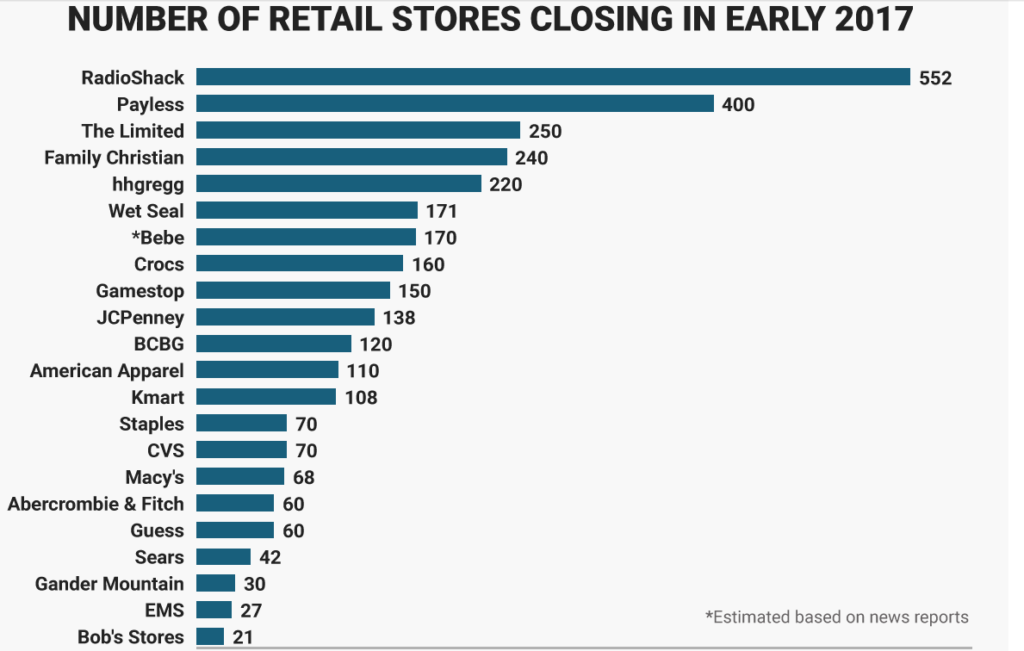
c/o Business Insider
Snap Posts $2.2 Billion Loss in First Quarterly Report
Snap (SNAP: $19.14, down 17%) reported a $2.2 billion loss Wednesday, in its first quarter as a publicly traded company, much deeper than the $105 million loss it posted a year ago, hurt by a one-time hit from IPO-related compensation expenses totaling $2 billion. The loss is one of the biggest in American corporate history. Snap had revenues of $150 million which more than quadrupled from the year-ago quarter but missed the consensus estimate of $158 million. Losses more than doubled to $188 million. We always find it strange for a company to lose more money than it actually took in in revenues.
Daily active users rose 36% to 166 million from the year-ago quarter, but the average revenue per user fell, while daily active user growth also disappointed.
Snap went public at $17 in March and reached $27 the second day of trading. We’ve been saying since the IPO that the company is overvalued. This earnings report goes a long way to backing us up on that.
Tesla Starts Taking Orders for its Rooftop Solar Tiles
Tesla has begun taking $1,000 deposits for its remarkable solar roof tiles at a lower price point than most folks expected. The company said it will begin with production of two of the four styles it unveiled in October: a smooth glass and a textured glass tile. They say that roofing a 2,000 square-foot home with 40% coverage of active solar tiles and battery backup for night-time use would cost about $50,000 after federal tax credits and generate $64,000 in energy over 30 years. That’s more expensive upfront than a typical roof, but less expensive than a typical roof with traditional solar and back-up batteries. The warranty is for the lifetime of your home.
They are obviously going after the wealthier clientele to start. Then again, so does Apple. And so do most companies. The cost for active solar tiles is about $42 per square foot, whereas normal roof tiles cost about $11 per foot. Tesla will manage the entire process of solar roof installation, including removal of existing roofs, design, permits, installation and maintenance. The company estimates that installation will take about a week.

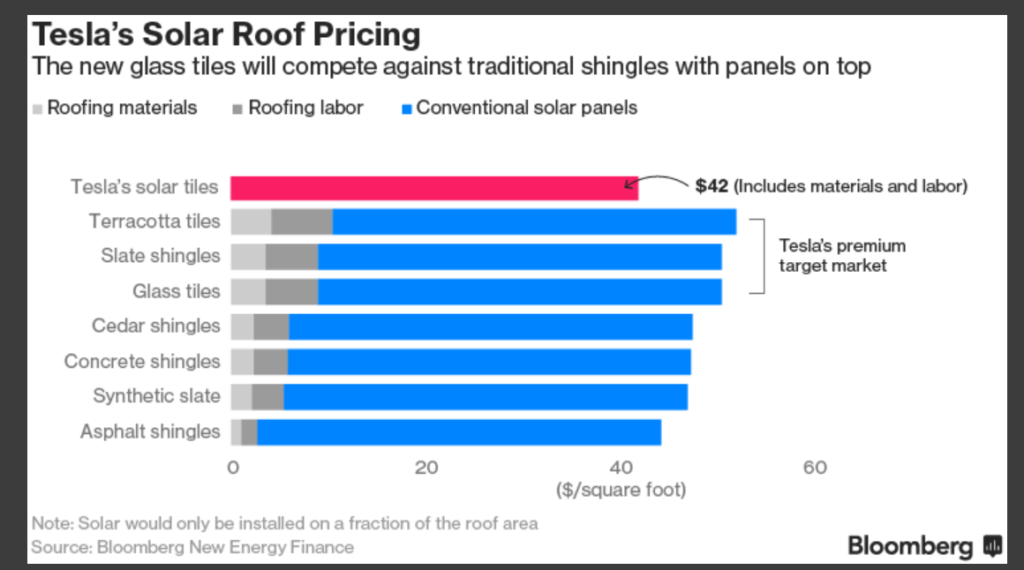
High Yield Report
The High Yield Corner
By Michael Foster
The biggest news of the week for The Bull Market Report’s High Yield portfolio came from AstraZeneca (AZN: $34), which jumped 9% thanks to positive results from a phase 3 study of its Imfinzi drug, a non-small cell lung cancer treatment. The FDA has already approved the drug for bladder cancer treatment, but of course lung cancer is a much bigger and more serious disease, so this is significant news for the company.
The stock had been struggling for nearly a year, falling precipitously both before and after the election. Before the election, fears that Clinton would gut pharma profits caused a big selloff, but that selling pressure increased tremendously following Trump’s election and the surprising news that Trump had little sympathy for pharma either, and he was going to take a scalpel to their profit margins as well. Things hit a low at the beginning of 2017, but recent political scandals and attention elsewhere, as well as the perhaps not too shocking news that Trump is finding it difficult to repeal the Affordable Care Act, have helped pharma companies revert back to a pre-election equilibrium.
Where does that leave us now? Clearly the market has taken its eye off the pipeline ball for a long time, and one has to wonder if the recent news on Imfinzi may in fact force some greater discipline on the market and make investors realize that a sub-30 P/E ratio on a company with many life-saving drugs in various stages of regulatory approval is perhaps unfair. Credit Suisse recently upgraded the stock for that very reason, and we expect more upgrades to come in coming weeks. We’re still 3% off the 52-week high, so there’s no reason to think the sudden buying pressure on Friday is a one-off.
In the more conventional world of ultra-high yield, we’re seeing a continuation of the BDC selloff and junk bond complacency that we have written about for several weeks now. BDC earnings results continue to come in, and for the most part things do not look good. The UBS BDC ETF (BDCS: $22, down 3%) was pummeled by a mix of falling NAVs at constituent firms and analyst downgrades. The downgrades partly come from the aforementioned weakness in NAV, but portfolio yields are also deteriorating at many BDCs. What is portfolio yield? Remember, a BDC is a collection of loans to small and medium-sized businesses. The BDC gets a coupon from each loan, which is the BDC’s yield per loan. Average those together and you get the BDC portfolio yield.
Here’s the real problem: those yields have been going down for a decade. That’s made investing in BDCs particularly tricky, and has caused the BDCs themselves to do a lot of things (lower fees, issue more stock, take on greater risk) to keep investors happy. But all that was supposed to stop when the Fed started raising interest rates, which would cause rates to rise everywhere else. And that is indeed happening elsewhere in the Financial world. Margin rates, preferred note rates, corporate debt rates, and even municipal bond rates have been inching up in anticipation of the Fed’s rate hikes. BDC rates have been on an almost constant slide downward - but the interest rates they need to pay for debt-based capital is going up. So BDCs’ cost of capital is broadly rising and their portfolio yields are going down, compressing margins.
This is a mess. Why is this happening? As far as we can tell, it’s a result of supply and demand. The supply of capital looking for yields has just grown and grown; there are more investors looking to lend to small and medium-sized businesses, thus competing with BDCs. Newer BDCs are showing up. Leveraged lending firms are competing with BDCs. Regional banks are getting back into the small business lending business too. All of this is a structural headwind to BDCs, as they face more competition and thus have to take on more risk or lower the rates they offer on loans. That’s a horrible place to be in, and is why we remain cautious on BDCs as a general rule.
So it’s not surprising that BDCs are down 3%, and we expect that to continue. At the same time, however, there is incredible calm in the junk bond market. The SPDR Barclays High Yield Bond ETF (JNK: $37, flat) barely shrugged this week thanks to little news of significance and a continuation of the declining bankruptcy trend that we’ve seen since early 2016. Again, this is a strong reminder that markets should be forward-looking. Bankruptcy rates were rising in 2015-2016, and junk bond funds were collapsing at the same time. But in early 2016 the bankruptcy problem largely came to a stop, partly thanks to a recovery in oil and partly thanks to the wave of bankruptcies already shaking out most of the weak hands. Yet investors were very slow to realize and jump in.
Now that oil is getting weaker again, one has to wonder if junk bonds are getting ready to peak and a new wave of defaults may be upon us. For sure, that is a possibility but few signs indicate that we will see a repeat of 2015-2016. Instead, we could see a lot of investors anticipate a repeat that never happens, resulting in a mini-correction that provides a buying opportunity.
This means right now is a good time to stick to well-yielding junk bond and high yield bond funds. The Bull Market Report portfolio includes the PIMCO Dynamic Income Fund (PDI: $29, down 1%) and the AGIC Equity and Convertible Income Fund (NIE: $20, down 1%). Admittedly, the discount to NAV on either fund is not particularly compelling right now, but the portfolio quality and historical track record are so good that investors are wise to hold onto these stocks if you have them. New purchases in new bond funds may be something worth considering in the future. More of that in future issues of The Bull Market Report.
Good Investing,
Todd Shaver, Founder, CEO and Editor
The Bull Market Report
www.BullMarket.com
Please consider subscribing to the Weekly Bull Market Report with all of our super research, as well as News Flashes during the week. We are just trying to help you find those stocks that will help you increase your wealth!
Go here: www.BullMarket.com/subscription
Thanks and Good Investing!