by Todd Shaver | Oct 19, 2023 | Instant News Flash, Uncategorized
Streaming giant Netflix (NFLX: $403, up $57, up 16%) posted a remarkable third quarter performance last night, reporting $8.5 billion in revenues, up 7% YoY, compared to $7.9 billion a year ago. The company posted a profit of $1.7 billion, or $3.73 per share, against $1.4 billion, or $3.10, in addition to a beat on estimates at the top and bottom lines, resulting in a strong 14% post-market rally in the stock following the results.
During the quarter, the company posted strong metrics across the board, starting with its new paid subscribers at 9 million, bringing its total to 250 million. This is largely the result of its crackdown on account sharing, which is now in full swing. Netflix has further rolled out its $6.99 ad-supported pricing tier in select regions worldwide, where these plans now account for over 30% of new subscriber additions.
In addition to this, the platform’s engagement metrics so far this year are off the charts. According to Nielsen, Netflix hosted the most-watched original series for 37 of the 38 weeks this year, and the most-watched movie for 31 out of the 38. Its share of total TV screen time within the US now stands at 8%, far ahead of other competitors, and only lagging behind YouTube, which has taken a slight lead at 9%.
With the success of content such as One Piece, The Witcher, and Top Boy, Netflix has officially cracked the originals game and continues to give traditional Hollywood studios a run for their money. While licensed content will continue to play an outsized role, originals help unlock additional monetization opportunities such as theatrical releases, product placements, and merchandising.
Netflix expects a significant jump in its free cash flow at $6.5 billion, resulting in lower content expenses. In fact, they expect to spend $14 billion on content next year, down from $17 billion which will surely increase cash flow. This has prompted the company to increase its buyback authorizations by $10 billion, creating plenty of support for the stock. The company ended the quarter with $8.6 billion in cash, $17 billion in debt, and $4.6 billion in cash flow. The stock has been hit hard these past five weeks, for conceivably no good reason, as this quarter shattered expectations. This company remains one of our favorites. Our Target is $590 and our Sell Price is: We would never sell Netflix. Yes, the Target is high. But yes, the stock will get there. 2024? 2025? It WILL get there. The competition is shattered and will have to consolidate, with Netflix the clear winner.
![THE BULL MARKET REPORT FREE MONTHLY for August 15, 2016]()
by Todd Shaver | Aug 15, 2016 | Monthly Newsletter Daily 6am if new, Uncategorized
Welcome to The Bull Market Report Monthly for August 15, 2016. This is a free publication from the subscription-based Bull Market Report, with access to News Flashes as they occur, and access to our four portfolios – Stocks for Success; Special Opportunities; High Yield; and Opportunities in Healthcare. The High Yield portfolio has been very special to our subscribers, as these are stocks paying 4%, 8% and even 12% dividends per year. AND the stocks themselves have been up 5% and 10% and even more than 20%, which amazes US!
In any case, and without further ADO, here is this month’s Bull Market Report MONTHLY. Enjoy!
Oh – we have a SPECIAL OFFER for you at the bottom of this newsletter. You know – they are ALWAYS SPECIAL, right? Will this one really is?!
Let’s Get Ready to Rumble!
On Thursday the Dow, S&P and Nasdaq all closed at records on the same day for the first time since 1999. (And the markets are in record territory again as we compile this on Monday.) Last time around this historic trifecta meant a fantastic year for stocks. Many on Wall Street are now hollering for a repeat. Some say the money flows are pointing to “the final melt up” and “a blow off top”. We don’t buy that. Everybody from pension funds to retirees are desperately searching for yield in a world of historically low bond returns. The new mentality that prevails is being called “TINA” investing, which stands for “there is no alternative”. If you are looking for new ideas in a market that may approach continued new highs, we highlight Mazor, Twitter, Netflix, and Splunk as places to find value. Have a great week!
Here is How The Major Indices Performed Last Week

Here is How Last Week Progressed
Monday (8/8) - S&P 500 -0.1%
The markets opened at fresh all-time highs only to drift toward an end result that was about flat for the day. China reported July trade data that confirmed a global slowdown. Specifically exports were down 4.4% versus the -3.5% consensus, and imports were down 12.5% versus the -7.0% consensus. The hoped-for moderation that would signal gearing up for orders heading into peak shopping season at year end did not come. Oil prices rose despite the glut of crude supply. Data revealed that corporate bond issuance totaled $88 billion worldwide in the first week of August, the most since 1999, which clearly highlights the amazing strength of the bond market, despite historic low yields.
Tuesday (8/9) - S&P 500 +0.1%
It was a very tepid day. The VIX nearly touched 11, which was last seen in July 2014. The 10-year US Treasury Note closed at 1.55%, which compares to the consensus forecast 8 months ago for the level to be 2.80%. Some savvy market participants are pointing to a 10-year of 0.80% in the intermediate term due to global spreads that face a widespread negative yield curve. (Of course, given consensus results as noted just above, it is obvious that no one has any idea.) Wholesale inventories rose mildly and sales surged to 4-year highs. The interpretation is that the inventory-to-sales ratio of 1.3x is in recession territory. Analysis from Morgan Stanley shined light on trailing 12 month profit margin now at the lowest levels since before the global financial crisis back in 2006 when the S&P was trading 700 points lower.
Wednesday (8/10) - S&P 500 -0.3%
The market continued grinding sideways. The BOJ disclosed in a policy report that tapering of its stimulus program in September is unlikely. The JOLTS data for job openings showed 5.62 million new jobs versus the expectation for 5.68 million. While the pace of hiring rebounded to 5.13 million from 5.05 million a month ago, the annual growth rate for hiring decelerated, which some pointed to as a key indicator that the US jobs market has peaked. Crude fell due to surprising builds despite gasoline drawdowns and production cuts. DOE data confirmed the build in crude of +1.05 million marked the third weekly rise. A rare event was seen in global treasury markets. The spread of the 10-year US Treasury Note to the 10-year GILT (UK bonds) exceeded 100bps, the widest spread seen since 2000.
Thursday (8/11) - S&P 500 +0.5%
The best day of the week so far. The Europe Stoxx 600 Index officially fully recovered from the Brexit decision. Oil prices rose 4% on the Saudi Minister’s OPEC remarks, saying that there is now a meeting scheduled for late September to discuss stabilizing prices, though is past times this rhetoric has led to little. The aforementioned good news overlooked lingering concern of the BLS massive downward revision of the 1Q16 annual growth rate for real wages to -0.4% from +4.2%. US federal tax receipts increased a modest +1% from last year slowing dramatically from the +13% pace of growth recorded just last summer.
Friday (8/12) - S&P 500 -0.1%
Word started circulating calling for a major melt-up in equity price indices. The upcoming Jackson Hole meeting with the leading economists in the US including Fed officials is anticipated to kick-start a discussion about the health of the US economy and a slow rate-hike cycle. At the same time, institutional investors will be returning from summer vacations needing to put money to work, where low interest rates is likely to force money flows into risk assets. St. Louis Fed President James Bullard was already on a radio show today talking about how the Fed sees no recession risk in the near term. A big firm in Europe sold $5 billion of gold futures right before the close perhaps bracing for a sell off on Monday.
Bull Market Report Companies and Commentary
Splunk (SPLK: $64, +5% for the week) Splunk caught a bid early in the week when Morgan Stanley raised its price target to $74 from $58 while reiterating an Overweight rating. What is there to like? The company is the leader in operational intelligence software that helps enterprises make sense of machine data. This end market is large and expanding, which offers a runway for sustainable 30% revenue growth. The business model is increasingly more predictable as the revenue base grows. In the most recent quarter, Splunk’s bookings accelerated to 48% annual growth, which was the highest pace recorded in six quarters. Moreover, the company guided well for the full year raising revenue guidance from $880 million to a new level of $895 million. We should also note that Splunk added 450 new customers and completed 320 deals over $100,000, up 40% from a year ago, which highlights very healthy demand. And this: The Splunk Cloud business doubled from last year, as well!
BMR Take: We see momentum carrying the shares to the $70+ level. This valuation assumes a premium to the peer group justified by the company’s leadership position.
Netflix (NFLX: $97, +1% for the week) Shares started the week off wobbly on news that Alibaba would not be making an investment in Netflix. However, by the end of the week, investor focus returned to the fundamentals, where there is a lot to like. A comparison of Google search volume suggests that "Stranger Things" has had the biggest debut of any new series in 2016 on traditional cable or online, and there is not even a close second place. The extraordinary consumer interest in this science fiction TV show is particularly notable given the lack of a large marketing budget and high profile talent on the show. We believe this demonstrates the power of scaled distribution online, as well as the benefits of full season releases, which allow for instant immersion in a series.
At this point, we do not believe any cable network could replicate this type of performance with a new series. Looking ahead, the release schedule includes Narcos 2 and Disney’s The Crown. While there was concern in the recent quarter over lighter than expected US and International subscribers, it was all driven by elevated churn, which is mostly believed to be the result of price increases in contrast to something more concerning like competition or saturation. Historically, 40% of churning subscribers ultimately return considering the content is increasingly irresistible as we just discussed, which means the recent softness may very well ease.
BMR Take: We remain positive on the long term outlook and expect shares to recover their footing to test 52-week highs of $133.
Mazor (MZOR: $24, +3%). We saw impressive gains in Mazor last week. The focus remains on continued performance improvement building off of the recent solid quarter result. Mazor recently received orders for 11 new Renaissance systems, six in the US, and five internationally. Importantly, there were 16 orders in 1H16, which marked the best six month period in company history. Sales in 2Q16 were up an impressive 30% sequentially. The outlook for the US pipeline in the second half of the year was strong. Utilization continues to increase as recurring revenue growth is running above 30% with increasing system usage cited by management as a key driver. Management has indicated confidence that 2016 will be a record year for both systems sales and procedure volumes. Lastly, the headcount of sales professionals during the quarter increased by one to 17. This compares to plans to reach hundreds of sales reps, which will be transformational.
BMR Take: We see strong fundamentals for long term growth. That said, the stock has appreciated significantly in a short period, so watch it closely.
Twitter (TWTR: $20, +7%). The company had a great week as it was in the headlines this week for a few whacky storylines, plus the prospects for an acquisition, the latest mentioned buyer being Alphabet. The core fundamentals have been steady in terms of revenue deceleration and slowing engagement growth. In fact, management’s latest 3Q revenue guidance of $600 million came in well below the consensus of $680 million. However, there are encouraging signs. In particular, there is much discussion over the new product pipeline. Growth in engagement is now being driven by product changes and marketing efforts, versus previously what were only marketing efforts. The fact that engagement growth is now coming from product changes is a clear sign of increased business momentum. We believe engagement growth coming from product changes is positive, and we would like to see this continue.
Additionally, there is opportunity in video. The company notes that video is one of the two big opportunities for growth, as online video ad budgets for clients across the marketing ecosystem have only recently been revised to permit allocations to Twitter. Note that video is the number one ad format in terms of revenue on Twitter. We likely will not see an impact from live video until 4Q16 since only three events were live on Twitter thus far and just two NFL games will be on Twitter in 3Q16.
BMR Take: Good things will happen here.
Apple Corner
Nothing much new with Apple (AAPL: $108) except another $800 million in cash in the bank this past week. Ha. Nothing new. Right. And the stock TRICKLED UP another 1%. This week? Well if the market moves higher, then Apple is going to add another few dollars. We really do believe we will see new highs in Apple down the road. This year? Maybe. But certainly next year. Can you wait for a year for the stock to move from $108 to $134? Well, let’s see. That’s a 24% return in a year if it happens. I guess we can wait for that! We are quite confident that this will happen.
Upcoming Economic News
It is a very quiet upcoming week for the economic data release schedule. The highlight will be housing starts, out Tuesday. A month ago, we observed the US Census released June housing start data that supported the long-term outlook for a slow-paced recovery to normalized levels. We believe the industry is benefitting from a return of the first-time homebuyer which has accelerated as 3% FHA loans have become more commonplace. We also see the recent decline in interest rates as a potential catalyst in the second half of the year as homebuyers look to take advantage of incrementally attractive financing opportunities. However, we note that permits are now lagging starts by over 5%, which is a relatively large margin from historical standards and does not verify future acceleration to be a given.

High Yield Corner
High yield assets continue to see strong performance throughout 2016, again confirming The Bull Market Report’s recommendation to go heavy into these sectors earlier this year. However, new warning signs suggest more caution is necessary as we plow through the second half of the year.
Junk bonds had another strong week, with the SPDR Barclays Capital High Yield Bond ETF (JNK: $36) up over 1% for the week. That means high yield is now up over 7% for 2016, and up 15% from the lowest point in February.
That’s all great news, but fundamentals urge greater caution right now. The junk bond default rate rose to 5.5% by the end of July, according to a new report by Moody’s, and the number of defaults in July rose by 11, meaning 102 defaults in total for 2016. That’s the highest amount of defaults since 2009. What’s causing the defaults? Oil, of course. Moody’s expects a shocking 10% default rate for metals and mining sectors and 7% for oil and gas. Defaults are also expected to continue to climb for the year, peaking at 6% by the end of the year.
Is the corporate bond market pricing these defaults in and offering creditors a higher yield on bonds to compensate for the risk? Simply put: no, it is not. The average yield on junk bonds fell again this week by nearly 2%, and yields have fallen over 30% from their highest point during the great risk-off moment in February. Right now the market seems to have an insatiable appetite for risk, meaning that investors are willing to buy high risk bonds even if the interest rate they are getting is lower than it was when the bond market was less risky. Why? Simple: there are few alternatives. U.S. Treasury yields continue to stay around all-time lows, meaning there are less places to get income than ever before without taking on more risk. Income-hungry investors are willing to accept the higher risks in the corporate bond world because there are few options out there.
This trend has also driven money into REITs, with the SPDR Dow Jones REIT ETF (RWR: $101) up over 10% year-to-date and up over 23% from the lowest point in February. The REIT world’s strength in 2016 has astounded us, even though we were bullish on REITs earlier this year.
Our favorite REITs continue to be strong performers and continue to cover dividends with funds from operations (FFO). Omega Healthcare Investors (OHI: $37) rose 5% this week, although the SPDR Dow Jones REIT ETF actually fell slightly, due largely to underperformance from large and low-yielding REITs that make up that index.
Our other favorite REIT, Digital Realty Trust (DLR: $103) is up another 2% for the week, and is up over 36% year-to-date. Digital Realty Trust has been one of our best picks this year, and the strong recent performance makes it tempting to sell the REIT and go elsewhere, but this temptation needs to be resisted. Why? Digital Realty Trust is optimally positioned to benefit from the continued explosive growth in cloud computing and companies’ and governments’ need for server space. As a competitive, attractively priced, and highly reliable lessor of server space, Digital Realty Trust has gained the respect and business of Amazon, AT&T, and the U.S. Federal Government - and each of these entities is not only renewing leases but demanding more. We want to profit from that continued high demand.
Another place where we have seen cautious growth is the BDC sector. The UBS Etracs BDC ETF (BDCS: $22) rose less than 1% this week and is up 7% year-to-date. That’s good, but our super pick Main Street Capital (MAIN: $34) is up over 1% for the week and a shocking 18% year-to-date. Plus, dividend coverage remains well over 100% and the company’s recent special dividend payout - and expected December payout - means this stock is yielding nearly 8% on an annualized basis. Such a high yield from a company that can cover payouts so well is unprecedented both inside and outside of the BDC world. Thus it’s no surprise that investors have been flocking to this stock in recent months, and that capital flow is likely to continue. Main Street’s management is just too good, and the company is too well positioned in the BDC world to attract the best quality debtors in need of cash. Thus the increased corporate default rate - which of course means higher defaults among smaller businesses - is not a concern for Main Street, while it dos remain a concern for smaller and less competent BDCs.
In summary, there are growing signs that investors need to be more cautious now that high yield defaults are up but yields are down. This means that a more careful and diligent allocation of capital to the best funds and companies is essential. The lower-quality companies are going to suffer, and that is going to impact indexes and the more risky funds. Sadly, this means investors cannot simply index the market and ride the valleys and troughs. It means investors need to be very careful, pick the best high yielding assets out there, and hold them in thick times and thin.
Note that our Weekly Newsletter has a lot more information - things like the Options Corner; commentary from one of the world's most renowned Energy expert, Philip Verleger; commentary from Gary Jefferson of UBS Financial Services; and a whole lot more. Plus we send out News Flashes when appropriate during the week if any news or announcements affect the stocks in our portfolio. Please join us and take advantage of some super discounts below.
Good Investing,
Todd Shaver
Editor in Chief
The Bull Market Report
by Todd Shaver | Jun 16, 2016 | Uncategorized
Key Measures:
Recent Price: $65
52 Week Price Range: $62-$82
FFO per share: $3.55
Shares Outstanding: 365 million
Market Capitalization: $24 billion
Target Price: $85
Sell Price: $55
Softness In Rental Housing Is Temporary: Equity Residential is a Buy
Demand for residential rental apartments has been on a strong upswing since the financial crisis eight years ago. There is more than one reason for this and this is not likely to change. The shortages of mortgage lending, low consumer FICO scores in the aftermath of the 2008 mortgage meltdown are just two of the well-publicized forces. Behind the headlines, there is the heavy underlying demand coming from millennials just starting out and to baby boomers downsizing. These two forces have conspired to create historically unprecedented demand for rentable housing.
But lately, the story has changed, with overbuilding in major urban markets like New York and San Francisco, followed by reports of sluggish traffic in the important spring apartment-hunting season. Questions are being raised in the investment world. Is this temporary? Or is there something more lasting? Is a shift taking place toward home ownership, leaving owners of rental properties with swelling vacancy rates? Social/demographic issues like child bearing among millennials that historically have sent young urbanites fleeing to the suburbs play a central role in the discussion.
This is hardly the first time this question has been raised. In fact, it is a question that has been raised with virtually every generation in the past 75 years, if not longer. With each wave, the circumstances are different. But the question remains the same. Here is what’s new this time around.
After a close look, it is easy see the forces still favoring demand for properties now in the rental pool. Here is why. While demand for rental housing in the past eight years has been exceptional, the price of home ownership has not stood still. Over the past 5 years, according to Case-Shiller, the average home price nationally has risen 6% annually, far higher than incomes have increased. So, in spite of record low interest rates, home affordability remains difficult for the average family. This is even more the case in key markets on the West Coast where property values have risen faster than average. Sales of homes in California in April of this year declined slightly from last year, with the high price of California homes holding back sales. What is true on the West Coast is also happening in the Northeast as well. Home prices are rising faster than incomes. If interest rates increase, it will only become more costly.
We have seen recent signs of oversupply of rental housing in major East and West Coast markets. But, this is a temporary situation, not the result of a mass exodus to the suburbs.
Equity Residential – Investing With a Real Estate Legend
Whenever a list of highly successful real estate investors is compiled, one name is always near the top: Sam Zell. Equity Residential is run by this property genius.
Equity Residential owns or has investments in 316 properties consisting of 85,000 apartment units located primarily in Boston, New York, Washington DC, Seattle, San Francisco and Southern California. These markets are where the most higher paying jobs are being created and where job growth is likely to remain the strongest.
The operating strategy of the company is spelled out in these five simple principals:
- High barriers to entry where, because of land scarcity or government regulation, it is difficult or costly to build new apartment properties, creating limits on new supply
- High home ownership costs
- Strong economic growth leading to job growth and household formation, which in turn leads to high demand for apartments
- Urban core locations with an attractive quality of life leading to high resident demand and retention
- Favorable demographics contributing to a larger pool of target residents with a high propensity to rent apartments.
The focus is maintaining a balance of high occupancy xxxx ssss ccccccc and realistic rental rates. This is combined with tight cost control to generate the highest possible return to shareholders. This idealistic objective is no different than any real estate company.
The fact that Equity Residential occupancy runs around 95% and that nearly $3 billion in revenues is generated with only 3500 employees is solid evidence that the company is achieving its goals.
The principal source of revenues comes from its rental properties. The other source is from the management of its real estate investment portfolio. At the end of last year, the value of real estate was carried on the balance sheet at $20 billion. However, this number is well below the market value of these prized properties. Over the last five years, Equity Residential has liquidated some assets. From 122,000 rental units in 2011, they have 110,000 at the end of last year. This has created over $550 million in realized gains over the past two years.
In September of last year, a deal was announced to sell 23,000 apartment units, or over 21% of its holdings. The properties are in non-core areas of South Florida, Denver and Phoenix, with a total value of $6 billion. At the time of the announcement, Wall Street skeptics wondered why Zell was liquidating such a sizable share of the Equity Residential portfolio. It may turn out to be one of Zell’s smartest moves.
Recent Results
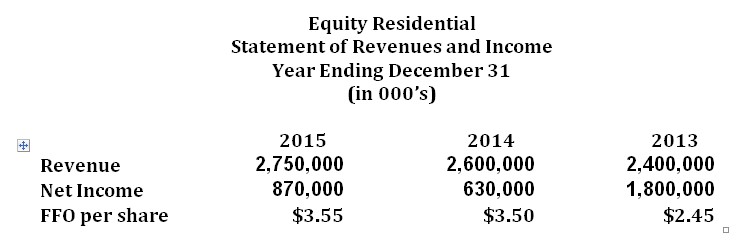
Over the past three years, revenues have grown an average of 7% annually while Fund Flows from Operations (FFO) have increased from $2.45 per share in 2013 to $3.55 in 2015. Virtually all of the growth is the contribution from the rental income portfolio.
Management’s decision to sell $6 billion in non-core assets is looking especially good this year with key markets in New York and San Francisco beginning to show signs of weakness. This creates acquisition opportunities in core markets that otherwise might never become available.
While the long term remains bright, Equity Residential will feel the short-term effects of a modest rental property oversupply. Twice this year, guidance has been revised downward. Compared with the outset of 2016 when management set revenue growth at 4.5%-5.25% and FFO growth of 5.0%-6.5%, it is now projected for revenue gains of 4%-4.5% and FFO of 4.5%-5.5%. We calculate that to translate into a 5% FFO gain to $3.73 per share. This is still faster growth by far than the average American company. Nothing wrong with that.
Balance Sheet: Undervalued Assets/Reducing Debt
The $6 billion asset sale was completed in February resulting in a special $9 per share dividend to shareholders. As of 1Q16, there was $6 billion in cash on the balance sheet with Long Term Debt at $8.5 billion down from $10.4 billion the previous year. When we dug deep into the 1Q16 financial report, we came across the most important piece of financial data. Of the $6 billion in property sales, $3.7 billion represented capital gains. That solidly confirms that Sam Zell’s properties are definitely worth much more than their stated value of $20 billion.
BMR TAKE
There is a slight weakness in the rental markets of New York and San Francisco but at $2,650 for a 300 square foot studio apartment (Manhattan) and with 95% occupancy, we’re not concerned. Weak occupancy is not unique to 2016. It has happened before and it never lasts for long. The attraction to these commercial hubs is self-renewing. Add this to a crafty operator like Mr. Zell, and you have a winning combination.
We like to find stocks of great companies that have been knocked down a bit. That is how winning investments get started. Since the start of the year, it has been a roller coaster ride for the stock, falling 20% to $65 from the all-time high of $82. We believe the market value of the existing real estate portfolio is $85 per share. Equity Research is structured as a Real Estate Investment Trust, and must pay out 90% of their income each year. They just raised the dividend to 57 cents a quarter, and thus the current dividend yield is an attractive 3.5%. Equity Residential is in all the right locations and we want to be with them all the way.
by Todd Shaver | Apr 11, 2016 | Uncategorized
What You Need to Know for April 12, 2016
• Double Reversal: Stocks fade for second straight day
• Dow, S&P 500 and Nasdaq start with a bang, end with a whimper
• Financials had a rare day of strength; Healthcare weak
• OPEC Oil production rose 1.2 million barrels in March
• Crude Prices rise 1.6% on the OPEC news. Can that be right?
• Gold closes at highest level in three weeks.
• Yield on the US 10-Year Note unchanged at 1.73%
• Goldman Sachs settles with the Fed for $5 billion; stock rises
• Another quiet day for economic news, get ready for Wednesday
• Comments on companies we favor: Adeptus Health, Under Armour
The Box Score
| Key Market Measures (Monday’s Close) |
| Dow Jones |
17,556 -22 |
-0.1% |
| S&P 500 |
2,042 -6 |
-0.3% |
| Nasdaq |
4,833 -17 |
-0.4% |
| Crude |
$40 +1 |
+1.6% |
| Gold |
1,260 +14 |
+1.1% |
Reversal Of Fortune:
Market technicians claim that they are able to see hidden clues in the stock charts that presage changes in market direction. Some technicians take it to the extreme. There is one such practitioner that even relies on astrology. We don’t fully subscribe to this principal in general, but treat technical analysis as another valuable input into the market.
One of the things technicians watch for are fading rallies. All three major indices have had two successive days of intraday reversals. There was precious little news. Yes, Jordan Spieth blew a big lead at the Masters golf tournament on Sunday and Under Armour, (one of his many sponsors) saw its stock fall 5% yesterday. But that is hardly the stuff that puts fear in the hearts of investors.
For the past couple of weeks we have been getting the sense that the market is coming into a period where it is susceptible to a pullback. The message from the last two trading reinforces this notion.
Oil Production: US down, OPEC up
The Baker Hughes weekly rig report Friday showed that the US count at 394 was the lowest since 2009. While the US is cutting, OPEC is still rising. Oil production by OPEC members rose by 40,000 barrels a day in March from a month earlier, to 32 million barrels a day. The increase was blamed on higher output from Iran, which climbed by 110,000 barrels a day to 3.2 million barrels a day. Iraqi output also rose by 30,000 barrels a day to 4.2 million barrels a day, according to the survey. The report was released late yesterday, so this news will have an impact on today’s trading.
BMR Company Comments and Other Thoughts
Goldman Sachs (GS: $152, up 1.3%) The stock was strong yesterday along with other financial stocks. In Shakespeare’s “The Tempest” Antonio famously declares, “what’s past is prologue”. And so it was yesterday when Goldman settled with various US government agencies for errors of omission in dealing with questionable mortgage loans dating back to the 2008 financial crisis. The cost for these errors was a tidy $5 billion. This legal albatross has been hanging around for quite a while. With the announcement came a nice pop in the stock. Once again Antonio was right.
Adeptus Health Inc. (ADPT: $53, down 7%) When we added Adeptus Health last week to our list of Special Opportunities, we knew that there were some exciting things happening with this pioneer in the free-standing Emergency Room business. We also noted how the stock had been hammered, and that 40% of the stock was in the hands of short sellers. In fact, this was one of several endearing features of the stock. What we have learned since then is that we aren’t the only admirers of Adeptus. The same time that our report came out the research firm Zacks Research issued a Strong Buy.
The stock’s volatility in the last week has been something else entirely. Moving up 11% from $54 on Monday to a high of $60 at one point on Friday was totally consistent with a short squeeze. There is nothing wrong with that price action.
The action on Friday and yesterday saw the stock trade in a range of $50-$60. Keep in mind, there was no company event, no outside news item or other relatable cause for this action. There aren’t even any rumors. So in order to adapt to Adeptus, we need to emphasize that volatility is a part of the package. Remember, just last August, the stock traded at $124. Volatility works in both directions.
Under Armour (UA: $41, down 5%) For the second time this year Morgan Stanley came out with a lengthy report knocking the prospects for the company. By lengthy report, we are talking about 50 pages. Those people who actually read the report noted how it is identical to the one released in mid-January just as the stock hit its 2016 low of $32. Can a broken clock be wrong twice? We think so.
Since those lowly days in January the stock has been a home run, up about 30%. We have been talking about a correction in the market for several weeks now and so a correction in this stock is not out of the question. You might even say a correction could be healthy. The fundamentals are exciting and this is a stock that we want to use a pullback to capture an even better price. Go footwear, Go Stephen Curry, Go women’s wear. Go Lauren Cheney, Heather Mills and Lindsey Jacobellis. This is a brand for the next generation.
Good Investing,
Todd Shaver
Editor in Chief
by Todd Shaver | Apr 6, 2016 | Uncategorized
• Fed Keeps Interest Rates Steady; Markets Regain Steam
• Oil Leads Markets Lower; Fed Leads Oil Higher
• Panama Papers Impact Muted, But Much More to Come
• It’s Elon Musk’s World; We Just Live In It
Key Market Measures (Wednesday’s Close)
Dow Jones 17,716 +0.6%
S&P 500 2,064 +0.4%
NASDAQ 4,920 +1.6%
Crude $38 +5%
Gold $1,224 -0.5%
Interest Rates “Trump” Oil Again; Markets Musky
Last week at this time we noted that movements in the price of crude were no longer calling the tune for U.S. equities. Instead, the accommodative interest rate posture of the Fed held sway, lifting U.S. equities to their 2016 highs. To begin this week, stocks appeared ripe for a pullback - and not coincidentally the price of crude began sliding back toward multi-year lows. As always, pundits were quick to suggest that oil and stock prices had peaked.
Once again, however, the Fed met Wednesday and essentially reaffirmed that interest rates would stay low for the foreseeable future. Yes, there may be a rate rise or two this year, but unless unexpected events develop, a go-slow approach for 2016 is the current interest rate path. None of this is too surprising, given the somewhat shaky global growth picture, and we’ve seen signals from the oil trading pits that the good old days of fossil fuel guzzling may have reached a tipping point.
Panama Papers and Tax Inversion
Two extraordinary events occurred this week, with far-reaching implications, have caused barely a ripple on Wall Street - but perhaps they should have, and may in the future. The release of the Panama Papers - secretly leaked documents from a Panamanian law firm protecting shell corporations - has already triggered government inquiries in Australia, Pakistan, France, Brazil, Great Britain, Argentina, Germany and others. Iceland’s Prime Minister quickly hung up his spikes upon their release.
In a nutshell, the Panama Papers have shined an intense spotlight on fictitious companies that corporations, wealthy individuals and government officials use to hide assets, launder money and evade taxes. If you don’t know where Panama is, get out a map: you’re going to be hearing a lot about those Panama Papers for months to come.
President Obama, meanwhile, had the Treasury Department issue its third and most far-reaching set of rules to control a related problem - tax inversion. Obama referred to inversion Tuesday as one of the “most insidious tax loopholes out there.” According to the Wall Street Journal, “The latest regulations, which target ‘serial inverters’ and post-inversion moves to reduce U.S. taxes, are threatening the largest inversion ever, Pfizer Inc.’s planned merger with Allergan PLC. The companies have said they are reviewing Treasury’s actions and haven’t announced what they will do.”
The result? Pfizer (P: $33, up 5%) and Allergan (AGN: $244, down $34) have killed their merger and all deals like this in the future are Dead On Arrival.
Bull Market Report Company Thoughts and Commentary
Tesla (TSLA: $265, up 4%) The Model 3 is here, orders are pouring in, and Elon Musk is laughing all the way to the bank, along with Tesla longs. At last count, Pacific Crest estimates that there will be between 350,000 and 400,000 Model 3 pre-orders by the end of the week. That translates into $15-$17 billion in car orders. Of course, Erickson fretted that he wasn’t sure the company would be able to deliver all of these cars on schedule, and no doubt that’s what Tesla-watchers will be monitoring closely in the months ahead. In the meantime, if you’re long Tesla, enjoy the ride.
Twitter (TWTR: $17.26, up 1.3%) The beaten-down stock of this tech laggard got a boost this week after inking a streaming content deal with the NFL. Initially shorts were concussed, but despite the positive overall market vibes, Twitter hasn’t been able to build significantly on the bounce move higher in the wake of that announcement. We still contend that it’s only a matter of time before shares of this bellwether social media concern begin to gain more traction. #bepatient.
Good investing,
Todd Shaver
Editor in Chief
by Todd Shaver | Apr 4, 2016 | Uncategorized
What You Need to Know for April 5, 2016
• Stocks marked time waiting for 1Q earning reports
• Factory Orders reported at 10:00AM sent stocks into retreat
• Market ends the day with only Healthcare in the positive column
• Transports weak: Factory Orders for Aircraft decline 28%
• Gold takes a pause; US Dollar slightly weaker in Europe and Asia
• Fed Still Feuding: Boston Fed President Rosengren turning hawkish - Yield on the US 10-Year Note falls after his speech
• Tesla: Model 3 deposits nearing 300,000
• Gilead Sciences acquisition announcement means big opportunity
• Comments on other companies we favor: Adeptus, Twitter, Facebook, Visa
The Box Score
| Key Market Measures (Monday’s Close) |
| Dow Jones |
17,737 |
-0.3% |
|
| S&P 500 |
2,066 |
-0.3% |
|
| NASDAQ |
4,892 |
-0.5% |
|
| Crude |
$37 |
Unch. |
|
| Gold |
1,216 |
-0.1% |
|
Stocks Down; Oil & Gold Practically Unchanged
After a solid opening, the market reacted to news that Factory Orders were down 1.7%. That was not far off estimates of down 1.6%. Even without a big surprise, the reaction brought the Dow, S&P and Nasdaq in lock step into negative territory. The disappointment came in Factory Orders for aircraft of all types. They fell a big-time 28%. As soon as the news got out, the market went into a slight nosedive of its own.
Today the Washington data machine cranks out the Trade Deficit (Forecast: Another increase to $46.2 billion), the ISM* Nonmanufacturing (Index rising to 54.5) and Job Openings (A drop from January’s 5.5 million). Translating government English, Non-manufacturing means services and that are one of the driving forces to the US economy these days. The index covers the month of March so it is really fresh data; therefore, the most important data point for today. We will be watching closely as usual. A reading above 50 signals a service economy in expansion. A reading below 50, points in the opposite direction.
*Institute of Supply Management
Fed Still Feuding
Last week it was Fed Chair Yellen’s turn to quell any notion of a quick hike increase in interest rates. Yesterday it was Boston Federal Reserve President Eric Rosengren’s turn. Without going into chapter and verse, here are his two basic conclusions: The world economy is not in as bad a shape as it seemed a few months ago. Since the futures markets aren’t forecasting a rate hike until at least September, to that he says, “The futures markets have it all wrong”. This interest rate dove is sounding more like a hawk. Our vote is for Chair Yellen.
BMR Company Thoughts & Commentary
Gilead (GILD: $94, up 0.1%) Gilead added a potential blockbuster hepatitis treatment with today’s announcement to acquire Nimbus Apollo, a privately held company. Here is the big deal: NAFLD stands for Non Alcoholic Fatty Liver Disease. Nimbus is on the Fast Track to getting approval of their NAFLD drug. There are estimated to be 3 million obese patients diagnosed with NAFLD each year. There is no existing treatment other than weight reduction (massively unsuccessful as we all know). There are 120 million obese people in the US alone so the 3 million tally is way too low. Score a big coup for Gilead. (See our Report and News Flash for details)
Adeptus Health (ADPT: $58 up 6%) We love the Adeptus story and the value so much that we wrote a review of Adeptus Health and included the Research Report as we added it to our Special Situations portfolio this week in The Bull Market Report yesterday. The company is pioneering the freestanding Emergency Room business. With only 83 locations, they already are the largest in a small industry that has huge upside. Revenues have increased 6-fold over the past three years. Wall Street expects profits to triple between now and the end of next year. Amazingly, this gem is under-followed and trading at the S&P 500 average of 21 time earnings but growing more than 20 times faster. Please see our complete research report on the website for full details.
Other Companies Making Noise
The Financial Technology-crazed world is meeting in Copenhagen this week for a confab called Money 2020. Payments processing is all the rage these days among FinTechies at Money 2020. Representatives from our friends at Visa (V: $78, up 0.2%) cast some magic dust on Facebook (FB: $113, down 3%) and Twitter (TWTR: $17, up 7%). Visa offered to partner with Facebook and Twitter to advance their payments goals. Skeptics might call the Visa invitation a bunch of hope and promise, but investors didn’t feel skeptical at all, at least not for Twitter. Visa offered to work together on peer-to-peer payments. Facebook initiated its own P2P payments system last year and Twitter has a “BUY NOW” button for payments. For Facebook, payments are another one of many opportunities in their tool kit. For Twitter, however, getting serious about payments could be just the spark needed.
Good investing,
Todd Shaver
Editor in Chief