
Amazon (AMZN, $820, +22% YTD)
Amazon CEO Jeff Bezos wants to be two things, a large company and an invention machine. The business model is proving to be unstoppable. By combining the extraordinary customer-serving capabilities that are enabled by size with the speed of movement, nimbleness, and risk-acceptance mentality normally associated with entrepreneurial start-ups, Amazon’s investments are blooming in a diverse set of ancillary business opportunities. Amazon Web Services is taking on Microsoft. Amazon’s early efforts in logistics are staring down Federal Express and UPS. Amazon’s plans to build grocery stores is frightening Safeway and Albertsons. The success Amazon is experiencing in new verticals is amazing. At the same time, the company has not lost an inkling of focus on its core eCommerce business, which continues to wreak havoc on the entire brick and mortar retail ecosystem.
In 2015, Amazon became the fastest company ever to reach $100 billion in annual sales. How did they do it? They built the Prime service to be such a good value that it’s become almost irresponsible to not be a member. The Prime service now comprises a two-day delivery selection of over 30 million items, comes with Sunday Delivery, has Free Same-Day Delivery on hundreds of thousands of products for customers in more than 35 cities around the world and more recently has been upgraded to include music, photo storage, the Kindle Owners’ Lending Library, and streaming films and TV. There are now 70 million Prime members. Back in July, on the company’s second inaugural sales event called Amazon Prime Day, these Prime customers bought a whopping $500+ million worth of goods in 24 hours. Unreal!
So in 2015 Amazon became the fastest company ever to reach $100 billion in annual sales. Also during that year, Amazon Web Services reached $10 billion in annual sales, doing so at a pace even faster than Amazon itself achieved that milestone. Remarkable! What IS Amazon Web Services though? Many people still have never heard of it.
Everybody refers to Amazon Web Services as just AWS. Just over 10 years ago, AWS started in the US with its first major service, a simple data storage service. Today, AWS offers more than 70 services for computing, storage, databases, analytics, mobile, Internet of Things, and enterprise applications. AWS is the leader in Cloud Computing, by far. Individuals and more importantly companies are no longer ordering their own equipment and hiring large technology teams. The world is moving to rent just what it needs from AWS in terms of equipment. As far as web engineers go, open sourcing lets third-party developers build whatever applications people want, so there is no longer a need to hire an internal tech team to do it. The cost effectiveness and advanced capabilities of the new era for the internet – this cloud computing business - is game changing.
MLB Advanced Media is an example of an AWS customer. MLB’s Statcast tracking technology is a new feature for baseball fans that measures the position of each player, the base runners, and the ball as they move during every play on the field, giving viewers access to empirical data that answers age-old questions like “what could have happened if…”, while also bringing new questions to life. Turning baseball into rocket science, Statcast uses a missile radar system to measure every pitched ball’s movements more than 2,000 times per second; streams and collects data in real-time through AWS; stores the data on AWS; and then performs analytics in AWS. The suite of services will generate new quantitative light on age-old, but never verified baseball pearls of wisdom like “never slide into first.” How cool!!!
Another customer example is Netflix (NFLX). About seven years ago, Netflix announced that they were going to move all their applications to the cloud. Netflix chose AWS because it provided them with the greatest scale and the broadest set of services and features. Netflix recently completed their cloud migration, and stories like theirs are becoming increasingly common.
The growth outlook for AWS is exploding. AWS now offers over 40 areas where AWS is available across over 15 countries worldwide. AWS started with developers and startups, and now is used by more than a million customers from organizations of every size across nearly every industry – including companies like Pinterest, Airbnb, GE, Enel, Capital One, Intuit, Johnson & Johnson, Philips, Hess, Adobe, McDonald’s, and Time.
AWS is bigger than Amazon.com was at 10 years old, growing at a faster rate, and – most noteworthy in our view – the pace of innovation continues to accelerate – as 720 significant new features and services announcements in 2015 represented a 40% increase over the prior year. Many characterized AWS as a bold – and unusual – bet when Amazon started. “What does this have to do with selling books?” “They should stick to their knitting.” These critiques showed an ignorance for what Amazon is, the world’s greatest innovation machine, which isn’t stopping at just Amazon.com and AWS.
Wait until you read the next couple paragraphs.
First, Amazon is now planning to open grocery stores. The small brick-and-mortar stores would sell produce, milk, meats and other perishable items that shoppers can take home. Additionally, through using their mobile phones or touch screens around the store, customers can order peanut butter, cereal and other goods with longer shelf lives for same-day delivery. For customers seeking a quicker checkout, Amazon will offer designated drive-in locations where online grocery orders will be brought to the car. In fact, Amazon is developing license plate reading technologies in order to speed up the wait times. Albertsons and Safeway are in for a competitive challenge like they’ve never seen. Look out!
Second, Amazon is looking to abandon UPS and FedEx in favor of its own delivery service. Some say Amazon is just doing it do save costs on their own logistics, but that is just not true. They are going to be a competitor. Amazon has recruited FedEx and UPS executives and recently brought back Uber executive Tim Collins to serve as vice president of global logistics. Before going to Uber, Collins worked for Amazon for 16 years, focusing on European operations. Amazon has already purchased long-haul trucks for ground deliveries, and in August debuted the first fleet of Amazon Prime Boeing airplanes for long-distance shipping. We can’t help but speculate for fun that Amazon could be looking to buy some of the recent shipping company bankruptcy assets! The logistics initiative dubbed “Project Consumer The City” will undoubtedly be put to use during the upcoming holiday season, but it could be years before we see a full-scale delivery system from this amazing company.
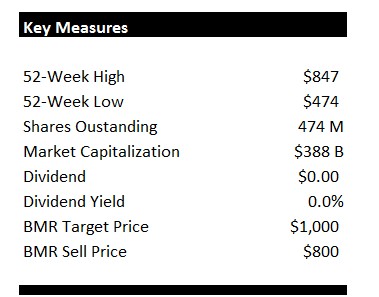
BMR Take: Amazon’s eCommerce business is booming and new initiatives in other areas present additional end market opportunity for revenue growth, in particular the opportunity at AWS. There really are not any credible arguments expressing concern about the future long term direction of Amazon’s business, only nuanced critiques. The ongoing debate is more so all about valuation. The stock is priced at greater than 100x this year’s consensus EPS estimate of $6.00. But the P/E multiple is inflated because the company is in hyper-growth mode. There will be a day when Amazon goes into profit-maximizing mode flipping the switch on milking over $200+ billion of sales for shareholders. We could see the current 5% net income margin heading to something like 10-15% or higher. Considering all that is going on from Amazon.com, AWS, grocery, and logistics, we see compelling value taking a long term view and believe shares are heading to our $1,000 price target.