
The Carlyle Group LP: A Value Investor’s Dream
The Carlyle Group LP: (CG: $15.80)
A Value Investor’s Dream
March 6, 2017
Company Description
One of the world's largest private investment firms, The Carlyle Group owns 250 companies and boasts more than $160 billion in assets under management. Activities include management-led buyouts, minority equity investments, real estate, venture capital, and leveraged finance opportunities in the energy and power; consumer and retail; defense and aerospace; and technology and business services industries. Other target sectors include financial services, healthcare, infrastructure, transportation, telecommunications, and media. Since its founding in 1987, Carlyle has made more than 1,700 investments. It has more than 35 offices across six continents.
The Carlyle Group operates four business segments. Corporate Private Equity, which accounts for more than 60% of its total revenue, oversees $60+ billion in assets under management (AUM) across over 20 buy-out and 10 capital growth funds. The Investment Solutions division (almost 15% of revenue) has $45 billion in AUM and advises a global private equity fund of fund program and related investments across 115 vehicles. The Real Assets segment (over 15% of revenue) oversees $35 billion in AUM across nine US and international real estate funds, and various infrastructure, energy, and power funds. Global Market Strategies (10% of revenue) advises a group of nearly 70 funds investing in credit and debt securities, commodities, hedge and mutual funds. More than 50% of Carlyle’s revenue comes from investments based in the Americas, while over 35% comes from the Europe, Middle East, and Africa region and almost 15% comes from the Asia Pacific Region.
Investment Thesis
There are two reasons that Carlyle’s shares have been a major disappointment in recent years, but all that is about to change, making Carlyle Group’s stock a value investor’s dream. The first issue is the complexity of the business model. The second issue is the corporate structure.
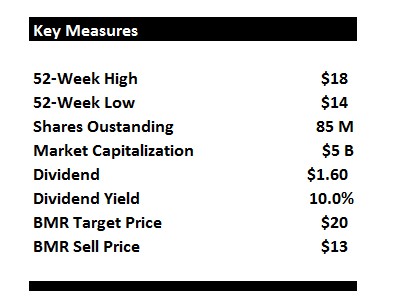
First, the business model is very complex. Carlyle executes complex transactions with long investment-cycles. The money-raising cycle to start one of their funds is a lengthy process. Exiting investments is another timely endeavor. Adding it all up, it can take 7+ years for Carlyle to raise money, invest it, exit the investment, and finally give back the money to investors with a return. Analysts have had to throw their hands up trying to forecast where earnings will be. Wall Street does not like the lack of visibility here, or anywhere for that matter. But all that is changing. Each passing quarter that Carlyle pays the dividend, proves the business is printing profits month in and month out. The company paid out a dividend of $1.69 in 2013, $2.01 in 2014, $2.19 in 2015, and $1.81 in 2016. This is an absurd greater-than-10% yield at current levels. Smart investors like legendary Chuck Royce of Royce Funds recognize this misunderstanding and are starting to buy the stock in a major way. So what if we can’t forecast the exact specifics of when a particular Carlyle fund investment cycle will end? Embrace the nature of the business and go with the dividend stream. There is just no reason to throw Carlyle’s stock in the trash can because the business model is complex. More and more investors are coming around to this point of view, especially right now with the dividend yield of greater than 10%.
Second, with the post-election focus on comprehensive tax reform, the topic of whether the Alternative Asset Managers (that is Carlyle Group and its peers) should be contemplating converting to a C Corp from a publicly traded partnerships (PTPs) is front and center. These companies have been speaking publicly. There are important implications on both earnings and valuations. The Alternative Asset Managers pass through certain qualifying income untaxed at the corporate level (e.g., carried interest, investment income, interest/dividends). Accordingly, shareholders receive a K-1 and have to file taxes on that income on their own. This creates a whole mess of operational challenges. One in particular is that a retail investor buying Carlyle stock in their IRA would not get any tax break and have to pay taxes on the Carlyle dividend stream even though they own the stock in their IRA. This one issue alone means most institutional fund managers running mutual funds can’t buy the stock. The bottom line is this, if Carlyle does switch to a C Corp structure from a PTP, then while we will see earnings dilution of 10-20% due to now having to pay tax, the sheer increase in demand of the number of investors who can now buy the stock is likely to drive PE multiple expansion of upwards of 3x according to an institutional survey of 70+ leading asset managers. What a catalyst!
Strategy
The Carlyle Group in 2016 reiterated its focus on expanding its investment capabilities through the creation or acquisition of new asset-, sector-, and regional-focused strategies to attract investor dollars with a range of investment options. By utilizing its established One Carlyle platform, the firm can take advantage of its large economies of scale to keep fund costs low while keeping a differentiated product portfolio.
Carlyle Group's funds vehicles have invested in more than 250 portfolio companies to date, including rental-car giant Hertz, AMC Entertainment, BankUnited, HD Supply, and Illinois Central School Bus. While it's known for turning small acquisitions into big companies, the firm has been making larger deals over the past few years. In January 2016, for example, in a move to boost its holdings in emerging and next-gen technologies, Carlyle purchased the information management systems business Veritas Technologies from digital security firm Symantec for a staggering $7 billion. In March 2015, through a joint venture with private equity firm Warburg Pincus and various individual investors, Carlyle bought DBRS, the fourth largest global credit rating agency. In 2014, Carlyle executed a $4 billion acquisition of the blood-screening and testing unit (Ortho-Clinical Diagnostics) of Johnson & Johnson.
Beyond largess, Carlyle also focuses on diversity. Its portfolio investments during 2015 included: an 85% stake investment in Peru-based cash management firm Hermes from Inversiones Centario; the acquisition of UK-based auto insurer Nationwide Accident Repair Services; its acquisition of Madrid-based IT infrastructure manager Telvent Global Services; and its majority stake investment in asset services firm Conifer Financial Services.
Ownership
Co-founders, co-CEOs, and directors William Conway and David Rubenstein each own about 15% of The Carlyle Group's shares. Founder and chairman Daniel D'Aniello holds an equal share. This little detail is worth a quick call out here because these guys are known for protecting their pocketbooks and you as a shareholder are aligned right beside them. What more can you ask for!
How We Got Here
Carlyle Group is among the top investment franchises in the globe. It’s a flat out powerhouse that sees basically every deal and employs the leading investors across every sector they get involved in. How did we get here?
In 1987 T. Rowe Price director Edward Mathias brought together David Rubenstein, a former aide to President Carter; Stephen Norris and Daniel D'Aniello, both executives with Marriott; William Conway Jr., the CFO of MCI; and Greg Rosenbaum, a VP with a New York investment firm. They pooled their experience along with a load of money from T. Rowe Price Associates, Alex. Brown & Sons, First Interstate (acquired by Wells Fargo), and Pittsburgh's Mellon family to form a buyout firm.
Named after the Carlyle Hotel in New York, the firm opted to make Washington, DC, its headquarters so it wouldn't get lost in the crowd of New York investment firms. The company spent its first years investing in a mish-mash of companies, using Norris' and D'Aniello's Marriott experience to focus primarily on restaurant and food service companies.
In 1989 it wooed the well-connected Frank Carlucci, who had served as President Reagan's Secretary of Defense, to join the group. Soon thereafter, Carlyle began making more high-profile deals. That year it acquired Coldwell Banker's commercial real estate operations (sold in 1996) and Caterair International, Marriott's airline food services (sold in 1995).
Carlucci helped redirect the firm's focus to the downsizing defense industry. Among its targets were Harsco (1990), BDM International (1991), and LTV's missile and aircraft units (1992). Carlyle helped overhaul their operations and make them attractive to the industry's elite, including Boeing and Lockheed Martin.
As the company's reputation grew, so did its cast of players. Among its new backers were James Baker and Richard Darman (both Reagan and Bush administration alums) and investor George Soros, who chipped $100 million into the Carlyle Partners L.P. buyout fund. With the help of its "access capitalists" such as Baker and Saudi Prince al-Waleed bin Talal (the firm helped add to his fortune in a 1991 Citicorp stock transaction), Carlyle made deals in the Middle East and Western Europe (including a bailout of Euro Disney) in the mid-1990s.
While the firm continued to be a side in the iron triangle*, acquiring such defense companies as aircraft castings maker Howmet in 1995, it picked up a grab bag of holdings, such as natural food grocer Fresh Fields Markets (1994; sold 1996). The quick turnaround helped build Carlyle's war chest. The firm also began investing in industrial-cleanup companies, seeing increased government spending as a major opportunity for profit. In 1999, the firm acquired automobile engine parts manufacturer Honsel International Technologies in Germany's first public-to-private transaction.
* The iron triangle is a mutually beneficial, three-way relationship between Congress, government bureaucrats, and special interest lobby groups.
Formerly a list of who's-who in aerospace and defense, Carlyle retooled its management board, and made its undertakings more transparent, in part due to suspicions regarding its dealings with Saudi investors (including the bin Laden family) in a post-9/11 world.
Out went the likes of former US President George H.W. Bush, former British Prime Minister John Major, former Secretary of State James Baker, and former US Secretary of Defense Frank Carlucci. They were replaced by business leaders such as Lou Gerstner, the former IBM chairman and CEO, former SEC chairman Arthur Levitt, and David Calhoun, a former vice chairman of GE.
The Carlyle Group added more than 50 businesses to its portfolio in 2007. Slightly more than half of these investments were in US-based companies, but the company also put its money in foreign ventures, ranging from a sporting goods manufacturer in China to real estate portfolios in Italy to an after-school tutoring institute in Korea.
Other acquisitions in 2007 included industrial chemicals firm PQ Corporation, software developer Open Solutions, and manufacturing concern Sequa in 2007. It acquired Allison Transmission for some $5.6 billion and home operator Manor Care for nearly $5 billion. Additionally, the company joined with Bain Capital and Clayton, Dubilier & Rice to buy HD Supply, the wholesale construction supply business of The Home Depot, for $8.5 billion.
In 2008 The Carlyle Group paid some $2.5 billion for a majority stake in Booz Allen Hamilton, which provides consulting services to the US Department of Defense and other government agencies at home and abroad. Booz Allen Hamilton went public in a 2010 IPO, and The Carlyle Group retained a 70% stake in the company.
The Carlyle Group, which had been closely-held by its founding partners since 1987, went public in 2012. The $670 million in proceeds was used to pay down debt. The truly amazing legacy and success of Carlyle rolls on to this day…
BMR Take:
Carlyle Group is a value investor’s dream. It’s a top investment franchise. It employs the who’s who of business. Year in and year out we are seeing evidence of reliable profits in the dividend stream. People love to hate it because it’s a complex business and because the publically traded partnership corporate structure causes some issues for certain investors. But there is a smart crowd buying the stock here as the value looks particularly compelling, especially with catalysts on the horizon.