
Market Rally Runs Out of Gas
The market rally born on that February day two and a half months ago has been amazing with lots of money being created. But the rally is showing signs of getting long in the tooth.
It is now two weeks in a row that the market has pulled back with all major stock indices ending lower. For the week, Crude pretty much held its own in the mid $45 area (which amazes us and pleases us.) Gold, however, retreated for most of the week before attempting a brief rally on Friday. It didn’t last long once the Jobs data was released.
Renewed global concerns about the pace of growth in China sent the market on a downward course early in the week. But the big focus in the US equity markets was on company earnings reports. Based on the volatility alone, it is easy to conclude that the grand prize for biggest paycheck goes to the option traders. The divergence between the winners and losers, judging solely on stock price volatility had to do with management’s guidance for the future. Those who met or exceeded expectations for 1Q16 were rewarded. Those who met or exceeded but offered even the slightest downward bias in their outlook got taken to the woodshed.
Traveling the East Coast
We are traveling for the month of May and observing the state of the economy, as well as meeting with investors and corporate executives of companies we like or are thinking about adding to our portfolios. Our take so far is that the economy is strong and resilient, and it is our feeling that it will be very difficult to bring this economy down. It is just too robust. This country is huge. Every time we leave our home in Aspen to see the real world we are amazed. The traffic in Washington DC is out of control; the number of homes and buildings that are going up around the Beltway in Washington are literally astounding. Jobs are being created and in some sectors companies are having trouble filling them. With interest rates at the lowest levels in history, we see no reason for anything to change this year or next. We have a very strong outlook on the future of commerce in the country this year.
Here is How the Major Averages Performed

Is The Market Telling Us to Go Away in May?The Job Market: The Flower Wilted Last Week
Interest rate hawks got some bad news last week. Data on the job market took a surprising turn to the soft side. Wednesday’s employment report for April fell 40,000 below the prior month and set the stage for Friday’s government numbers on Non-Farm Payrolls. These were even worse, falling 50,000. As we know, a healthy job market has been the Fed’s main argument for raising interest rates. Well, this argument is obviously no longer valid. We know you are familiar with the fact that interest rate futures can predict markets: According to traders in interest rate futures, the first month where there is a greater than 50% chance of a rate hike is mid-2017. That is surprising to us so let’s look at other metrics to see how 2016 is going to play out.
One of the oldest pearls of wisdom dished out by market pundits is: “Sell in May and go away.” So far we have only a week’s worth of evidence but already there is a small voice in the background whispering this time-tested advice. To be clear, we are not sellers. Our goal here is to position you to make good investment decisions that will lead to great money making. Market corrections give us this opportunity. The reason most investors are unable to take advantage of bargain prices is a lack of cash. So it is time to get some cash ready as the opportunity is presenting itself.
The market by historic measures is overvalued. In the last 140 years, whenever the market is valued more than 20 times earnings, it is a sign there is limited upside. As of Friday’s close the S&P 500 was valued at 24 times. Granted that interest rates are the benchmark off of which stock values are set, and we appreciate that interest rates these days are near record lows. Under these circumstances, it is easy to fall into the investment trap of thinking, “this time is different”.
There have only been two times in history when valuations were significantly higher. The first was the dotcom bubble of 2000 and the second was in 2008 during the financial crisis. We aren’t naysayers, we’re opportunists – we are looking for value.
Knee-Jerk Reaction To Earnings
A key point to observe is investor reaction to earnings reports during the past two weeks. Those companies whose results have varied even the slightest from guidance have been punished with double-digit price declines. This alone suggests caution. Remember, markets overreact - it happens all the time. It is our job to spot opportunities.
So far the Dow and S&P stocks have held up the best so opportunity may be easier to find in the Nasdaq where weakness has been evident for a while. In the last month the index has fallen over 4%. A “correction” is not before a fall of 10% takes place, so we are not even close yet. But this we have observed: Whenever a stock market correction occur, very often it starts with the Nasdaq.
The composition of the Nasdaq is weighted with technology, healthcare and energy. In the past month, technology has been down more than 6%. This is the hardest hit sector owing to heavyweights like Apple (AAPL: $93, unch for the week), Netflix (NFLX: $91, up 1%) Twitter (TWTR: $14.40, down 1%), Alphabet (GOOG: $711, up 3%) and Microsoft (MSFT: $50, up 1%). But the correction in Tech stocks is broader. Last week the big cybersecurity stocks including Palo Alto Networks (PANW: $141, down 10%) and our favored play, Splunk (SPLK: $47, down 10%) joined the correction.
So Technology represents the first group of opportunities being presented to us, but Healthcare is not far behind. A good example from last week is Endo International (ENDP: $16.17, down 40%) a manufacturer of branded and generic drugs. On Thursday the company’s first quarter results beat guidance both in revenues and earnings. However, the company revised its guidance downward for full year earnings from $5.85 to $4.50 per share. This bit of honesty on the part of management cost stockholders a cool 40% in the stock. With this in mind, we will be watching Healthcare in search of opportunities.
Economic Reports This Week
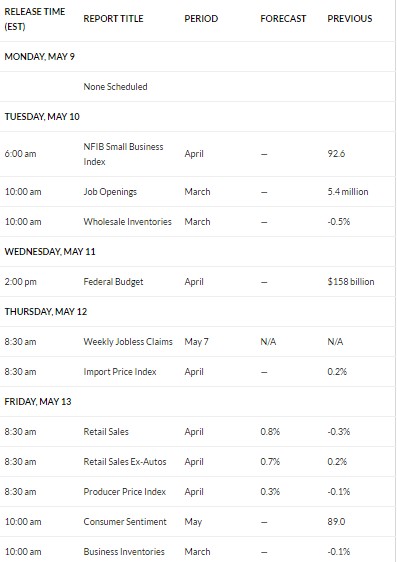
Investors who get easily bored of economic statistics will get a break with an unusually light calendar this week. The most important data point is on Friday with the Producer Price Index, which is expected to hit an annual rate of 3.6%. This would mark the biggest increase since December 2013. The number includes the pop in Crude prices, and is likely to produce a market reaction to the downside.
The other area to watch is Friday’s release of April Retail Sales. Economists are looking for 0.8% overall. This is a very ambitious forecast. So, overall, Friday is the most important day when the Washington Data Factory will have an impact on the market.
HIGH YIELD CORNER
The last week has been one of significant activity and significant stability in the high yield market, depending on which corner you look at.
Municipal bonds ended the week flat to close year-to-date up 1.5%, as evidenced by the iShares S&P National AMT Municipal Bond Fund (MUB: $112). The reason for the stability is quite clear: municipal bond defaults are rare and not rising. This is not the message many investors are getting, as the high profile non-payments in Puerto Rico have brought the municipal bond market back into the spotlight.
Besides defaults, municipal bonds tend to have less risk than corporate bonds or stocks, and their tax free payments make them attractive for retirees looking to receive tax-free income immediately. Defaults have remained absurdly low, far less than a tenth of 1%, according to Moody’s. That’s substantially less than the over 4% default rate that the corporate bond market is seeing, which is why municipal bonds pay a significantly lower yield than corporates. It’s also why municipal bonds and bond funds have considerably less volatile prices than corporate bonds.
And this was a bad week for corporates, especially high yield bonds. The SPDR Barclays Capital High Yield Bond ETF (JNK: $35) lost 1.7% with every day of the week slightly lower. As we noted last week, the junk bond market has been getting complacent, and in this week we may see that investors are getting a little too worried about that complacency. Yields on junk bonds have gone up over the last week, but remain still over 2 percentage points below their highest this year, indicating more price declines could be coming for the junk bond market.
Part of the pressure on bonds was a rash of disappointing results from Business Development Companies (BDCs.) Hercules Capital (HTGC: $11.90), Pennant Park Floating Rate Capital (PFLT: $11.70), Pennant Park Investment (PNNT: $6.10), THL Credit (TCRD: $10.55), Golub Capital BDC (GBDC: $17.10), Triangle Capital (TCAP: $17.40), and TPG Specialty Lending (TSLX: $16.00) all reported NAV declines, with Ares Capital (ARCC: $15.20) being the rare BDC to see a NAV increase. Worries about the quality of debt holdings and the ability of debtors to pay their debts are mounting, despite BDC price growth over the last few weeks. With these soft results, investors are being a bit more cautious about both BDCs and junk bonds.
With all the fears in the debt world, it was refreshing to see property REITs recover last week, as the SPDR Dow Jones REIT ETF (RWR, $97) shot up nearly 5%. That’s a strong recovery over the previous week’s declines, especially in the week before many REITs begin reporting results. Likely, the flow of money into some REITs is the result of investors predicting that the quarter won’t be as bad as many fear. So far, some big names have already reported with mixed results. Bull Market Report favorite Omega Healthcare Investors (OHI: $34) reported a 2 cent FFO beat that puts the already well-covered dividend in an even greater margin of safety, while the company’s full-year earnings guidance was reaffirmed.
Going into next week, we remain interested to see how the debt markets play out and whether a new risk averse trend is growing. The results in the REIT world will also have a major impact on the high yield market, while municipals will likely remain a constant in a sea of turbulent waters.
The Options Corner
Naked Calls
Last week we talked about naked puts which is a way to bring cash into your account with little work. It can also be a way to buy a stock you like at a lower price than it is at present. But it is very risky. This week, we’ll cover naked calls. First: Is this risky? YES IT IS RISKY. It is the riskiest type of option trading – equal to selling naked puts. Why? Because you can lose more than you invested. Repeat – you can lose more than you have invested. Why talk about this then? Because in moderation, selling naked calls can be very lucrative.
Start with a stock that you don’t think will go up. Many times we are good at this without knowing it – in other words, we try to find a stock that will go up and it goes nowhere. Of course this never happens at The Bull Market Report, right? Right! Let’s use real numbers. We can’t use a stock that we have in one of our portfolios because we are bullish on them all, by definition. So let’s go out and find a stock that we think will do one of three things – go down; go nowhere; or go up just a little. How about…….. Cisco? We actually like Cisco so we wouldn’t want to use this one. How about…… Valeant – Well, we secretly think the selling of the stock is way overdone and just might be the turnaround of the year. So that won’t work. What about Herbalife (HLF: $64)? You remember this one. This is the stock that Bill Ackman shorted heavily, went public with his position saying the company was a Ponzi scheme and saying it was worth ZERO (the ultimate short of course.) Remember? Well, Bill has lost at least $2 billion on the short and maybe as much as $3 billion. (Note what we said about risk above!) Friday the stock was up big as the company said it is in advanced talks to settle an FTC investigation into claims that it's a pyramid scheme. The stock was up $5 or 9% to close at $64.
OK, naked calls. WHAT IF you think the rise in Herbalife is about over? Remember, this is your decision and will be based on the situation that YOU believe will play out. Just like buying a stock like Apple that you think has great value and will go up, thinking that Herbalife will not go much higher for various reasons is your decision that you will act on and in this case, sell naked calls on.
Why does one do this? Option is a wasting asset. It has a value now based on what it is really worth (intrinsic value) and what people will pay for it since there is so much leverage (time value.) If the stock stays the same in price the intrinsic value won’t change, but as time goes by, the time value of an option will move towards zero. And if you SELL an option you get cash in your account and can sit back and watch the time value of the option go away, making you a little money each day.
The August options expire a little over three months from now (the 3rd Friday is on the 19th.) This works out to about 100 days, so the math works out really well here. Listen to this: The time value of the option loses about 1% every day. Get it? 100 days of life in the option - it loses 1% a day. So if you have $10,000 in options that you have sold, you make 1% a day, or $100 a day. Not bad. Now it turns out that an option that is out of the money is ALL time value. There is no intrinsic value. That’s perfect for what we want to do here.
Let’s look at some real prices. Herbalife is at $65 now and was up $5 on Friday. Let’s say that you think the run-up in price is about over and you don’t think it will go much higher. Let’s say you don’t think it will get to $70. Now you must ask yourself that question that we have suggested that you HAVE to ask each time you deal with options, and that is: What is the chance that Herbalife will get to $70 by August 19th? To be safer, you could look at the $75 price level too.
The price of an August 70 call is just less than $5 and the August 75 call is $3. Obviously there is less chance the stock will get to $75 than $70, right? So let’s analyze both. If you sell 10 August 70 calls for $5, your account will be credited with $5,000 the next day. (Note that you have to use “margin” to do this, but if you keep your portfolio at your broker, they will tell you how much margin you have and how many options you can sell. There is no cost for this.) Now, the fun begins. If the stock stays at $65 or so for two weeks, there will be 14 fewer days of life. There will be about 86 days left. The option should be worth about 14% less (yea). You will have “made” 14% x $5000 or $700. If the option heads towards $60, that’s even better. The further away from that dreaded strike price of $70 the better. But what if the stock heads towards $70? Then the option will generally rise in price which can put you in the red. The key is to kill the days off one by one, without the stock moving up sharply to the strike price. You want to get to August 19th and have the stock be under $70 so the option expires worthless. It turns out that your breakeven price for the stock is $75. Above that you start to lose money on the trade. This is on the day of expiration. If it goes to $75 in the first few weeks, this is not a good thing because there is so much more time left in the option’s life and the stock could go even higher.
If the stock goes to $80 you will be down at least $5 per share or $5,000. If it goes to $85, you are out $10,000. Do you see the risk?
But if the stock stays below $70, you stand to gain $5,000 by putting up just the margin necessary to do this.
And the “safer” $75 call for $3? That would put $3,000 in your pocket if the stock does not get to $75.
All for now. Next week we will talk about strangles, where you sell a naked put and a naked call on the same stock.
Discussion of Stocks in our Portfolios
AmerisourceBergen (ABC: $77, down 9%) is the most recently added name to our group of favored stocks. So far the stock has not lived up to its billing. Last week the company reported its March quarter ahead of guidance but lowered the outlook for 2016 EPS from $ 5.75 to $ 5.50. The reason for the change is in their generic drug business where deflation is greater than at any time in history. This is clearly disappointing but not a life threatening development by any measure.
The stock got hammered. At the end of last week, the price was at our sell point of $77. We are reviewing our research on the company and will let you know our thoughts on the stock this week. This we know with certainty: The stock is valued at 14 times revised earnings while offering a 2% dividend yield. Earnings are growing faster than average while the stock is valued at just over one-half the overall market. In a normal market these are very positive statistics.
Gilead Sciences (GILD: $85, down 4%) The stock drifted lower last week much to our surprise. The news a week ago on Friday that the Judge in the case of Merck vs. Gilead was reopening the case did not get much press coverage. We think it could be huge for Gilead. This completely opens the issue of who actually own the patents for Gilead’s Harvoni and Sovaldi and Merck’s Zepatier. Sales of these products are more than $12 billion, so this is a really big deal.
Based on false testimony by a former Merck employee, the March ruling of $200 million in favor of Merck is likely to be thrown out. Merck could actually end up owing Gilead for royalty payments on Zepatier. Gilead could even deny a license to Merck. This is extremely good news and makes us all the more excited about owning the stock.
Barrick Gold (ABX: $18.47, down 90 cents for the week) Barrick Gold has been solid for some time now, rising from the $16 level in mid-April to its present level, after hitting $19.40 a week ago. Gold itself has moved up $50 in the same time frame, so one would think the stock would have moved up. But this doesn’t concern us but in fact boldens us as we are confident that stock will catch up to the price of gold. If gold heads to $1325 and higher, we would expect to see Barrick above $20.
Netflix (NFLX: $91, up $1 for the week) Netflix is recuperating from an earnings report this week that made some on Wall Street a bit wary. We think this new lower price level makes the stock even more attractive. The more we read about this company the more we like it. As the internet continues to disrupt the world we live in (think Uber, Skype, Facetime, Alexa) the more we think Netflix can take a huge chunk of the TV viewing world from the Big Three – ABC, CBS and NBC. Amazon is already doing it; Hulu too. And soon Netflix. Watch out for Netflix. There is big money to be made here and we think this company will be a leader. And they continue to add subscribers to their base at a rapid pace and all of them are potential TV subscribers as well.
Facebook (FB: $119, up $2) Facebook continues strong. Some folks on the Street including some of our readers have decided to cash in their Apple and buy Facebook. They consider Facebook the future and Apple the past. We are certainly not going to say anything like this but we are just telling you this as food for thought. Facebook had a good week amidst a rough one for the market and many our stocks. They reported a huge quarter with big growth on the top line and big growth to the bottom line of profits as well. Zuckerberg says they are just in the 2nd inning.
The Energy Corner
Notes at the Margin
By Phil Verleger
www.PKVerlegerLLC.com
Saudi Arabia - Ministry of Petroleum IS OUT: Ministry of Energy, Industry, and Mineral Resources IS IN
The story next week and for the rest of the year will be Ali Naimi’s dismissal. Bloomberg reports that according to the Kingdom’s official news agency, the Saudi oil minister will be replaced by Khalid Al-Falih, chairman of Saudi Aramco. In addition, the mandate of the Ministry of Petroleum will be expanded as it becomes the Ministry of Energy, Industry, and Mineral Resources.
Al-Falih’s views on oil were captured in an April interview with The Economist. In it, he revealed that senior Saudis were worried about peak oil demand: Mr. Falih says that many policymakers in Saudi Arabia think that because of climate change, rising fuel efficiency and other factors, oil demand will probably peak before the supply starts to run out. The timing of peak demand is unclear, but whether it is 15 or 40 years away, he says the pressure is on to transform the Saudi economy: “If we end up being too anxious and calling it sooner than it really happens, it’s going to be for our betterment, because we will be ready sooner than others.”
With this background, it seems likely that Saudi Arabia will push for a change in OPEC’s direction. At the organization’s June meeting, expect the Kingdom to call on OPEC to become a reporting and monitoring agency, one that collects and publishes data.
Prices will not fall immediately, though. The fires in Canada, terrorist attacks in Nigeria, and the collapse in Venezuelan output will support crude for a time. Still, the long-term consequences are clear. Oil is the new corn. Indeed, oil has been the new corn for some time. Prices will rise when supply falls relative to demand, and drop when supply exceeds demand.
Apple Corner
Apple, the value stock(!), was unchanged this week at $93. In a week of weak earnings reports and a ho-hum stock market environment, hanging in there unchanged is a good sign for the future. We can’t imagine Apple going any lower so we would certainly add here at these prices. The company will be buying back its stock aggressively, so you might as well be on the same side of the fence as corporate Apple.
Under Armour (US: $39, down $5) The stock has been under pressure for a few weeks, but we are not concerned. We just stopped in an Under Armour store yesterday and the place was packed. We had to wait in line for a cashier. We use their products – they NEVER wear out and every athlete we know wears their stuff. Cotton is toast (disruptive); Under Armour is a stock to own for the next 10 years.
Good Investing,
Todd Shaver, Editor in Chief