
The Week Ahead
The Dow Jones Industrial Average shook off its worst start to a year ever to score its best performance since 2013, as investors banked on an improving economy. What’s ahead for 2017? US-Russia relations, Trump-flation, and stagflation will be central themes. We see an Energy sector recovery gaining momentum. Higher interest rates could pressure stock prices. Gold could be putting in a bottom as we speak.
It’s a light week ahead for economic news. But here we provide some insights on our latest thinking for Opko, Apple, Microsoft, Facebook, Kinder Morgan, Twilio, Celgene, Gilead, Bristol-Myers Squibb, and AstraZeneca. Happy New Year!
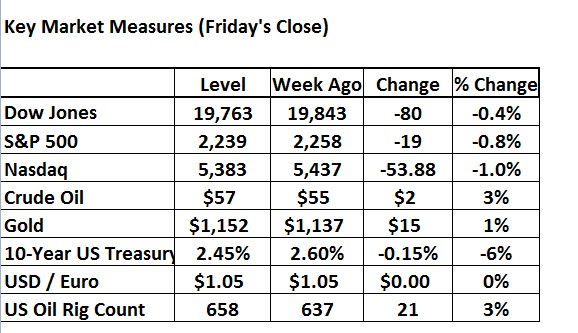
Highlights From The Past Week
US-Russia Relations. Trump and Putin have emerged as two of the most cunning leaders on the global scene. What these two men are up to in 2017 will certainly impact markets. Recently, Russian diplomats have been sanctioned by the US. Are dicey relations emerging? Putin says, “We reserve the right to retaliate, but we will not sink to the level of this irresponsible ‘kitchen’ diplomacy. We will take further moves on restoring Russian-American relations based on the policies that the administration of President-elect Donald Trump adopts.” Separately, the appointment of Rex Tillerson, Chairman and Chief Executive Officer of ExxonMobil, as Secretary of State, as well as various insinuations by the President-Elect to lift sanctions, all point to possibly greater oil production from Russia ahead. Russia has recently claimed that it will beat 2016’s estimated oil production total of 253 million tons in 2017.
Trump-flation. One idea most widely agreed upon is that Trump will spur inflation and US Treasuries are the last place to be. There is growing fear of a bond bubble. Trump-flation should drive equity prices higher and could kick-start a big rally in gold. We will be keeping an eye on inflation expectations in 2017.
Stagflation. Admittedly, the current economic expansion is quite advanced. It has already lasted about 18 months longer than the median completed expansion since the mid-1800s. And while expansions do not die of old age, history shows that they are at greater risk when spare capacity is exhausted, as it probably is now. So it is especially important to monitor whether growth may be running out of steam. The most important recession predictors, at horizons longer than the next few quarters, are spare capacity and past credit growth. Spare capacity has dwindled, which has boosted the recession probability somewhat, but output is not yet meaningfully above potential.
BMR Companies and Commentary
Opko Health (OPK: $9.30, -21% for the week)
Opko said its experimental drug for growth hormone deficiency (GHD) in adults failed to provide a statistically significant benefit over a placebo in a late-stage study. Investors were counting on the drug for future growth. Consequently, the disappointing news sent Opko’s shares much lower.
GHD is a rare disorder characterized by the inadequate secretion of the growth hormone from the pituitary gland, an organ responsible for the production of multiple hormones. The disorder can be hereditary, can be acquired as a result of trauma, infection, radiation therapy or brain tumor growth, and can even emerge without a diagnosable cause. OPKO was developing the drug with Pfizer to address GHD.
Is everything lost at this point? No.
While the recent study failed, Opko said it had started another late-stage study to evaluate the drug against Genotripin, which is another type of growth hormone disease more narrowly found in children. Opko will have world-wide collaboration rights and licensing rights with Pfizer for this drug to target Genotripin, if it is successful.
BMR Take: We have high hopes for this company and the new drug. We added the stock at $10 in September and it rallied to a shade under $12 just a few days ago. But Wall Street has been known for its mean responses to situations like this. They don’t have the patience that we generally have. So with that said, we are going to stick with our Sell Price of $8. If it hits $8 we are out.
Apple (AAPL: $116, flat for the week)
Some news just out - Apple will trim production of its iPhones by at least 10% in the first quarter of 2017.
The latest news comes after Apple slashed output in the January-March quarter of 2016 due to accumulated inventory of the iPhone 6S line at the end of 2015. That experience led Apple to curb production of the iPhone 7, introduced in September, by around 20%. Information on production of the latest models and global sales suggest cuts in both the 7 and 7 Plus lines in the coming quarter.
BMR Take: Don’t get too concerned about this discussion of product cuts in the first part of 2017. We have been talking about this for a while. Buy the stock on weakness. As we move through 2017, investors will be focused on growing anticipation around the iPhone 8 and a favorable long-term trajectory for Services growth.
With Trump working on a plan to help companies return the cash they hold overseas, there is no company that will benefit more than Apple, with their hoard of well over $240 billion in cash, most of which is overseas. We expect a good year for Apple’s stock performance in 2017.
Microsoft (MSFT: $62, flat)
Microsoft had a tremendous year in 2016. Let’s re-visit some of the big events. We understand it’s a backward looking exercise, but sometimes it’s helpful to do such a review in order to reaffirm our confidence that the franchise is on very solid footing.
Microsoft released its first major feature update for Windows 10. Dubbed the "Anniversary Update", this release featured improvements to the Start Menu, Action Center, Settings and Microsoft Edge, among other upgrades.
The Universal Windows Platform went even more universal this year, with Microsoft announcing Universal Apps for Xbox One. This unleashed a whole new market of apps for the Xbox, essentially turning it into a PC.
Microsoft surprised the entire gaming industry this year by announcing its brand new console, scheduled to launch in the fall of 2017, a whole year early. Microsoft originally had no plans to announce Project Scorpio in 2016, but with looming pressure coming from Sony and the PlayStation 4 Pro, the company felt they needed to get something out there and let gamers know Microsoft is serious about gaming.
Microsoft blew the crowds away with the Surface Studio announcement. It was known for some time that the company was interested in building an All-In-One PC, but we didn't know exactly what they had planned. When the unveiling finally arrived, the company once again proved to be staying current with product cycles.
The Creators Update is the next major version of Windows 10, scheduled to launch in early 2017 and is bringing several new features designed for creators.
BMR Take: The era for Microsoft under CEO Satya Nadella is blossoming. It is not just about all the product innovation discussed above that he is bringing to the forefront as a former engineer at the company. He is also quietly leveraging the balance sheet to buy back stock. In September 2016 he announced a $40 billion stock buyback program.
Facebook (FB: $115, -2%)
What’s in the news for Facebook lately? A bunch of noise about censorship. Facebook put a temporary ban on Kevin Sessums, who is well known for his celebrity profiles for Vanity Fair and two best-selling memoirs. The event triggered civil unrest over free speech and Facebook was painted as the enemy.
The journalist was temporarily banned from Facebook after sharing a post from an ABC political analyst, which called Trump supporters some derogatory names.
Facebook “reviewed and restored” Kevin Sessums’s ability to post messages. “We’re very sorry about this mistake,” a Facebook spokesman said. “The post was removed in error and restored as soon as we were able to investigate. Our team processes millions of reports each week, and we sometimes get things wrong.”
BMR Take: Facebook is on track to be the greatest advertising money-making machine of all-time. Censorship is a reality of the business, but not new nor disruptive. We think recent softness in the shares presents a great spot to buy more.
Kinder Morgan (KMI: $21, -2%)
Massachusetts has agreed to a $640,000 settlement from Kinder Morgan to allow the company to run a pipeline through conservation land in Berkshire County on its way from New York to Connecticut. The money will be spent on “mitigation and improvements” in the Otis State Forest and also to buy more conservation land in the area.
The Massachusetts Pipeline Awareness Network continues to object to the pipeline based on water quality concerns, and the disruption of stone walls important to Native American tribes.
There is a big shift going on regarding the above situation. A Trump administration is about jobs, jobs, jobs. He has been very outspoken about putting business above people’s sensitivities to the environment. The settlement Kinder Morgan just did may be a very early indicator of the courts moving in Trump’s direction to squash disputes and get business rolling. The Dakota Access Pipeline owned by Energy Transfer Partners (ETE: $36, a $20 billion market cap company) may be the first big test of this Trump concept. It will not be pretty if he reverses the hold that Obama has ruled.
BMR Take: Kinder Morgan is the best operators in a very tough business to enter. It requires a large sum of cash to acquire land rights to lay down a pipeline and a lot of expertise to obtain all the needed permits. With the energy sector on the recovery road, and Kinder Morgan’s un-rivaled assets, the outlook is very positive for the stock price.
Twilio (TWLO: $29, -10%)
While potential future competition from Amazon is a risk factor that investors must consider with respect to Twilio, today the Amazon relationship is healthy. The association is multi-faceted. First, Twilio runs entirely on AWS, Amazon Web Services. Second, Rick Dalzell (Amazon's former SVP of Worldwide Architecture and Platform Software and CIO) has been a member of Twilio's board of directors since 2014. Third, Twilio is already helping AWS build better products.
How tight is Dalzell to Amazon? Mr. Dalzell was Amazon CEO Jeff Bezos’ “right-hand man” at Amazon for a decade before retiring in 2007. As retold in the book, The Everything Store: Jeff Bezos and the Age of Amazon by Brad Stone, (a great book we have just finished reading and highly recommend), Bezos gave Mr. Dalzell quite a going away party: Four months later, enjoying retirement, Dalzell decided to visit his daughter in college in Oregon. His wife chartered a private plane for her husband, herself, and Dalzell’s parents. Strangely, their driver took them not to their usual airport but to a private airfield down the street from Boeing Field. Dalzell finally started to notice something was amiss when the car pulled up to a familiar hangar sheltering a Dassault Falcon. When he walked into the airplane, he found it full of friends, colleagues, and Jeff Bezos, all of whom shouted, “Surprise!” They were going to Hawaii for a gala given in appreciation of Dalzell’s longtime service. Andy Jassy, who attended the party, is the CEO of Amazon Web Services today.
Counter to concerns about the counterparty risk, in the near-term, the AWS relationship could improve, not get worse. At AWS re:Invent in November 2016, Twilio CEO Jeff Lawson hinted at an increasing level of collaboration between Twilio and Amazon when he said, "We're really excited to announce some upcoming collaboration soon."
BMR Take: Sentiment and the volatility in Twilio has been a roll coaster. The Amazon risk factor seems to be getting blown out of proportion right now. We actually like the prospects for the Amazon relationship in the near-term. As to the stock we remain a big believer in the company even as the stock is down dramatically from where we recommended it in October.
Celgene (CELG: $116, -3%)
Celgene must face a whistleblower lawsuit accusing it of promoting its cancer drugs Revlimid and Thalomid for off-label uses that were paid for by Medicare and Medicaid, a federal judge has ruled. Yikes! A U.S. District Judge in Los Angeles ruled that the lawsuit, brought by a former Celgene sales representative, can go forward for claims submitted to Medicare and most state Medicaid programs.
It’s not good, but things like this happen at big companies. Remember the London Whale incident for JP Morgan. Don’t panic.
There is much to like about Celgene. The drug in Celgene's lineup with the fastest sales growth is Otezla. Sales for the anti-inflammatory drug nearly doubled in recent quarters. Otezla appears poised to become yet another blockbuster for Celgene. Celgene's president of global inflammation and immunology, describes Otezla as transformational in the psoriasis market. When the drug was first approved, there was some skepticism about how it would compete against a crowded field of powerful biologics. However, Smith explains that 80% to 90% of Otezla patients weren't previously treated by biologics. Otezla didn't have to just grab its sliver of pie, it made the pie bigger.
BMR Take: Celgene hopes to expand the indications for Otezla. Late-stage studies are underway for treating ankylosing spondylitis (a form of arthritis affecting the spine and large joints) and Behcet's disease (a rare inflammation of blood vessels). Two mid-stage studies are also in progress for treatment of atopic dermatitis and ulcerative colitis. Celgene expects Otezla to reach peak annual sales of $2 billion if it wins regulatory approval for these additional indications. Rock on Celgene shares!
Gilead Sciences (GILD: $72, -3%)
Things are getting worse more slowly at Gilead Sciences, which should offer some comfort to investors. Recent data shows that total prescriptions for the company’s portfolio of hepatitis C drugs were down 4% in the fourth quarter compared with the previous three months. This is a significant improvement from the third quarter, when prescriptions were down by about 9%.
The stabilization should be a relief for investors. The stock has shed about 30% of its value this year as the hepatitis C franchise, which accounts for about half the company’s sales, has slowed down. A complete picture of the hepatitis C business won’t be available until Gilead reports fourth-quarter results in early February. So we are admittedly in more of a wait and see mode at the moment. In particular, our sources do not cover Gilead’s major customer the Department of Veteran Affairs, so there may be some inaccuracy.
BMR Take: We would be adding to our positions in Gilead here. The stock trades at less than seven times forward earnings estimates. Any glimmer of positive news will push the stock higher.
Bristol-Myers Squibb (BMY: $58, down 2%)
Bristol-Myers Squibb and Calithera Biosciences announced a clinical trial collaboration to evaluate Bristol’s Opdivo in combination with Calithera’s CB-839 in patients with clear cell renal cell carcinoma (ccRCC). CB-839 is an orally administered glutaminase inhibitor currently in Phase 1/2 clinical studies.
We will stop talking science right there.
Why does the above matter? We recently spoke to several executives at major Healthcare companies. All of them say the Opdivo franchise of Bristol will be a strong business for the company over a 5 year horizon. Bristol’s stock has been crushed because of some mishaps over Opdivo in the near-term. The above event just highlights there is a path forward for the Opdivo franchise, which our discussion with industry executives confirms is very likely to happen.
BMR Take: Don’t be timid here. Bristol is one of the top franchises in all of Healthcare. Now is an opportune time to be buying the shares for the long term.
AstraZeneca (AZN: $27, flat)
AstraZeneca has completed the sale of its small molecule antibiotics business to Pfizer. As part of the deal, Pfizer has acquired the commercialization and development rights of AstraZeneca’s approved antibiotics Merrem, Zinforo, and Zavicefta, as well as its ATM-AVI and CXL which are in the clinical development stage.
Pfizer has paid an upfront payment of $550 million for the late-stage antibiotics business in all markets where AstraZeneca holds the rights, mainly outside the US. Pfizer will make a deferred payment of $175 million in January 2019. Additionally, Pfizer had also agreed to make milestone payments for the small molecule antibiotics to AstraZeneca up to $250 million and up to $600 million related to sales and tiered royalties on sales of Zavicefta and ATM-AVI in select markets.
BMR Take: This deal was announced back in August. We highlight it again now because we are excited to see the cash flow on the way to AstraZeneca’s bank account. The cash cushion is like a 5% dividend yield at current levels. We see compelling value in the stock reaffirmed by the recent Pfizer deal.
Upcoming Economic News
It’s the first week of the New Year. Very light news flow. Lots more to discuss in the weeks ahead.
Have you heard about the BORDER TAX?
If not, READ THIS from Phil Verleger:
Notes at the Margin
Philip K. Verleger, Jr.
Former Director of the Office of Energy Policy at the United States Department of Treasury
Preparing for a Border Tax
This report can be described as nerdy or geeky. It never gets the attention that publications by Goldman Sachs, PIRA, or IHS receive. Its author is regularly ignored by the editors and reporters for Argus Media, the Energy Intelligence Group, and Platts. He is never invited to speak at conferences sponsored by these organizations, probably because he does not engage in the group think that is so essential to those attending. The lack of coverage is a source of dismay. We acknowledge, though, that the goal of our report is to inform and challenge, not to comfort. As noted last week, the oil industry prefers group think as it marches to oblivion.
However, the annoyance is offset by the fact that this publication was the first to understand the implications of the border tax adjustment proposed by House Republicans, a tax that now could become law. If it does, the change will impose billions if not tens of billions of losses on the industry. Most of those in it will be blindsided by this.
News organizations such as Argus Media, Platts, EIG, Financial Times, and The Wall Street Journal did not see the border tax coming.
Now as the tax comes hurtling toward us, everyone is scrambling to understand it. OPEC has been rendered irrelevant and the recent program to eliminate the global stock overhang “Trumped.” As The Wall Street Journal reports, House Ways and Means Committee chairman Kevin Brady intends to have a tax bill on President Trump’s desk within one hundred days of the inauguration. By May 1, the US may have a new corporate tax structure.
How the Tax Works
With apologies to readers who long ago moved away from algebra, we offer here a short mathematical explanation of how a border adjustment tax would work. Those not wishing to endure the pain—and believe me I understand—can jump to “Results” below. I add that the presentation here resulted from a long night lying in bed developing the equations as sleep refused to come. The equations have since been confirmed to be accurate and not the ramblings of a crazy insomniac.
Results. The analysis shows that domestic prices would be 25% percent higher with a 20% tax. Domestic prices would be 18% higher with a 15% tax.
The RACE
Google (GOOG: $772, down $18)
Apple (AAPL: $116, down $1) – Equivalent of $812, after reversing out the 7-1 stock split.
Amazon (AMZN: $750, down $11)
And let’s add Facebook (FB: $115, down $2) – Multiplying by 7 gives us a price of $805.
We’d say that Apple and Facebook are neck and neck. Google and Amazon had a rough week. Of course, we would put our money on all four of these great stocks. We just wonder who will win the race this year!
CBRE Group (CBG: $31, flat) continues on its powerful path to future success. We know how strong this company is in the commercial real estate world in NYC, London, Paris, Miami, Los Angeles, etc., but most on Wall Street don’t. But from the low of $23 in February we have seen a steady rise. We see no reason for this company to halt its tremendous growth. From $6.5 billion in annual revenue in 2012, to $7.2 billion in 2013, to $9.0 billion in 2014 and $10.8 billion in 2015, the company looks on track to report well over $12 billion in 2016, which we will be able to verify when they report earnings in the first week of February.
Earnings? From 86 cents in 2013 to $1.63 is pretty powerful. We expect around $2.20 for all of 2016. We’d buy this stock at $31, at $26 and at $36. We wouldn’t be surprised to see the stock in the 40s a year from now.
The High Yield Corner
By Michael Foster
An Integral part of The Bull Market Report Team
Happy new year everyone! 2016 was an exciting and eventful year both in and out of the markets. High yield investing had a banner year, with many assets reaching new heights while others saw intense volatility. The volatility wasn’t where most would naturally expect it; in fact, one of the biggest underperforming assets was municipal bonds, ending the year down slightly and falling 4% from their 2016 high.
This is partly why we hesitated to offer many muni bond picks this year (although more are coming very soon), limiting ourselves to just one high-quality muni fund: the Nuveen AMT-Free Municipal Credit Fund (NVG: $14.50), which ended the year with a 6% total return. That is better than many muni funds, thanks in large part to the fund’s strategic bond selection that has helped its NAV grow.
There were several picks that were much kinder to us in 2016.
At the end of February, we added our first high yield pick: the AllianzGI Equity & Convertible Fund (NIE: $18.40), which offered an 15% total return from the day when we picked it.
Shortly after recommending AllianzGI Equity & Convertible Fund, we recommended the Pimco Dynamic Income Fund (PDI: $28), which rose 22% since our recommendation. But even this stellar return was not our best performing high yield pick for 2016, but remains a mainstay of our high yield recommendations for 2017. This is a great, overlooked, high-yielding fund that offered a whopping 15% dividend yield including its December special dividend, which exceeded our conservative estimates with a $1.45 special payout on December 22nd. We were right to suggest keeping this fund for its special dividend, and we are confident it will continue to deliver in 2017 and beyond.
Our next pick is a classic story of growth and value: Digital Realty Trust (DLR: $98), which offered an 18% total return since our recommendation. This was the first of several REIT picks, and has withstood the recent correction in REITs that has tempered our returns and also urged us to be more cautious about the REIT universe in recent months. That caution is waning, however, and we expect to add more REITs to the High Yield portfolio throughout 2017.
In addition to Digital Realty, March brought Omega Healthcare Investors (OHI: $31) to the High Yield portfolio. Omega Healthcare has been a bit of a disappointment, falling 2% since our pick on a total return basis. However, its dividend has gone up twice in the 9 months since we picked it, and is set to continue to rise. If you bought this stock on our recommendation and held it have so far received a reliable 7% income stream that will continue to grow. Yes, the capital losses have offset that in the short term - but we recommend holding and waiting for the selling in Omega to stop. And we are confident that the selling will stop at some point in the next year.
Our final REIT pick for March was Kimco Realty (KIM: $25), which fell 3% on a total-return basis since our recommendation. Again, the massive REIT correction has caused the gains in this stock (which rose as much as 28% from our pick to its peak last year) has been the cause of this fall. We again expect this to be a short-term issue, as Kimco’s dividend coverage is better than the majority of REITs, and, like Omega Healthcare, Kimco raised its dividend after we recommended it.
Our next pick was admittedly a short-term dud: AstraZeneca (AZN: $27), which has fallen 7% on a total-return basis since our recommendation. However, we remain confident in the company’s product pipeline and remain confident that the political grandstanding about reigning in drug prices is more hot air than real policy, and drug companies will continue to financially benefit from improving people’s lives. Note that AstraZeneca and its biopharma peers fell steeply at the end of the presidential campaign as Hillary Clinton put them in the crosshairs; Trump’s recent populist snipe at these firms has caused that selling to continue. We expect this rout to abate next year as Trump’s policies on drug prices become clearer and less extreme. That makes AstraZeneca a better buy now than ever before.
Our next pick did so well that we had to change our target price several times. Main Street Capital (MAIN: $37) soared 26% at its peak and is up 24% from our recommendation date. Obviously this remains a good company, but is expensive at this level, which is why we remain cautious about buying it back now. But we do like it as a long-term dividend machine, although we remain worried that its price will correct in 2017.
We removed the stock at $37 in November. Here’s what we said in our newsletter of November 20th:
At the same time, we have finally gotten to a point where Main Street Capital has gotten overbought. The BDC is now up 16% from when we recommended it in April after rising 8% in the past month alone. We waited for this week’s dividend distribution to see if the stock would fall further after the payout, but it hasn’t; in fact the stock is up over 1% after its recent payout. That now means Main Street is selling at a 70% premium to its net asset value and it has passed our target price. We are keeping our price targets on Main Street, which means recommending selling at these levels and waiting for the price to correct before jumping back in. Main Street remains an excellent firm with impressive advisors and the capability to increase dividends for a long time, but the cost of that expertise and growth potential is too high now. We will buy again when the stock is more fairly priced.
In April we added a new and controversial REIT to the portfolio: Government Properties Trust (GOV: $19.07), which is up 11% since we recommended it. Shortly after we recommended this company, several professional investment bank analysts recommended selling it. The stock soared after they made the wrong call, and was up 40% at one point from the date of our recommendation. It’s corrected since then, but may return to that high point soon.
In September, we added a new Healthcare REIT to the portfolio: Care Capital Properties (CCP: $25), which has fallen 11% on a total-return basis since our recommendation. We ascribe that fall to short-term volatility and the broader correction in the REIT market. Nonetheless, the basis of our recommendation was its 8% dividend yield and the hopes for long-term capital gains. This short-term volatility, which has impacted all Healthcare REITs, should not be confused with the fundamental long-term strength of this company. We urge you to wait out this bump in the road and give Care Capital a chance - at least until a year has passed since our recommendation.
Our final recommendation in 2016 was Ventas (VTR: $62.50), which has gone up 5% since we recommended it in November. Again, short-term price gains are more a sign of volatility than anything else, so we won’t crow about this quite yet. In fact, the gains from Ventas help offset the declines in Care Capital Properties and provide a better averaged entry point for a diversified high yield portfolio. Still, it is far too early for us to see how our Healthcare REIT picks have shaped up, and we recommend holding all of these names until later in 2017 when the market’s mispricing of the industry and broader panic abates.
Overall, it has been a very good year for our High Yield portfolio. We had several double-digit gainers and an average yield of 8% across the portfolio. Providing an 8% income stream while also delivering capital gains across the portfolio is extremely difficult to do; in fact, many financial advisors will dismiss such a goal as impossible. Yet we have delivered it here at The Bull Market Report in 2016 and will deliver it again—and more—in 2017.
Equity Raise
The Bull Market Report will be raising some angel money this month directly from you, our subscribers, under a 506(b) offering, in order for us to grow the company to new heights. We want to increase the number of portfolios to at least eight and have 8-10 stocks in each. We wish to start an options newsletter, specializing in covered calls. We want to have more News Flashes each week. And we want to hire a CEO to run and company and add additional research analysts to give you the best consumer newsletter offering institutional-quality research.
We will be raising $100,000 or more from 2-3 investors and offering an equity stake in the company. If you are interested, write me directly at Todd@BullMarket.com. Include your phone number – I will call you personally.
Good Investing,
Todd Shaver
CEO, Founder and Editor
The Bull Market Report