
The Dow hitting 20,000 was no fluke. Today’s stock prices are well supported by solid prospects for corporate earnings and economic growth. In fact, if President Donald Trump can avoid stumbling into a trade war - or a real war - there’s no reason the Dow Jones Industrial Average can’t exceed 30,000 by the year 2025 or sooner. Clearly, part of the propulsion behind stocks has been the Trump administration and its flurry of business-friendly edicts. If Trump can succeed in reducing regulation and lowering corporate taxes, stocks could surge further this year. An additional 5% or even 10% gain in 2017 wouldn’t be surprising.
It was a strong week for the markets, with the S&P 500 closing up 1%. But the equity strength, driven partly by good earnings results so far, should give us pause. On Friday we saw fourth quarter GDP results come in below expectations. The market dismissed this entirely, and it’s not clear why. We suspect many investors shrugged at the news, thinking it’s old news and economic trends are fundamentally different in a Trump-led world. Nothing could be further from the truth. Despite his bombast, his ardent supporters and critics, and his aggressive use of executive orders, the economy does not hinge on the executive branch of the United States.
While the government can and does steer economic moods, animal spirits are aroused by many things. Ask yourself: Did you choose your last car because of who was president? Did you go out to dinner last night because Trump is president? Did you buy your house because of who is in the White House? For sure, government plans on corn subsidies, mortgage support via Fannie Mae and tax policies, and spending on infrastructure influence what we eat, where we live, and what we drive. But it’s very easy to over-estimate just how much of an impact there is, and it’s also easy to expect Trump to radically alter our consumption habits. Outside of Healthcare, there is little evidence to suggest Trump will change much else.
That may change, but until then investors should take a closer look at GDP announcements and other major macroeconomic indicators. It’s far too early to sell anything or change one’s market view. There is still broad strength and fairly valued or inexpensive assets out there.
This week we provide some insights on our latest thinking for PayPal, Facebook, Amazon, Celgene, Microsoft, and VMware.
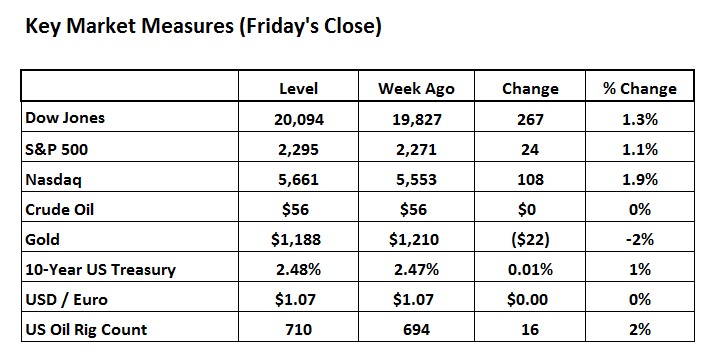
Highlights From The Past Week
Concerning the Auto Cycle. Despite record U.S. auto sales last year, the number of vehicles on car-dealer lots remains near record highs, and, as J.D.Power warned this week, 2016 ended with an inventory "bubble" that will require less production or more incentives to clear. With near record-high inventories of 3.9 million vehicles, U.S. auto inventory finished 2016 at about 66 days supply, up from 60 days a year earlier. Inventory would last 2.2 months at the November sales pace, according to the latest available data from the Census Bureau. The stock-to-sales ratio in 2016 is elevated compared to historical norms of 1.9 months.
California To Leave The United States? A proposal for California to break away from the United States has been submitted to the Secretary of State's Office in the state capital. If it qualifies, it could trigger a vote on whether the most populous US state should become a separate nation. The group behind the proposal, Yes California Independence Campaign, was cleared on Thursday by Californian Secretary of State Alex Padilla to begin the bid to collect some 600,000 voter signatures required to put the ambitious plan on the ballot. This would not bode well for the stock market. (Look what happened to Great Britain and Brexit.)
Let Trade Negotiations Begin. Starting With Mexico. Of the $300 billion in total Mexican exports (offset by $180 billion in imports), the largest two categories were electrical machinery & equipment, followed by nuclear reactors, boilers machinery & equipment, with motors only coming in third spot. But no matter the breakdown in categories, one thing is clear: Mexico needs the US - which imports over 80% of Mexico's net exports - and needs the NAFTA agreement far more than the US does. This is not to say that the US won't be impacted once NAFTA is eliminated. Trump began re-negotiating with Mexico’s President this week. Again, this could be rough sailing ahead for US stocks if things get messy. (How could they not?)
BMR Companies and Commentary
VMware (VMW: $87, +6%)
The company reported fourth quarter earnings. We observed more pieces of the puzzle coming together for VMware. revenue for 2016 was $7.1 billion, an increase of 8% from 2015. The CEO called the fourth quarter results “one of the most balanced quarters for VMware in years.” The tone of the earnings call was encouraging. Analysts were pleased with the strong product momentum and customer enthusiasm for the Cloud strategy. VMware is proving to the market that it has one of the world's most complete and capable hybrid cloud architecture, uniquely offering customers freedom and control in their infrastructure decisions.
Recall, in October, VMware and Amazon Web Services announced a partnership to provide a new VMware vSphere-based cloud service running on AWS. VMware Cloud on AWS will make it easier to run any application, using a common set of familiar software and tools, in a consistent hybrid cloud environment. This new service will be delivered, sold and supported by VMware and will be available later in 2017.
One of the best parts of the quarter was news of a stepped up buyback program. The company announced the authorization of an additional $1.2 billion of stock repurchases to be completed during 2018. The stock repurchase authorization is in addition to the company's existing $500 million stock repurchase program. This is big.
BMR Take: Management’s outlook for next year was as expected by consensus for the first quarter and slightly higher for the full year. Specifically, management tells us to now expect $7.6 billion of revenue this year versus consensus for $7.4 billion and EPS of $4.85 versus consensus of $4.65. All signs point to momentum and confidence building for the stock.
Amazon (AMZN: $836, +3%)
Amazon, aka the innovation machine, is at it again. Amazon’s next frontier to conquer? Auto Parts. Amazon boss Jeff Bezos, whose online behemoth is likely to become the country’s number one apparel retailer this year, is setting his sights on the next sector to dominate, the $50 billion do-it-yourself after-market Auto Parts business.
In recent months, Amazon has struck contracts with the largest parts makers in the country, including Robert Bosch, Federal-Mogul, Dorman Products and Cardone Industries. To further grease the wheels, it’s possible that Amazon may even snatch up some of the regional parts distributors.
This could spell bad news for the nation’s retailers - O’Reilly Auto Parts, Advance Auto Parts, AutoZone and Genuine Parts. The chains have prospered over the last several years as their profit margins have swelled, thanks in no small way to the iron grip they exercise on suppliers.
Amazon, which rang up revenue of $128 billion in the 12 months ended September 30th, could see its auto parts business expand more than 50% this year, to $5 billion. While some observers are skeptical that Amazon will succeed with auto parts as it has with books, electronics and toys, others aren’t taking Bezos’ moves lightly. He seems to just always figure it out after all.
Amazon recently widened its selection of name-brand parts — and is already selling them for less than its brick-and-mortar rivals. For example, a 34 Series RedTop Optima Battery was recently being offered at $166 on Amazon, versus $216 at AutoZone. In a September report, investment bank Jefferies said Amazon is offering same-day delivery for auto parts in 40 major US cities at prices that average 23% less than those of O’Reilly, Advance and AutoZone. That looks like disruption to us. What do you think?
BMR Take: There are two kinds of people in the world. Those that own Amazon stock and those that don’t. Those that do are on an enjoyable ride that just keeps on getting better.
Microsoft (MSFT: $66, +5%)
Microsoft delivered solid fiscal second quarter results, led by an upsurge in revenue and profits in the Cloud. There was some modest revenue and EPS upside to consensus estimates. Revenue was $24.1 billion versus $23.8 billion a year ago. EPS was $0.83 versus $0.62 a year ago. Most impressing, all segments were above consensus and operating expenses again came in below guidance. Customers are seeing greater value and opportunity as they partner with Microsoft for their digital transformation. Specifically, accelerating advancements in artificial intelligence across Microsoft’s platforms and services are providing further opportunity to drive usage growth of the Microsoft Cloud.
Business from Azure, the cloud-based business unit, surged over 90% from a year ago.
Microsoft’s Office business also had strong results as more of its customers signed on to use a subscription version of Office 365 software. Revenue rose 10% to $7.4 billion.
The category also benefited from $230 million in revenue that LinkedIn brought in for Microsoft after the acquisition closed. But LinkedIn lost $200 million during the period.
One of the biggest surprises of the quarter was a 5% increase in the revenue Microsoft received from personal computer makers for licenses to its Windows software.
This was the first quarter we saw any contribution from LinkedIn. Management’s guidance did not include any impact from LinkedIn, which was a point of some confusion for analysts, but really no big deal in our view. Specifically, the outlook for next quarter was slightly lower than expected for revenue, as not all the analysts knew whether or not to count LinkedIn, and if so how much, when establishing their forecasts in recent quarters.
BMR Take: We remain bullish considering operating momentum and the potential for estimates to move higher going forward.
PayPal (PYPL: $40, -3%)
PayPal delivered Q4 earnings in which revenues of $2.98 billion and EPS of $0.42 were both in line with consensus expectations. Management guided Q1 revenues to $2.9-$2.95 billion and EPS of $0.40-$0.42. Management’s outlook for 2017 was also slightly light with revenues expected of $12.55 billion as compared to the Street's $12.62 billion forecast. We are not concerned about these tiny adjustments.
Analysts were generally constructive towards the quarter. Total Payment Volume growth spooked some given the deceleration to 25% versus the heightened expectations calling for 29% growth. With that said, it was a solid quarter overall and many analysts were impressed by the momentum seen in (i) new customer accounts,* (ii) steady operating margins, and (iii) transactions per account increasing to 31x from 27x in the prior year. The potential for increasing strategic partnerships was one key highlight to be excited about. In particular, it was alluded that PayPal is in talks with Amazon (AMZN) about a payments partnership. We hope to hear more soon!
* Growth of 5.4 million active customer accounts in the quarter. Active customer accounts of 197 million, up 10%. with growth of 18 million active customer accounts versus last year. (Huge.)
BMR Take: Not a blow-out quarter for PayPal, but respectable; solid. We continue to be very bullish on the long term picture. Did you hear about India moving to a cashless economy? Such a trend could be a massive tailwind for digital payments platforms like PayPal.
Celgene (CELG: $114, +1%)
We remain bullish on Celgene as total revenues are expected to rise to $21+ billion by 2020. We expect Celgene’s four blockbuster drugs (Revlimid, Abraxane, Otezla, and Pomalyst) to drive revenues over $13+ billion in 2017. The recent acquisitions of Receptos and Delinia, as well as investments in collaborators like Acceleron, Epizyme, OncoMed, Agios, and others likely ensure growth from 2017 and beyond.
Further reaffirming our confidence in the outlook, we just received this week some favorable news about the blockbuster drug Revlimid. Specifically, Celgene received a positive CHMP (Committee for Medical Products for Human use) opinion to expand the use of Revlimid as maintenance therapy for patients newly diagnosed with multiple myeloma post autologous stem cell transplantation. The European Commission, which generally follows the CHMP’s recommendation, is expected to make its final decision in about two months. If approved, Revlimid will be the first and only licensed maintenance therapy available for these patients, further expanding its applicability across the disease spectrum of multiple myeloma and solidifying its leadership position in this area. Exciting!
BMR Take: Healthcare is a tough sector right now given the regulatory risk of imposing pricing deflation by the new administration. However, Celgene has four blockbuster drugs to carry big time revenue growth over the next several years. Accordingly, Celgene is our top pick in this sector.
Facebook (FB: $132, +4%)
Getting excited for the Super Bowl? Mobile upgrades are a touchdown for Super Bowl fans and Facebook. Super bowl tickets might cost thousands of dollars, but many attendees will spend much of their time texting, tweeting and posing for selfies. Being unable to post that one-handed touchdown catch or epic halftime performance on Facebook would be catastrophic. Until recently, that kind of frustration was the reality for mobile-savvy Texans fans at NRG Stadium.Before, you'd basically just sit there and drink your beer and wouldn’t bother messing with your phone. But the NFL's decision to grant Houston the 2017 Super Bowl helped prompt wireless providers to upgrade infrastructure at the stadium. Wi-Fi has been introduced. Prior, if you were with certain providers, it was not even worth bringing your phone in the stadium. Now, every phone has the ability to connect.
To prepare for this year's game, Verizon has spent nearly three years designing and building a system of 780 small antennas in the stadium. It also added antennas throughout, providing capacity equal to 54 cell towers. As of last February, it had spent more than $40 million on this distributed antenna system.
BMR Take: It doesn’t get much bigger than the Super Bowl and one of our favorite stocks, Facebook, will be right in the mix of things with millions of users at the game and at parties around the country sharing their fun with friends and family on the platform.
Facebook had a blowout week, up 4% setting all-time high this week of $133.50. The market cap is now $380 billion, running neck and neck with Amazon (at $395 billion), but still far behind Google ($575 billion) and Apple at $640 billion, the largest in the world. Do not think Facebook is done. Everyone we know uses Facebook. The women in our personal world are on Facebook for hours a day – we are not kidding. The Bull Market Report has decided to use Facebook now for advertising, instead of Google AdWords. 1.8 billion users and climbing, and run by one of the smartest men in the world.
Upcoming Economic News
MONDAY, JANUARY 30
Personal Income & Spending – December
Time: 8:30 am
Forecast: 0.4% income, 0.5% spending
Strong gains for average hourly earnings can put a halt to the decelerating growth trend in wage and salary income. Wages and salaries grew 4.1% year-over-year in the quarter ending November, the slowest pace in six months. But with average hourly earnings expanding at a 7-year high rate of 2.9% yearly, the tightening labor market is giving an added kick to income and spending.
Pending Home Sales Index - December
Time: 10:00 am
Forecast: 1.5%
Rising demand for home mortgages have the Pending Home Sales Index poised to expand in December after the significant decline in the previous month. The moving 4-week average of the MBA’s index of mortgage applications for home purchases is within 1% of the highest such value since June. To the extent that buyers are eager to head-off potential additional rate increases, the long-term uptrend in home sales will be sluggish at best.
TUESDAY, JANUARY 31
S&P CoreLogic Case-Shiller Home Price Index – November
Time: 9:00 am
Forecast: 5.0% yearly change in 20-city index
Tight housing inventories can help the Index maintain the 4-6% annual growth pace that has held for over two years. The 1.9 million existing homes available for sale in December is 27% under the historical average. Though growing briskly, the still depressed level of new home construction gives limited relief to the price-boosting lack of inventory.
Conference Board Consumer Confidence – January
Time: 10:00 am
Forecast: 112.8
The Conference Board measure of consumer confidence will perhaps step back in January after soaring to the 15-year high in December. The burst in optimism was led by the near 20 point jump in the expectations since October, as consumers anticipate great improvements in economic conditions. Yet the limitations of an aged recovery may serve to dampen such inflated attitudes in the months ahead.
WEDNESDAY, FEBRUARY 1
ISM Manufacturing Index – January
Time: 10:00 am
Forecast: 54.8
Positive short-term momentum for the Industrial sector can prevent the January ISM Manufacturing Index from backsliding after reaching the 2-year high in December. Industrial production expanded annually for the first time in 16 months, rising 0.5% year-over-year in December. Relief from the deep past declines in Mining and Utility sectors output will remove major drags on overall industrial sector performance.
Construction Spending – December
Time: 10:00 am
Forecast: 0.3%
Consistent gains in residential activity can lead overall construction spending higher for the third straight month in December. Housing starts rose 7% year-over-year last quarter, the quickest gain of the past three quarters. That positive trend is joined by private nonresidential construction, which expanded 6% year-over-year in the three months ending November.
FOMC Rate Decision
Time: 2:00 pm
Forecast: 0.5-0.75% fed funds target range
No significant action on monetary policy is likely in February after the Federal Reserve moved in December to lift its rates for the first time in a year. Continued uplift for prices and wages can keep the Fed on track to make three quarter-point rate hikes in 2017. Yet dollar strength and the limited feed-through from wages to prices can dampen inflation, allowing the FOMC to act more infrequently.
Vehicle Sales – January
Forecast: 17.7 million annualized
Vehicle sales are forecast to drop in January after leaping to the 11-year high in December. Heavy incentives have helped. Yet after managing a mere 1% year-over-year gain in the fourth quarter, no further maneuvering from sellers is likely to recapture the strong sales growth seen earlier in the recovery.
Productivity & Unit Labor Costs – Fourth Quarter
Preliminary Time: 8:30 am
Forecast: 0.5% productivity, 2.4% unit labor costs
Slower output growth and accelerating wage growth is expected to greatly limit the rise in productivity in the fourth quarter. Even after growing at the 2-year high rate of 3.1% annualized in the third quarter, productivity showed no change year-over-year. Reduced investment in heavy industry and restrained consumer demand has held back productivity gains over the long-term.
FRIDAY, FEBRUARY 3
Employment Report – January
Time: 8:30 am
Forecast: 163,000 non-farm payrolls, 4.7% unemployment rate
Job growth is projected to grow admirably in January, keeping new unemployment insurance claims near multi-decade lows. Though the yearly increase in nonfarm jobs has slowed to 2.2 million from the cycle high of 3.1 million, gains are more than keeping up with the rate of population growth. That trend will start to put more upward pressure on wages provided that the economic recovery persists.
ISM Non-Manufacturing Index – January
Time: 10:00 am
Forecast: 57.0
Steady demand for services can keep the January ISM Non-Manufacturing Index near December’s 14- month high. Real spending on services lagged for much of the recovery, yet it has stayed above 2% since late 2014. That area of spending is likely to stay firm in the near-term, with the orders component of the Non-Manufacturing Index reaching the 16-month high of 61.6 in December.
Factory Orders – December
Time: 10:00 am
Forecast: 1.1%
As with the expected outcome for durable goods orders, overall factory orders can reverse part of the steep November decline and turn higher in December. The first two months of last quarter brought strong gains for core capital goods orders. That raises the odds that real investment spending outside of inventories can quickly undo the 0.5% yearly decline recorded to the third quarter.
A Word from Gary Jefferson
Jefferson Financial Group
First Vice-President, Investments
UBS Financial Services, Inc.
A week ago Friday was quite an historic day – not for the stock market but rather for the United States of America. It could, however, be the beginning of an historic period for certain stocks and industries – what some call "an epic opportunity". It involves President Trump's proposed policy changes that could positively affect (in a major way) specific industries and companies in the next few months – and some stocks almost immediately. The last "epic opportunity" like this was in 1981 following President Reagan's election. His new pro-business policies sent the economy and certain stocks soaring. If Yogi Berra were to opine on the situation today we believe he would say, "It looks like déjà vu all over again".
First things first, however. The macro backdrop is already very favorable for anything else that could add to it. Today we have continued global growth, central bank support and an improved earnings outlook not only in the U.S. but also abroad. Now add to this the profound policy changes likely to be implemented: repatriation of trillions of dollars; trillions of infrastructure stimuli and the revision of one-sixth of our entire economy (healthcare). The "epic opportunities" abound in companies and entire industries that could benefit greatly from these and other policy changes. Some of the beneficiaries would almost certainly include corporations with large off-shore cash holdings, steel and other infrastructure industries and certain healthcare businesses.
That said, a quick caveat: Expectations for growth have improved post-election but so have valuations and sentiment – especially in some of the stocks widely expected to be the beneficiaries of coming changes. Because of the big post-election rally, stock and sector selection is at a premium. The S&P500 started the year at 2258, however, and has effectively gone nowhere for the past three weeks (today sitting around the 2266 level). We believe opportunities still remain across a subset of the market including, in particular, parts of the healthcare, energy, infrastructure and technology sectors, among others. We also believe merger and acquisition activity should pick up in the year ahead as a result of the potential influx of cash from repatriation and lower corporate taxes, and this could further broaden the scope of opportunities.
Finally, don't forget about interest rates, The rising rate policy, while not new, is certainly significant. We believe it is almost a certainty that rates continue to rise throughout the coming year. A Wall Street firm recently posted their latest equation on rising rates: "Rates still historically low + Signs of rising inflation + Economic acceleration + Growth oriented Trump policies = Higher Interest Rates".
Rising interest rates are not necessarily a bad thing. In fact, Stock Trader's Almanac has documented that stocks generally have performed well during the first few years of a new rising interest rate cycle. So, we'll add our own equation to the overall market scenario: "Favorable macro-economic backdrop + Beneficial Trump policy + Positive rising rate cycle = Epic Opportunities in the stock market."
Letter to the Editor
Hi Todd, Congratulations on your almost perfectly timed exit of Qualcomm. Do you have any updated thoughts now that the stock is much cheaper than your exit point?
Mike Jones
Editor’s Note: We exited Qualcomm (QCOM) on October 30th last year at $69 for a 59% gain in 10 months.
Hi Mike –
Qualcomm is an amazing company. They mint cash and have great management. So if the stock market holds from here the stock will hold as well. If the market is headed to 21,000 then QCOM will easily head back to $65 and higher, after the lawsuit with Apple blows over.
Thanks,
Todd Shaver
Apple Short Interest Falls Sharply Over the Past Two Weeks
The number of shares sold short in Apple fell by 3.1 million for the two-week period that ended January 13. That left the total at 44.5 million. For the period, Apple was the 12th most shorted stock on the Nasdaq. Our take is that being the largest market cap in the world there will always be naysayers out there. With 5.3 billion shares outstanding, 44 million is a drop in the bucket – it’s actually less than 1%. So we are paying this no heed.
Alphabet Reports 8% Profit Increase on a 22% Revenue Gain
Earnings: $6.6 billion vs. $6.0 billion. last year, 9.1% growth
EPS: $9.36 vs. $8.67 last year.
Revenue: $26.1 billion vs. $21.3 billion last year.
Revenue Change: 22%.
All in all a huge quarter. Again. We will report more in-depth information in a News Flash Tuesday morning.
Microsoft Sets New All-Time High
We have Microsoft (MSFT: $66, up 5%) in our Stocks for Success portfolio and with good reason. The all-time high of $120 was set in 1999 just before the dotcom crash of early 2000. The stock subsequently split 2-1 for the all-time high of $60 stood until late last year. But this week we saw the stock hit $65.91 giving the company a market cap of $511 billion. If you are not an owner, don’t despair. The stock is headed to $70 and $80 and beyond. Just be patient.
Opko Health (OPK: $8.69, up 1%)
We read this amazing article in Forbes on the company and its founder. If you have the stock or are thinking about buying at these new lower levels, you have to read the article. It is called: "A Bountiful Mind: Forget the 30 Under 30. If there were an 8 over 80, it would include Phillip Frost – doctor, investor, inventor." Frost is the CEO of Opko and after reading this article, if we at The Bull Market Report invested in our stocks, which we don’t, we would take a lot of our pennies and dollars and invest in this man. Read for yourself:
https://www.forbes.com/sites/schifrin/2017/01/03/meet-miamis-renaissance-billionaire/#3912053b7306
The chart here lists all of Frost’s and Opko’s investments. This list is AMAZING, and we are not exaggerating. We would strongly suggest that some or all of them will pay off in the future.
https://www.forbes.com/sites/schifrin/2017/01/03/the-buffett-of-biotechs-portfolio/#5cd7e7c3a4a3
BMR Take: We have a Sell Price of $8 on the stock, but we are contemplating buying more if it hits this level. Stay tuned. And write us here after you read the article: Info@BullMarket.com. We would love to hear your thoughts.
Notes at the Margin
by Philip K. Verleger, Jr.
Former Director of the Office of Energy Policy
at the United States Department of Treasury
In Denial: The Oil Industry’s Cluelessness about Trump
To emphasize Trump’s “America First” focus, his transition team outlined some goals on The White House website minutes after he took office. The first item under the “Issues” tab is “An America First Energy Plan,” which includes this text: “We must take advantage of the estimated $50 trillion in untapped shale, oil, and natural gas reserves, especially those on federal lands that the American people own. We will use the revenues from energy production to rebuild our roads, schools, bridges and public infrastructure. Less expensive energy will be a big boost to American agriculture, as well.”
The source of the $50 trillion estimate is not explained. The number implies that US oil and gas reserves total one trillion barrels if one assumes a price of $50 per barrel. This in turn implies that US oil and gas production should rise to the equivalent of 140 million barrels per day, a number completely at odds with all other calculations. One must leave it to The White House to explain. [Note: The world consumes 95 million barrels a day.]
The “American First Energy Plan” also asserts that “President Trump is committed to achieving energy independence from the OPEC cartel and any nations hostile to our interests.” This US policy change suggests the risk of investing in drilling projects here has dropped sharply. Firms can take greater chances going forward, knowing that any effort to “cap US shale activity” will be countered by a Washington government determined to protect US crude oil producers aggressively. The United States will now benefit from improving technology, greater access to resources, and our president’s desire to put America first.
An import fee or Border Adjustment Tax (BAT)* would eliminate most if not all the incentive for US producers of crude oil or products to export. In the case of a tax of, say, 25%, the effect is obvious. The cost of one barrel of crude to a US refiner would rise from $53, its closing value Friday, to $67. Producers in the Permian Basin or North Dakota could realize similar prices by selling to domestic refiners. Their realizations would fall to less than $54, though, were they to export.
The implementation of an import fee would give producers every reason to keep their oil in the US. With a fee in place, the United States would export as little oil as possible. The millions invested in export facilities on the US Gulf would go to waste. Some of the expenditures on natural gas export facilities might also go to waste as the increase in domestic oil prices might heighten the opportunity to displace oil with gas and the resulting higher prices could make exporting US gas unprofitable.
Refiners, too, would have far less interest in exporting if the Trump administration imposed a fee. Why, for example, would Marathon Petroleum or Valero accept $65 to $70 per barrel for products sold to buyers in Europe if buyers in New York and Boston would pay between $80 and $90? They wouldn’t. Instead they would rush to charter Jones Act ships to move product from the Gulf to the Northeast. Charter rates for those vessels would jump.
*Do you want to read more about the BAT? Go here:
http://www.forbes.com/sites/anthonynitti/2017/01/26/the-border-adjustment-tax-for-dummies-who-will-pay-for-the-wall/#d23a5eb15b68
The High Yield Corner
By Michael Foster
In the high yield world, the recovery in junk bonds hasn’t ended. There’s still good reason to think more investors will buy the growing number of corporate bonds that will be issued in the future, even with interest rates rising. But we don't have as high of a conviction to buy high yield assets as we used to. That’s why we’re keeping a close eye on our portfolio and looking to sell as assets hit our price targets.
This is especially the case with some strong performers in our portfolio, many of which beat the S&P 500 this week (and have been beating the index since we recommended them). The AGIC Equity and Convertible Income Fund (NIE: $19.10, up 2%) had an excellent week and is closing in on a 20% total return over the last year. The fund’s strong performance is largely the result of investors rediscovering convertible bonds, which were out of favor during fears of the now priced-in interest rate hikes the Fed is ready to hand us. Now that the market has priced in this risk and accepted it, more investors are realizing that convertibles offer equity upside on top of an income stream and can outperform in bull markets. So this fund’s net assets have increased in value, driving the fund upwards with it. We still want the fund’s discount to NAV to narrow a bit before selling; right now we're getting assets at a 12% discount. The stock continues to be a strong income producer and a great hold.
An even better showing came from our REITs. The SPDR Dow Jones REIT ETF (RWR: $92, up 1%) underperformed all of our REIT picks, of which Digital Realty Trust (DLR: $106, up 3%) was the best performer by far. Digital Realty is an odd pick for us, because it’s as much a growth company as a high yield play. What’s more, since going up over 40% in a year for us, it’s less of a high yielder than it used to be. But the good thing is that valuation metrics (price-to-FFO being the most important) don’t make it a particularly overpriced stock despite the strength, thanks to high net income growth that’s been sustained for years. Despite yet another strong week, we’re not ready to recommend selling the stock just yet.
We’re also seeing improvements in the Healthcare REIT world. Omega Healthcare Investors (OHI: $32, up 2%) and Care Capital Properties (CCP: $24, up 1%) have continued their recovery just a couple weeks before these companies report earnings. There’s still a lot of way to go, with both stocks down from a year ago. A few things have hurt this sector. Underperformance at HCP, Inc. hurt the entire industry. Worries about higher interest rates depressed REITs in the second half of 2016 after falling in 2015. Perhaps most significantly, concerns about the future of the Healthcare industry in a post-Obamacare world have raised many uncomfortable questions about Healthcare stocks in general. These risks were fully priced into these companies a long time ago, and they keep providing strong income and sustainable growth. Now is hardly the time to shy away from either company.
On the topic of healthcare, Astra-Zeneca (AZN: $27, down -2%) remains our worst performer among our high yield picks, and is now down 14% over the last year. We need to wait this out. Astra-Zeneca saw its operating margin rise in 2015 after many years of declines, and the company’s drug pipeline remains healthy. As with the Healthcare REITs, this company has been hit by worries about the future of healthcare, and that makes us more convinced that now is the time to buy and hold this company. Wait out the fears, because they will eventually change when we learn more about the future of healthcare in Trump’s America. Now is not the time to give in to fear and sell.
Good Investing,
Todd Shaver, Founder and Editor in Chief
The Bull Market Report