
The Week Ahead
“Kraft Makes Surprise Bid For Rival” was the weekend’s front page Wall Street Journal headline. The deal would be one of the biggest ever valued around $150 billion, ranking 2nd. However, it was flat out rejected on the premise of not being enough. Analysts expect Kraft to up the ante, perhaps substantially, so we could soon see the biggest deal ever in the next week or so. The largest deal so far was Vodafone buying Mannesmann for $172 billion in 2000. The second largest deal was Verizon Communications buying Verizon Wireless for $130 billion.
Why is all this M&A monitoring so important? If this deal passes, we would now have seen four out of the top five deals of all-time occur in the past two years. This flurry of mega deals reaffirms the strength of today’s bull market, which is perhaps turning into the greatest bull market of all-time.
Ha. This just in as we go to press. Kraft has withdrawn its bid. Story over for now.
The reality is, no matter what, there is always a bull market somewhere and you can always find it here. This week we highlight evidence of a bull market in the following securities: PayPal, Apple, Kinder Morgan, Home Depot, and Eli Lilly.
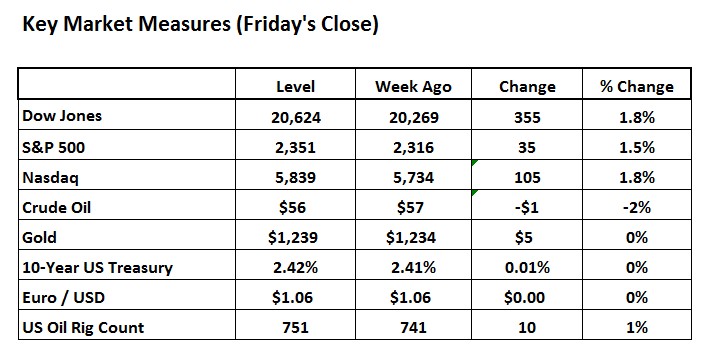
Highlights From The Past Week
Auto Bubble Bursting? For years there has been concern that record auto sales have been propped up by (i) low interest rates, (ii) a perpetual loosening of auto lending standards with terms being stretched to the max, and (iii) a wave of leases. All of these factors have allowed the American consumer to trade up to more expensive vehicles while maintaining low monthly payments. A quick look at the 61+ day delinquencies in General Motors' subprime securitization book would seem to support the rather negative thesis on future auto sales. January 2017 delinquency rates soared to the highest levels since 2010.
Mark Zuckerberg Rejects "America First" Calling For Global Community. Take a few moments to read the internal memo that he sent out to all Facebook (FB: $133, flat) employees:
“On our journey to connect the world, we often discuss products we're building and updates on our business. Today I want to focus on the most important question of all: Are we building the world we all want? History is the story of how we've learned to come together in ever greater numbers -- from tribes to cities to nations. At each step, we built social infrastructure like communities, media and governments to empower us to achieve things we couldn't achieve on our own. Today we are close to taking our next step. Our greatest opportunities are now global -- like spreading prosperity and freedom, promoting peace and understanding, lifting people out of poverty, and accelerating science. Our greatest challenges also need global responses -- like ending terrorism, fighting climate change, and preventing pandemics.
“Progress now requires humanity coming together not just as cities or nations, but also as a global community. This is especially important right now. Facebook stands for bringing us closer together and building a global community. When we began, this idea was not controversial. Every year, the world got more connected and this was seen as a positive trend. Yet now, across the world there are people left behind by globalization, and movements for withdrawing from global connection. There are questions about whether we can make a global community that works for everyone, and whether the path ahead is to connect more or reverse course.
“This is a time when many of us around the world are reflecting on how we can have the most positive impact. I am reminded of my favorite saying about technology: "We always overestimate what we can do in two years, and we underestimate what we can do in ten years." We may not have the power to create the world we want immediately, but we can all start working on the long term today. In times like these, the most important thing we at Facebook can do is develop the social infrastructure to give people the power to build a global community that works for all of us.
“There are many of us who stand for bringing people together and connecting the world. I hope we have the focus to take the long view and build the new social infrastructure to create the world we want for generations to come.”
A $17 Billion Trade Gone Wrong. Many traders across the Street were talking all week about a multi-billion dollar forced short cover by Catalyst Funds' Hedged Futures Strategy Fund (HFXAX). The fund was short upwards of $17 billion of S&P 500 call options and got backed into a corner and had to cover the position. Many believe this event pushed the S&P 500 Index over 2,300.
BMR Companies and Commentary
PayPal (PYPL: $42, +3% for the week)
The European commission has quietly launched the next offensive in the war on cash. These unelected bureaucrats have boldly asserted their intention to crack down on paper transactions across the E.U. and solidify a trend that has been gaining momentum for years. The financial uncertainty amplified by Brexit has incentivized governments throughout Europe to seize further control over their banking systems. France and Spain have already criminalized cash transactions above a certain limit, but now the commission has unilaterally established new regulations that will affect the entire union. The fear of physical money flowing out of the trade bloc has manifested a draconian response from the State.
The European Action Plan doesn’t mention a specific dollar amount for restrictions, but as expected, their reasoning for the move is to thwart money laundering and the financing of terrorism. Border checks between countries have already been bolstered to help implement these new standards on hard assets.
The above event further reinforces the secular idea of a cashless economy. This environment would be terrific for a purely online payments service like PayPal, just terrific! We highlight some additional opinions from credible sources on the topic below.
Governments around the world have pushed forward their agendas towards a cashless society. Former Chief Economist at the International Monetary Fund (IMF), Kenneth Rogoff, published a paper last year advocating for the U.S. $100 bill to be removed. He wrote: “There is little debate among law-enforcement agencies that paper currency, especially large notes such as the U.S. $100 bill, facilitates crime: racketeering, extortion, money laundering, drug and human trafficking, the corruption of public officials, not to mention terrorism. There are substitutes for cash - cryptocurrencies, uncut diamonds, gold coins, prepaid cards - but for many kinds of criminal transactions, cash is still king. It delivers absolute anonymity, portability, liquidity and near-universal acceptance.”
Former Treasury Secretary Larry Summers wrote last year that the E.U. would likely be the trailblazer of the West towards this new digital model: “But a moratorium on printing new high denomination notes would make the world a better place. In terms of unilateral steps, the most important actor by far is the European Union. The €500 bill is almost six times as valuable as the $100. Some actors in Europe, notably the European Commission, have shown sympathy for the idea and European Central Bank chief Mario Draghi has shown interest as well.”
PayPal announced this past week that it is acquiring the bill payment firm TIO Networks, which serves as a major player in the North American bill pay market, for $230 million. This will continue to help PayPal become more embedded in all of our financial lives.
PayPal has 200 million customers now and TIO Networks will add another 15 million. The market is big for bill pay. In the US, 15 billion bills were paid online worth $4 trillion. PayPal wants in and with TIO processing $7 billion worth, this a strong step in the right direction. PayPal did over $350 billion in payment volume last year, so this acquisition is small by any standard, but the way PayPal operates we can see this business doubling and tripling in the next five years. PayPal is a patient company and this is just another step in the right direction.
BMR Take: We are keeping eye on government actions that accelerate the speed the world is traveling at towards a cashless economy. PayPal is a big beneficiary. We’re up 18% since we added PayPal last year. We think it is lagging a bit lately and would definitely overweight the stock here at $42. Our Target remains the same at $48 which we would hope to see sometime in the first half of this year.
Apple (AAPL: $136, +3%)
It’s 13-F season. The 13-F report is filed by all investment shops detailing their holdings. This is where anybody with a computer and the internet can peer into the investment portfolios of the best investors on the planet. Well, our curious mind traveled through quite a few of the filings. We were surprised – though not really – to see investor after investor had recently increased their stake in Apple. The list of famous investors includes Greenlight Capital, Berkshire Hathaway, and Third Point. Berkshire won the prize for the largest increase in the size of their position, +277%. We recall that Warren took a position in Apple in May, right at the lows. He now holds 57.4 million shares, worth $7.8 billion. (This is the influence of Warren’s new young bucks who are making many of the new decisions in the company as the founder is now 86.)
So something must be going very right. Big investors are buying. Goldman Sachs research raised their price target from $133 to $150. What is going on? It is slowly coming to light just how undervalued the Services business is. People still don’t widely appreciate that Apple’s Services business alone would be a Fortune 100 company. Services now contributes profit greater than all non-iPhone segments combined.
UBS research estimates that if Services were valued similarly to PayPal, shares would be at least 10% higher.
BMR Take: There are times to be a contrarian, but now sure does not look like one of those times. The Apple train is breaking new speed.
Consensus Ratings for Apple
1 Sell Rating, 10 Hold Ratings, 36 Buy Ratings, 2 Strong Buy Ratings
2/14/2017 Robert W. Baird Target: $145
2/13/2017 Goldman Sachs Target: $150
2/8/2017 Bank of America Target: $145
2/7/2017 Canaccord Genuity Target: $154
2/6/2017 RBC Capital Markets Target: $140
2/2/2017 Wells Fargo & Company Target: $117
Come on, Wells Fargo. Get with the program!
Apple set a new all-time high last week of a shade over $136. We hereby raise the Price Target from $140 to $155. Our Sell Price remains: “We would not sell Apple.”
Home Depot (HD: $143, +2%)
The Home Depot recently announced its first major investment in a wind-powered renewable energy project. The energy purchased from the wind farm is enough to power 100 Home Depot stores for a year while also providing $150,000 in local community benefits.
The Los Mirasoles Wind Farm, owned and operated by EDP Renewables North America, is located in Hidalgo and Starr Counties, near McAllen, Texas. Through a 20-year power purchase agreement, Home Depot's annual purchase of 50 megawatts (MW) is a fifth of the wind farm's 250 MW capacity. The farm utilizes Vestas V110 2.0 MW wind turbines and produces enough power to provide more than 70,000 average U.S. homes with clean electricity each year.
As a part of its renewable energy initiative, The Home Depot's goal is to procure 135 megawatts of various renewable energy sources, including solar and wind, by the end of 2020.
The company also procures energy from solar farms in Delaware and Massachusetts. More than 150 stores and distribution centers utilize on-site fuel cells that produce roughly 85% of the electricity each store needs to operate.
BMR Take: We are glad to see Home Depot acting more like Amazon by getting more deeply involved in all aspects of their business--even it has nothing to do with lumber. The behavior is likely to lead to many more good things to come for Home Depot. The stock hit a new all-time high last week and the company is now worth $175 billion. Management knows what they are doing and we see no reason why the stock can’t hit $160 sometime this year if the market stays steady to higher. We hereby raise our Price Target to $160 from $135 and raise the Sell Price from $105 to $130. We are up 20% on the stock since we added it a year ago.
Kinder Morgan (KMI $22, -3%, market cap $49 billion)
Kinder’s CFO John Edwards spoke to investors at the Credit Suisse conference on Wednesday. Some insightful perspective was shared. Below we review the key points.
Kinder has an unparalleled asset footprint. They are the largest Energy Infrastructure company in the United States. They are the leader in all of their business segments. They are the largest natural gas network in North America moving over 40% of the gas in the U.S. They are the largest independent transporter of petroleum products, moving a little over 2 million barrels a day. They are the largest transporter of CO2. They are the largest independent terminal operator with approximately 155 terminals. And in the Canadian segment, they are the only pipeline serving the West Coast. These assets make Kinder well-positioned to take advantage of growth in North American energy.
While it might not seem like it to the casual eye, Kinder Morgan has a much simpler structure now than a few years ago. There is one publicly traded equity security versus four a few years ago, and that security is very liquid. It trades over 15 million shares a day, and the management team that is aligned with investors. Management and directors, own about 14% of the outstanding shares, a good thing.
Having survived the latest energy downturn, management is more than ever focused on remaining cost conscious. They want to control costs. Some people refer to management as cheap, but they want to make sure that they are spending money where they need to spend money, and they are not spending money where they don't need to. They do want to spend money on their assets to keep them operating safely and efficiently. On 35 out of 36 of metrics, they rank better than the industry average. Wow.
There is a very deep pool of capital out there in terms of the Canadian pension funds, The company is currently considering a Canadian IPO to tap that money. The IPO would be attractive capital. It would be long term. It would allow for growth investments and balance sheet improvement (paying off debt).
BMR Take: Fellow shareholders, Kinder has the best assets in North American energy. They have a management team that could be flashy but is instead frugal. We may get access to a flood of Canadian pension money. Life is good.
Eli Lilly (LLY: $80, +3%)
Additional results from the pivotal RA-BEAM study were published in New England Journal of Medicine. The study on their arthritis drug is being done by Eli Lilly along with Incyte Corporation. The goal is to greatly improve treatments for arthritis.
The New England Journal of Medicine publication included supplementary data, which showed that starting as early as week 8, and sustained through week 52, a higher proportion of patients taking baricitinib (a drug fighting arthritis) achieved 50% and 70% improvement - compared to the old drug adalimumab. These improvements were statistically significant. A breakthrough!
Lilly and Incyte previously announced positive topline results of at least a 20% improvement.
This is an exciting time for rheumatology, with potential new treatments for arthritis. The RA-BEAM study of baricitinib is the first phase 3 trial showing that a once-daily, oral treatment significantly improved clinical outcomes compared with a current standard of care, injectable adalimumab used with background methotrexate therapy. These data demonstrate that baricitinib could provide another treatment option for people with arthritis.
BMR Take: Eli Lilly’s success with the arthritis drug just further shows the business has a healthy pipeline of new products and is not broken. The stock has had a big rally from $64 back in December to now $80. Between a favorable trial outcome and the big rally recently, the Lilly turnaround is manifesting.
Lilly has reached our Price Target of $80. We are up 18% from where we added it just two months ago. We hereby raise the Price Target to $88 and raise the Sell Price to $76.
Upcoming Economic News
WEDNESDAY, FEBRUARY 22
Existing Home Sales – January
Time: 10:00 am
Forecast: 5.55 million
Existing home sales look to move higher in January after sliding in December. Sales rose 7% year-over-year in the fourth quarter, keeping the housing recovery steadily on track. With only four months’ worth of inventory at the latest monthly sales pace, prices will continue to climb, encouraging more homeowners to sell.
FOMC Meeting Minutes
Time: 2:00 pm
The minutes from the uneventful February FOMC meeting will give some indications about what policymakers expect for growth and inflation. The outlook for the economy is clouded by the potential actions of the new administration. Yet some near-term upward pressure on prices and wages still keeps the Fed on track to lift its policy rate three times this year. SO THEY SAY. Who is they? The analysts and pundits. We at The Bull Market Report aren’t so sure. We are watching the 10-year note which is stuck at the 2.4% range. We are in the camp of LOWER interest rates ahead, not higher. Watching and waiting are we.
FRIDAY, FEBRUARY 24
New Home Sales – January
Time: 10:00 am
Forecast: 575,000
New home sales are projected to rebound sharply in January after slumping to a 10-month low in December. Even with the December setback, the sales pace remains exceptionally strong at 25% year-over-year in the fourth quarter. Growth in new home sales can continue to be stellar. The most recent monthly sales pace is 25% above the average of the past 20 years.
University of Michigan Consumer Sentiment – February
Final Time: 10:00 am
Forecast: 96.0
The preliminary value of the Michigan Sentiment Index showed above-average confidence despite slipping from January’s 12-year high. Consumers are starting to feel the bite of higher gasoline prices, as short-term inflation expectations rose to equal the 23-month high. But long-term inflation expectations are muted at just 2.5% annualized between five and ten years ahead, as a sustained acceleration in price growth is doubtful.
Our Favorite Warren Buffet Quote:
"You can't produce a baby in one month by getting nine women pregnant." -- Warren Buffett
Love it. Be patient out there.
More on Stocks We Love
CBRE (CBG: $36, up 5%)
CBRE set a new 52-week high this week and is within a whisker of the all-time high of $38.50 set in 2015. We see no reason why the stock can’t hit $40 this year. It hit our Price Target of $35 this week, so we hereby raise the Target to $40. We are changing the Sell Price to $32.
Annaly Capital Management (NLY: $10.82, up 5%). Why We Love Thee.
With an 11.1% dividend yield, it's one of the highest yielding stocks on the market today. It is a real estate investment trust and a Mortgage REIT, specializing in mortgage-backed securities, or MBS's. A REIT is simply an investment fund that owns income-producing real estate or real estate-related assets. Among other requirements, a REIT must invest at least 75% of its total assets in real estate assets and cash, and derive at least 75% of its gross income from real estate-related sources. And it has to pay out 90% of its income.
In Annaly's case, it doesn't invest directly in real estate, but rather in MBS's. These are fixed-income securities, much like bonds, that are backed by residential mortgages. Annaly invests in securities that are issued by Fannie Mae or Freddie Mac, and are thus backed by the full faith and credit of the United States government. It means that the risk that its assets will default is nil.
On Annaly's most recent balance sheet, for instance, agency MBS's accounted for $82 billion out of $88 billion in total assets.
Annaly's biggest task is to deal with the interest rate risk. Annaly uses leverage to buy assets. They borrow money at low short-term interest rates and invest that money in higher-yielding long-term assets - MBS's. The firm has $88 billion in assets, composed of $13 billion in equity and $75 billion in debt. Thus the leverage is about 5 to 1. In years past, this leverage has been as high as 10-1. We are pleased to see the leverage at this lower level. Annaly hedges the risk of rising short term rates by buying interest rate swaps. These are financial derivatives designed to lock in the cost of financing. Annaly has outstanding interest rate swaps of approximately $31 billion.
As we mentioned above, as a REIT Annaly must distribute at least 90% of its income to shareholders to qualify as a REIT. Thus, Annaly doesn't have to pay corporate income taxes on its earnings.
The dividend yield of Annaly is currently 11.1%. That's almost six times greater than the 1.95% yield on the S&P 500.
In order to grow its capital Annaly sells new shares of stock in secondary offerings. In the old days they used to do this as much as twice a year, each time raising $500 million to $1 billion in fresh equity. In the new Annaly world, they don’t do as many secondaries, as management is content with growing the NAV slowly, with the company now worth over $11 billion.
BMR Take: We are comfortable with the company growing NAV slowly, as we hope you are too. Patient investors can sit back contentedly and enjoy the 11% dividend and if the stock is up just 50 cents in a year, that’s another 5% in overall growth producing over 15% in a year. And note that last week the stock was up 30 cents!
The Yield Curve Today. Or, Where are Interest Rates Going?
“Everyone” thinks rates are going higher. Right? You feel this way too, don’t you! Well, we don’t think this way. We think rates might just decide to peter out here and fall back. The 10-year US Treasury Note is at 2.42% right now, up from the 1.8% level before the election. But note that rates around the world are in many cases much lower than what we have in this country. In fact, late last year over $11 trillion was paying ZERO interest.
Take a look at this chart, concentrating on the 10-year notes in gray:
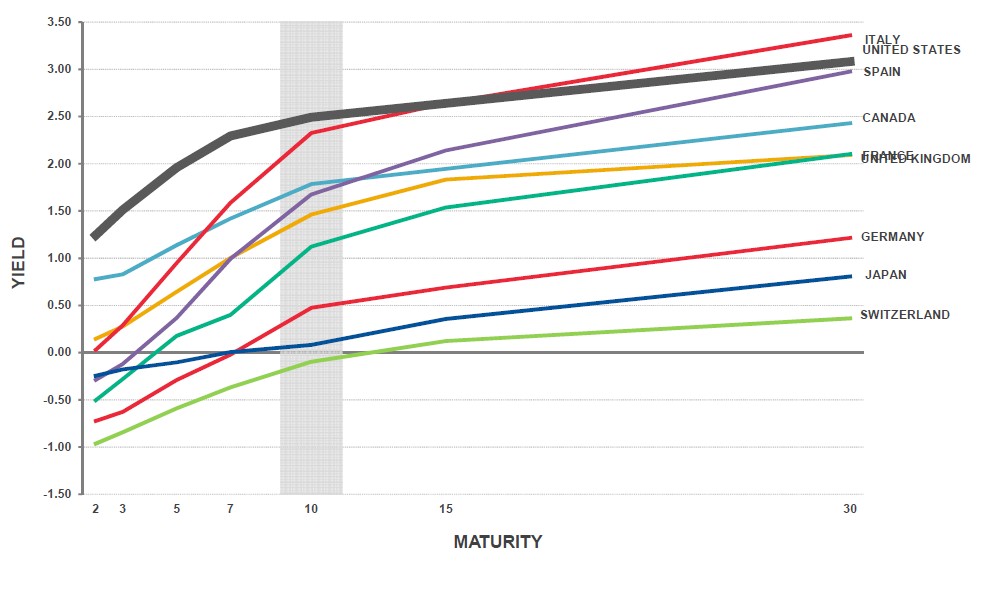
Note that Germany, Switzerland and Japan are hovering around 0%. How could this be? The answer to that may take our writing a book, but suffice it to say that IT IS REAL. And if it can happen in Germany and Switzerland, can it happen here?
BMR Take: The short answer? Yes it can. It “could” happen here. Will it? We wish we knew, but with all the turmoil in the world economically, we think there is more likelihood of rates going down rather than up at this time. We are not convinced that Yellen will have the power to buck THE MARKET. The MARKET will dictate interest rates, not the Fed. We see interest rates going lower rather than higher. And when rates go down, bonds and bond-like funds go up. Food for thought.
The High Yield Report
By Michael Foster
Special to The Bull Market Report
Another week, another bull run for the S&P 500.
The action has certainly slowed, but a 1% gain for the index is still impressive considering the long stretch of strength we’ve seen since November. The strength came on the back of Janet Yellen’s surprisingly hawkish testimony to Congress, an increase to unemployment claims that surprised analysts, and inflation rising to near 2%.
There’s a lot to unpack here.
First, let’s address Yellen, because this is most important to high yield markets. The Fed Chairwoman made her intentions very clearly in this paragraph:
"The Committee's view that gradual increases in the federal funds rate will likely be appropriate reflects the expectation that the neutral federal funds rate- - that is, the interest rate that is neither expansionary nor contractionary and that keeps the economy operating on an even keel- - will rise somewhat over time. Current estimates of the neutral rate are well below pre-crisis levels - a phenomenon that may reflect slow productivity growth, subdued economic growth abroad, strong demand for safe longer-term assets, and other factors. The Committee anticipates that the depressing effect of these factors will diminish somewhat over time, raising the neutral funds rate, albeit to levels that are still low by historical standards.”
Keep in mind that Yellen’s job is to talk in complicated, confusing phrases. But Yellen is actually a lot clearer than Greenspan was back in his day. In this block of awkward verbosity, we interpret what Yellen had to say:
1. Interest rates are going to naturally rise over time.
2. The Federal Reserve needs to anticipate these natural rises, because the market isn’t anticipating improvements in productivity, global conditions, investment, etc.
3. The Fed is going to raise interest rates swiftly and frequently.
If Yellen said this in 2014, the market would have tanked. Saying this in 2017, though, the markets barely budged. This is good for the Fed and bad for interest rates. It clearly means the Fed feels that it has the room to raise interest rates often and will do so throughout 2017. (We at The Bull Market Report are not so sure. See the following chart on interest rates around the world. We are not convinced that Yellen will have the power to buck THE MARKET. The MARKET will dictate interest rates, not the Fed. We see interest rates going lower rather than higher. And when rates go down, bonds and bond-like funds go up. Food for thought.
Where does that leave high yield assets?
On the surface, higher interest rates are bad for BDCs, junk bonds, and REITs. But remember that raising interest rates has been expected for years now; much of this is already priced in. The market knows this and so has not sold high yield assets in a panic.
Just look at the indices for high yield assets. The UBS BDC ETF (BDCS: $23, up 1%) ended the week up solidly, while the SPDR Barclays High Yield Bond ETF (JNK: $37, flat) held its ground. REITs did better than both of these assets. The SPDR Dow Jones REIT ETF (RWR: $94, up 2%) had yet another strong week despite the fact that higher borrowing costs will negatively impact REIT profitability. The market knows this and has already priced it into the sector.
In other words, everyone knows Yellen is getting more hawkish; they just don’t care.
Does this mean the market is overconfident and we should panic? No, not exactly. It does mean that there aren’t as many “screaming buys” in today’s market as there were at the start of 2016, when it was a much less obvious call to say junk bonds were worth snapping up at current valuations. But it also doesn’t mean those assets are overbought, either.
We’re clearly making the transition from “fear” to “greed,” as Warren Buffett would put it. But we’re not exactly at greed quite yet. In a market where buying and selling aren’t obvious choices, what can an investor do?
Simple: be selective. When it comes to being selective, it means finding assets that aren’t moving with the broader market. Fortunately there are some great values out there that are not performing as well as they should be. This week offered some new ones.
The first is a BMR favorite: Care Capital Properties (CCP: $25, down -2%), which failed to track the REIT bull run. Likewise, Omega Healthcare Investors (OHI: $32, down -2%) stumbled this week. Both REITs are in the Healthcare sector, which is being hit by greater uncertainty than the REIT universe as a whole. We’ve discussed in previous reports why we like both REITs. They’re well-managed and fear is driving the Healthcare REIT industry, making it a rare value play in a swiftly appreciating asset class.
To demonstrate just how undervalued these REITs are getting, compare them to our other REIT favorites Kimco Realty (KIM: $24, up 2%) and Government Properties Trust (GOV: $20, up 3%). Both outperformed the REIT sector as a whole this week.
Two more funds are getting attractively valued: the AllianzGI Equity and Convertible Income Fund (NIE: $19.35, up 1%) and the PIMCO Dynamic Income Fund (PDI: $28, up -1%). The Allianz fund went up this week, but its NAV has been going up at a faster rate than its stock price; as a result, its discount to NAV has grown to over 11%, making it a stronger buy than it’s been for months. Similarly, the Pimco fund’s decline this week makes it another great buy.
One final word on a stock that’s been a pain for us for a long time: Astra-Zeneca (AZN: $29, up 5%) had a stellar week. We’re now just 3% off from a year ago. This is a stock that has proven the old adage: best things come to those who wait. We’re still holding strong after liking what we heard at the company’s earnings release. Now we’re just anticipating possible dividend growth in this best-of-breed Pharma stock.
Good Investing,
Todd Shaver
Founder, Editor and CEO
The Bull Market Report
Since 1998