
The Week Ahead
“Smart Investors Turn To ETFs” was the front page Wall Street Journal headline over the weekend. It is sort of laughable. Wall Street seems to always proclaim it has found the holy grail. They sell product after product with the same pitch. This time we are seeing it happen in ETFs. Don’t be fooled. Look, we like ETFs. We have the Energy ETF in our portfolio. Beyond Sector ETFs, we think there are good investment opportunities in broad-reaching global ETFs. Yet, there remains good investment opportunities in individual common stocks. If anything, the time to by buying your favorite stocks is when everyone else is blindly buying ETFs.
No matter what, there is always a bull market here. Week in and week out, you can find it right here at The Bull Market Report. We currently see a bull market in the REIT universe. This week we highlight the following securities: Simon Property Group, Anally Capital Management, Care Capital Properties, Government Properties, and Welltower. Check out our new REIT portfolio on the website. If you have forgotten your User ID or Password, write us here: Info@BullMarket.com.
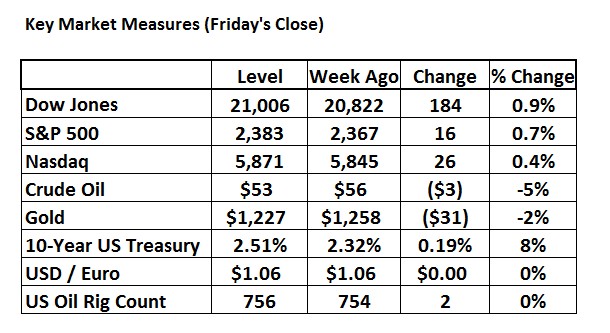
Highlights From The Past Week
IPO window wide open as Snap goes public. Having priced at $17, Snap (SNAP) opened for trading at $24, valuing the company over $34 billion - almost three times the size of Twitter, bigger than both HP and CBS, and almost as big as eBay. With losses running greater than revenue, investor demand for the Snap IPO reveals nothing less than a vibrant IPO market. And some craziness! And then the next day it jumped another 10%.
Goldman raises March rate hike odds move to 95% after Yellen speech. Following Yellen's speech which did not throw any curve balls to this week's sharply revised, hawkish narrative by her FOMC peers, a March rate hike - according to Goldman Sachs Research - appears to be in the books. Fed Chair Yellen said that a rate increase at the March FOMC meeting “would likely be appropriate”, as long as incoming data continue to confirm officials’ outlook. Goldman sees this as a “strong signal for action at the upcoming meeting, and we have raised our subjective odds of a hike to 95%." We’re not too worried. Rates hikes are good and bad. They are bad because no one wants to pay higher rates for loans. But they are good because it shows the economy is doing well.
The Fed Is preparing $1 trillion in Qualitative Easing (QE) for the next recession. Should the US encounter a recession in the next several years, the most likely reaction by the Fed would be another $1 trillion in QE, according to Deutsche Bank, delaying indefinitely any expectations for a return to a "normal" balance sheet. This provides downside protection in the event the current bull market loses any momentum.
BMR Companies and Commentary
Simon Property Group (SPG: $179, down 3%)
Houston we have a problem? Nope. Houston-area malls owned by Simon Property Group have not been harmed by market-specific energy-related challenges or broader retail-industry struggles.
Simon’s two Houston properties total 3.7 million square feet worth about 2% of the portfolio. Trends have been stable. Its top Houston mall, The Galleria, is in the midst of a redevelopment to add high-end shops and restaurants into a former Saks. The Galleria is anchored by Neiman Marcus, Nordstrom, Macy’s, and previously Saks. The other of the two malls, Katy Mills, is anchored by Neiman Marcus and Saks 5th Off.
It is not just Simon’s properties holding up. We see the same stability from General Growth Properties (GGP), which owns five Houston properties that total 5.5 million square feet, which is much larger than Simon’s.
BMR Take: The oil bust of late has placed some sour sentiment on any security with exposure to the commodity. The same thing is happening with regard to brick and mortar retail sales. We have not yet seen the two concerns hurt Simon. We are keeping a close eye out for any signs of stress. There is some concern in certain quarters that online shopping will ultimately impact the mall owners of the world like Simon. We don’t believe so, as people like the concept of shopping at 150 stores at a time in real stores, rather than sitting hunched over a computer. But, with that said, if Simon heads lower from here we are going to take a quick, minor loss and look for other places to put our money.
In the interim, we believe stocks like Simon are trading at compelling values.
Annaly Capital Management (NLY: $10.96, down 1%)
Annaly is an internally-managed Mortgage REIT based in New York City with total assets of $83 billion. Incorporated in 1996 and public since 1997, Annaly is by far the largest of the six public Mortgage REITs, which invest in Agency residential mortgage-backed securities.
The company currently invests solely in mortgage securities that are guaranteed by government-sponsored entities, Freddie Mac and Fannie Mae, or by an agency of the federal government, Ginnie Mae. All of these securities have an actual or implied AAA credit rating.
Annaly's principal business objective is to generate income for distribution to investors from the spread between its agency RMBS portfolio and the cost of borrowings. The key point to understand is that Annaly’s business model is very sensitive to interest rates, more so than even other REITs.
BMR Take: With the 10-year Treasury stepping up 19 basis points to 2.51% this week, Annaly shares remained relatively stable. This was a $10.22 stock a month ago, so we remain quite pleased with this investment.
Care Capital Properties (CCP: $26, up 1%)
Care Capital is a self-administered, self-managed Real Estate Investment Trust ("REIT") engaged in the ownership, acquisition and leasing of skilled nursing facilities and other healthcare assets operated by private regional and local care providers.
Care Capital primarily generate revenues by leasing properties to third-party operators under triple-net leases, pursuant to which the tenants are obligated to pay all property-related expenses, including maintenance, utilities, repairs, taxes, insurance and capital expenditures.
As of December 31, 2016, Care Capital had a diverse portfolio of 345 properties and 40 private regional and local care provider relationships. The portfolio is spread across 36 states and contains a total of roughly 38,000 beds/units.
Management is in the process of “re-positioning” the portfolio to improve portfolio metrics. The company was spun out of Ventas in August 2015 and since then has been selling assets and reinvesting in new development and redevelopment.
BMR Take: While near-term portfolio “re-positioning” is weighing on rental revenues and divestitures are resulting in lower earnings assets, ultimately we think the transition is working to produce a high quality better run portfolio that will receive more favor from the market.
Government Properties (GOV: $20, down 2%)
Government Properties is an externally advised real estate investment trust that owns, acquires, and manages office properties leased primarily to government tenants. The company’s niche focus afforded it the opportunity to go public in the midst of the financial crisis in 2009 where it raised $230 million.
Admittedly, core results have been mixed. Despite solid leasing volume, the real estate optimization strategy among government tenants remains a headwind. Average term of just 3.3 years marks the lowest term in recent memory. Tenants contributing 2.6% of rents are scheduled to vacate soon, as the Department of Justice, which currently represents 3% of rents, has moved from the “at risk” bucket to “vacating”. Fortunately, there is some offset by the National Institutes of Health, which has decided to stay. We don’t want to alarm you about recently mixed core results. It is the natural ebb and flow of the business. It could all easily swing the other way.
Providing some comfort, management had alluded to an expanding deal pipeline, given frothy pricing and demand for government-tenanted properties. We are seeing it happen. The company recently announced three acquisitions totaling roughly $130 million, with the largest asset being a 98% leased office park in Virginia; this property represents the largest investment since 2014.
BMR Take: Government Properties serves a unique niche in the REIT space and we see compelling value in the shares.
Welltower (HCN: $70, down 1%)
Welltower is at the forefront of investing in innovative healthcare infrastructure to create the physical and social environments necessary to promote wellness and quality of life for the aging population. Welltower’s operating platform supports post-acute care, independent living, assisted living and memory care facilities for more than 200,000 elderly residents and state-of-the-art outpatient medical facilities handling more than 16 million patient visits annually.
Recently, Welltower began collaborating with Johns Hopkins in a major new partnership. Johns Hopkins Medicine is one of the world’s pre-eminent patient care, research, and teaching institutions. Initially, Welltower and Johns Hopkins Medicine will explore joint initiatives in areas including: measuring quality outcomes in assisted living and memory care; educational programs for patients and care givers; and sharing of health and wellness and business expertise, information, best practices and research. The collaboration will also assess healthcare market opportunities and investments in modern, efficient infrastructure to deliver better care at a lower cost.
Americans ages 65 to 85 is the fastest growing segment of our population and the largest consumers of healthcare. Welltower is a leader in the space on all fronts from infrastructure to science.
BMR Take: The consensus forecast is for a dividend of $3.50 this year, $3.57 next year, and $3.82 in 2019. This 5% dividend yield looks compelling for a leading Healthcare REIT.
Upcoming Economic News
MONDAY, MARCH 6
Factory Orders – January
Time: 10:00 am
Forecast: 0.9%
Sizable growth in transportation sector orders is likely to lead overall factory orders higher in January. Core durable orders are showing positive trends for business investment in the near-term. Such orders rose 10.1% annualized in the three months ending January—the best such gain in nearly three years.
TUESDAY, MARCH 7
Trade Balance – January
Time: 8:30 am
Forecast: -$45.7 billion
The US trade deficit is likely to widen in January as the advance report on trade in goods showed significant gains in imports. Despite the growing trade gap, exports are once again adding to US output as opposed to representing a major drag on growth. Exports rose at the two-year high rate of 1.8% year-over-year in the fourth quarter while December’s 2.7% monthly advance was the best result in four years.
WEDNESDAY, MARCH 8
Productivity & Unit Labor Costs – Fourth Quarter
Time: 8:30 am
Forecast: 1.5% productivity, 1.5% unit labor costs
Long moribund productivity trends showed some uplift in the second half of last year, rising 2% annualized. Yet that recent bump needs to be sustained for quite some time to greatly undo the sickly 0.5% annualized gain for productivity over the past three years. Of concern to the Federal Reserve is the stronger pace of gains exhibited by unit labors costs, which rose 2.4% annualized over the same three-year period.
Import Price Index – February
Time: 8:30 am
Forecast: 0.1%
Moderation in the pace of raw materials price gains is expected to limit the February Import Price Index to its smallest gain of the past three months. Higher oil prices are facing resistance as current values entice a broader array of producers to drill. But the rising cost of imported goods is already weighing on consumer purchases, as the Import Index rose at the five-year high annual rate of 3.7% in January.
FRIDAY, MARCH 10
Employment Report - February
Time: 8:30 am
Forecast: 174,000 nonfarm payrolls, 4.7% unemployment rate
Job growth is showing no signs of stalling out after workers on nonfarm payrolls increased at the four-month high count of 227,000 in January. Employers are very hesitant to lay off staff, resulting in new claims for unemployment insurance hovering near lows not seen in over 40 years. That signal of labor market tightness can carry over to faster wage growth, helping to push up worker earnings above levels that remain historically weak for an extended economic expansion.
Apple Increases Research and Development Spend
Apple (AAPL: $140, up 2%) is pouring money into R&D in an attempt to improve products that don't currently generate revenue, but might in the future, according to remarks made by Apple CFO Luca Maestri at the Goldman Sachs investor conference Tuesday.
The company spent a huge $2.8 billion on R&D in 4Q16, bringing the total to nearly $10.5 billion in total for the year. Apple's annual spend is up by roughly $4 billion since 2014, marking a very noteworthy increase.
Why? Apple's hardware product range is growing. The iPhone is driving the company’s growth and it is adding new products to the lineup to further growth. The price of the phone is pricing out many customers, so we expect to see lower priced phones in the future, allowing them to sell a phone to everyone in the world.
Plus Apple's Services business, which comprises revenue from internet services, Apple Care, Apple Pay, licensing, and the App Store, is expected to grow to the size of a Fortune 100 company this year, according to Apple CEO Tim Cook. That's about $28 billion in revenue for the year, or a year-over-year growth of 15%.
BMR Take: Apple is sitting at an all-time high. We’ve been beating the drums, through endless negativity, especially when the stock fell into the 90s last summer. We were right and we are here to tell you that $150 is not out of sight. And we CAN’T WAIT until the President comes up with his repatriation plan for the $250 billion in cash the Apple has tucked away overseas.
Opko Health Discussion
Opko Health (OPK) had a rough week, losing 12% to $7.45. Earnings were reported last week. Revenue for the quarter was $275 million, flat from the year before. For the year: $1.22 billion, up from $490 million last year. Earnings for the quarter – a loss of $14 million. For the year: a loss of $25 million, compared to a small profit last year. The numbers were skewed by the purchase of BioReference Labs in 2015 for $1.5 billion, which added over $1 billion to revenues last year.
Opko says the potential market for Rayaldee, the kidney disease drug, could be as high as $10 billion but the drug didn't launch until November so there was no breakout of revenues that many were waiting for. We’ll just have to wait until next quarter to see any type of results from this drug.
The 4KScore test, launched several years ago, measures four prostate-specific substances in the blood to identify men who have a high likelihood of developing an aggressive form of prostate cancer. Opko that in Q4 about 18,000 4Kscore prostate cancer tests were ordered, representing growth of more than 12% compared to Q316. Some said they were looking for much bigger numbers here. The company has $170 million in cash and long-term debt of $110 million.
Consensus in the analytical community show that of the six analysts that follow the stock, four rate Opko a Buy, while two rate the stock a Hold. The stock’s consensus target price stands at $13.30.
BMR Take: We’ve said two things before: that if the stock hit $8 we would sell. But recently we said if the stock hit $8 we would buy more. We are going to reiterate this position now. We would buy more here. The caveat is that you have time to wait. Good things comes from patience. But patience in the financial world can be upsetting and cause you to lose sleep. So if this is the case with you, there are lots of other places to put your money. This company has great potential but we don’t control the marketplace that they live in and we don’t control management. We believe in management, but they might disappoint us. (See Under Armour.) Wall Street certainly thinks highly of the company. We give you the Consensus so that you can evaluate the whole picture. Some say that Wall Street analysts are mostly wrong. We don’t believe that. (See Apple, where EVERY ANALYST thinks the stock is going higher, and of course, the stock is sitting at an all-time high.) In any case, this company has amazing potential. Revenues are strong; cash and debt are certainly in line; it should be just a matter of time before we see positive results.
A Letter to the Editor about Simon Property Group (SPG: $179, down 3%)
Hello Bull Market,
Simon Property Group has been doing well but my concern is about the trend toward online retail which has and should continue to have a chilling effect on mall traffic. Doesn't it worry you that several large retailers that are anchor tenants at malls like Macy's and Sears have plans to close stores all over the country? To the extent that online purchases increase won't that hurt brick and mortar retail and foot traffic through malls? Thanks.
Richard Reed
Hi Richard -
We've discussed this with some folks on the Street as well as my own analyst team and it's no doubt that this is the biggest risk factor. If we start to see the risk having a bigger impact on the business, that would be a reason for us to exit. Not that we like to play with fire or pick up coins on the railroad track, but the reality is all businesses are not flawless and have their risks, so it not a reason to not invest. The good news here is that everyone knows this risk so we would argue that it is already baked into the stock's current price. And we must say that shopping online and shopping at 150 stores in a mall are two completely different experiences. It's pretty tough to buy a suit online. And furthermore, people love the social aspect of shopping in stories. That will never change.
BMR Take: Bottom line – if the overall stock market falters, and/or if Simon moves lower, we will take a small loss and move on. But we are believers in the company long term and we are watching closely.
A Word from Gary Jefferson
Jefferson Financial Group
First Vice-President, Investments
UBS Financial Services, Inc.
There are plenty of fundamental evidence in favor of US equities. The ISM Manufacturing Index, NFIB small business confidence gauge, and Consumer Confidence measures are all higher than 12 months ago and, historically, S&P 500 earnings growth has averaged nearly 15% in the year after such a simultaneous rise. UBS Financial is looking for 11% growth in 2017. UBS research also shows that since 1960, investors who have bought in when the market has been at an all-time high have performed similarly to those who have bought at other times. And investors who have bought in when the market has been trading in the current 18-20x PE valuation range have seen annualized returns of 10% and 7%, over one and 10- year time frames, respectively.
With all that being said, we are still in a rhetoric phase rather than a reality phase. In order to buck the odds of major stock market correction, we believe the following promised catalysts will have to show up this year:
Corporate Tax Break: The campaign pledge of a 15% rate is a powerful idea that would generate abundant earnings, GDP and equity growth. This is the "Holy Grail" for investors.
Individual Tax Break: This is also good for the economy, but the direct correlation to stock price gains is not expected to be as strong as the corporate tax break.
Infrastructure Spending: This should provide another big economic benefit.
We still believe an overweight in US equities and underweight in traditional bonds remains a valid tactical allocation in a rising interest rate cycle and expanding economy.
Analysts' Ratings for Under Armour (UA, $18.64, down 6%)
6 Sell Ratings, 21 Hold Ratings, 9 Buy Ratings
2/27/2017 Nomura $16
2/27/2017 Instinet $16
2/14/2017 Morgan Stanley $20
Things just keep getting worse at Under Armour. A tragedy.
Analysts' Ratings for Tesla Motors (TSLA: $251, down 2%)
7 Sell Ratings, 10 Hold Ratings, 12 Buy Ratings
Consensus Price Target: $256
2/27/2017 Morgan Stanley Outperform $305
2/27/2017 Guggenheim Buy $300
2/27/2017 Goldman Sachs Group Sell $185
2/24/2017 Deutsche Bank AG Hold $215
2/23/2017 RBC Capital Markets Target $314
2/23/2017 Royal Bank of Canada Target $314
2/23/2017 Robert W. Baird Outperform $368
Tesla was downgraded by analysts at Goldman Sachs from a “neutral” rating to a “sell” rating in a research note issued to investors on Monday, They presently have a $185 price target on the stock. Dougherty & Co lowered their price target from $500 to $375 and set a “buy” rating on the stock. Royal Bank of Canada increased their price target from $245 to $314 and gave the company a “sector perform” rating.
Analyst Ratings for Kimco Realty (KIM: $24, down 4%)
1 Sell Rating, 7 Hold Ratings, 8 Buy Ratings
Consensus Price Target: $30
2/3/2017 Canaccord Genuity Buy $34
1/23/2017 Barclays Overweight $27
1/9/2017 Raymond James Financial Outperform $28
THE HIGH YIELD CORNER
BY MICHAEL FOSTER
In high yield, this week was eventful on two fronts. Those who invest in closed-end funds likely received shareholder notices during the week, but the more exciting activity was in the BDC sector. A few BDCs reported this week and more are coming. Among the companies reporting was Goldman Sachs BDC (GSBD: $24.20), which reported a NAV decline exceeding 1% during the quarter and a near 3% decline in net investment income (NII). That wasn’t as bad as TCP Capital Corporation’s (TCPC: $17.20) 7% NII decline over the same period.
Neither stock was negatively impacted by the news, which wasn’t far from expectations anyhow, although Goldman’s BDC fell for the week and TCP Capital surprisingly rose. Goldman’s decline was modest and may ironically be a result of the company’s conservative approach. As one analyst wrote shortly after the earnings release, NAV’s decline is largely “a result of restructurings of non-accruals” and the firm’s more conservative approach to credit issuance. To wit, Goldman has not been expanding its loan portfolio significantly in a market that the fund’s managers have complained is not conducive to BDCs because of tight credit spreads, too much capital chasing too few deals, and overall risks in the marketplace. That has kept Goldman out of the market.
But surely Goldman can originate loans easily. Isn’t Goldman’s management in a position to throw billions of dollars’ worth of loans to their BDC? Well, yes; Goldman knows just about every wealthy person and multi-million dollar company on Earth.
The problem is a lack of incentives; Goldman has little reason to throw business the way of the totally separate and autonomous Goldman Sachs BDC, which is itself an entirely separate corporate structure. Combine this with the challenge of finding deals in a highly competitive marketplace, and you see why Goldman’s BDC is choosing to grow slowly rather than quickly.
The big takeaway from this is that now is not a good time to be in the BDC business. This is even truer for investors that rely on BDCs for passive income. There is so much competition between BDCs, that getting yields on loans is getting harder. And then there is so much competition between investors in BDCs, that premiums to stock values are getting higher, which in turn lowers dividend yields. Goldman Sachs’s BDC is trading at nearly a 30% premium to its NAV and is near its highest premium in history.
This is why we reluctantly sold Main Street Capital Corp (MAIN: $37) and continue to fret over the now absurd the 68% premium to NAV that the stock is currently trading at. Main Street is in our view the best BDC in the world but it’s just too expensive to own with a clear conscience. A diversified BDC fund like the UBS BDC ETF (BDCS: $23) is even worse, providing exposure to overpriced BDCs AND BDCs with bad portfolios or shady management. The sector provides value when it’s out of the market’s favor, but it’s in favor now so we continue to urge caution.
So where can an investor go for high yield? Other sectors are faring much better, and the 2016 muni bond rout seems to be fully behind us. The iShares S&P National AMT-Free Municipal Bond Fund (MUB: $108) had a flat week, but BMR pick Invesco Municipal Trust (VKQ: $12.53, up 1%) fared slightly better. Nuveen AMT-Free Fund (NVG: $14.41) fell a bit though, dropping just a shade over 1.5%.
These funds are paying around 5% in dividends, but remember that this is tax-free money. Depending on your tax status, that could mean an 8% taxable equivalent yield. With such a return, there is little rationale in staying away from municipals and taking on higher risk BDCs where defaults are much more likely, management fees are much higher, leverage is much more severe, and dividend payouts are much less sustainable.
On the issue of returns, let’s consider a moment the concept of the risk premium. Basic financial theory states that at-risk investments will always earn a return that is higher than the risk-free rate of return (ROR). There’s no such thing as 100% risk free, but U.S. Treasuries are about as close to risk free as you can get as long as you hold them to maturity. The Fed Funds rate is set to rise to 0.75% or even higher if Janet Yellen raises interest rates this month, which she says she will, and could go as high as 1.5% or above within a year or so. At-risk assets, then, need to offer a ROR above 0.75% for short-term assets. The calculation that is made is always between Treasuries and whatever risky investment you’re analyzing: Treasuries and oil junk bonds for instance.
However, there is another risk premium calculation that investors should make even though they generally don’t: The difference between the ROR on the investment you are considering and the taxable equivalent yield on municipal bonds. Why? Because retail investors can easily buy municipal bonds and get the income from those instead of choosing the riskier asset. This alternative means there is always a limit to just how low yields can go on at-risk assets before retail investors turn away from them.
Just how low is that yield? That’s a complicated calculation that would take a lot of data and a lot of analysis to figure out, but we can do a rough spot calculation by looking at the popular municipal bond ETFs, calculate their taxable equivalent yields, and compare that to the yields on taxable high yield assets. Doing so tells us that 4% is pretty much the limit. Corporate bonds now are apparently at or around their fair value from this metric.
Does that mean it’s time to buy these assets? Not really, but it’s not time to sell either. That means the SPDR Barclays High Yield Bond ETF (JNK: $37, flat) is not set for any great collapse but it isn’t exactly where you want to be either. It also means the near-term seems OK for BMR picks. The PIMCO Dynamic Income Fund (PDI: $29, up 1%) has reached a somewhat distressing premium to NAV of 8% but the fund’s sharp performance makes this bearable. The AGIC Equity and Convertible Income Fund (NIE: $19.73, up 1%) is seeing its discount to NAV remain around 11%, rather high from a long-term perspective and an attractive reason to hold.
Now, to REITs. The best news for BMR subscribers came from this sector this week, as the SPDR Dow Jones REIT ETF (RWR: $94.45, down 1%) saw a modest decline that was overshadowed by BMR’s REIT picks. Digital Realty Trust (DLR: $107, flat), Omega Healthcare Investors (OHI: $33, flat), and Care Capital Properties (CCP: $26, up 3%) were significantly better performers with flat to slightly up growth for the week. Government Properties Trust (GOV: $20, down 1%) tracked the market quite closely, showing that risky REITs are not selling off greater than the broader market, which is usually the signal of a broader and more worrisome panic. However, the most risk averse investors who look for more stable and less risky REITs are clearly selling off, as Kimco Realty (KIM: $24, down -4%) had a truly awful week. This appears indicative of a broader market trend towards risk aversion that is only beginning in the REIT sector but may continue in the weeks to come. Now is a good time to remain vigilant with the REIT sector and look to rebalance as mispricings continue. For now BMR’s recommendations remain unchanged, but more declines in Kimco could cause us to suggest a bit of rebalancing in the short term.
A final word on AstraZeneca (AZN: $30, up 2%). BMR has been following this drugmaker for a while and have held through months of weakness as the biotech industry was destroyed by political risk-related fears. Trump is now president and despite his tweets about drug prices, drugmakers don’t seem to be in any immediate danger. The market has recognized this and is slowly tiptoeing back into the sector. Astra-Zeneca is up 10% year-to-date for this reason alone. The pipeline hasn’t changed, but everyone is getting more enthusiastic about the company’s prospects. This remains a good time to remain long this stock.
Good Investing,
Todd Shaver, Founder, CEO and Editor
The Bull Market Report
Since 1998