
What a week just passed. The bond market sold off hard. An interest rate hike this coming week is as close to guaranteed as it gets. But how many more hikes will we see this year - 2 or 3 or 4 in total? Some savvy long timers are starting to talk about the days when the Fed hiked more than a quarter point per meeting. Could this return? Aside from Fed policy, the Trump team is on a roll. The appointed head of the Commerce Department, Wilbur Ross, spoke to his new 40,000+ employee team, and formally established so many new directives to change the game of US and global trade. The prospects for the bull market run in the stock market remain bright!
No matter what, there is always a bull market here! Week in and week out, you can find it right here at The Bull Market Report. We currently see a bull market across many parts of the stock market. This week we highlight the following securities: Bristol-Myers Squibb, Facebook, Simon Property Group, Tesla, VMware, Celgene and Amazon.
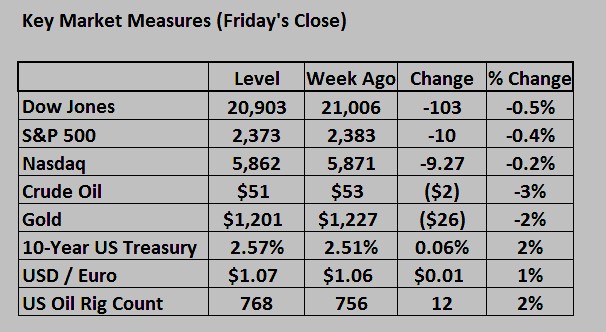
Highlights From The Past Week
Up, up, and away for stock markets. While expansion in PE multiples has sent the S&P 500 to a level above the 90% percentile of historical valuations, higher corporate profits are likely to push the equity market to even higher levels. We could see near-term weakness as earnings forecasts are revised downward due to tax reform occurring in 2018 versus 2017, but this should not jitter long term investors.
Record net inflows. "Fear of missing out" is quickly becoming the go to phrase for many of America's stock market investors. As The Wall Street Journal reports, investors poured money into stocks through mutual funds and exchange-traded funds in 2017, with global equity funds posting record net inflows in the week ended March 1st based on data going back to 2000. Inflows continued the following week.
Great Jobs report. Steady U.S. job growth has set the stage for the Fed to raise interest rates. A wave of hiring in February — President Trump’s first full month in office — pointed to a strong foundation for the nation’s economy, providing further evidence for the Federal Reserve that the moment to raise interest rates has come. The Labor Department reported a gain of 235,000 jobs and healthy wage growth in a month when even the weather cooperated. It was the last major data release before Fed policymakers meet Tuesday and Wednesday, when they have signaled their intent to increase the benchmark interest rate.
BMR Companies and Commentary
Bristol-Myers Group (BMY: $58, +2% - all price changes in this report are for the week)
Scott Gottlieb, a former deputy commissioner of the U.S. Food and Drug Administration, is President Donald Trump’s choice to lead the agency, per White House media relations.
Gottlieb, 44, served in several senior positions at the FDA during the Bush administration. He’s a partner at one of the world’s largest venture capital firms, New Enterprise Associates, which has a portfolio of more than 300 businesses in the Technology and Healthcare industries. He has talked extensively about how to lower the cost of prescription drugs by modernizing the agency’s approval process and speeding cheaper generic competitors to market. Since leaving the FDA, Gottlieb has worked as an adviser to investment firms and as a fellow at the conservative-leaning American Enterprise Institute, a Washington think tank. He has been the drug industry’s preferred choice for the FDA job and has worked as a consultant to some of its companies.
Bristol is largely already a good actor, but could have been taken down with the broader industry. Management understands the concern that with escalating healthcare costs, and with the increased burden they place on patients and their families, there needs to be close scrutiny. At the end of the day, Bristol feels that prices of its medicines should reflect the value they bring to patients, healthcare providers, payers and society as a whole. The results of how Bristol has contributed to the transformation of the treatment of diseases like HIV, HCV and cancer demonstrate that the model for sustainable innovation is working - which is good news for patients and society. For example, in melanoma, prior to the availability of Immuno-Oncology treatment options, 25% of patients diagnosed with metastatic melanoma survived 1 year. This increased to 75% with Immuno-Oncology therapies.
So you see Bristol is making real progress towards the goal of shifting cancer from a death sentence to a chronic disease that can be managed and controlled. Bristol is leading the way on the conversation for fair, reasonable, and visible drug prices, and the appointment of Gottlieb is far less disruptive than it could have been.
BMR Take: The event is a major positive for the Drug industry. The reason why is more so the counterfactual. With the current battleground discussion happening over the cost of drugs, Gottlieb is a far less extreme pick than some of the other candidate contenders. This means less pressure going forward for Bristol and others to lower prices.
Facebook (FB: $139, +1%)
Facebook has scored a deal to lives stream Major League Soccer matches. As competition in the live streaming space heats up, Facebook has scored a significant deal that will allow it to stream at least 22 live Major League Soccer matches on its social network.
Through a collaboration with both MLS and Univision, Facebook gained the rights to stream the 2017 MLS regular-season matches in English, as well as enhance the video content with various interactive elements. The streams will include Facebook-specific commentators and interactive graphics, as well as fan Q&A and polling features that let Facebook viewers engage with the commentators as the matches take place.
These are the same games that are being broadcast on Univision networks in Spanish, but Facebook has scored exclusive rights to the English language streams.
As a part of the deal, MLS will also produce more than 40 original “Matchday Live” analysis shows that will be posted to the MLS Facebook page. These shows will include feature highlights and discussions from around the league, as well as previews of the upcoming matches.
BMR Take: Soccer is the sport of the globe. Facebook just found a way in the back door to this global sport. It is exciting to see Facebook leverage the audience into stronger user engagement. Sitting at an all-time high of $139, we see no reason why the stock can’t continue higher. With management like Zuckerberg driving growth, we see this investment is in good hands. We hereby raise the Target to $150, and our Sell Price to $125.
Simon Property Group (SPG: $168, -6%)
We have here a REIT focused on owning and managing commercial real estate. The Simon portfolio is dominated by malls and premium outlets located in the U.S. Shares have been under elevated stress in recent weeks. Two factors are driving the concerns. First, a rising rate cycle presents headwinds. Second, retail exposure could be toxic.
The rising Fed Funds rate is leading to increasing debt costs for Simon. The company must successfully pass these increases to its tenants or operating results will suffer. Moreover, all of Simon's tenants will also have their own funding costs moving higher, which squeezes their capacity to pay rent. A challenging operating environment.
Malls and physical retail are also subject to secular pressure thanks to the internet's inroads throughout the retail space. Target and Macy’s recent earnings miss are the latest sign of the wave of stress coming. The fear is that if major anchor tenants in malls go down, then who could possibly step in to replace them. The answer is not clear.
We admit that Simon's has some great assets and can leverage them. However, the internet may affect the company in the future. BusinessWeek, in an article on Macy’s, said: “Long term bets on retail real state could be risky. America has too many stores, and more than 10% of US retail space - almost 1 billion square feet – may need to be closed, be converted to other uses, or charge less rent in the coming years. That could leave some REITs in trouble if they load up on losing properties or can’t find tenants, or if real estate values plummet. The larger retailers are shrinking their footprint. The question is, how far do they shrink it?”
BMR Take: We don't always get it right. But we do always address issues with you honestly when they happen. We are exiting our Simon position.
Tesla (TSLA: $244, -3%)
Tesla recently published its annual report and we have some notes to share.
SolarCity contributed $84 million in revenue from 11/21/16 to the end of the year. Their 10-K filing shows 2016 revenue totaled $730 million.
Tesla had 790 Supercharger stations worldwide at 2016 end, up from 715 locations globally at 3Q16 end (+8% q/q). The net book value of the Supercharger network was $207 million at FY16 end.
The company notes over 7,100 Tesla wall connectors have been installed at more than 4,100 locations worldwide to enable vehicle charging.
The company plans to begin production of its solar roof product at the Gigafactory 2 in Buffalo this summer, to be ready for customer installations later in the year.
Tesla estimates combined tax savings under agreements with the California Alternative Energy and Advanced Transportation Financing Authority will total approximately $200 million.
BMR Take: After reading the company’s annual report, we find a lot of tidbits of good information. Overall we continue to like the company’s prospects.
Elon Musk and His Take on Solar Panels for Your Home
Have you seen the presentation Elon Musk has put out for all to see?
Check it out here: http://read.bi/2mN4SLN
These new solar panels for your home look like any normal roof, but are indeed solar panels. Can you imagine how big this market is? We have solar panels on our roof here in Aspen and we don’t pay for electricity for eight months of the year. But we had to install those giant, bulky solar panels. Wouldn’t it be great to have a roof look like a roof but have it be totally solar?
Musk says his roofs are not expensive; we disagree. But what we do know is that over time the price will come down so everyone with a home will be able to afford a new solar roof.
Musk has grand ideas, some of which work, some of which don’t. (Have you heard that he is guaranteeing to fix Australia’s power outages for $100 million, but if he can’t do it in 30 days, the $100 million is on him!)* We love him for his brave ideas.
* From Reuters: Tesla boss Elon Musk on Friday offered to save Australia's most renewable-energy dependent state from blackouts by installing $25 million worth of battery storage within 100 days, and offering it for free if he missed the target.
The offer follows a string of power outages in the state of South Australia, including a blackout that left industry crippled for up to two weeks and stoked fears of more outages across the national electricity market due to tight supplies.
Musk made the offer on social media. He said via Twitter: "Tesla will get the system installed and working 100 days from contract signature or it is free. That serious enough for you?"
BMR Take II: We sure wish the stock wasn’t so darn volatile. We believe in Musk and we believe in Tesla (Solar City included.) And we think the stock can go to $400 and beyond. But the company certainly has its challenges financially. The market is so fickle that it might must crush the stock because of some short-term issue, scaring us and many investors out of this great company. Be diligent, Investors!
VMware (VMW: $90, flat)
VMware recently spoke at an investor conference. We wish to recap part of the discussion for you.
2016 was a very interesting year for VMware. It was a year that ended up with the company being in a much better position than what people expected, both in terms of the growth rate and customer satisfaction.
The company’s Chief Operating Officer specifically said one of the biggest things accomplished in 2016 was refining its strategy for customers. The Software-Defined Data Centers are the key part of the new strategy. The company has moved beyond compute to storage and networking. Four years ago, all VMware could talk about was Compute. Now, VMware has gone from nothing to the leader in storage and networking software with 7,000 customers. Plus, the recent Dell partnership just became a big opportunity for more growth.
BMR Take: VMware has been a great pick out of the gate for us at The Bull Market Report. We continue to believe in the company and believe the stock will go much higher towards our Target of $95. We just may raise the Target here soon.
Celgene (CELG: $124, flat)
Celgene recently spoke at an investor conference. We wanted to recap part of the discussion for you.
The big takeaway was this: The President of the Oncology division said, “I think it's fair to say that Celgene is at an inflection point. We have an incredible momentum as we've been saying and additional drivers that should absolutely enable us to achieve our 2020 numbers. The recent positive results that we have been reporting on ozanimod in relapsed multiple sclerosis have not been fully baked into the $21 billion revenue number of 2020. We have multiple Phase III studies, reading out. Five of them are going to read out by this year. So, I think we have a great opportunity to not only achieve but then overachieve what we've been telling you we should have as a financial goal for 2020.”
That is sure exciting. Don’t you agree?
BMR Take: Celgene is widely cited by Street analysts as a top pick in the space. We love it too. We raise our Price Target to $135 and our Sell Price to $115.
Upcoming Economic News
TUESDAY, MARCH 14
Producer Price Index – February
Time: 8:30 am
Forecast: 0.0% overall, 0.2% core
The downdraft in oil prices can leave the Producer Price Index unchanged in February after three straight monthly increases. Ahead of this potential pause, businesses were feeling somewhat higher cost pressures with the PPI equaling the 29-month high annual rate of 1.6% in January.
WEDNESDAY, MARCH 15
Consumer Price Index – February
Time: 8:30 am
Forecast: 0.0% overall, 0.2% core
While a decline in fuel costs can restrain the Consumer Price Index in February, the annual pace of growth will remain substantially elevated. The CPI has rapidly accelerated from the yearly advance of just 0.8% last July to the five-year high of 2.5% in January. The core CPI has long been pointing to livelier underlying inflation trends, rising more than 2% annually for 14 straight months.
Retail Sales – February
Time: 8:30 am
Forecast: -0.1% overall, 0.1% ex auto
A drop in gasoline sales is projected to lead a poor result for February retail sales. Outside of gasoline and plateauing auto sales, retail sales rose at the solid 5.0% yearly rate in the three months ending January. This points to higher potential for real consumer spending.
NAHB Housing Market Index – March
Time: 10:00 am
Forecast: 65
Homebuilder confidence is expected to remain elevated in the March NAHB index. Despite some slowing in the pace of new home sales, builders still foresee strong sales growth well into the future. The index of expected sales over the next six months was at 73 in February, far above the historical average of 57.
Business Inventories – January
Time: 10:00 am
Forecast: 0.3%
Business inventories are in line to expand for the third straight month in January amid improving production trends. Sharp growth in imports indicate that investment and output trends are moving into positive territory after extended soft periods.
FOMC Rate Decision
Time: 2:00 pm
Forecast: 0.75%-1% Fed Funds target range
Barring an unforeseen shock, the Federal Reserve is pushing toward lifting the Fed Funds target range at the March FOMC meeting. The more aggressive tightening stance is not entirely surprising, as a rate hike would have to be imminent to live up to policymaker projections of three increases this year. Unlike what has transpired in the past few years, there have been no financial market volatility or economic shortfalls to push the Fed off track.
THURSDAY, MARCH 16
Housing Starts & Building Permits – February
Time: 8:30 am
Forecast: 1.26 million starts, 1.25 million permits
Housing starts are forecast to hold steady in February, maintaining strong near-term gains. Starts rose 17% annualized in the three months ending January against the previous quarterly period, as homebuilding is recovering from the weak results in the middle of last year. The uplift in starts is set to continue with building permits rising 10% annualized in the three months ending January.
FRIDAY, MARCH 17
Industrial Production & Capacity Utilization – February
Time: 9:15 am
Forecast: 0.2% industrial production, 75.5% capacity utilization
Industrial production is looking to turn higher in February after the utility sector led an overall decline in January output. The manufacturing sector is reporting consistently positive results, rising in four of the last five months through January. The broad recovery in manufacturing will likely get little help from the auto sector, after auto output declined at least 2% in both November and January as sales slow.
University of Michigan Consumer Sentiment – March
Preliminary Time: 10:00 am
Forecast: 96.3
Consumer sentiment in the March Michigan survey is likely to be little changed from February’s three month low. Yet even with modest declines in the overall index, the Michigan readings on consumers’ assessments of current economic conditions have barely changed from December’s 11-year high. Continued positive trends in hiring and income are bolstering confidence, helping to lift potential consumer outlays.
Leading Economic Indicators Index – February
Time: 10:00 am
Forecast: 0.3%
Rising stock prices and the falling count of claims for unemployment insurance can help the Leading Economic Indicators Index expand for the sixth straight month in February. Much of the optimism baked into record stock index levels are derived from expectations of corporate tax cuts.
Amazon (AMZN: $852, flat) Grocery Sales
Nielsen, a consumer monitoring company, released a report entitled, The Digitally Engaged Food Shopper. It said that Amazon is 9th in groceries sales now. But they will be moving to 3rd by 2022. Wow. They said that online grocery shopping could grow 5-fold over the next decade, with American consumers spending upwards of $100 billion on food-at-home items by 2025. Online grocery spending could grow during the 2016-2025 forecast period from 4% of the total U.S. food and beverage sales to as much as a 20% share, based on the most upbeat scenario. Last year, online grocery sales were about $20 billion.
Amazon is setting up stores where you can order online ahead of time and then either pick up your order yourself, or have it packed and delivered to your home, usually within two hours. In fact, Amazon Go lets customers walk in, grab food from the shelves and walk out again, without ever having to stand in a checkout line. This is a new concept and they are just starting to test this in Seattle, their home base. The stock is trading within a whisker of an all-time high of $860, set on February 23rd. We have a $900 price target on the stock, but if and when it hits this number we are raising it to $1000.
Notes at the Margin
Philip K. Verleger, Jr.
Former Director of the Office of Energy Policy
at the United States Department of Treasury
March 13, 2017
Expectations Frustrate Oil Producers
The oil industry’s “high and mighty” met last week in Houston during IHS CERA’s annual conference. Oil ministers and company CEOs addressed the throngs in attendance. Separately, key individuals met privately. Lacking a castle in Scotland, the key OPEC representatives met with several CEOs there. As they did, the company counsels likely trembled while thinking of the potential antitrust implications.
Quoting one official on how companies are moving aggressively to bring breakeven costs down:
“Everyone is driving break-even prices down,” Deborah Byers, head of U.S. oil and gas at consultants Ernst & Young, said in an interview at the meeting, the largest annual gathering of industry executives in the world. "It isn’t just shale companies; it’s everyone, from deep-water to conventional."
Some examples:
--- Statoil has driven the costs for its next generation of projects from $70 per barrel to well below $30.
--- Exxon’s CEO Darren Woods and Total’s Patrick Pouyanné believe many projects can be profitable at $12 per barrel.
--- Rystad Energy sees a 46% decline in shale costs from 2014 to 2016.
--- Shell’s reported the company had cut deepwater costs 50% over two years.
The conference speakers all touted the increased output they expected to achieve, some mentioning rates of twenty and thirty percent per year. Markets responded to the news. Crude oil prices dropped sharply. The decrease in cash markets began on Wednesday. In three days, prices fell $4.50 per barrel,
[Verleger’s Conclusion: The world oil market has become much too sophisticated for OPEC management. ]
A Word from Gary Jefferson
Jefferson Financial Group
First Vice-President, Investments
UBS Financial Services, Inc.
Twelve days ago President Trump delivered just what investors wanted to hear during his Joint Session of Congress address. He talked about a large corporate tax cut, massive infrastructure spending, and tax relief for the middle class. All of these are pro-growth initiatives and were clearly the catalysts behind the impressive bull run the day after the speech.
Amazingly enough, we heard a couple of financial pundits on TV say something that actually made sense – that before the market moves much higher, investors will likely demand more proof of the actual implementation of these pro-growth policies. We say that the faster things come together the better. And, the longer it takes, the tougher it will be to continue to make new highs.
We think the market will focus in on three key things: The February Jobs Report, February CPI and the Fed's March Meeting. Unless there are some really bad surprises, we believe the Fed will raise rates at their March meeting this week. How high do rates have to go to raise a red flag for equities? The Oracle of Omaha recently stated that he thought the stock market would be fine until the 10-year Treasury rose above 3%. It's currently trading right around the 2.6% level, which is not that much higher than the average dividend yield of S&P 500 stocks.
Consensus Ratings for AstraZeneca (AZN: $29.50)
Ratings Breakdown: 1 Sell Rating, 5 Hold Ratings, 11 Buy Ratings
Consensus Price Target: $36
3/7/2017 Barclays Initiated Coverage - Overweight
Two Letters from Our Readers:
From John Tennant
Good call on OPKO in your March 5th report! I have been loading up under $8..... One of my larger positions now, average cost $8.50. Note new info from Dow Jones this morning. "OPKO Health: EU Orphan Drug Status Granted for AntagoNAT to Treat Dravet Syndrome"
Our answer:
Yes, so far so good. But $9 would make us feel a LOT better!
[Note: the stock was up 7% this week.]
Hi Todd,
After reading your newsflash on The Carlyle Group (CG: $15.70), I went to Yahoo Finance. The dividend shows $0.64. I then went to TDAmeritrade where it shows $1.84. Fidelity shows the same as TDAmeritrade. And the screen shot you shared shows $1.60.
I am a little confused as to which is the correct information. Could you please help resolve this? Thanks again for all your guidance week in week out. It is greatly appreciated.
Regards, Nilanjan Das
Our Answer:
Hi Das –
The problem for all reporting companies like us is that this company issues a different dividend each quarter. The last four dividend payments were: 26 cents, 63 cents, 50 cents and 16 cents. That’s $1.55. The four before that total $2.07. So go figure!
The point here is that the company will be paying out as much as possible, and we think that average will be around $1.60 to $1.80.
Todd Shaver
The Trillions of Dollars of Cash Overseas
We had a discussion with a friend of ours recently who is a very astute investor and we were impressed with actually how smart he is. On Election Eve when it was clear that Trump had won the election, the futures market was down 800 Dow points. He said he bought over $1 million of equities in the overnight trading markets. And he still has those positions. He wouldn’t tell me how much he is up but I can guess – 20%? 30%? Wow.
We then had a discussion over how much corporate cash is sitting in banks overseas. We know that Apple has over $250 billion stashed in Ireland and other places, and we always thought the total amount of cash was hovering around $1.3 trillion. He said that the number was $2.5 trillion. Well, we did a little research and found out that he is exactly right. $2.5 trillion is sitting overseas waiting to come back to America when Trump lays out his tax cut plans. We don’t think an overall corporate and personal tax cut is a good idea, but Trump says he is going to do it so we have to roll with it. Increasing the $20 trillion debt it not a good thing in our book, but Trump also says he can wipe out the debt in eight years. This ain’t gonna happen, folks.
But repatriating 50-75% of this cash will change America for the good. What can corporations do with this cash? Stock buybacks, starting new companies, investing in technology, hiring more people. The list is endless. Keep your eyes peeled for this big move from the White House.
The High Yield Corner
By Michael Foster
This week, we need to start with Treasuries.
High yield investors don’t buy Treasuries, especially not in a post-2006 world. After all, a 10-year Treasury note is paying a whopping 2.6% yield. With inflation going up, that’s not enough to cover the rising cost of living let alone provide a real inflation-adjusted return. But high yield investors need to keep paying attention to U.S. Treasuries, because they represent the baseline - the limit that high yield investments can go before they yield too little to warrant buying, given their greater risk.
That baseline is going up because Treasuries are going down. As Treasury prices fall, their yield goes up. And the 10-year yield has skyrocketed from less than 2% in 2016 to the 2.6% we’re seeing today. As a result, anyone who bought Treasuries in an attempt to find a low-risk investment is down on their investment big time. The iShares Barclays 20+ Year Treasury Bond ETF (TLT: $117) has fallen over 7% in the last year. So much for avoiding risk!
And while I pity people who bought Treasuries in 2016, I can’t say I’m all that surprised. Yields had fallen to their all-time historic low and political pressure on the Federal Reserve to raise interest rates made the low yield on long-term Treasuries untenable.
Here’s the problem for high yield investors: This makes the situation for many riskier debts untenable.
In particular, we are at a crossroads for the high yield world in which corporate bonds are getting to their breaking point. To demonstrate this, we need to look at a relatively obscure financial metric known as the Merrill Lynch US High Yield Option-Adjusted Spread. This is an index that calculates the difference between junk bond yields and Treasury yields..
This index tends to revert to its mean and go up and down wildly. When it’s at its highest points, like in early 2016, the market has sold off corporate bonds to such an extreme that there are a lot of bargains for selective investors. When it’s at its lowest points, like in June 2007, the market is way too complacent and a sell-off is likely on the horizon.
This index was at 8.6 in February 2016 when The Bull Market Report began aggressively recommending high yield investments. The index is now at 3.9. The bigger the spread, the more risk-averse bond investors are acting. The smaller the spread, the more risk hungry
We’re still 50% above its low in 2007, so we’re not at the top of a bubble by any means. But the index is at about the same level it was at in July 2014. That’s when the SPDR Barclays High Yield Bond ETF (JNK: $36) reached its top only to fall 21% until reaching its low in 2016.
The SPDR junk bond fund fell 2% this past week. It is flat year-to-date and up over 7% from a year ago. There is no indication that junk bonds are going to crash - but we also have clearly left the bullish trend that we saw in 2016.
This means investors need to stay cautious and ready to rotate out of junk bonds in the coming months. This is especially a prudent course of action before the Federal Open Market Committee’s March meeting next Tuesday and Wednesday. Janet Yellen has already dropped several strong hints that she is set to raise interest rates at this meeting. The futures market also thinks an interest rate raise is coming, with the futures market implying a 97% probability.
The drop in long-term Treasury prices is simply the market anticipating the Fed driving up short-term Treasury interest rates. But that doesn’t mean the move is fully priced in. What’s more, the junk bond market has not really priced this in at all. Junk bonds are up 7% during a time period when the Treasury market is down 7%. This is wild. With junk prices up, the rates have fallen. With Treasuries down, the rates have risen; and thus the spread between the rates has gotten about as small as it ever does outside of an unusual bubble situation like the housing disaster of last decade.
As a result, it’s time for high yield investors to lay off of junk bonds. We do not recommend selling all junk bond holdings, but a lighter allocation to previous BMR recommendation PIMCO Dynamic Income Fund (PDI: $28, down 1%) makes sense here. This fund’s near-5% premium pricing no longer makes sense in the current bond market, even though fundamentally this is a great fund to buy in most market conditions. A rebalancing slightly out of PDI now that the junk bond market is heating up makes sense, while still holding some shares to enjoy the double-digit yield.
So where should that money go instead? While corporate bonds have not priced in interest rate risks due to intense investor demand, the more easily frightening municipal bond market has. The Invesco Municipal Trust (VKQ: $12.16, down -3%) and Nuveen AMT-Free Fund (NVG: $14.11, down -2%) have continued to slide and are now yielding 6% each. Depending on your tax bracket, that could mean a taxable equivalent yield of 9%, making them close to PDI in terms of post-tax income.
At the same time, these funds have not been bid up in an overly risk-tolerant market like PDI, meaning the risks of capital loss are not as acute.
In fact, there is a lot of undue fear that tax policy changes will remove the tax benefits of municipal bonds, but now that the Trump administration has released its new budget plans, it seems that muni bonds are not a target. We at The Bull Market Report have reiterated this position repeatedly; it makes no sense for the Republicans to alienate retirees by cutting tax benefits to municipal bonds. But the market is still treating muni bonds as unduly risky, currently not a bad thing as yields have remained high.
Using Warren Buffet’s terminology of “greedy,” we like the more fearful approach of the municipal bond market, which is making investors more greedy. Conversely, the more greedy approach of the junk bond market is making us more fearful.
The same dynamic exists in other parts of the high risk lending world. BDCs are showing signs of weakness, but they aren’t suffering the kind of sell-off after last year’s run up. The UBS Etracs BDC ETF (BDCS: $23, down 1%) remains in the green for 2017 and is up a whopping 19% over the last year excluding (!) its 8% dividend.
This wouldn’t be a real problem if BDCs were reporting good earnings, but that’s not happening. Blackrock Capital Corporation (BKCC, $7.72) reported a 2% year-over-year decline in net asset value per share and the company cut its dividend by 14%. Yet the stock is up 11% year-to-date and has seen large daily drops and increases over the last week. This kind of volatility and disconnect between stock price and fundamentals is dangerous.
But it’s not just happening with Blackrock Capital. KCAP Financial (KCAP: $4.02) and Horizon Technology Financial Corp (HRZN: $10.33) reported a similar drop in NAV this week.
It isn’t all doom and gloom in the high yield sector though. REITs saw a sharp sell-off this week, uncovering some more bargains for income-hungry investors. The SPDR REIT ETF (RWR: $90) fell over 4% to show a 1% decline from a year ago. This is good news because it is unlocking several high quality REITs whose investment income remains strong and whose borrowing costs are still extremely manageable despite the shenanigans at the Fed, all of which is giving us continued opportunities to accumulate these high yields.
Healthcare REITs were particularly hit hard, which has resulted in BMR favorites Omega Healthcare Investors (OHI: $31) and Care Capital Properties (CCP: $24) to struggle. These REITs fell 5% last week and are down 6% and 12% respectively over the last year. This means it’s time to buy more. Omega’s yield is approaching 8% but its FFO is still amply covering dividends. Care Capital is now paying a huge 9% but it too is covering dividends. Both stocks are a screaming buy at this current level. After the Fed raises rates and the market sees that this won’t actually change much for the REITs, we’ll see both companies recover. Now is the time to get in before that happens.
Good Investing,
Todd Shaver, CEO and Editor
The Bull Market Report
Since 1998