
Highlights From the Past Week
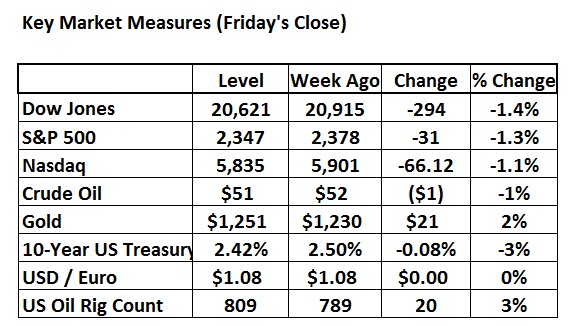
The markets were a bit weaker last week. Friday’s close ended with uncertainty over Healthcare reform. Regardless of the outcome, some people are starting to ask tough questions. Is this Congress going to be able to deliver on the aggressive Trump agenda? Across the board, we are not just talking simply healthcare, but taxes, trade, regulations, the wall, and so on. This very first test for the new Congress will set the tone for the years ahead. And we are sure you heard what happened on Friday. No healthcare deal. Now what?
No matter what, there is always a bull market here! Week in and week out, we you can find it right here at The Bull Market Report. We currently see a bull market across many parts of the stock market. This week we highlight the following securities: Mazor Robotics, Apple, Google, Facebook, Home Depot, Celgene, and VMware.
Keystone XL Pipeline To Start Construction. The Trump administration announced on Friday that it would issue a permit for the construction of the Keystone XL pipeline, a long-disputed project that would link oil producers in Canada and North Dakota with refiners and export terminals on the Gulf Coast. The announcement by the State Department, reversed the position of the Obama administration. The pipeline has been the focus of a long fight between environmentalists and the project’s advocates, who say it would further the goals of energy independence and economic growth. The event marks a key inflection point for American’s refocusing on business.
The Markets Don't Care About Healthcare As Long As They Get Their Tax Cut. For the stock market, the drawn out effort to pass the healthcare bill may not matter after all. Regardless of whether Republicans can push the bill through (they didn’t), pro-growth and economic policies are next on the agenda. If so, markets win either way. They are not willing to hold economic growth/tax reform hostage to the Affordable Care Act reform any longer. This is a broad market-positive signal that bolsters the case for 2017 tax reform. Tax reform will start to take center stage this Spring.
Optimism Sweeps the Nation and Pulls Money Into Stocks. The surge in business and consumer sentiment reflects an assumption that is deeply rooted in the American psyche: that deregulation and tax cuts always unleash transformative pro-growth entrepreneurship. That is what we are seeing since late last year. Money has been flowing into exchange-traded funds like never before, helping to propel stocks higher. $130 billion has flowed into these index-tracking funds in the first two months of 2017. This follows a record-breaking year in 2016, when ETF managers gathered more than $390 billion in new cash. Moreover, the CBOE Volatility Index, the VIX, a popular gauge of market fear, is trading near historic lows. Even the somewhat pretentious term -- “animal spirits” -- has come back with a vengeance in the financial media.*
*People say "animal spirits" as in reference to optimism and capitalistic mentality. Additionally they mean there is business opportunity out there that is obvious, management has that and is going for it.
BMR Companies and Commentary
Mazor Robotics (MZOR: $29, +24% - all percentages in this letter are for the last week)
Mazor had a big week. Honestly, there was no specific news on the company. There doesn’t always have to be a “new” story. Sometime, people just get more comfortable with what’s happening at a business, and they start to accumulate the stock.
The latest public development at Mazor was the Hartford HealthCare news. Hartford HealthCare is Connecticut's most comprehensive healthcare network. A week or so ago Hartford announced it was joining forces with Mazor. The new partnership will bring unprecedented precision to surgeons performing spine surgery and the patients they serve. The Mazor X system was developed to enhance predictability and improve patient outcomes. It enables surgeons to be more precise, more efficient, and reduce the overall risk rate of spinal surgery.
Hartford is the first healthcare system in the state of Connecticut and throughout the Northeast to debut this technique. Physicians performed surgeries this week at the Bone & Joint Institute at Hartford Hospital and at MidState Medical Center.
BMR Take: Mazor is serving quite the niche - spine surgery - and doing a great job. We continue to like this stock pick. This week’s healthy stock performance reaffirms our conviction. The stock reached our Target Price of $29, and we are now up 70% since June when we added the stock at $16. What should you do? Obviously you could sell or you could hold from here. We are raising our Target to $36 and raising our Sell Price from $18 to $26.
Apple (AAPL: $141, +1%)
With Apple once again moving to record highs, it seems that all anyone talks about is the next big iPhone launch. Buzz surrounding the coming 10-year anniversary iPhone is growing ever louder. Sales of the iPhone 8 debut later this year will shatter expectations and help fuel estimate-beating profit growth.
Yet high hopes for the iPhone 8 aren’t the only reason to take a bigger bite out of Apple. Let’s not forget, it is one of the few technology companies that pays a cash dividend to shareholders. There is talk that the iPhone maker is poised to announce next month plans to significantly increase the capital it returns to shareholders with a $35 billion boost to its existing share buyback plan and a 15% dividend hike. (AND WAIT UNTIL TRUMP starts his tax reform plan with the cash repatriation proposal.)
Apple is a great value proposition. Warren Buffett’s Berkshire Hathaway became one of the company’s biggest shareholders late last year when it added the stock to its portfolio.
BMR Take: With the iPhone continuing to blow away its competition, and Apple’s high-margin services business continuing to race higher, there is just so much to like here.
Google (GOOG: $814, -4%)
Google has run into a bit of a rough patch here. We like it even more down here at this level.
Major advertisers are halting advertising on YouTube after Google said it was taking steps to protect its clients from inadvertently supporting hate. The controversy over ad placement, is now in its second week. We believe it to be way overblown. Chairman Eric Schmidt said Google could "get pretty close" to guaranteeing companies' ads won't be placed near hateful material.
Range Rover it was suspending its YouTube campaign in South Africa while it investigates. Nissan said it was "urgently reviewing" its campaign with Google. JP Morgan Chase and Ford suspended their YouTube ads on Thursday. AT&T, Johnson & Johnson, GlaxoSmithKline and Verizon Communications have joined the boycott in recent days, after the BBC, Volkswagen and Toyota said they had pulled ads in the UK.
BMR Take: We reiterate that we believe this is a good opportunity to buy more of one of the best technology companies on the planet. Admittedly, Google isn't yet fully addressing advertisers' concerns and needs to take stronger steps to regain the trust of brands. However, they will get it right, and when they do, it’s back to the great story we know - and a much higher stock price.
Facebook (FB: $141, flat)
According to one Wall Street analyst’s recent due diligence, they observed Facebook advertising spend volume growing 85% so far this year, from a year ago, across its client base and ahead of the company’s internal forecasts.
Why the strength? Facebook’s customer match offerings and the return on investment benefits of lower cost per click are driving demand strength. Remember, they have 1.9 billion customers. 1.9 billion customers!
Separately, Instagram continues to represent a larger share of Facebook’s overall revenue and is a key driver of growth. Higher engagement is being driven by increased video content. What does this mean? Very good things. Higher engagement means more opportunity to sell advertising. With ad pricing stable, this trend adds up to more and more revenue. You get it. More engagement doesn't just mean people are happier on the platform. More engagement triggers more advertising opportunities for the business model.
BMR Take: It always nice to hear about how the current quarter is going before the current quarter is reported. We sleep well at night thinking about the future for Facebook’s advertising revenue.
Home Depot (HD: $148, -1%)
The remodeling boom continues. Remodeling is so popular right now that homeowners are expected to spend nearly $325 billion dollars on remodeling and repairs this year, according to Harvard. Wow!
Usually you decide to remodel or renovate your home when you're ready to upgrade worn-out areas, want to add new features, or simply because you're ready for a change. But like any good investment, there are a few areas where you can make a nice return on the money you're spending.
The number one interior improvement that ups the value of a home is a kitchen remodel. This can run $20,000 to $50,000 and even much more.
When it comes to the outside of the home, buyers apparently value structural upgrades over decorative improvements to the interior. New roofs lately have been growing fast.
BMR Take: Home Depot is benefiting from this remodeling boom. Retailers like Sears and Macys may be coming under increased pressure from online retailers, but Home Depot is trucking along just fine.
VMware (VMW: $92, -1%)
VMware is in a unique situation in the escalating hybrid cloud war. The company has a strong presence in datacenters but needs large public cloud providers as partners, given the high capital requirements to offer these services in scale. In February 2016, VMware entered into a partnership with IBM to offer hybrid cloud products. In October, VMware announced an alliance with Amazon, the largest public cloud provider, to do the same.
Recent quarterly results from VMware showed rising interest by customers in these partnerships. Lately we’ve seen rising customer confidence in VMware's long-term cloud strategy and its future position in the technology industry.
IBM's large client base in IT outsourcing gives it a novel edge as the adoption of hybrid cloud grows. It also has the entire breadth of services required to move clients at their pace from a legacy architecture to the cloud. IBM is also the world's largest IT services vendor with expertise in design, consulting and re-engineering of legacy IT to cloud. IBM is a leading vendor of both software and IT services, unlike other major cloud providers that historically focused more on software. Its early move into cognitive products through Watson should also help it drive additional growth in hybrid cloud.
BMR Take: We continue to like this core story around the “hybrid” cloud for VMware. Amazon and IBM - what great companies to call your partners! We expect more good news about this business in the near-future.
Celgene (CELG: $123, -2%)
The Affordable Care Act saga in Washington has created a buying opportunity for Celgene. We describe the situation below. The bottom line is that Celgene is lumped into the conversation with other bad actors. The reality is Celgene will do just fine if drug prices come down. It’s the real bad actors like Mylan that will be hurt.
The ACA saga in Washington has created a buying opportunity for Celgene. We describe the situation below. The perception is that Celgene is lumped into the conversation with other bad actors. The reality is that Celgene will do just fine if drug prices come down. It’s the bad actors like Mylan that will be hurt.
When you rush any kind of massive project, you raise the risk that people get hurt. That's certainly the case with healthcare reform. As President Donald Trump and congressional Republicans have scrambled (and lost) to save their troubled attempt to repeal and replace the Affordable Care Act, they addressed Trump’s repeated rhetoric that drug pricing needs to be rationalized. This is such a broad statement; there is a lot of uncertainty about how lower drug prices will impact each player in the healthcare space. So many medicines carry massive price tags because most patients typically pay just a small fraction of those list prices, while insurers handle the rest. We are all in wait-and-see mode as to how the new insurance schemes will influence drug pricing.
BMR Take: Lower drug pricing does not ruin Celgene. This is actually an opportunity for you, with this lower stock price. Celgene is widely cited by Street analysts as a top pick in the space as the franchise is best in class. The company has a stacked pipeline of new drugs creating strong financial prospects.
Consensus Ratings for Celgene
Ratings Breakdown: 1 Sell Rating, 4 Hold Ratings, 23 Buy Ratings
Price Targets:
3/8/2017 Cowen and Company $150
3/6/2017 Oppenheimer Holdings $148
3/2/2017 Cann $148
2/28/2017 Jefferies Group $155
2/25/2017 Canaccord Genuity $156
2/18/2017 Cantor Fitzgerald $159
2/18/2017 Credit Suisse Group $148
2/17/2017 Robert W. Baird $162
Must be something the Street likes about Celgene!
Upcoming Economic News
TUESDAY, MARCH 28
S&P CoreLogic Case-Shiller Home Price Index – January
Time: 9:00 am
Forecast: 5.7% yearly change of 20-city index
Gains in home sales over the long-term amid tight supply can keep the Case-Shiller home price index rising in excess of 5% annually in January. Nationally home prices now lag their pre-crisis peak by 7%, as certain local markets are considered overvalued. Yet broadly, consistent price gains have greatly reduced the share of homeowners underwater on their mortgages, which allows the housing market to function more smoothly.
Conference Board Consumer Confidence – March
Time: 10:00 am
Forecast: 113.0
Consumer confidence as measured by the March Conference Board survey is forecast to remain strong, even if the index slips a bit from February’s 15-year high. In February, the share of survey participants anticipating rising incomes exceeded the share expecting their incomes to decline by 10% for only the second time in the past decade. That gap points to persistent wage gains and an upward bias to price growth.
WEDNESDAY, MARCH 29
Pending Home Sales Index – February
Time: 10:00 am
Forecast: 2.4%
The Pending Home Sales Index is expected to rise in February after sliding to the 12-month low in January. Though sales and home lending are on a long-term uptrend, the pace of gains has not been consistent. Those uneven results imply that further gains in mortgage rates can weigh negatively on housing activity after borrowing costs rose in recent weeks to the highest levels since 2014.
THURSDAY, MARCH 30
GDP – Fourth Quarter (Third Estimate)
Time: 8:30 am
Forecast: 2.0%
Though overall GDP growth slipped in the fourth quarter, output still found support from a hearty pace of consumer spending. That may not be the case in the current quarter after January’s 0.3% decline in real consumer spending equaled the largest shortfall since 2009. Though GDP growth may once again disappoint in the early months of the year, healthy gains in jobs and improved industrial production trends signal stronger underlying economic progress.
FRIDAY, MARCH 31
Personal Income & Spending – February
Time: 8:30 am
Forecast: 0.4% income, 0.2% spending
Personal income is projected to rise 0.4% for the second straight month in February, aided by somewhat faster wage growth. Annual income growth touched 4% in January for the first time in over a year, partly signaling increased labor market tightness. Further gains must be registered in order for real spending to keep ahead of the recent uptick in inflation.
University of Michigan Consumer Sentiment – March
Final Time: 10:00am
Forecast: 98.0
Sentiment in the final March reading of the Michigan survey is likely to continue to display the strong post-election bounce. The reading on current economic conditions reached the highest level in 17 years in the preliminary March survey. That points to ample consumer resources that can keep the aged economic expansion chugging along.
Apple Hits New High This Week at $142.80
Pacific Crest raised their bullish price target for Apple to $175 based on the prospect of a cash repatriation holiday. This is a common song on Wall Street these days, and as you know we have been pounding the table about this for some time now. There is $2.5 trillion of cash overseas. Bring a little more than half of that back and you have $1.5 trillion that would be set to go to work creating jobs and benefitting stockholders. We might see a huge increase in the dividend. Maybe even a large, special distribution of $10-20 a share.
Goldman Sachs reiterated their Buy rating and $150 price target on Apple, saying the iPhone 8 supply chain data points to higher-than-usual seasonality in February based on average sales from six of the company’s suppliers.
And note that Apple was upgraded to Buy by one of the biggest bears on the stock on Wall Street. Bernstein now has a price target of $175. Now THAT’S saying something.
You heard it here first. What price would Apple have to hit to be the first* trillion dollar company? $190. Sounds like it's pretty far away, doesn’t it? But when Apple hits $160, it will be a hop skip and a jump away. Food for thought...
*Alas, PetroChina (PTR) was the first trillion dollar company, hitting that number in 2007. It’s worth just $200 billion now. (So we’re not counting it!) Apple will be the first. Or maybe Google or Amazon or Tesla. The race is on!
Number of monthly active Facebook users worldwide as 4Q16
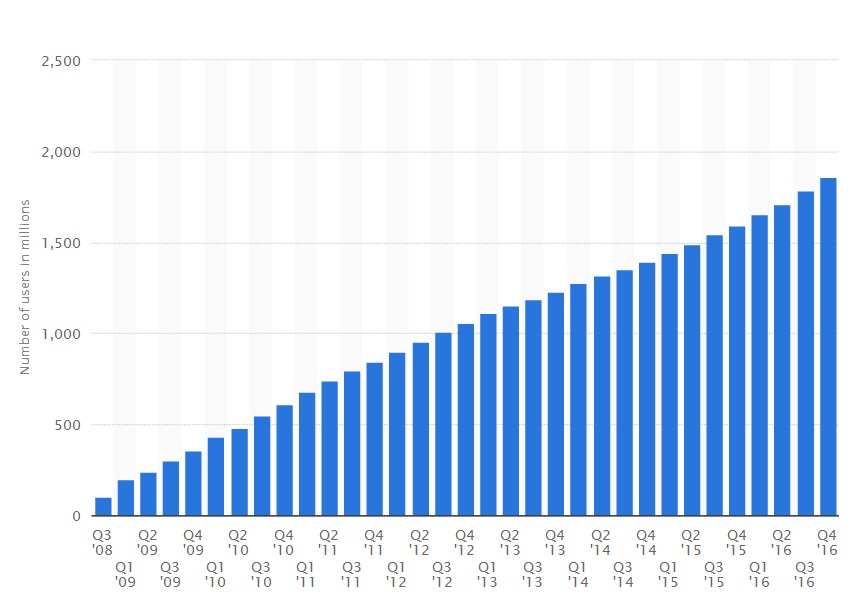
This statistic shows a timeline with the worldwide number of monthly active Facebook users from 2008 to 2016 in millions. As of the fourth quarter of 2016, Facebook had 1.86 billion monthly active users. Extrapolating, we'd say they are well over 1.9 billion. 2 billion look out!
Consensus Ratings for Facebook
Ratings Breakdown: 1 Sell Rating, 4 Hold Ratings, 39 Buy Ratings, 4 Strong Buy Ratings
Price Targets:
3/21/2017 BTIG Research $175
3/13/2017 Cantor Fitzgerald $175
3/6/2017 Royal Bank of Canada $170
3/3/2017 Nomura $155
3/3/2017 Citigroup $165
High Yield Corner
By Michael Foster
This was a particularly good week for many Bull Market Report picks even though the high yield markets were rather dull.
The SPDR Barclays High Yield Bond ETF (JNK: $37) ended the week flat despite some interesting excitement in the Treasury markets. The 10-year yield retreated throughout the week to 2.42%, a drop of over 8 bp from the start of the week. This is significant because that yield is a combination of economic growth and inflation expectations, and the yield has been driven higher by the Federal Reserve’s rate hike and forward guidance of more rate hikes throughout the year. With the 3-month Treasury yield up to 0.75% and market expectations of an end-of-year yield of 1.5%, the spread between short-term and long-term bonds has shrunk considerably in the last few months. This means the market does not believe rate hikes from the Fed will come hard and fast, but will happen very gradually over a longer time period.
Why does this matter? Rate hikes intrinsically sound like monetary tightening, which is particularly bad for bonds and other debt instruments. For high yield bonds, it’s especially bad because it suggests that yields need to go up to compensate for the risk as yields on Treasuries get bigger. Since yields and price are inverted, it also means high yield bonds currently issued will go down in price. That, in turn, would hit funds like the SPDR High Yield fund
However, the Federal Reserve is not tightening relative to expectations. That “relative” clause is key here. The Fed is making borrowing more expensive, but everyone in the market expects the Fed to do this. The real question is how fast and how often they do it. The market now thinks that the Fed will raise rates at a slower pace than the market used to think, which means the Fed is tightening less than expectations. This, paradoxically, is good for high yield bonds because it indicates the downside of a tight policy is already priced in.
Extraordinarily, that “priced in” moment came in 2015. We’re getting near the 2-year anniversary to that cycle of discounting corporate bonds for future rate hike action. And keep in mind that is after junk bonds were discounted for future rate hike action back in 2013. If you look at the price return for the SPDR fund over the last five years, the fund is down over 7%. In other words, junk bonds have been discounting the Fed’s future rate hikes for several years, and every time the rate hike schedule is delayed, it bolsters junk bonds’ value even further.
That doesn’t mean junk bonds have fully recovered, though. The market is still very cautious because of a lot of misunderstanding about what the rate hike really means for corporate bonds, causing money to be left on the sidelines. That makes junk still a good opportunity, although you can’t expect the 10% price returns on junk bonds that were so easy to get a year ago.
So with that in mind, there remain valuable funds with high yield and corporate bonds in them. BMR picks AGIC Equity and Convertible Income Fund (NIE: $19.11, down -1%) and the PIMCO Dynamic Income Fund (PDI: $29, flat) remain solid picks that are earning their dividends and have capital gains potential. Impressively, Pimco has already seen a 5% return in 2017 although we haven’t even gotten to spring yet! That doesn’t mean the performance will annualize at that rate by the end of the year, but it may. What it does mean is that the fund remains a market outperformer that can continue to pay out its current dividend in a market where many funds are cutting distributions.
The AGIC fund has not been as solid of a performer largely because of its equity holdings. The fund had a bad week, but has a 4% year-to-date performance when looking at its NAV. That lags the S&P 500, which is up 4.6% over the same period. That underperformance does not bother us for two reasons. Firstly, the fund has tremendous liquidity thanks to its high 8% yield. It also has maintained its 10%+ discount to NAV throughout the year because the market simply underappreciates this fund. Thanks to that discount, the fund’s management needs to get just a 7.1% return annualized to maintain payouts and not see NAV go down. Thanks to the market’s growth and high yields on convertible bonds, this not difficult for AGIC Equity to earn in the current market. While there are some other risk factors at hand, they aren’t significant enough at the moment for investors to be concerned with.
Elsewhere in the high yield world, things were quiet this week. The SPDR Dow Jones REIT ETF (RWR: $92, flat) saw little movement, but BMR picks fared far better. Digital Realty Trust (DLR: $104) and Kimco Realty (KIM: $23) ended the week flat alongside the broader market, but Omega Healthcare Investors (OHI: $32, up 3%), Government Properties Trust (GOV: $21, up 1%), and Care Capital Properties (CCP: $25, up 2%) fared significantly better than the index. We’re nowhere near overbought territory for these REITs, but we may get there if further price appreciation comes to these stocks.
One asset class was particularly hard hit this week, and it’s one that readers know we have been cautious about for several weeks now: BDCs. The UBS BDC ETF (BDCS: $23, down -1%) was one of the worst performers in the high yield world, but former BMR favorite Main Street Capital (MAIN: $37) did much worse, losing over 1% for the week. Now Main Street’s price is up only 1% for 2017, making it a market laggard. Nothing fundamentally has changed with Main Street, but the market has finally warmed up to this stock so much that it’s gotten far overpriced and thus is now a bad value. It trades at a tremendous premium to its NAV, as we’ve mentioned several times since The Bull Market Report pulled it from its High Yield portfolio. It remains a very high quality BDC with market dominance, but at a 6% yield excluding special dividends, it just doesn’t provide the income worth the risk of paying for such a high premium. We are happy for management to have earned a deserved price premium for the value they add for investors, but we are not willing to pay that premium. Main Street is fairly to slightly overvalued, which is what you would expect for a good company in a healthy stock market. We will wait to buy Main Street again if and when the market gets unhealthy.
Finally, a word on municipal bonds. In 2016 we were pounding the table aggressively on almost all high yield assets, but were tentative about municipal bonds. The asset class was overbought throughout 2016 and undersold before that run up, especially when compared to the more ridiculous panic selling elsewhere in REITs, junk bonds, and especially corporate bonds. We didn’t see muni bonds fairly priced until late 2016, and then they became near bargains a short time later. That is when we started to dip our toes in the asset class and see tremendous value in the market.
Slowly, the market is beginning to come our way. The iShares S&P National AMT-Free Municipal Bond Fund (MUB: $109, up 1%) had a very strong week, and that’s helped the fund return again to positive territory for 2017. BMR pick Nuveen AMT-Free Fund (NVG: $14.53, up 1%) had a similarly strong week and has a similar year-to-date performance. Yet its dividend yield is over twice the iShares fund and its capital gains potential is much greater as well. There is no reason to shy away from municipal bonds now, and we can only hope that the trend we saw last week will continue over the coming weeks. Muni bonds deserve more market demand - it’s only a question of when that market demand materializes.
Good Investing,
Todd Shaver
CEO, Editor and Founder
The Bull Market Report
Since 1998