
The Week Ahead
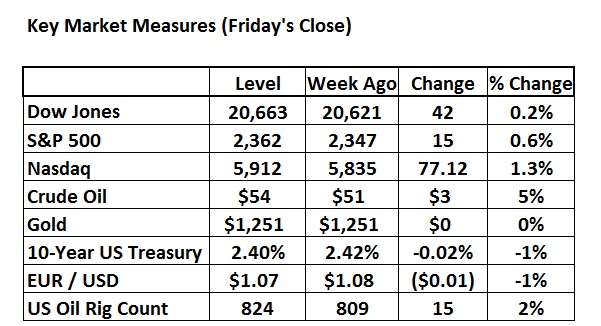
This past week was more of the same calm and collected march higher for the stock market. Optimism is at record highs for business and consumers. There are pockets of softness in the economy, like historically low labor force participation and declining commercial and industrial loan activity at banks, but with the credit market dealing with the stresses of low interest rates the stock market just keeps drawing interest from investors. We now head into April after what was a strong 1Q 2017. The consensus estimate for 2017 S&P 500 EPS is currently $129 revealing a reasonable 18x P/E multiple for today’s overall stock market.
The first quarter closed Friday with the S&P 500 notching its best quarter since 2015, up 5.5%. The Nasdaq had its best quarter since 2013, up 10%. The Volatility Index (^VIX), the fear gauge, posted its second lowest quarterly average in history at 12.37. And listen to this, the average daily percentage change for the Dow Jones during the quarter was the lowest since 1965. Things are CALM out there!
Apple (AAPL: $144, up 2%. All changes in this report are for the WEEK), a component in all three major indexes, jumped 24% during the quarter, nestled next to an all-time high set again this week. The company added $145 billion to its market cap in the quarter, besting its own record set in 2012 of adding more market cap in a quarter than any other company. It was the biggest gainer in the Dow Jones 30. Facebook, Amazon and Netflix all added 18%.
There is always a bull market right here at The Bull Market Report! This week we highlight the following securities: Visa, Amazon, Microsoft, Tesla, Splunk, and Shopify.
Highlights From The Past Week
Trump Talks Tough on U.S.-China Trade. President Trump appeared to follow through Friday on his promises to get tough on trade with China, less than a week before he is to meet with President Xi Jinping of China. In two executive orders, Mr. Trump called for tighter enforcement of tariffs imposed in anti-dumping and anti-subsidy trade cases, as well as a comprehensive review of the United States trade deficits - measures that reflect America’s economic tensions with China. Straightening out the US trade balance with China would be a major positive for US GDP growth, if Trump can accomplish the goal.
Why the Urge to Merge Could Return to Wall Street. Nothing appears to be off the table for the Trump administration as it seeks to pare back the regulations imposed on Wall Street and banks after the financial crisis. There has already been considerable talk about rolling back much of the Dodd-Frank Act of 2010, as well as the Volcker Rule that is intended to prevent Wall Street firms from engaging in proprietary trading. Already, the acting chairman of the Securities and Exchange Commission, Michael Piwowar, says his agency has stopped writing the rules and regulations mandated by Dodd-Frank - more than 20,000 pages so far - in anticipation of the confirmation of Jay Clayton as the commission’s new chairman. There is little doubt change is coming. But no one seems to be talking about whether Wall Street banks will again be able to engage in what has historically been one of their favorite pastimes: getting bigger through mergers and acquisitions. We could be in for an M&A boom across sectors not just Financials.
"Valeant Bet Was a ‘Huge Mistake," Hedge Fund Chief Ackman Says. It is rare that William Ackman, the brash activist investor, apologizes for anything. As a successful hedge fund manager, Mr. Ackman has made billions of dollars for himself and his investors with bold and counterintuitive bets. But this week he conceded that his firm’s biggest wager yet - on Valeant Pharmaceuticals International - was “a huge mistake” that has cost his hedge fund firm, Pershing Square Capital Management, “a tremendous amount.” “I deeply and profoundly apologize,” Mr. Ackman added in an annual letter to investors. It was an unusual moment of contrition for Mr. Ackman and a stark contrast to his emphatic support of Valeant in recent years. In the bigger picture, this event is just the latest of many recent developments pointing to troubling times for hedge fund managers as more and more investors turn to do-it-yourself and/or ETF investing.
BMR Companies and Commentary
Visa (V: $89, flat)
Samsung Electronics announced a strategic partnership with Visa to help bring Samsung Pay to online merchants. Starting later this year, Samsung Pay users will be able to shop online at hundreds of thousands of merchants around the world where Visa Checkout is accepted. The partnership just goes to show everybody in payments relies heavily on Visa.
Samsung Pay’s simple, secure checkout experience using fingerprint authentication gives users a more streamlined online shopping experience, eliminating the lengthy process of adding their payment card data, billing or shipping details each time they shop. Users with fingerprint authentication-enabled Samsung devices will be able to click the Visa Checkout/Samsung Pay co-branded button and touch the fingerprint sensor and the payment will proceed instantly, without needing to enter a user name and password for each purchase.
How cool! The days of filling out long forms or remembering usernames and passwords to make online purchases are continuing to wind down, as options like Visa Checkout’s open platform become accessible on hundreds of thousands of merchant sites, and companies like Samsung see the value in simplifying the process for both consumers and merchants.
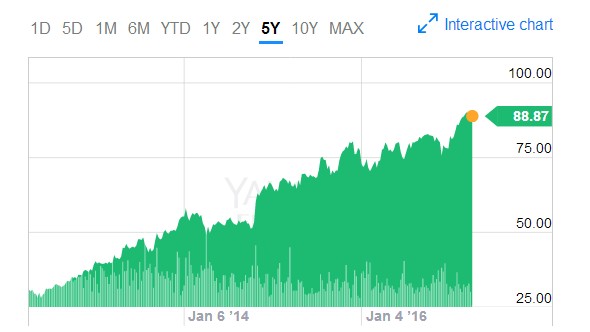
BMR Take: Visa trades at 26x the consensus estimate for this year’s fiscal EPS of $3.45. Take a look at this 5-year chart from Yahoo. Where do you think they are headed in 2017/8 and beyond?
Amazon (AMZN: $887, +5%)
Amazon is expected to enter the Australian market soon. Estimates call for this region to eventually contribute upward to $15 billion of sales to Amazon’s top line, which compares to this year’s sales tracking to be around $165 billion for the company.
What is great about Australia for Amazon? Online sales will account for just 12.5% of Australian retail sales by 2025, up from only 7% in 2016. In other words, Australia is just barely into the online sales phenomenon. We are likely heading to online sales being greater than 25% so there is just much growth runway ahead for Amazon in Australia.
What will be interesting to watch is what Amazon’s entry into Australia means for local retailers. Could it be an imminent disaster? Certainly, many local players will have to adjust to smaller store footprints, change pricing, and improve their customer engagement.
BMR Take: Amazon trades at 125x the consensus estimate for this year’s fiscal EPS of $7.09. It’s a big valuation, but growth is exceptional. EPS was a loss in 2014, $1.25 in 2015, and $4.90 in 2016 and now we see estimates for $7.10 in 2017, $12.35 in 2018, and almost $20 in 2019.
Consensus Ratings for Amazon
4 Hold Ratings, 45 Buy Ratings
Targets:
3/30/2017 Loop Capital $1,100
3/29/2017 Cantor Fitzgerald $970
3/28/2017 Stifel Nicolaus $1,025
3/17/2017 Pacific Crest $895
Apple (AAPL: $144, +2%)
In January, Forbes reported that a White House advisory panel issued a report recommending that the U.S. strengthen protection of the Semiconductor industry, especially against threats posed by Chinese policies to dominate the sector.
Then in March, Apple discussed publicly that the Japanese government is likely to ensure Toshiba is acquired. Prime Minister Shinzo Abe recently met with President Trump to discuss among other topics this one. There are now swirling talks that Apple is going to buy part of Toshiba. The deal could be executed for as much as $18 billion.
What does it all mean? Apple farms out their production for Macs, iDevices and accessories so that they can focus the bulk of their investments on software and engineering companies, setting up R&D centers around the world and building out new flagship Apple stores. We very well might be looking at the early signs of Apple soon making many of their products in the United States. Exciting.
BMR Take: Apple is again setting new all-time highs this week. The stock trades for just 15.5x this year’s consensus EPS estimate of $9.25. We are still seeing healthy EPS growth from Apple, as seen in the consensus forecast for EPS of $10.35 in 2018 and almost $11 in 2019.
Microsoft (MSFT: $66, +1%)
Last October Microsoft released the preview of Azure Analysis Services, which is built on the proven analytics engine in Microsoft SQL Server Analysis Services. With Azure Analysis Services, you can host data in the cloud. Users in your organization can then connect to your data models using tools like Excel, Power BI, and many others to create reports and perform ad-hoc data analysis. This is exciting stuff for the business community. You no longer need to run a big back office. You have Microsoft Azure!
Well, just this week, Microsoft announced that Azure Analysis Services is now available in two additional regions: Japan and the UK. This means that Azure Analysis Services is now available in the following regions: Australia, Canada, Brazil, Southeast Asia, North Europe, West Europe, the US, Japan and the UK.
BMR Take: Again a new all-time high for Microsoft this week as the cloud is taking over and Microsoft Azure is one of the top players. The stock trades at 21x this year’s EPS estimate of $3.10 though estimates call for EPS of $3.50 in 2018 and $4 in 2019.
Tesla (TSLA: $278, +6%)
Earlier this week, Tesla announced that Chinese Internet firm Tencent had acquired a 5% stake in the company for $1.8 billion. The cash infusion is good news for Tesla’s financial health, and the company’s growth prospects in the region.
In a recent filing, Tesla said that 2016 sales in China were $1.06 billion. That’s roughly a quarter of what the company made in the U.S. last year. And while the China figures represent significant growth from 2015, it’s still well below what CEO Elon Musk once imagined. In a 2014 interview with Bloomberg, Musk projected that China could eventually become the electric-car maker’s largest market. Admittedly, that day is a long way off, but we are moving closer and closer.
One big hurdle left to clear in China for Tesla is market share. According to CleanTechnica, 352,000 electric car sales were registered in China last year, which is nearly half of all plug-ins sold worldwide. Tesla, however, is the underdog. Despite being the best-selling foreign electric vehicle manufacturer to crack the Chinese market, the company only had a 3% share in 2016. Plenty of room left for improvement to drive more growth.
BMR Take: Tesla is selling cars in China like hotcakes. China LOVES Tesla and Elon Musk. We are excited to see the company make some progress in the attractive China market. The company is still losing money, basically because they are not making cars in mass quantities yet, so the extra money raised from the 5% stake sold is a welcomed boost of cash on the balance sheet. Tesla ended last quarter with over $8 billion in debt on total assets of $23 billion, a definitely elevated level.
Splunk (SPLK: $62, +2%)
An activist may have just shown up at the Splunk table. A notable language change in Splunk’s 10k filing was noticed this week. The new disclosure alerted investors to possible activist involvement in company operations.
The 2017 10-K included following phrasing absent from the previous year’s filing: "From time to time, public companies are subject to campaigns by investors seeking to increase short-term stockholder value through actions such as financial restructuring, increased debt, special dividends, stock repurchases or sales of assets or the entire company. If stockholders attempt to effect such changes or acquire control over us, responding to such actions would be costly, time-consuming and disruptive, which could adversely affect our results of operations, financial results and the value of our common stock. These factors could also make it more difficult for us to attract and retain qualified employees, executive officers and members of our board of directors."
BMR Take: The added language essentially fulfills the company’s legal obligation to warn investors of activist interference. So we would be in a for a nice catalyst here. We really like Splunk. All anybody ever talks about now is cybersecurity. The company has $1 billion in cash and just $100 million in debt. Consensus estimates call for meaningful growth from $0.40 of EPS last year to $0.60 this year and $0.90 next year.
Shopify (SHOP: $68, -1%)
There was a whirlwind of poor press circulating on the company this week. First of all, a research firm downgraded Shopify to a strong sell to reflect negative estimate revisions following an unimpressive full-year 2017 outlook and growing near-term headwinds. This is just near-term noise. We are focused on the longer term big picture, which is very attractive for Shopify. In particular, many investors are asking the question if it would make sense for Amazon to acquire Shopify. After all, the market cap is only $6 billion. This would be a rounding error on Amazon’s balance sheet.
Shopify offers an easy-to-use multi-channel commerce platform that targets small and medium-sized businesses. Its 2016 revenue was $390 million. This would be a bolt-on acquisition for the Amazon Web Services (AWS) business if the rumor is true. As far as what Amazon or another buyer might get for a bid of $7-8 billion or so, the Shopify website showed that more than 380,000 people have sold over $29 billion using Shopify. The service allows small and mid-sized businesses to fully customize their online stores and to add new sales channels, while managing unlimited products and inventory and tracking sales.
BMR Take: We are not worried that the stock took a few points of pullback this past week. This is a long-term investment that will pay off big in five years. EPS is expected to go from a slight loss this year of $0.18 to something like $1.25 by 2020. Given all the potential of Shopify’s technology and the earnings ramp set to occur, we remain excited about the future for this company.
Upcoming Economic News
It is a very quiet week ahead for economics news. Stay tuned for more economic news next week.
A Letter from a Reader
To: The Bull Market Report
From: Arthur Weed
Twilio, First Solar and Ferrellgas were all recommended at the high end of the price range. Shopify also is at the high end of the range in this market. Sometimes riding the market out for lower prices is a good option. I just prefer to watch for weakness and then go for it.
Hi Art –
OK, I understand. We all have our personal philosophies. I like to shoot for the fences with some of my assets. I missed Microsoft at 3 cents. And Apple at 11 cents . But I got AOL at $1 in the 90s and it went to $71. And I got Iomega at $17 even though the low was $3 for the year and it went to $330.
The facts:
Twilio was added after it dropped from its high of $71, and in fact, it had a fairly sharp drop from that level to $52 where we added it.
First Solar was added at $63 and a month later was $73. Revenues have fallen sharply.
The average price of Ferrellgas for the last 23 years is around $20. At $17 we thought we had a nice discount and an opportunity for it to go to $20 and then $25.
Our thoughts:
--- We believe Twilio will be a huge player in the internet communications marketplace. And we believe the stock can triple or more from $50.
--- First Solar has been a leader in this business for decades and until recently has the revenue to go with it. Unfortunately, we have to wait until 2019 for this one to play out. And that is not guaranteed, but we believe management can do it.
Note: First Solar was given a hold rating at JPMorgan Chase. They now have a $38.00 price target on the stock.
--- Ferrellgas has been a leader in the natural gas business forever. We didn’t know their big acquisition would go down as one of the worst in Wall Street history.
--- Shopify is the leader in e-Commerce by a wide margin and has big growth ahead of it. It is a potential Microsoft-like opportunity as the world is moving to mobile every single day, every week, every month, every year. We wish we had discovered it at $25 or $50. But if the stock goes to $100 and then $150-200 we won’t mind too much. We think this is quite possible over time.
Todd Shaver
A Letter from a Reader
From: Chet Malek
Sent: Thursday, March 30, 2017 9:07 AM
To: info@bullmarket.com
Subject: SNAP and Twitter
Todd – Do you have any thoughts on SNAP? Do you like Twitter better (I assume you do)?
Hi Chet –
We do not like Snap. They may surprise me and go to $50 and $100 but at the moment they are WAY behind where Facebook was when Facebook went public. And if you remember, they went public at $37, hit $43 that day, closed at $37 and then proceeded to go down to $16 in the next few months. Now the stock is at $142. BUT Facebook had big revenues and big profits at that time. Snap has good revenues but super negative earnings – They lost $515 million last year and $380 million in 2015! And they are a niche business unlike Facebook which covers it all.
We do like Twitter. One day they will figure it out. And one day someone will buy them at a 40% premium. If I were a gambling man I would buy 2-year LEAP options with a strike price of $25 or $30, cheap. [This is not for all. Consult your broker. High risk here.]
We really like Twilio – good business concept; strong revenues last quarter. No profits yet. But profits will come if the revenue is there, and it is.
Todd Shaver, Founder and Editor in Chief
Twilio Extends Relationship with Amazon
Twilio (TWLO: $29, flat) announced a further step in their relationship with Amazon. They said: Amazon Connect will use Twilio's programmable APIs to provide enhanced capabilities for customers.
(What are APIs? An Application Programming Interface is a set of subroutine definitions, protocols, and tools for building application software. In general terms, it is a set of clearly defined methods of communication between various software components. A good API makes it easier to develop a computer program by providing all the building blocks, which are then put together by the programmer. An API may be for a web-based system, operating system, database system, computer hardware or software library.)
From their public announcement Tuesday: Twilio, the leading cloud communications platform company, today announced support for Amazon Connect, the newly announced cloud-based contact center service from Amazon Web Services (AWS). Twilio's Programmable APIs will enable a range of new capabilities, including integrating phone intelligence lookup to personalize Amazon Connect contact flows, enhance customer contact details, and follow up with post-call surveys via text.
"We're pleased to further extend our work with Amazon Web Services by helping to power and further enhancing the capabilities of Amazon Connect," said Twilio CEO and co-founder Jeff Lawson. "Supporting the continued advancement of the contact center to its more agile future in software, frees developers and businesses from the legacy approach to contact centers -- an approach that simply can't keep pace with customer expectations today."
The announcement furthers the long-standing relationship between the two companies. Note that Twilio is built and globally deployed on the highly scalable AWS Cloud. Some say that Amazon can do what Twilio does and that all this hype is bad news for Twilio. We say the opposite. We think there is a symbiotic relationship here that appears to grow stronger and stronger each month.
Here’s what the company includes in their press releases:
About Twilio
Twilio's mission is to fuel the future of communications. Developers and businesses use Twilio to make communications relevant and contextual by embedding messaging, voice and video capabilities directly into their software applications. Founded in 2008, Twilio has over 650 employees, with headquarters in San Francisco and other offices in Bogotá, Dublin, Hong Kong, London, Madrid, Mountain View, Munich, Sweden, New York City, Singapore, and Tallinn [the capital of Estonia.]
Alphabet (GOOG: $830) is now covered by Barclays. They set an "overweight" rating and a target of $1,065. Our target is $900 but when that level is hit we fully expect to raise it to at least $1100. The only question is when.
The High Yield Corner
By Michael Foster, Special to The Bull Market Report
We start this week’s high yield summary with the GDP report. The headline news looks good: GDP grew at 2.1% versus 2% in the fourth quarter. Politically-minded Americans may want to dismiss this (and who isn’t politically minded these days?), arguing either things will get better or worse under Trump, depending on the flag they bear. We would suggest resisting the urge to devolve the topic to partisan bickering, because the details under this report are very important because they signal where exactly we are in the credit cycle. This, in turn, is important for one of the world’s biggest credit markets: U.S. corporate bonds.
The mainstream press focused on a couple of dynamics under the headline number, although both are relatively unimportant. A big theme, according to journalists, was consumer spending. This rose 3.5%, a sharp upwards revision from 3% previously. Since consumer consumption is the biggest driver of demand in the U.S., which in turn drives demand for the big industries abroad (manufacturing in China and Germany, exporting in Hong Kong and Singapore, commodities in Latin America, and so on), this is good news.
But it’s actually not the most important bit of good news from the report. The National Income and Product Accounts (NIPA) data, which makes up part of the GDP, gave significant and good surprises that have much more predictive power than consumer activity. According to the NIPA release, corporate profits rose after declining for three years. The “corporate profits” metric, jumped over 9% on a year-over-year basis in the 4th quarter of 2016, a sharp acceleration from the 2% increase seen in the 3rd quarter. Some economists have already said the so-called “corporate profit recession” has ended.
This decline, which was partly a result of the crash in commodity prices and partly the result of cash-strapped consumers pulling back, was a primary reason why the S&P 500 got more expensive. Because stock values are measured by dividing their current price by their earnings over a one-year period (the “price-to-earnings” ratio), stock values climbed higher and higher because profits were falling lower even as stock prices were going up. This caused the S&P 500 P/E ratio to shoot up to over 26 by the end of March, about 50% higher than its historical average. That definitely looked and smelled like an overbought market, but investors held their noses and bought stocks anyway.
We’re here to tell you that you can stop holding your nose. While the corporate profits measurement is not identical to the way S&P 500 companies report their earnings, they’re close enough. And with a 9% jump, that means the S&P 500’s one-year forward P/E ratio is less than 20, a very reasonable level.
At the same time, this increase in earnings is extremely good for corporate bonds, BDCs, and REITs for similar reasons. Let us go through these one by one to explain why.
Firstly, corporate bonds. The SPDR Barclays High Yield Bond ETF (JNK: $37) had a good week (up 1%) thanks in no small part to the GDP data, although investors are continuing to recognize what we have been saying for a long time: the default risks are over and will decline significantly because corporate profits are going up, meaning firms will have enough cash to pay their debts. What does this mean? All the risks that were priced into junk bonds back in 2015 are evaporating but the price hasn’t fully recovered on a real adjusted basis. Great news - this means we can buy junk bonds. But we can’t be indiscriminate about it. Well-managed funds like the PIMCO Dynamic Income Fund (PDI: $29) are ideally positioned to outperform. Last year PDI paid out a special dividend well over 4% of the fund’s value, bringing the annualized yield to over 13%. With the strength in junk bonds this type of return will be even easier for this fund to do this year, making it an obvious strong hold even though it is priced at a premium.
A similar rationale exists for why BDCs shot up this week: more corporate profits mean less concern companies will default on their debts. The UBS BDC ETF (BDCS: $24, up 2%) had an incredibly strong week as a result. However, we do not see this as a good enough reason to buy BDCs, especially the larger cap ones that are facing growing competition from banks that are increasing their middle market business lending practices. The market is cheering the macro conditions for BDCs, which are clearly much better than a year or two ago. However, the market is not taking into account the industry conditions for BDCs, which is more competitive and thus will force some BDCs to look for lower yielding or higher risk loans. This makes us cautious on BDCs just as we are more positive about their lower yielding competitors - namely, financial stocks.
Finally, let’s talk REITs. In the simplest sense, higher corporate profits mean more room to raise rents for industrial, commercial, and infrastructural tenants. Retail and commercial REITs make up a healthy chunk of the SPDR Dow Jones REIT ETF (RWR: $92, up 1%), but it also plays into the wheelhouse of The Bull Market Report’s favorite REITs.
Digital Realty Trust (DLR: $105, up 2.5%), Omega Healthcare Investors (OHI: $33, up 2%), Kimco Realty (KIM: $22, down 2%), Government Properties Trust (GOV: $21, up 2%), and Care Capital Properties (CCP: $27, up 6%) are all exposed to corporate and government tenants whose ability to tolerate raising rents is going up as corporate profits rise. This doesn’t mean the market is irrationally exuberant about the sector like they were in mid-2016, which again makes this a good sector to be into, especially if you’re choosing firms relying on commercial rents.
The market is stronger than the fearmongers would have you expect, and that strength is particularly acute in the high yield universe. It’s a great time to buy income.
Funny – as we write this last sentence above we think of all the folks out there who are thinking: How can I buy yield when interest rates are going to go up which means prices will go down? Well, we at The Bull Market Report don’t believe rates are going that much higher. In fact, if anything, we think rates could go lower, despite the Fed’s best wishes. Besides, as noted above and every week that we write this report, you surely notice that we are writing about strong companies with strong management who are well-aware of the world of interest rate risk. We believe in management of the companies we follow. Look at Annaly (NLY:$11.11). They paid a 30 cent divided this week (11% annualized), and the stock was flat. That’s a 2.7% gain for the week in our book. The stock is up over 10% from its low in December! And they’ve been doing this for 20 years.
Good Investing,
Todd Shaver
Founder and Editor in Chief
The Bull Market Report
Since 1998