
The Week Ahead
Tax season came to a close two weeks ago. We filed an extension of course. Now Tax Reform is front and center. A new plan released by the Trump Administration got the market excited about the prospects. The bull in us hopes to see the corporate tax rate dropped to 15% from 35% and tax repatriation bring home the bacon from overseas – they are talking 10% for this cash that totals $2.6 trillion. We personally are excited about that prospect. We look for more progress in the weeks ahead to drive continued improvement in sentiment and higher stock market prices.
There is always a bull market here at The Bull Market Report! This week we highlight the following securities: Amazon, PayPal, CBRE Group, UPS, Google, Celgene and Athenahealth.
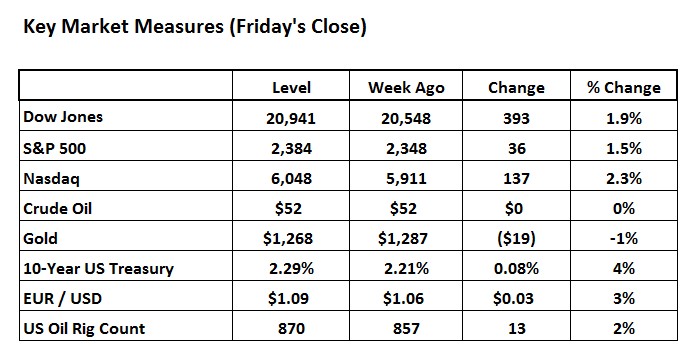
Highlights From The Past Week
The biggest tax cut in US history? The announcement outlined the general principles of proposed US tax cuts and reform. The proposals outline the lowering of the marginal corporate tax rate to 15% from 35%. This rate will be applied to a simplified tax code. Border tax adjustments have been said not to work in their current form but discussions are continuing. Overseas cash will be repatriated at a one-time lower tax rate, although this rate is yet to be determined. The timeline for US tax reform is still unclear. The budget neutrality of these proposals has not been outlined in detail. Secretary Mnuchin stated that the reform would pay for itself with economic growth. But we know this is just impossible. Arthur Laffer would be laughing from the grave. Oh wait – he is still around – a healthy 76 years old.
Remember the Laffer Curve? Google it. It has come to be remembered as the concept of lowering taxes (thus cutting tax revenue to the government) causing so much growth that the increased tax revenues pays for the tax cut. Again – this has been completely debunked over the past four decades.
Cash repatriation a big deal for the Technology sector. In recent years, US companies have accumulated estimated overseas cash balances of $2.6 trillion on their balance sheets. Overseas cash holdings are dominated by the Information Technology sector. Companies such as Apple ($255 billion), Microsoft ($110 billion) and Google ($75 billion) have significant cash holdings well in excess of their working capital requirement. If this cash starts coming back we think it will be a boost to the economy and the stock market.
No healthcare vote this past week. The latest House attempt to pass a revised Obamacare replacement bill seems to have stalled. Despite continued pressure from the White House and recent speculation that a vote could take place over the weekend, House Speaker Ryan and his top lieutenants decided during a late-night meeting on Thursday that they still do not have the votes to pass the legislation. Note that at least 15 House Republicans remain firmly opposed to the bill, while at least another 20 are leaning towards no or are still undecided. Recall that Republicans can lose only 22 votes. The Hill recently reported that at least 21 Republicans have said they would vote no on the bill.
Big inflows to equities. Dampened risk aversion surrounding the French election, tax reform back in the headlines, and better earnings sentiment all are reflected in the latest flow data. Equities saw $21 billion of inflows this week, the largest since the US election. US equities saw inflows of $14 billion, the largest in 19 weeks. Inflows to European equities were $2.4 billion, the most since December 2015. Emerging market equities saw its sixth straight week of inflows. US value has now seen outflows in five of the last six weeks. At the same time, we saw the biggest inflows to small caps in 23 weeks, the biggest inflows to Financials in seven weeks and outflows from bond proxies like real estate, utilities and telecom. Investment grade bond funds attracted funds for an 18th straight week. At the same time, the biggest inflows to Treasury/government bond funds in 13 weeks occurred.
BMR Companies and Commentary
Amazon (AMZN: $925, up 3% - but being up $27 sounds better!)
Amazon reported better than expected 1Q17 results, whereby revenue came in 1% above consensus and operating income was 10% above consensus despite a continued ramp in investments globally. All around it was a great quarter. Check out the News Flash from Thursday.
While Amazon continues to invest globally with a focus on content and fulfillment center expansion, in addition to starting up newer markets, like India, and services such as Prime in Mexico, we believe it is increasingly attracting a greater share of consumer wallets globally as a result of these investments and is focused on cost discipline and efficiency where possible. It’s a great strategy – one that is working and working well.
Amazon remains in investment mode globally, and we believe margins can be sustained as the company continues to focus on cost discipline, as earlier projects become increasingly efficient. As an example, most fulfillment centers typically need to go through three peak periods before reaching sustained efficiency levels. To this end, the maturing of existing fulfillment centers helped Amazon’s operating margin of 5.2% in 1Q17 beat projections. This is great news. Recall, a few quarters ago the stock sank on weak operating margin.
Internationally, Amazon is investing in newer markets and is rolling out many of its products and Prime benefits globally sooner than prior, pressuring profitability in the short term as international losses reached $1.5 billion over the prior three quarters alone. We note that Prime recently launched in Mexico with 20 million eligible items. We believe these member benefits should result in greater adoption of Amazon’s services globally.
Amazon Web Services (AWS) revenue of $3.7 billion increased 44% from last year and was largely in line with projections. AWS continues to launch newer products and we note recent customer additions, Snap, Dunkin Brands, and Liberty Mutual, among others.
BMR Take: Our $1,000 price target is quickly approaching. We expect around $19 of EPS in 2018 versus the $13 in 2017. We believe Bezos will be focusing on earnings as the company moves forward and with nearly 50% EPS growth in the cards, Amazon moving to $1,000 is not a stretch at all.
PayPal (PYPL: $48, up 9%)
PayPal delivered a solid set of results and raised its revenue and earnings outlook modestly by around 3%. The metrics were quite robust all around, starting with acceleration in active accounts (partly helped by consumer choice), robust transaction growth, healthy growth in total payment volume, a lower deceleration in take rate and numerous partnership announcements in the quarter highlighting business momentum.
In particular, we love to see big growth as that confirms a bull market is alive and well. On this front, PayPal delivered through mobile. Mobile volume growth was +50% overall with Venmo doing +115%.
First-quarter revenue of $3.0 billion (up 17% annually) and EPS of $0.44 (up from $0.37), beat estimates of $2.94 billion and $0.41. PayPal expects second quarter revenue of $3.1 billion and EPS of $0.42; and full-year revenue of $12.6 billion (up 16%) and EPS of $1.76. Over $2.7 billion in free cash flow is expected this year. Wow.
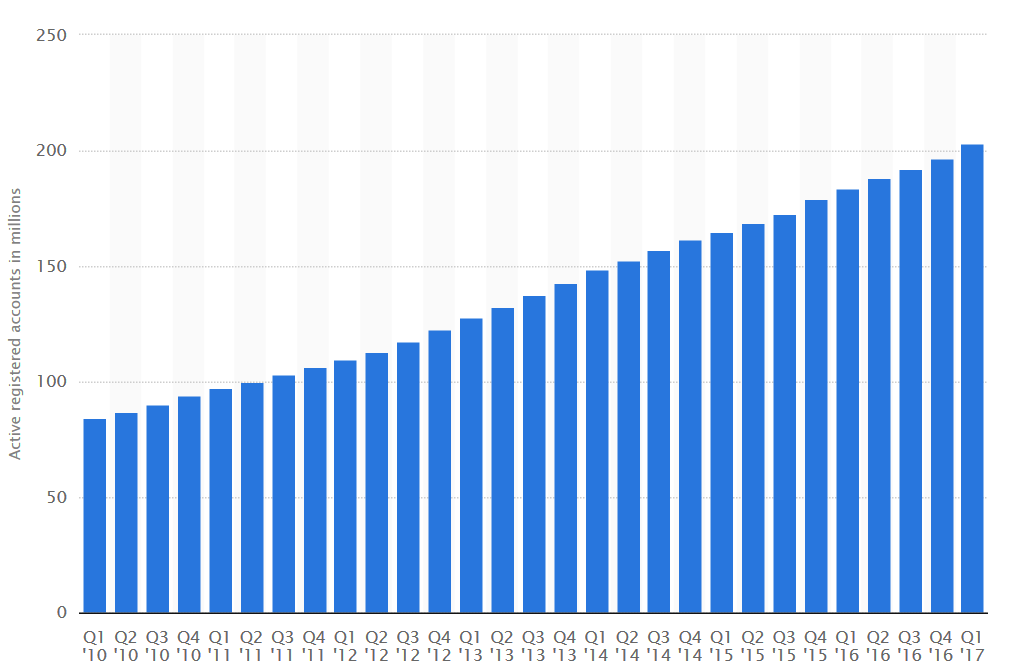
Number of PayPal's total active registered user accounts from 1Q10 to 1Q17 (in millions)
And check this out:
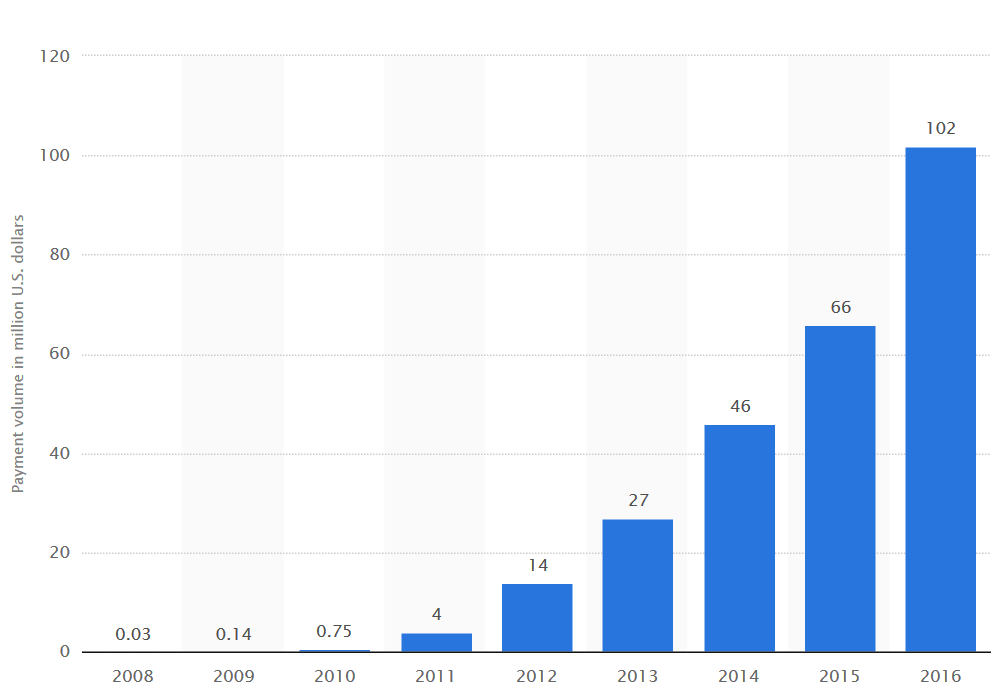
PayPal's annual mobile payment volume from 2008 to 2016 (in $billions)
PayPal announced a new $5 billion stock repurchase authorization. This news caught investor’s attention and was one of the key drivers to send the shares up 7% in the trading session the day after posting results.
One noteworthy ongoing debate is the option to move to more of an “asset light” model, which should increase the valuation the business receives from the market. This strategy would require selling PayPal Credit so the company doesn’t do any lending but only runs technology and processing operations. We would be pleased to see this catalyst occur.
BMR Take: EPS estimates call for around 15% growth to upwards of $2.50 in 2019. With all fundamentals looking great, this freight train is rolling, baby! Our Price Target is $48. Since it hit this price on Thursday, we hereby raise our Target to $56. With a market cap of $57 billion now, if it reaches this new target we will see the cap reach $67 billion. Now THAT’S a story.
Oh – our Sell Price? It remains the same: We would not sell PayPal.
Google (GOOG: $906, +8%, or $63 a share)
Results were better than expected in 1Q17. Gross revenue of $24.8 billion grew a nice 24% from a year ago and was 2% above consensus. The results reflected continued strength from mobile search, YouTube, and programmatic ads as paid clicks growth accelerated 53% from a year ago.
What is really exciting? There is a belief that it remains relatively early days for “mobile search monetization”. To this end, we saw local shopping queries increase by 45% from a year ago and the company achieved 2 billion app installs since September 2016. What does this all mean? More and more people are on their phones searching for stuff as they walk through malls, sit in their cars, and do whatever they do every day. This trend is unlocking “mobile search monetization” we described above. Bottom line, mobile search continues to lead to good results for Google for the foreseeable future.
YouTube did great. YouTube usage was 1+ billion hours of video watched daily in February. Holy cow! This might be the best asset in all of video media. During the quarter, we saw large brand advertisers increasingly come back to the platform after some recent mishaps around inappropriate video uploads being attached to the marketing campaigns of some advertisers on the platform. Very nice to see the recovery unfold here.
BMR Take: We continue to believe Google is among the best-positioned Internet companies due to its leadership position in artificial intelligence, mobile, search, video, and programming, all of which are core Internet growth drivers. With EPS on track to do over $50 in 2018, you just have to own this one.
CBRE Group (CBG: $36, up 4%)
Another Bull Market Report stock delivered a good quarter. It was a clean beat for CBRE. EPS of $0.43 came in well-ahead of the $0.33 consensus, as expenses trended materially below expectations.
CBRE Group’s resilient first quarter result validated the persistent strength of the commercial real estate cycle and the company’s first-rate global platform.
EMEA* and Asia stood out for the company. Asia posted 10% revenue growth.
*Europe, Middle East and Africa
The company has a strong outlook. Management commented that it was not making any adjustments to its 2017 earnings outlook of $2.40. The backdrop remains favorable as rates have retreated, the election fallout has stabilized, global economies are growing and new construction remains strong.
M&A is emerging again. This could be a big boost for the company. The company closed two investments in the quarter, and an additional one at quarter end. Management suggested that after a year of remaining mostly absent from the acquisition markets, pricing was becoming more rational again, suggesting we could see slightly more activity from the company. With a balance sheet that remains healthy, with in excess of $3 billion of dry powder on hand, management could step on the gas if they choose to.
BMR Take: CBRE Group is the Rolls Royce of real estate. With nearly $3.00 in EPS due in 2018 with upside from possible M&A, the current price in the mid $30s sure looks like a cheap value to us.
Celgene (CELG: $124, up 1%)
Celgene reported 1Q17 light on revenues, but modestly ahead of Street consensus on lower spending, and provided positive 2017 guidance. EPS of $1.68 was above Street consensus of $1.64. Revenues of $2.95 billion were slightly below consensus of $3.05 billion.
The modest revenue softness was largely due to weakness in sales of Otezla, which were negatively affected by a greater than anticipated contraction in U.S. prescriptions for psoriasis/psoriatic arthritis, and a modest inventory draw-down through 1Q17. Other products - namely Revlimid and Pomalyst - were also negatively affected by Medicare prescription problems.
We note that previous guidance of $1.5-$1.7 billion in net Otezla sales for 2017 remains intact despite this soft quarter. Further, the contracts negotiated with large payers have significantly broadened access to Otezla for up to 100 million covered lives, intimating future tailwinds for the asset.
BMR Take: We remain bullish on Celgene and forecast total revenues to rise strongly. We expect Celgene’s four drugs (Revlimid, Abraxane, Otezla, and Pomalyst) to drive revenues to over $13 billion by 2017, and over $21 billion by 2020. Note that revenues were $7.7 billion in 2014, $9.3 billion in 2015, and $11.2 billion 2016. Now that’s growth. Recent acquisitions of Receptos and Delinia along with investments in collaborators such as Acceleron, Epizyme, Agios, and others likely ensure growth from 2017 and beyond. We continue to view Celgene as a top large cap pick in healthcare. The market cap is at $96 billion now.
United Parcel Services (UPS: $107, +2%)
UPS pleased investors with earnings results too, mainly on the top line. Total revenue climbed 6.2%. Revenue grew in all segments and in all major product categories, as balanced market demand occurred across the company’s broad product portfolio.
There was a wave of other good news to report. Total fuel expense increased $187 million or 43% over Q1 2016. The fuel surcharge revenue lagged expense, however a February 2017 surcharge change mitigates this variance for future periods. Capital expenditures to support network enhancements were $938 million during the quarter, demonstrating a run-rate at the annualized guidance level.
UPS paid dividends of $775 million, an increase of 6% per share over the prior year, rewarding shareowners with continued strong dividend yield. The company repurchased 4.2 million shares for approximately $450 million in line with the company’s capital allocation policy.
What is exciting? The company is accelerating investments to create the industry's leading smart global logistics network and value-creating portfolio. UPS customers are benefiting from expanded capacity, choice and improved time-in-transit, while technology solutions continue to deliver efficiencies. One example of expanded service is the company's new Saturday delivery program, which began rolling out this year. While the roll-out cost the company $35 million this quarter, UPS is hoping it will give the company a leg up on competitors. The service is now in 15 metro areas. By the holiday season, the company hopes to have Saturday delivery capability in 4,700 cities.
BMR Take: UPS is without question a top logistics franchise globally. With projections pushing towards strong EPS growth and nearly $8 of EPS potential in a few years, we expect the company to deliver. The stock is slowly making a comeback from the sharp drop we saw from $117 to $103 in early February. We wouldn’t be surprised to see $110 soon and $115 again in a month or so. This $93 billion market cap company is a well-oiled machine and with more and more people buying online instead in malls, their business is assure of growth in the future.
US Economic Outlook
The first quarter can be full of surprises. During the existing expansion, first quarter GDP growth has come in short of consensus expectations every time, with an average absolute forecast error of 0.5%. Initially, disappointing first quarter GDP growth led some to question the durability of the expansion, but that should fade now that the issue of residual seasonality has come to the forefront.
Residual seasonality in GDP implies that there is a predictable seasonal pattern. This is clear in the first quarter, as GDP tends to be noticeably weaker than in the subsequent three quarters. The differences are frequent and large enough that they are unlikely a fluke. Also, residual seasonality is evident across many of the major components of GDP, including parts of services spending, exports, federal and state and local government expenditures, and nonresidential structures.
The Bureau of Economic Analysis has made adjustments to correct some of the issues related to residual seasonality, but it likely remains a sizable weight on GDP growth. GDP came in weak in the first quarter, rising 0.7% at an annualized rate. Residual seasonality appears to be shaving 0.5% off first quarter GDP growth. There are other reasons for the weakness in the first quarter, including weather and possibly the delay in tax refunds.

We believe the Fed will look through the poor start of the year, as GDP is inconsistent with other hard data, including employment. Still, sub-1% GDP growth could create a challenge for the Fed, since we still expect it to raise rates in June. Though GDP is heavily scrutinized, the employment cost index for the first quarter could have greater influence on monetary policy. The Fed is worried that the tight job market will lead to a sudden acceleration in wages that would then boost inflation.
Federal Reserve policy makers are set to meet next week, and while there is little expectation that an interest-rate increase will be announced when the meeting ends on Wednesday, the latest economic reading could sway the Fed’s outlook. The monthly report on job creation is due next Friday, and a strong showing could ease some of the concern over the lack of vigor in the first quarter.
Reaffirming its recent findings, the University of Michigan said its consumer sentiment index finished April with a decidedly bullish reading of 97, up from 87 just before the election.
A Word from Gary Jefferson
Jefferson Financial Group
First Vice-President, Investments
UBS Financial Services, Inc.
Viva Le Pen! Laissez les bon temps roulez! But wait a minute……..the market wants Macron to win and therefore is acting as though his election is a foregone conclusion. Does that ring a bell? Remember how Clinton was a "foregone conclusion" and how that night the market absolutely crashed……but made a miraculous recovery after the Trump victory. As far as we can tell, US stocks shouldn't be materially affected one way or the other and we view this as a "sideshow" to the earnings season that is under way here at home. Or, as Alfred E. Neuman might comment on the whole French thing, "What, me worry?"
President Trump announced a new tax plan which he called "bigger, I believe, than any tax cut ever". This news is, in our humble opinion, of much greater interest to the US investor than the French election. We are seeing a plan that is pro-growth and nothing but pro-growth, and which has a realistic chance of garnering enough support to get passed. If that happens, we expect a nice rally. If it doesn't, then we would expect the market to react with some sort of displeasure.
Earnings update: Thomson Reuters is reporting that earnings are expected to grow by more than 11% in the first quarter. 76% of the earnings reports have already come in above estimates. 62% of companies have beat revenue forecasts, and revenues are expected to be up just under 7% on the quarter. These are good, solid numbers. Numbers like these should provide durable support for the market.
Blackstone (BX: $31) killed in the first quarter of 2017. They earned 82 cents a share on revenue that rose 108% year over year to $1.94 billion. Analysts were looking for 68 cents on revenue of $1.6 billion. Total assets under management climbed to a record $368 billion. The company said that realizations totaled $16.6 billion, a company record. The bulk of the realizations came from the firm’s flagship private equity and real estate strategies, with an average multiple on invested capital of 2.6 times.
Underlying portfolio company fundamentals appear strong. Management noted its private equity portfolio companies are experiencing high single-digit EBITDA growth and in real estate, both rents and occupancy continue to improve.
BMR Take: And the stock took off this week. It was up 5%, counting the fabulous 87 cent dividend that it paid a few days ago. You know, we are always looking for new companies to invest in that will give you above-average gains. We will tell you this: There is going to come a time when this stock will skyrocket. We can see it hitting $40 down the road and it just might come sooner rather than later. Why? Because this stock has been undervalued so long that investors have given up on it. But don’t forget that Stephen Allen Schwarzman has NOT given up on it. From what we can gather he has 230 million shares. WOW. That’s 45% of the company, worth north of $15 billion. He thinks the stock is WAY undervalued and is working on a million ways to get the stock higher. We’re going with Steve on this one. We’re up 25% on Blackstone since early 2016, but our Target is $36 and we think hitting this is quite possible in the next few months.
Athenahealth (ATHN: $98) got hammered on Friday, dropping $23, all of our gains since we added the stock in November at $103. We’re down 5% now, not pretty, but not bad in the whole scheme of things. We just hate to see these overreactions. Look at this: revenues for the past three years are $750 million in 2014, $925 million in 2015, and $1.1 billion for 2016. The company reported revenue of $285 million in the quarter up from $255 million in the year ago quarter. And the company stated last week that they expect full-year revenue of $1.23 billion. So really, if you look at the numbers, everything is still solid. Earnings were $22 million, down from $24 million. Yes, earnings were a bit weaker, but revenue growth is key in our book.
We are going to stick with this company for now. We can see the overreaction continuing a bit, taking the stock down to $95 or even a little lower, so you have to make a decision – stick with it or bail. These are always tough decisions and of course, it is impossible to predict what will happen. Many investors say to cut your losses and move on. Others say, like we are saying here, that this great company is being punished by the market for a silly little miss on the earnings front.
Trump’s Repatriation Initiative
Credit Suisse told investors to buy high tech shares because the companies will thrive under President Donald Trump's tax reform, saying it will enable an increase to its shareholder return program and allow for more strategic acquisitions.
The firm raised its rating on one of the giant tech companies two notches, to outperform from underperform, a rare "double upgrade."
"We believe the possibility of an upcoming repatriation and balanced approach towards M&A [mergers and acquisitions] and capital return could drive long term earnings power," they said.
There is over $2.6 trillion of cash offshore, which can be "unleashed" under tax repatriation reform, at least half of which is controlled by Tech firms. If Trump's tax plan is passed, Credit Suisse estimated that about half of this ($650 billion) can return to shareholders during the next five years and another $500 billion could be used for mergers and acquisitions.
"The combination of a potential buyback combined with accretion from M&A, has the capacity to drive these firms’ earnings materially higher in the coming years," they wrote.
BMR Take: The firms with the largest hordes of cash are Apple with over $255 billion, Facebook, Google and Oracle, so we expect them to be the biggest beneficiaries of this tax cut if it every happens.
AstraZeneca (AZN: $30, flat) went up and down after reporting earnings. Revenue of $5.4 billion fell 12% from a year ago and EPS of 99 cents was 4 cents up from a year ago. The company’s ability to grow earnings with falling sales is impressive, and partly justifies the 24 P/E ratio. Most impressive was the company’s ability to lower core SG&A costs by 14% - greater than the sales decline, suggesting greater operational efficiency.
Why were sales down so much? Really this is a one-story issue: Crestor. This drug lost its patent in the U.S. and is a big hit to sales. The company still has plenty of cancer and diabetes drugs in the pipeline, indicating upside is still possible. We will be paying close attention to the company’s pipeline in the months ahead.
Shopify (SHOP: $76) hit an all-time high on Monday. Two weeks ago the stock surged from the $70 level to the $76 level and last week the gains were sustained. The market cap is still a tiny $7 billion and we continue to maintain that a firm could come in a make a $90 or $100 offer for them and it wouldn’t make a dent on the acquirer’s balance sheet. Apple with $255 billion in cash, or Oracle (ORCL: $45) worth $185 billion with $60 billion in cash are just two possible buyers. Don’t get me started on Google or Facebook or Amazon! With over 300,000 websites using Shopify software we expect great things for this company in the future.
The High Yield Corner
By Michael Foster
Special to The Bull Market Report
Of all the high yield sectors as a whole, junk bonds performed the best. The SPDR Barclays High Yield Bond ETF (JNK: $37, up 1%) closed the week stronger despite slightly disappointing GDP news, with the trend starting last Monday at its strongest and continuing throughout the week. The asset class did far better than U.S. Treasuries, especially on the long-term end of the curve, where yields slipped this week, although that slip began before the GDP data. This trend is not sustainable in the long term; junk bond yields cannot keep falling and U.S. Treasury yields cannot keep rising at the same time. At one point or another the gap between the two would narrow and there would be no risk premium for investing in assets that can and do default a lot (junk bonds), versus an asset that cannot default, outside of a major apocalyptic event (U.S. Treasury).
While junk had a good week, BDCs have had a good year so far. The UBS BDC ETF (BDCS: $24, up 1%) is up over 4% year-to-date versus junk bonds’ 1%, with the more popular BDCs becoming an increasingly popular trade. Main Street Capital Corporation (MAIN: $40) is now up 9% year-to-date after another 1% gain this week. But note that Friday was a peak that very swiftly and steeply fell, causing the stock to lose 1% in a day. With a premium to net asset value of 80% by the end of the week, we cannot expect this trend to continue. Of course, we have been saying this ever since we removed Main Street from the high yield portfolio and while we haven’t seen a correction, we have seen the stock’s run up stalling slightly. Timing a top exactly is impossible, but recognizing that we’re at or near a top is easy. This is the case with Main Street as well as several other popular BDCs. While we suspect a correction in the junk bond market to be uncomfortable, we expect a similar trend in BDCs to be much more severe. That may come next week or next year, but these 80% premium valuations cannot last forever.
We’ve given a similar word of caution regarding REITs. Last year, especially the start of the year, was a stellar time for the asset class, with post-August proving much more challenging and post-Trump proving even more difficult. The SPDR Dow Jones REIT ETF (RWR: $92, down 2%) had yet another rough week. Despite the problems surrounding REITs, we have not recommended exiting the sector entirely as we found most prudent with BDCs. The reason for that was simple: REIT valuations remained modest and much less efficient than in BDCs. Part of this is due to the greater ease of valuing BDCs in terms of the market value of their debt portfolio. Due to the strategy of accounting for depreciation with REITs, this sector is much more complicated. As a result, valuing these assets in terms of their book value is largely useless or must be done with extreme care. For this reason, many investors prefer to focus on price to FFO as a ratio - in other words, determining how much you’re paying for income instead of paying for the underlying assets producing this income. This of course is unwise because FFO and asset values can be extremely divorced from each other as a result of a variety of market factors.
Ultimately, this means a closer analysis of the underlying business is necessary when analyzing REITs, and in doing so investors can find amazing deals. This is the back story of our REIT picks, and is why Digital Realty Trust (DLR: $115, up 3%) has remained a major pick for a long time. This income stock is now up over 33% in the last year and the dividend has grown 6%, with more dividend hikes inevitable thanks to its strong and growing FFO. The market has no qualms giving this REIT a high valuation, so it’s no surprise that it jumped this week despite weakness in REITs elsewhere.
That weakness, however, impacted several other Bull Market Report picks. Omega Healthcare Investors (OHI: $33, down 4%), Kimco Realty (KIM: $20, down 6%), Government Properties Trust (GOV: $21, down 2%), and Care Capital Properties (CCP: $27, down 4%) fell with the broader market. These are extremely big movements, largely a result of market panic in the sector. It has also created tremendous opportunities, especially with the very safe Kimco Realty, which has an amazing track record and solid dividend coverage. This is a “buy the dip” opportunity.
A Note on Facebook’s Growth:
Facebook (FB: $150) has four operations that have over one billion users. There is Facebook itself with 1.9 billion. Messenger is at 1.2 billion, as is WhatsApp at 1.2 billion. Then there is Instagram. Listen to this: Since inception, the company has been adding 100 million users about every nine months. But something happened when they hit 500 million. Going from 500 million to 600 million took just six months. And getting to 700 million took just FOUR months. This is unreal growth. When will Instagram reach 1 billion? Good question, but at this rate it just might be in early 2018. And people wonder why the stock hit $150 this week, up 5%. Repeat – Facebook has FOUR operations with over 1 billion users. One billion. That’s 1000 millions. We are just in shock.
OK – the stock hit our Target of $150 Friday and we are now up 55% since we added it in January last year. The stock is going a lot higher folks, so we hereby raise our Price Target to $165 and our Sell Price from $125 to $140.
Good Investing,
Todd Shaver, CEO and Editor
The Bull Market Report
Since 1998