
Let's Get Started
The President took Air Force One for an international tour to promote peace, justice, and stability. His first stop is in Saudi Arabia to meet with over 50 Muslim leaders to discuss a shared fight against radical beliefs and terrorism. He will make his way next to Jerusalem and Bethlehem to re-build relationships that deteriorated under the last administration. Thereafter, he will spend time with the Pope at the Vatican strategizing on how Christian beliefs can bring about more peace in the world. We learned Saturday morning that Trump was greeted on his first stop in Saudi Arabia with $110 billion of deals for US companies in the region, in particular for General Electric and Halliburton. This one of the reasons why America voted for the man? But we’ll see if anything comes of it.
There is always a bull market here at The Bull Market Report! This week we highlight the following stocks: Athenahealth, Home Depot, Amazon, Facebook VMware, and Kinder Morgan.
Highlights From The Past Week
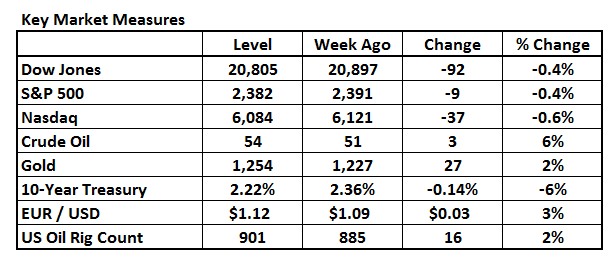
Why have stocks bounced? We see no one specific factor behind a stock market bounce that followed the biggest selloff since last September on Wednesday. Some are focused on the pervasive buy-the-dip mentality since the financial crisis bottom in 2009. The initial flurry of Trump impeachment talk following the Comey memo leak seems overdone. Trump heading overseas may shift some of the focus away from recent controversies toward foreign policy (and dampen his more combative tone). A stabilizing influence is Robert Mueller’s appointment as special counsel in the Russia investigation which brings credibility amid the chaos. Despite all the talk about the threat to Republicans’ legislative agenda, policy expectations have already been meaningfully dialed back. There is little change in a fairly upbeat fundamental narrative that has revolved around expectations for an upswing in global growth. In addition, central banks are still in an easy money stance.
Bullard says Fed’s path may be “overly aggressive”. At an address at Washington University, St Louis Fed President James Bullard noted that in the wake of the Fed’s March rate hike, financial markets saw declining long-term yields and weakening inflation expectations. He observed that this may suggest that the FOMC’s contemplated policy rate path is overly aggressive relative to actual incoming data on US macroeconomic performance. Bullard noted that labor market improvements have slowed over the last two years, and that inflation and inflation expectations have surprised to the downsize in recent months. Note that Bullard has been quite dovish in the past relative to rates, saying in January that there was no reason to move rates dramatically and standing by his forecast for a single rate hike in 2017. In statements following his presentation, Bullard reiterated his call that the Fed should shrink its balance sheet to gain policy space, and said the central bank should retain the option for future quantitative easing should it be necessary.
Oil supported by deal extension headlines. Oil posted a nice gain this week on growing expectations exporters will extend output cuts to curb a persistent glut in inventories at next week’s OPEC meeting. This follows headlines earlier this week that Saudi Arabia and non-OPEC Russia agreed to a 9-month extension. Reuters, citing OPEC sources, said the cartel’s panel reviewing scenarios for the 25-May meeting is looking at the option of deepening and extending the deal to reduce oil output. No agreement has been made on final scenarios. Some say a deeper cut in output is an option depending on estimated growth in supply from non-OPEC producers and US shale oil.
BMR Companies & Commentary
Athenahealth (ATHN: $130, +19% - all price changes are for the week)
Top-notch hedge fund Elliott Associates disclosed a 9.2% stake in Athenahealth this week sending the stock soaring.
Elliot believes the company operates in a highly strategic area at the intersection of technology and healthcare with a disruptive value proposition, a leading competitive position, and a compelling product set, the value of which is not reflected in the company's current market value. Interpretation: The stock is cheap. Elliot believes that there are numerous operational and strategic opportunities to maximize shareholder value. Elliot will engage in a dialogue with the company's board regarding these matters.
Elliot may consider and develop plans and make proposals with respect to operations and management, and all types of other changes that will add value to the stock.
Looking at the software landscape, IBM and Inuit have expressed a desire to break into Healthcare. Reports have also speculated that Aetna and UnitedHealth may also be interested.
BMR Take: Elliot Associates is the real deal as highlighted by Athena’s 19% move higher last week. We hit our Target of $125, having added the stock at $101 in November, so we are up 30% in six months. Not bad. We definitely would stick around to see what happens here. We could see another big move higher should the company be sold. We hereby Raise the Target Price to $140, and the Sell Price which was originally at $90, is now at $105, to $125. We don’t want to lose any of these massive gains.
Home Depot: (HD: $156, down 2%, but up from $144 a month ago)
Home Depot just blew earnings out of the water while the rest of Retail keeps falling apart. With mall retailers such as Sears and J.C. Penney seemingly on their deathbed, Home Depot once again proves why it pays to sell lumber and nails.
Last week, the home improvement retailer delivered first quarter results. EPS of $1.67 beat consensus of $1.61 on revenue of $23.9 billion versus consensus of $23.7 billion. Management reaffirmed full year sales growth guidance of +5% and lifted expectations for EPS growth 11% to $7.15. In February they announced an increase to $15 billion in the stock buyback program.
All merchandise departments delivered sales increases. Sales from contractors were stronger than those from typical consumers. Online sales surged 23%. "The housing market is very strong", Home Depot CFO Carol Tome said, adding that sales in May have been "very good."
So far, the U.S. housing market has withstood the rising interest rate environment (which we see as very insignificant). In turn, home improvement retailers such as Home Depot have continued to thrive as existing homeowners renovate their homes -- which are rising in value -- and builders try quickly to bring on badly needed supply.
Home improvement spending still remains healthier than most areas in retail. Trends remain strong as building materials, hardware and garden supply sales have grown 6.4% year over year.
BMR Take: Stick with this blue chip. Many analysts see the EPS outlook as conservative. Despite its impressive $95 billion sales base, Home Depot has ample opportunity to grow, especially in eCommerce. The company will continue to benefit from healthy home improvement spending, market share gains, and strong execution. The home improvement sector remains well-positioned to benefit from continued modest GDP growth, home price appreciation, and solid household formation. Our Target is $160 – getting close. We can’t wait to raise the Target soon.
Amazon (AMZN: $960, flat)
Amazon cut the price of the Echo to the lowest level in 2017. For a limited time users can purchase two Amazon Echos with the promo code ECHO2PACK effectively dropping the price to $140 each. The normal price is $180.
Why do we care?
Echo is Amazon’s ticket into a massive Home Services Market. It lets Amazon gather data for what is happening in the house as it records everything. It also provides a door for instant on-demand ordering. We have one and we love it!
Amazon, which launched its Home Services unit in 2015, now offers 1,200 services in more than 50 U.S. cities. Customers can select assembly or installation services, which will compete against those offered by retailers like Home Depot or Best Buy, in addition to other services like house cleaning, home repair and yard work, which will compete with Angie’s List. Throughout its 20-year history, Amazon has continued to explore areas of commerce that it believes it could disrupt and this is one ripe for disruption. In March, Amazon estimated that the on-demand Home Services market was valued between $500 and $700 billion.
BMR Take: Amazon is a serial monopolist company that picks markets to enter, disrupts them entirely, and runs away with market share. Home Services looks like the next target. Amazon is really expensive at 145x this year’s earnings, but Amazon doesn’t trade like a normal company. Bezos has said profits will come in due time. Lately they have been knocking out much bigger profits and the Street is content to wait and wait as the stock goes up and up. There remains a ton of upside to Amazon long term as the company is investing massively for growth and future earnings power more than supports the current valuation.
Facebook (FB: $148, -1.5%)
Facebook and Major League Baseball struck a deal to live stream games. The move is the latest initiative by Facebook to expand into the world of live programming. Facebook said that it would stream one game a week beginning immediately and the broadcasts would be available to everyone on Facebook in the U.S.
What does this mean? More engagement. More engagement means more advertising opportunities and more revenue. It’s great news.
MLB Commissioner Rob Manfred said at a news conference in New York, "Probably the most important single announcement is we've done an agreement with Facebook. It's really important for us in terms of experimenting with a new partner in this area. We are really excited about this."
"It's pretty cool," Ian Desmond of the Rockies said. "It's an opportunity to provide the game to everybody. That's what we're trying to do -- expand the game and make it more diverse. It's a step in the right direction. They're doing a good job with that."
BMR Take: The stock is having a great year so far, and we see so much more potential still. Consensus estimates call for EPS near $10 by 2020. At the current PE multiple or 27 where the stock is today, this implies shares can double.
VMware (VMW: $93, -1%)
VMware, a global leader in cloud infrastructure and business mobility, announced it will deliver VMware Horizon Cloud on Microsoft Azure. The integration helps customers accelerate the move to Windows 10 and brings VMware virtual desktops and applications to the increasing global presence of Azure in the enterprise -- available in 38 regions globally.
This is a great news item! Microsoft Azure is connected to so many of the world’s enterprises (large, medium and small) it is mind boggling. By becoming integrated with Microsoft Azure, VMware is now able to tap into all of these customer relationships. What a revenue opportunity.
BMR Take: The addition of a major cloud platform such as Microsoft Azure to VMware’s customer database has the potential to accelerate the growth of the company. VMware is expected to generate $5-6 of EPS consistently for the foreseeable future. Putting it all together, the outlook suggests the stock should continue to do well. We have a Target of $95 on the stock. We can’t wait to raise this Target when hit.
Kinder Morgan (KMI: $20, -2%)
Kinder Morgan had a rough week on some news about more obstacles surfacing. The Alberta Securities Commission is reviewing an environmental group’s request to halt a $1.28 billion share sale that Kinder Morgan needs to help finance the expansion of its Trans Mountain pipeline.
Earlier this month, Greenpeace Canada sent a letter to the Alberta commission, saying Kinder Morgan may have used outdated oil projections in its IPO prospectus. The Alberta commission acknowledged receiving the challenge and will give it "consideration.”
Kinder Morgan had been running a dual-track process, exploring both an IPO and a joint venture to finance the Trans Mountain expansion. In a regulatory filing earlier this month, the company said it was no longer looking into a joint venture.
BMR Take: Kinder Morgan needs to get this together and do so fast. With EPS in recovery mode from $0.66 this year back to $1.00 by 2020, this coincides with more normalized earnings levels prior to the recent drop in oil prices. We don’t need any hiccups to the business plans that push out earnings, especially as oil prices remain volatile.
You know what? The more we think about this company the more we think it is time to move on. $1.00 of earnings (previous paragraph) by 2020? That’s a long time to wait. We’ve got a LOT BETTER places to put our money than this one. Just take a look at any one of our High Yield portfolio stocks, or the REIT portfolio. We are just tired of waiting and waiting – it’s been over a year. We added the company in early 2016 at $18 and exit here at $20.
Upcoming Economic News
Tuesday, May 23, 2017 10:00 AM
New Home Sales
Period: APR
Consensus: 610,000
Prior: 620,000
Wednesday, May 24, 2017 10:00 AM
Existing Home Sales
Period: APR
Consensus: 5,650,000
Prior: 5,710,000
Thursday, May 25, 2017 08:30 AM
Initial Jobless Claims
Period: 5/20
Actual: N/A
Previous: 232,000
Consensus: 237,000
Friday, May 26, 2017 08:30 AM
GDP
Period: Q1
Actual: N/A
Consensus: 1.9%
Prior: 1.9%
A Word from Gary Jefferson
Jefferson Financial Group
First Vice-President, Investments
UBS Financial Services, Inc.
Friday the 12th marked the 13th straight day in which the S&P 500 failed to move more than 0.5% in either direction on a closing basis, the longest such streak since 1995.
Q1 results from 95% of S&P 500 members show earnings are up +14% from the same period last year on +8% higher revenues, with 72% beating EPS estimates and 66% beating revenue estimates. The proportion of companies beating both EPS and revenue estimates is 52%.
Importantly, the growth performance is broad-based and not narrowly concentrated. We had the leadership from the Finance space earlier in the reporting cycle, but the baton has since shifted to Tech and other areas, including Industrials, Basic Materials, and Energy. The big disappointment – you guessed it: brick and mortar retail stores. While brick and mortar stores may be ailing, however, online sales are doing great.
Here is the important takeaway: When looking at the last three quarters, the overall strong Q1 showing represents a notable acceleration in the growth momentum. We have never seen a bad market during a period when it was in the midst of an accelerating growth trend. It could happen of course as wild cards such as oil or geopolitical risks are always present, but if there was ever a silver bullet for the market, it is an accelerating earnings momentum. We do not expect to have a slew of 2nd quarter earnings revisions to the downside begin cropping up over the next few weeks. Rather, with any kind of good news from D.C. such as healthcare reform, tax reform or infrastructure programs, we expect the growth momentum to continue to accelerate on a year-over-year comparison.
Bottom line: Earnings are strong, rates should rise in conjunction with a tightening labor market and we believe stocks still offer greater upside than bonds or cash. Here are the numbers that we feel support this opinion:
The Q1 earnings season was better than expected, and it’s resulted in 2018 S&P 500 earnings estimates bumping up $1 from $134 to $137. (Source UBS) At the higher end of that range, the S&P 500 is trading at 17X next year’s earnings. That’s high historically to be sure, but it’s not "crazy" as some of the doom and gloomers are arguing, especially given low Treasury yield levels and expected macro-economic fundamentals. On the downside, if the S&P 500 were to drop to 2300, then the market would be trading at 16.7X 2018 earnings. In this environment (low yields, stable macro environment), the market could easily be considered fairly valued and a buying opportunity.
Right now, it’s more likely earnings expectations get revised higher in the future, not lower, and that will make the market cheaper.
Sectors which have strong momentum currently include Financials, Healthcare, Technology (including cyber security, which is in the forefront as "ransomware" attacks go worldwide) and Energy.
Square Announces a Debit Product
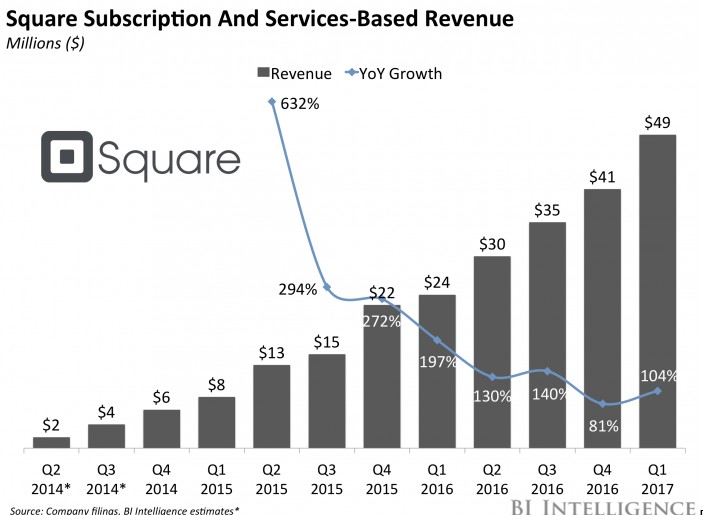
Square Cash, the mobile peer-to-peer (P2P) payment offering from Square, will launch a physical prepaid debit product. The card is funded by customers’ Square Cash balance, and can be used anywhere that accepts Visa.
Square (SQ: $20, flat) wants to get a bigger piece of the P2P space. Mobile P2P payments are growing fast. That’s increasing competition in an industry where no one player holds a true market majority. Square Cash is an important player, but it's not as well-positioned as market leader Venmo, owned by PayPal (a Bull Market Report favorite) or Zelle, which will have access to up to 85 million customers and is backed by Bank of America, U.S. Bank, and Wells Fargo and 17 other banks. Zelle Network Banks Processed 170 million P2P Payments, Totaling $55 billion in 2016. The market is BIG!
Cash and checks have historically dominated the P2P world. But as smartphones become a primary computing device, top digital platforms, like Venmo and Google Wallet, have enabled customers to turn away from cash and make those payments digitally with ease. A shift to mobile payments across the board and increased spending power from the digital-savvy younger generation will cause the mobile P2P industry to skyrocket.
Consumers want mobile P2P services, and they’re turning to them. As smartphones are increasingly used as computing devices, these consumers look to such services for fast and easy ways to pay.
Monetizing P2P is more important than ever. As volume grows and user bases scale fast, finding ways to monetize quickly should be a priority for firms looking to stay ahead. We believe Square has a good shot of winning a good piece of this market.
In-store card payments are still substantially more popular than any form of P2P transfer. A physical card could help Square stand out. Gaining access to a traditional card could help users form habits and encourage customers to run a Square Cash balance, thus engaging them more with the product and increasing volume.
Our Target is $24. We can see this getting hit and our having to raise the Target to $34 and beyond. Square could be a big one.
And this just in:
Washington, D.C., is enlisting Square’s help as its taxi commission tries to help the city’s cabbies compete with Uber drivers. By the end of August, all of the taxis in Washington have to tear out their traditional meters and start using smartphones or tablets. The Department announced that Square will process the payments going through those mobile devices.
Wow – that’s good news. Our takeaway is that this is a great PR move that will get more and more people to use Square. We use it. We love it. You will too. And the more customers the better. AND a higher stock price.
Annaly Keeps Chugging Along
Annaly Capital Management (NLY, $11.50) was up 2% this week and showed us a nice bounce back from recent lows after trading in the high 11s in early May. We have said this many times – the stock has its ups and downs and they are not anything to be worried about. The “interest-raising-talk” will accelerate in the press in the next few weeks, as the Fed prepares to raise in June or July, so buckle up your seat belts and sit back and watch Annaly handle all the bumps in the air. We are not worried. We’re quite content to sit back and collect the fabulous 10.4% yield.
Mazor Keeps Chugging Along
Mazor (MZOR: $43) had a stellar week, closing up 7%. Pretty volatile little stock, isn’t it? It hit $45 on Thursday and closed at $43. Crazy. We think it better to watch this stock on a weekly basis instead of daily!
Amazon Keeps Chugging Along
Amazon (AMZN: $960) was flat for the week, even after dropping $22 on nasty Wednesday. It bounced right back on Thursday. Love this company. Are you still hung up on the stock PRICE? Well, don’t be. Get some shares on Monday. On May 22, 2018 you will be ONE HAPPY CAMPER!
The High Yield Corner
By Michael Foster
The financial press was particularly amusing this week. On Wednesday we had a market correction that was called a disaster, a sign of turmoil, and a harbinger for a market crash. What caused the crash? Depends on who you read. We’ve seen explanations range from algorithmic trading going haywire, bank unwinding, bad earnings (really?), and, of course, geopolitical turmoil because of the Russia scandals. None of these really make any sense, and some are just plain wrong (earnings growth has accelerated, making S&P 500s forward P/E ratio relatively low), but the media keeps clutching for a narrative.
What are the facts? [No FAKE NEWS here at The Bull Market Report!] The Fed announced industrial production rose 1% in April, the largest gain since 2014 and near its all-time high. Unemployment claims fell to 232,000, maintaining levels lower than what we saw in the 1990s and early 2000s. Mortgage rates also fell to less than 4% (mortgage rates have been falling for a few weeks), and some analysts expect this to go lower. [We do.]
This is all good news and better than expected. Macroeconomically, there’s little to worry about in the U.S. And that may explain why the VIX dipped into single-digit territory, which created its own kind of paradoxical panic as many fretted that people aren’t scared enough. But the slew of good news indicates there is little to be afraid of.
That brings us to the most important but most controversial data point: household debt and credit. The Federal Reserve’s Household Debt and Credit Report announced that total household debt reached its highest point since 2008 ($12.7 trillion). While this may ring alarm bells to debt conscious individuals, from a macroeconomic perspective this is a good thing.
Here’s why. American consumers, for the most part, will take on credit only when they feel reasonably confident in their ability to earn money in the future. That’s not to say people are innately responsible with credit, but rather that they will to a certain extent take credit only when they feel confident about their own personal economies. The massive decline in debt following the 2008 crisis is an indication of this, especially when you look into the details. It wasn’t just mortgage debt that fell during the housing crash - it was credit card debt, auto loan debt, and personal loan debt. People just stopped borrowing money during the crisis. This was partly because banks stopped lending, of course, but not entirely. For a large part of America, it was time to tighten belts and weather the storm.
What did this mean for companies? Declining sales. Weaker profits. The need to cut costs, which often meant layoffs which in turn meant more belt tightening and thus even lower sales and weaker profits. This is the "deflationary spiral” economists warn about, and it is the reason why government stimulus is used during a recession.
The opposite of this deflationary spiral is a winding up of credit across the board. Americans are confident of their ability to pay back loans, so they borrow more, and then use that money to spend more. That results in higher sales and bigger profits for U.S. firms. That, in turn, results in firms hiring more people, thus creating a cycle of spending begetting spending and helping GDP rise across the board.
This has several implications for all kinds of investors. For stocks broadly, the news is good: it means higher sales and higher earnings (the S&P 500 has already reported both for the start of 2017). For other sectors, the news is also good but for different reasons.
For business development corporations (BDCs), it’s good because it means small and medium-sized businesses will have much higher demand for credit as they expand operations. This is partly why BDCs have been on a tear for the last couple of years - the market anticipated this expansionary climate. So the UBS BDC ETF (BDCS: $22) is up 10% from a year ago.
There’s just one problem: BDCs aren’t actually better investments.
The distributions that this ETF pays out have fallen in the past year as a result of yields on loans falling for individual BDCs. We’ve seen both NAVs and distributions fall for many BDCs, both big and small, over the last few months. As a result, the BDC ETF is down year to date and the BDC sector is by no means as attractive as it seemed a year ago. But if the macroeconomic climate is better for BDCs, why is this happening?
As we’ve said repeatedly at The Bull Market Report, BDCs are getting squeezed because of the better environment. This is attracting more competition from banks and leveraged lending firms. We’re also seeing smaller BDCs set up shop and compete with big guys like Main Street Capital Corporation (MAIN: $38), making its 70%-ish premium to NAV untenable. That’s why we cut Main Street from the Bull Market Report High Yield portfolio a few months ago, and that decision is finally getting vindicated: Main Street is now 7% off its all-time high reached just a few weeks ago at $41 and is down for the week. We are keeping a close look on the BDC sector and are looking for a company that has a reasonable market price and a strong income-producing portfolio. Until that shows up, we recommend caution.
Better options exist in municipal bonds for income. This sector has lost market favor for a very long time due to its more risk-hungry approach, and that’s caused yields on many muni funds to rise. Bull Market Report favorites Invesco Municipal Trust (VKQ: $12.64, flat) and the Nuveen AMT-Free Fund (NVG: $14.81, up 1%) are now yielding near 6%, tax free. These funds have risen slightly (about 3%) in 2017 but remain down from a year ago. There is still time to jump into these funds, although it appears that the window to get munis at a discount is shrinking.
Over the coming weeks we are going to get more macroeconomic data to determine exactly where we are in the economic cycle. During that time, holding high yield investments and doubling down on munis makes a lot of sense for income-hungry investors. There is a strong chance that the Federal Reserve will raise interest rates next month, and we may see second quarter GDP numbers that are strong. Neither of these are bad for high yield investments, because both signal a market in which people are spending and companies and municipalities can repay their loans. While the market is obsessed over a one-day drop on Wednesday, we will keep our eyes focused on the data to tease out what is really going on beyond popular distractions.
Good Investing,
Todd Shaver, Founder, CEO and Editor
The Bull Market Report
Since 1998