
The Week Ahead
Skepticism mounts for a post-June rate hike at the Fed. While Janet Yellen and her Federal Reserve colleagues are poised to raise interest rates at their meeting this month, investors increasingly doubt the central bank’s projection for additional hikes following soft reports on U.S. employment and inflation. Goldman Sachs pushed back its forecast for a third rate increase this year to December from September. Investors are now pricing in less than one rate hike in 2018 for the first time since the eve of the U.S. elections in November. What does it all mean? As long as the Fed is accommodative with low interest rates, we see the bull market continuing.
There is always a bull market here at The Bull Market Report! This week we highlight the following stocks: Nutanix, VMware, Microsoft, Tesla, Tesoro and Splunk.
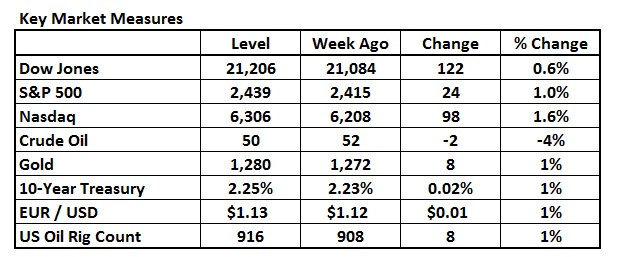
Highlights From The Past Week
"It's Not Just Wages" - Workers Without College Degrees Face "More Instability" If you believe San Francisco Fed President John Williams, the US labor market has almost never been more robust than it is today. Of course, middle- and working-class Americans who are struggling with levels of financial uncertainty that would be unfamiliar to their parents’ generation don’t necessarily care that the official unemployment rate is 4.3%. They’re too busy struggling to make ends meet when real wages have been stagnant for decades and economic growth is expected to slouch along at 2% for the foreseeable future. While researching their new book “The Financial Diaries,” Jonathan Morduch and Rachel Schneider followed more than 200 working and middle-class families around for a year and tracked “every dollar of their financial lives." They found that millions of workers without college degrees, especially those who are paid hourly, or who are paid by commission, experience what they call “income variability” - when their pay fluctuates by 25% above or below their average. Perhaps some of us can relate to facing "income variability" challenges, which is why you look to The Bull Market Report for good investment ideas to help supplement your future financial plans.
Stockman Warns Trump "Not a Chance of Reaching 4% Growth" Stuart Varney, the Fox Business economic host, recently interviewed David Stockman, the former Director of Office of Management & Budget under Ronald Regan. Stockman said that, during Reagan’s tax cut policy ranging from 1983 until Reagan’s exit in 1989, the U.S economy grew at an annual rate of 4.8%. However, he went on to say that there is no way we get to that level under Trump. To do so will require Trump-style inflation first, or “Trumpflation”. Doing so might not even be a good idea, he reminded the audience, by pointing out that Reagan’s greater than 4% growth was followed by a massive and deep recession in 1991 and 1992.
Central Bank Cash Flood Spurring Borrowing The good news for investors is that riskier assets will probably keep rallying in the near term. Companies and consumers have substantially boosted their leverage in the past few years as central bankers worldwide flood the market with cash to suppress borrowing costs. Though one thing to watch out for is lower recoveries in the future. In other words, companies and consumers that eventually become insolvent will have fewer assets available to repay their growing mountain of obligations. This is already happening on a small scale in the U.S. Auto industry, which has been suffering recently from falling sales and lower used-car values. Consumers borrowed more money than they could repay to buy new cars and trucks and are now defaulting on those loans at an increasing pace. Ultimate recoveries have declined to levels not seen since 2009.
BMR Companies & Commentary
Note: We would like to reiterate a part of our philosophy of investing here at The Bull Market Report. First of all, we primarily pick and follow stocks from this country. We don’t really have any great interest in Chinese companies. There are a few exceptions, but there are plenty of stocks to look at in this country, without worrying about what’s happening in Europe or Asia.
OK, on to the BMR Company section.
Nutanix (NTNX: $18.58, -5% - net changes in this newsletter are for the week)
Nutanix is a United States-based company that is an enterprise cloud platform that converges servers, virtualization and storage into an integrated solution.
Dheeraj Pandey, founder, chairman and CEO of "hyper-converged" technology vendor Nutanix is going up against all the old guard of tech, including Cisco. Hewlett Packard, Dell and VMware. He is undaunted, explaining his views on how companies and people evolve to new circumstances. He was recently interviewed and some of the excerpts are below.
Will Nutanix ever go all software? Is there are time when Nutanix will be all software, and stop making its own hardware appliances? Not anytime soon, he suggests. "Customers want a consistent experience, and the appliance will always be important for us. So, it’s very early to say that, for at least the next three to five years, it’s still an important part of our strategy” to have hardware. One reason is that some customers might want a “low-end” appliance. Pandey has noticed that other companies that were all software stumbled when they tried to meet such demands because it hit their high profit margins. “It’s about how we use the software gross margins to do a better job,” he says. "Oracle has done a good job of this, with their appliances. They started in software, and for us it’s the other way around. But think about how our software balances out the total company profit."
What about cloud computing? Doesn’t it constrain Nutanix’s growth? Not in Pandey’s view. In fact, he quickly rattles off the figures about Amazon’s AWS cloud service that he has committed to memory. When it was at $8 billion in annual sales, it was growing 84% per annum. When it reached $13 billion the slowed to 43%. "At $30 billion annually, they will be maxed out,” he says. "When we started this company, combined we had a $35 billion incumbency we were up against,” he says, referring to Cisco, privately held Dell, EMC, and the many other enterprise companies. In other words, $30 billion of AWS is not unlike the $35 billion of entrenched vendors Nutanix has already taken on. Then he adds, "What is the overall TAM [total addressable market] of computing? It’s about $215 billion, between servers and storage and networking. But OPEX [operating expenses] is over $400 billion annually." “So, it's more than a $600 billion market that needs to be addressed."
BMR Take: We feel Nutanix is undervalued, trading at 2.6x the consensus 2018 estimated sales forecast with Nutanix growing revenues 52% faster than peers.
VMware (VMW: $95, -2%)
Founded in 1998 and headquartered in Palo Alto, CA, VMware is the leading provider of virtualization solutions. Its virtualization solutions separate the operating system and application software from the underlying hardware, resulting in improvements in efficiency, availability, flexibility, and manageability, while lowering IT costs. In recent years, VMware has expanded beyond virtualization to include Software-Defined Data Center, Hybrid Cloud Computing, and End-User Computing.
The company reported strong F1Q18 results, with EPS of $0.99 (consensus $0.95) on revenue of $1.74 billion (consensus $1.71 billion) and also raised guidance for the year.
Overall, a number of things are going well for VMware, including: 1) its new products like NSX and vSAN, which grew license bookings 50%+ and 150%+ y/y, respectively; 2) its partnership with Dell, which is beginning to yield revenue synergies; and 3) perhaps most interestingly, the VMware Cloud on Amazon Web Services (AWS) seems to have relieved CTOs of some cloud transition anxiety and unlocked spending on VMware solutions.
In terms of the tech spending environment overall, CEO Pat Gelsinger made two key points. First, he simply said, “From the macro sense, we feel good.” Second, he argued that VMware is a beneficiary of the concept of digital transformation. In particular, as “every business is becoming a tech business,” VMware is “uniquely positioned to benefit from many of those trends” with its cloud offerings and software-driven offerings.
VMware said that it “made great progress with Dell this quarter.” In particular, Dell “grew well and performed a bit better” than VMware had expected in F1Q18. Management cited a number of key product areas that are benefiting from that partnership. In addition, VMware expects roughly $250 million of the $1 billion of revenue synergies from the partnership to be materialized in FY18.
BMR Take: We see VMware as a compelling value trading at just 18-19x the consensus 2018 earnings of $5.25, compared with $4.75 for 2017. Fundamentals are strong, revenue growth is in double-digits, and the new partnership with Dell brings excitement and much promise.
Microsoft (MSFT: $72, +3% - a new all-time high)
Microsoft is an American multinational technology company headquartered in Redmond, Washington, that develops, manufactures, licenses, supports and sells computer software, consumer electronics and personal computers and services. As we all know!
[Follow us here closely, as this discussion is about to get technical.] Microsoft Azure is a growing collection of integrated cloud services that developers and IT professionals use to build, deploy, and manage applications through the company’s global network of datacenters. With Azure, customers get the freedom to build and deploy software, using the tools, applications, and frameworks of the their choice. Azure modernizes IT applications. [For those of you more technically savvy folks, below is some of the specifics on how. For those of you who are bored by this, skip down to BMR Take, below.]
Microsoft will soon be delivering the Azure Stack capabilities that will provide Azure cloud services to customer and partner data centers. Combining current Azure cloud capabilities with the Azure stack will position Microsoft as the market leader in true hybrid platform and solutions which meet customers where they are, based on their current cloud adoption maturity. This hybrid approach translates into increased Microsoft hybrid platform adoption regardless of their current cloud maturity but more importantly secures an organization's future modern IT growth on the Microsoft hybrid platform.
A key reason Microsoft can leapfrog competitors is that its hybrid solution will allow customers to maintain their current Microsoft investments (e.g. platform, identity, infrastructure, tools, and resource skills) and extend their IT experience across cloud, hybrid, and on-premise.
It also overcomes connected and disconnected scenarios and data sovereignty limitations that limit many customer’s abilities to develop modern IT applications and accelerate their movement to hybrid models that best meet their risk and data requirements. Also, most Azure marketplace solutions will work on Azure Stack without modification driving more ISVs to promote their cloud-only offerings to on-premise opportunities expanding their potential revenue stream.
A key driver for Azure Stack adoption will also be the hardware and chip companies that can sell a full solution combining their hardware and Microsoft services for on-premise solutions. This will incent hardware manufacturers like Intel, HP, Lenovo to promote an Azure stack solution to maximize their hardware margins. It will also increase Microsoft hybrid adoption by customers driven by hardware partners.
Microsoft is best positioned to maintain its current on-premise customer base and to accelerate further Microsoft Azure adoption through unified development and operations capabilities and by Hardware and Cloud Software providers that want to take advantage of on-premise scenarios.
BMR Take: Microsoft Azure is one of the best assets in cloud technology and is fueling a new wave of growth for the company. While Microsoft is at all-time high, set Friday, the valuation of just 18x the ability to generate $4 of EPS with healthy dividends and buybacks, culminates in what we believe to be a compelling value.
Splunk (SPLK: $63, flat)
Splunk is an American multinational corporation based in San Francisco, that produces software for searching, monitoring, and analyzing machine-generated big data.
Splunk sold off quickly following Q1 earnings 10 days ago. However, most of the Q1 metrics in terms of revenue, billings and operating cash flow were solid. Furthermore, the revenue guide for Q2 and 2018 were raised a bit relative to consensus. The negative reaction towards Q1 results stemmed from License revenue and current product billings metrics that were soft and were attributable to Cloud revenue contribution and Europe region revenue under-performance.
The European results may have been related to deal-timing issues. Field contacts indicate that demand generation events have been well attended by prospects and sales activity in that region has been robust. Nevertheless, the shortfall in Q1 is going to necessitate that Splunk make organizational changes to get that region back on track.
Post Q1 checks indicate the Cloud business continues to enjoy momentum. AWS established a Quick Starts deployment option for Splunk this past February which could facilitate additional business on the AWS platform. Splunk continues to get tremendous leverage from the AWS platform.
Splunk has over 745 active partners globally, and the company wants to grow that number carefully, as we have seen other IT Security vendors suffer from being over distributed.
BMR Take: After a strong performance in the seasonally weakest quarter of the year, we would be buyers of Splunk on any weakness. Despite more than tripling revenue between FY:2014 to FY:2017 and consistently beating analyst expectations, the stock is 37% below the peak made in 2014. Now is a great time to take a closer look if you have not already.
Upcoming Economic News
United States - Total Light Vehicle Sales
Sunday, June 4 8:00 PM
Period: MAY
Actual: N/A
Consensus: 17.0M
Prior: 16.8M R
Unit: Millions of Vehicles
Institute for Supply Management (ISM) - Non-Manufacturing
Monday, June 5, 10:00 AM
Period: MAY
Actual: N/A
Consensus: 57.0
Prior: 57.5
Unit: Index
Notes: The Non-Manufacturing ISM Report on Business is based on data compiled from monthly replies to questions asked of more than 370 purchasing and supply executives in over 62 different industries representing nine divisions from the Standard Industrial Classification categories. A reading above 50 indicates that the non-manufacturing economy is expanding; below 50, that it is declining.
JOLTS* Job Openings
*Job opening and labor turnover survey – Janet Yellen’s favorite
Tuesday, June 6, 10:00 AM
Period: APR
Actual: N/A
Consensus: 5,725K
Prior: 5,743K
Unit: Thousands of Units
Notes: Part of the US Bureau of Labor Statistics, the Job Openings and Labor Turnover Survey (JOLTS) program produces a monthly study that has been developed to address the need for data on job openings, hires, and separations. With the release of May 2003 data, the JOLTS program began publishing industry estimates based on the North American Industry Classification System (NAICS).
Consumer Credit
Wednesday, June 7, 3:00 PM
Period: APR
Actual: N/A
Consensus: $15.0B
Prior: $16.4B
Initial Unemployment Claims
Thursday, June 8, 8:30 AM
Period: 6/03
Actual: N/A
Consensus: 240K
Prior: 248K
United States - Wholesale Inventories
Friday, June 9, 10:00 AM
Period: APR
Actual: N/A
Consensus: -0.3%
Prior: -0.3%
Notes: The Monthly Wholesale Trade Survey provides monthly estimates of sales and inventories of wholesale trade industries. .
A Word from Gary Jefferson
Jefferson Financial Group
First Vice-President, Investments
UBS Financial Services, Inc.
Well, finally, the market broke out and set a new all-time high, with the Dow closing above 21,200. This was despite some concerning bad economic news. New Home Sales for April fell 11%. The Richmond Fed Manufacturing Index for May fell off a cliff. The headline number declined from 20.0 to 1.0 and it was the first time in five months to be in single digits. New orders fell from 26 to zero. Order backlogs dropped from 4.0 to -15. The shipments component fell from +25 to -1. This suggests the post-election optimism in manufacturing sector is crashing. Another troubling component was shopper traffic that fell from 27 to 7 and expected demand fell from 96 to 73. Inventories fell from 24 to 1.
As we have said repeatedly, earnings fundamentals, of course, are ultimately the key in determining the price or value of a stock. Numerous research articles have shown that companies receiving upward earnings estimate revisions outperform the market while companies receiving downward earnings estimate revisions underperform the market. That's pretty much just plain old common sense. The fact remains that earnings estimate revisions are still the most powerful force impacting stock prices. Therefore, earnings, not other economic data, carried the day. Earnings are going to be the key that determines where the market ends up this year – i.e., they need to stay on track for the market to remain above 2400 and continue to move higher (2436 now.) And there was some good news to counter the weak numbers listed above which was found in the most recent GDP numbers:
GDPNow released it estimate at +3.7% for Q2 estimates and the Blue Chip economist consensus was at +3.1%. After eight years of sub 2%, these are very good numbers.
There are a couple of questions which need answering in order to get more clarity on the future of earnings. These include:
1) How many rate hikes will we get this year? Most analysts expect two more. The bigger question may be what the Fed will do to its balance sheet – if they decide to reduce it, this could create some issues for earnings and stocks.
2) Are current earnings growth estimates without a tax cut already priced into today's market? We think so. The question is raised whether tax cuts are still even possible or whether Trump's pro-growth agenda is completely derailed by a dysfunctional Congress caught up in all the political drama. It still seems to us that the market wants tax reform and wants the economic stimulus that will be provided by tax cuts, repatriation and infrastructure programs. As long as these things are still possible, we think the market will grind higher.
And, there are always the wild cards of 1) oil prices 2) an acceleration in the recent bond rally (bonds still compete with stocks) and 3) the overall world economy, in particular China. The bottom line at this juncture: The market is still signaling that it expects the current expansion to continue.
More on VMware (VMW: $95, down 1%)
VMware set a new all-time high on Thursday at $98 before settling a bit on Friday in a calm market. Here’s an update.
There are 34 Wall Street analysts that follow the stock:
18 Hold Ratings, 16 Buy Ratings
Targets:
5/31/2017 Royal Bank of Canada $110
5/31/2017 Robert W. Baird $115
5/25/2017 Cowen and Company $98
What are analysts saying about VMware stock?
Here are some recent quotes from research analysts:
"VMware’s revenues continue to register strong growth driven by its innovative product offerings. The company continues to benefit from its strength in the virtualization and hybrid cloud market. Its innovative product pipeline, strategic partnerships, frequent contract wins and robust international sales are expected to drive overall results.”
Drexel Hamilton: "VMware delivered a better than expected 4Q16 and we are pleased with the outlook for FY18. Moreover, VMware authorized an additional $1.2 billion stock repurchase program. As such, we are raising our price target to $105 from $90 and reiterate our BUY rating."
Robert W. Baird: "VMware posted a good Q4 and F18 guide. Its public cloud strategy is actually beginning to make sense, and we believe Dell has a better chance of driving revenue synergies than EMC.”
Jefferies Group: "Midway through an earnings season when many infrastructure software companies either reported soft results, guidance, or both, VMW reported one of its best quarters in years and gave very strong guidance that easily exceeded expectations.”
Note that VMware's management team includes the following:
Michael S. Dell, Chairman of the Board
Patrick P. Gelsinger, Chief Executive Officer, Director
Zane C. Rowe, Chief Financial Officer, Executive Vice President
Ownership of the company.
VMware's stock is owned primarily by Dell Technologies at 82%.
VMware declared that its board has authorized a share repurchase program in April, which allows the company to repurchase $1,2 billion in shares.
Cash and Debt
The company has $8 billion in cash and just $1.5 billion in debt. We like these numbers.
BMR Take: VMware is a fabulous company and we are seeing the rewards of the past few years as the company continues to tweak its business model and management continues to improve. With Michael Dell in control now, we expect even bigger things in the future. We wouldn’t be surprised if he decided to buy out the small interest in the company that he doesn’t already own. We added the stock at $83 and our Target is $95. The stock shot through our target recently so we hereby raise our Price Target to $108, and our Sell Price to $90 from $80. With the bull market continuing we expect to see the Target reached this year.
Tesla CEO and the Paris Climate Accord
Elon Musk had vowed to leave President Donald Trump’s advisory councils if the president were to pull the U.S. out of the Paris climate accord. Tim Cook of Apple placed a call to the White House on Tuesday with the same message. 25 companies, including Intel and Microsoft, have signed on to a letter that ran as a full page advertisement in the New York Times and Wall Street Journal on Thursday. A television ad ran Wednesday showed CEOs of top U.S. companies backing the pact.
To many of Musk’s fans, it’s about time. The accord was decades in the making, involving more than 200 nations representing almost the entirety of humanity.
He said Wednesday via Twitter before the announcement on Thursday:
“Don’t know which way Paris will go, but I’ve done all I can” to convince Trump to stick with U.S. commitments made under his predecessor, Barack Obama. Asked what he’d do if Trump decides to leave, the chief executive said he “will have no choice but to depart councils.”
Well, guess what? Trump ruled that we leave. Musk stuck to his word and left.
Tesla Motors (TSLA; $340) had another amazing week on Wall Street. The stock was up 5% to a new all-time high set Thursday. The company is worth $56 billion now.
The founder of Tesla and SpaceX angered many of his supporters earlier this year when he started meeting with Trump and joined the president’s business and manufacturing advisory councils. Some customers even canceled their $1,000 reservations for Tesla’s upcoming Model 3 electric car and posted their refunds on Twitter. Musk continued to advise Trump even as Uber CEO Travis Kalanick succumbed to similar pressure to step down. Musk insisted that it was his chance to ensure the president was hearing from people who take the threat of climate change seriously. Obviously, Trump doesn’t listen to the top minds of the world.
The only nations that haven’t signed on are Nicaragua and Syria.
Tesoro (TSO: $84.50, up 1%)
Tesoro is an independent petroleum refining, logistics and marketing company. The Company operates through three segments. The Refining operating segment refines crude oil and other feedstocks into transportation fuels, such as gasoline and gasoline blendstocks, jet fuel and diesel fuel, as well as other products, including heavy fuel oils, liquefied petroleum gas and petroleum coke for sale in bulk markets to a range of customers within its markets. The Logistics segment includes crude oil and natural gas gathering assets, natural gas and natural gas liquids processing assets, and crude oil and refined products terminaling, transportation and storage assets acquired from third parties. The marketing segment sells transportation fuels through branded and unbranded channels.
On the Street there are 19 firms that follow the stock.
There are 3 Hold Ratings and 16 Buy Ratings
Here are the Targets that a few firms have on the stock
5/30/2017 Morgan Stanley $110
5/19/2017 Credit Suisse Group $100
4/27/2017 Royal Bank of Canada $98
4/22/2017 Citigroup $104
4/19/2017 Jefferies Group $94
BMR Take: We’ve been saying for quite some time now that Tesoro is undervalued. But it’s been frustrating waiting and waiting. As you can see above, the Street has a strong following and high hopes for the company. Our Target remains at the high end as well at $110.
The Weekly High Yield Corner
By Michael Foster
AstraZeneca (AZN: $35, up 4%) had another strong week to help the stock reach a 52-week high, bringing the stock’s 1-year return to 18% excluding dividends. AstraZeneca has been an interesting company for a while, because it suffered both from market worries about pharmaceutical regulation and worries about British companies following Brexit. Both concerns have so far failed to materialize, with both the British economy showing consistently strong numbers and threats of pharma regulation having little bite in a Trump administration.
Instead, pharma is having something of a renaissance. FDA drug approvals have doubled from a year ago. At the same time, AstraZeneca’s pipeline is looking extremely strong. The company has unveiled new products on top of three recently released cancer-fighting drugs, bringing the firm halfway to its 2020 target to release six new medications for a variety of cancers. Ovarian cancer and lung cancer drug studies are so far looking good, with new drugs in Phase 2 and Phase 3 testing. That indicates a continually strong pipeline.
That, in turn, has made the stock more expensive in more than one way. Not only is the price up, but the stock’s PE ratio has risen to over 26. With new drugs in the works, this higher valuation is not unsurprising. It also means that Bull Market Report readers who bought this stock when it was down big got in at a much better valuation and are now better positioned to profit from the future earnings that drug pipeline will deliver.
Our Target has been $37 and our Sell Price has been $29. We raise both to $42 and $32 respectively. The all-time high of $39 set in 2014 is within reach.
More diversified Bull Market Report picks had a less strong but still good showing in the last week, with Invesco Municipal Trust (VKQ: $12.80) and Nuveen AMT-Free Municipal Credit Income Fund (NVG: $15.15) rising over 1% each in the last week. These funds are still delivering a 5%+ tax-free income stream and have delivered modest capital gains since the start of 2017. Both are also offering modest discounts to their net asset values (i.e., the value of the total assets in the fund if sold at market price and immediately distributed to shareholders).
Since Nuveen’s early 2017 dividend cut, the fund’s net investment income has been exceeding distributions on average and the fund is clearly better positioned to have a more sustainable dividend payments in the future. In fact, many municipal bond funds, following dividend cuts in the last five years or so, have been showing greater dividend sustainability in recent months. Why is this? Well, in part it’s because of the weakness in municipal bond markets last year. When muni bond prices go down, their yields rise, and that is actually a good thing for municipal bond funds like these. At the recent higher interest rates paid by already-issued municipal bonds, these funds can buy more aggressively by increasing leverage and/or by buying higher yielding bonds after older bonds in the portfolio are called away or expire. Since both the Nuveen and Invesco funds have loaded their portfolios with lower-duration municipal bonds (that is, bonds that expire in the next 3-4 years) over the last half decade, they have been in a prime position to buy more bonds.
If this sounds complicated, rest assured: These guys know what they’re doing. Nuveen and Invesco have seen their bond funds attract significant capital this year. They have the market experience and knowledge to take advantage of the recent weakness in the municipal bond market.
Now let’s talk REITs. We have been recommending Omega Healthcare Investors (OHI: $31) for a long time, which is why the early 2017 bump in the stock was a welcome sign that the market had caught on to our point of view. In fact, in April and May we came across several articles on various websites pounding the table on Omega Healthcare, arguing that demographic tailwinds, a sound and growing income stream, and an absurdly cheap valuation made this a great stock to buy.
We couldn’t agree more, as we have been saying this for over a year. And at the start of 2017, it seemed the market as a whole had accepted this way of thinking. Then, in the last few weeks something odd has happened with Omega. On May 25, the stock tanked for no clear reason. Again, exactly a week later, the stock tanked again - but recovered slightly to end this past week flat. After all of this, the stock is down over 3% from a year ago excluding dividends that yield 8% at the current price (and note those dividends have gone up every quarter). So no one who owns Omega should be crying just yet. In fact, it would make sense to buy at these current levels. The stock remains very well-valued considering its recent funds from operations report (think of it as EPS for REITs).
Elsewhere, we’ve seen Digital Realty Trust (DLR: $120, up 2%) continue to soar. The stock is now up over 21% year to date. That sounds like a heady number, but keep in mind that the stock was up a similar amount from the year before that. Why? We’re anniversaring the big REIT run-up of 2016, which was both great for Digital Realty and something of a curse in the late months of the year. Of course, that wasn’t a curse for us, since The Bull Market Report continued to recommend buying aggressively as the stock fell. Investors who did that in late 2016 are now sitting on more than 20% gains in a few months on top of the 20%+ gains from two years ago in June, 2015. Granted, the big price run-up means Digital Realty doesn’t really qualify as a “high yielder”, and one may question whether its 3% yield really prices in the risks of the data center rental space. That means the risks of buying at these levels are greater than before, and one may prefer to just hold the stock.
Let’s look at our Target and Sell Prices. We added the stock at $85 in early 2016 so we are up 41% not counting the dividend. The Target is currently $120 and the Sell Price is $89. We always hate to sell stocks that are doing well because of a previously picked Target Price. After all, the stock might go higher. So we will do this. We are going to set the Target at $125 but move the Sell Price up to $115. If it hits $115 we are out.
Good Investing,
Todd Shaver
Founder, Editor and CEO
The Bull Market Report
Since 1998