
The Weekly Summary
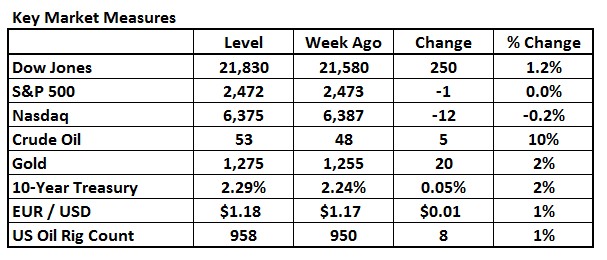
Months of boredom broken up by moments of terror. And then quickly back to the boredom. That’s how it’s been for U.S. stocks lately, where vast stretches of tranquility are occasionally interrupted by sudden bouts of selling on headlines trumpeting entanglements of President Donald Trump. It happened again during the last 30 minutes of trading Thursday, when the S&P 500 Index surrendered a quick five points after the Wall Street Journal reported special counsel Robert Mueller was said to have impaneled a grand jury in the Russia probe. More than half the swoon was erased by the close. A similar frenzy occurred July 20th, when Bloomberg News said Mueller was examining a broad range of financial transactions involving Trump’s businesses. The message from professional investors: In a market where the CBOE Volatility Index has consistently hovered just above 10 at historic lows, get used to it. Both the drops and the recoveries.
However, there is always a bull market here at The Bull Market Report! This week we highlight some of our favorite stocks: Apple, The Carlyle Group, Athenahealth, PayPal, Teva Pharmaceutical Industries, and Tesla.
BMR Companies & Commentary
Apple (AAPL: $156, up 5%)
Apple delivered solid third quarter results. Let’s break it down for you.
iPhone revenue was $24.9 billion versus the $25.5 billion consensus. Just shy. iPad revenue was $5.0 billion versus the $4.0 billion consensus. Mac revenue was $5.6 billion versus the $5.7 billion consensus. Services (the App Store) – the spot to watch – did $7.3 billion versus the $7.1 billion consensus. All in all, no complaints on the top line.
Average selling prices did trend lower, but who cares. The iPhone sold for an average of $606 versus the $621 consensus. The iPad sold for $435 versus $440 last year. Mac was $1,303 versus the $1,334 consensus. This is minor stuff in the long run. People should be concerned about the long term, big picture vision like we are.
Gross margin of 38.5% beat the Street’s 38.3% and hit the top end of guidance. Operating expenses were $6.7 billion vs. the consensus of $6.6 billion. Profits continue to flood in to the tune of about $800 million per week and now sit at $262 billion.
At the bottom line the company did $8.7 billion in earnings or $1.67 per share vs. $7.8 billion a year ago, $1.42 per share. Fabulous.
An overall great quarter. Apple reported unit and revenue growth in all product categories in the June quarter, driving 17% growth in EPS. The business also returned $11.7 billion to investors during the quarter, bringing total cumulative capital returns to almost $223 billion. Wow!
BMR Take: We remain very bullish. The stock is trading at 17x this year’s consensus EPS of $9.00. The Services business is on pace to double over the next few years supporting growth.
The Carlyle Group (CG: $22, up 6%)
Carlyle reported another strong quarter with EPS of $0.81, beating the $0.41 consensus by a mile. Revenue was $910 million versus the $680 million consensus. The company paid the $0.41 dividend shutting up all the naysayers about the businesses’ ability to consistently return capital.
Part of the big out-performance was admittedly just due to a one-time insurance recovery. But the core business looks great. The company is fundraising hand over fist and continues to generate great investment returns.
Overall, Carlyle produced another strong value creation quarter, with net unrealized gains awaiting to be returned to investors increasing 46% year to date. As a result of the strong performance Carlyle has delivered to fund investors, demand for new funds is high. The company raised over $8 billion of capital in the second quarter with acceleration likely in the second half of 2017.
BMR Take: Carlyle is probably heading to $30. Consensus is looking for a solid dividend of $1.80 next year and $2.15 the following. EPS is running closer to $3. Few institutional investors can buy the stock because the K1 tax structure creates issues. But that will change and when it does, look out on the upside!
Athenahealth (ATHN: $141, up 1%)
Athenahealth announced that the board and management team are conducting a strategic review of the company’s operational and financial strategy, leadership. and governance. Management has commenced a comprehensive review of its operations, cost structure and capital allocation, with the assistance of a globally recognized consulting firm. In conducting its review, the company has identified $100 million in cost-savings opportunities that will drive efficiency and targeted investment in the company's hospital and network services businesses. Athenahealth will provide additional information regarding details of these strategic initiatives by its Q3 earnings release in October. Co-founder Jonathan Bush, a cousin to former U.S. President George W. Bush, will remain as the chief executive of the company.
Athenahealth also intends to augment its senior management structure to establish the role of president. The president will be responsible for the execution of Athenahealth’s business operations and will report to Athenahealth CEO, Jonathan Bush. As previously announced, the company is also working to identify a CFO. The board has retained a search firm to fill the president and CFO roles promptly. Finally, the board plans to separate the roles of chairman and CEO and is working to recruit an independent chairman. In addition, the board has begun a search process to appoint an additional independent director. Recall, all this has been brought about by Elliott Management, a major activist hedge fund that disclosed a 9.2% stake in the company back in May.
"Athena needs a management team and operating plan that can successfully tackle the next stage of growth," said a portfolio manager for T. Rowe Price New Horizons Fund. "This plan is a large step in the right direction."
The company said its bottom line climbed to $20.5 million, or $0.51 per share in 2Q. This was higher than $13 million, or $0.34 per share, in last year's second quarter. Revenue for the quarter rose 15% to $300 million, up from $260 million last year.
The company, said it would invest in its fast-growing hospital and network services businesses.
BMR Take: With Elliott Management in there shaking things up, there is a lot of excitement ahead. We love this company but believe now is the time to take profits. We are up 38% since we added the stock at $103 in November. The PE is still a ridiculous 280 and to get it down to a ridiculous 70, profits will have to quadruple, which will take years. We hereby remove the stock from the portfolio.
What should YOU do? Totally up to you of course. You can sell, or you can stay the course and maybe the stock will continue its big ride. If you stay, you can protect yourself two ways. You can sell calls on the stock, say the December $150 for $10. Or you can put a stop order in place at say $135 or $130, to protect your gains. If the stocks goes higher, fabulous.
PayPal (PYPL: $59, down 1%)
PayPal is on a roll with new partnerships. The latest - Skype!
Skype is all about trying to make your life easier and more efficient. That’s why they recently developed Send Money, a Skype feature that allows you to transfer funds via the Skype mobile app while you’re in the middle of a conversation using PayPal. Sweet!
Skype users wishing to send money from a PayPal balance or a U.S. debit card won’t be charged for transactions, making it similar to how PayPal’s other peer-to-peer payment platforms function.
Potentially more important than this alone is that this is a deal with Skype's parent company, Microsoft, which now establishes a relationship with them. Last month, PayPal inked deals with the likes of Samsung Electronics, Apple, and JPMorgan. Skype has reportedly been downloaded over a billion times and boasts approximately 300 million monthly active users. Wow!
BMR Take: PayPal is at 200 million users in a world where Facebook is running a global internet business model with 2 billion. You see the growth here? !! We are riding PayPal far into the future.
Teva Pharmaceutical Industries (TEVA: $21, down 36%)
Teva announced earnings and got rocked. Revenues of $5.7 billion versus $5.0 billion last year. EPS of $1.02 versus $1.25 a year ago. Dividend of 8.5 cents, down 75% from 34 cents in the first quarter of 2017. The company only lowered EPS guidance from $5.10 to $4.40, which makes the stock very inexpensive relative to where it is trading right now on earnings. However, the problems are big.
Second quarter results were lower than anticipated due to the performance of the U.S. Generics business and the continued deterioration in Venezuela. In the U.S. Generics business, the company experienced accelerated price erosion and decreased volume mainly due to customer consolidation, and greater competition as a result of an increase in generic drug approvals by the FDA, and some new product launches that were either delayed or subjected to more competition. Not good.
In response, Teva must take swift and decisive actions. The company is now focused on executing meaningful cost reductions, rationalizing assets and maximizing value, actively pursuing divestiture opportunities and strengthening the balance sheet.
BMR Take: Life brings adversity. You, dear reader, have been around long enough to know this. This stock has just been rocked as bad as the loser in a UFC title fight. But it is just silly cheap right here. Buy more? Yes, if you are ready to take on some volatility. Sell? Not here. Hold? This seems like the best course of action with intentions to exit once the price gets up off the floor mat.
Tesla (TSLA: $357, up 7%)
Tesla reported Wednesday that its net loss widened in the second quarter as they opened new stores and prepared for the launch of its new lower-cost Model 3 sedan.
The loss grew 15% percent to $335 million from a loss of $290 million in the year ago quarter. But Tesla's adjusted loss of $1.33 per share, handily beat Wall Street's forecast of a $1.88 loss.
Revenue more than doubled to $2.8 billion, also beating Wall Street's forecast of $2.5 billion. Tesla's shares jumped 6% percent after the earnings release. Tesla saw significant growth in its energy generation and storage business, which contributed about 14% of its revenues. It bought solar panel maker SolarCity late last year and said it began taking orders for its new solar roof tiles in the second quarter, and recently began installations.
But most attention was focused on the Model 3, which was delivered to its first 30 customers — all Tesla employees — last week. CEO Elon Musk said the company has 500,000 reservations for a Model 3 and it wants to ramp of production as quickly as possible. But Musk has warned of “production hell” for the next six months or longer as the company goes from building 100 Model 3’s in August to 20,000 Model 3’s by December. He wants Model 3 output to grow to 40,000 cars per month by sometime in 2018.
Musk made a surprise announcement during Wednesday's second-quarter earnings call. Musk said Tesla will no longer use an entirely different vehicle architecture to build the Model Y, the compact SUV due to hit the market by 2020. Tesla will instead borrow from the Model 3's platform. That should make Model Y production a lot easier in the future. "Upon the council of my executive team to reel me back from the cliffs of insanity, the Model Y will, in fact, be using substantial carry over from Model 3 in order to bring it to market faster," Musk said. "I have to thank my executive team from stopping me from being a fool," Musk said. "Model Y will have relatively low technical and production risk as a result."
Tesla is averaging about 1,800 orders per day for its Model 3 since its big event a week ago Friday. Extrapolated, that’s over 50,000 orders a month. It opened 29 new stores and service centers in the second quarter in order to meet Model 3 demand. It's also planning to double the number of fast-charging Supercharger outlets this year to 10,000 worldwide. The company delivered 22,000 Model S and Model X vehicles in the second quarter. That was up 53% from the same quarter a year ago, but down from 25,000 in the first quarter.
Management is expecting positive Model 3 gross margin in Q4 and targeting 25% margin in 2018. Model S and Model X deliveries are expected to increase dramatically in the 2nd half of 2017.
During the initial phase of the Model 3 ramp in Q317, the volume produced will be tiny relative to the installed production capacity. As a result, Model 3 gross margin in Q3 will be impacted by the excessive allocation of labor and overhead costs and depreciation over this tiny volume. In the absence of these one-time elevated cost allocations, Model 3 gross margin in Q3 would already be positive, resulting in a positive cash contribution.
BMR Take: The future of automobiles are electric and Tesla runs the show. We are looking at EPS estimates of $14 in 2020.
Upcoming Economic News
Consumer Credit
August 7th, 3:00 PM
Period: June
Consensus: $16.0 billion
Prior: $18.4 billion
JOLTS Job Openings
Tuesday, August 8th, 10:00 AM
Period: June
Consensus: N/A
Prior: 5,666,000
Wholesale Trade
Wednesday, August 9th, 10:00 AM
Period: June
Consensus: 0.40%
Prior: -0.50%
PPI
Thursday, August 10th, 8:30 AM
Period: July
Consensus: 0.10%
Prior: 0.10%
CPI
Friday, August 11th, 8:30 AM
Period: July
Consensus: 0.15%
Prior: 0.0%
Google Reports Earnings
Google (GOOG: $928, down 1%) continues to reports huge gains in sales and earnings, despite having to pay the European Commission a $2.7 billion fine. EPS of $5.01 beat estimates by $0.60 and revenues of $26.0 billion beating estimates by $400 million. Total revenue was up 20% year over year, and was in fact up 23% when adjusted for currency fluctuations. 87% of Alphabet's $26 billion of revenue during the quarter came from advertising, which was up 18%. Google’s “other” business - everything that’s not advertising, including its cloud business and Google Play app store - grew 40% year over year to $3.1 billion. “Other” now represents 12% of Google’s business, up from 10%. Sales from the Europe and Africa account for about 34% of the company’s overall revenue,
Google's paid clicks were up 52% year over year. The average cost-per-click was down 23% year over year. We are not fretting over the last statistic. But we are salivating over the first. 52% growth. Huge.
Advertising revenue growth was driven by mobile and YouTube. And the cloud business was big. Cloud deals larger than $500,000 tripled year over year.
BMR Take: Buy today. Buy tomorrow. Buy next month. Buy next year.
A Word from Gary Jefferson
Jefferson Financial Group
First Vice-President, Investments
UBS Financial Services, Inc.
The number one question to us over the past few weeks has been, "When is this bull market going to end?" Run away as fast as you can from anyone who tells you they know. That said, however, it is a very important question to ask because, believe it or not, risk matters. And you can rest assured that Murphy's Law will prove that risk matters most when it appears risk no longer exists. The S&P 500 is up nine straight months and the VIX hit an all-time historical low last week. The media seems to think that, somehow, no one seems nervous. That's not what we see. We see a lot of nervousness and the question we prefer to answer instead of being asked to foresee the future is, "What signs of a bear market do you see today?"
Aside from the always present danger of a global conflict, we do not see the most common indicators used to predict coming recessions such as falling sales, production and earnings. What is happening instead is a real turnaround in earnings growth momentum to the upside. The key ingredients for a typical bull market are still in place:
The economy is expanding.
Earnings growth is accelerating – we've seen three quarters in a row and 2Q17 looks like it will be the best so far. Stocks are not cheap, but with few exceptions they still offer a more attractive value than bonds (The 10-year Treasury is still around 2.3%)
One Wall Street research firm recently said, "Just realize that this bull is eight years old. The easy gains have been made. Now it's a slower grind higher. So stay focused on the key long term trends and be patient waiting for the profits to unfold".
What we read into the words, "a slower grind higher" is a market that has more of a pattern of two steps higher and one or one-and-a-half steps lower, rather than the four or five steps higher to each step backward that we have enjoyed for several years. It is a rare year that the market doesn't experience a 5% pullback at some point – we think that would be not only be normal but also a "healthy" thing to see. Stock Traders Almanac, researching patterns in the market over the past 50 years, reports that strong post-election years typically point to summer selloffs. Looking at the 50-year charts, these seem to range in the 4% or the 9% area with the "average" being somewhere in-between. We don't see anything that would make us disagree with historical norms because "It's different this time". Thus, we expect to see some sort of sell-off over the August-October time frame that's in line with historical averages.
However – Oppenheimer announced last week that it was raising its 2017 earnings estimates for the S&P 500 from $125 to $129 per share, and raising its year-end target for the index from 2450 to 2650. Most resources we follow have a price target between 2500 and 2650. Should we see a decline from 3% to 10%, most experts are saying that there will be a substantial year-end rally from that low point which will propel the market to further all-time highs by next year. But that's the "slower grind higher", and watching the market drop 10% and then going all the way back up to get another 5% or 6% will not be "easy". To that end, patience will be a true friend and we would also keep in mind that, "Without a selloff, there can be no rally".
The High Yield Report
By Michael Foster
Special to The Bull Market Report
Earnings season for REITs continues, and the news for Bull Market Report subscribers has been great.
Government Properties Trust (GOV: $18.35, up 1.5%) saw sales and earnings beat expectations by a healthy margin. Revenues rose 9% year-over-year to $70 million and FFO for the quarter beat expectations by a penny at 60 cents per share. On a trailing 12-month basis, dividend coverage is now 132%, above the 130% cutoff that we prefer and far beyond many more “conservative” REITs.
Government Properties Trust is a really interesting stock, because it is always seen as extremely high risk despite its business model and fundamental results. Quarter after quarter, Government Properties Trust reports high occupancy rates, strong revenue, and a healthy amount of income that is higher than dividend payouts. So why does the market give this stock a 9.5% dividend yield, when some REITs with worse dividend coverage ratios are yielding 5% or even less?
A large part of it has to do with the company’s size. At a $1.8 billion market capitalization, the firm is definitely one of the smaller and less geographically diverse. But that lack of diversification is more than offset by its business model: renting to United States government agencies and offices, usually with long-term lease contracts. Back in 2013-2016, when expectations of a shrinking government were rampant (and actual downsizing was happening a bit), this didn’t seem like a good thing. But we’ve seen this REIT weather that storm, thanks in no small part to its tenant mix and, most recently, its move into more conventional office leasing.
But now that government downsizing is not as sharp of a focus in D.C., Government Properties is quietly driving revenue with strong demand from government agencies, who are also quietly expanding. On the firm’s earnings call, President David Blackman announced that 290,000 square feet of new and renewal leases were completed in the second quarter, with 235,000 square feet being rented to government tenants. The weighted average lease term for those leases is 8 years.
This means 82% of the revenue the company is going to get over the next 8 years is virtually guaranteed by the full faith and credit of the United States. On top of this safety, the REIT reported that 22% of the firm’s rented space is going to face an expiration in the next two years. Let’s dig into that. If that 22% remains vacant, and there’s no growth anywhere else in the firm’s portfolio, that means annualized FFO would drop to about $1.76 just a hair above the company’s $1.72 dividend.
Obviously, this is an extreme scenario that is virtually impossible to occur. Even in the depths of the 2008-2009 recession, REITs simply did not have a 78% occupancy rate. So even in the most absurdly dire, extreme hypothetical scenario, Government Property’s dividend is secure.
This is why the stock is really worth buying even as its yield is over 9% and despite the 24% price drop we have seen over the last year. The stock is volatile because there’s a lack of investor enthusiasm - but as a vehicle for capturing an income stream, it’s a solid choice, especially now after its drop.
Let’s talk about another REIT that released earnings this week - Apollo Commercial Real Estate Finance (ARI: $18.01, up 1%), which reported a slight miss on revenues that rose 33% year-over-year and EPS of 46 cents, in line with expectations.
Looking over the press release and listening to the earnings calendar, there really isn’t much to raise eyebrows - which is why the stock didn’t really change much. In a way, the firm’s results are best summarized by CEO Stuart Rothstein, who said this during the earnings presentation:
"Importantly for Apollo's business, transaction volume remains healthy driven by both a significant amount of capital committed to or targeted for value add real estate equity investment and the availability of various debt financing alternatives. At present, Apollo has a strong pipeline consisting of both new opportunities many of which involve repeat clients, as well as the option and opportunity to participate in the refinancing of some existing transactions.”
There are no surprise new investments, no sudden influx of demand for commercial loans or new borrowers coming to the table. It’s very much business as usual. And that means $800 million in new investments year-to-date for the firm and an extra $150 million in funding on previously closed transactions. This contributed to 46 cents in net interest income, giving the dividend a pretty worrisome coverage ratio on a trailing 12-month basis: 98%.
There are a couple of things to keep in mind. This is a mortgage REIT (mREIT), where dividend coverages tend to be significantly lower than in property REITs. Investors are compensated for this with a higher dividend yield, and Apollo Commercial is giving a 10% yield right now. However, investors need to brace for the possibility that the dividend could get cut in the future - although the cut could be miniscule to bring the company back to a 100% dividend coverage ratio.
Fortunately, that is extremely unlikely for one reason: This company has been growing like a weed, as you can see from revenue jumping by a third from a year ago. This is very much a growth income stock - an odd thing that is hard to find, but needs to be thought about differently. High yield stocks tend to rise in price, and thus have a lower yield, as the company proves the sustainability of its income stream over time.
Of course, there is a risk that the growth will slow or stop, and that’s one of the big risks that this stock’s big yield is compensating investors with. So far, there is no indication that the growth will stop - the healthy pipeline of loans makes it clear that there’s still room for the company to grow into its dividend. But there’s also no indication that growth is on track for a rapid expansion - instead, it’s simply chugging along. That probably means investors can expect its yield to continue and its stock to stay where it is - which means it’s a great hold for now to capture those 10% dividends.
Good Investing,
Todd Shaver, CEO, Editor and Founder
The Bull Market Report
Since 1998