
The Weekly Summary
Repetitive. That’s what the talking heads are on CNBC. That’s what you see in the local newspaper and even in the Wall Street Journal. All anybody talks about is Trump this and Trump that. Rising interest rates and the Fed. So on and so on. It’s all in hindsight too. Rarely ever do you hear forward thinking. Well, not here at the Bull Market Report. We aren’t anchored to the mainstream. We aren’t beholden to anything or anybody other than giving fresh perspective to you, our subscribers.
This week the one thing that caught our eye was hardly discussed at all in the media. China’s travel and tourism growth rate over the next 10 years is expected to outpace the USA and all other major nations. We are sure you know that China has 1.4 billion people versus our 325 million. We are at a major disadvantage in terms of population size. We better be smart in all we do. We better remember what got us here -- the wisdom of the founding fathers and bold actions (like starting a fight over tax reform by sinking a ship). What wise and bold actions are we taking today? Politically? Financially? Socially? Our Fed can’t even raise rates one-quarter of a point eight years after a crisis. While we are stalled, places like China with 4x the people-power we have are taking over. Let’s go!
No matter what is happening out there, there is always a bull market here at The Bull Market Report! This week we highlight some of our favorite stocks/funds where we think you can still make good money, including: Nutanix, Opko, Apple, Cloudera, Carlyle Group, PayPal, and we discuss Bitcoin.
BMR Companies & Commentary
Nutanix (NTNX: $24.50, up 14% for the week)
Nutanix is on a role. You know why? We’ll tell you the secret. Here is what the smart money sees: It all comes down to new customer growth and average revenue per customer. Sometimes it is just this simple. You look at the business model. You see what is happening with the leading indicators. These are the drivers of where the business is going. And it’s clear what is going to happen.
As of the end of July, Nutanix had 7,050 customers up from 3,770 customers in the year ago period. Out of this pool, there were just 400 customers doing over $1 million of business versus 210 customers in the year ago period.
What does this mean?
The total number of customers just doubled. Hardly any are doing over $1 million of business yet. An analysis of lifetime value from seasoned customers reveals this initial buy is 1x; after 18 months customers spend 4x the initial buy, and the top 25 customers end up around 19x.
So you see it’s just math. We could analyze the product all day (which is fabulous) and the market is buying it. Customers are flocking in.
BMR Take: Nutanix is a once-in-a-generation opportunity according to Goldman Sachs. But note that Nutanix is the classic busted IPO. Busted IPOs are where the initial hype around the first day of official trading on a public exchange gets a bit too high. There is a lot of excitement after all. And there is a lot on the line for investment bankers and management to get top dollar on the IPO price. Then the stock deflates. This is where it is a good time to buy. Nutanix is a great business - not much has changed since the IPO, aside from the fact that now is a much better time to start buying.
Opko Health (OPK: $6.71, up 12%)
The CEO bought 15,000 shares at around $6 per share. They say people sell stocks for any number of reasons. But there is only one reason you buy a stock – you think it’s worth a lot more. Now, when that person happens to be the CEO, that is interesting. The CEO should know the business really, really well. Many academic studies have shown that following insider buying by top executives is a money making strategy in the markets. So again why is the CEO buying shares right now? Whatever he sees leads him to believe he is going to make some money.
BMR Take: Consensus calls for about $1.2 billion of revenue for the company this year heading to $2 billion in a few years. We could be in for some major upside to estimates. Now wouldn’t that be nice, after being so patient with this little $3.75 billion company.
Apple (AAPL: $152, down 5%)
Apple had its worst week in 17 months for a number of reasons but what some say is muted demand. They say the old Apple of Steve Jobs never would have even come out with this phone. Today they just do an upgrade, throw a party, and expect people to flock to it. In fact, they are charging $1,000 now. The old Apple wouldn’t do something unless it was innovative. Nowadays it’s just boring old corporate culture. While demand for the new iPhone was weaker than expected, the reality is it is not a needle-moving matter or a reason to sell the stock. Apple is among the best franchises in the world and they are still selling a millions of iPhones. This is a great buying opportunity.
What else? If you updated to iOS 11 after it launched on Tuesday, chances are that you’ve noticed your battery is draining at an alarming rate. On Thursday, mobile security firm Wandera dove into the update and discovered that iPhone and iPad users who upgraded to iOS 11 are seeing their battery life decay more than twice as fast as it was on iOS 10. So clearly there are some kinks to work through.
BMR Take: We are not particularly concerned with these recent developments. Many times the bad news comes out first after a product launch and then the good news trickles out over the coming weeks and months. Apple is approaching their big selling season here shortly and in October will start taking orders for the Apple X. We will suggest to you here that the orders will be big and the hype bigger, and expect the stock to recover nicely in the coming months.
Cloudera (CLDR: $16.90, down 8%)
Cloudera is issuing new stock, diluting existing stockholders, hence why the stock is down. Specifically, Cloudera announced that it has filed a registration statement with the U.S. Securities and Exchange Commission relating to a proposed follow-on public offering of its common stock. A portion of the shares to be sold in the offering will be sold by existing stockholders of Cloudera, and a portion of the shares will be sold by the company. Cloudera will not retain any proceeds from the shares sold by existing stockholders. The number of shares to be sold and the allocation of the shares between existing stockholders and the company have not yet been determined.
Morgan Stanley, J.P. Morgan, and Allen & Company are acting as lead bookrunners for the offering. BofA Merrill Lynch, Citigroup, and Deutsche Bank Securities are acting as book-running managers and Stifel, JMP Securities, and Raymond James are acting as co-managers.
BMR Take: Two weeks ago they reported this:
Recent Business and Financial Highlights:
Subscription revenue was up 46% year-over-year to $74 million
Subscription revenue represented 82% of total revenue, up from 79% in year-ago period
Subscription gross margin for the quarter was 85%, 200 basis points higher than second quarter fiscal 2017
Dollar-based net expansion rate was 140% for the quarter
45 net new Global 8000 customers added
And they have $500 million in the bank. Yes, they aren’t profitable yet, but remember, revenues tell all.
Taking a step back, companies do what Cloudera just did all the time -- raise equity and use the proceeds for corporate purposes. It is not a reason for us to sell the stock or for the stock to be down as much as it is. The fundamental business has not changed one iota on this development. So it makes sense for us to stay invested. We will certainly keep a close eye on this management team though. For the time being, we are sticking with the company.
The Carlyle Group (CG: $24, up 4% this past week and 17% in the past two weeks)
We have written often about liking Carlyle since it was trading much lower than here. We think $30 is in the cards. Many investors still don’t understand or appreciate the business.
But what is really interesting is that the company just issued a new preferred. But in today’s low interest rate environment, many investors aren’t interested in bonds but still need to find a yield. A lot of money is being made in preferred stocks with their higher yields. Well, Carlyle just issued a preferred stock you can now buy. The Carlyle Group announced the pricing of a $400 million offering of its 5.875% Series A Preferred Units.
BMR Take: We would be buyers of the stock up to $30 a share. But now take a look at this new preferred and make close to a 6% yield. We know that Carlyle knows what to do with $400 million in cash! We just interviewed David Rubenstein, founder and Co-CEO. He is a powerhouse and we are quite happy investing in him and his management team. Have you seen his TV show on Bloomberg TV? Peer To Peer Conversations. Watch this show and buy some stock. You will be happy you did.
PayPal (PYPL: $65, up 6%)
CEO Dan Schulman says the company is looking for acquisitions. Schulman told the media that nothing is imminent but that they are on the hunt.
What could they do?
Historically, they bought money transfer services XOOM and Venmo. These services were natural extensions to PayPal’s brand. They spent a lot of money on tiny revenue producing business, but the technology of these companies is top notch and can scale big time under PayPal brand, so it was a strategic way to not pay a lot for something completely already built.
What would we like to see?
We would like to see the company do something exciting! Little small M&A deals are boring because they take forever to work. We would like to see PayPal take a swing at doing something big.
BMR Take: PayPal is a growth story for decades to come. EPS is growing greater than 10% and has been for a very long time. We see PayPal eventually taking on Visa and Mastercard for the top spot in payments. Setting a new all-time high on Friday, the company is now worth $78 billion. Do you have a PayPal account yet? You will.
Upcoming Economic News
Consumer Confidence
Tuesday, September 26th at 10:00 AM
Period: SEP
Consensus: 120.0
Prior: 122.9
Durable Orders
Wednesday, September 27th at 8:30 AM
Period: AUG
Consensus: 1.0%
Prior: -6.8%
GDP
Thursday, September 28th at 8:30 AM
Period: Q2
Consensus: 2.2%
Prior: 2.2%
A Word from Gary Jefferson
Jefferson Financial Group
First Vice-President, Investments
UBS Financial Services, Inc.
We have looked at the effect the hurricanes might have on the US economy. This is important to the stock market because any disruption to the expectations of continued earnings growth and GDP expansion could trigger a serious correction. The good news is that, although there will be a negative impact, it is not expected to be large enough to "derail" the upward trajectory of earnings growth and higher GDP numbers.
Meantime, one of our favorite resources recently said, "This is now the 2nd longest bull market in history. And I'm betting that it ultimately becomes the longest running bull market in history, eclipsing the current record of 12.3 years. We're less than four years away from surpassing that. And I think we most certainly will, and more……."
We can't argue with this because, fundamentally, the market's gains are rooted in real earnings numbers and economic stats - not speculation. Just one example is the recent solid reading from the Empire State Manufacturing Survey which came in at 24.4 vs. the consensus for just 19.0, and in which analysts noted that the New Orders component grew at the fastest monthly rate in eight years.
And, last but certainly not least, stock valuations, although being higher than historical averages, are nowhere close to "bubble" territory.
Today, if we had to worry, our main fear would be if tax reform ever gets labeled as "dead". If that happens, expect a selloff, but not the beginning of a new long-term bear market. On the whole, the upside momentum for the markets should remain on track.
The Bitcoin Corner
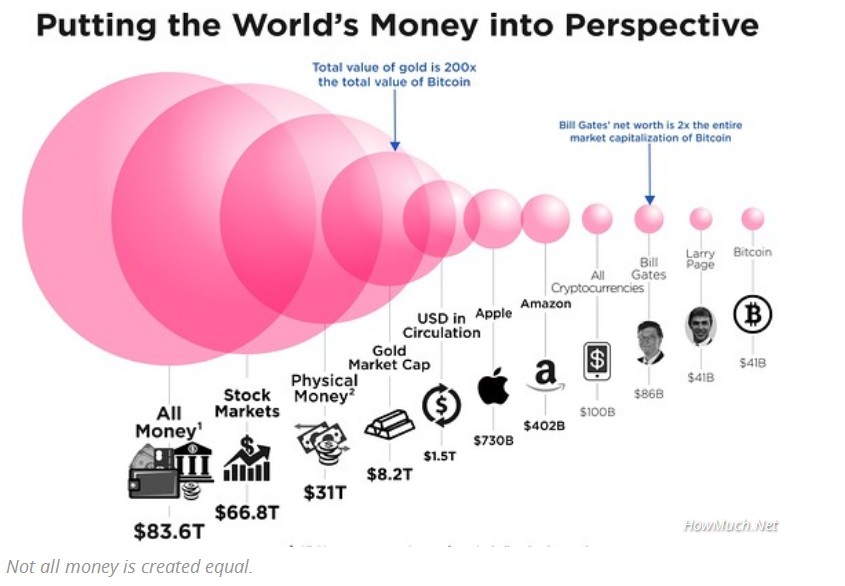
Wow. Where do we start? Discussion of Bitcoin and Ethereum and a host of other cryptocurrencies is skyrocketing. Anything that goes from $2 to $4000 in five years is going to get talked about. Repeat: $2.00 to $4,000.00 – this is not a misprint. The Bitcoin world is now worth about $42 billion which is a tiny part of the world’s money supply, but then again, $42 billion is a big number. We wouldn’t mind having 0.01% of this!
What is Bitcoin?
That’s a good question. For one thing, there can be no more than 21 million of them. There about 16.7 million in circulation and it is getting harder and harder to “mine” them. So one of the reasons for its great rise recently is the scarcity value.
Here is one definition:
Bitcoin is a worldwide cryptocurrency and digital payment system, called the first decentralized digital currency, since the system works without a central repository or single administrator. It was invented by an unknown group of programmers, under the name Satoshi Nakamoto and released as open-source software in 2009. The system is peer-to-peer, and transactions take place between users directly, without an intermediary. These transactions are verified by the network and recorded in a public distributed ledger called a blockchain.
What is a blockchain?
The blockchain is a public ledger that records bitcoin transactions. A novel solution accomplishes this without any trusted central authority: The maintenance of the blockchain is performed by a network of communicating nodes running bitcoin software. Network nodes can validate transactions, add them to their copy of the ledger, and then broadcast these ledger additions to other nodes. The blockchain is a distributed database – to achieve independent verification of the chain of ownership of any and every bitcoin amount, each network node stores its own copy of the blockchain, Approximately six times per hour, a new group of accepted transactions, a block, is created, added to the blockchain, and quickly published to all nodes. This allows bitcoin software to determine when a particular bitcoin amount has been spent, which is necessary in order to prevent double-spending in an environment without central oversight.
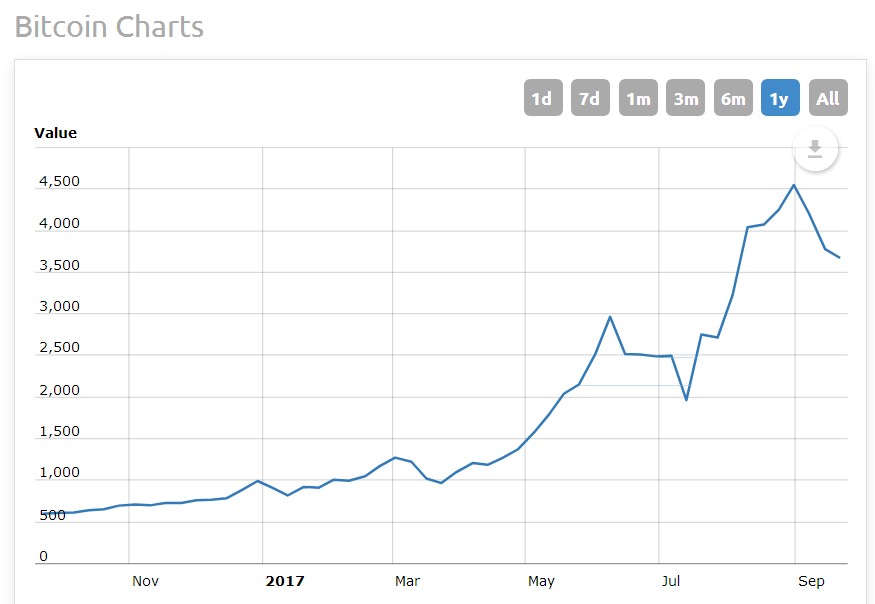
We at The Bull Market Report have started buying some ether, another cryptocurrency. We will explain what this cryptocurrency is all about next week. It peaked at about $390 on the 1st of this month and with all the news about China shutting down the exchanges*, the price fell to $206 on the 15th and is around $285 at the moment. But a year ago it was around $12. Don’t ever say that cryptocurrencies aren’t volatile!
Bitcoin peaked at about $4,900 at the start of the month and dropped to $3,000 by the 15th. It is now at $3,670 as we write this. But note that these two cryptocurrencies trade 24-7. That’s right, they trade 24 hours a day, 7 days a week. So by the time you read this, the price will have changed. A year ago it was around $500.
Some symbols for these two are BTCUSD or BTCUSD=X for bitcoin and ETHUSD or ETHUSD+X for ethererum.
* Chinese cryptocurrency exchange ViaBTC has announced its plans to launch a trading platform based outside of China. The decision to establish an overseas-based platform follows announcements that the exchange will shut down operations in mainland China on September 30th.
The debate on bitcoin is raging. The CEO of JP Morgan, Jamie Dimon, called it a speculative bubble and a fraud. The same day Jack Dorsey of Twitter and Square said blockchain is the future and a major unlock opportunity for technology.
So which is it?
The High Yield Corner
By Michael Foster
We have now enjoyed a second week of calm in the high yield world, with a lot of Bull Market Report recommendations seeing slight upticks for the week and a few dipping slightly. The biggest declines, which weren’t really all that big to begin with, were in the REIT space, where nerves about the upcoming interest rate hikes from the Federal Reserve are making investors cautious about future borrowing costs for these firms.
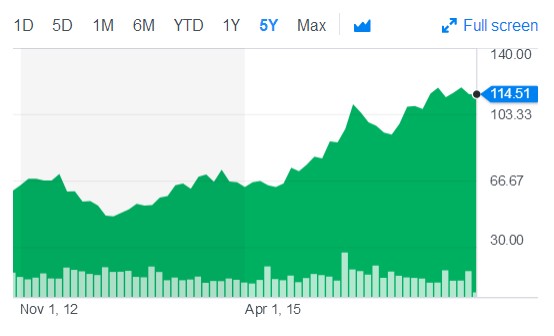
But not all of the declines are in Janet Yellen’s shadow. Digital Realty Trust (DLR: $115, down -2%) continues to see a mixture of profit taking and selling pressure as a result of more predictions about future server needs. Additionally, the debate is hitting many major financial and technology publications, with a growing number of experts weighing in to express caution or contempt for the bearish viewpoint.
Since this debate is heating up, we should dig in a little deeper into its history and the bull and bear cases. We will take this whole issue of The High Yield Corner to discuss this fabulous company (market cap $24 billion, 3% dividend.)
It all began with Social Capital's Chamath Palihapitiya, a CEO who left Facebook to head his own tech investment firm. Palihapitiya has serious tech chops (an is worth $1 billion.) He also worked at AOL and Winamp back when those were big names in tech, and he’s become a titan of the industry by moving to the Next Big Thing before the rest of us realized where the Tech world was going. So when he talks, we should all listen.
Palihapitiya’s idea is simple: Technological improvements are going to cause a rapid and accelerating reduction in the physical size of individual servers. The numbers he threw out boil down to this: 50% of all computing needs will one day run on 10% of the silicon that is currently required. This drastic reduction in the server size will also result in servers being small enough to fit in an RV that you could park beside a data center. "Plug it into some air conditioning and power and it will take those data centers out of business,” he said.
The rebuttal is that it’s going to take a very long time for those developments to come into play. Digital Realty CEO Andy Power made a pretty simple rebuttal: Amazon, Google, and other big tech giants developing and expanding their content delivery network systems around the world are still signing 10 to 15 year leases with Digital Realty. Since Palihapitiya’s bearish view depends on Google developing their own tech to displace Digital Realty, it seems like what Google is really doing contradicts his theory of what they may do at some unspecified point in the future.
That would definitely be a point in Power’s favor. However, we should remember that Digital Realty and Google are counterparties, and tech companies are notorious for trying their best to become less reliant on partners. Google, for instance, famously went against Apple and tried to compete head-on with Android. Then they went against Samsung and acquired their own cell phone company - something that Google recently did yet again. Google is obviously interested in taking as much “in house” as possible, and they have the cash to buy their own real estate and create their own server farms - especially if the size required will be so much smaller in the future.
With that in mind, there’s definitely a pretty strong chance that Palihapitiya will be proven right. Eventually. And that’s the key. In finance, there is a famous adage that “being too early is the same as being wrong.” If Palihapitiya is proven right in, say, 2025, and it causes Digital Realty’s revenues to drop 20% then, but the markets have knocked off 10% of Digital Realty’s valuation in 2017, can we really say that the price hit was fair? Probably not.
And this is the key - a kind of miscommunication between tech and finance that happens all the time. The time horizons are so different, and techies and investors will almost always disagree on the implications of when and how to move investments as a result of changes to the landscape. That, we believe, is what is happening here. Investors are acting too quickly to price in an event because no one really knows how long it’s going to take to actually happen.
What does this mean for Digital Realty’s stock? In most cases of a massive misunderstanding of an emergent technology, you get an S-curve. This happened with Baidu, Facebook, and plenty of other tech stocks. Initial enthusiasm causes a surge in valuations - then the uncertainties around the new technology causes a panic, driving valuations down sharply. Then there’s a recovery as the market realizes they had over-exaggerated the risks, and underestimated the power of the new technology.
With Digital Realty, we think there’s a good chance that we will get this kind of movement. Initial enthusiasm about the technology will cause the REIT to fall further, maybe dragging the price down 10% from its top. Maybe it will go down even more. Then the market will realize they have dramatically overestimated the time frame of these new “microservers” and the stock will recover. Hence an S-curve. The time horizon for this price movement is obviously unpredictable, but tech does tend to move fast. Investors should be prepared for a bit more volatility with Digital Realty over the next few weeks.
Investors should sit tight. If Digital Realty’s dividend yield falls below 4%, it will obviously be a strong buy. Funds from operations and organic growth are strong enough to support the dividend for many years. We may also see Digital Realty increase their dividend (they have the coverage ratio to do it any day now) if the stock falls too heavily. That would be Power’s way of telling investors clearly: “We are confident in our ability to make money.” And that will help the stock recover even faster.
Good Investing,
Todd Shaver
Editor, Founder and CEO
The Bull Market Report
Since 1998
