
The Weekly Summary
Welcome to October! Boo! October can be a scary time in more ways than just Halloween. October has a special place in finance, known as the October effect, and is one of the most feared months in the financial calendar. Why? Check the history. There was The Panic of 1907 (October), where multiple bank runs and heavy panic selling occurred on the stock exchange. There was The Crash of 1929 (October), where stock market slides set records. There was Black Monday in 1987 (October), when automatic stop-loss orders and financial contagion gave the market a thorough throttling as a domino effect echoed across the world in a quick 22% drop. In summary, keep a close eye on what’s around the next corner, and don’t get surprisingly spooked by market volatility.
No matter what is happening out there, there is always a bull market here at The Bull Market Report! This week we highlight some of our favorite stocks where you can still make good money, including: Celgene, BlackRock, Facebook, UPS, Home Depot, PayPal, and Government Properties Income Trust.

BMR Companies & Commentary
BlackRock (BLK: $447, up 3% - all prices are for the week)
BlackRock was upgraded to buy this week by Goldman Sachs and placed on the conviction buy list. We love to see Goldman following The Bull Market Report into the stocks we like. This demonstrates the quality of our research and the sincere value we price it at to you our dear subscriber. In other words, it’s not $10,000 a year!
So why all the love for BlackRock right now? It really is as simple as this. The world of ETF investing is dominating the investment management business and BlackRock is the leading provider of ETF products.
BlackRock has $5.1 trillion of assets under management as of December 31, 2016. With employees in more than 30 countries who serve clients in over 100 countries across the globe, BlackRock provides a broad range of investment and risk management services to institutional and retail clients worldwide. The company’s flagship product line-up is the popular iShares exchange-traded funds (“ETFs”). These ETFs are used by everyone from tax-exempt institutions; to charities, foundations and endowments; official institutions such as central banks, sovereign wealth funds, supranationals and other government entities; taxable institutions, including insurance companies, financial institutions, corporations and third-party fund sponsors, and retail investors.
BMR Take: We think BlackRock is a compelling value trading at 17x next year’s consensus EPS estimate of $25. But don’t take it from just us. One of the world’s best hedge funds, Third Point, just bought the stock and believes BlackRock is a “misunderstood franchise” with a massive 38% market share of exchange-traded funds. Third Point’s CEO said he thinks this acceleration in ETFs is just getting started and BlackRock is valued like a traditional asset manager, but it has much greater potential for structural revenue growth and operating margin expansion. We stand by our $510 price target and have already made some good ground on the path here since our initiation to the stock in late August at $415.
Price too high for you? Just buy 20 shares. Just buy 50 shares. Buy 11 shares – but get some BlackRock. Remember, the “price” is irrelevant. What if BlackRock split their stock 10-1 next week? Would that change your thinking because you now have 10 times as many shares at $44 a share? You answered correctly if you said – NO. Of course. The price of the stock would change nothing.
Celgene (CELG: $146, up 1%)
Celgene recently announced that the FDA has placed a partial clinical hold on five trials and a full clinical hold on one trial of the FUSION program for Imfinzi (durvalumab). This is not the best outcome for Celgene, but remember the company’s portfolio is broadly diversified so we view the development as a minor set-back not a game-changer. In fact, most analysts had not yet even been considering the financial impact of these drugs into their estimates. The trials subject to the hold are studying drugs for leukemia and lymphoma. We emphasize that the decision by the FDA was based on safety data derived from other trials involving drugs in patients with multiple myeloma in combination with immunomodulatory agents.
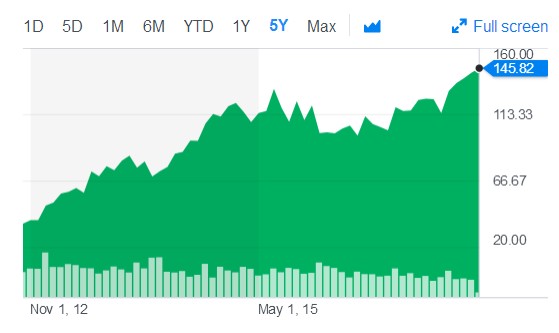
BMR Take: We expect Celgene’s four blockbuster drugs (Revlimid, Abraxane, Otezla, and Pomalyst) to drive revenues of over $13 billion in 2017, and over $21 billion in 2020, while the recent acquisitions of Receptos and Delinia as well as investments in collaborators like Acceleron, Epizyme, Agios, and others will likely ensure growth in 2018 and beyond. We continue to view Celgene as a top large-cap pick in Healthcare. We continue to see our $150 price target as fair for right now, but admit there is upside to our target as the business executes on the revenue path we anticipate.
This is no small company, with a market cap of $115 billion, setting a new all-time high this week. Check out this 5-year chart:
Facebook (FB: $171, flat, after dropping like a stone on Monday to $162)
Instagram recently disclosed that it's added another 100 million monthly users. That brings the photo-sharing app to 800 million monthly active users, up from 700 million in April. This is the fastest 100 million the firm has ever added – five months. When do you think they will hit a billion? Let's see... August 2018?
Five hundred million of those are daily active users, or consistently engaged using the service. That means that Instagram is still far, far ahead of rival Snap in terms of users. Snap said in August that it had 173 million daily active users. The announcement from Facebook-owned Instagram further solidifies Facebook as one of the most dominant companies in online advertising.
Why does all this matter so much? Viewing photos on Facebook used to be very clunky. It was a muddled, buggy experience, yet it’s what most people use Facebook for the most. Over 250 million images are uploaded to Facebook each day, making it the most popular photo-sharing site on the internet. Facebook is without a doubt the YouTube of photos. So Instagram is a critical piece of technology, ensuring the health of the Facebook platform and the future growth and engagement activity of users.
BMR Take: Facebook is an advertising machine and the business is nowhere near mature. EPS is expected to grow more than 20% per year into 2020 bringing EPS close to $10. We hereby raise our target price from $178 to $190 and strongly recommend you get this stock into your portfolio. The Sell Price remains at $155.
UPS (UPS: $120, up 2%)
UPS has been doing all the right things for a long, long time. The latest out of the company this week is a new JV in China.
UPS and SF Express announced approval of their planned joint venture by China’s Ministry of Commerce. The JV enables UPS and SF to collaborate on development and provision of international delivery services from China to the U.S. and, in the future, to other trade lanes. The JV approval is a positive development for international trade and allows the two leading companies to leverage their complementary networks, service portfolios, technologies and logistics expertise.
UPS is the world’s largest express delivery company and a leading global supply chain integrator. SF is a market leader in express delivery in China, with extensive China-wide network coverage, comprehensive service capabilities, and the highest brand recognition in the Chinese small package industry. The newly approved joint venture is a continuation of UPS and SF’s collaboration that began in 2015, when UPS Worldwide Express service was made available at SF’s retail stores in Shanghai and Shenzhen.
BMR Take: This JV is highly symbolic of UPS’s confidence in long-term growth opportunities in China. With EPS growing high-single-digits on its way to $8/share by 2020, we think this stock is a reliable performer for any stock portfolio and stand by our $125 price target for the time being. We’d love to raise it when it hits that magic number.
Home Depot (HD: $164, up 2%)
The story here at Home Depot is that growth is soaring right now. Why? The underlying fundamentals show us one of the best housing markets seen on record. Imagine that after the sub-prime crisis not all that long ago!
Indicators of the housing market were strong in the first half of 2017. Construction starts were healthy for both single-family and multifamily housing. Home purchases were solid while the supply of homes for sale rose for both new single-family homes and previously owned housing. The Federal Housing Finance Agency’s and the CoreLogic Case-Shiller repeat-sales house price indices showed home values rising, with annual price appreciation stable in a reasonable 5-6% range. Based on its National Delinquency Survey, the Mortgage Bankers Association reported that measures of delinquency declined, so people are paying their bills!
BMR Take: A resilient housing market means great things for Home Depot and we sure are seeing that effect take hold. With EPS growing around 10% per year and heading to $10, we raise our price target from $170 to $180 and see even more upside ahead. How’s this for a 5-year chart:

Government Properties Income Trust (GOV: $18.77, up 2%)
Government Properties Income Trust is a real estate investment trust (REIT) focused on owning and operating properties mostly leased to government tenants. Government Properties is the U.S. Government’s largest landlord and owns 74 properties located in 31 states and Washington D.C. containing approximately 11.5 million square feet. Historically, government tenants remain in place significantly longer than private sector tenants, with U.S. Government tenants occupying the same space for more than 20 years.
Properties are 95% leased and occupancy has remained well above 90% since inception. The company is rated investment grade by Moody’s (Baa3) and S&P (BBB-). 88% of rental income is paid by the U.S. Government (on behalf of 37 agencies.)
BMR Take: Look, Government Properties is a niche REIT serving government clients unlike anybody else in the business. They own and rent some of the best properties to clients like the Department of Justice and the IRS. Yes, we need to keep an eye on Trump cutting out all of the fat from the government budget and reducing the size of government. But in reality he can’t vacate signed leases, so there is not much he can do. For right now, however, the outlook looks just fine, and the juicy dividend yield of 9.25% is very attractive.
Moreover, in June, GOV agreed to acquire First Potomac Realty Trust for approximately $1.4 billion. Upon completion, this acquisition will increase exposure to the metro Washington, D.C. market, and expand GOV’s acquisition strategy in that area. We like this catalyst to spur excitement for the stock and for the positive impact it will have on the business. We trim our price target to $24 ($27 previously) out of conservatism.
Update on PayPal Holdings (PYPL: $64, down 1%)
PayPal Holdings is likely to make a strategic acquisition in coming months, according to Bernstein Research and Loop Capital. Last week, the firm put out a note to its customers wherein they believe a purchase of a European payments asset is most probable, with top targets Adyen (private), Klarna (private), Square (SQ) and Stripe (private.) The have an outperform rating on the stock.
“Acquiring Square (SQ: $29) would help PayPal increase its offerings at brick-and-mortar retailers and bring in more customers for PayPal’s Venmo service, as the small business customers on Square could accept Venmo transactions as payment,” they said. “By having both consumers and retailers on its platform, the combined entity would have significantly increased strategic positioning and optionality,” they wrote.
BMR Take: Both PayPal and Square are within a whisker of all-time highs. Square is on a roll and as we have said many times, could be a takeout prospect, and we are only at the beginning stages of Square’s future as a disruptive company in payments. With a market cap of just $11 billion we see big times ahead for this innovative company. And they could be bought out for $15-18 billion in a whisker by one of the big boys. PayPal? We see no top to this amazing success story.
Note this about Jack Dorsey of Twitter and Square:
Dorsey has bought over 1 million shares of Twitter in 2017, while selling much of his position in Square. Dorsey has sold more than $31 million worth of Square stock in that time. After Friday’s purchase, Dorsey owns more than 16 million shares in Twitter. He still owns a big stake in Square, but he is obviously moving to up his investment in Twitter at this time.
Upcoming Economic News
ISM Manufacturing
Monday, October 2nd, 10:00 AM
Period: September
Consensus: 58.0
Prior: 58.0
Total Light Vehicle Sales
Tuesday, October 3rd, 8:00 AM
Period: September
Consensus: 16.3M
Prior: 16.0M
Trade Balance SA
Thursday, October 5th, 8:30 AM
Period: August
Consensus: -$42.9B
Prior: -$43.7B
What follows is not a recommendation, but an information piece on a Nasdaq stock that invests in bitcoin.
Bitcoin Investment Trust (GBTC: $702, market cap - $1.2 billion)
Bitcoin Investment Trust, the only exchange-traded product that offers Bitcoin exposure, is an exchange-traded note, backed by Bitcoin, and it trades at an astonishing 95% premium that has been as high as 125%. That means investors are paying twice as much, plus fees, to own Bitcoin - a premium that will probably disappear as the Bitcoin market matures and access becomes less of an issue.
That’s already happening. In July, the U.S. Commodity Futures Trading Commission unanimously approved LedgerX’s cryptocurrency-trading platform for clearing derivatives; it will start with Bitcoin options. CBOE Holdings and Gemini Trust, the digital currency exchange founded by the Winklevoss twins, announced a partnership to offer Bitcoin futures as early as this year. VanEck has filed to bring products holding Bitcoin “instruments” to market. Exchange-traded fund provider REX is planning two Bitcoin-based derivatives ETFs.
The SEC has rejected Bitcoin exchange-traded funds, citing a lack of regulation of the Bitcoin spot market; a derivatives market in Bitcoin would remedy that. It also doesn’t hurt that Dalia Blass, who hails from the law firm that represented the Winklevoss twins’ ETF, has been named director of the SEC’s Division of Investment Management.
Bitcoin, the cryptocurrency polarizing governments, banks, and investors alike, is currently trading at $4,330, down from its peak of $4,980 in early September, but up from its lows of $3,000 in the middle of September. The sell-off was largely driven by Chinese regulators formally shutting major Bitcoin exchanges. As you can see, it is quite volatile, rising from $600 a year ago.
It didn’t help that JP Morgan Chase CEO Jamie Dimon called Bitcoin a “fraud” and “worthless” and that Bridgewater’s Ray Dalio called it “a bubble” in the days following China’s crackdown. Fundstrat Global Advisors’ Thomas Lee disagrees, saying that China’s recent moves are a short-term head wind, given that the region represents just 20% to 25% of global trading volume. Lee, in a recent note to clients, wrote that Bitcoin was “increasingly representing the gold investment” for millennials and will ultimately displace the precious metal in portfolios. He contends that Bitcoin could reach $25,000 by 2022, given that it accounts for 5% of the $7.5 trillion alternative currency market, which is growing by 6% annually. By early 2018, he sees it hitting $6,000, a whopping upside of 60%.
Here’s an interesting commentary on the bitcoin world, and an interview with John McAfee, the founder of McAfee Associates, the anti-virus software company that was eventually sold to Intel. McAfee is a bitcoin miner now, and appears to be "all-in" on bitcoin.
https://www.cnbc.com/2017/09/13/john-mcafee-challenges-jamie-dimon-bitcoin-skepticism.html
McAfee has stated that bitcoin could go to $500,000. Wow.
Teva Pharmaceuticals Names New CEO
Seven months after Erez Vigodman stepped down, Teva Pharmaceuticals (TEVA: $17.60, up 2%) has appointed a new CEO - Kare Schultz. Schultz, who has served as CEO of Danish pharmaceutical company H. Lundbeck since 2015, will be tasked with reviving sales and reducing debt for the world’s largest generics manufacturer. According to Bloomberg, Schultz will likely face pressure to split the company - with one focusing on “patented specialty medicines and the other on cheap copycat drugs.”
Twilio Shares Drop after Amazon Text Messaging Announcement
Twilio (TWLO: $30, down 3%) is a communications company that uses a cloud-based software to help businesses insert "real-time" communication into their apps. Amazon announced this past week that its Pinpoint system now allows users to trigger 2-way SMS messaging.
Some on the Street think this is bad for Twilio, but Twilio management thinks this is a good thing. "This is a continuation of our technology partnership with Amazon. Two-way texting is another capability being utilized by Amazon Pinpoint as part of our existing relationship," said a Twilio spokesperson.
Twilio CEO Jeff Lawson, who used to work at Amazon, said in a tweet that he's "excited that Twilio is now helping to power engagement on Amazon Web Services Pinpoint."
BMR Take: We believe in this company. Watch revenues – revenues rule all. And revenues have been spectacular as you know, since we have reported on this company continually. The stock is way off its highs of course, but we feel the stock is putting in a strong base here at this level.
A Word from Gary Jefferson
Jefferson Financial Group
First Vice-President, Investments
UBS Financial Services, Inc.
What's going on with the Fed and why should we care? Today, the Fed is sitting tight with rates of 1.0-1.25%. Two weeks it announced it would start reducing their balance sheet in October. So, what does that mean? For years the Fed has been buying trillions of dollars' worth of US Treasuries and mortgage backed bonds, and reinvesting all the earnings back into more of the same. Next month it will start "shrinking" its balance sheet by not buying (reinvesting, or as some call it, "normalizing") tens of billion worth of Treasury's and mortgage bonds. Going forward, the Fed will ramp up the amount "normalized" every three months, hoping that this stair-step approach will not create turmoil in the markets. However, everyone knows the US government has to issue bonds to raise the money needed to pay its debts, so who is going to step in and buy these bonds now that the Fed is gone? That is something that no one knows because it's never happened before.
Our take is that the Fed will continue to monitor the economy and if it senses trouble – either from rising interest rates or the shrinking of their balance sheets – they will back down by either leaving rates alone or even halting the balance sheet reduction strategy. Thus, if the Fed continues to raise and shrink, it means the economy remains on solid footing. If things begin to slow, the Fed will most likely keep rates low and start buying again, both of which should benefit the market. An optimist will see this as a win-win scenario for keeping the market's prospects of continued growth intact.
We tend to be optimists at this point even though we don't like the fact that there seems to be so much dependence upon the Fed. We are optimistic because the market seems to have been able to shrug off not one, but several things that normally would have had some sort of consequential impact upon it. When one considers that Hurricanes Harvey, Irma and Maria slammed into the United States and Puerto Rico, North Korea tested another missile (and have threatened more), President Trump upset the establishment at the United Nations, and London was hit by another terrorist attack – it is remarkable that the market didn't suffer a significant correction. All this tells us that the earnings growth story for the market is for real and, if we can actually get a tax reform bill from D.C. – well, that would conjure up images of Gene Autry back in the saddle singing "Happy Days Are Here Again".
The High Yield Corner
By Michael Foster
The week saw a small bit of volatility for high yield investments in a surprising divergence from the stock market, which has virtually no volatility, and which had yet another strong week.
Is this a cause for concern? To answer that question, let’s take a look at where the biggest weakness was, determine what was the cause of that weakness, and try to extrapolate the probability of that weakness continuing.
Several of The Bull Market Report's high yield picks saw a 1% drop in the last week, such as Omega Healthcare Investors, Inc (OHI: $32, down 1%). For those of you who have followed this Healthcare REIT for a while, you know that a one-week 1% decline isn’t really terribly unusual, so it isn’t something that should inspire any alarm. On top of that, the decline happened without any unusual spike in volume and without any significant news, so we can’t conclude that there’s any material public information driving this decline. Short-term volatility caused by random inflows and outflows of investor capital seem the driver of the 1% fall here.
Not the same could be said for Apollo Commercial Real Estate Fund (ARI: $18.15, up 4%), which announced a 46 cent dividend just two weeks ago - a payout in-line with its previous payouts. It was paid out Thursday, and as per usual, the stock opened up 46 cents lower. So with the stock closing the week up 21 cents, plus the dividend, the stock was up a huge 4% for the week. Remember that the Apollo Fund isn’t a Property REIT but a Mortgage REIT, meaning that the way it earns income and its structure are more like a loan fund than a company like Omega. As a result, Apollo Commercial Real Estate Fund is sensitive to interest rate changes and default rate trends more than on the market’s perception of the value of its holdings, its property cap rates and occupancy rates, and other real-estate specific metrics. And we are in fact seeing an increase in long-term interest rates as we get nearer the December rate hike that the Federal Reserve has strongly hinted is inevitable.
While that’s bad for the Apollo Fund and a justifiable reason for caution, it’s offset by the fact that commercial real estate defaults are extremely low and are not going up. Thanks in part to improving profitability for companies, rising sales, and a stronger GDP growth rate, companies’ ability to pay their mortgages is as strong as could reasonably be expected. That, at the end of the day, is an arguably more important factor in determining the safety of Apollo’s future cash flow.
Is Apollo’s 10% dividend worth investing in? We think so. Risks of a cut are far lower than a double-digit yield would suggest, so investors should consider holding this even if we see some more volatility in the next couple of months before the drama from the Fed plays out in December.
Municipal bonds, which started the week in solid recovery mode, are taking a bit of a break. We’ve seen the sector weaken slightly in the last couple of weeks, and that trend has continued this week. As a result, Nuveen AMT-Free Municipal Credit (NVG: $15.39, down 1%) and Invesco Municipal Trust (VKQ: $12.77, down 1%) both had a bit of softness. While a 1% decline isn’t a lot when compared to just about any other asset class, it is a lot for the typically sleepy muni market. These bonds rarely see big price moves, so a 1% decline is something to consider. We’re still in positive territory for 2017, but that may not last long. The Fed’s interest rate hikes spook muni investors more than perhaps any other group of investors - even if interest rate hikes don’t hurt munis all that much. For that reason, we can’t promise these funds won’t fall later in the year, and even fall into red territory. Looking further, however, there will be a recovery when the market realizes the mistake they made and they start buying back in. After all, that’s what we saw after the hike in December 2015 and the hike in December 2016.
Interestingly enough, the taxable bond world is shrugging off the upcoming Fed rate hikes in the most contemptuous way. Let’s start with AllianzGI Equity & Convertible Fund (NIE: $21, up 1%), which announced its quarterly results that didn’t yield any major surprises. NAV growth and investment income are more than sufficient to yield a strong total return for investors, and the dividend of 7.3% remains very sustainable.
The convertible bond part of the portfolio is rising in value despite the clear message of an interest rate hike. Why? Again, it goes back to the fundamentals. Economic growth is strong enough for companies to pay their bills, which helps bonds rise in value. A similar tailwind has also helped PIMCO Dynamic Income Fund (PDI: $31, up 1%) enjoy a NAV boost for a long time now, so its last week of strength is no surprise. This fund remains priced at a premium to NAV, albeit just 6.5%, which is admittedly a cause for concern.
Additionally, Pimco Dynamic is under-earning its payouts, which means the year-end special dividend is likely to be smaller than it’s been in previous years - if there’s one at all. Still, on a total return basis there is just too much upside still in PDI because of its focus on mortgage-backed securities and corporate bonds.
Good Investing,
Todd Shaver, Founder, CEO and Editor
The Bull Market Report
Since 1998