
The Weekly Summary
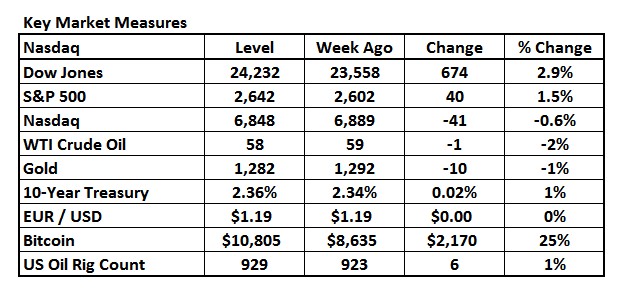
Before we tell you the big news for the week. Let’s just remember: The politicians in our country still have a lot of room for improvement. Let’s not praise them for accomplishing something they should be doing. With that said, Senate Republicans narrowly approved the most sweeping rewrite of the U.S. tax code in three decades, slashing the corporate tax rate and providing temporary tax-rate cuts for most Americans. It was a close vote of 51-49 that was placed just before 2 AM Saturday. Trump expects to sign the bill before Christmas but before that, there are a number of discrepancies to resolve, which could cause a lot of commotion in the weeks ahead. All in all, tax reform is a major milestone and had this not happened we could have seen a jolt to the markets. But the Bull Market remains alive and well!
No matter what is happening out there, there is always a bull market here at The Bull Market Report! This week we highlight some of our favorite stocks where you can still make good money, including: WageWorks, Blackrock, PayPal, Square, Nutanix, and Annaly.
BMR Companies & Commentary
WageWorks (WAGE: $64, up 2%)
WageWorks is catching a bid as they say, when a stock starts to work. What is happening recently? Well, the company has published its latest update for “The Definitive Guide To HSAs”. This is the best blueprint on the planet for how to run your business for your employees. Most employees are not prepared to handle unexpected medical expenses. A recent survey from Aflac found that 65% of respondents have less than $1,000 to pay for out-of-pocket expenses related to an unforeseen illness or injury. So, how do you offset rising healthcare costs, while keeping employees happy and healthy? For many organizations, the answer is a high-deductible health plan (HDHP) paired with a Health Savings Account (HSA). All of this detail is covered in the updated guide just published. The key takeaway is that December is the point in the year where all of WageWorks’ clients renew and many new clients come onto the platform. Revenue will be strong, and we will get an updated client count in the next earnings release, which will give us great visibility into just how good business will be in 2018.
BMR Take: The consensus EPS is currently $1.80 this year heading to almost $2.00 next year. We expect upside to next year’s EPS estimate to be evident on the upcoming earnings call, as the company announces a number of new client wins during this year’s selling season.
---------------------------------------------------------------------------------
BlackRock (BLK: $502, up 5%)
BlackRock and Citibanamex, a subsidiary of Citigroup, announced a definitive agreement for BlackRock to acquire the asset management business of Citibanamex. The two companies will also enter into a distribution agreement to offer BlackRock asset management products to Citibanamex clients in Mexico. Through its network of 1,500 branches in Mexico, Citibanamex provides wealth management products and services to more than 20 million clients. The transaction involves approximately $31 billion in assets under management of Citibanamex, across local fixed income, equity and multi-asset products, primarily for retail clients. The transaction is part of Citi’s emphasis on expanding access to best-in-class investments products, rather than on manufacturing proprietary asset management products. BlackRock’s business in Mexico currently focuses mostly on institutional clients, offering international investment and risk management products and services across asset classes, strategies and geographies.
BMR Take: This is why we like BlackRock. The company’s reach globally is unbelievable and getting bigger. Consensus calls for EPS to grow from $22 this year toward $33 in 2020. This ride is just getting started.
---------------------------------------------------------------------------------
PayPal (PYPL: $75, down 4%)
PayPal has had to suspend operations and that has weighed on the stock. PayPal announced an update on the suspension of operations of TIO Networks (TIO), a payment processor PayPal acquired in July 2017. A review of TIO's network has identified a potential compromise of personally identifiable information for approximately 1.6 million customers. The PayPal platform is not impacted in any way, as the TIO systems are completely separate from the PayPal network, and PayPal's customers' data remains secure. As announced on November 10th, PayPal suspended the operations of TIO to protect customer data as part of an ongoing investigation of security vulnerabilities of the TIO platform. This ongoing investigation has identified evidence of unauthorized access to TIO's network, including locations that stored personal information of some of TIO's customers. As a result, PayPal is taking steps to protect affected customers.
BMR Take: While this isn’t great, we applaud PayPal’s swift and serious preventative measures. So many other companies, like Equifax, have done it all wrong. This is why PayPal is a market leader in payments as they set the example. With EPS set to grow from $1.90 this year to over $3.00 by 2020 there is more room to run in PayPal’s stock, unreal considering how much the stock has already appreciated.
---------------------------------------------------------------------------------
Square (SQ: $38, down 22%)
Square has been red hot, moving straight up from below $10 since the summer of 2016. We added the stock at $17 in March of this year and are still up over 120% even after last week. We saw a big pullback last week but are not overly concerned. One of the reasons was that an analyst at BTIG (who?) came out with a Sell rating on the company saying the bitcoin rally was speculative, overdone, and ripe for a correction. (The company created a buzz announcing the Square Cash app that will buy and sell bitcoin.) It is not optimal or correct for the company’s fortunes to be tied to cryptocurrency. This is just a small experiment which we applaud, but if it doesn’t work out we’re not worried and it certainly won’t impact the company materially. Shares dropped about 16% on the release of this report. All in all, we like what Square is doing.
BMR Take: The major takeaway is not getting caught up in the volatility of cryptocurrency, but that Square is pioneering payments in a manner not seen at its major peers. This makes Square the innovation leader in the space and a must-own stock for the long haul, like a Tesla or Amazon, where it’s not that the numbers don’t matter, but just not yet and won’t for a long time. Revenues are growing dramatically and ultimately the Street believes in revenues first and then profits.
---------------------------------------------------------------------------------
Nutanix (NTNX: $36, up 5%)
Nutanix absolutely crushed the quarter and the stock went flying higher. Revenue of $276 million grew 46% year-over-year. Billings of $315 million grew 32% year-over-year. The loss per share of $0.39 compares to a loss of $1.89 a year ago, but recall that if the company stopped marketing heavily tomorrow, EPS would increase over $1.00. We don’t want this to happen as we want long term marketing investments for future revenue growth. The cash balance ended the quarter at $365 million, a healthy figure. Nutanix ended the first quarter of fiscal 2018 with 7,800 customers, adding over 760 during the quarter. First quarter customer wins included ConocoPhillips; Toyota Motor North America, and Trek Bicycle Corporation. Nutanix increased the number of $1 million+ deals in the quarter, up 36% from last year.
BMR Take: Nutanix delivered a great quarter. The stock is a great investment opportunity and we have seen a massive move since we added the position to our portfolio in May at $17. From here, we look for more steady revenue performance in 2018 and believe this can continue to push the stock higher. We see the company clearing the $1.0 billion revenue milestone for the first time next year! Revenues for the past three years ending July were $765 million last year, $445 million in 2016 and $240 million the year before. Now that’s called growth! At $6 billion in market cap the company has reached the medium-time (in other words not the big-time! Yet.) but they are moving swiftly in the right direction. Of course, the company remains a buy-out candidate as $6-10 billion is chump change for the big boys. Now wouldn’t it be nice to have this one bought out at $50 a share sometime next year. Our Target is $42, recently raised, but we sure wouldn’t mind raising this Target to $50 if the stock hits $40 in the next few months.
Upgrades this week: Nutanix price target raised to $51 from $39 at Maxim and kept their Buy rating after this week’s earnings beat. The company's latest guidance looks to improve the sales productivity metric from 32% to 39% in FY19.
Nutanix price target raised to $40 from $34 at Oppenheimer saying the company reported another strong quarter ahead of expectations. The "clear highlight" was management's commitment to a software-focused model going forward. The research company is bullish on the transition and looks forward to a "large gross margin boost over time." He maintains an Outperform rating on Nutanix.
Nutanix price target raised to $40 from $28 at Piper Jaffray saying the company's transition to a software model highlighted its "solid" Q1 results. The transition will result in "significant" gross and operating margin expansion, and should ultimately drive a "re-rating of the multiple." They have an Overweight rating on the stock.
---------------------------------------------------------------------------------
Annaly (NLY: $11.80, flat)
Annaly is worth a close look right here. The company is a leading diversified capital manager. The yield on the stock right now is greater than 10%. They are the largest Mortgage REIT in the world with a market cap of almost $14 billion, which is 20x the market cap of the median Mortgage REIT. Their diversified business model has them investing in agency loans, residential credit, commercial real estate, and middle marketing lending. Let’s review these:
--- The Agency group invests in agency Mortgage Backed Securities collateralized by residential mortgages which are guaranteed by Fannie Mae or Ginnie Mae. These are the safest government bonds around, but do carry interest rate risk.
--- The Residential Credit group invests in non-agency residential mortgage assets. This area is more complex because there is no government guarantee, but the opportunity for enhanced investment returns is greater.
--- The Commercial Real Estate group originates and invests in commercial mortgage loans, securities, and other commercial real estate debt and equity investments, which is a great way to pick-up real estate exposure in your portfolio.
--- The Middle Market Lending group provides financing to private equity-backed middle market businesses across the capital structure, which can be quite lucrative. The company is very well run, in fact the best in the industry, and the Board of Directors appointed Chief Executive Officer and President Kevin G. Keyes as Chairman effective January 1, 2018.
BMR Take: With a 10% dividend yield, and sturdy fixed income investments across asset classes, we see compelling value in the stock. If we see a volatile equity market, their portfolio of mortgage-backed securities should provide steady income to support the $1.20 dividend that is covered by earnings. Higher interest rates could cause some near term volatility, but Annaly will be able to reinvest at the higher rates ultimately driving higher dividends that should appeal to any high income seeking investor.
---------------------------------------------------------------------------------
---------------------------------------------------------------------------------
Upcoming Economic Calendar
Factory Orders
Monday, December 4th, 10 AM ET
Period: October
Actual: N/A
Consensus: -0.40%
Prior: 1.4%
Trade Balance
Tuesday, December 5th, 8:30AM
Period: October
Actual: N/A
Consensus: -$47.0B
Prior: -$43.5B
Consumer Credit
Thursday, December 7th, 3:00 PM
Period: OCT
Actual: N/A
Consensus: $16.5B
Prior: $20.8B
Unemployment Rate
Friday, December 8th, 8:30 AM
Period: November
Actual: N/A
Consensus: 4.1%
Prior: 4.1%
---------------------------------------------------------------------------------
---------------------------------------------------------------------------------
A Word from Gary Jefferson
First Vice-President, Investments
Jefferson Financial Group
UBS Financial Services, Inc
I remember riding as a kid over the desolate highways in west Texas and every now and then you would see a great big billboard with the ominous message "The End Is Near". Well, as investing goes in the year 2017, the end really is near, except the message thus far is extremely positive - although it still contains a slightly menacing element. We haven't had the almost obligatory 5-10% market correction after such a strong run-up. That's because through today, there is still a little bit more than just "hope" that tax reform will happen. Should tax reform fail, then we would be in the shock-and-awe camp if the market treated it as a non-event. Whatever the result, the year-end should be a net positive one.
As we approach the new year, we do not see a scenario that would involve making major changes to our asset allocations or investment strategies. First and foremost, we don't see a recession anywhere on the horizon. It is just the opposite – we see continued expansion in both US and global corporate earnings. It is that simple and we don't see any reason to try and make it any more complicated. We will certainly keep an eye out for the accepted early warning signs of potential trouble ahead such as an inverted yield curve or runaway inflation. And, there is always the proverbial geopolitical risk and the energy wild card. At this time, however, the energy card looks to be fairly stable, as do the Mideast and North Korean tensions.
We think Technology will still be a leader because we are right in the heart of the 4th Industrial Revolution and it is all about technology – artificial intelligence, augmented reality, the Internet-of-Things, the "Cloud", driverless cars, e-commerce and the list goes on and on. The first Baby Boomer is only 71 and 10,000 people turn 65 every day now, which will continue for another 10 years. Healthcare can't help but be a tremendously important sector for years to come because of its unstoppable momentum. While we continue to like these two sectors, we also see a lot of potential in many other areas. That is why we continue to use diversification as the cornerstone of our investment strategy. For several years the large-cap S&P 500 stocks were about the only positive area in worldwide markets and diversified portfolios lagged their performance. Today, however, Europe, Asia, Emerging markets, small caps and alternatives are finally participating in the overall success of global markets, allowing traditional diversification to reward investors. We, along with most major firm analysts, expect this broad-based positive performance to continue into 2018, albeit at a lesser pace than this year's torrid rate.
One thing we are sure of is that a market correction will happen – we just don't have any idea as to the timing (nor does anyone else, so run away as fast as you can whenever you hear someone specify the time and date). Unless the fundamentals that got us here collapse, we will view a correction as a normal market event, not as a reason to panic but rather more likely as an opportunity to seize. Bearing that in mind, while the "end is near" for investing in 2017, we think of it as a useful billboard alerting us to plan and prepare for investing in 2018. Diversification, with some emphasis on Technology and Healthcare, remain solid portfolio choices.
---------------------------------------------------------------------------------
Amazon (AMZN: $1162, down 2%) price target raised to $1,525 from $1,430 at Wells Fargo to reflect increased outer-year estimates for Web Services as well as a higher sum-of-the-parts valuation. The research firm highlighted the "very successful" five-day Amazon Wed Services conference in Las Vegas, "record-breaking" early holiday sales data, and another Healthcare industry development with CNBC reporting* the company is in talks with generic manufacturers Mylan (MYL) and Novartis (NVS). They see an increasing likelihood that Amazon "ultimately becomes a disruptor" in Healthcare, with generics representing a potential point of entry. The Wells Fargo Healthcare team sees generics as a "simple entry point" in Pharma as it involves many players with ready supply and a price competitive market. They keep an Outperform rating on Amazon.
* CNBC reports that Amazon has held preliminary talks with generic drug companies, including Mylan and Novartis' Sandoz, regarding the ecommerce giant's possible entry into the pharmacy market. It is unclear whether Amazon is planning to enter the space as a drug wholesaler or as a retailer but Sandoz said it does not expect the move, which could potentially disrupt the drug distribution industry led by McKesson (MCK), AmerisourceBergen (ABC) and Cardinal Health (CAH), and which could have a "major impact' on its business.
---------------------------------------------------------------------------------
Visa (V: $111, down 1%) remains solid as a rock. This company is BIG, at $250 billion in market cap. The dividend is not worth mentioning, but the company is all about growth. Revenues the last three years were $14 billion in fiscal 2015 (ending September), $15 billion in 2016 and $18.4 billion in 2017. With after-tax income of $6.7 billion, this company is a cash machine. 36% after tax? Simply astounding. The company has $10 billion in cash and $16 billion in long-term debt, a good ratio. We sure would like to see a higher dividend, but we’ll settle for our Target Price of ….. Wait a second. It just hit our Target of $110. So we hereby raise it to $123. Our Sell Price is: We would not sell Visa. Invest in this puppy for the grandkids. They'll be happy you did.
---------------------------------------------------------------------------------
The High Yield Report
By Michael Foster
There are a couple of big-picture items to talk about. One kinda big and one really, really big.
Let’s start with the kinda big item. Pimco. The Bull Market Report has recommended the PIMCO Dynamic Income Fund (PDI: $30, up 1%) for nearly two years now, and in that time the fund’s distributions have remained constant. But what really has pushed this fund over that period has been its special distributions. In late 2016, this fund gave out an extra $1.45 in a special end-of-year payout that boosted its annual dividend to over $4, which makes the return a whopping 13% on stock. And the fund’s net assets have actually grown while paying those distributions. This kind of performance is the thing dreams are made of.
Now we’ve come to the end of 2017, and we’re wondering if that same lightning will strike again. If you were reading our columns last year, you know that we were expecting an end-of-year payout of over $1, and Pimco crushed our expectations with nearly 50% more cash to shareholders than what we were hoping. So what about this year?
Unfortunately, this is the weirdest year in the history of this fund. Keep in mind that the Dynamic Income Fund specializes in mortgage-backed securities (MBS’s), which are one of the few asset classes to be Hollywood famous. In the movie-adaptation of Michael Lewis’s The Big Short (and, if we may say, the book is much better than the movie and definitely worth a read), the public was given an insight into these derivative investments that, frankly, were one of the primary weapons of the 2007-2009 financial crisis.
That big crash is, paradoxically, why Pimco spun off this fund in 2012 and why it’s done so well since. With a focus on MBS’s, the fund looked to find assets in the marketplace that were trading at absurd discounts to their NAV. Pimco found MBS’s that had been discounted to trade for 20 cents on the dollar, and then they did an analysis to see if more than 20% of the underlying mortgages would avoid defaulting. If so, they bought the MBS.
They did a lot of this in 2012 and 2013, which was really the bottom of the MBS market. Since then, Pimco has been collecting the income from those mortgages, and that massive interest payment (since those assets were bought at a huge discount) has resulted in a high yield for investors.
It’s been a decade since the crisis began, which means the total number of distressed mortgages has declined as a result of payoffs, refinancing, and so on. That means there are fewer distressed mortgage-backed securities in the market. At the same time, more investors have realized how oversold the MBS market was in the aftermath of the financial crisis, and a lot of competition to buy these assets began in 2013. That has heated up extremely in 2017, which means the Dynamic Income fund has been buying fewer and fewer MBS’s at those big discounts and buying more at much smaller discounts.
As a result, the Dynamic Income fund has been earning a lower yield on its investments - but its dividend has remained constant. That has translated into a lower dividend coverage ratio that actually fell below 100% in 2017 for the first time in years.
This has worried a lot of investors, but it shouldn’t. We are still years and years away from this fund being a sell. It does mean that it is harder to earn the massive income stream that it has had in the past, but it is still very easy to earn capital gains by identifying underpriced MBS’s in the market. Pimco is particularly good at this, so the fund is seeing its NAV rise at a faster pace than any other time since 2012.
But all of this puts the special dividend at risk. Will Pimco give out a special distribution from capital gains? We simply don’t know. In the past, the fund has paid out a special distribution from investment income, which makes sense (this is the structure many Closed End Funds and mutual funds follow). PDI can choose to give a special distribution from capital gains or not give a special distribution at all. No one knows whether they’ll choose to give a special distribution from cap gains or no special at all.
So, sadly, we cannot predict an end-of-year payout this year. It could be anywhere from $0 to $2.00 (the amount the fund’s price has gone up in 2017). Personally, we would like to see Pimco offer no special dividend and use that cash to get better returns - but, then again, investors would’ve been well-served had Pimco done that in previous years, and they didn’t. So the future of the fund’s special dividend is in question.
The normal dividend is not in question, however, and the NAV growth is strong enough to keep holding the fund in your portfolio.
The second really big issue is a lot bigger but also a lot simpler: the tax code.
Municipal bond funds Nuveen AMT-Free Municipal Credit (NVG: $15.31, down 1%) and Invesco Municipal Trust (VKQ: $12.30, down 1%) have taken a hit alongside all municipal bond funds on the uncertainty of municipal bond tax credits. Specifically, there is worry that the new tax plan will remove the tax-free status of “private activity bonds,” or PABs, which tend to be used by local governments to provide funding for private entities that will develop a new building or piece of infrastructure that has a broader public use (for instance, a new hospital). There remains uncertainty as to whether munis will maintain their tax-free status. The tax plan from Congress eliminates their tax-free status, and the Senate retains them. That split indicates to us that this is a battleground for quid-pro-quo politics, and we may see a last-minute reversal as a result of a back-door deal.
Nonetheless, the municipal market is assuming this is just plain bad for municipal bonds. The reality is much less clear. This may result in fewer bonds in the market, and that would mean higher prices for bonds (especially older bonds). That would be very good for existing muni bond funds. But it really depends on the final legislation, which no one knows yet.
We don’t believe munis will be stripped of their tax-free status. We see this as a buying opportunity for municipal bonds, since the potential upside is something the market isn’t focusing on. The market is too big and too important for such a major change to occur.
Good Investing,
Todd Shaver
Founder and CEO
The Bull Market Report
Since 1998