
Teva Pharmaceutical Industries (TEVA: $31)
An addition to our Healthcare Portfolio
Date: May 18, 2017
Company Description
Teva is a multi-national generic and specialty pharmaceutical company with a global commercial footprint and portfolio of generic, branded generic, branded and OTC products. Through a series of acquisitions, it has grown into the largest generics company in the world and has added several specialty assets in central nervous system, migraine, and respiratory.

We are going out a limb here with this addition to our Healthcare portfolio as we think Teva is a strong value at current levels; in fact, we believe them to be way undervalued.
From their website: Teva Pharmaceutical Industries is a leading global pharmaceutical company that delivers high-quality, patient-centric healthcare solutions used by millions of patients every day. Headquartered in Israel, Teva is the world’s largest generic medicines producer, leveraging its portfolio of more than 1,800 products to produce a wide range of generic products in nearly every therapeutic area. In specialty medicines, Teva has a world-leading position in innovative treatments for disorders of the central nervous system, including pain, as well as a strong portfolio of respiratory products. Revenues in 2015 amounted to $19.7 billion.
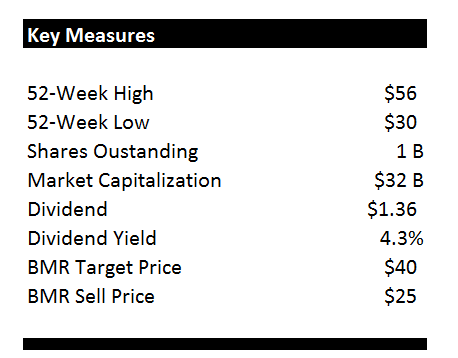
Our view is based on: (i) one of the most diversified product portfolios in this Healthcare market; (ii) strong cash flow generation, which will allow the company to de-lever rapidly and continue to payout the comforting $1.36 annual dividend that yields 4.25% right now; and (iii) multiple pipeline catalysts which provide optionality to organic growth.
The stock is widely followed by Wall Street with most price targets in the high $30s or low $40s. We think the stock is worth $45 by placing the historical average 3.0% dividend yield on the current $1.36 dividend.
Framing The Debate
Before you buy any stock, you have to do some work to understand “what’s happening”. Let us catch you up to speed.
Just recently, the company reported 1Q results. The stock was up 2% following the report, which showed a $0.03 EPS beat despite revenue coming in 1% below consensus – big deal. Expense control was the primary driver of the earnings upside as operating expenses came in lower than expected and offset a 90 basis point miss in gross margin. This year’s guidance was reaffirmed and the company now expects to realize synergies and cost reductions of $1.5 billion by the end of the year, which represents a $200 million increase from previous guidance. It was a good quarter! Revenue $5.63B vs consensus $5.70B, and EPS $1.06 vs consensus $1.03.
However, sentiment remains mixed. Many analysts gave some credit for the operational execution, but expressed more concern around top-line trends as generic pricing erosion was larger than expected. This is indeed a longer-term secular issue that could weigh on the company’s performance in the quarters and years ahead, but it is not surprising, not new, and should not be a reason to never own the stock.
With secular headwinds* well understood and generally not believed to abate in the near term, most of the debate around the stock centers on valuation. Bulls point toward the 3.6% dividend yield as attractive and how it minimizes the downside, while more cautious analysts highlight the difficult operating environment and debt load that limits the ability to pursue growth via acquisitions. The drug pipeline is widely cited as a potential swing factor, with results for fremanezumab (migraines) frequently discussed as a notable near-term event.
* long-term trends
In conclusion, the current set up offers compelling risk/reward.
Key Highlights
#1 – Poor sentiment has plenty of room for improvement. We cannot ignore current sentiment on the stock, which remains skewed to the negative following a slew of negative news (including weak earnings reports, CEO turnover, and competition concerns) over the past 12 months, but these issues are in the past, and looking forward, we see the picture getting better for the company. And while sentiment over the near term is likely to be largely driven by management commentary on the generics business and the outcome of the search for a new CEO for the company, we believe many potential upcoming positive events are being overlooked.
#2 – Big time de-leveraging on the horizon. The company is expected to generate the highest level of operating cash of its peer group over the next 12 months, implying more rapid debt paydown than the Street is anticipating.
#3 — The company can live with weakness in the generics business. Although recent commentary from Cardinal Health points to a generics landscape that is still in flux, Teva’s 2017 generics guidance suggests estimates that are achievable. Assuming the erosion of pricing in the generics-based business, as well as new product launches, the business still adequately covers the dividend. Why all the fuss? We don’t get it.
#4 – We view copaxone (one of the company's main drugs that is now facing revenue declines) as a cash flow “enabler,” as we believe these drugs have the potential to generate $4 billion in peak sales for the company. Some analysts/investors get stuck on the declining revenue of this drug, for which we can't provide a counter argument, but we do note that as long as the drug is producing revenue this is positive for the de-leveraging story, which is all we need for the stock to work, as opposed to landing some remarkable growth breakthrough. We view the resulting incremental cash flows from copaxone revenues (and consequently also debt paydown) as totally underappreciated.
#5 – The pipeline could deliver a big upside. We view Teva’s key branded pipeline assets (fremanezumab – a drug for migraines, and austedo – a drug for Huntington's disease - a failure of the nervous system). While we would potentially be in favor of increased branded pipeline activity, as the company attempts to mitigate the likely impact of generic copaxone over the coming years, we would be in favor of the company doing more acquisitions in the years ahead only after de-levering the balance sheet to get the debt levels under control.
#6 – New CEO to be announced soon. While we have no insights on the timing of the hire of a new CEO for Teva, we do believe that the hiring of an executive with solid pharma and operational experience, as well as credibility with the Street, is of paramount importance for the company and investors, as the company has had five CEOs in the last five years.
Generics Business
Analysis of Teva’s 2017 guidance suggests estimates are achievable. In particular, when assessing the potential erosion of the “base” business, the impact of incremental competition to concerta*, and likely new product launches is supportive of estimates that are in line with, and potentially slightly ahead of, consensus. If anything, we see upside to these estimates due to the slower-than anticipated erosion of generic concerta following the launch of the Mylan generic in December. Don’t worry about soft Generics performance, it’s to be expected.
* Concerta is generic ritalin. Ritalin (methylphenidate) is a central nervous system stimulant that affects chemicals in the brain and nerves that contribute to hyperactivity and impulse control. Ritalin is used to treat attention deficit disorder, attention deficit hyperactivity disorder, and narcolepsy.
Generics Revenue Forecast

Copaxone
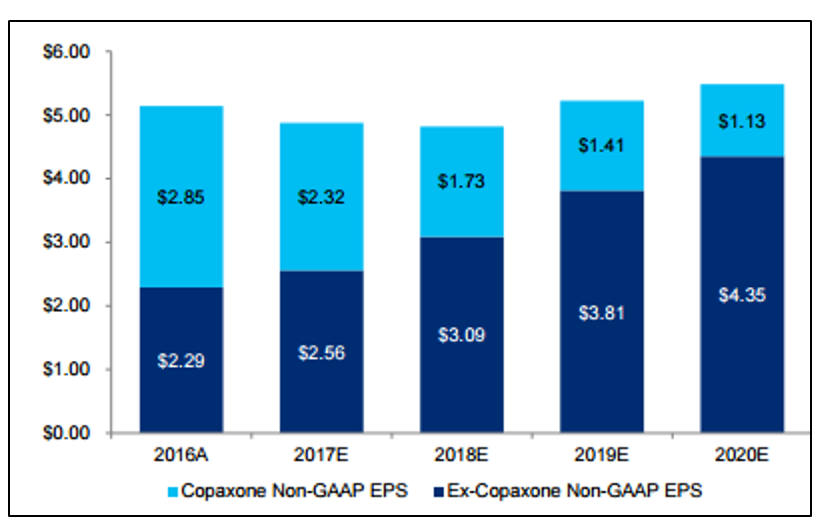
While Copaxone is by no means a growth driver for Teva, it nonetheless remains an “enabler” and an important source of cash generation at a time when the company is seeking to rapidly reduce its $35 billion debt burden following the acquisition of Actavis Generics*. Below we highlight the EPS contribution from this drug. We think this source of cash flow its totally under-appreciated for what it can do to de-leverage the balance sheet.
* Allergan received $33 billion in cash and approximately 100 million Teva shares.
With the acquisition, Teva now has approximately 338 product registrations pending FDA approval and holds the leading position in first-to-file opportunities with approximately 115 pending ANDAs in the U.S. In Europe, after divestitures; Teva will have a pipeline capable of over 5000 launches across the region. In Teva growth markets including, Asia, Africa, Latin America, Middle East, Russia and CIS, there are now approximately 600 pending product approvals. Overall, Teva is planning for 1,500 generic launches globally in 2017.
Teva’s products generated approximately $215 billion in savings in the last decade to the U.S. healthcare system; this number will continue to increase and even accelerate as a result of the acquisition.
Copaxone EPS Contribution
Pipeline Potentials
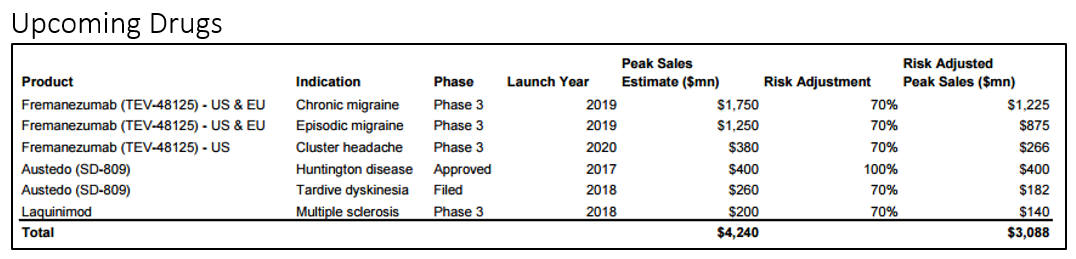
$4 billion of new revenue is to come online if the pipeline drugs make it through trial. While TEVA’s branded pipeline is unlikely to constitute a key source of investor focus over the near term, such as the pending ongoing uncertainties surrounding the generics business, as well as the identity of the new CEO, it is worth noting that the company’s key pipeline assets are maturing, and set to constitute revenue opportunities over the near to medium term (austedo for Huntington’s Disease and Tardive Dyskinesia, and fremanezumab for chronic/ episodic migraine.
CEO Search
A new CEO is crucial to restoring credibility with investors. CEO turnover has, unfortunately, constituted a recurring theme for Teva over the past five years. Following the recent departure of the latest CEO, along with the struggles that the company has faced in its generics business and its levered balance sheet following the acquisition of Actavis Generics, the hire of a CEO with strong operational and pharma experience is crucial in order to (i) restore investor confidence; and (ii), communicate, and unlock the attractive risk-reward profile we see in the stock.
New CEO, new strategy? We don’t think so. The debate regarding a CEO with branded vs. generic pharma expertise for Teva remains ongoing. Over the near to medium term, we believe that broad pharmaceutical expertise and international experience for the incoming CEO is key. The company’s strategy has to focus on de-levering as rapidly as possible following the recent acquisition of Actavis Generics, which has left Teva with $35 billion of debt on the balance sheet. Longer term, we believe there is room for the drugs in the pipeline to be unlocked by a CEO with broader branded pharmaceuticals expertise.
BMR Take:
The key to success for the company is knocking down the $36 billion debt on the balance sheet. (They do have $1.7 billion in cash.) We think the company can do it, and when they do, Wall Street will give the company credit by sending the stock much higher. The stock didn’t even trade this low in the Financial Crisis of 2008. We will explain why we feel this way below.
Our view is based on: (i) one of the most diversified product portfolios in this healthcare niche; (ii) strong cash flow generation, which will allow the company to de-lever rapidly and continue to pay out the comforting $1.36 annual dividend that yields 4.2% right now; and (iii) multiple pipeline catalysts which will provide organic growth.
The stock is widely followed by Wall Street with most price targets in the high $30s or low $40s. We think the stock is worth $45 by placing the historical average 3.0% dividend yield on the current $1.36 dividend.
The company needs to take strong steps quickly in order to fix its balance sheet, replace its top management, and establish a plan to navigate the maze of challenges it needs to get through. But if the company does these things well, which is likely, then we expect Wall Street to rapidly push the stock higher.