by Todd Shaver | Dec 7, 2017 | 6pm News Flash
Cloudera (CLDR: $16.60) beat earnings expectations after the close today. The company still can’t figure out how to make money but revenues were strong. Revenue rose to $95 million from $67 million in the year-ago period, a jump of 42%. The company reported a net loss of $55 million, or 40 cents a share, compared with a loss of $44 million in the year-ago period. Adjusted loss was 17 cents a share.
- Q317 revenue was up 41% year-over-year
- Subscription revenue was up 48% year-over-year. Subscription revenue represented 83% of total revenue, up from 78% last quarter.
Operating cash flow for the third quarter of fiscal 2018 was -$2.4 million compared to operating cash flow of -$32 million in the third quarter of fiscal 2017, a good sign.
As of October 31st, the company had total cash of $485 million and no debt. We like.
BMR Take: Cloudera produced a strong quarter revenue-wise, with not-so-hot losses. Wall Street wants to see profits but it appears that Cloudera will be losing money for the foreseeable future. Not good. We love this company; we like what they do,* but they continue to think that we will wait forever for profits and a doubling of the stock. This isn’t going to happen until they report profits which appears to be possible by the 2019 arena – a LONG time to wait. This wait of course, is up to you. We want this quarter to sink in with us a bit so stay tuned for an update in a week or two.
* They operate a data management, machine learning, and analytics software platform in the United States, Europe, and Asia. The company’s platform delivers an integrated suite of capabilities for data management, machine learning, and analytics to customers for transforming their businesses.
by Todd Shaver | Jun 16, 2017 | 6pm News Flash
We’ve been waiting all week for the market to calm down. The Tech mini-pullback started a week ago in the middle of the day on Friday, the 9th. Monday of this week was a bad day. Tuesday was somewhat of a comeback, and Wednesday saw the Fed move higher, even though the 10-year Treasury dropped like a stone that day before the announcement at 2 PM Eastern, closing at 2.13%. Unreal low. Remember that interest rates in many parts of Europe and Japan are in negative territory. Can they go lower here? You bet. Watch the 10-year like a hawk. This will tell you what is going to happen to stocks. The market likes lower rates.
In any case, the market was calm Thursday and today, with things starting out lower today but rallying as it closed. A few of the Tech stocks came back nicely. Amazon announced they are buying Whole Foods for $14 billion and the stock RALLIED $23. Usually the stock of the company doing the buying goes down. Cloudera (CLDR) was up big today, up 7%. We still believe in this one. Google (GOOG) did not come back this week – disappointing. Apple was weak too, down $2 today to $142. And Microsoft was flat at $69. Facebook, however is hanging in there nicely at $150.
So all in all, we saw mostly good news to close the week.
More this weekend in our Weekly newsletter.
by Todd Shaver | Jun 14, 2017 | 6pm News Flash
Apollo Commercial Real Estate Finance
Symbol: ARI
Date: June 14, 2017
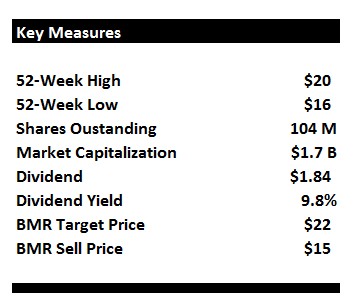
Current Price: $18.75
Apollo Commercial: Business Overview
Apollo Commercial Real Estate Finance is a real estate investment trust (REIT) specializing in commercial mortgages and their derivatives. Unlike many conventional REITs, including those already in The Bull Market Report High Yield portfolio, Apollo does not invest in property; instead, this company invests in mortgages issued on commercial properties and then earns an income stream from the interest payments made on those mortgages.
Apollo has been in operation since 2009 and has invested over $14 billion in commercial real estate debt. The firm focuses on American debt, with 87% of its portfolio being in the United States and nearly half of that in the New York City area. Here is a breakdown of Apollo’s debt portfolio as of the end of the first quarter 2017:

The firm is externally managed by a subsidiary of Apollo Global Management, a private-equity juggernaut well known for its strong growth in a variety of alternative investment markets over the last decade.
Loan Portfolio Makeup and Outlook
Apollo’s loan portfolio can be seen from two angles: according to the property type underwritten by the loans and by the type of loan being distributed.
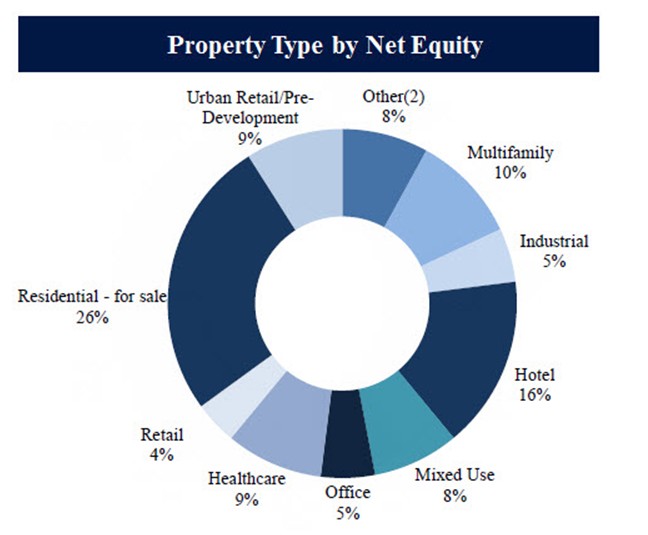
When looking at property type, Apollo clearly has diversified its holdings widely so that it is not unduly exposed by any one real estate niche. Its heaviest exposure at the moment is in residential for sale properties—in other words, mortgages being given to residential properties purchased or built by companies that will then be resold to either other firms or individual owner-occupiers. The rest of the portfolio is almost evenly divided between office, healthcare, retail, mixed use, hotel, industrial, and other kinds of properties:
As we saw from the geographical makeup above, Apollo is more exposed to urban rather than rural regions. This is significant for any REIT investor, as the majority of real estate growth, both in pricing and demand, is coming from urban areas. This is the result of many factors, including urban regulations, growing wealth concentration, a trend towards de-suburbanization, a loss of rural employment opportunities, and other broader socio-economic developments that are benefitting urban real estate over rural areas. It is also important to note that, as a general rule, Apollo avoids shopping mall and suburban retail outlets and currently has no suburban shopping mall exposure; its exposure to the well-publicized decline in retail foot traffic is minimal.
While Apollo’s geographic diversification is a source of safety, Apollo is slightly riskier than other Mortgage REITs when we look at the firm’s loan makeup. Less than half of the firm’s assets are invested in first mortgages, with the rest in subordinated debt and commercial mortgage backed securities, or “CMBSs”:
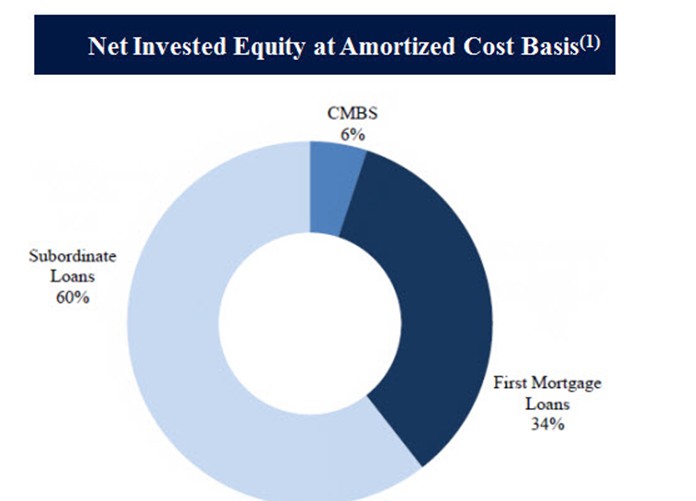
While subordinate loans sound risky at first glance, it’s important to keep in mind that Apollo has rules in place to limit the risks of these loans. The firm has a ceiling of 75% loan-to-value when giving subordinate loans, and these loans are limited to stable properties with positive cash flow.
By the end of the first quarter of 2017, the average LTV of the firm’s outstanding mortgages was 63%, and these loans were providing an internal rate of return of 14%--far in excess of dividend payout needs with a healthy margin of error for defaults.
The risks involved in these subordinate loans are reflected in the stock’s high dividend yield of almost 10%. A closer look at the company’s stock performance, funds from operations, and dividend payouts will also demonstrate that investors are more than compensated for this risk thanks to a high and growing dividend payout.
Historical Performance and Dividend Analysis
Apollo is one of the few mortgage REITs that not only has failed to slash dividend payments, but has also increased them following the Great Recession and subprime mortgage crisis.

While the REIT’s payouts have increased, the stock’s yield has barely budged since its IPO and has actually failed to fall below 8.75% since its inception despite the company’s ability to increase payouts. Usually, high yields indicate market skepticism that a company will be able to continue to pay out its current dividend in the future; in the case of Apollo, the market has priced in a dividend cut that has never come, while payments have increased.
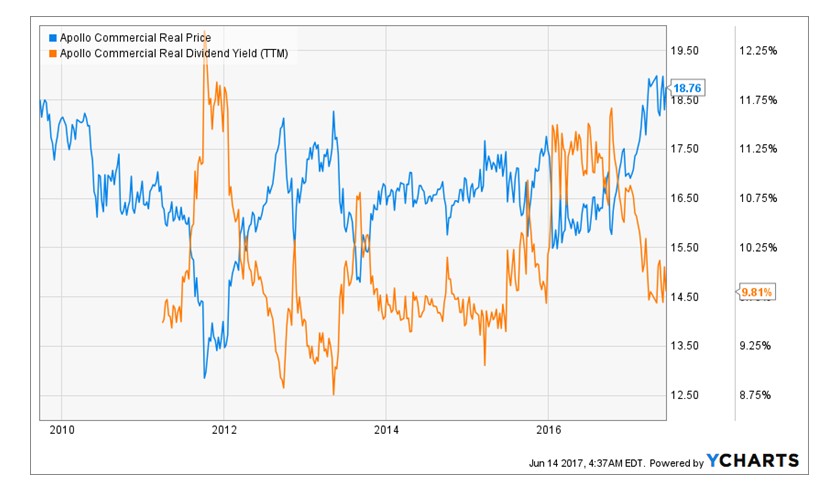
Apollo has funded these higher payouts by growing the company’s business and investing in more debt. The firm’s book value has increased nearly 10-fold since its IPO to almost $2 billion, which has allowed the company to further diversify its assets into more geographical regions and loan types:

Recent Earnings Results and Current Valuation
One of the most attractive aspects of Apollo right now is that it is selling at a discount to the firm’s book value per share. By the beginning of June that discount had remained relatively stable at nearly 11%, which makes Apollo far more valuable than in 2010 and between 2013-2015 when it sold for a premium to book:

Buying Apollo when it trades at a discount to book has been an easy way to make quick capital gains, as we see by looking at the stock’s price trend from September 2015, when it went from trading at a premium to a discount, to the present:

Last quarter, the firm earned 41 cents per share, with earnings over the last 12 months reaching $1.93. That is in excess of the company’s $1.84 annual dividend payouts, indicating the dividend should remain at the very least flat for the foreseeable future.
Finally, Apollo shareholders are in a comfortable position to see shares appreciate before a secondary offering dilutes shareholder ownership further. Like many REITs, Apollo will at times issue additional shares to fund new moneymaking opportunities, and secondary offerings like these will temporarily cause the stock to dip. Apollo issued such a secondary offering at the end of May after doing a similar secondary offering in the middle of December. These offerings indicate Apollo sees a lot of opportunity to expand its business—and the firm has recently issued $500 million in mortgages across four large properties—but the timing of these offerings also indicates that Apollo shareholders will not see another sudden dip in price for at least 5 months, if not longer.
BMR Take: Apollo is a small niche Mortgage REIT that is rapidly growing in size and is trading at an undeserved discount. Thanks to its connections to the private equity world and an established track record of wisely using capital and increasing dividends, we expect this stock to attract more investor attention and more capital for a long time to come.
by Todd Shaver | Jun 13, 2017 | 6pm News Flash
It’s been an anxious two and a half days for all investors. Starting mid-day Friday Tech stocks sold off big time, with most down 3-4%. Netflix was down 5% Friday. Monday was a continuation of the selling and the big question was whether it would continue today. The market was up in overnight trading early this morning and the market rallied and held its gains, right to the close, closing at the highs of the day.
Tesla set a new all-time high today right after the close, at $377. Huge. The market cap is now $62 billion and is worth more than BMW. Wow. This just in – Tesla’s Model X was awarded the highest safety rating of any SUV. Tesla short sellers lost another $500 million today. Too bad. Ron Baron who manages $23 billion said today on CNBC that Tesla can go to $1000 by 2020. Wow. And he expects the company to have $70 billion in revenue and to be earning $10 billion in operating profits. By 2020, the company expects to be selling 1 million cars per year. And he loves the Solar City acquisition. Of course he has $300 million invested in the stock, so he is a bit biased. But we’ll take it.
OK, back to Tech. Most of the FAAMG stocks performed well today. Amazon was up $17 or 1.8%, Facebook was up 1.6%, Microsoft was up 1.3%, Apple +0.9% and Google up 1.1%. To say the least, we were pleased with the market today. Now we just have to get through Janet Yellen’s big interest rate announcement tomorrow.
by Todd Shaver | May 24, 2017 | 6pm News Flash
We are well aware of price of the Mazor (MZOR: $39.60) these past few days. The stock has been downgraded by a few firms due to valuation. Hmmm. What does that mean? It means the stock has gone up, perhaps higher than they ever thought. And yes, we know the stock has gone up. We are way up on the stock since we added it in the teens last year.
Needham & Company restated a hold rating in a research report on May 11th. First Analysis downgraded shares from an overweight rating to an equal weight rating and boosted their target price for the company from $28 to $38 in a research report on the same day. Wells Fargo downgraded shares from an outperform rating to a market perform rating in a research report on May 11th as well. These aren’t stellar reports but they aren’t that bad either. They are just protecting themselves.
The recent downgrade was May 17th, a week ago, with nothing new since then. The stock is volatile and traded as high as almost $46 on the 18th, $45 on the 19th, and $43 on Monday of this week. It wasn’t until yesterday that the stock really sold off. The point is that it’s not the end of the world. However, we don’t know where the stock is going. We know where the COMPANY is going. We believe the COMPANY is doing well. Super well. But maybe the market will drop the stock to $35 or $30 and that would be devastating.
So what to do from here is up to you. We are going to stick with it a little bit longer and watch for it to get back on track. If it doesn’t we will exit with well over 100% gains.
by Todd Shaver | May 22, 2017 | 6pm News Flash
Blackstone (BX: $32, up 7% Monday) announced intentions to raise a $40 billion infrastructure fund, including an already funded $20 billion through the Public Investment Fund of Saudi Arabia. This is an impressive event and is being interpreted by investors as a critical valuation catalyst.
One key implication is that this new fund will diversify the company into a 5th leg of growth (adding infrastructure to the existing list of private equity, credit investing, real estate, and hedge funds investments). With focus turning to fiscal versus monetary stimulus on the global scene, the timing seems just right to be getting into infrastructure. Below we highlight some of the key takeaways about the new infrastructure fund.
Key takeaways:
(i) We expect there will be a 50 basis point management fee during the capital raising stage (50 basis points multiplied by $40 billion is a lot of money!)
(ii) We believe the management fee will rise to 1% following capital raising (upside to the math describe above—awesome!)
(iii) Management fees will be paid on “fair value” rather than “raised capital” so investments and mark-to-market will positively impact management fees
(iv) The fund will not be subject to redemption risk (investors can’t get out, so fees are going to be very stable – good.)
(v) We believe the fund will seek a 10% IRR hurdle (i.e., no investment will be made if they aren’t likely to return at least 10% - pretty standard)
(vi) Management expects to ultimately make $100 billion of infrastructure investments using leverage (thus the fees will be juiced even more)
___________________________________________________________________________________________
BMR Take: The stock is up 7% today as one firm upgraded the shares to Buy seeing what we described above. With the consensus EPS outlook calling for around $3 this year, and a 7% dividend yield still in place, the stock remains a compelling value.
