
The Week Ahead
The stock market is trading at all-time highs on a price basis, a price to sales basis, and a price to book basis. Price to earnings ranks in the top decile of historical valuations. The optimism/pessimism index is now over the 70 level on the optimistic side, but which has never been sustained for very long. Times are good. We don’t see the weeks ahead with the holidays disrupting the market’s current feeling. But prices are starting to bake in high expectations. We are going to need to see some real tangible progress from the economy starting off the year in 2017.
This week we provide some insights on our latest thinking for Annaly Capital Management, Apple, Bristol-Myers Squibb, Eli Lilly, Home Depot, and Netflix.
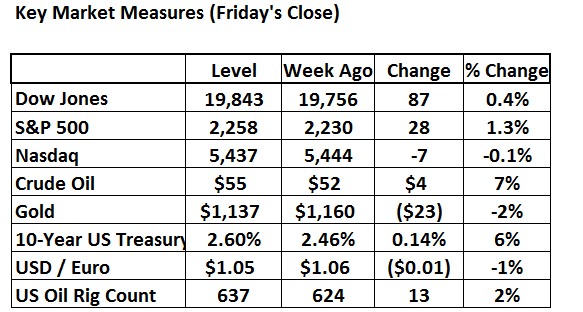
Highlights From The Past Week
China-US Relations. China must have access to US consumer markets, and President Elect Donald Trump knows it. The US is not dependent upon China for any strategically important commodities or products and the US has significant extra capacity in many of its manufacturing sectors. Data and opinions are pouring in about a potential US-China trade war. Sorry to break it to some of these folks, but trade has and will always be a war. Donald Trump is just way more outspoken about negotiation tactics. There is nothing new under the sun here. Get ready for some near term negative consequences from US-China relations stemming from US leadership turnover, but keep your head up, the trade deficit with China is so bad for the US it is hard to see how Donald Trump can do any worse. Trump named Iowa Governor Branstad the Ambassador to China and billionaire Wilbur Ross Secretary of Commerce - these guys are seriously qualified and talented and accomplished, although there are many that will fight them in Congress. What else is new?
Technology Sector Visits Trump Tower. Many of the companies we cover had their CEOs invited to Trump Tower to meet with the President Elect. The gathering included Jeff Bezos of Amazon; Elon Musk of Tesla; Tim Cook of Apple; Sheryl Sandberg of Facebook; Larry Page and Eric Schmidt of Alphabet, Google’s parent company; and Satya Nadella of Microsoft, among others. Trump told the crowd, “There is nobody like you in the world;” “I am here to help you;” and “We want you all to do really well.” Microsoft CEO Satya Nadella brought up perhaps the most thorny issue, immigration, saying how the government can help Tech with things like H-1B visas to keep and bring in more talent. Alphabet Executive Chairman Eric Schmidt, who briefly noted that he pondered what he would do if he were president, then made the point that governmental information technology programs were antiquated and unsafe, and needed to be upgraded. How exciting is this - to see our greatest leaders finally all sitting around the table discussing and solving problems!
Interest Rate Outlook. We have to keep an eye on the interest rate situation. The 10-year US treasury is now at 2.60%, up from 1.70% before the election. On the one hand, the stock market has been STRONG in the face of this rate risk, the exact opposite situation many were inferring would happen whereby stocks go down when rates go up. However, we are not yet out of the woods. Fed Chairwoman Yellen suggested that three rate hikes likely in 2017, up from two. Goldman Sachs claims that at the current pace of interest rate hikes, the yield curve will finally start to offer decent returns by the end of 2017. This means we could see some investors who have been sticking around the stock market due to the terrible bond rates start to finally reallocate their money into the bond market. This is a trend that could develop and would not be great for the stock market. Interest rates have risen at one of the fastest rates in history. We would love to see a breather here in order for all markets to assimilate this big move. And we are talking the US stock market as well as overseas markets. The latter needs to assimilate the much stronger dollar as well as the higher rates.
BMR Companies and Commentary
Annaly Capital Management (NLY: $10.20, -3%) Interest rates have been on the rise and are likely to continue moving higher. The market assumes that rising rates hurt Annaly. This is actually not so. Yes, the company can be impacted in the short term. But in the long term the company receives a much higher return from their investments and is more profitable for the firm. Book value was $11.69 at the end of the third quarter. Analyst estimates call for book to decrease by 9% to $10.62 in the fourth quarter. But in this case numbers don’t tell the whole story.
Let’s revisit how Annaly makes money. Annaly invests in US Government MBS (Mortgage Backed Securities). Recall, Agency MBS is simply all the good residential loans made to the qualified deserving buyers who meet minimum standards (such as income, debt to income, loan to value, etc.) as set by the government agencies (Fannie Mae, Freddie Mac, and so on). The government agencies buy all these loans from banks and other lenders, then package them up into huge pools, and sell them through MBS to investors like Annaly.
Annaly’s portfolio of Agency MBS declines in value as interest rates rise, just like a bond. The company hedges to help dampen the impact. Analyst estimates say that in the fourth quarter the net decline in book value was $1.26.
BMR Take: Rising rates is a tough backdrop for Annaly but what people forget is that Annaly is laddered. They have notes maturing every month of the year. And guess what? They get to invest that at the higher interest rates that prevail at that time. So yes, book will be down in the short term, but soon enough book will pop right back up again as the company continues to roll over lower interest rate vehicles and invests in the new higher rates. This is what we love so much about Annaly.
Apple (AAPL: $116, +2%) The Apple train keeps rolling. One of the top Wall Street analysts who started following the company at $2 per share wrote his last note, as he is moving on to start a venture capital fund. He told everyone to stick with the stock as the train is heading toward $150.
As we move into 2017 investors will be focused on growing anticipation around iPhone 8 and a favorable long-term trajectory for Services growth. Some investors might be concerned that Apple could miss iPhone sales estimates for the first half of the year because of relatively little innovation in the iPhone 7 and buyers holding out for the next version. (We’ve heard this SO many times.) Should there be a first-half 2017 iPhone hiccup, we expect minimal downside, as investor focus narrows on the iPhone 8, which is why we started this paragraph making this point.
For those in the know, the Services business is actually a reason to be excited about 2017. Apple's Services business includes Apple Music, Apple Pay, iCloud backup and other offerings. Services accounted for 11% of Apple's total revenue in the fiscal year ended September 25, which amounted to $24.3 billion. Services revenue in fact rose 22%, where Apple's overall revenue fell 8%. Note that if Apple’s Services business were a standalone company it would rank in the Fortune 100. Look for Services revenue to clear $28 billion in 2017.
BMR Take: There is much conjecture and anticipation of the new Trump presidency and his talk about lowering taxes for repatriation of corporate cash overseas. With more than $200 billion overseas, Apple is listening and watching and so are we. We believe the Trump hype. We think it will happen. All signs point to more upside ahead for the Apple story.
Bristol-Myers Squibb (BMY: $59, +3%) Bristol is roaring back, up 20% from the recent sell-off lows. Recall that in October, Bristol announced an evolution of its operating model to drive the company’s success in the near and long term through a more focused investment in commercial opportunities, streamlined operations, and realigned manufacturing facilities. We are already seeing progress.
This week, Bristol announced investments in the (i) construction of a new R&D building at the company’s New Jersey campus that will co-locate lab-based Discovery and Translational Medicine activities, (ii) construction at its New Brunswick, New Jersey facility to support biologics development, and (iii) construction to continue expansion of its biologics campus Massachusetts.
The company also announced it intends to initiate a phased multi-year closure of its Hopewell, New Jersey site by mid-2020 and will not renew its lease in Seattle in 2019. The company confirmed previously announced plans to close its Wallingford, Connecticut site by the end of 2018, and also announced it will no longer build a Connecticut Development site. The company expects many of the roles from Wallingford, Hopewell and Seattle will transition to other U.S. locations.
BMR Take: We were so excited on the last earnings call to hear the company commit to operating expense discipline. Watching them follow through so quickly is encouraging.
Eli Lilly (LLY: $73, +8%) Lilly’s stock took a big hit last month on the failure of an experimental Alzheimer’s drug. However, this week, Lilly gave an upbeat outlook for the coming year, estimating that both sales and earnings will come in above Wall Street’s expectations.
This huge Pharmaceutical company expects adjusted earnings between $4.05 and $4.15 a share on revenue of $21.8 billion to $22.3 billion, well above analysts’ forecasts for earnings of $3.97 a share on $21.7 billion. Lilly is not a broken company just like we thought!
Lilly said the new estimates signal mid-single-digit growth from the current year, boosted by increased volume from new products. Lilly also projected an increase in gross margin despite offering discounts for its insulin brands for certain patients, as the Pharmaceutical industry has come under fire for soaring prices.
Some upgrades from the major research firms certainly helped. Morgan Stanley bumped their Target to $82. Goldman Sachs raised them to a “Conviction Buy,” whatever that means. We’ll say that is good(!) Jefferies is at $100 and Argus is at $95. All good. Our Price Target remains at a very doable $80 but we are secretly ready to raise the Target by $10. Don’t tell anyone. Having added the stock on Tuesday at $69, we are quite pleased so far. This one is big company with a $77 billion market cap. And while you wait, it is paying close to 3%. We expect good things from this company.
BMR Take: Lilly's new product growth drivers are in place, and we believe Lilly's guidance is low risk and achievable. Additionally, management has a history of providing conservative guidance, so we should see more weeks of solid stock performance ahead like this past week.
Home Depot (HD: $135, +1%) Housing starts tumbled 19% in November, which was way more than most expected, and we need to keep an eye on how higher interest rates impact household’s ability to buy new homes or spend money on their existing homes. Despite this issue , the 2017 outlook for Home Depot is encouraging.
Home Depot’s sales growth last quarter accelerated to a 6% pace from 5%, which trounced rival Lowe's 3% uptick. Professional customers are descending on the company’s stores. These shoppers spend far more than the company average -- over $900 per transaction in many cases -- so even a small increase in demand from these customers translates into significant gains. Last quarter we saw high-dollar transactions grow 11%.
The company is generating excess capital, enough to fund nearly $5 billion of stock repurchases and $2.6 billion of dividend payments annually. Home Depot is more generous with the dividend payout of 50% of earnings versus Lowe’s 35% target. We look for a similar smart use of capital to lift results in 2017.
BMR Take: We are encouraged by what is happening at Home Depot as the economy slowly churns out bigger numbers with no let-up in sight. The stock is closing in on all-time highs at $139.
Netflix (NFLX: $124, +1%) Netflix members worldwide can now download as well as stream great TV series and films at no extra cost.
While many members enjoy watching Netflix at home, the company has often heard customers also want to continue their binges while on airplanes and other places where Internet is expensive or limited. Now, customers can just click the download button for a film or TV series and can watch it later without an internet connection.
Many of people’s favorite streaming series and movies are already available for download, with more on the way, so there is plenty of content available for those times when customers are offline.
BMR Take: Aside from maybe You Tube, nobody is winning in the television and movie game as big as Netflix right now. They will spend $6 billion on content in 2017 and as we know, content is king. We see so much opportunity for the business ahead. Yes, they are taking a big step and some say a big risk, but they continue to blow away their competition by adding huge numbers of subscribers each quarter.
Athenahealth (ATHN: $115, +19%) Athena soared nearly 23% Thursday after the company reaffirmed its guidance for the fiscal year and issued an upbeat forecast for 2017.
The company, which provides cloud-based services for Healthcare, said for 2016 it expects earnings in the range of $1.65 and $1.85 per share on revenue between $1.085 billion to $1.115 billion. Analysts expected $1.79 a share on revenue of $1.10 billion.
Athena also said total annual revenue could hit as much as $1.33 billion in the new year. These are very healthy figures confirming that the company’s core services are in hot demand.
BMR Take: We like where we added the stock to our portfolio ($101 on November 11th.) And we like the prospects for the business. Now it’s time to enjoy the ride.
Upcoming Economic News
WEDNESDAY, DECEMBER 21
Existing Home Sales – November
Time: 10:00 am
Forecast: 5.5 million
As with housing starts, existing home sales in November are expected to decline following October’s 9-year high. Home sales continue to push higher, but tight inventory is limiting the pace of growth. The volume of existing homes available for sale in October is equivalent to 4.2 months at the latest sales pace, well behind the historical average of 6.1 months.
THURSDAY, DECEMBER 22
GDP – Third Quarter (Third Estimate)
Time: 8:30 am
Forecast: 3.3%
Third quarter economic output was underpinned by the firm 2.8% pace of consumer spending. Yet over the long-term, spending has shifted lower, with the yearlong advance of 2.6% to the third quarter representing the slowest pace in eight quarters. The slower pace of jobs gains and renewed monetary tightening will push against the potential growth boosts from fiscal stimulus in the year ahead.
Durable Goods Orders – November
Time: 8:30 am
Forecast: -3.8% overall, 0.4% ex transportation
A large downshift in Transportation sector orders is forecast to lead a decline in November durable goods orders after producing the sharp gain of the previous month. Core orders can show more stability in industrial demand by rising for the third straight month in November. Core capital goods orders rose 4.4% annualized in the months ending October, a promising signal for business investment after deep declines were registered in the first half of this year.
Personal Income & Spending – November
Time: 10:00 am
Forecast: 0.3% income, 0.5% spending
Personal income may only expand at a measured pace in November after a weak result for average hourly earnings growth. The 2.5% yearly advance of hourly earnings to November equals the slowest pace of the last eight months, which can prevent income growth from approaching 5% in the near future. Yet with alternative measures of wage growth showing more vigor and the labor market continuing to tighten, both hourly wages and income may skew higher in the quarters ahead.
Leading Economic Indicators Index – November
Time: 10:00 am
Forecast: 0.2%
Exceptionally few unemployment insurance claims and higher stock prices can push the Leading Economic Indicators Index up for the third straight month in November. Recent tallies of unemployment claims have produced some of the lowest counts of the past four decades. The indicator of a robust job market can feed into quicker wage growth and limited letup in the solid pace of hiring.
FRIDAY, DECEMBER 23
New Home Sales – November
Time: 10:00 am
Forecast: 575,000
Insatiable demand for new construction has new home sales positioned to rise in November. Sales rose 18% year-over-year in the quarter ending October, more than making up for the more measured gains seen earlier this year. Given how the level of homebuilding remains historically depressed, the uptrend in new home sales has some room to resist the recent rise in mortgage rates.
University of Michigan Consumer Sentiment – December
Final Time: 10:00 am
Forecast: 98.2
The final reading on consumer sentiment in the December Michigan survey can improve on the initial 2-year high result. The end of a trying election season has reduced the anxiety of many consumers.
Tesoro Petroleum (TSO: $91, flat) was upgraded recently by Wells Fargo to Outperform without putting a Price Target on it. Credit Suisse has a $100 Target, Citigroup has a $102 Target, Barclays is at $105 and Bank of America is at $109. We are in good company here. We added the stock on November 15h at $85 and we sit with our Price Target of $110. With OPEC bringing Christmas presents to the Energy markets, we’re looking for slow and steady growth from this medium-sized $11 billion market cap company, paying you a 2.4% dividend while you wait.
THE RACE
Google (GOOG: $791)
Apple (AAPL: $116 - $810 equivalent)
Amazon (AMZN: $758)
For the week:
Google was flat. (BTW, we love calling them Google, rather than…… A to Z.)
Amazon was down 1%.
Apple – Up 2%. Yea. Remember that we are reversing out the 7-1 split in 2014 so that Apple is now at the equivalent of $812. Apple is the clear winner so far! And Apple is doing it with the far bigger market cap than the other two. Apple is at $618 billion. Amazon is at $360 billion and Google is at $550 billion. It should be easier theoretically for Amazon to grow faster. But Apple just keeps chugging higher. Love this company! We can’t wait for it to set a new high at $134 and then shoot to $150. That will show all those naysayers. Yea.
A Discussion of Twilio (TWLO: $29, flat)
Twilio’s high valuation builds in a great deal of growth, and there is a lot of downside risk. The stock trades at 11 times sales while operating at a loss. The market has high expectations for the stock. Buying Twilio here at such expensive prices is a risky proposition. As richly valued as Twilio stock may be, however, it was trading at an even higher multiple of sales in October. The stock reached its 52-week high of $71 in September, and at that price we saw a multiple of nearly 25 times sales, a very high expectation.
The lock-up period is expiring on December 20th and Twilio’s largest stockholder, Bessemer Venture Partners at 25%, may sell some stock. So look for a drop this week and then the bottom will be set.
First Solar (FSLR: $35) had a good week, rising 4%. As we have mentioned many times, this is a great company that is going through tough times. We think it will take until late 2017 for them to straighten things out, but this company has a history of big revenues and strong earnings. Perhaps they will turn it around sooner. We don’t know, but we do know we wouldn’t sell the stock here. In fact, we would take some of our aggressive money and add to positions here.
The High Yield Corner
The biggest news for our High Yield portfolio came from Pimco. The special end-of-year distributions were finally announced, and as we expected, our Pimco fund had the highest special payout of all the Pimco funds. It’s important to reflect on what this means for high yield investors.
Throughout 2016, we have consistently and constantly recommended Pimco Dynamic Income Fund (PDI: $29, up 1%) even as the fund soared to our Target Price and its discount to Net Asset Value (NAV) turned into a premium. Often, investors and financial advisors sell Closed End Funds when they reach a premium to their NAV, because it looks like an opportunity to sell $1.00 of assets for more than $1.00 - every value investor’s dream. We recommended not falling for this temptation for one simple reason: The Pimco fund has been a monster in earning a strong return, building up an income reserved, and paying investors a high yield.
In fact, the yield on the fund has been so high - over 9% for most of the year and briefly over 10% - that many investors felt it had to be too good to be true. This yield is over a 4 times the premium to the 10-year U.S. Treasury, now at 2.6%, implying a massive amount of risk and danger. That, in turn, has kept unsophisticated investors out. The reality is that the Pimco fund offers a tremendous return on NAV for several reasons.
First and foremost is the mandate. The fund operates by investing in mortgage backed securities as well as other high quality high yield assets, including some well-picked junk bonds. This has made it possible for the fund to outearn its dividend since its inception.
Additionally, there is the quality of fund management. Pimco is one of the best asset managers in the world with unique access to opaque assets most investors simply cannot get their hands on. This is true of all of Pimco’s funds, and the Dynamic fund is no exception.
This means that Pimco’s closed-end funds are declaring tons of special dividends now that the calendar year is ending. Pimco Corporate & Income Opportunity Fund (PTY: $14.40) is offering the smallest special dividend of just 16 cents. Our pick is offering the most - $1.45.
This is more than we previously estimated, and brings the fund’s annualized yield to 14%. That is not a typo. That also means the fund’s annual yield is higher than Pimco High Income Fund (PHK: $9.10), which cut its payouts last year while the Dynamic fund increased payouts. The High Income fund’s price has also gone down 40% since inception, while the Dynamic fund has gone up 15%. At the same time, the High Income fund has suffered massive asset erosion while the Dynamic fund’s net asset value has gone up.
In short, The Dynamic fund has provided capital gains and the highest yield possible from Pimco. This is why we picked the fund earlier this year and why we recommended keeping it even when it had gained over 6% year-to-date. Now we get to enjoy the payoff in the form of that special dividend.
The world at large. Let’s extend our vantage point here at talk about the big picture. The FOMC* made its much-anticipated rate hike with a new Fed funds rate target 25 basis points above the previous one. That wasn’t the shocking news, but the expectation of three rate hikes in 2017, up from two expected, was the surprise. Apparently the Federal Reserve is expecting more inflation next year and a tighter monetary policy will be necessary. That caused the broader market to dip slightly, but a recovery later in the week saw equities close out flat for the week. The S&P 500 is holding on to its double-digit gains for the year, and it seems likely that it will close out the year with those gains.
*FOMC – Federal Open Market Committee, part of the Federal Reserve Board
This surge in equities means the market is now outperforming high yield assets after underperforming them for most of the year. The SPDR Barclays High Yield Bond ETF (JNK: $36) was flat this week, giving it a year-to-date return of 7% excluding dividends. Granted, those dividends bring it near S&P 500 performance, and the low beta on the fund means that junk bonds are also lower risk and lower volatility than stocks. So, in all, holding a junk bond index fund meant you outperformed the market in 2016 on a risk-adjusted basis. This should be good news for high yield investors. They can sleep soundly knowing that they are not sacrificing safety by looking for income, which was certainly the case back in 2013 and in years past.
Will this trend continue in a rising rate environment? We think so. The lack of a real correction in junk bonds after the rate announcement indicates that the market has priced in higher rates in junk as well as corporate bonds. This also is good news for rate-sensitive assets. This week we saw Main Street Capital ($37) and Digital Realty Trust (DLR: $95) resist the rate hike expectations and end the week flat. On the other hand, more rate sensitivity was felt in Omega Healthcare Investors (OHI: $30, down 1%) and Kimco Realty (KIM: $26, down 2%), although fundamental strength in funds from operations and occupancy rates keeps us invested in these REITs. More worrying is the greater weakness in Government Properties Trust (GOV: $19), which fell 5% this week. More short-term declines are likely if investors remain worried about interest rates. Government Properties is one of the more volatile REITs in the marketplace, suggesting it will fall steeply in moments of panic. Since its dividend is sustainable for a while, we do not believe its income stream is at risk. However, keeping a close eye on its price, and rebalancing your portfolio accordingly would be a prudent position in the short term.
Christmas Season is Upon Us
That’s a wrap for this week. Next week is Christmas and the markets are usually quite calm with most of Wall Street taking off for the Holidays. So we will not publish next week. BUT, if major events happen we will keep you informed via News Flash.
If you have a moment, we would love to hear from you on two fronts. What section of The Bull Market Report do you like best? And which section do you skip over every week? And as always, we are all ears for any input, suggestions, commentary, complaints or kudos. Send them our way at Info@BullMarket.com.
The Bull Market Report will be raising some angel money in January directly from our subscribers under a 506(b) offering, in order for us to grow the company to new heights. We will be raising just $100,000 from 4-5 investors and offering an equity stake in the company. If you are interested, write me directly at Todd@BullMarket.com. Include your phone number – Todd or one of our staff will call you.
Good Investing,
Todd Shaver
CEO, Founder and Editor
The Bull Market Report