
The Week Ahead
The S&P was up 4% in the month of November. We've seen a 6% rally since the US Presidential election. With so much money being made in the month of November, we are hopeful for December’s prospects but realistic that repeating November’s performance is a tall order. One particular area to focus on this month is the upcoming Fed meeting. Everyone will be watching for clues from Yellen about the pace of interest rate hikes for next year. The market is currently pricing in two hikes so anything more would be troubling.
This week we provide some insights on our latest thinking for Athenahealth, Apple, Amazon, Splunk, and the iShares Dow Jones US Energy Sector ETF.
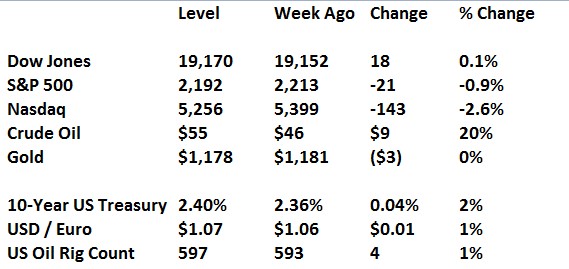
Key Market Measures (Friday’s Close)
Highlights From The Past Week
Looming Pension Crisis. Stanford University’s pension tracker database pegs the 2015 market value of California’s total pension debt at $1 trillion or $93,000 per California household. In 2014, California’s total pension debt was calculated at $77,700 per household, but has increased dramatically in response to abysmal investment returns at California’s public pension funds that hover at or below 0% annual returns. Looking back to 2008, the under-funding levels of California's public pension have skyrocketed 157%. The fact that CalPERS is having such a difficult time with what should have been an easy decision to lower their long-term return expectations to 6% from 7.5%, just further reinforces how big of a mess this entire pension issue is.
Italian Referendum. The vote happens today. While the post-Trump euphoria in US stocks has been the perfect distraction from the ugly realities elsewhere, this weekend's Italian Referendum could well be the biggest 'revolt' yet, topping Brexit and Trump. Should Italy vote "no", as polls forecast, Prime Minister Renzi may quit, which would leave the Italian bank recapitalization underway in jeopardy. Some say, this could cause a Greece-like market reaction on steroids.
The Future of the Fed. As Trump and his new appointments take power, the Federal Reserve could be targeted for overdue changes and reforms. Let’s take a look at how the Trump administration may change the Fed, as ultimately, the future leadership of the Fed will mean a lot for interest rate levels and so much more. It’s no secret that Trump has a bone to pick with the Fed, so he could be the first President in years to strip away its independence. There’s no law on the books that protects the Fed’s independence. The broad freedom assumed by the Fed over the past several decades relies solely on the president’s discretion. Just days before the election, perhaps sensing reason to be worried, Fed Chair Janet Yellen started to publicly argue the importance of an independent Fed.
Separately, Trump himself has toyed with the idea of putting America back on the gold standard. There are two empty seats on the Board to fill. Fed Chair and Vice Chair appointments will happen very soon in 2018. So much to watch.
BMR Companies and Commentary
Athena (ATHN: $96, -6% for the week) The stock struggled this week. There was no company-specific news; rather, broader industry events developing. President-elect Donald Trump’s selection of Republican Tom Price to head the Department of Health and Human Services signals that the new administration is all-in on both efforts to repeal the Affordable Care Act and restructure Medicare and Medicaid. This change is going to matter for Athena.
Privatizing the Medicare program for seniors and disabled people and turning the Medicaid program for the poor back to the states are long-time goals for Republicans in Congress and the White House. They say the moves could help put the brakes on healthcare spending.
Why does the policy change have to be done? Healthcare spending is out of control. Medicare, which covers roughly 57 million elderly and disabled Americans, and Medicaid, which covers more than 77 million people with low incomes, are among the biggest items in the federal budget, together costing an estimated $1 trillion in 2016, according to the Congressional Budget Office.
However, cutbacks to healthcare spending will weigh on companies in the industry, like Athena. Estimates from the Urban Institute say that new proposals could result in 17 million people losing coverage and that payments to healthcare providers could be cut by nearly a third. Ouch.
We want to point out that that the potential repeal of The Affordable Care Act does not impact Athena as their market share as of this point is virtually zero. While the numbers look big at first glance, don’t panic because it doesn’t mean the cuts will hit everybody equally. Athena is very well-positioned to see much less headwind than others. Plus, whatever reimbursement headwinds surface to pricing, Athena can offset that by more volume through working with more providers and offering more products.
BMR Take: We think now is an opportunistic time to be buying Athena. The company is a leading provider of cloud-based services and mobile applications for medical groups and health systems. Sentiment around healthcare is at noteworthy low levels. You can buy a superior company in the space for under $100 that was not long ago greater than $165.
Amazon (AAPL: $740, -5%) Amazon’s annual AWS re:Invent conference was held in Las Vegas this week. New products, features, and services are extending Amazon’s cloud lead across the cloud computing sector.
AWS (Amazon Web Services) introduced over 24 new products and features this week and is on track to add 1,000 new products this year (up 40% from a year ago). One of the key announcements was improvements to the database storage product, Aurora, which is the fast growing product within AWS.
Enterprises, both large and small, are increasingly adopting more of AWS’s products and services, creating a more loyal base among its 1 million+ users. As an example, the government agency FINRA (Financial Industry Regulatory Agency) was at the conference discussing how they not long ago made the decision to move to AWS. FINRA’s adoption of AWS took 2.5 years to complete and is one of the largest migrations to-date due to its vast amount of data. FINRA oversees around 4,000 financial institutions, 64,000 brokers, and stores 75 billion events per day generating 20+ petabytes of data and trillions of records, and now 90% of its total data volumes are stored in AWS. What a success story!
BMR Take: AWS is on track to contribute $17.5 billion of revenue for Amazon this year, that’s up 40% from a year ago. The cloud business remains explosive and one of the core reasons we are positive on the stock.
Apple (AAPL: $110, -2%) After skipping Black Friday last year, Apple returned to the traditional one-day shopping event with Apple Gift Card discounts across products such as the iPhone, iPad, Apple Watch, Mac and Apple TV. Apple remains one of the best-positioned tech companies to benefit from spending trends this holiday season with a well-received iPhone 7 and 7 Plus, a new Apple Watch, and a new MacBook Pro with Touch Bar. It was exciting to see the company get back in the discount game with the “one-day shopping event” and we are confident the marketing strategy boosted holiday sales.
For several years, Apple participated in the Black Friday celebration; however, the company surprised everyone when it sat out last year's Black Friday celebration. The company returned this year with Apple Gift Cards with the purchase of certain iPhones, iPads, Apple Watches, Macs and Apple TVs. In 2014, Apple offered RED iTunes Gift Cards during Black Friday but this year is offering Apple Gift Cards.
Specifically, for iPhones Apple was offering $25 and $50 Apple Gift Cards. This implies a discount of 6-9%.
BMR Take: We think Apple at $110 is a compelling value (with $44 of that in cash.) We see the return to discount pricing as a potential game changer for holiday sales this year. If true, the Wall Street adage of “better numbers means the stock is going higher,” seems at play.
Splunk (SPLK: $54, -8%) Splunk reported earnings this week. The company delivered a strong quarter, with revenue of $245 million, up 40% from a year ago, versus consensus of $230 million and EPS of $0.12 versus consensus of $0.08 and $0.05 a year ago. Splunk raised full-year guidance as overall execution is running solid. A very strong report.
The highlight of the quarter was an acceleration in license growth from 32% a year ago in Q2 to 34% in Q3, which dramatically beat consensus expectations calling for deceleration to 23%. Splunk added 500 new customers and completed 480 deals over $100k, up 30% from last year. Cloud business tripled, once again exceeding the company’s plan. All great stuff!
BMR Take: It was nice to see quarterly results largely confirm why we like the outlook for the stock. Many analyst price targets remain at $70 or higher. In fact, one investment bank just recently initiated the company with a $80 price target. All signs point higher.
iShares Dow Jones US Energy Sector (IYE: $41, +3%) Did you catch the crude oil price change in the Key Market Measures chart earlier in this report? Crude oil at $55 up 20% from just last week. Not a typo! OPEC reached a deal to cut production. Oil prices surged upon Saudi Arabia and Iran signing on to a deal at the OPEC meeting in Vienna.
They say Russian President Vladimir Putin played a crucial role in helping OPEC rivals Iran and Saudi Arabia set aside differences to forge the cartel's first deal with non-OPEC Russia in 15 years. Putin’s role was also a testament to the rising influence of Russia in the Middle East since its military intervention in the Syrian civil war just over a year ago.
BMR Take: With OPEC, Putin, and Trump all pushing for higher oil prices, it sure seems like the $50-60 level is here to stay, or even perhaps the $60-70 level may be quickly approached. Investing in the Energy sector recovery remains one of our favorite ideas.
Upcoming Economic News
MONDAY, DECEMBER 5
ISM Non-Manufacturing Index – November
Time: 10:00 am
Forecast: 55.1
The ISM Non-Manufacturing Index looks to edge higher in November as consumer spending on services continues to advance at a steady pace. Real spending on services rose at least 2.5% in each of the past two quarters, avoiding the letdown seen in the Manufacturing sector. The new orders component of the Non-Manufacturing index exceeded the solidly expansionary level of 57 in four of the past five months. That indicator supports growing demand for services in the months ahead.
TUESDAY, DECEMBER 6
Trade Balance – October
Time: 8:30 am
Forecast: -$40.0 billion
Rising imports are expected to cause the US trade deficit to widen in October. Exports have been on a tear of late, adding 1.2% to real growth in the third quarter - the largest contribution in 11 quarters. Yet that boost came before the latest run-up of the dollar, which will challenge export growth going forward.
Productivity & Unit Labor Costs – Third Quarter
Final Time: 8:30 am
Forecast: 3.2% productivity, 0.3% unit labor costs
The revision of third quarter productivity figures will likely confirm the strongest result of the past eight quarters. Positive effects from growing inventories and relatively restrained hiring growth has boosted output efficiency. Yet with productivity growing a mere 0.3% annualized over the past two years, stronger sustained trends in investment are needed to improve the long-term pace.
Factory Orders – October
Time: 10:00 am
Forecast: 2.4%
A bulge in Transportation sector orders is forecast to lead overall factory orders higher for the fourth consecutive month in October. Near-term business investment trends are looking solid after core capital goods orders rose 4.4% annualized in the quarter ending October. Yet continued progress is needed to lift industrial output trends, as such orders fell 3.6% against the same period in 2015.
FRIDAY, DECEMBER 9
University of Michigan Consumer Sentiment – December
Preliminary Time: 10:00 am
Forecast: 94.0
Consumer sentiment may rise to the highest level in 7-months in December, perhaps reflecting some of the same post-election optimism seen in the stock market. Prior to recent OPEC moves to tighten supply, consumers benefitted from gasoline prices that fell to 7-month lows in late November. However, those gains may not filter to retailers, who are being hurt by having to offer consumers greater discounts.
Eli Lilly (LLY; $67, down 2%) The Latest News
Eli Lilly is a $71 billion machine that has seen a rocky road these past few weeks. After hitting the $78 level in early November the stock got hammered down to its current level due to Lilly’s announcement that its Alzheimer's drug solanezumab had failed to significantly improve on cognition. But then on Friday we saw some good news with an announcement that the FDA approved Lilly's new drug application for Jardiance to be used in reducing cardiovascular mortality in adults with type 2 diabetes. One analyst reported that Lilly’s revenue could increase by $1.7 billion in 2025 on expanded Jardiance sales. Wow. The good with the bad. The bad with the good. All in all, Lilly will survive and thrive. And we are preparing a research report and should be able to publish this mid-week.
Apple Investment Idea
The Options Corner
Here’s an idea for the aggressive investor to put some cash in your account using this stock. If you agree with the premise that every share of stock at $110 includes $44 in cash, you might conclude, like we do, that there is somewhat of a floor under the stock. There is no other company in the history of Wall Street that has had this much cash as a percentage of the stock price. $44 a share is in cash. That’s 40% of the price of the stock. So you get the entire company, ex-cash for only $66. Now, with that said, what we are going to suggest here is a very risky idea: Selling naked puts on Apple.
Selling naked puts offers you two things: Being able to but the stock at a lower price than it is now (if the stock falls), and a way to put cash in your account immediately. But it comes with great risk.
There are lots of choices of selling puts on Apple, but let’s say you think the stock going down to $100 by February 17th is not likely. And in fact, if it did, you wouldn’t mind buying the stock down there. What you can do is to sell the February 100 put for $1.45. Since options are traded in 100 share lots, that means you can get $1,450 for every 10 options that you sell. Now by doing this transaction you are obligated to buy 1000 shares at $100 if it goes below $100. So you must have $100,000 at the ready to do this. The stock is at $110 now so buying it a $100 sounds good at this point. Also, since you got $1.45 a share for selling the put your actual purchase price is $98.50. Again, this sounds good, unless the stock goes to $95 and you are forced to buy it at $100, which can happen, and that’s why selling naked puts is risky.
However, you can always BUY BACK the options that you sold to get out of the trade. In other words, you are not 100% obligated to buy the shares if it goes lower – you can always buy back the option which leaves you with no position and thus no risk. You may have to pay a higher price for it since the price will go up as the stock goes down, and thus you will lose money on the trade, but at least you can get out of the trade if you like. Note that as time goes by – as you get closer to the expiration of the option, February 17th, and if the stock stays in the same general area of $110, the price of that option will approach zero which of course is exactly what you want to have happen. (If you sell something first, you want it to go to zero. If you buy something, you want it to go up. Right?)
That’s our discussion of options this week. You can do this with most stocks, so it doesn’t have to be Apple. Virtually all stocks have listed options and you can check them out here:
http://finance.yahoo.com/quote/AAPL/options?p=AAPL&date=1487289600
This is a great site with a wealth of information about option pricing. You can spend hours here researching all of your favorite stocks.
Groundbreaking news: The US is Now a Net Exporter of Natural Gas The U.S. exported an average of 7.4 billion cubic feet of gas a day in November, more than the 7.0 billion it imported, with the biggest buyers being Mexico and Canada. Gas exports have risen more than 50% since 2010. The Energy Department says the country will be the world’s 3rd-largest producer of liquefied natural gas by 2025, trailing Australia and Qatar.
FANG Stocks Taking a Breather
Three of the four big internet stocks that make up the FANG group took a pounding last week, despite upbeat reports from various firms on the Street. FANG is made up of Facebook (FB: $115, down 4%), Amazon.com (AMZN: $740, down 5%), Netflix (NFLX: $121, up 3%) and Google-parent Alphabet (GOOG: $750, down 1%). We always like to add Apple, to make it FAANG because there is so much value represented here, Facebook - $330 billion; Amazon - $350 billion; Apple - $585 billion (largest in the world); Netflix - $52 billion – just a puppy; Google - $520 billion - Going to catch Apple some day?
BMR Take: Since Trump was elected these stocks have been poor performers. Do we care? Well, we care but we are not worried. Why? Because we know that the companies don’t care – in other words, all they care about is increasing revenues and profits; well, at least all of them except Amazon! We kid about Amazon. We just read the book The Everything Store by Brad Stone. Shall we say this is a must-read? Wow – what a story. Read this and you will think like we do that Amazon can go to $1500 a share in the near future. Amazon is making money – it’s just that they are spending it just as fast on infrastructure build. We secretly believe that they could report stellar earnings any time they darn well please. But since DAY ONE they have been building for the future. And selling over $30 billion each QUARTER is proof that they are on to something big.
We digress. Our point is this: Each of these five stocks is growing revenues in a big way. Profits have followed at all of them but Netflix, but they are building for the next decade and are spending big money on content ($6 billion next year). So again, we are not worried about a slight lull in the upward march of the stock prices for these five. It will come in due time,
Ferrellgas Update
Ferrellgas (FGP: $5.65, down 14%) cut the dividend from $2.00 a share to 40 cents, bigger than what we had thought and bigger than the market had anticipated. This is a savings for about $160 million a year. The company cited difficulties in its midstream business due to the loss of its largest customer (supplier Jamex Marketing), a warmer-than-expected early winter season, and "general market conditions." Blah, blah, blah. We’ve heard that story before. A lot of this mess was caused by buying troubled midstream company Bridger Logistics last year which has caused big writedowns and liquidity issues. What a way to destroy a strong, old line, profitable company.
Obviously, we should have stuck to our guns of selling at $15 when we first issued our research report in September. Why didn’t we? Well, discipline. The lack thereof. It’s human nature and we are human just like you are. We added the stock at $17, we had a Sell Price of $15 so we should have removed the stock at $15. That’s it, pure and simple. But we got swayed by the lower stock price and how cheap the stock was, being down from its 52-week high of $21 and an all-time high of $28 set in 2014. We couldn’t see the forest of the trees, and certainly didn’t anticipate that management would make such a big mistake by buying Bridger.
What to do now? It all depends on how much stock that you have and what percentage this investment is in your overall portfolio. So we can’t answer this question for you here personally in this forum. The company is operating on thin ice and the stock could stay here for many months, if not years. But if you want a personal opinion on what to do in your own portfolio, don’t hesitate to write us here at Info@BullMarket.com. Give us some details and we’ll give you our opinion.
Goldman Sachs Group Update
Goldman Sachs (GS: $223, up 6%) had another amazing week and hit $227 on Thursday before pulling back a bit on Friday. We hereby raise our Sell Price from $196 to $214, preserving our big gains, currently up 52%. And we are raising our Target Price from $220 to $245.
The High Yield Report
A Close Look at the Municipal Market
The biggest news in the high yield world right now is actually hard to find; many leveraged closed-end funds reduced distributions this week, after Nuveen cut dividends on a number of funds. This impacted one of the funds in the Bull Market Report portfolio: the Nuveen Enhanced AMT Free Municipal Bond Fund (NVG: $13.90), which fell a little less than 1% this week as the municipal bond market continued to struggle. The decline seems unrelated to the distribution cut, but it is something that investors should be aware of.
At the same time, there’s no reason to panic. The distribution cut was a little over 4% to 7.25 cents from 7.6 cents every month. That’s a loss of 4.2 cents per year, meaning the fund’s yield is still above 6%. Dividend cuts are never welcome news, but as these things go this one is quite small.
Could this cut have been predicted? In a broad sense, yes; as a general rule the ultra-low interest rate world we live in puts inevitable pressure on high yield, which is why investing in these selectively is crucial. On the other hand, the timing of this cut is odd. Interest rates have actually been rising lately, with A-rated bond yields up 18% in the last month. To make things even stranger, Nuveen did not cut distributions on all municipal bond funds. On top of that, Nuveen cut distributions on dozens of funds, ranging from equity-focused to municipals. It seems Nuveen decided to lower distributions to make payouts more manageable across its fund offerings except in those cases where distributions where already so very low that distributions could easily be maintained.
Nuveen is a good fund manager and has done a good job with the Enhanced AMT Free Fund. The fund’s NAV has grown over 6% since inception and the stock has gone up over 7% in the last three years. The recent collapse in the municipal bond market means its NAV is down 3% year-to-date, which is the case for pretty much all municipal bond funds. Cutting distributions to protect future payouts and keep some capital to invest in new municipal bonds makes sense right now, despite the frustrations to investors.
Fortunately, NVG is just one of the 14 high yield recommendations in the Bull Market Report portfolio, so the distribution cut will have a marginal impact on our total payouts. We are still bullish on the fund as an outperformer in the municipal bond market and we are still bullish on municipal bonds, so we are not changing our recommendation for this fund right now. Instead, we encourage you to consider slowly building on your position in the Nuveen fund in anticipation of the inevitable municipal bond recovery.
That brings us to a bigger question - why are munis tanking? Most municipal bond indexes have fallen over 3% in a month’s time. A muni index fund like the iShares S&P National AMT-Free Municipal Bond Fund (MUB: $107) lost 1% this week (more than the Nuveen fund did) and is down nearly 6% over the last three months. Munis are supposed to be a stable asset class. What is going on here?
There are two main causes of the municipal bond rout, and they’re worth understanding in detail.
1. Retail fears. Retail investors dominate the municipal bond market and they will sell off in moments of particular panic. We are in such an environment right now, with greater uncertainty about the future of Treasuries, the economy as a whole, and trade relations between America and foreign nations. Fear is motivating selling.
2. Possible tax cuts. This is arguably the biggest driver behind the municipal bond sell-off. Why do investors choose munis over corporates? One is the relative safety of munis, but a much bigger reason is the tax benefits. Muni bond distributions are tax free, corporate bond distributions are not. With President-elect Trump widely expected to change the tax code, the future of muni tax treatment is uncertain. The thinking is that a big tax cut could motivate people to leave munis because the tax benefits are less than they used to be.
Will Trump change the tax code? We’re not political analysts, and Trump is very unpredictable, so we can’t give an answer with any sort of confidence. What we can say is that the municipal market is over-reacting to the risks of this eventuality. To understand how this is the case, let’s take a close look at the spread between corporate and muni 5-year bond yields. A-rated 5-year munis yield 2.11% on average versus 2.28% for corporates. That’s a difference of 0.17%, or $1.70 for every $100 invested. A month ago, the difference was 0.28%, or $2.8 for every $100 invested.
This means that the market has removed 39% of the tax-based arbitrage opportunity investors have to buy municipal bonds instead of corporates. In other words, the market is anticipating that the tax benefits of munis will disappear and is pricing them accordingly.
The closer municipal bond yields come to corporate bond yields, the bigger opportunity there is for municipal bond prices to rise if the tax benefits do not disappear, since prices are inverse to yields. Additionally, the arbitration opportunity for investing in munis because of their lower default rate also goes up as their yields get closer to corporates. For this reason, we are going to keep a close look at municipal and corporate bond rates to identify when we reach the bottom for munis. It is clearly coming soon, and may arrive before the end of the year.
On the topic of closed end fund distributions, we also heard from one of our favorite funds - the Pimco Dynamic Income Fund (PDI: $29), which soared 3% this week. The fund is now up 5% year-to-date. The fund’s regular dividend is staying the same at a 9% yield, but we did not hear about the fund’s special dividend yet. Pimco seems to be waiting a bit before announcing special dividends on its funds; we expect to hear about this next week or, at the latest, the week after. We know many folks who are buying this stock to get the anticipated big dividend. Of course, be aware that on ex-dividend date the stock opens lower that morning the exact amount of the dividend. So it’s not all icing on the cake, but generally over time the stock moves back to where it was. The operative word is “generally” so be a good investor and be wary.
Finally, on BDCs: The UBS Etracs BDC ETF (BDCS: $21.90) fell 1%, mostly in line with the broader market. This is a modest move, indicating that BDCs are maintaining their strength alongside the Financial sector. We remain constructive on Main Street Capital (MAIN: $36, down 1%) but are still waiting for it to reach a lower level before jumping back in.
Good Investing,
Todd Shaver
Founder and Editor
The Bull Market Report