
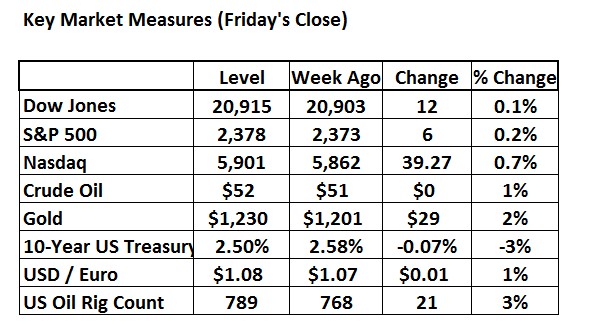
What a week. Another interest rate hike has come. The entire market and all the Fed officials, except one dissenting opinion, wanted the March rate hike. Who dissented? Minneapolis Fed President Neel Kashkari. Why? Kashkari said the announcement of the Fed’s balance sheet plan could trigger somewhat tighter monetary conditions resulting in the equivalent of a rate hike of unknown size. After it has been published and the market response is understood, then he says the Fed can return to using the federal funds rate as a primary policy tool, with the balance sheet normalization under way in the background. Understanding Kashkari’s lone wolf dissenting opinion is something to take note of. We need to keep an eye on the rising interest rate cycle and how it impacts the bull market going forward. For the time being, the bull market continues to break new highs.
No matter what, there is always a bull market here! Week in and week out, you can find it right here at The Bull Market Report. We currently see a bull market across many parts of the stock market. This week we highlight the following securities: Tesla, Visa, Apple, Google, and PayPal.
 )
)
Highlights From The Past Week
Another Week of Huge Cash Inflows! According to industry data, overall cash continued to flood into equities for a total of $14.5 billion, the 11th consecutive week of inflows. Most of this was due to allocations to ETFs, which saw $19.7 billion in inflows, the highest weekly amount YTD, offset by $5.1 billion in outflows from actively managed funds. Looking at what its private clients are doing, an investment bank notes that the top 3 ETF inflows in the past 4 weeks were Financials, Bank Loans, and MLPs.
Has OPEC Underestimated US Oil Production Once Again? The U.S. crude cowboys are back on their horses and leading a strong recovery in the oil patch that is not expected to falter. With lessons learned from the oil price crash, companies have streamlined their budgets and are focused on the most prolific shale plays. U.S. drillers are giving OPEC a hard time by raising output and hedging future production. This is all good things for US energy independence and stability.
Refreshed Fed Forecast Leaves Long-Run Rate Outlook Unchanged. For those curious what the Fed's latest Fed Funds rate forecast reveals, here is the summary: (i) median target for end-2017 is 1.375%, unchanged; (ii) median target for end-2018 is 2.125%, unchanged; (iii) median target for end-2019 is 3% vs. 2.875% in December; and (iv) long-run target is 3%, unchanged. Given that the long-run expectations of 3% is unchanged, some say we could see a more gradual rising interest rate cycle than some had thought. Good thing for equities!
Homebuilders: Not Been This Confident Since The Peak Of The Last Housing Bubble. Builder confidence in the market for newly-built single-family homes jumped six points to a level of 71 on the National Association of Home Builders/Wells Fargo Housing Market Index (HMI). This is the highest reading since 2005 - the ultimate peak of the last housing bubble. This record confidence level is welcomed for the current bull market.
BMR Companies and Commentary
Tesla (TSLA: $262, +7% - all prices are for the previous week)
Tesla’s $170 million battery play is just the beginning. Tesla is ready to power some grids. And not just in California or Australia. Last week, Elon Musk wagered he could address South Australia’s energy crisis with 100 megawatts (MW) of batteries installed in 100 days or less – “or it’s free.” The exchange blew up on Twitter and led to phone calls between Musk and leading Australian politicians, including Prime Minister Malcolm Turnbull. (Ukraine Prime Minister Hroisman later chimed in that he’s interested, too.)
An analysis finds that such a deal wouldn’t only alleviate South Australia’s blackouts, but would also be profitable - at an anticipated cost of roughly $170 million. Battery prices are tumbling fast - by almost half since 2014 - and such mega projects are increasingly popping up around the world.
Megawatts measure the amount of power a battery can provide at any given time. Tesla’s battery projects typically supply a four-hour duration for each megawatt, so it’s reasonable to assume that South Australia’s 100 MW project would entail a 400- megawatt-hour battery installation. That would make it Australia’s biggest battery-capacity project, and one of the biggest on Earth.
BMR Take: Tesla led by Elon Musk has time and time again been at the front of the pack doing innovating things in the world. This battery event is just yet another example of the value of Tesla and Elon Musk to the world and why we favor the stock of Tesla.
Consensus Ratings for Tesla
Ratings Breakdown: 1 Sell Rating, 2 Hold Ratings, 1 Buy Rating
Consensus Price Target: $280
3/17/2017 Goldman Sachs Group Target: $187
3/9/2017 Sanford C. Bernstein Target: $250
2/23/2017 Dougherty & Co Target: $375
2/23/2017 Royal Bank of Canada Target: $314
Visa (V: $90, +1%)
Visa took the microphone at a major investment banking conference this week. What did management have to say? Here are a few tidbits of color on the business and market environment from Visa management:
“We certainly have seen a tick-up in what I would call the drivers of the business, which is what we like because that is, in the end, what counts.”
“We saw, a step-up in payment volumes almost everywhere except a couple of places like Brazil; we saw a nice step-up in Europe. Certainly, in the U.S., we were helped by gas, and also, we were helped by the portfolio wins we've had like Costco and USAA.”
“What really helped was cross-border volume growth getting to double-digits. It's been a long time since we've had double-digit cross-border volume growth. I think you have to go back three or four years. In fact, I think the U.S. cross-border volume growth was double-digit for the first time since early 2014.”
BMR Take: Visa is a powerhouse in payments. Fundamental trends are strong. A new all-time high this week. Stay the course!
Apple (AAPL: $140, +1%)
Taking a look back at another week of news from Apple, this week’s developments include: the high price of the IPhone 8, the sneaky MacBook Pro price cut, details on the new iPad, the AirPods health-focused future, price fixing in Russia, the challenge from the Galaxy S8, and running Windows XP on your iPhone.
The key to watch is how expensive will the new iPhone 8 be, in our view. One of the major big picture trends in the smartphone market is the proliferation of competition and how, if at all, will it impact Apple. Will Apple be able to sell expensive phones for a long time to come? We are keenly focused on this question.
One way to keep up the price of the iPhone for Apple is constant innovation and great features. Leaks about iPhone 8 say that Apple’s decision to switch the redesigned iPhone from LCD (Liquid Crystal Display) to OLED (Organic Light Emitting Diode) improves screen visualization. We hope to hear more about new improvements. Apply customers are as loyal as they come and are likely to dig deep into their wallets for the latest and greatest.
BMR Take: Expectations for iPhone sales are a key driver of the business. We continue to monitor developments closely. All is checking out okay so far this year. And Apple sets a new all-time high this week. The market cap is now $735 billion, on the way to $750 billion and then $800 billion.
Google (GOOG: $852, +1%)
Google had to apologize to the UK government over some YouTube ads. Google apologized to senior officials representing the government and pledged a review of their advertising systems.
Google advertising revenues were $60 billion in 2014, $67 billion in 2015, and $79 billion in 2016. The acquisition cost of this revenue is just 20% leaving 80% going to gross profit. What a hugely profitable business this is! We see continued growth ahead. Google AdWords remains a world class place for performance-based advertising. Admittedly, like the UK situation, there are sometimes kinks in the armor though they are minor in the overall picture.
BMR Take: Google is fighting to hold onto a top spot in the advertising world. This UK news is just one of many examples of some of the challenges the company is facing. The good news is that as Google’s YouTube irons out its business model, we think YouTube could be one of the top assets in all of media in 10 years.
PayPal (PYPL: $43, flat)
Big news out this week was that Google’s gmail can now send payments. There is a lot of debate about what this means for PayPal. Some believe it’s a competitive threat, but for right now it just looks like more fear than reality. Why?
Being an independent platform like Paypal is so important in payments. All PayPal does is sit at the center of commerce as an exchange for trading goods and services. In contrast, Google and so many other playing in the mobile payments space have alternative interests. Obviously, Google is big in advertising.
Merchants have been very clear they want an independent platform as a partner not a potential competitor. This is why Home Depot works with PayPal and not Apple for mobile/online payments.
BMR Take: If you own PayPal, don’t be frightened by the Google gmail news out this week. You already own the best asset in the space. Don’t doubt it.
Upcoming Economic News
WEDNESDAY, MARCH 22
Existing Home Sales – February
Time: 10:00 am
Forecast: 5.58 million
February existing home sales are expected to slip from January’s decade-long high, but still contribute to steady long-term growth. Sales rose 6.4% year-over-year in January, an admirable pace given the limited inventory. Home prices rose at the yearly rate of 5.6% in the December 20-city Case-Shiller index, part of a consistent path of gains that can draw more sellers to the market.
THURSDAY, MARCH 23
New Home Sales - February
Time: 10:00 am
Forecast: 560,000
February new home sales are projected to rise marginally from January’s level. Sales of new homes have cooled a bit, rising 6% year-over-year in the three months ending January after soaring by 20% in Q3. Yet if last year’s highs proved unsustainable, the rising number of new household units amid the continued economic expansion will keep new home sales and construction on an uptrend.
FRIDAY, MARCH 24
Durable Goods Orders – February
Time: 8:30 am
Forecast: 1.0% overall, 0.5% ex transportation
Core durable goods orders figure to rise in February after falling for the first time in seven months in January. Even with the January dip, orders rose 10% annualized in the past three months, the best such result in three years. That upturn in demand reflects rising domestic confidence and improved economic prospects across the globe.
The Glamour of Dividend Stocks Has Lessened [THEY SAY]
[Who’s “They”?]
So says RBC Capital, as the premium investors earn from glamour dividend stocks over the benchmark Treasury rate has narrowed.
Really we say?
They say: "The average dividend spread in our coverage is 1.9% currently, compared to 2.1% in the past 5 and 10 years." Narrower spreads were caused by fluctuations in the 10-year Treasury rate and changes in dividend policies, RBC said. "Although average dividend yields did not change much, the spreads vs. 10Y T-bond are narrower today vs. the 10-year average.”
OK – Go on…. We’re not buying this argument yet. [Nor ever for that matter.]
“Meanwhile, some peculiar changes have come about in the consumer staples sector. First, while the dividend yield for the consumer staples index remains constant at 2.6%, the spread over the Treasury rate has changed from negative to positive.”
“Secondly, tobacco stocks no longer earn the highest dividend yield among consumer staples.”
OK – Who would want to own tobacco stocks anyway?
In fact, they noted, "At present, Coca Cola has a higher dividend than Altria Group. This compares to MO carrying a dividend yield that has historically been 200 bps-plus higher than KO. This could be due to investor concerns over Coca Cola's core business, combined with investor excitement over consolidation in the tobacco industry.”
BMR Take: All in all, a very boring report. It’s typical of the big research firms always talking about the “high dividend paying stocks” like Coca-Cola and Altria. Coke pays 3.5%. And Altria pays 3.25%. Big deal we say. Why? See our High Yield Portfolio discussed below and on the website where the average stock pays 6-8%, with Annaly (NLY) still paying 11%!
The Bull Market High Yield Report
By Michael Foster
Special to The Bull Market Report
Of course, we need to start with the rate hike.
Last week we said that Janet Yellen would almost certainly raise interest rates. Now it has happened. The rate hike itself was exactly as markets expected: 25 basis points, with forward guidance of two more rate hikes this year. So we’re in a tightening part of the credit cycle.
Yet everything went up. A lot. This caused a great deal of consternation in the financial press. We saw three common responses:
1. The rate hike is the beginning of more, and the bond and stock markets should go down but they didn’t.
2. The rate hike was too small and should be bigger - 50 bp rate hikes might be coming soon, and the stock and bond markets should go down to factor this into account.
3. The rate hike was a bad idea and will cause financial/economic mayhem, so the stock and bond markets should go down but they didn’t.
This is very gloomy, negative, cautious sentiment about the rate hike all around, with even more negativity about the market’s strong response following the move.
If you have been reading this column with any regularity, you know that we have little respect for much of the financial press. They just get things wrong too often, and their incentives for more page views, clicks, ratings and so on, actively encourages hysteria and overly positive or negative responses to markets that are on the whole quite rational. This week’s move is case in point; the S&P 500 ended the week up a whopping 0.24%. Big deal. While PE ratios are high at nearly 27, there are many reasons to dismiss this metric, such as: the combination of an unusual monetary policy regime, years of virtually no inflation, repressed corporate earnings, the structural shift towards technology stocks where PE ratios tend to be higher, and the drag from the still mostly unprofitable Energy sector.
More crucially, we saw the markets make a modestly constructive response to a modestly constructive monetary policy. Yellen is slowly and rather gracefully raising interest rates at a time when the economy and the stock market can handle it.
This is why the financial press narratives are wrong.
Stocks and bonds went up following the rate hike for pretty much the same reason: Yellen’s rate hike is actually quite dovish. Let’s listen to the Fed itself speak:
"The stance of monetary policy remains accommodative, thereby supporting some further strengthening in labor market conditions and a sustained return to 2 percent inflation.”
This is the crux of the FOMC’s recent statement, and it’s a pretty simple premise: while the rate hikes sound hawkish on the surface, they are in fact rather dovish. The reality is that, relative to labor, inflation and other financial indicators, the Fed’s 25 basis point hike and plans for another two hikes in 2017 are very dovish. They don’t superficially represent QE* in 2013 or ZIRP* in 2014-2015, but they are pretty much the same thing.
*Qualitative Easing; Zero interest-rate policy
Yet throughout 2013-2015 there were many periods where the market sold off stocks and bonds in anticipation of scheduled rate hikes. But each period turned into a “buy the dip” opportunity. Those who are bearish about higher interest rates and their impact on equities and bonds have pretty much given up. Yet the bulls haven’t fully taken over. The result is a rather measured, moderate response to the Fed’s monetary policy, which is itself quite measured and moderate.
Of course, that doesn’t make for sexy headlines. “The Fed is Competent and the Market is Responding Rationally” doesn’t make for salacious reading. Yet the dynamics at play here, especially in the backdrop of years of QE in the US and ongoing QE in Europe and Japan (as well as the looser monetary policy in China and many, many other dynamics we simply don’t have time to discuss here), indicate that a bearish viewpoint would be a hysterical and irrational one.
However, if you want to find a pocket of irrational exuberance, you can find a bit of it in the high yield world. This bothers us as high yield analysts; We’d like for this pocket to be a bit more fearful than the market as a whole, providing buying opportunities. Alas, animal spirits are heating up more here than elsewhere, which is urging caution and consolidation.
As a result, we are sadly and reluctantly off all BDCs despite our affection for the sector. The UBS BDC ETF (BDCS: $23, up 2%) went up way too much this week, compounding an over 3% year-to-date gain and now 21% year-over-year gain. This is absurd, especially as most BDCs have reported and NAVs have declined in many cases and barely risen in others. We need to see a major correction before this sector gets attractive.
The same could be said, although less stridently, about junk bonds. The SPDR Barclays High Yield Bond ETF (JNK: $37, up 1%) had a strong week and remains up 7% over the past year. Those aren’t stratospheric numbers like BDCs, but it does show a curious disconnect. Often, investors obsess over default rates. And it’s true that middle market defaults at 1.5%, are far less than the 5.8% default rate in junk bonds*. Of course, there’s more to this story than meets the eye. Middle market default rates are going up and junk bond rates are going down - some estimates believe high yield debts could see a 4% default rate by the end of this year. And looking at the price trends over the last two years, these default risks are priced in.
*Remember, BDCs specialize in middle market loans
So we remain bullish on junk bonds to a limited extent, and prefer them over BDCs. But one needs to be selective to avoid those defaults. The PIMCO Dynamic Income Fund (PDI: $29, up 2%) remains a top pick although it is approaching a sell point. We at the Bull Market Report may need to find another junk bond fund to replace this one. This is a great fund, but it’s trading at a hefty 7% premium to net asset value. In such a situation the upside this fund provides may sadly be already priced in.
If you’re looking for deals and high yield, now is still the time to buy municipal bonds. We suspect there will be a lot of time to buy munis - the market continues to discount them based on several irrational fears, and the risk-averse retiree-investor base of these assets means fears tend to be priced into munis longer than other asset classes. Additionally, many municipal bonds are bought in open-end funds where money managers are often forced to sell if they face fund redemptions. With so many people looking to buy other assets and fearing rate hikes, it’s not surprising that they’re pulling cash out of the muni market. But this pressure isn’t due to fundamental weakness in munis, meaning they will come back. But it may take time.
That’s great. That means investors can greedily snap up munis. The iShares S&P National AMT-Free Municipal Bond Fund (MUB: $108, flat) is one option, but you’ll get assets at a discount, a better quality portfolio, and access to cheap leverage with Invesco Municipal Trust (VKQ: $12.23, up 1%) and the Nuveen AMT-Free Fund (NVG: $14.28, up 1%). Note both had a stronger week than the muni index ETF from iShares, and that is likely to be the story for a while to come if the market comes to its senses about munis.
As you can see, the big theme here is that the market is being “mostly” rational: But slightly irrationally bullish in one asset class (BDCs) and irrationally bearish in another (municipal bonds). For investors, this means rotating into the best funds exposed to the sector that’s getting unfairly punished and avoiding the irrational bullishness in the other sector. Sadly, this is not as easy as making money in 2016, when you could just buy junk bonds and REITs at the start of the year and rebalance once or twice later in the year.
It will be harder to make good money in the high yield market in 2017, but it won’t be impossible. We identified REITs as one pocket of potential after the big selloff in the middle of 2016. And now that payoff is really coming to fruition.
The SPDR Dow Jones REIT ETF (RWR: $92, up 2%) had an extremely strong week thanks to the Fed’s dovish position. However, the REIT ETF remains down over 6% over the last six months. So we’re in a good position to add to REIT positions without being back at the top.
But what REITs? Care Capital Properties (CCP: $25, up 3%) is great to hold but the recent run-up exceeds other high-quality REITs such as Digital Realty Trust (DLR: $103, down 1%) and Omega Healthcare Investors (OHI: $32, up 1%). It may make more sense to buy a bit of Digital Realty and Omega Healthcare if you’re looking for REIT exposure right now.
And at the moment, buying a bit of REITs and a bit of municipals makes a lot of sense. We’d like to see more caution in other pockets of the high yield market before betting too big in it, but we aren’t at the point of calling a top either. Now is the time to stick with high yield, reallocate to the underappreciated asset classes, and wait to see if the sentiment changes. And it will. It always does.
Good Investing,
Todd Shaver
Founder, CEO and Editor
The Bull Market Report
Since 1998