by Todd Shaver | Apr 17, 2017 | Monthly Newsletter Daily 6am if new
The Week Ahead
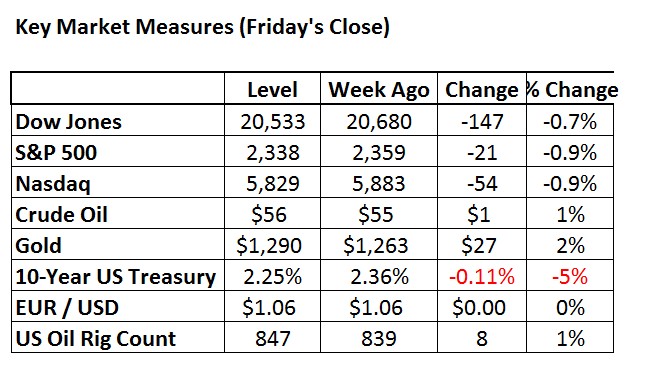
What did the Easter Bunny bring this April to the markets? Much lower interest rates! The 10-year dropped 11 bp to 2.25%. Who says interest rates are going up this year? Not us, for sure. Geopolitical worries are the primary culprit. North Korea, Syria, the Middle East, all the regular actors are to blame. The 10-year Treasury now rests around 5 month lows. Everyone will look to the Fed for guidance about where the markets are going. Interestingly, Trump is now praising Yellen in a public call for Fed consistency, which contradicts his accusations on the campaign trail that she was artificially manipulating the economy in a detrimental way. Hmmm…does Trump see an opportunity to take advantage of low borrowing costs for his $1 trillion infrastructure plan? His Treasury Secretary Steven Mnuchin has publicly expressed interest in doing big time deals for 100 year bonds. And we applaud this. We’ll have to wait and see.
There is always a bull market right here at The Bull Market Report! This week we highlight the following securities: Shopify, VMware, Amazon, Annaly, Apple, and Tesla.
Highlights From The Past Week
Watchful Eye On North Korea. US officials are saying the Trump administration is focusing its North Korea strategy on tougher economic sanctions, possibly including and oil embargo, banning its airline, intercepting cargo ships, and punishing Chinese banks doing business with Pyongyang. According to one official, US President Donald Trump has approved a preliminary broad approach on North Korea and asked his national security team to craft a more detailed framework for new international sanctions and other actions. The official said the administration is considering an array of stiffer sanctions that could be applied on a "sliding scale," proportionate to North Korean actions. Some steps could be applied unilaterally, with others through the United Nations.
Business Returning to the Center Stage in the USA. Business leaders are gaining more and more influence in Trump's White House. Most recently, Jared Kushner, the president's son-in-law, is trying to orchestrate more power for National Economic Council Director Gary Cohn while dampening the influence of chief strategist Steve Bannon. It is quiet the change in scenery to see Washington acting as a friend to business led by accomplished business people. All good news for the markets.
Infrastructure Bill On The Horizon. One of Trump's top policy advisers said the timing of the President's $1 trillion infrastructure package is still up in the air as the administration considers its best path forward. D.J. Gribbin, special assistant to the president for infrastructure policy, said the timeline will hinge on whether it moves as a standalone measure or if it is attached to another legislative priority. It adds that they are still crafting the infrastructure measure. Transportation Secretary Chao said the package could be unveiled as soon as next month. We can’t wait.
BMR Companies and Commentary
Shopify (SHOP: $71, +4%, all price changes in this report are for the past week)
Shopify had a solid week as talks of a takeover swirled. If true, we could see some very nice upside in the near-term. If not, that’s fine with us, as we still like the company’s fundamentals and prospects. Bottom line, Shopify still has room to run whether there is a takeover. Let’s re-visit why.
One can hardly kick back on the couch and watch CNBC or browse through your favorite financial publication these days for more than a few minutes before you come across a discussion of Amazon, as the online Retail juggernaut has skyrocketed to become an American business behemoth. And rightfully so.
For investors who want to capitalize on the undeniable secular growth trend of eCommerce, but who either missed the boat on Amazon or are wary of its nosebleed valuation, is there another road less traveled that they could embark on to get exposure to the eCommerce tidal wave? One that has impressive momentum and an ascendant stock price, but just not as frothy of a gain as Amazon? Yes there is. That’s Shopify.
Shopify not long ago announced its full-year financial results for 2016, and boasted 90% revenue growth and 99% growth in gross merchandise volume, (a term used in online retailing to indicate a total sales dollar value for merchandise sold through a particular marketplace over a certain time frame.) As an added bonus, Shopify's “Sell on Amazon” integration was made generally available to merchants in December. This mean Shopify now seamlessly connects store owners to the millions of customers searching for products to buy on Amazon, and merchants can now conveniently manage their product catalog for their eCommerce website, retail store, Amazon store, and other sales channels all in one place. This is big time! Since this integration just took place in December, we are only at the tip of the iceberg in terms of benefits and synergies from the move for Shopify.
BMR Take: The consensus calls for Shopify to more than double revenue from $600 million this year to $1.4 billion by 2020. This kind of explosive growth could cause the stock to double over the same period.
Amazon (AMZN: $884, down 1%)
A new week; Another big move brewing for Amazon. It is said that the eCommerce giant considered internally whether Whole Foods would help invigorate its nearly decade-long push into groceries. That is, Amazon kicked around the idea of buying the grocery chain!
Whole Foods has long been seen as a buyout target. Activist investor Jana Partners set off a new wave of speculation this week when it acquired a stake and urged the company to evaluate a sale. With a market valuation of $11 billion, the ailing organic-food retailer would be a powerful acquisition for Amazon -- dwarfing its 2009 purchase of online shoe retailer Zappos for about $1.2 billion. But the deal would turn Amazon into a grocery giant overnight and help it sideline Instacart, a startup that delivers grocery orders from Whole Foods stores in more than 20 states.
Jana has called for Whole Foods to overhaul its operations and brought in retail and food experts to help foster a turnaround. It also urged the company to consider a sale. A list of potential bidders includes Amazon, as well as traditional grocery chains such as Kroger and Albertsons. Whole Foods remains an attractive asset, even after a sales slump and the loss of market share to mainstream supermarkets, because the brand is strong and could be leveraged into something big.
BMR Take: Amazon and CEO Jeff Bezos are winning at everything. Why not grocery? Current Street earnings estimates call for $27 per share by 2020. With so much growth and strong earnings potential, the shares are compelling here.
Annaly Capital Management (NLY: $11.63, +5%)
Looking for yield in this market? Look here! Annaly Capital Management is a top pick in the Mortgage REIT sector.
Let’s review some of the reasons to like Annaly. Home price gains were up 6% in latest report from Case-Shiller, showing acceleration in home price increases. Tight supplies and rising prices may be deterring some people from trading up to a larger house, further aggravating supplies because fewer people are selling their homes. This is a good trend for Annaly. Annaly owns mortgages so rising home prices means the credit risk of owning the bonds is safer.
Annaly has a broad exposure across the US unlike other competitors more narrowly focused on only a particular market like New York. Yet another reason to like Annaly.
BMR Take: With a yield of 10.6% and a track record of over 20 years doing this, we continue to pound the table on Annaly. Look at this stock – up from $10.12 in mid-January in the midst of a strong interest rate rise with EVERY pundit saying that Annaly will be impacted sharply with the higher rates. Boy oh boy where they ever wrong. And boy oh boy were we ever right. Of course we’ve been saying this since we founded The Bull Market Report in 1998!
Apple (AAPL: $141, -2%)
Apple to buy Disney? Now that’s exciting! It could be more realistic than you think. Apple has the cash to pull off a $200 billion-plus takeover of Disney — creating a company worth $1 trillion with “almost limitless opportunities in content and technology.
A combined Apple-Disney would create an instant competitor to Netflix that would take advantage of the Mouse House’s content and Apple’s user base. Other benefits include: integrating Apple consumer tech as experiences in Disney’s theme parks; and landing global streaming sports rights for ESPN via Disney and Apple distribution and a strong balance sheet. Content is a major focus for Apple, target size is not an issue, and Disney offers an avenue to diversify away from hardware without diluting the strong Apple brand.
The M&A rumor mill got new grist last fall, when Apple chief Tim Cook told analysts that he was “open to acquisitions of any size.” In addition, Apple execs met with Time Warner honchos in 2015 in a discussion that raised the possibility of a merger - before AT&T moved on its $85 billion bid for Time Warner,
Per one analyst’s estimates, the merger of Apple and Disney would be highly accretive to earnings, to the tune of a 15%-20% increase in earnings per share based on the presumed 40% premium deal price and Disney’s low debt load. Nice!
BMR Take: We say it every week and we’ll say it again. Apple is really cheap compared to the current EPS outlook for this year of nearly $9. And all that cash put to good use through buying a storied franchise like Disney could be an exciting catalyst/prospect for the company.
Tesla (TSLA: $306, flat)
Tesla is a new entrant into the automobile, solar and battery storage businesses. Since Tesla’s current revenue is roughly 99% automobile related and, due to the Model 3 introduction and projected sales, this ratio will likely remain similar for quite some time. Thus, Tesla is an auto manufacturer, plain and simple. Panasonic supplies Tesla with batteries. Other companies provide Tesla with electric motors, tires, wheels, etc. Thus, with a few extraneous business lines, Tesla designs and assembles cars. Until Tesla’s battery storage business and solar equipment business become majority contributors, it will remain viewed as an auto company.
The good news is that’s okay!
Tesla CEO Elon Musk says his company will unveil its electric tractor-trailer truck this September, calling the vehicle “seriously next level” and praising the Tesla team for doing “an amazing job.” He also revealed that Tesla will show off an electric pickup truck in 18 to 24 months. Awesome innovation.
BMR Take: Street estimates call for sales growth from $7 billion last year to $11 billion this year to $33 billion in 2020. This is an exciting time for the business and the stock.
Note that Tesla was upgraded by Piper Jaffray from a "neutral" rating to an "overweight" rating last week. They now have a $368 price target on the stock, up previously from $223. We have a $325 Price Target on the stock.
Netflix (NFLX:$143, flat) had its price objective hoisted by Cowen from $165 to $170 in a research note released on Tuesday. Our Price Target is $165.
Upcoming Economic News
FRIDAY, APRIL 14 (Yes, this was on Friday – Good Friday)
Consumer Price Index
For March
Forecast: -0.1%
Actual: -0.1%
The Consumer Price Index was forecast to fall 0.1% in March following a 0.1% gain in February and 0.6% increase in January. It did. This was the first decline in the CPI since February 2016. Energy prices were a net drag on the CPI in March. The CPI for food and beverages rose 0.2% in February, the strongest since September 2013.
Retail Sales (This too was announced on Friday the 14th.)
For March
Forecast: -0.3%
Actual: -0.2%
Consensus expected retail sales to have dropped 0.3% in March following a 0.1% gain in February and 0.6% increase in January. Results were slightly better than expected. We believe weather was likely a small negative for sales. Non-store sales (online) have been contributing more to growth in retail sales recently. Already released data showed that unit vehicle sales dropped 5.5% in March and shaved 0.4% off total retail sales growth.
Tuesday, April 18th
Housing Starts
Period: March
8:30 AM
Consensus: 1,245,000
Prior: 1,288,000
Housing starts should continue to signal a healthy economy. The data reveals the number of housing units started in the United States. The U.S. Census Bureau's New Residential Construction release provides statistics on the construction of new privately-owned residential structures in the United States.
Thursday, April 20th
Leading Indicators
Period: March
10:00 AM
Consensus: 0.3%
Prior: 0.6%
This one is interesting to watch. Everybody is so focused on trying to figure out what direction the markets are heading. This is one of the key metrics that tells us. Leading indicators are economic series that tend to change direction ahead of shifts in the business cycle. There are 10 components of the U.S. Leading Composite Indicator published by The Conference Board. The index is constructed by averaging the individual components in order to smooth out a good part of the volatility of the individual series. Historically, the cyclical turning points in the leading index have occurred before those in actual economic activity.
Facebook Adds a Million Advertisers in 7 Months
There is a big move going on in the digital marketing world that many are not aware of. More than 5 million businesses are advertising on Facebook each month, Reuters reports. That is up from 4 million monthly advertisers in September 2016, and the 3 million monthly advertisers it had in March 2016. Significant upside remains as Facebook’s 5 million advertisers are less than 10% of the 65 million businesses that are active on the network.
Facebook is one of two undisputed leaders in digital advertising. Alongside Google, the company is expected to generate about half of online ad spend in 2018. Facebook generated close to $27 billion, and Google close to $80 billion, in ad revenue last year.
Small and midsize brands are flocking to advertise on Facebook. Big brands may drive the bulk of revenue in advertising markets, but there is still ample opportunity for growth with the smaller brand advertisers. The sheer volume of advertisers on Facebook reflects the company’s success in attracting these smaller firms its platform.
A few industries are generating the bulk of Facebook ad spend. E-commerce and Retail, and Entertainment and Media are the biggest industries represented in Facebook's advertiser base.
Facebook is doing a great job at building its advertising base overseas - over 75% of advertisers are outside of the US. India, Thailand, Brazil, Mexico and Argentina are the fastest-growing markets.
Mobile is big, as you know. Almost 50% of advertisers create ads on mobile devices. More than 90% of Facebook users access the network via mobile. And mobile advertising accounts for 85% of ad revenue. Creating mobile-first experiences is particularly key in emerging markets.
The biggest users of Facebook are the US at 220 million; India at 210 million; Brazil at 120 million; Indonesia at 75 million and Mexico at 65 million.
Our Take on SNAP
Snap (SNAP: $20) went public at $17 in early March and promptly opened at $24. They raised $3.4 billion making it the largest IPO since Alibaba went public in 2014, raising $20 billion. The market cap is now $23 billion and all of this for a company with no revenue in 2015, $400 million in 2016 and losses of $500 million in 2016. Ouch. More losses than revenues. Not a good business model.
Snapchat has grabbed the attention of a generation of younger smartphone users, who post and share photos and videos on the app that can disappear after a set amount of time. The app - developed by Stanford University students, two of whom are still executives at Snap had 160 million daily active users as of December 2016,
BMR Take: We are steering clear of this one. One might compare this a bit to Facebook, but Facebook had huge revenues and real earnings when it went public, and the growth since then has been phenomenal as you know. The Snap IPO has invigorated the IPO market and Wall Street is generally pleased, but for this company to get to $40 or $50 a share, we will have to see revenues of 10-20 times current levels, and big profitability, both of which may never materialize. We are steering clear.
The High Yield Report
By Michael Foster
Special to The Bull Market Report
It was a short week, but an eventful one. Already we’re seeing tons of articles about how the stock market is in crisis. Looking at volatility, there seems to be reason to think this; we went from a VIX of about 10 to nearly 16 in days. This means there is more caution in the market, and expectations of a short-term downturn. However, those expectations will disappear as they always do and the bull market will return as it always does.
We can already see pockets of optimism in the high yield world. In fact, We’d go so far as to say we’re beginning to see a sector rotation among investors that is benefitting parts of the high yield universe.
Before we get into that, though, let’s look at who is not winning. The UBS BDC ETF (BDCS: $23, down 1%) saw a soft week that was no worse than the broader market, but definitely was not good. This move is actually not that bad, considering that BDCs have had a massive run-up for months and has driven the entire sector higher. One well-known BDC analyst recently pointed out that the sector has beaten the S&P 500 since the start of 2014. This kind of cherry-picking time series doesn’t tell us much, but it does remind us that BDCs had an extremely vicious decline in 2013 and have been recovering for years since then as the market readjusts its understanding of what a rising rate environment means for these assets. It also means that the bargains in this odd corner of the business lending universe have dried up. That’s a shame, because The Bull Market Report is eagerly awaiting adding a BDC to the high yield portfolio, but this week’s 1% decline isn’t enough for us to do it. In fact, the recent decline may indicate that weaker prices might be just on the horizon, indicating a need to buy some BDCs when the price is right. Stay tuned as we keep focusing on this story.
So if BDCs aren’t benefiting from the fall in stocks this week, who is?
The answer is obvious: REITs. The SPDR Dow Jones REIT ETF (RWR: $94) was mostly flat for the last four days but is up 1% from last Friday - and comparing REITs to a week ago is really key here, because the momentum in REITs really started to kick off on Monday and has stayed strong with the many REITs in the Bull Market Report portfolio.
Let’s start with Kimco Realty (KIM: $22, up 4%), which shot up at the start of the week and has maintained its higher price level. Kimco is expected to report earnings by the end of this month, and analysts’ expectations are strong. Despite expectations of a 1% revenue decline, FFO expectations put Kimco’s dividend coverage in the 140% range. This means that Kimco is expected to far cover its dividend and have room to increase payouts. That should mean the company should be a low yielder, but this company’s 5% dividend yield indicates market expectations of risk are growing. Why the disconnect?
Simple: the decline in Retail.
Long story short, shopping malls are collapsing. The high-profile news of bankruptcies at Sears and JCPenny are making investors grow increasingly confident that the Retail sector is an apocalypse that no investor should come near. Of course these people are forgetting just how strong things are for Whole Foods, upscale outlet malls, Apple stores, and several other corners of the retail market that Kimco just happens to be focused on. In fact, Kimco’s tenants tend to be the most well-heeled and revenue-safe firms in the Retail landscape, so this collapse has little impact on them. Their occupancy rates have remained near 99% throughout. And although these issues are now high profile, they’ve been top of mind for Kimco management for a decade - and management has addressed these issues both in their strategic decisions and in their earnings calls.
In short, Kimco is not affected by the slowdown of the suburban American shopping mall.
Investors don’t know this, of course, so they’re throwing out the baby with the bathwater. That means now is a buying opportunity unlike no other. In fact, Kimco looks like one of the most attractive options for high yield investors. Of all our picks, Kimco looks like one of the most undervalued.
A similar story hit Government Properties Trust (GOV: $22, up 3%) over the past week, making it one of the top performers in a well-performing sector. Government Properties is heavily exposed to federal government tenants, and lower government spending has been seen as a real risk for the company. As a result of this fear, the company has looked to diversify by investing in office space that would be more insulated from the expected weaker demand in government properties. That has created a swiftly diversified portfolio that also has firm dividend coverage, but the market never really saw it that way. Instead, Government Properties is always seen as a risky option, which is why it often traded at an 11% yield. That’s what the stock was yielding when we first recommended it, and now it’s trading at less than an 8% yield, thanks entirely to capital gains. Sadly, that means buying more of Government Properties isn’t the greatest idea right now, but it does remain a solid hold thanks to its capital gains. The last week’s recent 3% jump is likely just the beginning; this company has a much safer income stream than its yield would indicate, meaning price gains are likely to come. We recommend staying in the stock to enjoy those gains as demand for REITs continues to rise.
Our other REITs did well this week too. Digital Realty Trust (DLR: $110, up 1%), Omega Healthcare Investors (OHI: $34, up 1%), and Care Capital Properties (CCP: $27, up 1%) all saw modest gains largely as a result of the continuation of a recent trend. CCP and OHI have been recovering recently from an oversold situation in healthcare REITs - in short, the market sold way too many of these because they thought a variety of risks (interest rates, cuts to Medicaid and Obamacare, etc.) would damage these firms permanently. These were considered long-tail risks not priced into the stocks, and yet these companies are doing fine and the risks the market has perceived are not materializing. In fact, they may never be real concerns for the companies. As a result, the stocks have no place to go but up. While we’re sitting on double-digit gains for Care Capital, we see more room to grow and thus recommend holding tight on these firms.
Finally, a word on municipal bonds. The iShares S&P National AMT-Free Municipal Bond Fund (MUB: $110, flat) didn’t move much this week although our muni bond picks did. Invesco Municipal Trust (VKQ: $13, up 1%) and the Nuveen AMT-Free Fund (NVG: $15, up 1%) outpaced the market, and we expect further gains in the municipal bond market to drive both of these funds higher. What’s going on is quite simply secular demand for munis returning to the market, largely a result of the higher uncertainty and fear that is driving stocks lower. In short, many retail investors are getting skittish and feel a need to pull out of risk and get lower risk assets.
This is driving a broad base of investors to demand more municipal bonds, driving up their value and in turn driving up the net asset values of these and other municipal bond funds. Since munis are far undervalued again due to risks that were feared but are not materializing, there is a lot more room for these funds to rise in price before they’re fairly valued. Thus muni fund holders should enjoy the gains they’re getting now but shouldn’t sell yet; if the market stays afraid these funds are destined to rise considerably. If the market gets more courageous, these funds are still destined to rise (although perhaps at a slower pace) because they have been massively undervalued due to ridiculous fears about muni bonds that aren’t materializing. Either way, the direction is clear: Keep and hold these funds and wait for their pricing to better match their real value.
Good Investing,
Todd Shaver
Editor, Founder and CEO
The Bull Market Report
Since 1998
by Todd Shaver | Mar 20, 2017 | Monthly Newsletter Daily 6am if new
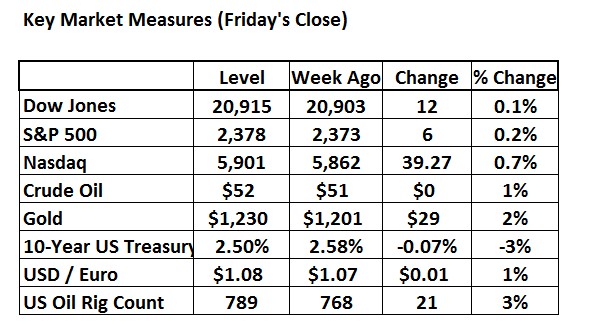
What a week. Another interest rate hike has come. The entire market and all the Fed officials, except one dissenting opinion, wanted the March rate hike. Who dissented? Minneapolis Fed President Neel Kashkari. Why? Kashkari said the announcement of the Fed’s balance sheet plan could trigger somewhat tighter monetary conditions resulting in the equivalent of a rate hike of unknown size. After it has been published and the market response is understood, then he says the Fed can return to using the federal funds rate as a primary policy tool, with the balance sheet normalization under way in the background. Understanding Kashkari’s lone wolf dissenting opinion is something to take note of. We need to keep an eye on the rising interest rate cycle and how it impacts the bull market going forward. For the time being, the bull market continues to break new highs.
No matter what, there is always a bull market here! Week in and week out, you can find it right here at The Bull Market Report. We currently see a bull market across many parts of the stock market. This week we highlight the following securities: Tesla, Visa, Apple, Google, and PayPal.
)
Highlights From The Past Week
Another Week of Huge Cash Inflows! According to industry data, overall cash continued to flood into equities for a total of $14.5 billion, the 11th consecutive week of inflows. Most of this was due to allocations to ETFs, which saw $19.7 billion in inflows, the highest weekly amount YTD, offset by $5.1 billion in outflows from actively managed funds. Looking at what its private clients are doing, an investment bank notes that the top 3 ETF inflows in the past 4 weeks were Financials, Bank Loans, and MLPs.
Has OPEC Underestimated US Oil Production Once Again? The U.S. crude cowboys are back on their horses and leading a strong recovery in the oil patch that is not expected to falter. With lessons learned from the oil price crash, companies have streamlined their budgets and are focused on the most prolific shale plays. U.S. drillers are giving OPEC a hard time by raising output and hedging future production. This is all good things for US energy independence and stability.
Refreshed Fed Forecast Leaves Long-Run Rate Outlook Unchanged. For those curious what the Fed's latest Fed Funds rate forecast reveals, here is the summary: (i) median target for end-2017 is 1.375%, unchanged; (ii) median target for end-2018 is 2.125%, unchanged; (iii) median target for end-2019 is 3% vs. 2.875% in December; and (iv) long-run target is 3%, unchanged. Given that the long-run expectations of 3% is unchanged, some say we could see a more gradual rising interest rate cycle than some had thought. Good thing for equities!
Homebuilders: Not Been This Confident Since The Peak Of The Last Housing Bubble. Builder confidence in the market for newly-built single-family homes jumped six points to a level of 71 on the National Association of Home Builders/Wells Fargo Housing Market Index (HMI). This is the highest reading since 2005 - the ultimate peak of the last housing bubble. This record confidence level is welcomed for the current bull market.
BMR Companies and Commentary
Tesla (TSLA: $262, +7% - all prices are for the previous week)
Tesla’s $170 million battery play is just the beginning. Tesla is ready to power some grids. And not just in California or Australia. Last week, Elon Musk wagered he could address South Australia’s energy crisis with 100 megawatts (MW) of batteries installed in 100 days or less – “or it’s free.” The exchange blew up on Twitter and led to phone calls between Musk and leading Australian politicians, including Prime Minister Malcolm Turnbull. (Ukraine Prime Minister Hroisman later chimed in that he’s interested, too.)
An analysis finds that such a deal wouldn’t only alleviate South Australia’s blackouts, but would also be profitable - at an anticipated cost of roughly $170 million. Battery prices are tumbling fast - by almost half since 2014 - and such mega projects are increasingly popping up around the world.
Megawatts measure the amount of power a battery can provide at any given time. Tesla’s battery projects typically supply a four-hour duration for each megawatt, so it’s reasonable to assume that South Australia’s 100 MW project would entail a 400- megawatt-hour battery installation. That would make it Australia’s biggest battery-capacity project, and one of the biggest on Earth.
BMR Take: Tesla led by Elon Musk has time and time again been at the front of the pack doing innovating things in the world. This battery event is just yet another example of the value of Tesla and Elon Musk to the world and why we favor the stock of Tesla.
Consensus Ratings for Tesla
Ratings Breakdown: 1 Sell Rating, 2 Hold Ratings, 1 Buy Rating
Consensus Price Target: $280
3/17/2017 Goldman Sachs Group Target: $187
3/9/2017 Sanford C. Bernstein Target: $250
2/23/2017 Dougherty & Co Target: $375
2/23/2017 Royal Bank of Canada Target: $314
Visa (V: $90, +1%)
Visa took the microphone at a major investment banking conference this week. What did management have to say? Here are a few tidbits of color on the business and market environment from Visa management:
“We certainly have seen a tick-up in what I would call the drivers of the business, which is what we like because that is, in the end, what counts.”
“We saw, a step-up in payment volumes almost everywhere except a couple of places like Brazil; we saw a nice step-up in Europe. Certainly, in the U.S., we were helped by gas, and also, we were helped by the portfolio wins we've had like Costco and USAA.”
“What really helped was cross-border volume growth getting to double-digits. It's been a long time since we've had double-digit cross-border volume growth. I think you have to go back three or four years. In fact, I think the U.S. cross-border volume growth was double-digit for the first time since early 2014.”
BMR Take: Visa is a powerhouse in payments. Fundamental trends are strong. A new all-time high this week. Stay the course!
Apple (AAPL: $140, +1%)
Taking a look back at another week of news from Apple, this week’s developments include: the high price of the IPhone 8, the sneaky MacBook Pro price cut, details on the new iPad, the AirPods health-focused future, price fixing in Russia, the challenge from the Galaxy S8, and running Windows XP on your iPhone.
The key to watch is how expensive will the new iPhone 8 be, in our view. One of the major big picture trends in the smartphone market is the proliferation of competition and how, if at all, will it impact Apple. Will Apple be able to sell expensive phones for a long time to come? We are keenly focused on this question.
One way to keep up the price of the iPhone for Apple is constant innovation and great features. Leaks about iPhone 8 say that Apple’s decision to switch the redesigned iPhone from LCD (Liquid Crystal Display) to OLED (Organic Light Emitting Diode) improves screen visualization. We hope to hear more about new improvements. Apply customers are as loyal as they come and are likely to dig deep into their wallets for the latest and greatest.
BMR Take: Expectations for iPhone sales are a key driver of the business. We continue to monitor developments closely. All is checking out okay so far this year. And Apple sets a new all-time high this week. The market cap is now $735 billion, on the way to $750 billion and then $800 billion.
Google (GOOG: $852, +1%)
Google had to apologize to the UK government over some YouTube ads. Google apologized to senior officials representing the government and pledged a review of their advertising systems.
Google advertising revenues were $60 billion in 2014, $67 billion in 2015, and $79 billion in 2016. The acquisition cost of this revenue is just 20% leaving 80% going to gross profit. What a hugely profitable business this is! We see continued growth ahead. Google AdWords remains a world class place for performance-based advertising. Admittedly, like the UK situation, there are sometimes kinks in the armor though they are minor in the overall picture.
BMR Take: Google is fighting to hold onto a top spot in the advertising world. This UK news is just one of many examples of some of the challenges the company is facing. The good news is that as Google’s YouTube irons out its business model, we think YouTube could be one of the top assets in all of media in 10 years.
PayPal (PYPL: $43, flat)
Big news out this week was that Google’s gmail can now send payments. There is a lot of debate about what this means for PayPal. Some believe it’s a competitive threat, but for right now it just looks like more fear than reality. Why?
Being an independent platform like Paypal is so important in payments. All PayPal does is sit at the center of commerce as an exchange for trading goods and services. In contrast, Google and so many other playing in the mobile payments space have alternative interests. Obviously, Google is big in advertising.
Merchants have been very clear they want an independent platform as a partner not a potential competitor. This is why Home Depot works with PayPal and not Apple for mobile/online payments.
BMR Take: If you own PayPal, don’t be frightened by the Google gmail news out this week. You already own the best asset in the space. Don’t doubt it.
Upcoming Economic News
WEDNESDAY, MARCH 22
Existing Home Sales – February
Time: 10:00 am
Forecast: 5.58 million
February existing home sales are expected to slip from January’s decade-long high, but still contribute to steady long-term growth. Sales rose 6.4% year-over-year in January, an admirable pace given the limited inventory. Home prices rose at the yearly rate of 5.6% in the December 20-city Case-Shiller index, part of a consistent path of gains that can draw more sellers to the market.
THURSDAY, MARCH 23
New Home Sales - February
Time: 10:00 am
Forecast: 560,000
February new home sales are projected to rise marginally from January’s level. Sales of new homes have cooled a bit, rising 6% year-over-year in the three months ending January after soaring by 20% in Q3. Yet if last year’s highs proved unsustainable, the rising number of new household units amid the continued economic expansion will keep new home sales and construction on an uptrend.
FRIDAY, MARCH 24
Durable Goods Orders – February
Time: 8:30 am
Forecast: 1.0% overall, 0.5% ex transportation
Core durable goods orders figure to rise in February after falling for the first time in seven months in January. Even with the January dip, orders rose 10% annualized in the past three months, the best such result in three years. That upturn in demand reflects rising domestic confidence and improved economic prospects across the globe.
The Glamour of Dividend Stocks Has Lessened [THEY SAY]
[Who’s “They”?]
So says RBC Capital, as the premium investors earn from glamour dividend stocks over the benchmark Treasury rate has narrowed.
Really we say?
They say: "The average dividend spread in our coverage is 1.9% currently, compared to 2.1% in the past 5 and 10 years." Narrower spreads were caused by fluctuations in the 10-year Treasury rate and changes in dividend policies, RBC said. "Although average dividend yields did not change much, the spreads vs. 10Y T-bond are narrower today vs. the 10-year average.”
OK – Go on…. We’re not buying this argument yet. [Nor ever for that matter.]
“Meanwhile, some peculiar changes have come about in the consumer staples sector. First, while the dividend yield for the consumer staples index remains constant at 2.6%, the spread over the Treasury rate has changed from negative to positive.”
“Secondly, tobacco stocks no longer earn the highest dividend yield among consumer staples.”
OK – Who would want to own tobacco stocks anyway?
In fact, they noted, "At present, Coca Cola has a higher dividend than Altria Group. This compares to MO carrying a dividend yield that has historically been 200 bps-plus higher than KO. This could be due to investor concerns over Coca Cola's core business, combined with investor excitement over consolidation in the tobacco industry.”
BMR Take: All in all, a very boring report. It’s typical of the big research firms always talking about the “high dividend paying stocks” like Coca-Cola and Altria. Coke pays 3.5%. And Altria pays 3.25%. Big deal we say. Why? See our High Yield Portfolio discussed below and on the website where the average stock pays 6-8%, with Annaly (NLY) still paying 11%!
The Bull Market High Yield Report
By Michael Foster
Special to The Bull Market Report
Of course, we need to start with the rate hike.
Last week we said that Janet Yellen would almost certainly raise interest rates. Now it has happened. The rate hike itself was exactly as markets expected: 25 basis points, with forward guidance of two more rate hikes this year. So we’re in a tightening part of the credit cycle.
Yet everything went up. A lot. This caused a great deal of consternation in the financial press. We saw three common responses:
1. The rate hike is the beginning of more, and the bond and stock markets should go down but they didn’t.
2. The rate hike was too small and should be bigger - 50 bp rate hikes might be coming soon, and the stock and bond markets should go down to factor this into account.
3. The rate hike was a bad idea and will cause financial/economic mayhem, so the stock and bond markets should go down but they didn’t.
This is very gloomy, negative, cautious sentiment about the rate hike all around, with even more negativity about the market’s strong response following the move.
If you have been reading this column with any regularity, you know that we have little respect for much of the financial press. They just get things wrong too often, and their incentives for more page views, clicks, ratings and so on, actively encourages hysteria and overly positive or negative responses to markets that are on the whole quite rational. This week’s move is case in point; the S&P 500 ended the week up a whopping 0.24%. Big deal. While PE ratios are high at nearly 27, there are many reasons to dismiss this metric, such as: the combination of an unusual monetary policy regime, years of virtually no inflation, repressed corporate earnings, the structural shift towards technology stocks where PE ratios tend to be higher, and the drag from the still mostly unprofitable Energy sector.
More crucially, we saw the markets make a modestly constructive response to a modestly constructive monetary policy. Yellen is slowly and rather gracefully raising interest rates at a time when the economy and the stock market can handle it.
This is why the financial press narratives are wrong.
Stocks and bonds went up following the rate hike for pretty much the same reason: Yellen’s rate hike is actually quite dovish. Let’s listen to the Fed itself speak:
"The stance of monetary policy remains accommodative, thereby supporting some further strengthening in labor market conditions and a sustained return to 2 percent inflation.”
This is the crux of the FOMC’s recent statement, and it’s a pretty simple premise: while the rate hikes sound hawkish on the surface, they are in fact rather dovish. The reality is that, relative to labor, inflation and other financial indicators, the Fed’s 25 basis point hike and plans for another two hikes in 2017 are very dovish. They don’t superficially represent QE* in 2013 or ZIRP* in 2014-2015, but they are pretty much the same thing.
*Qualitative Easing; Zero interest-rate policy
Yet throughout 2013-2015 there were many periods where the market sold off stocks and bonds in anticipation of scheduled rate hikes. But each period turned into a “buy the dip” opportunity. Those who are bearish about higher interest rates and their impact on equities and bonds have pretty much given up. Yet the bulls haven’t fully taken over. The result is a rather measured, moderate response to the Fed’s monetary policy, which is itself quite measured and moderate.
Of course, that doesn’t make for sexy headlines. “The Fed is Competent and the Market is Responding Rationally” doesn’t make for salacious reading. Yet the dynamics at play here, especially in the backdrop of years of QE in the US and ongoing QE in Europe and Japan (as well as the looser monetary policy in China and many, many other dynamics we simply don’t have time to discuss here), indicate that a bearish viewpoint would be a hysterical and irrational one.
However, if you want to find a pocket of irrational exuberance, you can find a bit of it in the high yield world. This bothers us as high yield analysts; We’d like for this pocket to be a bit more fearful than the market as a whole, providing buying opportunities. Alas, animal spirits are heating up more here than elsewhere, which is urging caution and consolidation.
As a result, we are sadly and reluctantly off all BDCs despite our affection for the sector. The UBS BDC ETF (BDCS: $23, up 2%) went up way too much this week, compounding an over 3% year-to-date gain and now 21% year-over-year gain. This is absurd, especially as most BDCs have reported and NAVs have declined in many cases and barely risen in others. We need to see a major correction before this sector gets attractive.
The same could be said, although less stridently, about junk bonds. The SPDR Barclays High Yield Bond ETF (JNK: $37, up 1%) had a strong week and remains up 7% over the past year. Those aren’t stratospheric numbers like BDCs, but it does show a curious disconnect. Often, investors obsess over default rates. And it’s true that middle market defaults at 1.5%, are far less than the 5.8% default rate in junk bonds*. Of course, there’s more to this story than meets the eye. Middle market default rates are going up and junk bond rates are going down - some estimates believe high yield debts could see a 4% default rate by the end of this year. And looking at the price trends over the last two years, these default risks are priced in.
*Remember, BDCs specialize in middle market loans
So we remain bullish on junk bonds to a limited extent, and prefer them over BDCs. But one needs to be selective to avoid those defaults. The PIMCO Dynamic Income Fund (PDI: $29, up 2%) remains a top pick although it is approaching a sell point. We at the Bull Market Report may need to find another junk bond fund to replace this one. This is a great fund, but it’s trading at a hefty 7% premium to net asset value. In such a situation the upside this fund provides may sadly be already priced in.
If you’re looking for deals and high yield, now is still the time to buy municipal bonds. We suspect there will be a lot of time to buy munis - the market continues to discount them based on several irrational fears, and the risk-averse retiree-investor base of these assets means fears tend to be priced into munis longer than other asset classes. Additionally, many municipal bonds are bought in open-end funds where money managers are often forced to sell if they face fund redemptions. With so many people looking to buy other assets and fearing rate hikes, it’s not surprising that they’re pulling cash out of the muni market. But this pressure isn’t due to fundamental weakness in munis, meaning they will come back. But it may take time.
That’s great. That means investors can greedily snap up munis. The iShares S&P National AMT-Free Municipal Bond Fund (MUB: $108, flat) is one option, but you’ll get assets at a discount, a better quality portfolio, and access to cheap leverage with Invesco Municipal Trust (VKQ: $12.23, up 1%) and the Nuveen AMT-Free Fund (NVG: $14.28, up 1%). Note both had a stronger week than the muni index ETF from iShares, and that is likely to be the story for a while to come if the market comes to its senses about munis.
As you can see, the big theme here is that the market is being “mostly” rational: But slightly irrationally bullish in one asset class (BDCs) and irrationally bearish in another (municipal bonds). For investors, this means rotating into the best funds exposed to the sector that’s getting unfairly punished and avoiding the irrational bullishness in the other sector. Sadly, this is not as easy as making money in 2016, when you could just buy junk bonds and REITs at the start of the year and rebalance once or twice later in the year.
It will be harder to make good money in the high yield market in 2017, but it won’t be impossible. We identified REITs as one pocket of potential after the big selloff in the middle of 2016. And now that payoff is really coming to fruition.
The SPDR Dow Jones REIT ETF (RWR: $92, up 2%) had an extremely strong week thanks to the Fed’s dovish position. However, the REIT ETF remains down over 6% over the last six months. So we’re in a good position to add to REIT positions without being back at the top.
But what REITs? Care Capital Properties (CCP: $25, up 3%) is great to hold but the recent run-up exceeds other high-quality REITs such as Digital Realty Trust (DLR: $103, down 1%) and Omega Healthcare Investors (OHI: $32, up 1%). It may make more sense to buy a bit of Digital Realty and Omega Healthcare if you’re looking for REIT exposure right now.
And at the moment, buying a bit of REITs and a bit of municipals makes a lot of sense. We’d like to see more caution in other pockets of the high yield market before betting too big in it, but we aren’t at the point of calling a top either. Now is the time to stick with high yield, reallocate to the underappreciated asset classes, and wait to see if the sentiment changes. And it will. It always does.
Good Investing,
Todd Shaver
Founder, CEO and Editor
The Bull Market Report
Since 1998
by Todd Shaver | Feb 20, 2017 | Monthly Newsletter Daily 6am if new
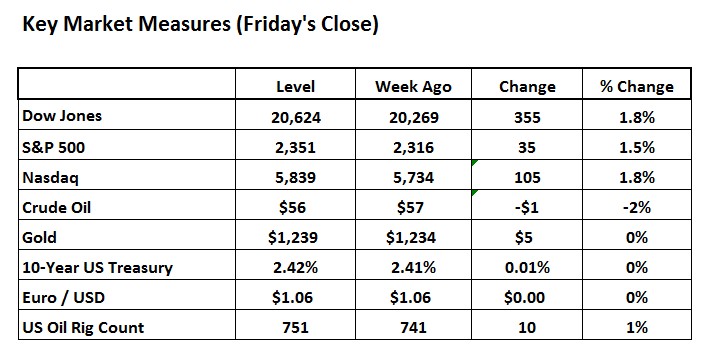
The S&P, Nasdaq and the Dow closed at a record high Friday.
With more than 75% the S&P 500 having reported results, fourth-quarter earnings are on track to have climbed 8%, which would be the best performance since the third quarter of 2014. The S&P 500 posted 48 new 52-week highs and no new lows; the Nasdaq Composite recorded 150 new highs and 22 new lows.
The reality is there is always a Bull Market somewhere and right now it is in the United States. This week we provide some insights on our latest thinking for Twilio, the iShares Energy Sector ETF, CBRE Group, the Nuveen Municipal fund, and Facebook.
Highlights From The Past Month
Leadership Turnover At The Fed. Dan Tarullo unexpectedly announced that he is resigning in early April, just days after the Fed's general counsel Alvarez also announced that he is departing the Fed. What makes Tarullo's resignation particularly notable is that he has been the Fed's "regulatory point man" since 2009, suggesting some regulatory friction has emerged. In light of Trump's vow to crush Wall Street regulations, one can see why Tarullo thought his services are no longer necessary. His brief resignation letter to Fed Chairwoman Janet Yellen didn’t give a reason for his departure. He said he has been privileged to serve at the Fed for eight years. The letter said his resignation will take effect “on or about” April 5. We wonder just what is in store for Yellen and other members of the Fed. This is such a critical juncture for interest rates.
Prime Minister Abe Visits The USA. With a hug and a handshake, President Donald Trump and Japanese Prime Minister Shinzo Abe opened a new chapter in U.S.-Japan relations a week ago with Trump abruptly setting aside campaign pledges to force Tokyo to pay more for U.S. defense aid. Trump avoided repeating harsh campaign rhetoric that accused Japan of taking advantage of U.S. security aid and stealing American jobs. "We are committed to the security of Japan and all areas under its administrative control and to further strengthening our very crucial alliance," Trump said. "The bond between our two nations and the friendship between our two peoples runs very, very deep. This administration is committed to bringing those ties even closer," he added.
BMR Companies and Commentary
Apple (AAPL: $136, +3%)
It’s 13-F season. The 13-F report is filed by all investment shops detailing their holdings. This is where anybody with a computer and the internet can peer into the investment portfolios of the best investors on the planet. Well, our curious mind traveled through quite a few of the filings. We were surprised – though not really – to see investor after investor had recently increased their stake in Apple. The list of famous investors includes Greenlight Capital, Berkshire Hathaway, and Third Point. Berkshire won the prize for the largest increase in the size of their position, +277%. We recall that Warren took a position in Apple in May, right at the lows. He now holds 57.4 million shares, worth $7.8 billion. (This is the influence of Warren’s new young bucks who are making many of the new decisions in the company as the founder is now 86.)
So something must be going very right. Big investors are buying. Goldman Sachs research raised their price target from $133 to $150. What is going on? It is slowly coming to light just how undervalued the Services business is. People still don’t widely appreciate that Apple’s Services business alone would be a Fortune 100 company. Services now contributes profit greater than all non-iPhone segments combined.
UBS research estimates that if Services were valued similarly to PayPal, shares would be at least 10% higher.
BMR Take: There are times to be a contrarian, but now sure does not look like one of those times. The Apple train is breaking new speed.
Consensus Ratings for Apple
1 Sell Rating, 10 Hold Ratings, 36 Buy Ratings, 2 Strong Buy Ratings
2/14/2017 Robert W. Baird Target: $145
2/13/2017 Goldman Sachs Target: $150
2/8/2017 Bank of America Target: $145
2/7/2017 Canaccord Genuity Target: $154
2/6/2017 RBC Capital Markets Target: $140
2/2/2017 Wells Fargo & Company Target: $117
Come on, Wells Fargo. Get with the program!
Apple set a new all-time high last week of a shade over $136. We hereby raise the Price Target from $140 to $155. Our Sell Price remains: “We would not sell Apple.”
Twilio (TWLO: $32, +16% for the month*)
*All prices in The Bull Market Report are for the past 30 days
We wrote early this in the Weekly Bull Market Report week about Twilio’s encouraging quarter. We wanted to circle back and follow up with more detail here about what investors are worried about. Sometimes when you ask the hard questions and go searching for the answers, you find out that the risks are less of a concern than one fears on the surface.
Investors’ worries on this stock generally fall into several categories: 1) gross margins; 2) eventual competition from AWS**; 3) pricing pressure from current competitors; and 4) the lock-up expiration. Let’s hit each one.
**Amazon Web Services
Twilio’s gross margin of 59% this quarter was above consensus of 56%. When asked about how the company plans to get from here to its long-term target 60-65%, CFO Lee Kirkpatrick pointed out that Twilio has “significant levers” that it can pull. The first is product mix. Management described the second lever as efficiencies gained through scale – this includes driving better deals with carriers and passing less of the savings to customers.
Another risk for investors to keep an eye on longer term is the potential for competition from AWS. AWS is not a competitor today, but Amazon CEO Jeff Bezos is known to covet large markets and the communications services market is substantial. In fact, Amazon and Twilio are currently working together. The Amazon relationship seems to be strong and is multifaceted. Note that Twilio runs entirely on AWS. Second, Twilio is already helping AWS with mobile products. Third, CEO Jeff Lawson was on stage at AWS re:Invent in November and commented, “We’re really excited to announce some upcoming collaboration with AWS soon.” Last, Rick Dalzell (Amazon’s former SVP of Worldwide Architecture and Platform Software and CIO) has been a member of Twilio’s board of directors since 2014.
Investors are also concerned Twilio may face pricing pressure from its current competitors, which include Nexmo (Vonage acquired them in May) and Plivo, among others. Twilio’s services are generally priced at a premium to these competitors. For example, for outbound SMS messages, Twilio charges $0.0075/message, compared to $0.0061 for Nexmo and $0.0035 for Plivo. Our view is that Twilio is generally able to charge a premium because it: 1) has significant mindshare within the developer community; 2) offers a high-quality, reliable solution; and 3) continues to release new features and software products. Mr. Lawson indicated on the earnings call that he seeks to “build a broad platform that is widely applicable, priced aggressively, and designed to enable developers’ creativity to flourish across the widest set of use cases imaginable.”
The availability of additional shares for sale in the market could adversely affect Twilio’s stock price. Twilio went public in June, selling 10 million shares at $15. Twilio completed a follow-on offering in October selling 7 million shares at $40. Roughly 30 million shares cleared lock-up restrictions in December and another 36 million shares were set to clear lock-up restrictions on January 19th. However, roughly 31M of those shares were subject to the company’s black-out period for insiders. Our understanding is these shares will clear the restricted period this Friday. Some of the largest shareholders of Twilio include Bessemer Venture Partners, Union Square Ventures, and Redpoint Ventures, which owned 17M, 10M, and 3M shares immediately after the follow-on offering, respectively.
BMR Take: Okay, we might see some pressure from the lock-up expiration that happened a week ago Friday, but this is normal Wall Street procedure. Besides, we are sure that many of these owners will want to hold on for the coming years of growth. Furthermore, the business is building momentum making the stock attractively priced at this level.
CBRE Group (CBG: $36, +16%)
What a week. CBRE ended 2016 on a high note. For the year, revenue was $13.1 billion, up 20%, and EPS was $2.30, up 12%. CBRE recorded double-digit earnings growth for the fourth quarter and the year, with excellent performance in all three regional services businesses.
These results are particularly noteworthy in a year of generally softer market-wide property sales volumes, virtually no carried interest income, and tepid global economic growth. In fact, the company’s revenue and earnings performance set new record highs in 2016.
In addition to achieving record financial performance, very importantly, CBRE continued to advance its strategy. This strategy centers around delivering exceptional outcomes to clients. The company’s people and the operating platform that supports them are the key elements to delivering these outcomes. Both advanced materially in 2016, and the impact is showing up on the company’s results.
CBRE is in a stronger competitive position than ever. A good example of the strategic gains made in 2016 is the work done integrating the Global Workplace Solutions acquisition, one of the largest and quite possibly the most complex in the history of the real estate sector. This effort involved massive client facing, and line of business and back-office transformations. The result of having largely completed this challenging work is that the company’s occupier outsourcing business is much larger, much more capable of producing strong client outcomes, and well-positioned for strong long-term growth.
The company is now serving clients with employees on the ground in over 100 countries. What a big business. CBRE remains riveted on sustaining progress with particular focus on areas such as technology and data analytics where it can capitalize on the expertise and vast amounts of information it possesses. For example, last month CBRE acquired Floored, a leading software-as-a-service platform that produces scalable, interactive 3D visualization technologies for commercial real estate. Clients should expect continued visible advancements from CBRE in the technology area.
BMR Take: CBRE’s nickname is the “Bentley” of the real estate sector and in 2016 the business lived up to the expectations. The key takeaway from the earnings call was that no matter the interest rate environment, performance should be rock solid in 2017.
Facebook (FB: $133, +4%)
The controversy is nearing an end as Facebook committed to an audit of ad metrics by a media watchdog. Facebook agreed to submit to audits by the media industry’s measurement watchdog, the Media Rating Council, helping address concerns among some advertisers who had become skeptical of the social network’s metrics.
Facebook had come under fire recently after a series of missteps in which it disclosed several mistakes in reporting data to partners and advertisers. The company conducted its own review of practices and vowed to be more transparent about errors in the future. According to plans for the next year laid out in a statement Friday, Facebook said it aims to release more detailed information, such as metrics on how long users view an ad and how much of it was visible on the screen.
“We want to provide transparency, choice and accountability,” Facebook said. “Transparency through verified data that shows which campaigns drive measurable results, choice in how advertisers run campaigns across our platforms, and accountability through an audit and third-party verification.” Representatives from Facebook gave a presentation Thursday in Washington to the board of the Association of National Advertisers, a trade group for marketers. The meeting attendees were particularly interested in the promise for more transparency and an audit process.
BMR Take: Investors have been waiting for the advertising reporting issues to go away. Well, here we are - the event is happening. This new audit should address and resolve the issue. No more overhang for the stock from this. Having an independent organization validate the metrics Facebook puts out makes the data more trustworthy and provides advertisers with the ability to compare results across ad platforms. Now we can go back to focusing on the fundamentals where Facebook is firing on all cylinders. We are big believers in Facebook as it hovers near its all-time high of $135.50. And despite all of the controversy as discussed above, the stock stays within a whisker of its all-time high.
Upcoming Economic News
WEDNESDAY, FEBRUARY 22
Existing Home Sales – January
Time: 10:00 am
Forecast: 5.55 million
Existing home sales look to move higher in January after sliding in December. Sales rose 7% year-over-year in the fourth quarter, keeping the housing recovery steadily on track. With only four months’ worth of inventory at the latest monthly sales pace, prices will continue to climb, encouraging more homeowners to sell.
FOMC Meeting Minutes
Time: 2:00 pm
The minutes from the uneventful February FOMC meeting will give some indications about what policymakers expect for growth and inflation. The outlook for the economy is clouded by the potential actions of the new administration. Yet some near-term upward pressure on prices and wages still keeps the Fed on track to lift its policy rate three times this year. SO THEY SAY. Who is they? The analysts and pundits. We at The Bull Market Report aren’t so sure. We are watching the 10-year note which is stuck at the 2.4% range. We are in the camp of LOWER interest rates ahead, not higher. Watching and waiting are we.
FRIDAY, FEBRUARY 24
New Home Sales – January
Time: 10:00 am
Forecast: 575,000
New home sales are projected to rebound sharply in January after slumping to a 10-month low in December. Even with the December setback, the sales pace remains exceptionally strong at 25% year-over-year in the fourth quarter. Growth in new home sales can continue to be stellar. The most recent monthly sales pace is 25% above the average of the past 20 years.
University of Michigan Consumer Sentiment – February
Final Time: 10:00 am
Forecast: 96.0
The preliminary value of the Michigan Sentiment Index showed above-average confidence despite slipping from January’s 12-year high. Consumers are starting to feel the bite of higher gasoline prices, as short-term inflation expectations rose to equal the 23-month high. But long-term inflation expectations are muted at just 2.5% annualized between five and ten years ahead, as a sustained acceleration in price growth is doubtful.
Our Favorite Warren Buffet Quote:
"You can't produce a baby in one month by getting nine women pregnant." -- Warren Buffett
Love it. Be patient out there.
More On Stocks We Follow
Opko Health Update (OPK: $8.81, flat) Here is a typical report from a typical day in the life of Opko CEO Philip Frost: “CEO Philip Frost bought 10,000 shares of the business's stock in a transaction on Monday, January 30th. The shares were acquired at an average price of $8.49 per share, with a total value of $85,000. Following the transaction, the chief executive officer now directly owns 3,069,000 shares of the company's stock, valued at $26,055,000. The acquisition was disclosed in a document filed with the Securities & Exchange Commission.”
Here is another: “Opko Health CEO Phillip Frost acquired 12,000 shares of the business's stock in a transaction dated Friday, January 27th.”
BMR Take: This guy knows something we don’t know. Have you read the article in Forbes about him yet? We published the url twice now. (If you haven’t read it and would like to, please write us at Info@BullMarket.com) Despite these purchases the stock remains weak. We believe in this man and this company. We would buy some here, buy some at $7 if it goes lower, and we would buy some every dollar higher as it moves towards $15 again.
Annaly Capital Management (NLY: $10.82, up 5%).
Why We Love Thee.
With an 11.1% dividend yield, it's one of the highest yielding stocks on the market today. It is a real estate investment trust and a Mortgage REIT, specializing in mortgage-backed securities, or MBS's. A REIT is simply an investment fund that owns income-producing real estate or real estate-related assets. Among other requirements, a REIT must invest at least 75% of its total assets in real estate assets and cash, and derive at least 75% of its gross income from real estate-related sources. And it has to pay out 90% of its income.
In Annaly's case, it doesn't invest directly in real estate, but rather in MBS's. These are fixed-income securities, much like bonds, that are backed by residential mortgages. Annaly invests in securities that are issued by Fannie Mae or Freddie Mac, and are thus backed by the full faith and credit of the United States government. It means that the risk that its assets will default is nil.
On Annaly's most recent balance sheet, for instance, agency MBS's accounted for $82 billion out of $88 billion in total assets.
Annaly's biggest task is to deal with the interest rate risk. Annaly uses leverage to buy assets. They borrow money at low short-term interest rates and invest that money in higher-yielding long-term assets - MBS's. The firm has $88 billion in assets, composed of $13 billion in equity and $75 billion in debt. Thus the leverage is about 5 to 1. In years past, this leverage has been as high as 10-1. We are pleased to see the leverage at this lower level. Annaly hedges the risk of rising short term rates by buying interest rate swaps. These are financial derivatives designed to lock in the cost of financing. Annaly has outstanding interest rate swaps of approximately $31 billion.
As we mentioned above, as a REIT Annaly must distribute at least 90% of its income to shareholders to qualify as a REIT. Thus, Annaly doesn't have to pay corporate income taxes on its earnings.
The dividend yield of Annaly is currently 11.1%. That's almost six times greater than the 1.95% yield on the S&P 500.
In order to grow its capital Annaly sells new shares of stock in secondary offerings. In the old days they used to do this as much as twice a year, each time raising $500 million to $1 billion in fresh equity. In the new Annaly world, they don’t do as many secondaries, as management is content with growing the NAV slowly, with the company now worth over $11 billion.
BMR Take: We are comfortable with the company growing NAV slowly, as we hope you are too. Patient investors can sit back contentedly and enjoy the 11% dividend and if the stock is up just 50 cents in a year, that’s another 5% in overall growth producing over 15% in a year. And note that last week the stock was up 30 cents!
The Yield Curve Today. Or, Where are Interest Rates Going?
“Everyone” thinks rates are going higher. Right? You feel this way too, don’t you! Well, we don’t think this way. We think rates might just decide to peter out here and fall back. The 10-year US Treasury Note is at 2.42% right now, up from the 1.8% level before the election. But note that rates around the world are in many cases much lower than what we have in this country. In fact, late last year over $11 trillion was paying ZERO interest.
Take a look at this chart, concentrating on the 10-year notes in gray:
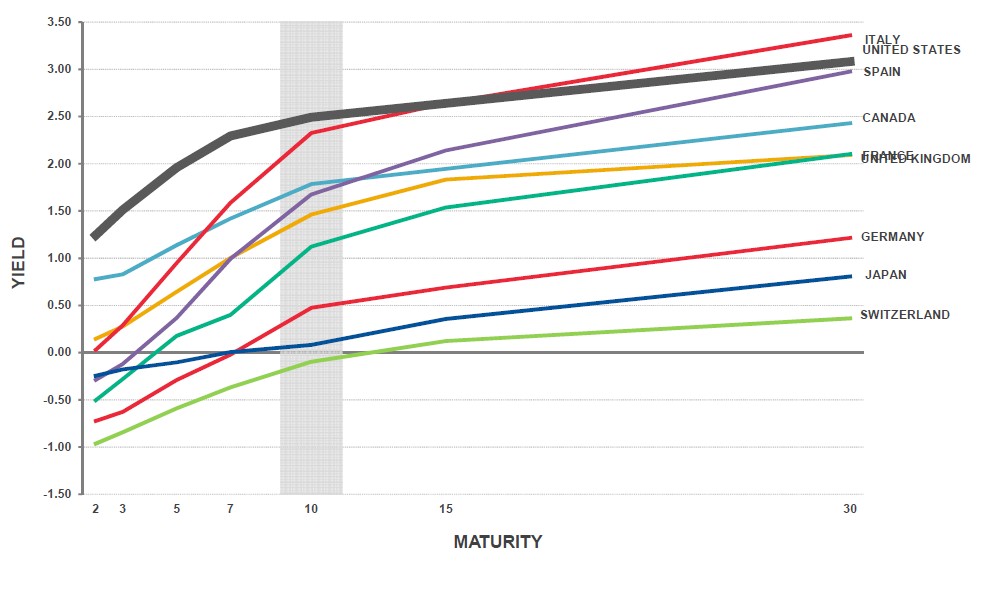
Note that Germany, Switzerland and Japan are hovering around 0%. How could this be? The answer to that may take our writing a book, but suffice it to say that IT IS REAL. And if it can happen in Germany and Switzerland, can it happen here?
BMR Take: The short answer? Yes it can. It “could” happen here. Will it? We wish we knew, but with all the turmoil in the world economically, we think there is more likelihood of rates going down rather than up at this time. We are not convinced that Yellen will have the power to buck THE MARKET. The MARKET will dictate interest rates, not the Fed. We see interest rates going lower rather than higher. And when rates go down, bonds and bond-like funds go up. Food for thought.
The World of the Supernova
This is Tom Friedman’s name for the Cloud. We don’t generally plug books here at The Bull Market Report, but if you want to know what the world of Technology is doing right now, the book to read is his new book, Thank You for Being Late. What the internet and Moore’s Law* is doing in this world of ours is astounding. Here’s some food for thought, a quote from Tom Goodwin of Havas Media in March, 2015: “Uber, the world’s largest taxi company, owns no vehicles. Facebook, the world’s most popular media owner, creates no content. Alibaba, the most valuable retailer, has no inventory. And Airbnb, the world’s largest accommodation provider, owns no real estate. Something interesting is happening.” Friedman goes on to say: “In the age of the supernova, there has never been a better time to be a maker – anywhere.”
*Moore’s Law – The power of the microprocessor doubles every two years. Since 1971.
BMR Take: Why are we printing this here? We want you to THINK about the Technology companies that are driving this growth. The Facebooks, the Apples, the Googles, the Amazons, the Microsofts. These companies are all in our High Technology portfolio and they will continue to lead and drive the growth and innovation in the world in the next decade(s).
What the Street Thinks of Athenahealth (ATHN: $119, down 1%)
Consensus Ratings: 1 Sell, 8 Hold, 12 Buy
Consensus Price Target: $135
Some Ratings from the Street:
2/6/2017 KeyCorp Target $140
2/7/2017 Piper Jaffray Target $162
2/7/2017 Berenberg Bank Target $143
2/6/2017 Dougherty Target $143
2/4/2017 Oppenheimer Holdings Target $142
2/3/2017 Robert W. Baird Target $155
1/31/2017 Cantor Fitzgerald Target $135
1/4/2017 Pacific Crest Target $140
The High Yield Corner
By Michael Foster
Special to The Bull Market Report
This week was another quiet one for the markets, and high yield assets saw minimal movements with a couple of important exceptions. The biggest exception is the BDC sector, which was driven higher by some good earnings results. The UBS BDC ETF (BDCS: $23, up 2%) was one of the biggest gainers among high yield ETFs this week, thanks to constituent firms like Pennant Park Floating Rate Capital (PFLT: $14.00) and Medley Capital Corporation (MCC: $8.00) reporting solid earnings. Medley alone soared over 4% by the end of the week despite a 1% decrease to NAV that has become expected for BDCs. Also baked into valuations was a 16% decrease in net investment income per share - we’re now sitting at 19 cents for the company. Yet Medley’s dividend is 22 cents per share, so this quarter the company under-earned its payout by over 13%. That’s a pretty big miss.
Medley Capital is just one example of a problematic industry that requires more selective investing and a lot more due diligence than was necessary in the past for BDCs. These are effectively funds that leverage assets that are then lent to companies picked by management. In such a situation, debt quality is critical. Yet many of these companies have no real credit rating to speak of - and many of them are tiny, with revenues below $100 million per year. BDCs comprise dozens, sometimes over 100 of such companies. To really determine the value of a BDC and its relative future strength, you would need to look into the revenue trends for each of these companies and the condition of their existing capital. No small task, and a lot of time to invest for what should ultimately remain a very small portion of any one investor’s portfolio.
And that’s why we’re currently on the BDC sidelines, despite some strength in the broader index. The problem is this: we’re seeing net investment income per share drop for most of these companies, with only the best and brightest outperforming. In the past, such as in 2013, the market viciously punished these sorts of declines, but we’re not seeing that punishment yet. There is a clear disconnect between fundamentals and the value that the market is seeing in the BDC space. That’s enough to make anyone cautious, and has left us clearly on the sidelines until we can get some more coherent and consistent income growth. Especially since income growth is easy to find in many other pockets of the market.
Take, for instance, PIMCO Dynamic Income Fund (PDI: $29, up 1%), which has seen its NAV grow at an annualized 17% since its IPO. The fund has already appreciated by over 2% in 2017, and we’re not even at Valentine’s Day. The feat this fund has accomplished is really incredible - so much so that many people fundamentally misunderstand and mistrust how this fund makes money.
So how do they do it? The rather simple answer is asset selection. By combining undervalued corporate bonds with a variety of mortgage-backed securities, the Dynamic Income Fund has been able to sustainably return double-digit yields to investors without depleting capital. The market has rewarded this outperformance with a premium to NAV - something that one must always watch carefully, especially in a world as volatile as closed-end funds. And PDI’s premium is growing. In fact, PDI’s 10% premium is almost at the highest level we have ever seen for this fund. But there’s no fundamental weakness in this fund and no reason to expect its strong historical performance to stop.
So what is an investor to do? At the moment, we recommend holding, but a rotation of assets from PDI to a similar but better-valued fund may be in order in the future. This is an area worth watching closely and we’ll have ideas for you if things change.
It would be nice to see a similar problem come to the AllianzGI Equity and Convertible Income Fund (NIE: $19.44, up 1%), but this fund’s current 10% discount is pretty much par for the course when we look at its historical discount. Allianz’s fund hasn’t been priced at a premium since 2009, but its discount has frequently dipped below 15% in recent years. The fact that we’re at the upper end of the historical range for the discount indicates that even this unloved but strong performer is getting closer to pricing to perfection. But that doesn’t mean we need to sell the fund. This is a great closed end fund that has given investors a 6% annualized NAV return since inception, and its NAV is even 9% higher than it was at inception - a rare feat for CEFs. Allianz has done a great job of doing, in the convertible and equity sectors, what Pimco has done with its Dynamic Income Fund in the corporate and mortgage-backed bond markets: Make great investments by selective choices, and provide a strong return as a result.
This doesn’t mean we’re recommending holding these funds forever. We are getting closer and closer to a portfolio rotation moment in high yield, which means watching the market weekly is getting more important than ever before.
And the markets are telling us that there’s some exhaustion in the protracted Trump bull rally. Again, you can forget the political controversies surrounding the executive orders; they make great talking points for both sides of the aisle, and they’ve unfortunately made their ways into the editorial pages of the financial press, but none of this has any significant impact on America’s financial or economic future at the moment. The real action is elsewhere, namely in monetary policy and GDP growth. We really need to see changes to the Fed’s monetary policy (or at least a delivered rate hike as promised) or significant changes in the GDP growth rate to drive high yield assets away from their current trendline.
We’re not seeing that, so the indexes are a bit sleepy. The SPDR Barclays High Yield Bond ETF (JNK: $37) and the SPDR Dow Jones REIT ETF (RWR: $94) were flat for the week, with minimal gains in the REIT world offset by a small decline in the Alerian MLP ETF (AMLP: $13.04, down -2%). Meanwhile, there was more sleepy action with the iShares S&P National AMT-Free Municipal Bond Fund (MUB: $108, flat).
This quiet is actually good news for long-term investors. We’ve been inundated with gloom and doom economic forecasting since 2008 - and why not? Plenty of data points look bad, and the Global Financial Crisis is still a recent memory for most of us. And every passing year since the crash urges more pundits and analysts to tell us that we’re “overdue” for a correction or an outright recession. Yet the markets do not see things that way.
At the same time, markets aren’t going crazy. We’re not seeing the heady bubble days of 2006-2007. No one is suggesting there is any “sure thing” in the markets, just like people insisted buying a house was a “sure thing” in 2006. There is a lot of price growth in equities, but no real sign of a runaway market where prices have gone far past fundamentals. Things look even more cautious in the municipal and junk bond markets, where prices still remain below their high point in 2014 and 2015. We are far away from the irrational exuberance that Nobel-winning economist Robert Shiller warned about both before the dotcom bust and before the housing crisis. That means income-seeking investors can still find funds to invest their money and get strong returns.
Unfortunately, such a state of affairs won’t last forever, so investors need to remain aware of the risks in the market. But they don’t need to be in a panic.
Finally, a quick word on one outperformer that bears a bit of particular scrutiny. AstraZeneca (AZN: $29.50, up 6%) continued to have a monstrous bull run after their recent earnings results. Fourth quarter earnings surged 56% and beat expectations by 3 cents at $1.21 per share despite a 13% slide in total revenues. This was driven by a 52% decline in Crestor sales and a 14% decline in Symbicort sales, which was offset by growth in newer drugs like Zoladex. Following the news, Bloomberg published a rumor that the company may sell off its old drug businesses to raise cash that could be applied to new research initiatives.
Our take on all this is clear: AstraZeneca has been a thorn in our high yield portfolio, being the only significant decliner in a portfolio of otherwise sharp outperformers. It was only a matter of time before the company lived up to its potential, and we’re happy to finally see that start to happen. We’re still down slightly from a year ago (excluding dividends.) But the recent turnaround tells us there’s more room for Astra-Zeneca to redeem itself.
Good Investing,
Todd Shaver, Founder, CEO and Editor
The Bull Market Report
Since 1998

by Todd Shaver | Jan 19, 2017 | Monthly Newsletter Daily 6am if new
The Week Ahead
We are quickly approaching Donald Trump’s Friday inauguration. The event will mark a key inflection point for the markets. After the big rally in stocks and sharp sell-off in bonds following the November election, a plethora of expectations for the future will soon meet the reality of what is possible, as we move into the first 100 days of the President’s term.
This week we provide some insights on our latest thinking for Amazon, Facebook, Google, Netflix, Bristol-Myers Squibb, and Tesoro Petroleum.
Highlights From The Past Week
Recession Watch. History has shown us that a recession has generally occurred during the first term of a new president, especially when following a two-term presidency. Could this be the case this time around? The leading economic indicators (LEIs) are positive, and there has never been a recession without those indicators going negative. CEO confidence is moving up and consumer confidence is exploding, which seemingly points to the likelihood that a recession is not imminent. We are not big believers in patterns, to tell you the truth. So we are leaning towards a continued strong economy and a continued bullish stock market.
There may be a Trump backlash coming though. You know, the one we expected in November after the election. We have talked to a number of our subscribers and many of you are worried about this. Our suggestion is that if you are worried so much so that you are losing sleep, with commissions as low as they are in this century, it is easy enough for you to sell those stocks that make you nervous and look to some of the issues in our High Yield Portfolio. They are generally more stable than other stocks.
However, there is also talk that the Trump presidency could be the best thing Wall Street has seen in a long time. Cutting taxes, bringing back the huge horde of cash overseas, tackling the infrastructure building that needs to be done, etc.; these are all things that could help the economy. Dow 25,000 soon? Oh wait – we haven’t hit 20,000 yet! Stay tuned.
Interest Rates. If the economy continues to grow steadily, the US Treasury 10-year Note could hit 6% in four years, about the time of the next presidential election, up from its current level of 2.4%. Inflation and economic growth are already at levels similar to 2006, when interest rates were at that level.
Stronger dollar. The dollar holds a unique position in the global economy, and a rapidly rising dollar exchange rate has historically caused something somewhere in the global economy to break. Those in emerging markets that have borrowed in dollars face the reality of a liability stream that has become more expensive to repay. Meanwhile, the second largest economy on the planet, China, has informally pegged the yuan to the dollar. A stronger dollar generally means a stronger yuan; a stronger yuan means a less competitive export sector for an economy that is all about trade.
BMR Companies and Commentary
Amazon (AMZN: $817, +3% for the week)
JP Morgan Chase is offering a new, co-branded Visa rewards card through Amazon that offers compelling rewards for both Amazon Prime purchases and all other purchases outside of Amazon. Specifically, the new Chase card offers 5% cash back on all Amazon purchases by eligible Amazon Prime members. This deal marks another win for Amazon deepening their existence in banking.
How about the core business of Retailing? What started out as an online bookseller is now on pace to overtake Macy’s as the world’s largest apparel retailer, a startling development when you remember that e-commerce was once considered an impossible way to sell clothing. Amazon has reportedly recorded record holiday season sales at the same time that traditional department stores, including Macy’s, Sears, and Kohl’s, have reported declines. These companies aren’t adding thousands of new workers like Amazon. To the contrary, Macy’s plans to close 100 stores to improve profitability, and Sears has sold its Craftsman tools line for $900 million to raise cash.
BMR Take: Amazon is currently not far from its all-time high of $844, set in October. There is still the potential for upside for investors here, and the stock could go even further, perhaps passing the $1,000 mark sometime in 2017 or 2018.
Facebook (FB: $128, +4%)
Facebook has underperformed the Nasdaq since the company’s 3Q16 earnings report, due to a number of factors, including concerns about slowing growth, heightened expenses in 2017, and sector rotation out of Technology.
Investors have also cited concern about the headwind from a possible 1Q17 IPO of Snap. As far as the competitive risks of new more exciting Tech IPOs stealing away investors from Facebook, any impact is likely to be temporary and potentially more modest than investors fear. Press reports suggest that Snap (aka Snapchat) was considering an IPO as early as March at a valuation as high as $40 billion. Given that Snap’s IPO will represent the largest tech IPO since Alibaba went public in 2014, some investors have begun to question how the issuance may impact existing public market Tech stocks and in particular its closest comp, Facebook.
BMR Take: Yes, it has underperformed since November, but it has been on a TEAR since the start of the year. Be advised that the upcoming Snapchat IPO will be all over the headlines, but don’t sell your Facebook over this. Facebook’s long term prospects are fantastic. Facebook is fast approaching its all-time high of $133.50 set in October. And fast approaching 2 billion users. The company adds 1 million subscribers every two days. With growth of 35% a year projected for the next two years, the stock is not over-priced.
Netflix (NFLX: $134, +2%)
A big name stock analyst that was short Netflix covered his call this week. It’s nice to see them come join our camp. There is so much to like about Netflix. In fact, the stock hit an all-time high of $133.93 this week!
On the heels of new details about Hulu’s upcoming live TV offering (pricing, content lineup, etc.), Netflix reiterated that it has no plans to make any other meaningful changes to its business model or content strategy, stressing that the simplicity of its offering is a key advantage.
The company has also evaluated the merits of an ad-supported model but continues to believe that focusing on its core business provides the greatest return on investment. Looking back at Netflix’s pricing changes and the un-grandfathering it worked through in 2016, the company feels good about its pricing power and is satisfied with the outlook. They also expect future price increases to be more staggered by country/region rather than by universal global changes.
While Netflix intends to keep pricing relatively consistent globally, in Japan, for instance, it has a lower price for its lowest tier ($5/month) in order to address Netflix’s more limited brand recognition in that market (i.e., to better spur new user adoption).
Netflix now has 50%+ of its content catalog available for downloads on Android and iOS today, and it expects that percent to increase. The company is increasingly self-producing content, which it believes can ultimately be 30%+ cheaper than licensing. Like what began in 3Q16, this will continue to impact cash burn in the near-term given the up-front costs associated with producing content.
BMR Take: Netflix is changing the game for television. We continue to believe they are on a long term path to 2020 EPS of $10 where a 20x PE multiple supports a $200+ valuation.
Google (GOOG: $808, flat)
Speaking of the future of media, Google’s YouTube is just crushing it. We highlight the following data points tracking YouTube through December 2016:
--- YouTube worldwide video views for the top 1000 publishers in December 2016 totaled 70 billion, which was up dramatically from last year. This brings total cumulative views on YouTube for these top publishers to 1.97 trillion – wow. On a trailing three-month basis, total views were 190 billion - these numbers are astronomical! In November 2016 alone, videos uploaded to YouTube generated 147 Billion views, both organic and paid.
--- The total number of subscriptions to the top 1000 YouTube video publishers’ channels was 3.9 billion at the end of December, adding 120 million channel subscriptions in the last month alone, up nearly 70% from this time last year.
--- The total number of videos available on YouTube from these top publishers was 5 million at the end of December, accounting for 19% more content on the platform than in December 2015.
BMR Take: If these numbers don’t describe a healthy business, we don’t know what does. We view Google as a core holding, given: 1) the company remains a top player in the internet space 2) management's track record of execution, 3) the potential to maintain double-digit earnings growth for many years, and 4) attractive valuation.
Tesla (TSLA: $238. Up 4%) has been on a tear. At $182 on December 1st, the stock is up over 30%. The company just opened a showroom in Aspen and the place is packed. I met a friend on the street on Friday and motioned for him to come in. Guess what: He is taking a test drive next week and might buy one of the Model X’s that start at $85,000. 0-60 in 2.9 seconds. Call it a cult, or call it what you will, but this company is real and this company is exciting. With Saturday’s Space X launch of 10 satellites on the Falcon 9 and then landing the rocket on the drone ship in the ocean, Elon Musk’s star is riding high. Musk sent out this Tweet:
Elon Musk @elonmusk
Mission looks good. Started deploying the 10 Iridium satellites. Rocket is stable on the droneship.
BMR Take: We’ve said many times before in these pages that the stock is not for the conservative and that the stock could go to $150 before it goes to $250 due to its volatility, but we will tell you that this stock could go to $400 this year or next. We hereby raise the Price Target from $250 to $290 and raise the Sell Price from $150 to $180.
FAANG Stocks Bite Back Adding $90 Billion In Market Cap Over the Past Two Weeks. Technology stocks have found a cure for whatever was plaguing them during the early stages of the Donald Trump bull market. In especially brisk health is the FAANG block of Facebook, Amazon, Apple, Netflix and Google, which have rallied at 3.8% on average this week, poised for their best performance since October. About $85 billion has been added to their value as investors rotate back into post-election laggards. FAANG stocks were oversold after the election, although there’s likely no real impact from a Trump administration on the highest quality internet names. These five stocks could potentially outperform in 2017, despite pretty clear skepticism among almost all investors, who see a sustained rotation away from growth stocks in the wake of the Trump election. Not us. We are sticking with them. Like glue.
Alphabet (GOOG: $802, up $30)
Apple (AAPL: $119, up $3)
Facebook (FB: $127, up $12)
Amazon (AMZN: $808, up $58)
Netflix (NFLX: $140, up $16)
The Border Tax
Notes at the Margin
Philip K. Verleger, Jr.
Former Director of the Office of Energy Policy
at the United States Department of Treasury
The House of Representatives’ Republican leadership seems set on pushing the plan through despite suggestions from some experts that it is a bad idea. Indeed, their determination to pass the law seems palpable even though major economic players such as James Bullard, president of the Federal Reserve Bank of St. Louis, have admitted publicly that they do not understand the concept.
Still, for the world’s oil industry, it is critical to understand the border tax quickly. Why? Because its passage will likely change oil flows completely. Most US oil producers would have every incentive to sell at home and none to export. Bluntly speaking, for oil the law’s passage is pure mercantilism. Exporters from Mexico, Canada, and the rest of the world could be shut out.
How might this happen? Start with the fact that the “Made in America” price could be 25% higher than world prices. The boost occurs because US producers would pay no tax if they export oil while US importers would pay a 20% tax. This means US producers would receive $50 per barrel if they export. On “paper,” at the margin they would have to pay a 20% tax if they sell to domestic buyers. This means those buyers would have to pay $62.50 per barrel in a $50-per-barrel world for the domestic producer to net $50.
The High Yield Corner
By Michael Foster
Special to The Bull Market Report
It was a quiet week for the markets, with the S&P 500 ending flat with few dramatic days. Donald Trump’s odd press conference, in which the president-elect took a victory lap after his election win but failed to provide clarity on fiscal spending plans or an economic blueprint, caused a brief upset to the markets, but strong results from financial firms on Friday offset the macro worries quickly.
With that in mind, it’s unsurprising that the market was mostly quiet for high yield assets. The UBS BDC ETF (BDCS: $23) was mostly unchanged this week after accounting for its dividend payout, while the SPDR Barclays High Yield Bond ETF (JNK: $37) also saw no major move in any direction. Impatient traders may be frustrated at the lack of volatility, but we are pleased. Junk bonds and BDCs had a tremendous year in 2016, causing many funds and companies in these spaces to become worryingly overvalued. If we don’t see an aggressive run-up in pricing this year, we would be in a better position to hold our positions, add more on short-term dips, and avoid the need to sell overbought assets without viable alternatives for our cash.
This situation is particularly good for the PIMCO Dynamic Income Fund (PDI: $28, down -1%), which fell slightly this week but still has excellent dividend coverage and growth potential. After the fund paid out a massive special dividend last month (which we predicted), the fund is now in a position to accumulate new investment income and pay another big special at the end of this year. We fully expect this to happen, so we want to hold on. There’s only one problem: this fund's premium to its NAV is around 9%, bringing us dangerously close to a point where we would need to offload and choose another, lower-priced bond fund. We’d rather avoid making that trade because there are maybe two funds in the world that can match this fund in terms of yield, portfolio quality, and management acumen. As it stands, we can avoid choosing an alternative to the Pimco fund and enjoy its massive yield.
While things were quiet in BDCs and corporate bonds, there was a bit more action in municipal bonds, although this sleepy asset class is notorious for its low volatility and small moves. The iShares S&P National AMT-Free Municipal Bond Fund (MUB: $109) was flat this week, but our municipal bond picks both outperformed the broader index. Invesco Municipal Trust (VKQ: $12.58) and the Nuveen AMT-Free Fund (NVG: $14.63) both rose over 1% this week thanks to the market finally realizing these funds were underpriced relative to their portfolio quality. It makes little sense for these funds to offer discounts to their NAV, so we expect both to continue to rise in price as municipal bonds strengthen from the blood bath of 2016. For this reason we recommend a solid weighting of your overall portfolio in these bond funds for the foreseeable future.
Our biggest winner this week was AstraZeneca (AZN: $29, up 3%), which has been recovering from the broad panic that President-elect Trump is going to reign in drug prices and pressure Pharmaceutical firms’ profit margins. While a lot of talk before the election from both sides of the aisle pressured Pharma firms, the lack of clarity in Trump’s speech this week was ironically a positive for AstraZeneca. Investors are becoming more certain than ever that promises to reign in drug prices will get watered down heavily before they ever become a legislative reality - and that might never even happen. With that in mind, the big dip that this and other Pharma companies have suffered over the last year is becoming a buying opportunity. We’re pleased to keep AstraZeneca in our high yield portfolio for this very reason.
There is one sector that really took a beating this week: REITs. The SPDR Dow Jones REIT ETF (RWR: $93, down 2%) was the biggest loser of all the indices we track, but our REIT picks outperformed by a substantial margin. Even high-risk and overly volatile Government Properties Trust (GOV: $20, down 1%) saw declines only a fraction of the REIT sector as a whole. This is rare, as Government Properties Trust is notorious for rising more aggressively and falling more precipitously than REITs more broadly.
With one exception, our other REITs fared as well or better. Omega Healthcare Investors (OHI: $32, down 1%) and Care Capital Properties (CCP: $25, down 1%) fell slightly alongside the market, but Digital Realty Trust (DLR: $102) held on to its 2016 gains and ended the week flat. Digital Realty Trust has seen some of the highest capital gains of any of our high yield picks, but we aren’t selling quite yet. As we lap the year since we picked this stock and short-term capital gains become long-term capital gains, we might revisit this stock and consider changing our recommendation to a sell if (and only if) its price rises too fast and its upcoming earnings results shows weak FFO growth. This is something for us to keep our eye on.
Finally, our REIT under-performer is a surprising one: Kimco Realty (KIM: $25, down 3%). Usually a solid and low volatile firm, Kimco slid this week despite getting an upgrade by Raymond James. Kimco also announced that its next dividend will match its last one: 27 cents per share, which is up over 6% from just four months ago. The sell-off may be a result of impatient investors disappointed that we aren’t seeing another rate hike, although Kimco tends to do just one rate hike per year, and they did their last one last quarter. We’re shrugging at this dip, although it does mean Kimco is now flat on a year-over-year basis. Still, we aren’t in Kimco for capital gains, we’re in it for the dividend, so if we see Kimco start to fall further we might recommend doubling down.
All in all, a peaceful week for high yield, which is great for us since we’re getting paid 8% to hold these names. It’s also nice to see high yield resist growing market certainty that an interest rate hike is around the corner. If this trend continues for a few more weeks, we could easily expect high yield to be one of the strongest asset classes of 2017.
This coming week: Watch for a new research report on a fast-growing, powerful company in the virtualization and cloud infrastructure solutions space. Sounds pretty technical, doesn’t it? We’ll make it simple and understandable for you. As always.
Good Investing,
Todd Shaver, Founder, CEO and Editor
The Bull Market Report

by Todd Shaver | Dec 19, 2016 | Monthly Newsletter Daily 6am if new
The Week Ahead
The stock market is trading at all-time highs on a price basis, a price to sales basis, and a price to book basis. Price to earnings ranks in the top decile of historical valuations. The optimism/pessimism index is now over the 70 level on the optimistic side, but which has never been sustained for very long. Times are good. We don’t see the weeks ahead with the holidays disrupting the market’s current feeling. But prices are starting to bake in high expectations. We are going to need to see some real tangible progress from the economy starting off the year in 2017.
This week we provide some insights on our latest thinking for Apple, Bristol-Myers Squibb, Eli Lilly, Goldman Sachs and Netflix.
Highlights From The Past Week
China-US Relations. China must have access to US consumer markets, and President Elect Donald Trump knows it. The US is not dependent upon China for any strategically important commodities or products and the US has significant extra capacity in many of its manufacturing sectors. Data and opinions are pouring in about a potential US-China trade war. Sorry to break it to some of these folks, but trade has and will always be a war. Donald Trump is just way more outspoken about negotiation tactics. There is nothing new under the sun here. Get ready for some near term negative consequences from US-China relations stemming from US leadership turnover, but keep your head up, the trade deficit with China is so bad for the US it is hard to see how Donald Trump can do any worse. Trump named Iowa Governor Branstad the Ambassador to China and billionaire Wilbur Ross Secretary of Commerce - these guys are seriously qualified and talented and accomplished, although there are many that will fight them in Congress. What else is new?
Technology Sector Visits Trump Tower. Many of the companies we cover had their CEOs invited to Trump Tower to meet with the President Elect. The gathering included Jeff Bezos of Amazon; Elon Musk of Tesla; Tim Cook of Apple; Sheryl Sandberg of Facebook; Larry Page and Eric Schmidt of Alphabet, Google’s parent company; and Satya Nadella of Microsoft, among others. Trump told the crowd, “There is nobody like you in the world;” “I am here to help you;” and “We want you all to do really well.” Microsoft CEO Satya Nadella brought up perhaps the most thorny issue, immigration, saying how the government can help Tech with things like H-1B visas to keep and bring in more talent. Alphabet Executive Chairman Eric Schmidt, who briefly noted that he pondered what he would do if he were president, then made the point that governmental information technology programs were antiquated and unsafe, and needed to be upgraded. How exciting is this - to see our greatest leaders finally all sitting around the table discussing and solving problems!
Interest Rate Outlook. We have to keep an eye on the interest rate situation. The 10-year US treasury is now at 2.60%, up from 1.70% before the election. On the one hand, the stock market has been STRONG in the face of this rate risk, the exact opposite situation many were inferring would happen whereby stocks go down when rates go up. However, we are not yet out of the woods. Fed Chairwoman Yellen suggested that three rate hikes likely in 2017, up from two. Goldman Sachs claims that at the current pace of interest rate hikes, the yield curve will finally start to offer decent returns by the end of 2017. This means we could see some investors who have been sticking around the stock market due to the terrible bond rates start to finally reallocate their money into the bond market. This is a trend that could develop and would not be great for the stock market. Interest rates have risen at one of the fastest rates in history. We would love to see a breather here in order for all markets to assimilate this big move. And we are talking the US stock market as well as overseas markets. The latter needs to assimilate the much stronger dollar as well as the higher rates.
BMR Companies and Commentary
Apple (AAPL: $116, +2% for the week) The Apple train keeps rolling. One of the top Wall Street analysts who started following the company at $2 per share wrote his last note, as he is moving on to start a venture capital fund. He told everyone to stick with the stock as the train is heading toward $150.
As we move into 2017 investors will be focused on growing anticipation around iPhone 8 and a favorable long-term trajectory for Services growth. Some investors might be concerned that Apple could miss iPhone sales estimates for the first half of the year because of relatively little innovation in the iPhone 7 and buyers holding out for the next version. (We’ve heard this SO many times.) Should there be a first-half 2017 iPhone hiccup, we expect minimal downside, as investor focus narrows on the iPhone 8, which is why we started this paragraph making this point.
For those in the know, the Services business is actually a reason to be excited about 2017. Apple's Services business includes Apple Music, Apple Pay, iCloud backup and other offerings. Services accounted for 11% of Apple's total revenue in the fiscal year ended September 25, which amounted to $24.3 billion. Services revenue in fact rose 22%, where Apple's overall revenue fell 8%. Note that if Apple’s Services business were a standalone company it would rank in the Fortune 100. Look for Services revenue to clear $28 billion in 2017.
BMR Take: There is much conjecture and anticipation of the new Trump presidency and his talk about lowering taxes for repatriation of corporate cash overseas. With more than $200 billion overseas, Apple is listening and watching and so are we. We believe the Trump hype. We think it will happen. All signs point to more upside ahead for the Apple story.
Bristol-Myers Squibb (BMY: $59, +3%) Bristol is roaring back, up 20% from the recent sell-off lows. Recall that in October, Bristol announced an evolution of its operating model to drive the company’s success in the near and long term through a more focused investment in commercial opportunities, streamlined operations, and realigned manufacturing facilities. We are already seeing progress.
This week, Bristol announced investments in the (i) construction of a new R&D building at the company’s New Jersey campus that will co-locate lab-based Discovery and Translational Medicine activities, (ii) construction at its New Brunswick, New Jersey facility to support biologics development, and (iii) construction to continue expansion of its biologics campus Massachusetts.
The company also announced it intends to initiate a phased multi-year closure of its Hopewell, New Jersey site by mid-2020 and will not renew its lease in Seattle in 2019. The company confirmed previously announced plans to close its Wallingford, Connecticut site by the end of 2018, and also announced it will no longer build a Connecticut Development site. The company expects many of the roles from Wallingford, Hopewell and Seattle will transition to other U.S. locations.
BMR Take: We were so excited on the last earnings call to hear the company commit to operating expense discipline. Watching them follow through so quickly is encouraging.
Eli Lilly (LLY: $73, +8% in the last two weeks) Lilly’s stock took a big hit last month on the failure of an experimental Alzheimer’s drug. However, this week, Lilly gave an upbeat outlook for the coming year, estimating that both sales and earnings will come in above Wall Street’s expectations. We added the stock to our Healthcare Portfolio at $68 so we are pleased with such a great shot higher.
This huge Pharmaceutical company expects adjusted earnings between $4.05 and $4.15 a share on revenue of $21.8 billion to $22.3 billion, well above analysts’ forecasts for earnings of $3.97 a share on $21.7 billion. Lilly is not a broken company just like we thought!
Lilly said the new estimates signal mid-single-digit growth from the current year, boosted by increased volume from new products. Lilly also projected an increase in gross margin despite offering discounts for its insulin brands for certain patients, as the Pharmaceutical industry has come under fire for soaring prices.
Some upgrades from the major research firms certainly helped the stock. Morgan Stanley bumped their Target to $82. Goldman Sachs raised them to a “Conviction Buy,” whatever that means. We’ll say that is good(!) Jefferies is at $100 and Argus is at $95. All good. Our Price Target remains at a very doable $80 but we are secretly ready to raise the Target by $10. Don’t tell anyone. Having added the stock on Tuesday at $69, we are quite pleased so far. This one is big company with a $77 billion market cap. And while you wait, it is paying close to 3%. We expect good things from this company.
BMR Take: Lilly's new product growth drivers are in place, and we believe Lilly's guidance is low risk and achievable. Additionally, management has a history of providing conservative guidance, so we should see more weeks of solid stock performance ahead like this past week.
Goldman Sachs (GS: $239, +7% in the last two weeks) Goldman Sachs had another great week pushing to fresh new highs. What’s happening?
The large-cap banks and investment banks have been the most structurally impacted by the burdensome regulatory regime following the financial crisis. Accordingly, the Trump administration’s general proposals for “less regulation” will most positively impact these sectors, which includes Goldman Sachs.
What could change? Financial companies like Goldman Sachs may be required to hold less capital on their balance sheet as reserves for future losses. However, all the specifics remain unclear at this point. Looking at the Financial CHOICE Act as a potential blueprint, we note that both Morgan Stanley and Goldman Sachs are currently operating below the 10% leverage ratio threshold. (Goldman is at 6.3%.) What does this mean? In order to fall into the technical category for having “too much regulation”, the Financial CHOICE Act states you would need to currently have a 10% leverage ratio or higher. Those with 10% leverage ratio or higher will be given an “off ramp” to less regulation in a Trump Administration. However, since Goldman doesn’t meet the initial qualification in terms of capital levels, they may not even get to participate in what the Trump Administration is planning.
BMR Take: The stock is trading well above book value of $172 as of the most recent quarter. Goldman has been a great pick for is and the franchise is strong. This is a company that knows how to make money in good markets and bad. But good markets are always much better for Financial firms like Goldman. And we are in a big bull market now as you know. We issued a News Flash on Thursday raising the Target to $270 and moving the Sell Price to $234 which will cement our gains, having added the stock in January at $147.
Netflix (NFLX: $126, +1% last week) Netflix members worldwide can now download as well as stream great TV series and films at no extra cost.
While many members enjoy watching Netflix at home, the company has often heard customers also want to continue their binges while on airplanes and other places where Internet is expensive or limited. Now, customers can just click the download button for a film or TV series and can watch it later without an internet connection.
Many of people’s favorite streaming series and movies are already available for download, with more on the way, so there is plenty of content available for those times when customers are offline.
BMR Take: Aside from maybe You Tube, nobody is winning in the television and movie game as big as Netflix right now. They will spend $6 billion on content in 2017 and as we know, content is king. We see so much opportunity for the business ahead. Yes, they are taking a big step and some say a big risk, but they continue to blow away their competition by adding huge numbers of subscribers each quarter.
Athenahealth (ATHN: $115, +19%) Athena soared nearly 23% Thursday after the company reaffirmed its guidance for the fiscal year and issued an upbeat forecast for 2017.
The company, which provides cloud-based services for Healthcare, said for 2016 it expects earnings in the range of $1.65 and $1.85 per share on revenue between $1.085 billion to $1.115 billion. Analysts expected $1.79 a share on revenue of $1.10 billion.
Athena also said total annual revenue could hit as much as $1.33 billion in the new year. These are very healthy figures confirming that the company’s core services are in hot demand.
BMR Take: We like where we added the stock to our portfolio ($101 on November 11th.) And we like the prospects for the business. Now it’s time to enjoy the ride.
THE RACE
Google (GOOG: $791)
Apple (AAPL: $116 - $810 equivalent)
Amazon (AMZN: $758)
For the week:
Google was flat. (BTW, we love calling them Google, rather than…… A to Z.)
Amazon was down 1%.
Apple – Up 2%. Yea. Remember that we are reversing out the 7-1 split in 2014 so that Apple is now at the equivalent of $812. Apple is the clear winner so far! And Apple is doing it with the far bigger market cap than the other two. Apple is at $618 billion. Amazon is at $360 billion and Google is at $550 billion. It should be easier theoretically for Amazon to grow faster. But Apple just keeps chugging higher. Love this company! We can’t wait for it to set a new high at $134 and then shoot to $150. That will show all those naysayers. Yea.
The High Yield Corner
The biggest news for our High Yield portfolio came from Pimco. The special end-of-year distributions were finally announced, and as we expected, our Pimco fund had the highest special payout of all the Pimco funds. It’s important to reflect on what this means for high yield investors.
Throughout 2016, we have consistently and constantly recommended Pimco Dynamic Income Fund (PDI: $29, up 1%) even as the fund soared to our Target Price and its discount to Net Asset Value (NAV) turned into a premium. Often, investors and financial advisors sell Closed End Funds when they reach a premium to their NAV, because it looks like an opportunity to sell $1.00 of assets for more than $1.00 - every value investor’s dream. We recommended not falling for this temptation for one simple reason: The Pimco fund has been a monster in earning a strong return, building up an income reserved, and paying investors a high yield.
In fact, the yield on the fund has been so high - over 9% for most of the year and briefly over 10% - that many investors felt it had to be too good to be true. This yield is over a 4 times the premium to the 10-year U.S. Treasury, now at 2.6%, implying a massive amount of risk and danger. That, in turn, has kept unsophisticated investors out. The reality is that the Pimco fund offers a tremendous return on NAV for several reasons.
First and foremost is the mandate. The fund operates by investing in mortgage backed securities as well as other high quality high yield assets, including some well-picked junk bonds. This has made it possible for the fund to outearn its dividend since its inception.
Additionally, there is the quality of fund management. Pimco is one of the best asset managers in the world with unique access to opaque assets most investors simply cannot get their hands on. This is true of all of Pimco’s funds, and the Dynamic fund is no exception.
This means that Pimco’s closed-end funds are declaring tons of special dividends now that the calendar year is ending. Pimco Corporate & Income Opportunity Fund (PTY: $14.40) is offering the smallest special dividend of just 16 cents. Our pick is offering the most - $1.45.
This is more than we previously estimated, and brings the fund’s annualized yield to 14%. That is not a typo. That also means the fund’s annual yield is higher than Pimco High Income Fund (PHK: $9.10), which cut its payouts last year while the Dynamic fund increased payouts. The High Income fund’s price has also gone down 40% since inception, while the Dynamic fund has gone up 15%. At the same time, the High Income fund has suffered massive asset erosion while the Dynamic fund’s net asset value has gone up.
In short, The Dynamic fund has provided capital gains and the highest yield possible from Pimco. This is why we picked the fund earlier this year and why we recommended keeping it even when it had gained over 6% year-to-date. Now we get to enjoy the payoff in the form of that special dividend.
The world at large. Let’s extend our vantage point here at talk about the big picture. The FOMC* made its much-anticipated rate hike with a new Fed funds rate target 25 basis points above the previous one. That wasn’t the shocking news, but the expectation of three rate hikes in 2017, up from two expected, was the surprise. Apparently the Federal Reserve is expecting more inflation next year and a tighter monetary policy will be necessary. That caused the broader market to dip slightly, but a recovery later in the week saw equities close out flat for the week. The S&P 500 is holding on to its double-digit gains for the year, and it seems likely that it will close out the year with those gains.
*FOMC – Federal Open Market Committee, part of the Federal Reserve Board
This surge in equities means the market is now outperforming high yield assets after underperforming them for most of the year. The SPDR Barclays High Yield Bond ETF (JNK: $36) was flat this week, giving it a year-to-date return of 7% excluding dividends. Granted, those dividends bring it near S&P 500 performance, and the low beta on the fund means that junk bonds are also lower risk and lower volatility than stocks. So, in all, holding a junk bond index fund meant you outperformed the market in 2016 on a risk-adjusted basis. This should be good news for high yield investors. They can sleep soundly knowing that they are not sacrificing safety by looking for income, which was certainly the case back in 2013 and in years past.
Will this trend continue in a rising rate environment? We think so. The lack of a real correction in junk bonds after the rate announcement indicates that the market has priced in higher rates in junk as well as corporate bonds. This also is good news for rate-sensitive assets. This week we saw Main Street Capital ($37) and Digital Realty Trust (DLR: $95) resist the rate hike expectations and end the week flat. On the other hand, more rate sensitivity was felt in Omega Healthcare Investors (OHI: $30, down 1%) and Kimco Realty ($26, down 2%), although fundamental strength in funds from operations and occupancy rates keeps us invested in these REITs. More worrying is the greater weakness in Government Properties Trust (GOV: $19), which fell 5% this week. More short-term declines are likely if investors remain worried about interest rates. Government Properties is one of the more volatile REITs in the marketplace, suggesting it will fall steeply in moments of panic. Since its dividend is sustainable for a while, we do not believe its income stream is at risk. However, keeping a close eye on its price, and rebalancing your portfolio accordingly would be a prudent position in the short term.
Good Investing,
Todd Shaver
CEO, Editor and Founder
The Bull Market Report
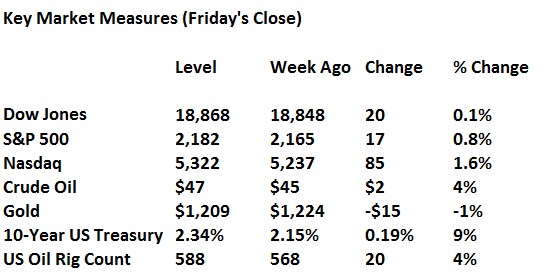
by Todd Shaver | Nov 21, 2016 | Monthly Newsletter Daily 6am if new
The Week Ahead
We finished this week above the fresh all-time highs set just a week ago. But we raise the question - have we come too far to fast? The frenzy seen post- election is seemingly pricing in a lot of good to come from new leadership in Washington. Are expectations reasonable or too aggressive? We note that Caterpillar recently said even if a $1 trillion infrastructure spending bill was passed today, it would take at least a year for projects to start, given the timelines for making the equipment needed. And we haven’t yet passed a $1 trillion infrastructure bill nor have we any clarity about how one would be funded. This infrastructure example highlights one market over-reaction to Trump, which is happening across many more sectors.
Good stock picks can make money in any market. This week we provide some insights on our latest thinking for Under Armour, Tesoro, Facebook, Amazon, and Microsoft.
Highlights From The Past Week
Repatriation. Many people are asking the question - If new leadership in Washington does lower repatriation taxes so that US companies bring home the $2+ trillion currently parked overseas, what will the money be used for?
The prevailing view at this time seems to be that much of the capital repatriated from overseas will be returned to shareholders, via repurchases and dividends. This is good for the stock market and for investors like us. However, we need to keep a close eye on how everything develops. Some are saying if the money just goes to buybacks and dividends rather than capital expenditures, then we won't see the big benefits to job growth and middle class income. There is talk of a flat 10% repatriation tax which should bring billions back to the US, but we’ll have to wait and see!
Fiscal Stimulus. Like Andrew Jackson’s populism, people are saying that we’re going to build an entirely new political movement: It’s everything related to jobs. They will be able to push a trillion-dollar infrastructure plan. With negative interest rates throughout the world, it’s the greatest opportunity to rebuild everything. Ship yards, iron works, new infrastructure projects get them all jacked up. We can just throw it up against the wall and see if it sticks. It will be as exciting as the 1930s, greater than the Reagan revolution. Exciting times! (We shall see.)
Interest Rates. The bond market bloodbath continues. The 10-year US Treasury yield is up a stunning 65 basis points from the Trump-win lows, spiking to 2.35% - the highest since December 2015. In fact, the entire Treasury yield curve is now higher in yield on the year, leaving most of everything newly issued in 2016 now under water. We are going to have to keep a close eye on where rates stand going forward. The cornerstone of fiscal stimulus will be low rates. But if the bond market re-prices rates much higher, the increased interest expense could throw a wrench in gears turning all of the current excitement.
BMR Companies and Commentary
Facebook (FB: $121, up 3% today)
Again, Facebook has found more miscalculated advertising metrics. The company said it has uncovered several more miscalculated metrics related to how consumers interact with content from marketers and publishers, and it unveiled additional independent review of some measurements to calm unease over the their data. An internal metrics audit found that discrepancies led to the undercounting or overcounting of four measurements, including the weekly and monthly reach of marketers' posts, the number of full video views and time spent with publishers' Instant Articles.
Does it matter? Should we be worried? What is the impact?
None of the metrics in question impact Facebook's billing. The only financial impact would be from customer perception about what has occurred, leading to customers shying away from spending money to advertise with Facebook because they have new concerns over these metrics. It is a stretch to go there. Facebook has well over 1 billion users. Just because a few mistakes were made on some back-office tasks doesn’t change how the business model connects advertisers to world. (We are not discounting this issue, but we think the market will perceive it to be a small matter. The company is already working on the PR to reduce the impact on perception.)
Let’s stay focused on what matters. Recall, it was a stellar quarter just recently reported. Facebook's Q3 earnings update that came in better than expected on top line revenues of $7.0 billion versus the $6.92 billion consensus and EPS of $1.09 was ahead of the Street's $0.97 expectations. Daily active users of 1.18 billion and monthly active users of 1.8 billion were both ahead of the Street's expectations as well. Management offered updated guidance on expense growth of 40-45% that was lower than the prior 45-50%. The negative takeaways were comments about decelerating revenue growth and heavy investments in 4Q16 and 2017. Many people think this was just management setting the bar low so they can beat it more easily. We agree.
BMR Take: If the first time miscalculated metrics didn’t shatter the Facebook growth story, we don’t think the second time around will. Clearly an operational mistake we don’t like to see, but we don’t see reason to exit our position in the stock over it. We think the company is set up to deliver better than expected financial results over the next several quarters. Stick around!
And this just in: Facebook will repurchase up to $6 billion in stock (first time they have ever done a stock buyback.) The buyback will start in the first quarter of 2017, using some of their $26 billion in cash. The market liked the news: the stock was up over a $1 in after-hours trading Friday.
BTW, we just noticed that Facebook’s all-time high is the same as Apple’s - $134. We wonder who will get their first. Our guess? Facebook. Why? Smaller market cap - $340 billion vs. $590 billion. Higher growth rate. So now we have two races to watch. Google vs. Amazon is the other. They both closed at the same price Friday. Love it!
Amazon (AMZN: $776, up 3% last week and up $16 today)
The word is CEO Jeff Bezos is telling executives to “Do what it takes to succeed” in India. Amazon fell a little behind in China early and business never quiet was able to recover to be as big as it could have been. Bezos is going on all in on India to ensure the same thing doesn’t happen twice.
Amazon had been India’s #2 ecommerce player. But that has changed. Bezos is now communicating to the market that Amazon has pulled ahead to be #1, with market share estimated around 28%.
India is a huge opportunity for Amazon. India has a population of 1.2 billion with about 40 million online shoppers. Goldman Sachs calls for ecommerce sales in India to grow 10-fold from today’s level of $11 billion over the next decade. And since only about one-third of Amazon’s sales are international, there is tremendous room for growth here. We understand that Bezos is going to invest another $3 billion in June into the India operation, in order to make the business even better. Amazon currently has over 80 million products selling in India. (This is not a misprint.) And they have more than 120,000 sellers, compared to 40,000 sellers a year ago. In June, the company said it will invest an additional $3 billion in India after it exhausted its earlier investment pledge of $2 billion. The company also launched its Prime membership program in July in more than 100 Indian cities, offering one-day and two-day delivery
BMR Take: Amazon’s stock has been down since the latest earnings report. The concern is that they are in a short term cycle of big investment spending. This news of more investments in India certainly plays right into the bearish outlook. Long-term, we think every dollar Bezos spends re-investing in the business will pay dividends later on. In the near-term, we brace for negative sentiment about how profits are being weighed down today due to these investments. Listen, we are not negative on the company nor the stock. We just want to give you both sides of the story. In fact, we think the market will shrug off this news and do what it always does, buy the story of bigger is better, awaiting huge profits in the future. But you never know…
Microsoft (MSFT: $61, up 2% last week)
Goldman Sachs upgraded the stock to Buy with a $68 price target. What’s the story here? Why did they upgrade? What are they now saying? Why is Microsoft all the sudden a buy?
The company got off to a strong start to FY17 as revenue and EPS came in above consensus estimates. The strength was driven by growth of Azure (the cloud business) and adoption of Office 365 (the web version of Office).
Many are now expecting the upcoming quarter to be an inflection point for Microsoft, as the company will complete the sale of its phone business and the acquisition of LinkedIn, signifying the end of the old and the beginning of the new.
We believe the integration of LinkedIn will enhance the value proposition of Microsoft’s entire platform, including Azure, Office 365, and Dynamics. As such, we believe the best is yet to come as we expect revenue growth acceleration and margin expansion ahead.
BMR Take: Glad to see Goldman Sachs come around to support our outlook. What a humbling game investing is. The world’s most powerful investment bank is playing catch up to a little tiny newsletter service out of Aspen, Colorado.
Goldman Sachs (GS: $210, +19% in the past two weeks)
Financials including Goldman Sachs rallied the most this past week. With rates finally rising, a steeper yield curve is good for banking and capital markets. More importantly, plans to roll back regulation are coming, which is huge for all of Financials, as they have had a bad stigma for years under the Elizabeth Warren era of denouncing Wall Street.
The regulatory discussion is currently all over the map right now about what we could see. The end of Dodd Frank? The termination of the Consumer Financial Protection Bureau? No more Volcker Rule allowing proprietary trading (again)? Some even say Glass-Steagall* could be on the table (again). Note that Trump has called for a general guideline of allowing new regulations to be implemented only if they replace two existing regulations. This all amounts to positive implications for Goldman Sachs.
*The Glass–Steagall Act describes four provisions of the U.S. Banking Act of 1933 that limited securities, activities, and affiliations within commercial banks and securities firms.
One more thing to ponder - who will Trump name as Treasury Secretary? The position once held by Alexander Hamilton is considered one of the highest honors in all of Finance for those asked to serve. Rumors are floating that Goldman’s CEO Lloyd Blankfein is possible candidate, as well as CEO Jamie Dimon of JP Morgan Chase.
BMR Take: Goldman is the #1 investment banking franchise. The investment banking business follows a boom-bust cycle. With the sharp rally recently, we are implementing a stop at $196 to protect our gains but we do not want you to miss more upside if the train keeps rolling. We added the stock at $147 in February, so we are up 43% in nine months.
Upcoming Economic News
Tuesday, November 22nd
Existing Home Sales – October
Time: 10:00 am
Forecast: 5.46 million
Existing home sales are projected to be little changed in October with tight inventories constraining transactions. Sales fell 0.4% year-over-year last quarter for the first decline of the past two years. Sharply rising Treasury bond rates will feed through into higher mortgage rates, adding another impediment to existing home sales growth.
Wednesday, November 23rd
Durable Goods Orders – October
Time: 8:30 am
Forecast: 1.0% overall, 0.2% ex transportation
Rising aircraft orders in October following two straight deep monthly declines can lead a strong overall gain in durable goods orders. Industrial demand has shown some recent promise; core capital goods orders increased 5.2% annualized in the third quarter against the previous quarter. Yet that recent burst in activity is tempered by the weak long-term trend; such orders fell 4.1% year-over-year during the same period.
New Home Sales – October
Time: 10:00 am
Forecast: 585,000
New home sales can dip a bit in October yet still point to strong long-term growth. Third quarter sales rose 23% year-over-year, as volumes continued to trend higher from depressed post-crisis levels. Though up substantially on an annual basis, last quarter’s 600,000 unit annualized pace trails the average rate of the past 20 years by 18%.
University of Michigan Consumer Sentiment – November
Time: 10:00 am
Forecast: 91.6
The post-election bounce in the stock market may ultimately feed into somewhat higher readings in consumer sentiment. The preliminary reading in the November Michigan survey was the highest in five months as consumers are reporting improved financial conditions. Renewed declines in oil prices can also spur stronger inclinations to increase spending on other items.
FOMC Meeting Minutes
Time: 2:00 pm
Given the jolt to interest rates and inflation expectations following the election, the minutes of the early November FOMC meeting will be somewhat stale. Yet the general push toward hiking the Fed Funds target in December will likely find additional support in the minutes. The next key question for monetary policy is how much policy tightening is likely in the year ahead. Economic projections released by the Federal Reserve next month will provide crucial guidance on this subject.
Twilio (TWLO: $37) had a good week, rising 17%. We’ve said many times how much we like this one, but the market has been hammering the stock these past few weeks. The turnaround in a week when most Tech stocks were hit hard, is impressive. Again, we think this is a $75 stock if they continue their phenomenal revenue gains that we saw in the past few years, and certainly last quarter. Twilio did $167 million in sales last year, up from $90 million the year before and the company is on a $1 billion annual run rate by the second half of 2018. Can’t wait for next quarter’s earnings. If strong, the stock should get back to the 50s and 60s in no time.
The Energy Corner
North Dakota’s crude-oil production in September dropped to the lowest level in more than two years. Crude production fell 1.1% on the month to 970,000 barrels a day in September, the lowest level since February 2014. North Dakota is home to the Bakken Shale formation, one of the world’s highest-cost oil fields. Growing confidence that crude prices will rise in coming months is sustaining the expansion of oil drilling in the shale patch. Rigs targeting crude rose 19 to 470 this week, the biggest increase in the last 16 months, according to Baker Hughes data reported Friday. Shale drillers have now added 155 rigs since an expansion started at the end of May. Gas rugs were flat, bringing the total for oil and gas up by 20 to 588.
This news just in - the Obama administration on Friday banned offshore drilling in the Arctic, setting a likely collision course with President-elect Donald Trump, who has vowed to “unleash” new energy production in the United States by rolling back restrictions on oil. Great – a new story for us to worry about.
So, US rig count is up sharply, which should produce greater volumes as we move into 2017. This counteracts the move by OPEC to cut production, which hasn’t been approved yet, and may indeed never happen
Interest Rate Corner
Federal Reserve Chairwoman Janet Yellen reiterated that an increase in short-term interest rates "could well become appropriate relatively soon" but offered no new signals about what the central bank will do at its meeting next month.
We are in the camp at The Bull Market Report that a ¼ point rise is baked in for December. Of course, she could surprise us with a ½ point rise, which would probably tank the markets like what happened last December. We hope she maintains some sense here. The 10-year Treasury note has exploded, from a low of 1.37% in July to 1.80% before the election to 2.34% Friday.
Tesla Update: It’s official: Tesla (TSLA: $187, down 2% last week) shareholders approved the acquisition of SolarCity. The company is now an unequivocal sun-to-vehicle energy firm. And Chief Executive Officer Elon Musk didn’t take long to make his first big announcement as head of this new enterprise. Minutes after shareholders approved the deal - about 85 %of them voted yes - Musk told the crowd that he had just returned from a meeting with his new solar engineering team. Tesla’s new solar roof product, he proclaimed, will actually cost less to manufacture and install than a traditional roof - even before savings from the power bill. “Electricity,” Musk said, “is just a bonus.”
If Musk’s claims prove true, this could be a real turning point in the evolution of solar power. The newly announced rooftop shingles are made of textured glass and are virtually indistinguishable from high-end roofing products. They also transform light into power for your home and your electric car.
“So the basic proposition will be: Would you like a roof that looks better than a normal roof, lasts twice as long, costs less and - by the way - generates electricity?” Musk said. “Why would you get anything else?” On a large house over a long period of time, the value of that electricity could exceed $100,000. The new roofing material he unveiled this past week is considerably cheaper, and it's considerably more promising for the future of rooftop solar power.
We love Musk. He never ceases to amaze and shock. Can he pull this off? Will he have enough cash to make it work? We think yes. But again, this stock could hit $150 before it hits $250. Volatile!
Goldman Sachs Maps Out Its Top Market Themes for 2017
They're heavily influenced by President-elect Trump.
Goldman Predicts: U.S. recession risk remains low in 2017
Goldman released its top 10 market themes for next year. "High growth, higher risk, slightly higher returns," is how their strategists view the year ahead - and it's clear that their outlook has been heavily influenced by the pending regime change in Washington.
Here's a brief summary some of the themes Goldman sees as forming the backdrop for investing in 2017. All thoughts and comments are for Goldman.
Expected returns: Only slightly higher
Relative to its 2016 forecasts, Goldman says owners of financial assets can reasonably able to expect more upside - but stresses that these returns will still likely remain low. The best improvement in the opportunity in global equities is in Asia ex-Japan, where we forecast returns of 12.5% (versus 3.8% for 2016.) At the other end of the equity spectrum, in Japan we are forecasting declines of 3.7% on the Topix (vs. +5.2% for 2016).
U.S. fiscal policy: A pro-growth agenda
President-elect Donald Trump's focus on infrastructure spending during his victory speech on Nov. 9 - rather than trade protectionism or immigration restrictions - catalyzed the risk-on sentiment that's pervaded markets.
Markets are starved for growth
This is plainly visible in the eagerness with which markets seized on Trump’s growth-focused message. It is also visible in the speed with which the market’s narrative on the economic outlook under Trump has shifted from uncertainty to growth. Fiscal stimulus in the U.S. will help reflate the economy, and stands a good chance of passing through Congress.
U.S. trade policy: Concerns are likely overdone
Goldman doesn't see an imminent trade war on the horizon, and expects any re-negotiation of agreements currently in place (like NAFTA) to focus on attempts to improve the prospects for the U.S. manufacturing sector. We think the popular media narrative on the downside risk of a trade war is overstated. Our tentative view is that Trump’s use of punitive tariffs will be just as pragmatic as President Obama’s, albeit more vocal.
Emerging markets risk: “Trump tantrum” is temporary
Emerging market assets have been crushed since the election, as the rise in Treasury yields has reduced the need to reach for yield overseas, and the potential for protectionist trade policies threatens to curtail growth opportunities.
Monetary policy: Focusing the toolkit on credit creation
Better-targeted monetary stimulus could help avoid some negative side effects associated with quantitative easing and negative rates that inhibit credit creation.
Corporate revenue growth recession: Signs of inflection
For years, S&P 500 companies have exceeded analysts' expectations on the bottom line more often than the top line during quarterly earnings seasons, as a combination of cost-cutting and shrinking share count, rather than soaring sales, fueled the growth in earnings per share. However, Goldman expects 2017 to confirm that the U.S. corporate sector has emerged from its recent 'revenue recession.' A firming global economy and recovery in oil prices from their February lows significantly buoys the outlook for revenue growth stateside.
For 2017, Goldman expects that modest improvements in the macroeconomic backdrop will help lift S&P 500 operating EPS by 10% and they have a year-end S&P 500 target of 2200, currently 2180 now. [Not terribly exciting if you ask us. We differ. We don’t normally predict, but we would certainly be looking for 2300 or 2400.]
Inflation: Moving higher across developed markets
Market-based measures of inflation expectations in the U.S. have spiked since the election, as traders bet that Donald Trump will be the inflation president.
What seems clear to us, as argued above, is that economic issues, notably tax cuts, infrastructure spending and defense spending, are high on the agenda - a recipe for reflation. We are forecasting large boosts to public spending in Japan, China, the U.S., and Europe, which should fuel inflationary pressures in those economies.
The next credit cycle: Kinder and gentler
While commodity-sensitive segments of the credit market have suffered pain in 2016, there hasn't been much in the way of contagion. Goldman's team expects more of the same in 2017, with the credit cycle not making a turn for the worse. The strong ‘business cycle’ component in the behavior of high yield defaults, and our view that U.S. recession risk remains low in 2017, leave us comfortable with the view that the inflection point is unlikely to materialize next year, despite the weak state of corporate balance sheets.
Mortgage Rates Surge After Election
Here is some news on the state of the mortgage market. Mortgage rates surged after the election win of Donald Trump. But housing experts say consumers shouldn't get carried away by the post-election wave. The advance of the past week or so, stoked by a surprise victory that turned economic expectations on their head, could soon settle.
"Consumers considering buying or refinancing now should stay patient, as we'll likely see rates stabilize once markets find a new equilibrium," says Zillow, the mortgage rate real estate company.
In the week ended Thursday, the average rate on the 30-year fixed-rate loan jumped to 3.94% from 3.57% the previous week, mortgage company Freddie Mac reported. A year ago the market was at 3.97%. The average for a 15-year mortgage climbed to 3.14% from 2.88%
The High Yield Corner
We have seen our first full post-Trump trading week, and it wasn’t bad. Actually, things were impressive considering the expectations and last week’s bull run. The S&P 500 rose nearly 1% by the end of the week, but the really interesting story is the difference between different stock groups. Large caps underperformed small caps significantly - this has a lot of important implications for high-yield investors, so is worth a closer look.
The Dow Jones Industrial was pretty much flat last week, while the Russell 2000 went up 2.6%. The difference between these two is the result of different trends between different investors: the risk-averse are more worried than the less risk-averse, who are willing to give small caps a chance in the hopes that they will deliver the higher-than-big-cap returns that they gave in the past. This has pushed small caps up to a 17% year-to-date return after rising 8% in the last month.
But here’s the really interesting part: the Dow Jones is up 10% year-to-date after a 4% return over the last month. The S&P, however, is up 7% year-to-date after rising 2% in the last month.
What this means is that risk appetites have grown in the last month while the more cautious are less eager to jump into the Trump rally. They aren’t avoiding it, but they aren’t going into it as much as the more risk-tolerant investors. In other words, we’re having a growing disagreement about future risks with the economy as a whole.
This is not uncommon, but wasn’t the case earlier in 2016. Both large caps and small caps had similar high returns for much of 2016 - and now that convergence is subsiding.
This is important for high yield investors for two reasons. First, junk bonds and BDCs tend to trade closely with small cap stocks as they attract similar investors: risk-tolerant institutions. Second, a market where the risk-averse are more cautious and the risk-hungry are less so often portends a bubble followed by a crash. That is not in the cards quite yet, but it does make one wonder if the industries getting a big boost - Financials in particular - might get overbought if they haven’t already.
With this as our backdrop, let’s take a look at how each asset class performed in the last week and why:
REITs - Initially REITs were the hardest hit by Trump’s victory on fears that his spending plans would kickstart inflation and thus increase REITs’ borrowing costs. This remains a concern, as the U.S. Treasury 10-year keeps going higher, but we’ve finally gotten to a point where the risks are priced in. Fortunately for REITs they already began correcting before the election, so this week’s return was just barely green, according to the SPDR Dow Jones REIT ETF (RWR: $89. Flat).
Results for individual REITs varied, but our picks did OK. Kimco Realty (KIM: $26) rose slightly, Digital Realty Trust (DLR: $90) rose over 1%, Omega Healthcare Investors (OHI: $28) was flat, Care Capital Properties (CCP: $24) rose 4%, and Government Properties Income Trust (GOV: $18.90) rose less than 1%. We also added a new REIT to our portfolio: Ventas (VTR: $60), which rose 2% this week. Ventas is one of the few REITs that is up year-to-date in the Healthcare space: rising 6% so far this year, but its price-to-FFO ratio and growth potential make it extremely attractive.
Junk bonds - The corporate bond market is now dominated with changing inflation expectations. Love him or hate him, but the market believes Trump is going to cause inflation to accelerate. This isn’t a testament to his failures or abilities, however; much of these expectations are the end result of the Fed’s constant efforts to improve inflation rates and a time when low oil prices and high supplies are priced in. There are many reasons beyond Trump to think inflation will not stay low forever, and having a president in the office (whoever it may be) who is focused on rising inflation with a House and Senate that will work with him, almost seems a perfect formula for rising inflation.
That is why junk bonds have done particularly badly after Trump, but the real surprising thing is that they didn’t do poorly for longer. Last week the SPDR Barclays High Yield Bond ETF (JNK: $36) rose over 1% and is now up 5% from the beginning of the year. Yet the fund has a near 7% dividend yield that is far higher than it has been in recent years. This is partly because of expectations of a rate cut for the fund*, which has happened in the past, so it’s important to keep in mind the more actively managed alternatives that aren’t tied to an index** and thus have more flexibility to ensure payouts remain constant. Note that the ETF recently registered $342 million asset inflows for a 3.15% increase.
*JNK's distribution cut is expected because the BofA High Yield index has fallen. Since JNK tracks that, its distribution should fall too.
**Active funds like PDI vs. passive indexing funds like JNK. In other words, “alternative funds that are actively managed" makes that clearer.
Our pick to take advantage of this strategy remains Pimco’s Dynamic Income Fund (PDI: $27), which had a nice 4% gain this week to offset last week’s massive decline. The fund is still down over 4% from a month ago which means it is poised to improve in recent weeks. The fund is also now flat year-to-date with a near 10% dividend and a looming special dividend that we believe will be at least 3%. That turns this fund into a 13% dividend payer with a sustainable dividend. That is almost impossible to find in the market (we know as we’ve looked for more, but Pimco’s fund seems to be it!)
Municipal bonds - Rising interest rates are a problem for all bonds, but they are actually worse for corporate bonds than municipal bonds because of the risks and the way these are structured. Yet looking at the municipal bond world lately, you’d think it’s the riskiest asset in the world. The iShares National Municipal Bond ETF (MUB: $108) fell 1% this week and is down 3% over the last month. The ETF is also down 2% for the year, making municipal bonds one of the few asset classes that has had negative returns for the year.
We have been wary of municipal bonds this year because of their massive run-up before the summer and rate hike concerns. We don’t believe rate hikes directly are a drain on municipal bonds, but fears about rate hikes often overshoot the real risks and cause a big and prolonged selloff. We saw this in 2015 and have seen this to a lesser extent this year. This is why we have only recommended one municipal bond fund this year: the Nuveen Enhanced AMT-Free Municipal Credit Opportunities Fund (NVG: $14:04). The fund is down 2% over the last week and is down 3% year-to-date. The most shocking figure is the three-months metric: the fund is down 14% in that time.
We expect these massive declines to reverse, but it is going to take a while for that to happen and it is difficult to time. While municipal bonds are already oversold, that does not mean the market knows they are oversold, and they can go down even lower. Nuveen’s fund is a good long-term hold and we expect it to hold its NAV for the long term, as it has done for over a decade already. However, we also expect greater volatility to hit this and all municipal funds. Anyone wishing to invest in munis now will have to endure these short-term price declines with patience, buying more as the stock goes down.
From one extreme of the risk/reward spectrum to the other, let’s turn to BDCs. The UBS BDC ETF (BDCS: $22) rose over 1% over the last week and has had a somewhat strong showing after the Trump election. While BDCs aren’t going up nearly as much as Financials, they are both rising for the same reason: an expectation that deregulation is going to cause credit to flow and the Financial sector to boom. BDCs cannot help but benefit from this, so they are rising with the Financial sector. However, they are not rising from an extreme bottom as Financials are, so the asset class’s 2% monthly return is a fraction of the double-digit returns of the Financial sector as a whole. This is unlikely to change.
At the same time, we have finally gotten to a point where Main Street Capital (MAIN: $36.50) has gotten overbought. The BDC is now up 16% from when we recommended it in April after rising 8% in the past month alone. We waited for this week’s dividend distribution to see if the stock would fall further after the payout, but it hasn’t; in fact the stock is up over 1% after its recent payout. That now means Main Street is selling at a 70% premium to its net asset value and it has passed our target price. We are keeping our price targets on Main Street, which means recommending selling at these levels and waiting for the price to correct before jumping back in. Main Street remains an excellent firm with impressive advisors and the capability to increase dividends for a long time, but the cost of that expertise and growth potential is too high now. We will buy again when the stock is more fairly priced.
Good Investing,
Todd Shaver, Founder and Editor in Chief
The Bull Market Report
