
The Week Ahead
Year to date the S&P 500 is up 5%. The train keeps on rolling. Weak GDP in the US - no problem. Energy industry falls apart - no big deal. Lack of middle class household income growth doesn’t matter. Troubling student debt burden is what it is. With low rates and bond prices and record low levels, the only game in town is equities. There is a record amount of cash sitting on the sidelines waiting to go into stocks.
Wall Street enters the thick of earnings in week three of the season with Apple (Tuesday) and Alphabet (Thursday) reporting this week (see our Earnings Preview to be sent out Monday morning). Instead of a widely expected earnings decline, Thomson Reuters now anticipates 1% growth in the S&P 500 companies the quarter, reversing previous expectations of a decline. This could be the first time we see an increase since the second quarter of last year. So far this quarter, 20% of S&P 500 companies have reported on their recent quarters with 80% beating estimates.
It has been a good not great year for stocks, though we are coming to an inflection point. They say if Republicans win the White House the market will sell off. They say if Democrats win the White House the Fed will raise rates in December and the markets will sell off. So brace for some turbulence, but don’t stop investing in great stocks. This week we highlight Facebook, Google, First Solar, Microsoft, Qualcomm, Amazon, and PayPal, among others.
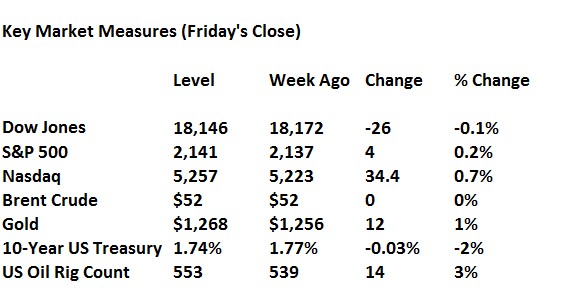
Highlights From The Past Week
Record Cash Levels. Investor cash levels jump to levels not last seen since 9/11. Fund managers are now holding 5.8% of their portfolios in cash, up from 5.5% last month. The current level was a bit higher than what happened right after Brexit. We haven’t seen cash levels this high since 2001, shortly after the terrorist attacks in the US. It’s hard to get a total reading on cash levels, but some say there is $1.5 trillion in corporate cash on the sidelines. What is driving the caution? The commonly cited reasons are an EU breakup, a bond market crash, and a certain Republican winning the White House.
What Junk Bonds Are Saying About Risk. High yield bonds, also known as Junk Bonds, are a key indicator of appetite for risk. There are two things occurring providing insight into market sentiment. First, the interest rate spread of junk over treasuries has compressed to the point where history suggests there is not much further to go. This could predict a reversal soon coming. In other words, investors are so thirsty for yield they are overpaying for risk assets, where all it will take is a little turbulence to rattle confidence. Second, actual defaults on junk bonds are decelerating. This is due to the improving Energy sector. The key point is that while we might see more risk start to get priced into the market there is still little evidence of a recession happening in the next 12 months based on default rates.
European Taper Tantrum. European Central Bank President Mario Draghi came out this week and said he will not be scaling back bond purchases prior to March. After March there is risk of doing so, but for right now the window for bond purchases is ongoing. Recall that in the US when the Fed started scaling back bond purchases, interest rates spiked impacting various sectors. For instance, Mortgage REITs went down as much as 50% and banks rose, as the steepness of the yield curve hurt/helped the respective business models. Accordingly, all eyes are on Draghi and the ECB for a European Taper Tantrum and any flow-through effect to US markets.
BMR Companies and Commentary
Alphabet (GOOG: $799, up 3% for last week; currently $807)
The stock hit an all-time high Wednesday at $804. Alphabet is schedule to release its earnings on Thursday after the market closes. The Street is looking for $8.62 of EPS on $18.2 billion of revenue.
We expect to see Google's search revenue growth momentum be sustained. We understand that expectations for search budget growth earlier this year were around the 12-15% level, but now these expectations have been ratcheted higher to the 15-20% range. In particular, we understand that feedback from advertisers suggests that budget deployment into search started to accelerate over the course of the quarter as the market gears up for the crucial holiday period. Advertisers are specifically citing the newly-released Expanded Text Ads feature as one of the reasons for their pick-up in spend.
Outside of search, we like Google Cloud and we like YouTube. Neither business is the size or impact of Search. But we like that they are heading in the right direction. The larger and larger contribution from YouTube is particularly exciting. There have been some rumors of YouTube soon doing large deals with content providers like Disney. This could be very exciting and we want to see more. By owning Google, we own the best asset in all of media - YouTube.
BMR Take: We expect a very strong quarter and will look to be revising our $850 price target higher.
Amazon (AMZN: $819, flat last week, currently $835)
The long term Amazon Web Services (AWS) operating margin expansion potential remains a controversial topic for Amazon. Let’s discuss it.
We are in the camp that expects to ultimately see a 40% long term operating margin in the AWS division. This outlook includes the fact that they have aggressive expense growth projections, specifically an incremental $1.5 billion over the next five years versus the historical ramp of $600 million to $1.0 billion. What we are saying is that it's not like they need to stop spending money. In fact, they can spend a lot. That's okay. They are bringing in the revenue – and ultimately profits.
Many are concerned about all the competition in the space, namely Microsoft Azure, Google Cloud, Oracle, and so on. Right now there is no evidence of a price war but there certainly is the possibility as these three giants fight it out. We will keep a close eye out for any change.
Why is all this talk of AWS operating margin important? Within five years, AWS will account for roughly 40% of the company’s consolidated free cash flow, if the profitability ramp plays out. Given the total addressable market of $1 trillion for AWS, it is very likely the 40% figure proves conservative. Free cash flow is the basis for how most analysts are valuing the stock. Some valuation models are inferring a price target of $1,600 for Amazon should we see the free cash flow production really start to ramp. Now that would be interesting, $1,600! We aren’t ready to place our rational expectation for the stock there yet, but there is real potential and we are watching closely.
BMR Take: Amazon is an invention machine and the latest breakthrough is AWS. AWS has the potential to unlock substantial value for shareholders. So we care about its prospects and free cash flow contribution. We think the stock has tremendous value here at this price.
Facebook (FB: $132, up 3%, currently $133)
FB shares are currently trading at 25x and 20x our 2017 and 2018 earnings estimates respectively. This is versus expectations of 26% EPS growth per year over the next five years. What value! In fact, the stock hit an all-time high Friday and is now worth $380 billion, just behind Amazon at $390 billion, Microsoft at $465 billion and Google at $560 billion. All we can say is Wow.
Investors are overcoming concerns around two things - tougher comparisons beginning in 4Q16, and moderation of ad load growth. While the former is a mathematic reality as the company gets bigger (you can’t grow revenues at 40% forever), we expect the latter to become less of a concern as Facebook has taken steps to modify existing ad units and release new products.
Why is slowing ad load growth not an issue? Did you hear during the Presidential debates the constant reference to “on Facebook over 100 million people are saying…”
Additionally, we believe Facebook is taking steps to introduce a new prospecting product to help advertisers find new customers, as well as to monetize Messenger in 2017. Recent feedback from advertisers suggest that the company continues to innovate on product development.
BMR Take: Now is a great time to buy this technology blue chip. Our $140 price target is a layup with many analysts already pushing the bar much higher. We hereby raise our price target to $150.
Netflix (NFLX: $127, up $26 since we wrote this piece on 10/16)
We think Netflix is ultimately heading to $200 based on 20x a 2020 EPS outlook of $10. However, Deutsche Bank initiated the stock with a Sell rating and a $90 price target last week. We recap their call below so you have all the information. We believe you should side with us because there is a lot of money to make if we are right.
The report admits to be positive on the business and but cautious on the stock. Netflix has a long runway for growth due to its first mover advantage and self-reinforcing model.* They say and we agree, that increasing content and user experience investment drives subscriber growth and pricing power, which funds further content and user experience investment. The report doesn’t take issue with the business model, but only the valuation on the stock, saying this is a very long duration, high multiple investment with market expectations that appear too high through 2020.
* The self-reinforcing model entails increasing content, and user experience investment drives subscriber growth and pricing power, which funds further content and user experience investment in an endless loop of growth.
Folks, they have been saying this same thing about Netflix’s valuation for years. The business is doing so well, that is why the valuation is high, unless you are telling us the business is turning south. In our view the valuation is going to stay where it is. The business is heading in a healthy direction.
The report argues there is no take-out value*, specifically citing that nobody on the speculative list of buyers would have an interest. This list includes among others Disney, Amazon, and 21st Century Fox. They say severe economic/earnings dilution would be a major obstacle to a potential combination. They say there would be 25% EPS dilution for Disney. This is all true we must admit. But we don’t really care. You don’t need a take-out to do well in your investment as we like Netflix on a standalone basis.
* The estimated value of a company if it were to be taken private or acquired.
Netflix’s pivot to original programming, the development of its own in-house studio, the growth in aggregate studio output, and the size of Netflix’s programming budget all mitigate the apparent risk from Amazon, Hulu, and local international players increasing their subscription video on demand programming spend. This is the sell report’s argument not ours. This seems like a reason to own the stock not sell it, don’t you agree?
BMR Take: Netflix has a long runway for growth due to its first mover advantage and self-reinforcing model. The business is firing on all cylinders. Don’t pass on this just because it’s not a thrift store cheap stock. We like Netflix and have a $133 target price on the stock but are considering raising this soon.
High Yield Report
This was the week when markets breathed a sigh of relief. The S&P 500’s slightly positive performance for the week helped reverse recent weakness and fears that a major correction is imminent. At the same time, most high yield assets outperformed the market slightly as income continues to remain a key motivator for buyers in the market.
Energy was a top performer this week, especially when we look at the High Yield space. The Alerian MLP fund (AMLP: $12.70) rose 1% this week, helping it reach a 5% year-to-date return excluding its dividend. (13%+ return so far YTD.) That’s a healthy return, but many MLPs are still struggling against weak energy prices, and oil’s close of the week around the $51 mark suggests the weaker firms will still struggle to produce positive cash flow.
When it comes to oil and gas exposure, we are still most positive about Kinder Morgan Inc. (KMI: $21), which soared 4% this week. The stock got a boost after reporting strong cash flow. It’s true that revenue and earnings disappointed, with negative EPS of 10 cents, with lower oil and gas volumes contributing to the results. However, the fact that Kinder Morgan is able to deliver strong cash flow that will exceed dividend payouts “for the foreseeable futures,” as management put it, indicates the firm’s resilience in the face of weak energy prices. That helped the company get three upgrades this week from Credit Suisse, Stifel Nicolaus, and Wolfe Research. We remain positive on the stock and expect it to continue to outperform.
The junk bond market saw a weaker but still strong performance, as the SPDR High Yield Fund (JNK: $37) rose nearly 1% this week, bringing the year-to-date price return up to over 8%. That’s double the S&P 500, indicating that the corporate bond market is continuing to enjoy its protracted correction after the panic of late 2015. That panic was driven by a fear that the Federal Reserve’s interest rate hike would decimate corporate bonds, and it’s true that we have seen a steady increase in corporate defaults throughout 2016. But those defaults seem largely priced into the market. So junk bonds remain risky but not riskier than the market had been expecting.
If junk bonds remain risky but still provide opportunities, investors need to avoid an index approach to the market and diversify among corporate bonds and other high yield instruments. That’s why we continue to like Pimco Dynamic Income Fund (PDI: $29), which rose nearly 1% this week and is currently yielding 50% higher (at 9.2%) than the JNK SPDR fund. That higher yield implies greater risk, but since the Pimco fund diversifies between mortgage-backed securities and high yield corporate bonds, we see it as a much less risky alternative to a junk bond index fund. Additionally, the fund’s undistributed net income has hit a one-year high and December is just around the corner: Pimco will announce its special dividend, and we are confident it will be over $1. That will bring its annual dividend to over 12%, making it one of the highest yielding funds out there, especially when considering its risk profile (fairly low) and its dividend stability (high). Since inception, PDI has both grown dividend payouts and never cut distributions. It’s impossible to find such a performance elsewhere.
Let’s turn to REITs. These investments have been interesting to look at this year. Changes to indexes have meant a reclassification of REITs away from other Financials, which the market interpreted as higher demand for REITs from index funds. That helped many of these stocks soar throughout 2016, but now the indexes have completed their restructuring and the last few weeks saw a correction in REIT prices as investors felt there was no further growth to come. Yet this week the SPDR Dow Jones REIT ETF (RWR: $93, flat) remains up 2% year-to-date.
Let’s compare our REIT picks. Kimco Realty (KIM: $28, paying 3.6%) is up 6% year-to-date and remains a low volatile and low risk REIT that still has the potential for dividend growth for years to come. Digital Realty Trust (DLR: $96) is up 27% year-to-date and continues to benefit from demand for server space thanks to the explosion in cloud computing. Government Properties Trust (GOV: $21) is up 30% year-to-date and remains the most controversial of our picks. Some people are worried about the company’s shift in strategy towards moving beyond its leases to government agencies, which is partly why the fund is still yielding 8% (although it was yielding 11% when we first recommended it). It’s still covering its dividend by 140%, suggesting dividend growth is easily obtainable. Or, if the bears contend, the company cannot grow funds from operations, it should still be able to manage payouts for quite some time.
We continue to recommend holding these three REITs instead of indexing the market both for a higher yield and for sustainable dividends. These picks, in addition to our bond, energy, and other high yield picks, provide a portfolio of 8% yields on average and sustainable payouts. This is not easy to do in a market where Treasuries are yielding less than 2%, but these great companies deliver it and are capable of continuing to deliver it for quite some time.
Good Investing,
Todd Shaver
Editor in Chief
The Bull Market Report