
Get ready for some fireworks! The Tech sector pullback is raising eyebrows. It all started Friday June 9th mid-day and followed through on Monday the 12th. Up until this point, mega cap tech names had been leading the market higher all year. In fact, if you excluded them, the market has been sideways. But the softness that started in the first half of June continued in the later weeks of the month.
What’s going on? Profit taking? Too far too fast? Buybacks on pause because of the earnings season quiet period? We think the market is just catching its breath, taking a quick break, sort of like half-time. After all we just finished the first half of the year. We are sticking with the outlook that the bull market will continue and that the stocks that got us here – FAAMG* - will continue to lead the charge higher.
*Facebook, Apple, Amazon, Microsoft, Google.
There is always a bull market here at The Bull Market Report! This week we highlight the following stocks: Microsoft, Tesoro, Facebook, Google, and Government Properties Trust.

Highlights From The Past Week
Searching for the Bottom as Taps Plays on the Best Nasdaq Run Since 2009. All good things must come to an end. Or is it a pause? Either way, recent convulsions in Tech shares saddled the Nasdaq 100 Stock Index with a loss in June, snapping the longest streak of monthly gains since 2009 at 7.
The gauge is down 2.2% since May 31st, poised for the biggest retreat in a year. Now the question to investors is whether the weakness is a natural reversion from higher prices or a sign of broader drawdowns to come. One savvy observation to highlight is that we’re getting to a point where the biggest buyers of Tech shares are the companies themselves, but we’re about to go into a black-out period for that due to earnings. This buying will not stop, and in fact should increase with these lower prices, and we will see Tech stocks snap back to the upside after earnings season.
Technology Selloff Couldn’t Come at a Worse Time for These Funds. U.S. investors who entrusted $40 billion to stock-picking computers are having some pretty lousy luck. Several multi-billion-dollar exchange-traded funds that are billed for their low volatility have been anything but in recent days, after rebalancing into a record amount of Technology shares. Suddenly, they’re cauldrons of turbulence after a three-week span in which computer and Internet stocks went from the market’s standard-bearers to its worst performers. Tech shares led the S&P 500 Index to its worst drop in six weeks on Thursday. The weakness in Tech comes after the $7 billion PowerShares (SPLV) and $14 billion iShares (USMV) products, two of the most popular low volatility ETFs, both rebalanced last month pumping up Technology to 11% of Powershare’s holdings and 18% for iShares, the most since their inception in 2011. Now, there are hints of turbulence creeping back into the market, which is unfortunate for these low-volatility strategies now concentrated in technology mega caps. We shall see if they stay the course or sell, but if they sell, look for more downward pressure in the weeks ahead.
Banks Add $40 Billion in Value as Fed Unlocks ‘Treasure Chest. The biggest U.S. banks added more than $40 billion in market value after the Federal Reserve’s annual stress tests opened the way to surprisingly big increases in dividends and share buybacks. The results came in well ahead of both our estimates and consensus estimates as the Fed allowed for a large step-up in payouts to shareholders. Lofty payouts made banks hot stocks until the financial crisis exposed many of them as too thinly capitalized. The companies unveiled plans Wednesday showing how they’re trying to generate investor interest -- even as many still struggle to meet profitability targets and a few languish below book value. The sun is setting on the post-crisis balance sheet rehab. These payouts and an improved earnings outlook reflecting higher rates should alleviate calls for breaking up the banks. The Financial sector outlook is bright.
Big Tech Deals Take a Holiday. Enjoy It While It Lasts. Rest In Peace big technology deals. It was fun while it lasted. But also good riddance, even if they won't stay dead for long. This year through Thursday, there have been about 6% fewer takeovers of U.S. technology companies than there were in the same period of 2016. That's not bad, but the value of those deals is a stunner. Acquisitions of U.S. Tech companies this year have a combined announced price tag of $35 billion, about one-third of the $105 billion in collective takeover value at this point in 2016. The big change is the number of large acquisitions. In the first half of last year and in 2015, there had been on average of more than 15 U.S. Tech takeovers at more than $1 billion each. So far this year there have been just seven.
Outside the U.S., megadeals have also been scarce compared with prior years. It's inevitable there would be a bit of a breather after two banner years for corporate acquisitions. That doesn't explain the decline entirely, especially given how many people predicted an M&A bounty when the man behind "The Art of the Deal" moved into the White House. But who knows? Maybe with the pullback in Tech recently we will see some M&A heat up.
America’s Pension Bomb: Illinois Is Just the Start. We’ve been hearing it for years: America’s public pensions are a ticking time bomb. Well, at long last, the state of Illinois is about to expose just how big this blowup could be. As of the 2015, Illinois had promised its employees $200 billion in retirement benefits. Right now, it’s $120 billion short. That gap lies at the center of a years-in-the-making fiscal mess that’s threatening* to drop the state’s credit rating to junk-bond status. But Illinois is hardly alone. Connecticut and New Jersey - states that, to most of the world seem like oases of prosperity - are under growing financial strain, too. Illinois is just the tip of the iceberg.
* Threatening? Why is it not already rated junk? Some things just don't make sense.
BMR Companies & Commentary
Microsoft (MSFT: $69, down 3% - all price changes in the newsletter are for the week)
Microsoft has some exciting things happening. A re-focus on engaging clients, particularly within the cloud business, is likely to improve the company's EPS outlook. The company is making a big shift to focus on selling cloud solutions across industry verticals. In fact, the company is re-organizing its internal management structure to do so.
Microsoft is expected to unveil a business reorganization plan in the week ahead that will support its shift towards a cloud-first organization. It’s been several years since Microsoft introduced its “mobile first, cloud first” mantra, but the catchphrase continues to guide the company even as it invests in emerging areas like machine learning and artificial intelligence, gaining ground on Amazon Web Services (AWS) market share. (This whole restructuring reminds us of how Bill Gates in the mid-90s changed the whole structure of the company to embrace the internet.)
Size in the channel matters. Microsoft wants to leverage its massive distribution partner ecosystem as a differentiator in the market. Microsoft will emphasize their size and channel relative to Amazon Web Services (AWS) and Google, to explain to partners why they should align with Microsoft. Look out: Here comes the Microsoft Machine!
BMR Take: The bull case on Microsoft remains 20x $4.00 of EPS that is coming into view sometime in 2019. If you are good at math, that equates to an $80 stock. That leaves a nice chunk of upside still. Plus the current dividend yield of 2.3% is attractive in this low rate environment.
Facebook (FB: $151, down 3%)
What is happening? Facebook now doing TV? They did it again. They found a way to increase interest in the platform and generate more ad revenue.
Facebook is looking to produce original scripted TV shows by late summer. The company is telling studios and agencies it is willing to spend up to $3 million per episode on production, though it's also interested in shows that would cost in the range of $5-$8 million.
Without getting specific, Facebook executives have confirmed that the company is working with partners and creators on episodic shows ranging from sports to comedy to reality to gaming. This is really happening!
Facebook is focusing on viewers in the 17-to-30 age range and benchmarking against shows like Pretty Little Liars, Scandal, and The Bachelor. Facebook is willing to take shows that other networks have passed on.
This is all great stuff, but to cap it off, CEO Mark Zuckerberg dropped news this week that Facebook now has 2 billion monthly users. Wow! How many people are on planet earth again? (7.4 billion) Zuckerberg is closing in on global domination. (Some say he is already there.)
BMR Take: The EPS outlook for Facebook calls for greater than 20% growth for the foreseeable future, which would put EPS near $10 by 2020. The stock is up a lot this year, but EPS is there to support it, and in fact offers plenty of room for more gains ahead.
Tesoro (TSO: $94, up 1%)
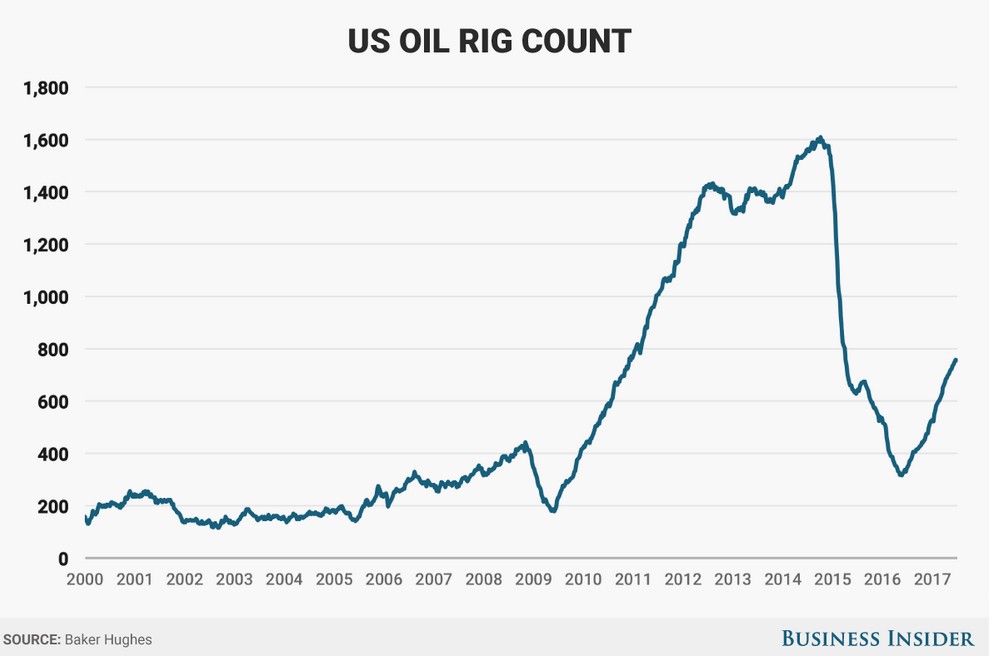
Did you see oil get crushed in recent weeks? Did you notice that rig count fell by 1 this week declining for the first time in a long while? With so many Energy stocks getting hammered in this tough operating environment, how is Tesoro doing so well?
The answer is why we picked the name for you. Tesoro is a refiner. It makes money off the spread between the price it pays to buy a barrel of oil and the price it receives after refining it into usable gasoline for your car. The dynamics of the all-important spread work like this: When oil prices fall, the price Tesoro can buy barrels of oil for falls faster than the retail price of gasoline. When oil prices rise, the opposite occurs. In other words, right now is the best environment for Tesoro as oil prices are falling. Profit margins at the business are exploding and so is the stock.
Adding fuel to the fire, Goldman Sachs came out just recently and added Tesoro to its conviction buy list and the CFO bought shares.
Tesoro is firing on all cylinders. Recall that the company also recently achieved an investment grade credit rating from S&P. And the big Western Refinery acquisition is on track for closing and integration.
BMR Take: We like to look at Tesoro’s value based on net asset value. NAV is $106 right now. So we are still at a big discount to NAV. In contrast, Warrant Buffet’s beloved Phillips 66 trades for a 20% premium to NAV. So we just see a ton of upside ahead still for Tesoro.
Google (GOOG: $909, down 6%)
It was a tough week to be a Google fan. The European Commission levied a huge fine on the company. The size of the fine the tech giant will have to pay for abusing its monopoly in online search, $2.7 billion, sets a record for European antitrust penalties. Yet more important than the amount is that the regulator provided a rough guide to how the European Commission plans to deal with Google and other online firms which not only dominate a market, but essentially are the market.
Google has $92 billion in cash, so $2.7 billion is just is 3% of its cash. The company made $6.8 billion last quarter before taxes, so $2.7 billion is just 40% of this, or 36 days’ worth of earnings. A pittance really. But there is much more to the story – keep reading.
In the 2000s Microsoft got into trouble because it had expanded its Windows monopoly by bundling it with its web browser. By comparison, Google’s infraction seems minor. In 2002 it launched a price-comparison service called Froogle, later renamed Google Shopping. In 2008 it changed how this service works. According to the commission, the new version systematically favored Google’s own comparison-shopping results by giving them prominent placement at the top of its generic search results and demoting links to rival offerings to pages further down in its results, where users hardly venture.
The prevailing wisdom, particularly in America, used to be that “super-platforms”, despite their size, do not unfairly use their market power and thrive because of their unceasing innovation.
But as digital platforms have grown ever bigger, that thinking has started to change, even in America. A growing number of antitrust experts now accept the European Commission’s view, that network effects create high barriers to entry in online markets. This means that Google, for instance, can in fact degrade its search results selectively (and disadvantageously to its direct competitors) without having to fear that its users will defect. But we need these super-platforms to adhere to a principle of neutrality for a fair marketplace to exist.
BMR Take: We at Bull Market Report always will tell it to you like it is. Google is in some trouble here and you could argue the antitrust issues probably extend to many other large cap tech names as well. We are going to monitor the situation for now as it would take a whole lot of things to happen for this regulatory risk to seriously impact the company and others in Tech. With the stock now trading at 27x this year’s EPS outlook of $34, the stock is cheaper here than last week. But if the US Government gets involved and starts investigating the company here in the US, things could get dicey. Search is 87% of Google’s profits. If outside influences affect this cash machine, there just might be trouble ahead for the stock. It is certainly a lot cheaper than its all-time high of $988 on June 6th, just three weeks ago, but as noted, there is risk here, like all stocks.
Government Properties Income Trust (GOV: $18, down 19%)
Don’t fall over in your chair! The stock got crushed this week, but it was because of an acquisition. Let us explain.
First Potomac Realty Trust (FPO) will be acquired by Government Properties. To finance the deal, the company sold 25 million shares in a secondary at $18.50, raising over $450 million. They had to knock the stock lower to get the funds they needed. This is typical. We believe the deal will work out well, and that we will see a full recovery and then some.
And the underwriters have been granted a 30-day option to purchase up to an additional 3,750,000 common shares. Two things: These overallotments are exercised about 99% of the time so expect to see another $65 million of cash in the bank. And expect to see the stock stay around this level for a month. Then there is a great likelihood that the stock will move back into the low 20s.
You should be excited. The acquisition of First Potomac Realty Trust enables Government Properties to expand its business strategy to include the acquisition, ownership and operation of office properties leased to both government and private sector tenants in the metropolitan Washington, D.C. market area. The metropolitan Washington market area is one of the largest office markets in the U.S. and the nation’s largest beneficiary of spending by the U.S. government. Outside of the metropolitan Washington market area, Government Properties will continue to focus on acquiring, owning and operating office properties that are majority leased to government tenants.
In addition to this transaction providing Government Properties with new potential growth opportunities, management expects to realize approximately $11 million of annual general and administrative expense savings compared to First Potomac Realty Trust on a standalone basis.
Management is very pleased that they were able to achieve an attractive per share purchase price. Their preliminary estimates call for meaningful accretion and more detail will be forthcoming.
BMR Take: NAV was $20.90 prior to raising some equity at $18.50. We don’t see any reason for the stock to trade at a discount to the lower level of $18.50. This is a buying opportunity for sure. Why do you think institutional investors just took down 25 million shares at $18.50? Get on board and put new money to work at a 9.4% yield right here in this name!
Upcoming Economic News
ISM Manufacturing
Monday, July 3, 10:00 AM
Period: June
Consensus: 55.1
Prior: 54.9
Note: The Manufacturing ISM Report on Business is based on data compiled from monthly replies to questions asked of purchasing and supply executives in over 400 industrial companies. An index reading above 50% indicates that economic activity is generally expanding; below 50%, that it is generally declining.
Factory Orders
Wednesday, July 5, 10:00 AM
Period: May
Consensus: -0.40%
Prior: -0.20%
Note: The Manufacturers' Shipments, Inventories, and Orders (M3) survey provides broad-based, monthly statistical data on economic conditions in the domestic manufacturing sector. The survey measures current industrial activity and provides an indication of future business trends.
Trade Balance
Thursday, July 6, 8:30 AM
Period: May
Consensus: -$46.1B
Prior: -$47.6B
Note: The monthly goods and services deficit is published by the U.S. Census Bureau and the U.S. Bureau of Economic Analysis. Trade statistics are estimates of transactions between foreign countries and the 50 states and our territories.
Nonfarm Payrolls
Friday, July 07, 8:30 AM
Period: June
Consensus: 175,000
Prior: 138,000
Note: Measures nonfarm payroll employment.
Twilio (TWLO: $29, down 2%) Makes the List
Oppenheimer is a leading investment bank and full-service investment firm that provides financial services and advice to high net worth investors, individuals, businesses and institutions, for over 130 years. They just came out with the “28 Best Ideas List” and we are glad to see that Twilio was on the list. They said: The cloud communications platform provider is poised to generate strong revenue growth for the foreseeable future and report upside metrics versus consensus estimates.
So there you have it. Short and sweet and another firm backing up what we have been saying here at The Bull Market Report. We were early, but we are going to be right in the long haul. This company is a factor in the growth of commerce on the internet. If revenues keep growing like they have been, the stock price will follow. Be patient.
Tesla Sales in China Are Big
Here are some snippets of what Tesla (TSLA: $381, down 6%) is doing in China. The sold 10,000 last year, which was triple what they sold in 2015. The produced $1.1 billion in revenues. For the first quarter of 2017, they are on pace to more than double 2016.
The Chinese love their SUVs and with taxes and fees, the prices are 25% higher in China. The love the Model X SUV.
BMR Take: We expect big things from Tesla in China.
An Update on Nutanix (NTNX: $20, Up 4%)
The stock had a good week, despite the nasty Nasdaq selloff. The company went public on September 30, 2016. It opened at $26.50 and hit $39 that day. The next trading day, October 3rdm it hit $46.78. A month later, by Nov 4th, the stock was at $24. On May 3, 2017 - $15.
Now, on May 24th of this year, we added Nutanix to our Special Opportunities portfolio at $17.45. We said at the time we thought the stock had great potential. Well, we did and we do still feel the same way. Revenues are the key. Last quarter they did $192 million, up from $115 million. We call that growth. Can they continue at this pace? We believe so.
We have a price target of $30 on the stock. Aggressive yes. We believe they can hit this later this year.
And Update on PayPal
PayPal (PYPL: $54, flat) has been strong and steady these past 2-3 months. Since April at $42, the stock is up almost 30%. We call that a nice return. Stick with us on this one. It is going places.
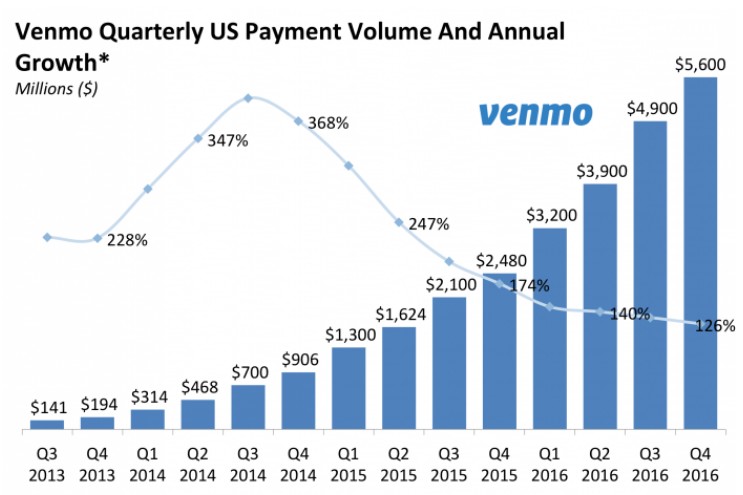
Venmo is a subsidiary of the company. It allows people to send money to friends and businesses at the touch of a button on their cell phone. Growth is off the charts. In 2015 they handled $7.5 billion in transactions. In 2016 the hit $18 billion. Wow. In the first quarter of 2017 they did $7 billion. As we said above for Nutanix, now that is growth.
At the moment Venmo is a small piece of the pie for PayPal, kind of like the iPhone for Apple 10 years ago. Tiny. But if they keep up this growth, in five years, they will be hitting $150 to $200 billion in transactions.
One forecast shows that volume of money transfers will reach $75 billion this year in the US. Volume is expected to pick up significantly by 2020, reaching $500 billion. This reflects a compound annual growth rate (CAGR) of 80% between 2015 and 2020.
PayPal itself is not a small company. The market cap is $65 billion and due to its potential, the PE is not small. It is listed at 45 and we feel it is worth every penny. As the world continues to move to mobile, PayPal is at the forefront on how to handle financial transactions simply and easily.
A Word from Gary Jefferson
Jefferson Financial Group
First Vice-President, Investments
UBS Financial Services
In ancient Roman religion and myth, Janus is the god of "duality". He is usually depicted as having two faces, since he looks to the future and to the past. What we are seeing today is a "Janus" market: One face is looking at a new era of higher earnings and economic growth while the other face is forecasting a dire end to the market based on past actions.
Two weeks ago, JP Morgan went on the record warning investors of an equity market collapse. The bank thinks that a number of factors will undermine stocks such as Fed rate hikes coupled with decreased easing from the European Central Bank and Bank of Japan. The bank further said it thinks the coming plunge in stocks will be steep, citing the possible emergence of “tail risks”, or seemingly unlikely scenarios which could have big negative effects on stocks. Bank of America also weighed in on the possibility of a coming fall, saying that “peak liquidity and peak profits mean a big top in autumn.” These warnings tie in to the core belief of this side of the Janus face which is forecasting imminent danger to the market; i.e., these experts, analysts and investors believe that the entire 2009-2017 stock rally is nothing more than the result of a historic, globally coordinated credit creation program from the world's major central banks, and this credit expansion is now unwinding.
While it is a fact that every major central bank in the world has done some qualitative easing over the past eight years, pumping the world full of cash, the other side of the Janus face is telling us that there is no hard proof that this global credit expansion is the sole reason behind stock prices moving higher.
We believe the Janus side which sees that market moves and valuations still come down to one single word – earnings, and which sees that future earning prospects are now rising, not falling. What we haven't heard from any of the doomsters is how far earnings are going to fall, or even that they are going to fall at all. Nor do we see a dotcom bubble with 100 PE multiples or a real estate bubble financed by NINJA loans*. A 10% correction is considered a "normal" market occurrence, so that possibility exists at any given point in any market's history. But a major crash is typically accompanied by a bubble or recession which collapses earnings, and we don't see clear cut warnings signs of either.
* A NINJA loan is a slang term for a loan extended to a borrower with "no income, no job and no assets"
All of which brings us to this point: the market has always loved "to climb a wall of worry".
[BMR thoughts: This dichotomy of half the folks thinking things will get worse while half the people think things will get better is nothing new. In fact, virtually every day for the past 100 years people have felt that way. That’s what makes a market. And we at The Bull Market Report are optimists and bullish on America. We along with Warren Buffett believe values will be higher a year from now and five years from now and we will continue to invest accordingly.
[With that said, if it’s too hot, get out of the kitchen and get into any or all of the stocks in the High Yield and REIT portfolios and sit back and collect the 6%, 8% and 10% dividends these stocks offer.]
More on Facebook and This Big Number: 2 Billion
Despite Facebook’s size and age, at 17% its user count is growing as fast or faster than any year since 2012. And people aren’t using it less either. In fact, 66% of Facebook’s monthly users return each day now compared to 55% when it hit 1 billion.
Two billion makes Facebook the largest social app. YouTube has 1.5 billion, WeChat’s has 900 million, Twitter’s has 330 million and Snapchat’s is around 250 million.
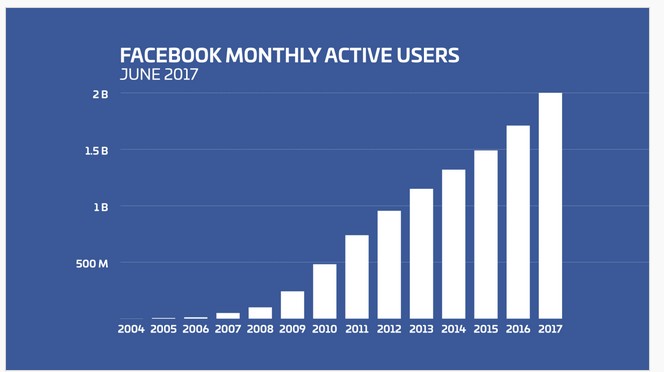
Facebook’s growth the last five years has been fueled by the developing world. It’s added 750 million users in Asia since hitting 1 billion users total. It’s only added 40 million in the U.S. and Canada. Facebook has set a goal to help 1 billion users become part of what Zuckerberg calls "meaningful groups," in a push to reverse what has become a pronounced decline in community membership around the world. Stronger community engagement on and offline will be key to solving critical global problems like climate change and public health issues, Zuckerberg said.
“A more connected world is going to be necessary to take on the greatest opportunities and challenges for the next generation, everything from stopping climate change, to stopping pandemics, to funding research,” Zuckerberg said. “These are not fundamentally national problems anymore. In order to get there, you need to build a world where every person has a sense of support and purpose in their life so they don’t just focus narrowly on what’s going on in their lives, but can think about these broader issues as well.”
Facebook now has 27% of the people on the planet on their platform. In August, 2015, the firm hit 1 billion users. It took the firm less than two years to double in size, adding another one billion users. Wow. That’s an average of 1.4 million users a day. Do you think this growth is going to stop? We say NO WAY. And with this young genius at the helm, we will follow him anywhere. $200 a share? Certainly a possibility. Any bets on WHEN this will happen?
Thoughts on UPS (UPS: $111, flat)
UPS has a $10 billion pension deficit. We are not happy they let themselves get into this predicament. They have said they will freeze its pension plan for nonunion workers and replace it with a 401k plan. The switch will affect 70,000 employees over five years.
BMR Take: We are not happy about this. The stock market has had no reaction to this news, as the stock was flat all last week. But we are here to look into the unknown future. Could it affect the stock? It sure could. It just might be time to take profits. We added the stock at $105 in April last year. It sure hasn’t done much these past 15 months. Yes, it pays a 3% dividend, but that’s really not much. Yes, we are up 5% plus the dividend, but that’s really not terribly exciting. It certainly is a solid company and stock. Amazon is changing the world and UPS is right there to deliver that change. But it may just be time to move on out and into something much more interesting. This $96 billion market cap company has some problems. So, if the stock drops to $106, we are out.
The High Yield Corner
By Michael Foster
We saw the market turn ugly on Thursday in the kind of selloff that investors should actually appreciate. This was largely concentrated in Tech stocks, with the Nasdaq falling a lot more than the S&P or Dow Jones, which meant that the more stable and less speculative asset classes were spared significant declines. Some, like a few high yield assets, actually went up as the Tech stocks went down. Is this a rotation from growth into value and income? One day does not a trend make, so we can’t say for sure. But it’s definitely something to look more closely at as we drill down into the most important moves in the high yield world for the week.
Bull Market Report pick the AllianzGI Equity and Convertible Income Fund (NIE: $19.75) was able to withstand Thursday’s selloff with marginal damage, closing the week flat. The fund’s net asset value also closed on a relatively strong point, resulting in the fund’s discount to remain at a solid 10%. We have seen that discount rapidly fall from the start of 2017. We’re now at one of the highest discounts to the fund’s NAV since 2014, which might encourage some investors to sell. And, indeed, if one wanted to take profits on this fund, now would be one of the better times to do so. However, investors should also consider that the fund is in a better position to cover its dividend than it has been in a long, long time. The fund’s NAV, at $21.88, has gotten to a point where the fund’s managers need to only get a 7% net rate of return to cover the fund’s dividend. Considering the fund’s holdings and its use of convertible bonds, as well as the broader trend towards higher interest rates thanks to the Federal Reserve, there’s a lot of justification for the view that the fund will continue to cover its dividend. That makes this as good of an income producing fund to hold than ever, so income-focused investors should consider holding the fund to continue to collect those dividends.
Of course, the biggest news of the week for the Bull Market Report’s High Yield portfolio was Government Properties Trust (GOV: $18.31), which announced its intention to purchase First Potomac (FPO: $11.10) for $11.15 per share in cash. The deal, announced on Wednesday, immediately caused Government Properties to fall. The selloff continued shortly thereafter when the REIT announced it would sell 25 million shares in a secondary offering, with shares priced at $18.50 - $1 below the stock’s price at the time of the announcement, but $4 below the price on Monday. All of this has hit the stock very hard, and it’s down 19% in a week’s time.
That also means Government Properties Trust is now just 2% higher than it was when we recommended the stock, erasing a year’s worth of solid capital gains overnight. While these kinds of moves are unfortunate, it’s important to remember that investors have earned about 12% in cash dividends over that period, so while the capital gains are gone, the income stream has already made this a positive-returning investment. The issue now is how investors should act given the recent acquisition.
Let’s take a look at the figures. First Potomac has 11 million square feet of office space in the Washington, D.C. area, which fits nicely with Government Properties’ own 95-building portfolio across 73 properties. While Government Properties has invested in D.C., it is much more widely diversified, which in the past was seen as a risk factor because the firm was seen as intensely exposed to cash-strapped municipalities and local governments who were cutting jobs and thus had a lower need for physical office space. Now that President Trump is in office and has promised budget cuts, does this mean that the D.C.-focused First Potomac is similarly at risk?
We say no. Since Trump’s election, the First Potomac has risen 26%. Part of the reason for this may indeed be Trump himself. Non-profit organizations, think tanks, lobby groups, and media companies have put more attention and focus on D.C. than we have seen for years, arguably decades; that means they need to rent offices. And that is a natural tailwind for First Potomac Realty because it drives demand for real estate in and around the Beltway.
Government Properties’ decision to buy into this newfound demand makes sense. Nonetheless, the deal is done and First Potomac has rising rents and high occupancy rates on its books when the deal closes. This is going to make Government Properties Trust’s dividend theoretically safer than it has been before.
For this reason, there is no reason to sell Government Properties stock right now - and perhaps more reason to buy as this temporary selloff due to the acquisition will not last forever.
Elsewhere in REITs, Bull Market Report’s recent pick Apollo Commercial Real Estate Finance (ARI: $18.55) was up 1% this week after the dividend payout on Wednesday of a 46 cent distribution in-line with the previous payout in March. Apollo Commercial continues to show incredible strength and remains one of the more reliable income generators in the mortgage REIT marketplace. The stock is up 15% from a year ago and we see more room for it to rise even further, bringing its current near-10% yield down a notch. Investors should consider buying now following the dividend payout and slight stock price decline to capture this great income payer at a low price.
Quote of the Day
Listen more than you talk. Nobody learned anything by hearing themselves speak.
Richard Branson,
Founder of Virgin Atlantic Airways and Virgin Group
Good Investing,
Todd Shaver
Founder, CEO and Editor in Chief
The Bull Market Report
Since 1998