
The Week Ahead
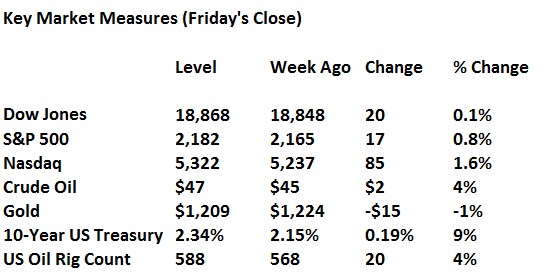
We finished this week above the fresh all-time highs set just a week ago. But we raise the question - have we come too far to fast? The frenzy seen post- election is seemingly pricing in a lot of good to come from new leadership in Washington. Are expectations reasonable or too aggressive? We note that Caterpillar recently said even if a $1 trillion infrastructure spending bill was passed today, it would take at least a year for projects to start, given the timelines for making the equipment needed. And we haven’t yet passed a $1 trillion infrastructure bill nor have we any clarity about how one would be funded. This infrastructure example highlights one market over-reaction to Trump, which is happening across many more sectors.
Good stock picks can make money in any market. This week we provide some insights on our latest thinking for Under Armour, Tesoro, Facebook, Amazon, and Microsoft.
Highlights From The Past Week
Repatriation. Many people are asking the question - If new leadership in Washington does lower repatriation taxes so that US companies bring home the $2+ trillion currently parked overseas, what will the money be used for?
The prevailing view at this time seems to be that much of the capital repatriated from overseas will be returned to shareholders, via repurchases and dividends. This is good for the stock market and for investors like us. However, we need to keep a close eye on how everything develops. Some are saying if the money just goes to buybacks and dividends rather than capital expenditures, then we won't see the big benefits to job growth and middle class income. There is talk of a flat 10% repatriation tax which should bring billions back to the US, but we’ll have to wait and see!
Fiscal Stimulus. Like Andrew Jackson’s populism, people are saying that we’re going to build an entirely new political movement: It’s everything related to jobs. They will be able to push a trillion-dollar infrastructure plan. With negative interest rates throughout the world, it’s the greatest opportunity to rebuild everything. Ship yards, iron works, new infrastructure projects get them all jacked up. We can just throw it up against the wall and see if it sticks. It will be as exciting as the 1930s, greater than the Reagan revolution. Exciting times! (We shall see.)
Interest Rates. The bond market bloodbath continues. The 10-year US Treasury yield is up a stunning 65 basis points from the Trump-win lows, spiking to 2.35% - the highest since December 2015. In fact, the entire Treasury yield curve is now higher in yield on the year, leaving most of everything newly issued in 2016 now under water. We are going to have to keep a close eye on where rates stand going forward. The cornerstone of fiscal stimulus will be low rates. But if the bond market re-prices rates much higher, the increased interest expense could throw a wrench in gears turning all of the current excitement.
BMR Companies and Commentary
Facebook (FB: $121, up 3% today)
Again, Facebook has found more miscalculated advertising metrics. The company said it has uncovered several more miscalculated metrics related to how consumers interact with content from marketers and publishers, and it unveiled additional independent review of some measurements to calm unease over the their data. An internal metrics audit found that discrepancies led to the undercounting or overcounting of four measurements, including the weekly and monthly reach of marketers' posts, the number of full video views and time spent with publishers' Instant Articles.
Does it matter? Should we be worried? What is the impact?
None of the metrics in question impact Facebook's billing. The only financial impact would be from customer perception about what has occurred, leading to customers shying away from spending money to advertise with Facebook because they have new concerns over these metrics. It is a stretch to go there. Facebook has well over 1 billion users. Just because a few mistakes were made on some back-office tasks doesn’t change how the business model connects advertisers to world. (We are not discounting this issue, but we think the market will perceive it to be a small matter. The company is already working on the PR to reduce the impact on perception.)
Let’s stay focused on what matters. Recall, it was a stellar quarter just recently reported. Facebook's Q3 earnings update that came in better than expected on top line revenues of $7.0 billion versus the $6.92 billion consensus and EPS of $1.09 was ahead of the Street's $0.97 expectations. Daily active users of 1.18 billion and monthly active users of 1.8 billion were both ahead of the Street's expectations as well. Management offered updated guidance on expense growth of 40-45% that was lower than the prior 45-50%. The negative takeaways were comments about decelerating revenue growth and heavy investments in 4Q16 and 2017. Many people think this was just management setting the bar low so they can beat it more easily. We agree.
BMR Take: If the first time miscalculated metrics didn’t shatter the Facebook growth story, we don’t think the second time around will. Clearly an operational mistake we don’t like to see, but we don’t see reason to exit our position in the stock over it. We think the company is set up to deliver better than expected financial results over the next several quarters. Stick around!
And this just in: Facebook will repurchase up to $6 billion in stock (first time they have ever done a stock buyback.) The buyback will start in the first quarter of 2017, using some of their $26 billion in cash. The market liked the news: the stock was up over a $1 in after-hours trading Friday.
BTW, we just noticed that Facebook’s all-time high is the same as Apple’s - $134. We wonder who will get their first. Our guess? Facebook. Why? Smaller market cap - $340 billion vs. $590 billion. Higher growth rate. So now we have two races to watch. Google vs. Amazon is the other. They both closed at the same price Friday. Love it!
Amazon (AMZN: $776, up 3% last week and up $16 today)
The word is CEO Jeff Bezos is telling executives to “Do what it takes to succeed” in India. Amazon fell a little behind in China early and business never quiet was able to recover to be as big as it could have been. Bezos is going on all in on India to ensure the same thing doesn’t happen twice.
Amazon had been India’s #2 ecommerce player. But that has changed. Bezos is now communicating to the market that Amazon has pulled ahead to be #1, with market share estimated around 28%.
India is a huge opportunity for Amazon. India has a population of 1.2 billion with about 40 million online shoppers. Goldman Sachs calls for ecommerce sales in India to grow 10-fold from today’s level of $11 billion over the next decade. And since only about one-third of Amazon’s sales are international, there is tremendous room for growth here. We understand that Bezos is going to invest another $3 billion in June into the India operation, in order to make the business even better. Amazon currently has over 80 million products selling in India. (This is not a misprint.) And they have more than 120,000 sellers, compared to 40,000 sellers a year ago. In June, the company said it will invest an additional $3 billion in India after it exhausted its earlier investment pledge of $2 billion. The company also launched its Prime membership program in July in more than 100 Indian cities, offering one-day and two-day delivery
BMR Take: Amazon’s stock has been down since the latest earnings report. The concern is that they are in a short term cycle of big investment spending. This news of more investments in India certainly plays right into the bearish outlook. Long-term, we think every dollar Bezos spends re-investing in the business will pay dividends later on. In the near-term, we brace for negative sentiment about how profits are being weighed down today due to these investments. Listen, we are not negative on the company nor the stock. We just want to give you both sides of the story. In fact, we think the market will shrug off this news and do what it always does, buy the story of bigger is better, awaiting huge profits in the future. But you never know…
Microsoft (MSFT: $61, up 2% last week)
Goldman Sachs upgraded the stock to Buy with a $68 price target. What’s the story here? Why did they upgrade? What are they now saying? Why is Microsoft all the sudden a buy?
The company got off to a strong start to FY17 as revenue and EPS came in above consensus estimates. The strength was driven by growth of Azure (the cloud business) and adoption of Office 365 (the web version of Office).
Many are now expecting the upcoming quarter to be an inflection point for Microsoft, as the company will complete the sale of its phone business and the acquisition of LinkedIn, signifying the end of the old and the beginning of the new.
We believe the integration of LinkedIn will enhance the value proposition of Microsoft’s entire platform, including Azure, Office 365, and Dynamics. As such, we believe the best is yet to come as we expect revenue growth acceleration and margin expansion ahead.
BMR Take: Glad to see Goldman Sachs come around to support our outlook. What a humbling game investing is. The world’s most powerful investment bank is playing catch up to a little tiny newsletter service out of Aspen, Colorado.
Goldman Sachs (GS: $210, +19% in the past two weeks)
Financials including Goldman Sachs rallied the most this past week. With rates finally rising, a steeper yield curve is good for banking and capital markets. More importantly, plans to roll back regulation are coming, which is huge for all of Financials, as they have had a bad stigma for years under the Elizabeth Warren era of denouncing Wall Street.
The regulatory discussion is currently all over the map right now about what we could see. The end of Dodd Frank? The termination of the Consumer Financial Protection Bureau? No more Volcker Rule allowing proprietary trading (again)? Some even say Glass-Steagall* could be on the table (again). Note that Trump has called for a general guideline of allowing new regulations to be implemented only if they replace two existing regulations. This all amounts to positive implications for Goldman Sachs.
*The Glass–Steagall Act describes four provisions of the U.S. Banking Act of 1933 that limited securities, activities, and affiliations within commercial banks and securities firms.
One more thing to ponder - who will Trump name as Treasury Secretary? The position once held by Alexander Hamilton is considered one of the highest honors in all of Finance for those asked to serve. Rumors are floating that Goldman’s CEO Lloyd Blankfein is possible candidate, as well as CEO Jamie Dimon of JP Morgan Chase.
BMR Take: Goldman is the #1 investment banking franchise. The investment banking business follows a boom-bust cycle. With the sharp rally recently, we are implementing a stop at $196 to protect our gains but we do not want you to miss more upside if the train keeps rolling. We added the stock at $147 in February, so we are up 43% in nine months.
Upcoming Economic News
Tuesday, November 22nd
Existing Home Sales – October
Time: 10:00 am
Forecast: 5.46 million
Existing home sales are projected to be little changed in October with tight inventories constraining transactions. Sales fell 0.4% year-over-year last quarter for the first decline of the past two years. Sharply rising Treasury bond rates will feed through into higher mortgage rates, adding another impediment to existing home sales growth.
Wednesday, November 23rd
Durable Goods Orders – October
Time: 8:30 am
Forecast: 1.0% overall, 0.2% ex transportation
Rising aircraft orders in October following two straight deep monthly declines can lead a strong overall gain in durable goods orders. Industrial demand has shown some recent promise; core capital goods orders increased 5.2% annualized in the third quarter against the previous quarter. Yet that recent burst in activity is tempered by the weak long-term trend; such orders fell 4.1% year-over-year during the same period.
New Home Sales – October
Time: 10:00 am
Forecast: 585,000
New home sales can dip a bit in October yet still point to strong long-term growth. Third quarter sales rose 23% year-over-year, as volumes continued to trend higher from depressed post-crisis levels. Though up substantially on an annual basis, last quarter’s 600,000 unit annualized pace trails the average rate of the past 20 years by 18%.
University of Michigan Consumer Sentiment – November
Time: 10:00 am
Forecast: 91.6
The post-election bounce in the stock market may ultimately feed into somewhat higher readings in consumer sentiment. The preliminary reading in the November Michigan survey was the highest in five months as consumers are reporting improved financial conditions. Renewed declines in oil prices can also spur stronger inclinations to increase spending on other items.
FOMC Meeting Minutes
Time: 2:00 pm
Given the jolt to interest rates and inflation expectations following the election, the minutes of the early November FOMC meeting will be somewhat stale. Yet the general push toward hiking the Fed Funds target in December will likely find additional support in the minutes. The next key question for monetary policy is how much policy tightening is likely in the year ahead. Economic projections released by the Federal Reserve next month will provide crucial guidance on this subject.
Twilio (TWLO: $37) had a good week, rising 17%. We’ve said many times how much we like this one, but the market has been hammering the stock these past few weeks. The turnaround in a week when most Tech stocks were hit hard, is impressive. Again, we think this is a $75 stock if they continue their phenomenal revenue gains that we saw in the past few years, and certainly last quarter. Twilio did $167 million in sales last year, up from $90 million the year before and the company is on a $1 billion annual run rate by the second half of 2018. Can’t wait for next quarter’s earnings. If strong, the stock should get back to the 50s and 60s in no time.
The Energy Corner
North Dakota’s crude-oil production in September dropped to the lowest level in more than two years. Crude production fell 1.1% on the month to 970,000 barrels a day in September, the lowest level since February 2014. North Dakota is home to the Bakken Shale formation, one of the world’s highest-cost oil fields. Growing confidence that crude prices will rise in coming months is sustaining the expansion of oil drilling in the shale patch. Rigs targeting crude rose 19 to 470 this week, the biggest increase in the last 16 months, according to Baker Hughes data reported Friday. Shale drillers have now added 155 rigs since an expansion started at the end of May. Gas rugs were flat, bringing the total for oil and gas up by 20 to 588.
This news just in - the Obama administration on Friday banned offshore drilling in the Arctic, setting a likely collision course with President-elect Donald Trump, who has vowed to “unleash” new energy production in the United States by rolling back restrictions on oil. Great – a new story for us to worry about.
So, US rig count is up sharply, which should produce greater volumes as we move into 2017. This counteracts the move by OPEC to cut production, which hasn’t been approved yet, and may indeed never happen
Interest Rate Corner
Federal Reserve Chairwoman Janet Yellen reiterated that an increase in short-term interest rates "could well become appropriate relatively soon" but offered no new signals about what the central bank will do at its meeting next month.
We are in the camp at The Bull Market Report that a ¼ point rise is baked in for December. Of course, she could surprise us with a ½ point rise, which would probably tank the markets like what happened last December. We hope she maintains some sense here. The 10-year Treasury note has exploded, from a low of 1.37% in July to 1.80% before the election to 2.34% Friday.
Tesla Update: It’s official: Tesla (TSLA: $187, down 2% last week) shareholders approved the acquisition of SolarCity. The company is now an unequivocal sun-to-vehicle energy firm. And Chief Executive Officer Elon Musk didn’t take long to make his first big announcement as head of this new enterprise. Minutes after shareholders approved the deal - about 85 %of them voted yes - Musk told the crowd that he had just returned from a meeting with his new solar engineering team. Tesla’s new solar roof product, he proclaimed, will actually cost less to manufacture and install than a traditional roof - even before savings from the power bill. “Electricity,” Musk said, “is just a bonus.”
If Musk’s claims prove true, this could be a real turning point in the evolution of solar power. The newly announced rooftop shingles are made of textured glass and are virtually indistinguishable from high-end roofing products. They also transform light into power for your home and your electric car.
“So the basic proposition will be: Would you like a roof that looks better than a normal roof, lasts twice as long, costs less and - by the way - generates electricity?” Musk said. “Why would you get anything else?” On a large house over a long period of time, the value of that electricity could exceed $100,000. The new roofing material he unveiled this past week is considerably cheaper, and it's considerably more promising for the future of rooftop solar power.
We love Musk. He never ceases to amaze and shock. Can he pull this off? Will he have enough cash to make it work? We think yes. But again, this stock could hit $150 before it hits $250. Volatile!
Goldman Sachs Maps Out Its Top Market Themes for 2017
They're heavily influenced by President-elect Trump.
Goldman Predicts: U.S. recession risk remains low in 2017
Goldman released its top 10 market themes for next year. "High growth, higher risk, slightly higher returns," is how their strategists view the year ahead - and it's clear that their outlook has been heavily influenced by the pending regime change in Washington.
Here's a brief summary some of the themes Goldman sees as forming the backdrop for investing in 2017. All thoughts and comments are for Goldman.
Expected returns: Only slightly higher
Relative to its 2016 forecasts, Goldman says owners of financial assets can reasonably able to expect more upside - but stresses that these returns will still likely remain low. The best improvement in the opportunity in global equities is in Asia ex-Japan, where we forecast returns of 12.5% (versus 3.8% for 2016.) At the other end of the equity spectrum, in Japan we are forecasting declines of 3.7% on the Topix (vs. +5.2% for 2016).
U.S. fiscal policy: A pro-growth agenda
President-elect Donald Trump's focus on infrastructure spending during his victory speech on Nov. 9 - rather than trade protectionism or immigration restrictions - catalyzed the risk-on sentiment that's pervaded markets.
Markets are starved for growth
This is plainly visible in the eagerness with which markets seized on Trump’s growth-focused message. It is also visible in the speed with which the market’s narrative on the economic outlook under Trump has shifted from uncertainty to growth. Fiscal stimulus in the U.S. will help reflate the economy, and stands a good chance of passing through Congress.
U.S. trade policy: Concerns are likely overdone
Goldman doesn't see an imminent trade war on the horizon, and expects any re-negotiation of agreements currently in place (like NAFTA) to focus on attempts to improve the prospects for the U.S. manufacturing sector. We think the popular media narrative on the downside risk of a trade war is overstated. Our tentative view is that Trump’s use of punitive tariffs will be just as pragmatic as President Obama’s, albeit more vocal.
Emerging markets risk: “Trump tantrum” is temporary
Emerging market assets have been crushed since the election, as the rise in Treasury yields has reduced the need to reach for yield overseas, and the potential for protectionist trade policies threatens to curtail growth opportunities.
Monetary policy: Focusing the toolkit on credit creation
Better-targeted monetary stimulus could help avoid some negative side effects associated with quantitative easing and negative rates that inhibit credit creation.
Corporate revenue growth recession: Signs of inflection
For years, S&P 500 companies have exceeded analysts' expectations on the bottom line more often than the top line during quarterly earnings seasons, as a combination of cost-cutting and shrinking share count, rather than soaring sales, fueled the growth in earnings per share. However, Goldman expects 2017 to confirm that the U.S. corporate sector has emerged from its recent 'revenue recession.' A firming global economy and recovery in oil prices from their February lows significantly buoys the outlook for revenue growth stateside.
For 2017, Goldman expects that modest improvements in the macroeconomic backdrop will help lift S&P 500 operating EPS by 10% and they have a year-end S&P 500 target of 2200, currently 2180 now. [Not terribly exciting if you ask us. We differ. We don’t normally predict, but we would certainly be looking for 2300 or 2400.]
Inflation: Moving higher across developed markets
Market-based measures of inflation expectations in the U.S. have spiked since the election, as traders bet that Donald Trump will be the inflation president.
What seems clear to us, as argued above, is that economic issues, notably tax cuts, infrastructure spending and defense spending, are high on the agenda - a recipe for reflation. We are forecasting large boosts to public spending in Japan, China, the U.S., and Europe, which should fuel inflationary pressures in those economies.
The next credit cycle: Kinder and gentler
While commodity-sensitive segments of the credit market have suffered pain in 2016, there hasn't been much in the way of contagion. Goldman's team expects more of the same in 2017, with the credit cycle not making a turn for the worse. The strong ‘business cycle’ component in the behavior of high yield defaults, and our view that U.S. recession risk remains low in 2017, leave us comfortable with the view that the inflection point is unlikely to materialize next year, despite the weak state of corporate balance sheets.
Mortgage Rates Surge After Election
Here is some news on the state of the mortgage market. Mortgage rates surged after the election win of Donald Trump. But housing experts say consumers shouldn't get carried away by the post-election wave. The advance of the past week or so, stoked by a surprise victory that turned economic expectations on their head, could soon settle.
"Consumers considering buying or refinancing now should stay patient, as we'll likely see rates stabilize once markets find a new equilibrium," says Zillow, the mortgage rate real estate company.
In the week ended Thursday, the average rate on the 30-year fixed-rate loan jumped to 3.94% from 3.57% the previous week, mortgage company Freddie Mac reported. A year ago the market was at 3.97%. The average for a 15-year mortgage climbed to 3.14% from 2.88%
The High Yield Corner
We have seen our first full post-Trump trading week, and it wasn’t bad. Actually, things were impressive considering the expectations and last week’s bull run. The S&P 500 rose nearly 1% by the end of the week, but the really interesting story is the difference between different stock groups. Large caps underperformed small caps significantly - this has a lot of important implications for high-yield investors, so is worth a closer look.
The Dow Jones Industrial was pretty much flat last week, while the Russell 2000 went up 2.6%. The difference between these two is the result of different trends between different investors: the risk-averse are more worried than the less risk-averse, who are willing to give small caps a chance in the hopes that they will deliver the higher-than-big-cap returns that they gave in the past. This has pushed small caps up to a 17% year-to-date return after rising 8% in the last month.
But here’s the really interesting part: the Dow Jones is up 10% year-to-date after a 4% return over the last month. The S&P, however, is up 7% year-to-date after rising 2% in the last month.
What this means is that risk appetites have grown in the last month while the more cautious are less eager to jump into the Trump rally. They aren’t avoiding it, but they aren’t going into it as much as the more risk-tolerant investors. In other words, we’re having a growing disagreement about future risks with the economy as a whole.
This is not uncommon, but wasn’t the case earlier in 2016. Both large caps and small caps had similar high returns for much of 2016 - and now that convergence is subsiding.
This is important for high yield investors for two reasons. First, junk bonds and BDCs tend to trade closely with small cap stocks as they attract similar investors: risk-tolerant institutions. Second, a market where the risk-averse are more cautious and the risk-hungry are less so often portends a bubble followed by a crash. That is not in the cards quite yet, but it does make one wonder if the industries getting a big boost - Financials in particular - might get overbought if they haven’t already.
With this as our backdrop, let’s take a look at how each asset class performed in the last week and why:
REITs - Initially REITs were the hardest hit by Trump’s victory on fears that his spending plans would kickstart inflation and thus increase REITs’ borrowing costs. This remains a concern, as the U.S. Treasury 10-year keeps going higher, but we’ve finally gotten to a point where the risks are priced in. Fortunately for REITs they already began correcting before the election, so this week’s return was just barely green, according to the SPDR Dow Jones REIT ETF (RWR: $89. Flat).
Results for individual REITs varied, but our picks did OK. Kimco Realty (KIM: $26) rose slightly, Digital Realty Trust (DLR: $90) rose over 1%, Omega Healthcare Investors (OHI: $28) was flat, Care Capital Properties (CCP: $24) rose 4%, and Government Properties Income Trust (GOV: $18.90) rose less than 1%. We also added a new REIT to our portfolio: Ventas (VTR: $60), which rose 2% this week. Ventas is one of the few REITs that is up year-to-date in the Healthcare space: rising 6% so far this year, but its price-to-FFO ratio and growth potential make it extremely attractive.
Junk bonds - The corporate bond market is now dominated with changing inflation expectations. Love him or hate him, but the market believes Trump is going to cause inflation to accelerate. This isn’t a testament to his failures or abilities, however; much of these expectations are the end result of the Fed’s constant efforts to improve inflation rates and a time when low oil prices and high supplies are priced in. There are many reasons beyond Trump to think inflation will not stay low forever, and having a president in the office (whoever it may be) who is focused on rising inflation with a House and Senate that will work with him, almost seems a perfect formula for rising inflation.
That is why junk bonds have done particularly badly after Trump, but the real surprising thing is that they didn’t do poorly for longer. Last week the SPDR Barclays High Yield Bond ETF (JNK: $36) rose over 1% and is now up 5% from the beginning of the year. Yet the fund has a near 7% dividend yield that is far higher than it has been in recent years. This is partly because of expectations of a rate cut for the fund*, which has happened in the past, so it’s important to keep in mind the more actively managed alternatives that aren’t tied to an index** and thus have more flexibility to ensure payouts remain constant. Note that the ETF recently registered $342 million asset inflows for a 3.15% increase.
*JNK's distribution cut is expected because the BofA High Yield index has fallen. Since JNK tracks that, its distribution should fall too.
**Active funds like PDI vs. passive indexing funds like JNK. In other words, “alternative funds that are actively managed" makes that clearer.
Our pick to take advantage of this strategy remains Pimco’s Dynamic Income Fund (PDI: $27), which had a nice 4% gain this week to offset last week’s massive decline. The fund is still down over 4% from a month ago which means it is poised to improve in recent weeks. The fund is also now flat year-to-date with a near 10% dividend and a looming special dividend that we believe will be at least 3%. That turns this fund into a 13% dividend payer with a sustainable dividend. That is almost impossible to find in the market (we know as we’ve looked for more, but Pimco’s fund seems to be it!)
Municipal bonds - Rising interest rates are a problem for all bonds, but they are actually worse for corporate bonds than municipal bonds because of the risks and the way these are structured. Yet looking at the municipal bond world lately, you’d think it’s the riskiest asset in the world. The iShares National Municipal Bond ETF (MUB: $108) fell 1% this week and is down 3% over the last month. The ETF is also down 2% for the year, making municipal bonds one of the few asset classes that has had negative returns for the year.
We have been wary of municipal bonds this year because of their massive run-up before the summer and rate hike concerns. We don’t believe rate hikes directly are a drain on municipal bonds, but fears about rate hikes often overshoot the real risks and cause a big and prolonged selloff. We saw this in 2015 and have seen this to a lesser extent this year. This is why we have only recommended one municipal bond fund this year: the Nuveen Enhanced AMT-Free Municipal Credit Opportunities Fund (NVG: $14:04). The fund is down 2% over the last week and is down 3% year-to-date. The most shocking figure is the three-months metric: the fund is down 14% in that time.
We expect these massive declines to reverse, but it is going to take a while for that to happen and it is difficult to time. While municipal bonds are already oversold, that does not mean the market knows they are oversold, and they can go down even lower. Nuveen’s fund is a good long-term hold and we expect it to hold its NAV for the long term, as it has done for over a decade already. However, we also expect greater volatility to hit this and all municipal funds. Anyone wishing to invest in munis now will have to endure these short-term price declines with patience, buying more as the stock goes down.
From one extreme of the risk/reward spectrum to the other, let’s turn to BDCs. The UBS BDC ETF (BDCS: $22) rose over 1% over the last week and has had a somewhat strong showing after the Trump election. While BDCs aren’t going up nearly as much as Financials, they are both rising for the same reason: an expectation that deregulation is going to cause credit to flow and the Financial sector to boom. BDCs cannot help but benefit from this, so they are rising with the Financial sector. However, they are not rising from an extreme bottom as Financials are, so the asset class’s 2% monthly return is a fraction of the double-digit returns of the Financial sector as a whole. This is unlikely to change.
At the same time, we have finally gotten to a point where Main Street Capital (MAIN: $36.50) has gotten overbought. The BDC is now up 16% from when we recommended it in April after rising 8% in the past month alone. We waited for this week’s dividend distribution to see if the stock would fall further after the payout, but it hasn’t; in fact the stock is up over 1% after its recent payout. That now means Main Street is selling at a 70% premium to its net asset value and it has passed our target price. We are keeping our price targets on Main Street, which means recommending selling at these levels and waiting for the price to correct before jumping back in. Main Street remains an excellent firm with impressive advisors and the capability to increase dividends for a long time, but the cost of that expertise and growth potential is too high now. We will buy again when the stock is more fairly priced.
Good Investing,
Todd Shaver, Founder and Editor in Chief
The Bull Market Report