
The Week Ahead
The stock market hit fresh all-time highs on news of the Donald Trump victory. This was despite one of the larger components of the market, the Technology sector, trading lower. The rally is being fueled by the outlook for what new leadership brings to Washington and its future impact on the economy and financial markets. It is not as much Trump the markets are cheering, but rather the Republican sweep of the White House, the Senate, and the House, because for the first time in quite a while the balance of power falls with one party, meaning there finally will be an end to at some of the gridlock we all have become numb to.
That said, stocks have moved higher fast and could be pricing in too much optimism about how much change can come and how quickly. This week we provide some insights on our latest thinking for Goldman Sachs, Amazon, Home Depot, Bristol-Myers Squibb, Annaly Capital Management, and Netflix.
Highlights from the Past Week
In this edition of ‘Highlights from the Past Week’, we recap what are being discussed as the key things to watch for from new leadership in Washington.
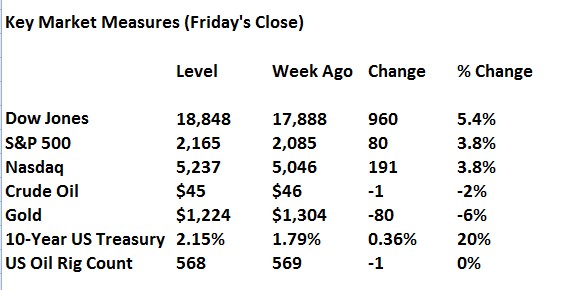
Investors embraced the election of Donald Trump as president, snapping up stocks and selling bonds in a bet the Republican's plans for fiscal stimulus will succeed in breaking the U.S. out of a post-crisis economic funk. The Dow had its best week in five years.
The Dow Jones Industrial Average rallied on Monday and then posted its second large gain of the week Thursday, rising 257 points to 18,590, led by a rally in Financial and Healthcare firms. Meanwhile, the yield on the 10-year U.S. Treasury note surged to 2.07%, its highest level since January. Then on Friday, the Dow set another all-time high, closing up 40 points to 18,847, even though the overall market was down a shade.
Tax Reform & Budget Policy. Corporate tax reform is probably the top Republican priority. Expect lower taxes rates here and the end of double taxation on overseas earnings. Congress may target eliminating corporate deductions, but will be pressed to maintain small business tax breaks. Trump has proposed infrastructure spending programs of at least $500 billion over 5 years with an increase in the defense budget of 15%.
Trade. The White House will seek to tax imports and renegotiate proposed and existing trade deals. Extensive tariffs may quickly generate opposition from the many US firms whose supply chains stretch overseas.
Immigration. Trump’s plans to build a wall along the Mexican border and threats to deport many immigrants remain controversial. Republicans in Congress are likely to support improved border security and law enforcement but reject the more contentious issues of a wall and large-scale deportation.
Economic Policy. The administration and Congress may reach consensus to support fossil fuels and approve the energy pipeline projects that have stalled on environmental concerns. There have been proposals for a temporary moratorium on new financial and environment regulations.
Healthcare. Republicans and the President-elect both agree with repealing and replacing the Affordable Care Act. The new program is likely to feature market-oriented solutions, such as health savings accounts. The use of block grants to states for Medicaid spending could grant states flexibility (but may not cover all constituents.)
BMR Companies and Commentary
Goldman Sachs (GS: $204, +16% for the week)
Financials including Goldman Sachs rallied the most this past week. With rates finally rising, a steeper yield curve is good for banking and capital markets. More importantly, plans to roll back regulation are coming, which is huge for all of Financials, as they have had a bad stigma for years under the Elizabeth Warren era of denouncing Wall Street.
The regulatory discussion is currently all over the map right now about what we could see. The end of Dodd Frank? The termination of the Consumer Financial Protection Bureau? No more Volcker Rule allowing proprietary trading (again)? Some even say Glass-Steagall* could be on the table (again). Note that Trump has called for a general guideline of allowing new regulations to be implemented only if they replace two existing regulations. This all amounts to positive implications for Goldman Sachs.
*The Glass–Steagall Act describes four provisions of the U.S. Banking Act of 1933 that limited securities, activities, and affiliations within commercial banks and securities firms.
One more thing to ponder - who will Trump name as Treasury Secretary? The position once held by Alexander Hamilton is considered one of the highest honors in all of Finance for those asked to serve. Rumors are floating that Goldman’s CEO Lloyd Blankfein is possible candidate, as well as CEO Jamie Dimon of JP Morgan Chase.
BMR Take: Goldman is the #1 investment banking franchise. The investment banking business follows a boom-bust cycle. With the sharp rally recently, we are implementing a stop at $196 to protect our gains but we do not want you to miss more upside if the train keeps rolling. We added the stock at $147 in February, so we are up 39% in nine months.
Amazon (AMZN: $739, -2%)
CEO Jeff Bezos has had several past run-ins with President-Elect Donald Trump. The run-ins are now putting his shareholders in a nervous place, as the outcome of this election could have implications for the stock. Using his private funds, Bezos bought the Washington Post for $250 million in 2013. The paper (and on occasion Bezos himself) has been sharply critical in review of Trump’s campaign, something which the incoming president did not appreciate. Trump has fought back saying that “if Amazon ever had to pay fair taxes, its stock would crash and it would crumble like a paper bag”; “The Washington Post scam is saving Amazon by lobbying DC to not tax online retail”; and “I would go after him for antitrust, because he’s got a huge antitrust problem, because he’s controlling so much. Amazon is controlling so much of what they’re doing.”
BMR Take: Trump is not going to go after Amazon anytime in the near future. A big chunk of this country depends on Amazon. Amazon is improving many parts of the economy. The pullback in the stock is a strong buy opportunity.
Bristol-Myers Squibb (BMY: $56, +10.5%)
Many Healthcare investors are breathing a sigh of relief now that Trump has defeated Clinton in the presidential race. Shares of Pharmaceutical giants and big Biotech firms surged this week, largely due to hopes that a President Trump will not be as concerned about high drug prices as Clinton would have been. Trump still will fight high drug prices, but it is not a top priority of his administration, as instead his first choice in Healthcare is to repeal and replace Obamacare. (The latest news now is that he will just modify the Affordable Care Act.)
Drug and Biotech companies have been under attack on Capitol Hill for the past year due to price increases for life-saving drugs like Mylan's (MYL: $38) EpiPen, so the change in the landscape is big.
Separately, this week Bristol Myers benefited from some more specific events for the company, such as: (i) licensing a new liver drug from a Japanese company for $100 million that is believed to be a $1 billion+ drug; (ii) announcing a new pact with John’s Hopkins University to research immune-oncology; and (iii) its blockbuster drug Opdivo succeeded in a key stomach cancer study.
BMR Take: We are reassured to see signs of life out of our Bristol-Myers position. The stock had come under heavy poor sentiment, but now we have a string of good news from the recent quarter’s results that promised big stock buybacks and flat operating expenses, to a more favorable political landscape, to general good news about the core business. We think the stock is putting in a firm bottom and now is a great time to be accumulating.
Home Depot (HD: $130, +7%)
This business had been sagging with US GDP running 1-2%. With monetary policy out of gas, sentiment was turning negative that sluggish growth would re-accelerate. However, now with Trump’s idea of spending $500 billion on infrastructure over 5 years, and exciting prospects for GDP growth to return to 3-4%, means a lot better backdrop for Home Depot as the economy will be picking up, and more and more people will be employed. Home Depot will be reporting earnings this week on Tuesday. Watch for any commentary on the general economic outlook, customer traffic trends, and marketing spend - as key details aside from earnings results. Just three months ago CEO Craig Menear and his team projected that comps will rise at a 5% pace for the full fiscal year, marking a slight slowdown from 2015's 7% spike, which we hear could be on track to a recovery to high single digits, considering what’s recently changed in terms of fiscal stimulus for the economy.
BMR Take: Home Depot is a blue chip on very stable ground and we expect solid performance to continue. With only 15% market share of a $500+ billion US market opportunity, this is not a stalled-out growth story by any measure.
Annaly Capital Management (NLY: $10.09, -2%)
Interest rates moved sharply higher this past week. The 10-year Treasury note moved from 1.79% to 2.15%. We have not seen such a rapid rise since the Taper Tantrum that occurred three years ago. The stock has held up well. Why? More confidence in hedging programs? Better portfolio mix? More reasonable expectations for performance in a rising rate environment? Yes. Yes. And yes.
Rates are rising because expectations now call for fiscal stimulus to reaccelerate GDP growth from 1-2% to 3-4%, which in combination with higher headline inflation figures, will perhaps force the Fed to raise rates. The jury is still out on if the 10-year will spike to 2.75% from here, hold, or give back some of the recent move. In any event, it was very re-assuring to see Annaly’s stock hold firm around $10 this week.
BMR Take: We at The Bull Market Report actually think that rates my hold here and move lower in the next few weeks and make life even more difficult for the Fed on its decision-making about the rate rise in December. Annaly has the best long-term total return record of any Mortgage REIT. The company has paid out $14 billion in dividends since inception in the 1990s. With rates up a bit just recently, Annaly’s 10.4% dividend yield continues to look compelling.
Netflix (NFLX: $115, -6%)
Another company under fire right now is Netflix. The president-elect has tweeted his displeasure with net neutrality, but there is no formal plan in place at this time to address the issue. Everybody is in wait and see mode. As Republicans prepare to swarm Washington, the fate of net neutrality, or the policy that broadband providers do not favor traffic from one source or destination over another, is in question*. Netflix has the most to gain or lose. Without net neutrality rules in place, broadband providers would be able to charge online video services for bandwidth usage, as well as priority access (guaranteed streaming quality) and favor their own services. This could potentially crush Netflix. For instance, let's look at an example of somebody who has their home internet through Comcast. Comcast could start their own streaming service, as they are already are working on. They could then provide you with unlimited internet connection to watch their Comcast streaming service, but restrict internet access for other services like Netflix.
*Net neutrality – a very complex subject. Google it for details if you are so inclined.
BMR Take: As with Amazon, we think the fear here presents opportunity. Netflix and CEO Reed Hastings are bringing a lot of innovation and customer satisfaction to TV. We just don’t see net neutrality as a top priority for new leadership in Washington and thus we continue to hold Netflix in high regard as they continue to build their customer base and work on new content in their quest to become the next big TV network.
Upcoming Economic News
TUESDAY, NOVEMBER 15
Import Price Index* – October
Time: 8:30 am
Forecast: 0.3%
Import prices are projected to rise for the second straight month in October, bringing the index nearly even with the year-ago level. Yet in September the Import Index still trailed 2012’s cycle high by 16%, as long-term commodity cost pressures have not developed. Future movements in import prices are shrouded in doubt given the uncertain direction of the dollar and difficulties for OPEC in implementing oil supply cuts.
*The International Price Program produces Import/Export Price Indexes containing data on changes in the prices of nonmilitary goods and services traded between the U.S. and the rest of the world.
Retail Sales – October
Time: 8:30 am
Forecast: 0.6% overall, 0.5% ex-auto
Retail sales in October look to equal September’s hearty 0.6% monthly gain. Sales are supported by wage gains, with the 2.8% yearly change in average hourly earnings in October representing the fastest pace in seven years.
Business Inventories – September
Time: 10:00 am
Forecast: 0.2%
Business inventories are forecast to grow steadily in September, as the economic drag from the reduced pace of stockpiling appears to have ended. Inventories were initially estimated to have added 0.6% to real GDP growth last quarter after subtracting from output in the five previous quarters. Modest acceleration in revenues and slim inventories raise the prospects for higher corporate profits in the quarters ahead.
WEDNESDAY, NOVEMBER 16
Producer Price Index – October
Time: 8:30 am
Forecast: 0.3% overall, 0.2% core
Some uplift in fuel costs are expected to lead to a sturdy gain in the October Producer Price Index. Past deflationary trends in commodity costs are fading out as the PPI rose 0.7% yearly in September after annual declines were recorded in most of the prior 18 months. Underlying business cost trends remain weak, with the core PPI rising only 1.2% yearly through September.
Industrial Production & Capacity Utilization – October
Time: 9:15 am
Forecast: 0.2% industrial production, 75.5% capacity utilization
Industrial production can creep higher in October amid limited signs of rising industrial sector demand. The ISM Manufacturing Index reading on new orders has held in positive territory for two straight months. Monthly readings on core capital goods orders have also largely expanded in recent months.
THURSDAY, NOVEMBER 17
Housing Starts & Building Permits – October
Time: 8:30 am
Forecast: 1.16 million starts, 1.19 million permits
Housing starts are expected to leap higher in October after September’s disappointing 18-month low. Building permits hint of a turnaround in construction activity after rising 13% annualized in the third quarter. Though multi-family building is contracting, single-family home construction has expanded annually in every quarter since early 2014.
Consumer Price Index – October
Time: 8:30 am
Forecast: 0.4% overall, 0.2% core
Higher gasoline costs may lead the Consumer Price Index in October to equal the largest monthly increase of the past three years. The extended period of minimal price gains might be over after the CPI failed to grow faster than 1.5% annually in nearly two years. Higher observed price growth can help lift consumer inflation expectations, which would allow for some limited tightening of monetary policy.
FRIDAY, NOVEMBER 18
Leading Economic Indicators – October
Time: 10:00 am
Forecast: 0.1%
Encouraging labor market trends can push the Leading Economic Indicators Index higher for the second consecutive month in October. Sustained gains in the labor market participation rate among prime age workers this year is a sign that improved job prospects are resonating with previously idled individuals. That expansion of the work force boosts overall personal income growth and bolsters consumer spending.
A Word from Gary Jefferson
Jefferson Financial Group
First Vice-President, Investments
UBS Financial Services, Inc.
[Gary hinted Monday before the election not to rule out a Trump victory. Very astute prediction, Gary! These comments below are from Monday, the day before the election.]
From a longer-term perspective, and regardless of who wins, we believe the best "candidates" for potential future dividend growth (going into and out of this election) may be found in the Consumer Discretionary, Healthcare, Financials, and Information Technology sectors. It all goes back to earnings – not who is president. Companies that grow their earnings and dividends at an accelerated rate year in and year out will, as they have throughout history, offer the best potential for outperformance on an absolute and risk-adjusted basis.
The bottom line: These sectors are expected to be able to grow earnings notwithstanding any political headwinds they may face. So, while elections are extremely important to the well-being of our country, earnings are also important to the well-being of the markets and your individual portfolio. If we stay focused on earnings as opposed to elections, media "noise" and emotions, we expect good things will happen over the next four years.
[Well said, Gary.]
A Question For You
We always secretly wonder whether folks will avoid a stock like Amazon or Google because the stock price is so high. So we’d like to do an informal survey on whether you are intimidated by a high priced stock like Amazon or Google.
And here’s a second question: These two stocks are at about the same price now with Google at $753 and Amazon at $740. Which company do you think will be leading in 6-12 months? Write me directly here: Info@BullMarket.com.
The Energy Information Administration: Higher US Crude Oil Output in 2017
The Energy Information Administration (EIA)*, says this is due to the ramp-up in drilling in west Texas. They boosted their forecast of U.S. oil output this year and 2017 to average 8.8 million barrels a day this year and 8.7 million barrels a day next year, up from its prior forecasts of 8.7 million in 2016 and 8.6 million in 2017.
U.S. oil production has dropped from an average of 9.4 million barrels a day last year. But the EIA’s expectations for U.S. oil output have crept up this year as oil prices have increased.
* The U.S. Energy Information Administration (EIA) is responsible for collecting, analyzing, and disseminating energy information to promote sound policymaking, efficient markets, and public understanding of energy and its interaction with the economy and the environment. EIA programs cover data on coal, petroleum, natural gas, electric, renewable and nuclear energy and is part of the U.S. Department of Energy.
Listen To This: After talking cuts, OPEC members have pumped record amounts of oil
The Organization of the Petroleum Exporting Countries has ramped up production to record levels beyond 33.5 million barrels a day. Plus Russia has added about 500,000 barrels a day of oil production in the past two months, while the combined production of Libya and Nigeria brought another 500,000 barrels of new output. No wonder this increase in crude production has depressed crude, which is down 15% in the last three weeks.
The International Energy Agency said OPEC’s oil production rose to record highs in October and is expected to remain elevated this month, despite word of production cuts.
OPEC crude output rose by 230,000 barrels a day to a record high of 33.8 million barrels a day in October. Production recovered in Nigeria and Libya and flows from Iraq hit an all-time high of 4.6 million barrels a day.
OPEC is going to have big problems cutting global oil supplies since there are many producers that are not part of OPEC, such as Russia, Canada, Kazakhstan and Brazil, which are attempting to increase their own production levels.
Our prediction: Oil will stay in the 40s and might even move into the 30s in the next few weeks and months.
Tesla Update
The company announced a slew of new products including a more powerful Powerwall 2 (it stores the electricity produced from the solar array on your house), and a new Solar Roof – an AMAZING new product. We have a video for you to watch, but first, note that this is not going to happen under the auspices of Tesla, unless the merger with Solar City takes place. We think it WILL happen, due to the persuasiveness of Elon Musk but if the government decides against it, even Musk might not be able to make it work. Check out Musk explaining these new products here:
https://www.youtube.com/watch?v=0v_qqtlN8j8
Interest Rate Rise in December?
The Federal Reserve is on course to raise interest rates next month, a Reuters poll of economists showed. Before the election, many economists had said ensuing uncertainty from a Trump win might put up a roadblock. But roughly 85% of 62 respondents in a survey taken on Wednesday after the shock vote said the Fed would go ahead with a rate rise, its first in a year. But don’t forget what happened last year in December when the Fed raised. January of this year was a disaster. (BTW, the Wall Street expression “As January goes, so goes the year.” This year you can throw this one right out the window.
Gosh we hate platitudes like that one.
How about the talk that if the Fed starts raising rates, the market will go down? Well, look at December 2015 with the Fed raising rates and what happened this year. Note that historically the market rallies 1-2 years after the Fed starts raising. We think 2017 is going to be a good year.
More News on Goldman Sachs
We read a great article in The Economist about Goldman Sachs entitled Too Squid to Fail. Silly title, but good article. Write us if you wish to read the whole article: Info@BullMarket.com. Some highlights: It has the best brand name in the business. But like the rest of its industry, it has not fully recovered from the near-death experience of 2008. Even the boss of one, Credit Suisse, has described them as “not really investable”, and, sure enough, shares in many of the most prominent firms - Deutsche Bank, Citigroup, Bank of America - trade well below book value, suggesting they would be better off liquidated. Goldman’s shares trade virtually at book value. But even it is a shadow of its former self. [Since the article was written last week, the stock is up sharply, so it is trading at 110% of book. We wonder if this article had something to do with its sharp rise this week.]
Goldman is turning into an industry leader in another way: as an exemplar of the wrenching transformation banks need to undertake in order to survive and prosper.
Goldman reported its first double-digit return on equity for six quarters, and it did so by making money in its traditional trading and advisory businesses. The results seemed to vindicate those who have argued that the ever-thinner elite of global investment banks would eventually come good, as weaker rivals retrench and leave the field.
Far from it. The good quarter was a single swallow. Returns on equity and assets have not rescaled former peaks. Rather, they have fallen to a new, significantly lower, plateau. The industry remains squeezed between two secular trends that are not going to ease. One is towards the “disintermediation” of banks, a decades-long process accelerated by a technological revolution. This led Wall Street firms to seek profits as risk-takers rather than intermediaries. But that trend runs counter to the second: tighter regulation imposed in the wake of the crisis in 2008, to try to ensure it never happens again. This is eliminating whole lines of business, and, through the imposition of higher capital requirements, is making others less profitable.
An obvious response to this squeeze is the most brutal and immediate form of cost-cutting: redundancies and the elimination of any expense seen as discretionary. Buried within recent upbeat earnings reports by the banks were announcements of more job losses, including at Goldman. A more profound response, however, is to go beyond retrenchment to recognize that banks are, at their core, technology companies, whose business is to push numbers down digital pipes. Money has long been primarily an electronic construct.
Goldman is ahead of the pack in embracing the changes this recognition implies. A plethora of new initiatives seeks to turn technology into its friend and take it into entirely new lines of business. In-house, it is automating and streamlining its traditional businesses, identifying 146 steps across 45 systems that can be simplified in an initial public share offering, for instance. This month it launched a new internet operation, named Marcus, to lend to consumers. It has incubated a number of tech firms. One, Symphony, offers a messaging platform, and dreams of rivaling Bloomberg. Another, Kensho, offers a kind of real-time cyber-encyclopedia to find correlations between world events and price-sensitive assets.
Some of these Goldman initiatives may come to be seen as faddish indulgences and fail - and they are mirrored by a scramble for new ideas at its peers. But the effort puts Goldman on the right side of an embattled industry that, unable to transform its operating environment, must transform itself.
Tech Stocks Get Hammered
Nearly every major Tech stock was down on Thursday, one day after Donald Trump was elected president. Facebook, Apple, Alphabet, Microsoft, and Amazon were all down sharply, despite the overall market being up. The Dow was up more than 200 points on Thursday (1.2%), but the tech-heavy Nasdaq ended down 1.6%. Amazon was down 3.8%, Apple down 2.8%, Facebook down 1.9%, Alphabet down 2.9%, Microsoft down 2.4%, and Netflix down 5.4%. We’ve seen Tech stocks drop like this before, but never on a day when the overall market is skyrocketing.
Some analysts said Tech stocks are getting hit because people are concerned inflation might be higher under Trump. We’re not really buying this pitch. But note that Trump and the Tech industry have been sparring throughout the presidential campaign. Trump made curtailing immigration a centerpiece of his platform - a potential problem for the tech firms that employ a large number of foreign engineers. He pledged to force Apple to manufacture the iPhone in the US, which probably won’t happen, as well as to crack down on Amazon's tax practices.
BMR Take: We see a buying opportunity in Tech.
HIGH YIELD CORNER
We have a new president-elect, and the results were a shock to almost everyone. Whatever your politics, the change in office is something we need to look at carefully as market participants, because this is a clear shake-up to the stock market.
Some sectors are rallying. Financials in particular are doing well on the hope that Dodd-Frank will be repealed or Trump will initiate bank-friendly policies. At the very least, there is speculation that Trump will encourage inflation and thus higher interest rates, again pushing bank margins higher. This means Wells Fargo (WFC: $52) is up an eye-watering 16% in a single week. Other mainstream banks and big financial companies are up big as well. Similarly, BDCs did well with the hopes of higher interest rates and relaxed credit rules; the UBS BDC ETF (BDCS: $22) rose 5% last week.
How does this impact the high yield world?
Let’s take it one sector at a time. High yield bonds did not like the news. The SPDR High Yield Bond ETF (JNK: $35, down 2%) fell significantly for the same reason banks rose. An expectation that interest rates will rise is going to hurt corporate bond values. That doesn’t mean it’s time to sell junk bonds - but it does mean it’s a good idea to diversify and get a higher yield than you’d get from the SPDR fund (6.1%).
We recommend adding to a position in the Pimco Dynamic Income Fund (PDI: $26) on its recent weakness. Yes, the 5% decline in one week is hard to swallow - and the fund is now down year-to-date for the first time since May. We’re also now flat from our initial recommendation. But that doesn’t mean it’s time to sell - it means it is time to buy more. The fundamentals of this fund are stronger than when we first recommended it: Its undistributed net income is higher; it can match its dividend with bonds thanks to rising yields earlier this year; and the much anticipated special dividend is literally weeks away. Hold on and buy more.
What about REITs? Ironically, the REIT sector has done badly with a real estate mogul getting into the White House. It’s also doubly ironic, since Donald Trump owns several REITs. Still, the SPDR Dow Jones REIT ETF (RWR: $89) ended the week just flat after falling sharply on Wednesday and Thursday after the election results came out. Many individual REITs did much worse, but Healthcare REITs were one of the worst hit.
This is a problem for us, because Healthcare REITs are our favorite subsector in the asset class. Does this recent downturn change our positions on the two Healthcare REITs in the Bull Market Report portfolio?
Simply put: no. Irrational fears of unknown healthcare reforms to come are driving the sell-off, but there’s no justification for the worries.
Care Capital Properties (CCP: $23) had a disastrous week, falling over 7%. The stock is now down 26% year-to-date. This is extremely alarming, especially in light of a Mizuho report on the company with a new $26 price target.
They reported Funds from operations of $63 million, or 75 cents per share, in the period. Net income came in at $19 million or 23 cents, down from $36 million or 57 cents last year. Revenue hit $87 million in the period vs. $81 million last year. The company is looking for full-year funds from operations of $3 per share.
The drama around Care Capital might seem worrying at first glance, but we remain optimistic. First, the company reported a 5 cent FFO beat for the third quarter and revenues rose 6% year-over-year. The company is also expanding its skilled nursing facility (SNF) and senior housing community properties for $39 million in a sale-leaseback deal with an existing customer. This is good news, because Care Capital knows their customers and knows their financial health, so a sale-leaseback to an existing customer is a promising source of incremental cash. On top of that, Care Capital is now covering dividends with a 140% coverage ratio. Not only are payouts far from threatened, but likely to rise soon. Yet the market is pricing in risk with a 10% yield.
Part of this is fear over Medicare’s future. With President-elect Trump in a position to scrap Obamacare and replace Medicare with a voucher system, SNFs seem a prime risk. But Trump’s actual decisions regarding medical care are unknown; we don’t know if he really will scrap Obamacare, since he’s reiterated post-victory that there are parts of the plan he likes. What’s more, even if he revamps or removes Obamacare and Medicare completely, that doesn’t necessarily mean he won’t replace it with something that will benefit firms like Care Capital.
But the markets are playing it safe and punishing Care Capital as well as another Healthcare REIT favorite of ours, Omega Healthcare Investors (OHI: $28), which fell 3% in the last week. We see this as folly. As with Care Capital, Omega outearns its dividend and has strong growth potential. We recommend aggressive purchasing on these fears of a cut to Medicare hurting these firms.
What about Energy? Trump has been perceived as a champion of the Energy industry, with promises to increase coal mining in America and domestic energy production. However, domestic energy production is already booming and the real problem is the volatile and declining commodity costs that have come from higher supplies. There’s little reason to see Trump’s presidency impacting energy at all.
It’s no surprise, then, that the Alerian MLP (AMLP: $12) ended the week up over 1% - not unusual for the sector. (Alerian is a collection of energy MLPs. Since MLPs tend to trade in tandem with energy prices and they pay out 90% of income in the form of dividends, an MLP ETF is one of the highest yield ways to invest in energy.) Wednesday and Thursday were strong, with a correction on Friday, indicating there isn’t a Trump momentum here. The market is focusing much more on upcoming temperatures in gas-dependent cold climates; OPEC’s ability to strike an output freeze deal; and how a change or repeal of NAFTA will ultimately affect energy production in America. These are a lot of complicated issues with too many unknowns, so we remain on the sidelines for MLPs right now - but if there’s a serious correction that may change in the future. Volatility is likely to continue in the high yield world as investors get their bearings and prepare for rising interest rates and Trump’s still unclear economic plans. But this is a buying opportunity, as high yield investments will continue to be in demand as investors search for yield and diversify away from equities.
Michel Foster
High Yield Analyst
For The Bull Market Report
That’s all for this week. We look forward to how the market will handle the election news this coming week, a week after the fact.
Good Investing,
Todd Shaver, Founder and Editor in Chief
The Bull Market Report