
The Week Ahead
We finished this week at all-time highs - again! The ‘Trump’ rally has turned into the ‘feel-good’ rally we often see around Thanksgiving and Christmas. With the election over, political uncertainty is down (but not out.) With the post-election rally, the odds of a December rate hike is being priced in by the bond market at 100%, (actually 100.2%), reducing rate uncertainty. What’s left to focus on? We dare say company-specific fundamentals. If that’s the case, we really like the prospects for active stock selection. This week we provide some insights on our latest thinking for Apple, Blackstone, Tesla, Facebook, and Welltower.
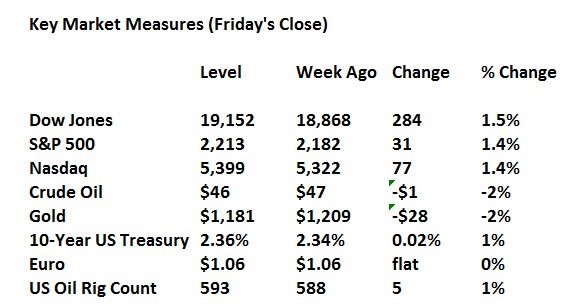
Highlights From The Past Week
First, there was Brexit. Then, there was Trump. Now the discussion is turning to Frexit - France electing to exit the European Union (EU). Many are saying that the European Union could not conceivably survive in its current form if France elects National Front leader Marine Le Pen to the Presidency next May. Le Pen is campaigning for a wholesale renegotiation of the EU’s treaties, restoring the primacy of national law, de-emphasizing the European Central Bank, and ending the free movement of labor and goods across the region. We all must watch closely. The political system as we know it in several regions across the globe is crumbling.
Mortgage Market. The rapid rise in interest rates since Election Day is taking a toll on the mortgage market, and lenders are scrambling to adjust. Since Donald Trump’s surprise victory, average rates for a 30-year, fixed-rate mortgage have leapt by more than half a point, to 4.18% on Wednesday. The fast rise in rates has spurred homeowners to pull back from refinancing their mortgages. Applications dropped 3% in the week ended November 18th from the prior one, the seventh consecutive weekly decline, and the second since Election Day. The Mortgage Bankers Association estimates refinances will fall 46% next year, to $485 billion, which will hurt Americans’ ability to free up cash by reducing the cost of their monthly mortgages. As we learned from the 2008 Financial Crisis, given its size, the Mortgage market is a key pillar of the economy. Higher monthly mortgage payments and slower loan growth for banks matter to the economy and sentiment. We need to care about what goes on here.
Infrastructure. The talk of the town right now is Trump’s $1 trillion fiscal stimulus plan for infrastructure investments in the United States. But what many people don’t realized yet is that the amount might be much, much bigger. Why? The concept of Public Private Partnerships (PPPs). PPPs were used by Obama under the Build America Investment Initiative that helped fund the Denver FasTracks commuter and light rail projects in Colorado, the Goethals Bridge reconstruction project linking New York City and New Jersey, and the Bayonne Water Joint Venture project in New Jersey. What PPPs do is match every $1 of private capital offered for a project with $1+ or more of fiscal stimulus money. So Trump’s $1 trillion will really end up resulting in $2+ trillion of infrastructure investment. Exciting stuff! Oh wait – a little bird just told us he has to deal with Congress to get this approved. Now that will be fun to watch.
BMR Companies and Commentary
Apple (AAPL: $112, +2%)
President-elect Trump recently spoke to Apple CEO Tim Cook. Trump asked Cook to think about opening multiple plants in the US to make their products. Trump said he will institute tax breaks for him to do this. Will Apple comply? Can Trump pull it off? What are the implications?
Trump doesn’t want Apple to continue going to China or Vietnam to manufacture iPhones. He wants Apple to do it right here in the US. Trump says it will be a major achievement for the US middle class if he can find the solution to make it happen.
The jury is still out on what it all means, however. Does the US have the skilled labor to do the task? Is this a waste of time because machines are soon going to be doing the work regardless? How many more jobs are we actually talking about here?
Trump’s first line of defense to force the issue on Apple is the threat to tax imports from China. However, China has already committed to a tit for tat trade policy against Trump (whatever he does they will respond equally). Not good. Trump must be careful.
We understand Cook very much wants to repatriate Apple’s foreign cash and Trump has mentioned that he will work on ways to reduce taxes to make this happen. We believe much of the money will likely go to dividends and repurchases. So we will be watching very closely to see if new incentives arise that detour the money into capital expenditures such as new manufacturing facilities.
BMR Take: As long as the repatriation of foreign cash happens, we are content either way with the outcome. If the money goes to dividends and stock repurchases, Apple will head a bit higher in the near-term. If the money goes back into re-building America, this better long term picture for US GDP would be a positive for all stocks.
Blackstone (BX: $27, flat)
Blackstone was solid this week, as we await a move to $30. What’s happening here? So many headlines: Key executive Jon Gray won’t be heading to DC to serve as Treasury Secretary; there is a lucrative deal swirling to pick-up some of Valeant Pharmaceuticals assets on the cheap; a deal is pending to sell a chunk of Japanese real estate holdings; the investment in Optiv has reached a successful exit through the recent $100 million IPO.
We think the big story is simply the broad-based strength seen in the US equity markets. US equity markets are breaking all-time highs. This is a major tailwind for Blackstone. The company has $350+ billion of capital invested where the fees coming back to shareholders are very closely linked to overall valuation levels of the market. The M&A frenzy we’ve recently seen, the return of a healthy IPO window, and the generally more positive sentiment about the US GDP outlook - it all means upside to earnings at Blackstone.
BMR Take: The consensus EPS outlook calls for nearly $3 of earnings in 2017. The current dividend yield is greater than 6%. Why is this not a $30 stock? Why is this not a $40 stock? What a bargain.
Tesla Motors (TSLA: $197, +6%)
Tesla moved up nicely last week. One driver is all the talk of rolling back regulation and placing bigger incentives are what matters most. Despite some of the negative press Tesla gets, you may be surprised to learn that Tesla receives nowhere near the government support of other industries. Perhaps the future for the company will include greater government support.
Tesla has received only a fraction of the subsidies the Big Three auto manufactures have received. Specifically, since inception Tesla has received about $2.4 billion of subsidies or tax breaks. About $1 billion of that was for tax breaks over a 20-year period that started in 2014 when Tesla started construction on the Gigafactory in Nevada. Tesla has yet to utilize those tax breaks and it will have to spend tens of billions of dollars in the state of Nevada over the next decade in order to fully take advantage of them. Look at what other US-based automakers have received over the years. Here are the report cards for Fiat/Chrysler, General Motors, and Ford, in that order: $17 billion, $50 billion, and $27 billion. Wow! Not even close!
Turning to the Energy industry, it’s hard to even quantify considering the influence of using national defense to protect oil interests. Most agree the numbers are much bigger than auto.
BMR Take: Tesla’s receives a lot of flak for the subsidies it receives, but the fact of the matter is that it’s not a lot of money compared to other companies and other industries. The subsidy discussion matters a lot particularly following the November approval by shareholders for the Solar City acquisition. We think Tesla is an even more exciting company with SolarCity and we don’t see a reason to think government support is going away.
Facebook (FB: $120, +3%)
Late last week, Facebook announced authorization to repurchase $6 billion in existing stock. At face value, the authorization reflects 23% of the 3Q16 cash balance and approximately 2% of the market cap. Assuming 100% repurchase in 2017, we estimate about 1-2% potential accretion to 2017 earnings. In terms of timing, the company indicated the repurchase program goes into effect in 1Q17, but gave no specific deadline. One could argue that Facebook is now prepared to act on expected future stock volatility post the 1Q earnings call. One could also argue the buyback announcement now suggests that Facebook sees the stock as attractive today.
BMR Take: We think Facebook is on track to be the greatest advertising machine ever. This repurchase authorization just further supports management’s confidence in the cash flow capability of the company. They must know something we don’t. Can Facebook hit $150 or higher and start to catch Google in market cap? (Facebook is at $347 billion. Google is at $430 billion.) We wouldn’t bet against them.
Welltower (HCN: $63, flat)
The entire Real Estate segment of the market has not been performing well these past few weeks for a variety of reasons. Rising rates hurts the value of real estate prices through higher cap rates. Tepid economic growth limits the ability of raise rents. Sector-specific concerns in Healthcare around drug prices and reimbursement rates have been severely impairing to some tenants.
That said, we continue to see compelling value in Welltower. Welltower is the largest Healthcare REIT and the sixth largest REIT in the US. The 85+ age population is set to double in the next 20 years and Welltower will directly benefit. In fact, the company is increasing its senior living concentration from 65% of the portfolio to 70% in order to capitalize on the opportunity. Compared to other larger diversified Healthcare REITs, Welltower claims the lowest leverage. The company’s real estate holdings touch all major markets in the US, offering strong diversification. The stability of the business is further supported by an investment grade credit rating. The 5.5% dividend yield is more than covered by cash flow, as the payout ratio is greater than 85%.
BMR Take: In real estate, Welltower is a blue chip. We think the 5.5% dividend yield is particularly attractive. We see continued cash flow growth translating into dividend increases, supported by the growth driver of an aging US population occupying Welltower’s real estate holdings.
Upcoming Economic News
Special Edition: 2017 Outlook
There are four key pillars forming our outlook:
--- We look for GDP in 2017 to expand just under 2%...again
--- Fiscal policy, though highly uncertain, should be more of a tailwind.
--- And monetary policy more of a headwind, as the Fed is expected to deliver two more hikes next year
--- Productivity growth will remain subdued
As 2016 draws to a close, the US economy appears to have grown at a hum-drum pace of about 1.8%, quite similar to last year’s 1.9% performance. We’ve been looking for a similar slow slog going forward next year, though recent political developments add an interesting mix to that otherwise boring forecast. On the one hand, if President-elect Trump and his Republican allies in Congress push through the large tax cuts and equally large increases in defense and infrastructure spending that he campaigned on, the implied fiscal stimulus could push growth above 3%. (We won’t mention the big deficits this will incur - ouch.) On the other hand, if the incoming administration prioritizes increasing import duties, the disruptions to critical supply chains could have a chilling effect on business activity. The likelihood of the former, more benign, outcome seems greater than that of the latter, although the change in the outlook for growth would be larger under the latter outcome. For the time being we are penciling in a small fiscal boost, which would add to annualized GDP growth beginning in 3Q17 and extend into 2018. Even with this fiscal stimulus, we only see GDP growth next year getting to 1.9%.
While policy can potentially lift aggregate demand next year, there are fewer reliable remedies for the slow productivity growth that has plagued the economy. This slow productivity growth is the reason that even growth in the neighborhood of 2% has been enough to support a robust need for businesses to keep hiring. And six consecutive years of job creation in excess of two million jobs per year has finally tightened labor markets to the point where we are seeing more convincing evidence of accelerating wage growth, albeit from a low starting point.
Consumer price inflation has only partly followed suit. After averaging 1.4% in 2015, core inflation has recently been running around 1.7%. The continued upward move in wages should put downward pressure on margins and upward pressure on prices, and we see core inflation getting back to the Fed’s target of 2.0% by the end of 2017. The ongoing progress toward the Fed's inflation and employment objectives should keep them on track to slowly normalize short-term interest rates: we look for a hike in December and two more next year.
Digging a little deeper into sector performance, we note the consumer was the mainstay of the economy in 2016, an outcome which we expect will continue in 2017. Although the pace of job growth may be slowing modestly, wage gains are picking up. This vigor in labor income could get added support from tax cuts, further boosting disposable personal income. Household balance sheets remain healthy, supported by ongoing valuation gains in stocks and, particularly, housing, and the appetite for debt growth has remained modest. Consumer sentiment has also been supportive, as households have been mostly unfazed by global stress and political uncertainties. The one fundamental that looks a little less supportive relative to last year is energy prices. The tailwind of earlier declines in retail gas prices helped fuel a spending binge in early 2016 that is moderating a bit as we head into 2017.
More Apple Info
CNBC has noted that “If the company’s massive cash pile was its own company, it would be the seventh largest in the S&P 500 and the 14th largest public company in the world.” This pile is now $238 billion and growing at almost $1 billion a week, so it is well over $240 billion now. We’ve noted many times that that cash can be used to invest in new products, buy other companies or be paid out to stockholders through dividends and stock repurchases. It seems to us that many investors just forget about it. We certainly don’t. We don’t understand. It’s like having a net worth of $1 million and having $400,000 in cash in Ireland. How would YOU feel? We say pretty good!
At current prices, Apple has a PE of about 13, a significant discount to the overall stock market with a PE of 19. The stock didn’t participate in the stock market rally post-election and there seem to be many rumors about why. We don’t think it is necessary to go into them all, as most of them are made-up, meaningless excuses, and in the long run the only thing that matters is where the company is going with new products and increased sales and earnings. We believe they are going in the right direction. The current Christmas quarter is always their best one – they continue to sell iPhones at extraordinary rates
Gilead Sciences News
Stifel Nicolaus initiated coverage on Gilead Sciences (GILD: $75, up 1%) in a research note issued on Monday. The firm set a buy rating and a $100 price target on the biopharmaceutical company’s stock. The price target price would indicate a potential upside of 33% from the company’s current price.
Several other equities analysts have also recently commented on Gilead. Piper Jaffray set a $108 price target and gave the stock a buy rating in a research note in August. Cowen set a $120 price target on the stock in October. RBC Capital Markets reaffirmed an outperform rating and set a $105 price target in July. 10 research firms rate the stock with a hold rating, 19 have assigned a buy rating and two have given a strong buy rating to the company’s stock. Gilead Sciences has a consensus rating of “Buy” and an average price target of $98.
BMR Take: What can we say. We think these analysts are secretly reading The Bull Market Report. We have a Target of $115 on the stock.
Netflix News
Brean Capital began coverage on shares of Netflix (NFLX: $117, up 2%) in a research note issued on Monday. The firm set a $145 price target on the stock. Several other research firms also recently weighed in on Netflix. Cantor Fitzgerald set a $135 target price on October 27th. Guggenheim reissued a “buy” rating and set a $140 target price on October 26th. Finally, FBN Securities reissued an “outperform” rating and set a $130 target price on October 21st. 8 analysts have rated the stock with a sell rating, 13 have issued a hold rating and 30 have given a buy rating to the company.
BMR Take: This stock is not for the weak. It has little in the way of earnings now, but huge potential down the road as it moves into the programming side of TV and movies. We have a price target of $133. And if this price is hit, we think it will go a lot higher in the coming years. But this stock could go to $100 before it gets to $133. In fact, it could go to $80 first. So be careful out there. We hereby change our Sell Price to $105, from “We would not sell Netflix.” Why? Well it all depends on Wall Street. With the Dow at 19,000 everything is rosy. But if the Trump rally fades with the market falling sharply, and the Dow heads to 17,000, this will bring all stocks down harshly. We just want you to be prepared.
A Letter to The Bull Market Report about First Solar
Hi Todd,
Hope you are well. It is hard to watch First Solar (FSLR: $31, up 5%) continue to plummet. I had lost on Solar in the past but bought on your recommendation. I am holding now as you feel it can double over the next year. What do you see as the catalyst?
Thanks.
Richard Reed
We said:
Richard -
First Solar looks sick, yes, but it will come back. It has done so many times in its history. And really, the world is poised for solar installations. But earnings are not going to happen until late 2017 and possibly on into 2018 and in the world of Wall Street this is a long time to wait. And the market will overdo it to the downside, especially now with higher interest rates on the horizon. They always do. So if you have strength and courage, you should stay in. If not, just call it quits. I am very upset about this outcome, Richard.
Todd
Hi Todd,
Thanks for your response. The tough thing for me was I held my nose buying this stock because your thesis made sense. Despite having lost on Solar stocks in the past I thought this may be the time. My tendency is to get out but I continue to hold on your recommendation. You have given up on some stocks recently so I know when you are sufficiently disenchanted you will sell. The question for me at this point is how much lower this will go before the possible upturn. I am assuming you feel that the risk-reward is in favor of holding. Thanks again.
Richard Reed
The Google vs. Amazon Race
Google (GOOG: $761, flat) and Amazon (AMZN: $780, up $20) were neck and neck last week, but look at the results for the past week. Amazon came back with a vengeance to take the lead in this race.
Now we want to add another stock to this complex race. Apple. Apple closed at $112, but they split their stock two years ago 7-1. So multiply by 7 and you have $784, the same price as Amazon. So we are adding Apple to the race. For fun, let’s put a time limit on this race. Let’s pick the end of the first quarter of 2017. Who do you think will win? Send your votes here: Info@BullMarket.com. Who do you think WE believe will win the race?
Tons of Cash Leads to Stock Buybacks
The biggest US companies are set to spend a record amount of cash buying their own shares in 2017, according to Goldman Sachs. Goldman estimates that S&P 500 buyback spending will total $780 billion next year. That would be more than their estimate of $600 billion in 2016, which is on track to be a record. Buybacks reduce the number of outstanding shares, boosting earnings per share. Some say the companies buy their own stock because they think the stock is undervalued, which we tend to agree with.
Goldman thinks the splurge on share repurchases it expects in 2017 will be driven by a 12% increase in total cash use and $2.6 trillion in spending. There’s a lot of cash held overseas and Trump has proposed to cut the rate to 15% from 35%, which Goldman thinks is very likely. And they think that most of the cash repatriated will go towards share repurchases. They even mention a number - $150 billion. That’s a lot of buying power.
Musk Says Tesla’s Solar Shingles Will Cost Less Than a Dumb Roof
Electricity is Just a Bonus
Tesla shareholders approved the acquisition of SolarCity. (85% of them voted yes.) And Chief Executive Officer Elon Musk didn’t take long to make his first big announcement as head of this new enterprise. Minutes after shareholders approved the deal, Musk told the crowd that he had just returned from a meeting with his new solar engineering team. Tesla’s new solar roof product, he proclaimed, will actually cost less to manufacture and install than a traditional roof - even before savings from the power bill. “Electricity,” Musk said, “is just a bonus.”
Well, we are taking this with a grain of salt, but it sure makes good headlines. Musk is making some big comments: He says: So the basic proposition will be: Would you like a roof that looks better than a normal roof, lasts twice as long, costs less and by the way generates electricity? Why would you get anything else?”
The company says that on a large house over a long period of time, the value of that electricity could exceed $100,000.
BMR Take: We’re drinking the Kool-Aid, just like everyone else. That’s why we keep saying that this company is risky and could go to $150 or lower before it goes to $250 and higher. Listen, we love this company and its leader. But again, be careful.
A Word from Gary Jefferson
Jefferson Financial Group
First Vice-President, Investments
UBS Financial Services, Inc.
Bond markets have literally been beaten up since Donald Trump’s election, with 10-year Treasuries currently seeing 2.36% yields (up 30% from the 1.8% range!) and total losses at well over $1 trillion. Last week we wrote that one of the reasons for the plunge was the market discounting a new era of inflation - however, the exact reasons why bond markets are falling were and are still not entirely obvious. Does higher expected inflation really account for the steep rise in yields?
An article last week from Money and Market had some new information into what else is going on. It said that world governments were selling Treasury bonds hand over fist leading up to the election because of yuan-supporting in China and budget reasons in Saudi Arabia, so the market already had a lot of downward momentum. Also, investors may fear inflation, but they also are fearful of another huge pile of Treasury debt. The bottom line with all this is that no matter the reason, there are too many of them. Especially if you believe in any of the old investment maxims such as, "don't fight the Fed", "the trend is your friend", "don't fight the tape", and "don't catch falling knives," etc. Bonds are under pressure and likely to stay so until the new administration's agenda becomes more clearly understood.
In this wonderful new period of optimism for the market, we want to issue one caveat. Let's consider that the entire recovery, at least post 2010, has been built on fake economic data to perpetuate a fake narrative of growth. In other words, it may be much harder for a new administration to get the economy going again because the true condition of it has been "covered up." For example, according to Value Bit News last week, "There is no way on earth that the real unemployment rate is less than 5%. Over 45 million people are on food stamps and over 94 million people are out of the work force. Claiming unemployment is at 5% in the context of these two other data points is like claiming you’re in incredible shape provided you don’t count body fat or cardiovascular health".
It's well known that the US has yet to achieve a single year of 3% GDP growth in the last eight years. Moreover, many analysts say even these weak growth numbers were doctored and that in reality the US’s economy stripped of accounting gimmicks is in fact much worse. What we do know is that the recovery has been weak despite the US spending a truly staggering amount of money.
Again, according to Value Bit News, "During a period in which tax revenues have risen every year since 2009 with record tax revenues hitting in 2013, 2014, 2015 and soon to be 2016, the US Government has still managed to outspend this amount to the tune of $8.1 TRILLION. Put another way, despite the US Government raking in RECORD amounts of tax revenues in the last four years, it still managed to grow the debt by $2.5 trillion. And if you go back to 2009, the debt has grown $8 trillion. And what has the US got to show for it? Let’s be clear here. We’ve spent a staggering amount of money, increasing the US’s Debt to GDP ratio from 77% to 105%, and yet we’ve had the weakest recovery in US economic history…"
Trust in the media is at all-time lows and for good reason. Don't let media "noise" deflect you from staying focused on earnings and quality stocks if the mainstream narrative suddenly reverses in the coming months.
We don't doubt good things are on the way - we're just trying to temper expectations that it will be fast and easy to turn around an economy that probably isn't as strong as we have been led to believe.
Well, that is some powerful stuff to think about, Gary. We look forward to your input each week.
The Dollar and the Euro are Moving Towards Parity
The euro and the U.S. dollar could be trading one-for-one next year as Europe struggles with political uncertainty and the U.S. is expected to go on a fiscal splurge. Goldman Sachs predicted the two currencies will reach parity by the fourth quarter of 2017. The dollar has risen 4.4% against the euro, and 2% against a basket of world currencies since Donald Trump won the U.S. presidential election Nov. 8. The euro is currently trading at $1.06.
Investors have viewed Trump's proposals to spend heavily on infrastructure, while cutting taxes, as a catalyst for further domestic growth and inflation. They're also expecting more interest rate hikes from the Federal Reserve to match rising inflation. Other analysts expect the euro and dollar to reach parity even sooner. Nomura thinks it could hit as soon as six months, which would see parity as early as May. Citigroup said it had shifted its euro-dollar forecast “180 degrees.” The bank now predicts the euro will tumble to 98 cents in the next 6-12 months.
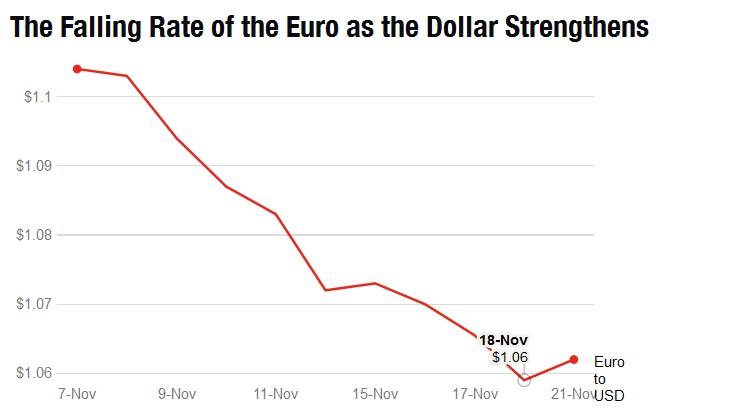
The market is watching Trump like a hawk, and the Fed is doing everything it can to strengthen the dollar, and at the same time the European Central Bank will probably do nothing to support the euro. If the Federal Reserve increases rates, expectations are the dollar would rise further by drawing money to the U.S. looking for higher returns. The European Central Bank, meanwhile, is showing no changes in monetary policy that has pushed rates into negative territory and includes a huge bond-buying program.
We have seen a 10-day losing streak for the euro against the U.S. dollar as we write this over the weekend. In the last two weeks, the euro has fallen 4% against the dollar, hitting $1.06, a level last seen 12 months ago.
Introduced in 1999, the common currency spent much of its early years below parity, falling to as low as 83 cents in 2000, when there was a strong U.S. economy and a weak one in Europe. But the currency has traded above $1 since late 2002, climbing to a high of $1.60 as the U.S. struggled with the financial crisis in 2008.
Goldman expects one interest-rate increase soon from the Fed, followed by three more in 2017, and thinks the ECB will extend its quantitative-easing program to the end of 2017.
Europe has already witnessed one political earthquake this year, when the British surprised investors by voting to leave the European Union. Now, the eurozone’s political diary is full of potential market shocks. Early next month, a constitutional referendum in Italy could sink the government of Prime Minister Matteo Renzi. The resignation of Mr. Renzi, one of Europe’s most reform-minded leaders, could freeze Italy’s economic overhaul and erase the meager growth the country has generated.
Also lining up are key elections in France, Germany and the Netherlands, all of which have seen populist right-wing parties move higher in the polls.
A strong dollar is good for the US, as it draws investment to the country, and it could actually be good for Europe as it makes their goods less expensive here in the US which should increase trade.
The High Yield Report
Due to internet issues, we don’t have the High Yield Report for this week. We will send it out as a News Flash as soon as we are able.
$8.2 billion Withdrawn from Bond funds
Investors withdrew $8.2 billion from U.S. bond funds in the week ending November 16, 2016, the largest outflow since June 2013. Investors have liquidated fixed-income funds more than they have over the past three years. This sell-off has depressed fixed-income fund prices, which have driven up the yields, as there is a negative correlation between the two.
Check out the price action over the past 14 days in several popular fixed-income funds. The iShares Barclays Aggregate Bond Fund (AGG) is down 2.4%, the iShares IBoxx Investment Grade Corporate Bond Fund (LQD) is both down 2%. The iShares iBoxx High Yield Corporate Bond (HYG) fund has rebounded, and is flat. While at first glance that may seem optimistic, recent developments in the junk bond market cause reason for concern.
The high-yield market has been smooth with more than $5 billion in debt issued following the election. High-yield has not been immune to withdrawals as in the three-week period ending November 16, investors liquidated $7.1 billion from junk bond funds, the largest three-week outflow since 2015.
The bottom line is that as long as we continue to see outflows in the fixed-income bond funds, prices will be depressed, and investors will be cautious. As we see a return to higher interest rates there could be an influx of money into U.S. fixed-income as the global hunt for yield continues. In Europe and Japan, pension funds and insurance companies remain hungry for yield, especially given the rise of negative interest rates.
Good Investing,
Todd Shaver
Founder and Editor in Chief
The Bull Market Report
Since 1998