
The Weekly Summary
US equities ended higher this week, again! Major indexes ended at their best levels in history. Economic data, earnings, M&A and the recently released House tax plan grabbed most of the attention. Tech and Healthcare were the best performing sectors. There was lots of focus on the recently released House tax plan. As expected, backlash has heated up quickly, particularly when it comes to who get the benefits of new incentives between the super-rich and the middle class. The tax bill is not expected to survive in current form and some focus is already shifting to the Senate’s revisions.
In terms of other developments surrounding Washington, Trump said "We'll see" if Secretary of State Tillerson makes it through his term. Jay Powell was named by President Donald Trump as his nominee to serve as the next chair of the Federal Reserve, as he moved to make his mark on the world’s most powerful central bank. The news ends months of speculation ahead of the end of Janet Yellen’s first term as chair in February. The 64-year-old Mr. Powell has been a serving Fed governor since 2012. A centrist on monetary policy, he is known as a pragmatic and down-to-earth official with private sector and government experience. A trained lawyer and former partner at private equity firm Carlyle Group, he also served in the Treasury under former president George H. W. Bush in the 1990s. Powell is worth upwards of $50 million.
Consumer Confidence hit a 17 year high. Are you confident in this bull market? Good. We are too. And again, if you want to cash in some chips and buy some REITs and some high-yield stocks, we have two fabulous portfolios loaded with stocks that are paying 4%, 6%, 8% and 10%. But we are sticking with our Tech stocks, especially FAAMG stocks – Facebook, Apple, Amazon, Microsoft and Google. Their combined market cap is $3.3 trillion. We’re looking for $4 trillion next year. With Apple at $890 billion now, we could see them be the first trillion dollar company in history. (That price would be around $194 – not too far away.)
No matter what is happening out there, there is always a bull market here at The Bull Market Report! This week we highlight some of our favorite stocks where we know you can still make good money, including: Facebook, Microsoft, Home Depot, CBRE Group, Tesla, and Apple.

BMR Companies & Commentary
Facebook (FB: $179, up 0.5% - all % changes are for the week)
Facebook reported revenue of $10.3 billion compared to just $7.0 billion last year. EPS was $1.59 versus $1.09 last year. Revenue beat expectations by nearly 5% and EPS was a big $0.31 ahead of the consensus.
Wow.
“Our community continues to grow and our business is doing well," said Mark Zuckerberg, Facebook founder and CEO. "But none of that matters if our services are used in ways that don't bring people closer together. We're serious about preventing abuse on our platforms. We're investing so much in security that it will impact our profitability. Protecting our community is more important than maximizing our profits."
The majority of analysts were bullish on the report. Facebook continues to grow at an impressive rate with strong profitability as gross margin was way better than expected. User engagement continues to increase and is helping drive demand and in turn pricing. One of the more negative data points brought up was how duplicate accounts now compromise 10% of global monthly active users, but nonetheless both monthly and daily active users came in slightly ahead of consensus expectations.
BMR Take: Facebook remains the greatest advertising machine the world has ever known. With consensus EPS forecasts of $5.80 this year heading to $10.00 by 2020, this stock remains a compelling value.

A 1-year Chart for Facebook
+++++++++++++++++++++++++++++++++++++++++++++++++++
Microsoft (MSFT: $84, flat)
We love to see marquee deals and partnerships. They are symbolic signs of a vibrant business.
Microsoft and United Technologies (UTX: $121 - $97 billion market cap), a major industrial company, on Wednesday announced a strategic agreement that will create a differentiated customer and employee experience using intelligent technology innovation.
United Technologies builds and services millions of products in the field, from elevators in some of the world's tallest buildings, to engines and aerospace equipment in the skies, to commercial products that power smart buildings. Leveraging Microsoft Dynamics 365 and Azure, United Technologies intends to empower employees globally with the digital tools and information needed to support customer interactions for faster, better and more personalized service.
"United Technologies is a global leader in the aerospace and building industries and has a deep commitment to innovation," said the executive vice president, Worldwide Commercial Business, Microsoft. "The combination of United Technologies’ customer service expertise together with Microsoft's intelligent cloud will provide a digital business model for United Technologies businesses across multiple industries."
BMR Take: One of the reasons we see so much upside ahead for Microsoft is the breadth of their customer base that includes so much of the Fortune 500. This deal with United Technologies is just a reminder that Microsoft can sell the right product into this customer base with ease. Recall that earnings expectations were recently reset much higher by most analysts, calling for upward of $5.00 of EPS, which supports this stock heading much higher.

A 1-year chart for Microsoft
+++++++++++++++++++++++++++++++++++++++++++++++++++
The Home Depot (HD: $164, down 2%)
Don’t fret about Home Depot being down a bit this week. There was some chat that concerns about e-commerce have driven down the valuations of some retailers, and that short interest in the six largest brick-and-mortar retailers is currently higher than the levels hit in 2008 during the throes of the economic downturn. This impacted Home Depot’s stock this week.
There was also chat about how management teams at a number of beaten-up retailers are buying back shares, and that the economy should keep consumers shopping during the holiday season. So the world is not coming to end this year.
In other news, while online competition may be pressuring some retailers to hire fewer seasonal workers this holiday season, staffing firms suggest the problem is deeper, with prospective employees seeking more flexibility with their schedules, training, and pay. This could cause some more ongoing headline news that negatively impacts Home Depot.
BMR Take: Home Depot is a bellwether of industry. In such cases, these types of stocks are more susceptible to the large macroeconomic factors as opposed to company specific fundamentals. Stay focused on the latter. Home Depot is due to report EPS of $7.25+ this year heading to around $10.00 by 2020. Earnings power ultimately drives stock prices and we expect that to happen here. Can you believe this company is worth almost $200 billion? $170 a share will do it!

A 1-year chart for Home Depot
+++++++++++++++++++++++++++++++++++++++++++++++++++
CBRE Group (CBG: $40, up 1%)
CBRE reported revenue of $3.6 billion versus $3.2 billion last year. EPS was $0.64 versus $0.50 a year ago. Revenue was about $100 million above the consensus estimate. EPS beat expectations by $0.07. The strength in the quarter was expected to be maintained as the company raised its full year EPS guidance up by $0.05. Awesome quarter!
The strength of performance in Q3 was broad-based. Each of the company’s three global regions produced solid organic growth. Leasing returned to double-digit growth, and was especially strong in the U.S. Revenue growth accelerated in outsourcing business, as the company continue to capitalize on its commanding position in this growing sector. Global property sales saw healthy growth, despite a generally tepid market for transaction activity, reflecting the strength of the company’s brand and ability to take market share. Finally, the business also delivered excellent performance across all of their real estate investment businesses.
BMR Take: With the business closing in on $3 of EPS, we think the current stock price undervalues this leading franchise. CBRE is the ‘Mercedes Benz’ of the real estate world. Own this one for the long-haul!
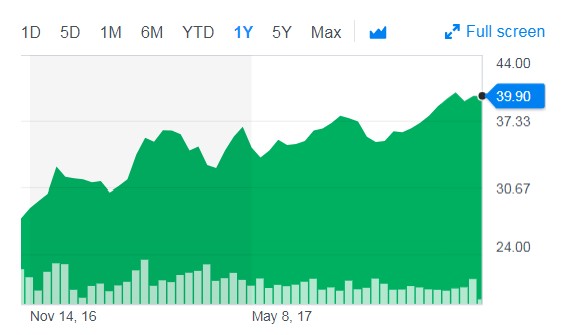
1-year chart for CBRE
+++++++++++++++++++++++++++++++++++++++++++++++++++
Tesla (TSLA: $306, down 5%)
Tesla reported revenue of $3.0 billion versus $2.3 billion a year ago. EPS was -$2.92 versus +$0.71 a year ago. Revenue barely beat expectations but earnings were much worse than expected. Ouch!
Tesla is one of the most closely watched tech companies in the world, where its zero-emissions vehicles resonate with environmental sensibilities. But with that scrutiny has come a great deal of criticism over labor issues in its plant, along with customer complaints about materials and workmanship, and frequent production delays with all of its vehicles.
Analysts were quick to jump on the per-share losses and problems getting the entry-level Model 3 sedan to market. Though Tesla is promising more Model 3 production in 2018, 2017 has been a miss to this point in terms of model production. Of note is Tesla pointing to difficulties in producing the battery packs at the Gigafactory for the vehicle. On a brighter note, Model S and Model X demand still seems to be doing well, but the fact remains that Tesla is still burning cash and needs to right the ship with Model 3 in order to succeed.
BMR Take: Tesla is set to lose over $3 per share this year. But the 2020 consensus forecast is for great than $11. Somewhere here we expect a major swing to profitability. With a brand that stands for innovation, we can see Tesla emerging to become a cherished stock once the profits start rolling in. Speculative? You bet. But we love that buy Musk.
+++++++++++++++++++++++++++++++++++++++++++++++++++
Apple (AAPL: $173, up 6%)
Apple delivered $53 billion of revenue versus $47 billion a year ago. EPS was $2.07 versus $1.67 a year ago. It was a really good quarter for Apple.
In a quarter which many thought would be more subpar due to delayed shipments of the iPhone X and due to many reports indicating weaker than expected sales of the iPhone 8, Apple delivered results that were much better than expected, and it is guiding for a generally strong next quarter as well.
iPhone sales of 47 million grew by 3% from a year ago and were slightly above consensus of 46 million. We saw strong and accelerating growth in services (up 24% from last year). Apple’s Services revenue of $8.5 billion is heading towards $50 billion annually. We observed good growth in China and strong growth in emerging markets (with India more than doubling). iPhone X is about to ramp in sales helping the average selling price. The iPhone X, with a price of $999 to $1,149 (vs. Apple’s blended price of $618 last quarter) becomes available this week, and we expect iPhone average selling price to increase to over $700. We could go on and on.
BMR Take: We reiterate our strong enthusiasm for Apple that we had before the quarter now that the results are in. EPS was $9.20+ this year and heading to greater than $11 next year. With cash and equivalents now totaling $270 billion, wow, this company remains as solid as a rock!
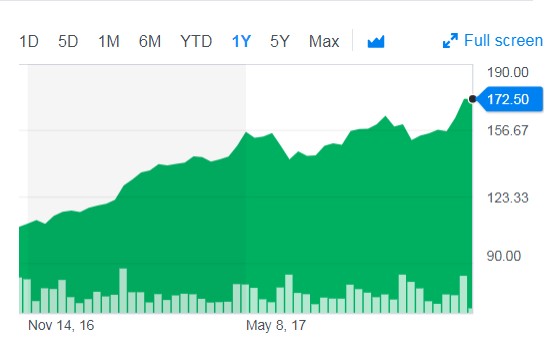
1-year Chart for Apple
+++++++++++++++++++++++++++++++++++++++++++++++++++
+++++++++++++++++++++++++++++++++++++++++++++++++++
Upcoming Economic News
JOLTS Job Openings
Tuesday, November 7th, 10:00 AM, Eastern
Period: September
Consensus: 6,082,000
Prior: 6,082,000
Initial Claims
Thursday, November 9th, 8:30 AM
Period: Week of 11/4
Consensus: 230,000
Prior: 229,000
Michigan Sentiment (Preliminary)
Friday, November 10th, 10:00 AM
Period: October
Consensus: 100.2
Prior: 100.7
+++++++++++++++++++++++++++++++++++++++++++++++++++
Eli Lilly ($87, flat)
Solidity Personified
If you want solidity and stability you can get it here. Eli Lilly and Company was founded in 1876 and is headquartered in Indianapolis. The company is worth $87 billion, pays a 2.5% dividend and has moved from $20 in 2008 to its current level, in a pretty straight line. Revenues are solid too. Revenues had a nice bump from the $20 billion in 2015 to the 2016 total of $21.2 billion. This year looks like $23 billion is in the bag. Slow and steady. And profitable. $2.7 billion ($3.00 a share) to the bottom line after taxes in 2016 up from $2.4 billion in 2015. Not counting some non-recurring charges this year, the company should hit north of $4 billion before tax and about the same as last year in 2017. Solid.
The company is in two primary areas of pharmaceuticals: Human Pharmaceutical Products and Animal Health Products. The company offers products to treat diabetes; osteoporosis in postmenopausal women and men; human growth hormone deficiency; and testosterone deficiency. It also provides neuroscience products for the treatment of depressive disorders, diabetic peripheral neuropathic pain, anxiety disorders, fibromyalgia, and chronic musculoskeletal pain; schizophrenia; attention-deficit hyperactivity disorders; depressive, obsessive-compulsive, bulimia nervosa, and panic disorders; and adult brain imaging. In addition, the company offers products to treat non-small cell lung, colorectal, head and neck, pancreatic, metastatic breast, ovarian, bladder, and metastatic gastric cancers, as well as malignant pleural mesothelioma; and cardiovascular products to treat erectile dysfunction and benign prostatic hyperplasia; and migraine headaches. And this is just a small part of what they do for humans. They do similar things for animals and are noted for their science and expertise. Plus they have collaboration agreements with Daiichi Sankyo, Incyte, Pfizer, AstraZeneca, William Sansum Diabetes Center, Purdue University, and Nektar Therapeutics. Truly a worldwide leader in big pharma.
BMR Take: This amazing company should hit another $3 a share in 2017, giving the firm a PE of under 28. We expect the company to hit the $4 level in a few years and wouldn’t be surprised to see the stock in the 90s within two years. Solid as a rock.
+++++++++++++++++++++++++++++++++++++++++++++++++++
Amazon’s Jeff Bezos Sells Shares
Jeff Bezos sold 1 million shares of Amazon (AMZN: $1112, up 1%) this week for $1.1 billion. The sale represented 1.3% of his holding and leaves Bezos with a 16.4% stake in the company. The world’s richest man said in April he would sell $1 billion a year in Amazon stock to fund Blue Origin, the rocket company he owns to explore Mars and outer space. He had already sold another batch of a million shares in May. So that’s 2 million shares in our book.
+++++++++++++++++++++++++++++++++++++++++++++++++++
From: Ron Shepro [ronshepro@xxxzz.com]
Sent: Tuesday, October 24, 2017 8:50 PM
To: 'The Bull Market Report'
Subject: RE: EARNINGS PREVIEW FOR THE WEEK AHEAD
Hi Todd – I Just wanted to say thanks for your good work. I find it interesting that Paul Mxxxxxx (a money manager), comes up with new recommendations that you had ages ago. Latest one being Splunk (SPLK: $68, up 1.5%). Looks like you are ahead of the legends. There are more, but I am sure you are aware of them. You also made the call on Paypal earlier.
Our Answer: Thanks, Ron. I think we have a fine little financial newsletter here. We just need another 5000 subscribers! We’ve had some nice wins with Nutanix, Square, PayPal as you mentioned, and CBRE (CBG) – the quiet real estate company.) And of course Splunk, which we added at $46.
Good Investing,
Todd Shaver
+++++++++++++++++++++++++++++++++++++++++++++++++++
A Word from Gary Jefferson
Jefferson Financial Group
First Vice-President, Investments
UBS Financial Services
After the week before "melt-up", we noticed that the fear factor kicked up another notch. This past weekend, media pundits again started making comparisons to the March 2000 crash. Back then it was referred to as either the dot.Com bubble or the Tech Wreck. But there are some differences that should be noted. In 2000, the PE of the S&P 500 was about 30X, and many tech stocks had PE's in the triple digits or no PE's at all because they didn't even have revenues yet, much less earnings. Today's trailing PE is estimated to end the year somewhere in the area of 18X. This is higher than average, but not nearly as frothy as the 2000 period.
The question now becomes, "With this being the second longest and second biggest bull market in history, and with valuations as high as they are, can stocks keep climbing?" The easy answer is "yes", and the reasons are readily apparent. We have a strong economy and it is getting stronger. It is not just the US economy either – most major world economies such as Europe, Japan and China are also experiencing solid economic growth. Thus, we are part of a worldwide bull market, which makes it much easier on the US market.
More importantly, earnings are still getting stronger rather than leveling off or declining. According to Thomson Reuters, earnings growth for the third quarter is now 6.7%. Of the companies that have posted earnings, 74% have topped expectations - compared to the 72% average that beat expectations over the past four quarters. Good earnings growth is the key reason stocks can and should continue to climb higher. And, any tax reform will make it all the more likely that earnings growth will continue to be robust for the next year or two.
We also have history on our side. In the year after reaching a new peak, the S&P 500 has had positive growth 72% of the time. (Bloomberg) We would, however, caution investors that the bar is much higher today than it was over the past several years, and therefore the pace of growth may not be as rapid or the returns as high as we have experienced over recent years. In our experience, "euphoria" has never been a part of any successful investment strategy.
+++++++++++++++++++++++++++++++++++++++++++++++++++
The High Yield Corner
By Michael Foster
Obviously, the biggest news of the week for high yield investors came from Omega Healthcare Investors ($28), which fell massively on an earnings and revenue miss. The stock immediately fell over 3% on the news and has been falling further, causing a stock that was flat year-to-date to suddenly be down 7%. Panic selling also means the dividend yield has risen to 9.2% - a level we haven’t seen since 2011. Note that the company paid out a 65 cent dividend on Monday. So it really wasn’t as bad as it seemed.
This sounds like a time to sell, but it really isn’t. When we take a deeper look at the earnings result, we quickly see why.
The company reported a 2.2% decline in revenues on a year-over-year basis and a near 5% decline in FFO per share for the same period. This was all due to a $6.3 million loss in FFO, which was itself the result of late rent payments from the company’s biggest tenant, Orianna Health Systems. The story is pretty complicated, but it means that Omega Healthcare and Orianna are going to need to renegotiate their current arrangement, which could mean Omega cutting their rent down (this would be the best case), or an outright bankruptcy that results in Omega fighting for their back payments in court (the worst case).
If they are able to reduce rents, it could mean Orianna will start paying their bills again and FFO will start to trend upwards. And even if we are stuck with a bankruptcy proceeding, Omega will still get some money back, but predicting how much and when would be impossible (anyone who has ever been through America’s civil court system knows rulings can get pretty bizarre).
So what we are facing now with the stock, following Omega’s write-down of Orianna, is the worst situation. There is upside in either the best or worst case, but the amount of upside will depend on which route they go and how fast a deal is made. For now, Omega Healthcare’s dividend coverage has taken a hit - there’s no denying that. With the decline in earnings, the dividend is now only covered by… 130%.
That’s right. What we are looking at right now is a REIT yielding 9% that still has 130% dividend coverage. That’s at the bottom end of what’s ideal for REITs in our mind (regular readers know we look for 130% dividend coverage for REITs as the starting point for a safe yield), and that’s more than compensated by the 9% dividend yield.
It also means that a dividend cut is really unlikely to happen anytime soon. Omega Healthcare has established a track record of penny-per-quarter dividend increases, and if it continues that trend for the next year, its dividend coverage will fall to 128% by the end of next year, assuming no increase in earnings.
Do we think Omega will be able to continue its penny-per-quarter dividend increases forever? No. But we do think it can continue this trend for the next five years at the very least. But with the latest price drop, the market is pricing in the company stopping these increases much sooner. The market will probably realize the error of its ways pretty soon. Maybe next quarter when Omega shows stability or improvements, the market will buy in again. Maybe it’ll take a few quarters until Omega and Orianna reach a deal and the market realizes their fears were overblown.
Either way, now’s a great time to buy a 9% yielding stock with 130% dividend coverage.
Let’s move on to other news - there was a lot last week.
Digital Realty (DLR: $119, up 2%) announced another dividend (the December one) at a 93 cent per share distribution, in-line with the previous payout. This is not good. As we’ve written about frequently, we want Digital Realty to increase distributions because of their exploding FFO, which is far ahead of the dividend. But we understand why the company sees no need to give shareholders a pay raise quite yet - the stock has rebounded about 3% off its post-earnings low, so demand for the stock is definitely still there.
That, by the way, is why investors should continue to hold Digital Realty. There is tremendous value here, and the recent price dip was a buying opportunity - not unlike the more recent dip in Omega.
In other earnings results, Apollo Commercial Real Estate Finance (ARI: $18.35) saw NII jump 34% from a year ago, above expectations. This is pretty impressive, because expectations have heated up for this specialty mortgage REIT, and its stock price has soared in recent months accordingly. But the company is not running out of deals to make, with $425 million in new investments in the recent quarter, bringing the annualized deal flow to $1 billion by the end of the year. Also, last quarter’s dividend coverage ratio was a nice 117%. Keep in mind that coverage ratio thresholds are different for mREITs compared to property REITs. Because of their use of bond spreads to make a profit and their lack of dividend growth, lower coverage ratios are to be expected. And from a mREIT perspective, 117% is nice.
The stock got a slight price bump after the results, but nothing major. That was no surprise - the market has had high expectations for this firm for a while.
Finally, another REIT reported earnings last week: Government Properties (GOV: $18.43, up 2%), which beat on revenues thanks to a near 9% year-over-year increase, but FFO was a penny shy of expectations. That’s really too small of a miss to matter, especially since the market has discounted poor earnings for months now. So the stock actually went up over 1% following the release and over 2% for the week. We still need to see dividend coverage improve, but there is fundamental stability which indicates this remains an attractive 9% yielder.
Good Investing,
Todd Shaver, Founder and CEO
The Bull Market Report
Since 1998