
The Week Ahead
Year to date the S&P 500 is up 5%. The train keeps on rolling. Weak GDP in the US - no problem. Energy industry falls apart - no big deal. Lack of middle class household income growth doesn’t matter. Troubling student debt burden is what it is. With low rates and bond prices and record low levels, the only game in town is equities. There is a record amount of cash sitting on the sidelines waiting to go into stocks.
Wall Street enters the thick of earnings in week three of the season with Apple (Tuesday) and Alphabet (Thursday) reporting this week (see our Earnings Preview to be sent out Monday morning). Instead of a widely expected earnings decline, Thomson Reuters now anticipates 1% growth in the S&P 500 companies the quarter, reversing previous expectations of a decline. This could be the first time we see an increase since the second quarter of last year. So far this quarter, 20% of S&P 500 companies have reported on their recent quarters with 80% beating estimates.
It has been a good not great year for stocks, though we are coming to an inflection point. They say if Republicans win the White House the market will sell off. They say if Democrats win the White House the Fed will raise rates in December and the markets will sell off. So brace for some turbulence, but don’t stop investing in great stocks. This week we highlight Facebook, Google, First Solar, Microsoft, Qualcomm, Amazon, and PayPal, among others.
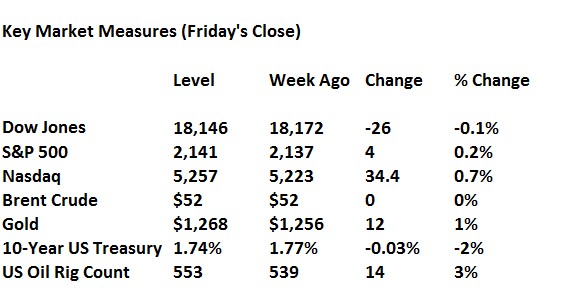
Highlights From The Past Week
Record Cash Levels. Investor cash levels jump to levels not last seen since 9/11. Fund managers are now holding 5.8% of their portfolios in cash, up from 5.5% last month. The current level was a bit higher than what happened right after Brexit. We haven’t seen cash levels this high since 2001, shortly after the terrorist attacks in the US. It’s hard to get a total reading on cash levels, but some say there is $1.5 trillion in corporate cash on the sidelines. What is driving the caution? The commonly cited reasons are an EU breakup, a bond market crash, and a certain Republican winning the White House.
What Junk Bonds Are Saying About Risk. High yield bonds, also known as Junk Bonds, are a key indicator of appetite for risk. There are two things occurring providing insight into market sentiment. First, the interest rate spread of junk over treasuries has compressed to the point where history suggests there is not much further to go. This could predict a reversal soon coming. In other words, investors are so thirsty for yield they are overpaying for risk assets, where all it will take is a little turbulence to rattle confidence. Second, actual defaults on junk bonds are decelerating. This is due to the improving Energy sector. The key point is that while we might see more risk start to get priced into the market there is still little evidence of a recession happening in the next 12 months based on default rates.
European Taper Tantrum. European Central Bank President Mario Draghi came out this week and said he will not be scaling back bond purchases prior to March. After March there is risk of doing so, but for right now the window for bond purchases is ongoing. Recall that in the US when the Fed started scaling back bond purchases, interest rates spiked impacting various sectors. For instance, Mortgage REITs went down as much as 50% and banks rose, as the steepness of the yield curve hurt/helped the respective business models. Accordingly, all eyes are on Draghi and the ECB for a European Taper Tantrum and any flow-through effect to US markets.
BMR Companies and Commentary
Alphabet (GOOG: $799, up 3% for the week)
The stock hit an all-time high Wednesday at $804. Alphabet is schedule to release its earnings on Thursday after the market closes. The Street is looking for $8.62 of EPS on $18.2 billion of revenue.
We expect to see Google's search revenue growth momentum be sustained. We understand that expectations for search budget growth earlier this year were around the 12-15% level, but now these expectations have been ratcheted higher to the 15-20% range. In particular, we understand that feedback from advertisers suggests that budget deployment into search started to accelerate over the course of the quarter as the market gears up for the crucial holiday period. Advertisers are specifically citing the newly-released Expanded Text Ads feature as one of the reasons for their pick-up in spend.
Outside of search, we like Google Cloud and we like YouTube. Neither business is the size or impact of Search. But we like that they are heading in the right direction. The larger and larger contribution from YouTube is particularly exciting. There have been some rumors of YouTube soon doing large deals with content providers like Disney. This could be very exciting and we want to see more. By owning Google, we own the best asset in all of media - YouTube.
BMR Take: We expect a very strong quarter and will look to be revising our $850 price target higher.
Amazon (AMZN: $819, flat)
The long term Amazon Web Services (AWS) operating margin expansion potential remains a controversial topic for Amazon. Let’s discuss it.
We are in the camp that expects to ultimately see a 40% long term operating margin in the AWS division. This outlook includes the fact that they have aggressive expense growth projections, specifically an incremental $1.5 billion over the next five years versus the historical ramp of $600 million to $1.0 billion. What we are saying is that it's not like they need to stop spending money. In fact, they can spend a lot. That's okay. They are bringing in the revenue – and ultimately profits.
Many are concerned about all the competition in the space, namely Microsoft Azure, Google Cloud, Oracle, and so on. Right now there is no evidence of a price war but there certainly is the possibility as these three giants fight it out. We will keep a close eye out for any change.
Why is all this talk of AWS operating margin important? Within five years, AWS will account for roughly 40% of the company’s consolidated free cash flow, if the profitability ramp plays out. Given the total addressable market of $1 trillion for AWS, it is very likely the 40% figure proves conservative. Free cash flow is the basis for how most analysts are valuing the stock. Some valuation models are inferring a price target of $1,600 for Amazon should we see the free cash flow production really start to ramp. Now that would be interesting, $1,600! We aren’t ready to place our rational expectation for the stock there yet, but there is real potential and we are watching closely.
BMR Take: Amazon is an invention machine and the latest breakthrough is AWS. AWS has the potential to unlock substantial value for shareholders. So we care about its prospects and free cash flow contribution. We think the stock has tremendous value here at this price.
Facebook (FB: $132, up 3%)
FB shares are currently trading at 25x and 20x our 2017 and 2018 earnings estimates respectively. This is versus expectations of 26% EPS growth per year over the next five years. What value! In fact, the stock hit an all-time high Friday and is now worth $380 billion, just behind Amazon at $390 billion, Microsoft at $465 billion and Google at $560 billion. All we can say is Wow.
Investors are overcoming concerns around two things - tougher comparisons beginning in 4Q16, and moderation of ad load growth. While the former is a mathematic reality as the company gets bigger (you can’t grow revenues at 40% forever), we expect the latter to become less of a concern as Facebook has taken steps to modify existing ad units and release new products.
Why is slowing ad load growth not an issue? Did you hear during the Presidential debates the constant reference to “on Facebook over 100 million people are saying…”
Additionally, we believe Facebook is taking steps to introduce a new prospecting product to help advertisers find new customers, as well as to monetize Messenger in 2017. Recent feedback from advertisers suggest that the company continues to innovate on product development.
BMR Take: Now is a great time to buy this technology blue chip. Our $140 price target is a layup with many analysts already pushing the bar much higher. We hereby raise our price target to $150.
First Solar (FSLR: $42, up 7%)
Whoa! The stock has a pulse! Momentum has shifted and a turnaround appears underway.
We look forward to First Solar’s Q3 earnings report on Thursday. We continue to believe the company’s financial position and product technology are second to none. We expect the company to emerge stronger and more dominant following the industry’s latest capacity shakeout, but we also expect it to use its competitive strength to apply pressure in the marketplace during the coming year.
What is all the fuss? First Solar goes into 2017 with the lowest backlog coverage in several years, and with utility-scale project pricing hitting new lows. The company has reiterated its determination to keep its factories running at full capacity in order to be ready for the 2018 turn. We cheer them on! Though it means operating losses in 2017.
The 2017 revenue outlook by consensus is $2.9 billion, down from $3.8 billion this year. There is not much debate about the revenue picture. All the debate is over how bad operating margins will be in 2017. The tricky part is due to the fact that the company doesn’t provide a great detail about the mix of variable versus fixed costs.
BMR Take: Why are we talking about 2017 margins? The Street is looking for EPS of $2.00+, but some estimates are much lower, running through rougher margins. You need to be prepared for a worse 2017 EPS figure than $2.00. Look it doesn’t matter because there is a turnaround already underway and it’s all about 2018. But the shares could go down before going up much higher should this margin issue surface. We see shares on a recovery path back to $55. Momentum is turning in our favor, though let’s be ready for possible turbulence around margins in 2017.
Microsoft (MSFT: $60, up 4%)
Microsoft had a fantastic quarter. The stock hit a new all-time high Friday. The stock is trading above the high set in 1999, following 1Q17 results that outpaced consensus metrics across-the-board. Guidance for the second quarter at the midpoint fell short of existing consensus numbers; however, management reiterated its focus on cloud-based services, including investments to position its product and services for long-term growth.
Analysts viewed the results positively, with the majority impressed with the organic growth results, particularly focusing on the +120% growth of Azure, the firms cloud service, re-accelerating sequentially. Commercial Cloud and Office 365 growth led the bulk of analysts to increase conviction that the organic growth trends are sustainable.
Guidance for 2Q was the main sticking point in the quarter, with some analysts seeing the initial guidance as typical management practice, citing consistently lower-than-consensus out-quarter estimates followed by outperforming results. However, others pointed to increasing underlying operating expense trends, suggesting any meaningful acceleration of gross margins over the medium-term may not materialize.
BMR Take: Microsoft is expected to generate $25+ billion of free cash flow this year. The free cash flow per share forecast for next year is $4.00 supporting a bull case of $80 based on 20x. We love what we are seeing from the company, in particular the Azure segment. Our current $66 price target is conservative.
PayPal (PYPL: $44, up 13%)
Blowout quarter. Revenues were $2.67 billion vs. $2.3 billion last year, with EPS of 35 cents vs. 31 cents last year. The stock hit a new all-time high of a shade under $45 and the company hit the $50 billion market cap goalpost level, closing at $53 billion. Management discussion of the results centered on the updated outlook, with the commitment to stable margins perhaps the most well-received item given recent debate around the long-term trajectory. Also some upbeat commentary around increased revenue growth over the medium term and continued strong user metrics, especially for Venmo - the mobile payment technology business that was recently acquired.
PayPal demonstrated another strong quarter of customer acquisition, adding new consumers and merchants to the platform. The company grew its active customer accounts by 11%, ending the quarter with 192 million active customer accounts.
The move to customer choice (see next sentence) is also allowing PayPal to forge valuable, new strategic partnerships across the ecosystem. During the quarter, PayPal announced major agreements with Visa and MasterCard. In addition, as an extension of previous agreements with Alibaba, PayPal launched the first stages of becoming a payment option on Alibaba's global retail marketplace, AliExpress.
Note that PayPal was upgraded by investment banker Stifel Nicolaus from a hold rating to a buy. They now have a $49 price target on the stock, up previously from $43.
BMR Take: PayPal is a business with sustainable competitive advantages, long growth runways, and strategically-minded management. There was nothing shocking about this quarter. Instead, we all got a reminder that revenue and profit trends are sustainable and PayPal is going to be kicking butt for a long time to come. We’re up 44% since we added the stock this year at $31. Our target is hereby raised from $48 to $52. We would hope to see this number later this year or early next.
Qualcomm (QCOM: $68, up 3%)
Bloomberg is saying that a Qualcomm deal to acquire $34 billion NXP Semiconductors (NXPI: $102) could be announced next week. Apparently the price is around $110 per share for NXP, which will likely be paid in cash. NXP is due to release earnings on Wednesday so perhaps we will see the news break officially right after earnings.
What does the deal mean for Qualcomm? It’s great news if it happens. In short, this deal would be 25% accretive assuming Qualcomm utilizes its offshore cash pile of approximately $29 billion. Qualcomm and NXP together strategically makes sense. NXP has a strong automotive presence, boosting Qualcomm’s presence in an market that management has frequently said they want to target. We note that management has mentioned on a number of occasions that they gravitate toward smaller, tuck-in acquisitions, so NXP, not being a small company, is certainly a transformational situation.
BMR Take: The NXP Semiconductors acquisition is a powerful catalyst for Qualcomm as it will be materially accretive to EPS. We expect Qualcomm shares to rise considering the improved EPS outlook, on their way to our $72 price target.
**************
Upcoming Economic News
Tuesday, October 25th
S&P Case-Shiller Home Price Index – August
Time: 9:00 am
Forecast: 5.0% yearly change in 20-city index
Tight housing supply will keep prices advancing solidly. Nationally, home prices have risen 42% since bottoming in 2012, yet still trail their boom-era high by 8%. The 1.9 million existing homes available for sale in August is the least in 15 years, as the historically low pace of homebuilding and increased rental activity has limited housing inventory.
Conference Board Consumer Confidence – October
Time: 10:00 am
Forecast: 100.5
Consumer Confidence is projected to step back in October after jumping to the 9-year high in September. Expectations about the future hold at merely average levels. Steady job growth persisting beyond the election, should help.
Wednesday, October 26th
New Home Sales – September
Time: 10:00 am
Forecast: 604,000
New home sales are forecast to be little changed in September, contributing to continued rapid annual growth. Such sales rose 25% year-over-year in the three months ending August, the fastest advance in three years. Demand for newly constructed homes remains stout. The NAHB survey measure of builder expectations for future sales rose to the highest level of the past year in October.
Thursday, October 27th
Durable Goods Orders – September
Time: 8:30 am
Forecast: 0.0% overall, 0.2% ex-transportation
Core durable goods orders will potentially rise in September after slipping in the previous month. Recent orders data hint of some uplift in business investment spending despite continuing to decline on an annual basis. Reversing a contractionary trend throughout this year, core capital goods orders rose 2% annualized in the three months ending August.
Pending Home Sales – September
Time: 10:00 am
Forecast: 1.4%
The Pending Home Sales Index looks to advance in September, yet not by enough to undo August’s 2.4% drop. The index has fallen in three of the past four months as home lending volume fails to expand. Mortgage application volume for home purchases fell 6% sequentially in the last quarter.
Friday, October 28th
GDP – Third Quarter (Advance Estimate)
Time: 8:30 am
Forecast: 2.5%
GDP growth is slated to improve significantly in the third quarter as the drag from slower inventory growth fades out. But the underlying economic lift from consumer spending is sliding after rising 4.3% annualized in the second quarter. With auto sales flattening out and growth in housing activity falling short of expectations, broad economic activity has limited potential to reach 3% real growth over the medium-term. This is an unfavorable outcome. Our GDP prospects of 1-2% are dismal and highlight a stagnant economy.
University of Michigan Consumer Sentiment – October Final
Time: 10:00 am
Forecast: 88.0
Historically low consumer inflation expectations can have serious policy implications. The initial October reading of 2.4% annualized expected inflation between five and ten years from now is at an all-time low. That muted price outlook justifies very infrequent moves from the Federal Reserve to lift the Fed Funds rate.
*****************
A Word from Gary Jefferson
First Vice-President, Investments
Jefferson Financial Group
UBS Financial Services, Inc.
Early disappointing corporate earnings and weaker economic data from China weighed on the markets and October is off to a poor start. That was expected, especially since we believe the market is beginning to price in a December hike in interest rates.
Earnings season really kicked off last week with more than 80 S&P 500 companies having reported. Some of the big names include Bank of America, IBM, J&J, United Health, Intel, Microsoft, Verizon, Travelers, GE, Honeywell and McDonald's (just to name a few). Nearly 400 more of the S&P 500 companies will report over the next three weeks.
But herein lies the problem - third quarter earnings reports have started to come in and analysts are expecting yet another period of negative earnings growth. According to Thomson Reuters, estimates for Q3 profits and revenues declined over the last several weeks. Overall, they are reporting that S&P 500 company earnings are expected to be down -3% over Q315, though revenues are expected to be up +1%. These numbers are still "guesses" and we can expect plenty of surprises and individual success or "miss" stories as earnings season progresses.
We really need some decent earnings and guidance for the 4th quarter in order to get a year-end rally jumpstarted. That said, this is the view from UBS: "The third quarter should be an important one for investors. We expect that S&P 500 EPS will rise on a year-over-year basis for the first time since 2Q15. Perhaps just as important, S&P 500 companies should guide for a sustained profit recovery, with earnings growth accelerating in the fourth quarter and remaining squarely in positive territory in 2017. When all is said and done, we expect 3Q16 S&P 500 EPS to rise by 3%, a healthy improvement from the 6% decline in the first quarter and the 1.4% decline in the second quarter of the year."
Those are two views which certainly are not compatible – the former represents the 6th down quarter for year-over-year earnings comparisons while the latter gives the green light to the long-awaited year-end rally for the market.
Basically, UBS is saying earnings growth numbers have not really been that terrible but rather have been skewed downward due to the Energy factor. The next three weeks should tell the tale.
Meantime, the news ("noise") in the weeks ahead will likely be dominated by the upcoming November elections. As election uncertainty continues to resolve itself, attention should rightfully turn to the Fed's December meeting and year-end economic data. Earnings will become ever more important to a successful Santa Clause rally.
*****************
Aetna Update (AET: $111, up 1%)
The stock is being penalized for the uncertainty of the pending transaction with Humana (HUM: $176). We think the stock will move higher if the deal goes through. And if the deal doesn’t go through we think it will trade higher as well. It looks like win-win to us. Earnings are solid for the 3rd quarter as we look to Thursday morning before the market opens when they report.
The pending Humana deal continues to be a drag on the stock. The market is putting a low probability on the deal getting approved. Either way, we are fond of this company. We maintain our Price Target of $135.
*****************
High Yield Report
This was the week when markets breathed a sigh of relief. The S&P 500’s slightly positive performance for the week helped reverse recent weakness and fears that a major correction is imminent. At the same time, most high yield assets outperformed the market slightly as income continues to remain a key motivator for buyers in the market.
Energy was a top performer this week, especially when we look at the High Yield space. The Alerian MLP fund (AMLP: $12.70) rose 1% this week, helping it reach a 5% year-to-date return excluding its dividend. (13%+ return so far YTD.) That’s a healthy return, but many MLPs are still struggling against weak energy prices, and oil’s close of the week around the $51 mark suggests the weaker firms will still struggle to produce positive cash flow.
When it comes to oil and gas exposure, we are still most positive about Kinder Morgan Inc. (KMI: $21), which soared 4% this week. The stock got a boost after reporting strong cash flow. It’s true that revenue and earnings disappointed, with negative EPS of 10 cents, with lower oil and gas volumes contributing to the results. However, the fact that Kinder Morgan is able to deliver strong cash flow that will exceed dividend payouts “for the foreseeable futures,” as management put it, indicates the firm’s resilience in the face of weak energy prices. That helped the company get three upgrades this week from Credit Suisse, Stifel Nicolaus, and Wolfe Research. We remain positive on the stock and expect it to continue to outperform.
The junk bond market saw a weaker but still strong performance, as the SPDR High Yield Fund (JNK: $37) rose nearly 1% this week, bringing the year-to-date price return up to over 8%. That’s double the S&P 500, indicating that the corporate bond market is continuing to enjoy its protracted correction after the panic of late 2015. That panic was driven by a fear that the Federal Reserve’s interest rate hike would decimate corporate bonds, and it’s true that we have seen a steady increase in corporate defaults throughout 2016. But those defaults seem largely priced into the market. So junk bonds remain risky but not riskier than the market had been expecting.
If junk bonds remain risky but still provide opportunities, investors need to avoid an index approach to the market and diversify among corporate bonds and other high yield instruments. That’s why we continue to like Pimco Dynamic Income Fund (PDI: $29), which rose nearly 1% this week and is currently yielding 50% higher (at 9.2%) than the JNK SPDR fund. That higher yield implies greater risk, but since the Pimco fund diversifies between mortgage-backed securities and high yield corporate bonds, we see it as a much less risky alternative to a junk bond index fund. Additionally, the fund’s undistributed net income has hit a one-year high and December is just around the corner: Pimco will announce its special dividend, and we are confident it will be over $1. That will bring its annual dividend to over 12%, making it one of the highest yielding funds out there, especially when considering its risk profile (fairly low) and its dividend stability (high). Since inception, PDI has both grown dividend payouts and never cut distributions. It’s impossible to find such a performance elsewhere.
Let’s turn to REITs. These investments have been interesting to look at this year. Changes to indexes have meant a reclassification of REITs away from other Financials, which the market interpreted as higher demand for REITs from index funds. That helped many of these stocks soar throughout 2016, but now the indexes have completed their restructuring and the last few weeks saw a correction in REIT prices as investors felt there was no further growth to come. Yet this week the SPDR Dow Jones REIT ETF (RWR: $93, flat) remains up 2% year-to-date.
Let’s compare our REIT picks. Kimco Realty (KIM: $28, paying 3.6%) is up 6% year-to-date and remains a low volatile and low risk REIT that still has the potential for dividend growth for years to come. Digital Realty Trust (DLR: $96) is up 27% year-to-date and continues to benefit from demand for server space thanks to the explosion in cloud computing. Government Properties Trust (GOV: $21) is up 30% year-to-date and remains the most controversial of our picks. Some people are worried about the company’s shift in strategy towards moving beyond its leases to government agencies, which is partly why the fund is still yielding 8% (although it was yielding 11% when we first recommended it). It’s still covering its dividend by 140%, suggesting dividend growth is easily obtainable. Or, if the bears contend, the company cannot grow funds from operations, it should still be able to manage payouts for quite some time.
We continue to recommend holding these three REITs instead of indexing the market both for a higher yield and for sustainable dividends. These picks, in addition to our bond, energy, and other high yield picks, provide a portfolio of 8% yields on average and sustainable payouts. This is not easy to do in a market where Treasuries are yielding less than 2%, but these great companies deliver it and are capable of continuing to deliver it for quite some time.
*****************
Apple Corner
We read a lot of research each and every day, seven days a week. Here are some highlights of some recent Apple research reports from a few of the top firms on the Street.
--- It's all about expectations over the coming year – the iPhone 8 produce cycle.
--- The iPhone 8 cycle could be reflected in stock as early as the first two months of 2018.
--- So all you have to do is correctly predict Apple's next 12-month sales relative to
expectations. [Boy these guys are smart! Not.]
--- Consensus for iPhone unit growth in 2017 is 8%.
--- A few firms forecast a 16% unit increase. Given the 12-month lead, the stock could begin to discount the iPhone 8 cycle in early 2017.
--- Apple's discount to the market is 30%, which should narrow closer to its 5-year average of 20%. [Of course, we think there should be NO discount, but we can’t change that even though we feel it should be trading at a premium.]
--- Apple had its price target raised by analysts at Cowen and Company from $125 to $135 on Friday.
BMR Take: We think Apple is doing just fine and that earnings coming up on Tuesday after the close will be solid. They still have $40 per share in cash which is unprecedented in global financial history, and that number should grow when they report. Yes, the Samsung tragedy has helped Apple, big time. Who would want to buy a product from this $260 billion market cap company? So this will continue to drive the world to buy the iPhone as we move forward into 2017 and beyond.
Good Investing,
Todd Shaver
Editor in Chief
The Bull Market Report