
The Week Ahead
What a wild end to the week. In the last several hours of trading the probability of a Fed rate hike in December dropped from 75% to 70% as the US election noise started getting louder and louder. There is heightened uncertainty right now. In addition, late Friday FBI Director James Comey informed top members of Congress in a letter that the bureau had “learned of the existence of emails that appear to be pertinent to the investigation.” And the market sagged. After being up 100 points by mid-day it promptly dropped 150 points, before closing flat for the day.
Fortunately, US GDP roared back 2.9% in 3Q16. Moreover, we observed many companies deliver respectable 3Q16 earnings results. We continue to see equity to be much more attractive than bonds or cash. This week we highlight Qualcomm, Bristol-Myers Squibb, Under Armour, Visa, Alphabet, and Equity Residential.
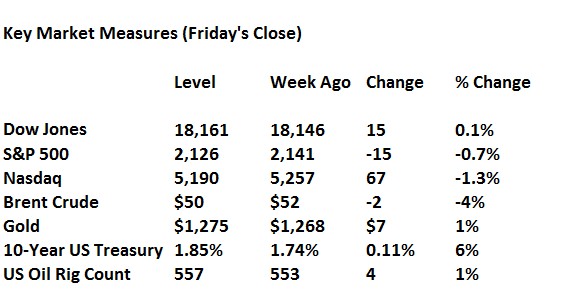
Highlights From The Past Week
Global private equity leader switches gears. KKR ranks among the list of the best investment shops in the world. Earlier in the year they backed up the truck and bought distressed energy and commodity bonds during February lows and on Brexit concerns. They now say those distressed investments they made are paying off handsomely, in fact much faster than anticipated. Accordingly, they now see more balanced risk/reward and are exiting those trades.
Recession risk is rising. While many US labor market indicators look rosy, one is flashing lights of caution. We are referring to the Fed Labor Market Conditions Index, in particular the year over year growth rate trend. After falling just three times from 2012 to 2015, the index has fallen every month of 2016 except for one. And in July the annual change from July 2015 turned negative. That's only the eighth time in nearly 40 years the index was down on a year-over-year basis. This event occurred in 2002 and 2007 prior to the proceeding recessions. Again we can’t help but wonder - is this cycle coming to an end?
Mergers set a monthly record as election eve looms. We observed $245 billion of M&A this month, surpassing the prior record of $240 billion in July 2015, with last week’s $177 billion of volume the all-time high weekly record. We have recently seen a wave of major deals getting pushed through by Wall Street. Bankers are clearly not sitting on their hands and taking advantage of what might be the last window of opportunity, in terms of both market conditions and considering the election, they have to rake in big time fees. We’ve seen announcements of AT&T buying Time Warner, Qualcomm buying NXP, the FedEx/UPS of China go public, and now the long awaited IPO of Snapchat finally coming. Snapchat is expected to raise as much as $4 billion in its planned IPO at a valuation of $40 billion, making it the biggest social media company to go public since Twitter's IPO in 2013. These sorts of deals are clear signs of aggressive market behavior. The question is if and how long it can last?
BMR Companies and Commentary
Qualcomm (QCOM: $68, up 1% for the week – all prices are for the week)
Well, the rumor turned out to be true. Qualcomm announced it is buying NXP Semiconductors (NXPI: $100, down 2%) for $110 per share. The offer is all cash, which will be funded using offshore monies and newly issued debt of $11 billion. Putting the two companies together, annual revenues will be over $35 billion. The deal is expected to close by the end of 2017 subject to regulatory approvals. Consensus expectations call for the deal to lift Qualcomm’s existing EPS outlook by 20-30%.
The deal is a good one for Qualcomm on many levels. Qualcomm has been focused on expanding its business beyond mobile into a number of growing businesses. NXP has a strong automotive presence, which boosts Qualcomm's presence in a market that management has frequently said they want to target. The deal also comes with $500 million of expected cost synergies. Lastly, there will be ample free cash flow to maintain the dividend and grow it, all while de-leveraging.
The consensus 2018 EPS outlook now calls for EPS of $5.00. At $70, shares are now at a fair to lofty level of 12x an EPS figure that is far away. Recall, this stock’s PE can quickly flip to 10x as seen in the past. We think the risk/reward here is now balanced.
BMR Take: The most important question is, what do we do now? We continue to like the business, and the acquisition is a good strategic fit, but the stock is fairly valued, so we are exiting our position.
We added the stock to our portfolio at $43 in February and are exiting at $68.40 for a 59% gain. Now, what should YOU do with your stock? That’s up to you, of course. We like Qualcomm and believe in them long term so you may wish to stay in a little longer. The NXP deal is not done yet so there is some uncertainty here of course. If you think they are going higher, you can put a stop in place and if it hits a certain price below the current price then your order will get executed. This is a good way to ride a stock upwards, protecting your profits all the way up.
Bristol Myers Squibb (BMY: $51, up 2%)
It was a really strong quarter. The stock traded up as much as 8% on Thursday on the earnings release. We think this is the turnaround now starting. We are excited to see the shares regain confidence and momentum and start to make a run at the 52-week high of $77.
The immuno-oncology franchise has recently stumbled, but the core business is healthy and there remains prospects for a turnaround in immuno-oncology. Management says they are working through recent disappointing results from Opdivo and will still build a valuable immuno-oncology franchise. Moreover, just to provide some re-assurance, a new operating model was announced along with 3Q16 earnings that commits to roughly flat operating expenses through 2020.
If that wasn’t enough, in conjunction with earnings, the company announced a new $3.0 billion share repurchase authorization, that is incremental to the existing authorization with $1 billion remaining. This new buyback cushions the 2017 EPS outlook providing for $3.00 of EPS.
One of the reasons we really like the stock is the solid balance sheet and the downside protection it provides us. The company ended the quarter with $8.4 billion of cash with debt of $6.8 billion.
BMR Take: We believe now is an opportune time to be accumulating a position in this blue chip Healthcare stock. The nearly 3% dividend yield is a cushion while you wait for a turnaround.
Under Armour (UA: $31, down 18%).
We wanted to follow up on Under Armour considering the shock this quarter and our continued strong interest in the name. We believe buying the pullback presents a very attractive risk/reward proposition.
While management lowered their 2018 operating income targets, the fundamentals have just not changed. The company still has a roadmap to $7.5 billion of revenue in 2018 and to ultimately be a $10 billion revenue business, as compared to $4.9 billion of sales expected this year. That is explosive growth. Under Armour is one of the Top 3 fastest revenue growers out of all of the S&P 500. All that is happening at the moment is that management is taking down near-term profits a bit by increasing marketing expenses in order to ensure sales growth continues for a long time.
We expect Under Armour to continue to beat revenue guidance based on ongoing investments in faster growth segments like footwear and international, and aggressive demand due to its major marketing pushes with endorsements in golf and basketball.
Even with ramped up expenses, the outlook still calls for greater 20% EPS growth per year. The future is bright!
BMR Take: We think the pullback is an opportunity to accumulate shares. Under Armour is the new Nike. There are years ahead of good performance you don’t want to miss out on. The all-time high is $50, which is an attainable mark to beat as the revenue base is on track to double from here in the next 3-4 years.
Visa (V: $82, flat)
It was a solid earnings quarter for Visa. The stock traded down 0.4% following the Q416 earnings release this week, which included better than expected bottom line results of $0.79 on revenue of $4.3 billion that was modestly above consensus expectations. The issue was soft 2017 guidance, where management forecast annual revenue growth of 17% and EPS growth in the mid-teens as compared to consensus of 20%, and 19.5% respectively.
While the forward outlook was disappointing, we were pleased to see decently strong revenue this quarter. The drivers were healthy, in fact accelerating cross-border volume, US credit growth acceleration, new wins like USAA and Costco, and moderating headwinds from foreign currency and the oil patch. We are optimistic these factors can continue to drive further revenue upside. Our outlook is shared by Goldman Sachs, as they are calling for the 2017 revenue outlook provided by management to be very beatable.
BMR Take: Solid results. As expected. No big surprises. Just what we love about Visa. Steady. Stable. Consistent. We raise our price target from $85 to $95.
Equity Residential (EQR: $60, down 1%)
The company reported 3Q16 FFO (an EPS proxy of cash flow for real estate companies) of $0.78, which was in line with the consensus expectation, though down from $0.89 a year ago. Overall, this quarter’s result was okay.
However, the forward outlook was worse than expected. Organic income growth guidance was reduced again, to 3.95% from 4.00% prior on higher operating expense growth. Higher expenses were driven by a combination of real estate taxes, tenant incentives, and personnel costs as apartment deliveries have created a competitive environment.
With income growing by just 2.4% during 3Q16 versus a high of nearly 7.0% during 2015, we see 2017 (and possibly 2018) as being a very challenged in terms of upside to growth trends. Of course, the outlook is mixed. The top net operating income growth markets include Seattle and Southern California, up 6.4% and 6.0% respectively. Though there are lagging markets like New York, Washington DC, and Boston, which experienced -4.0%, 0.7%, and 1.5% growth respectively from a year ago this quarter. San Francisco and New York continued to be highly pressured markets due to new construction and decelerating job growth.
Also, the company is working on seven new apartment communities under construction, which are about 70% completed and 70% leased and will come online by 2018 to help cushion net operating income growth. But putting it all together, we see Equity Residential struggling to grow much from here over the next two years.
BMR Take: We like Equity Residential as a leader in the apartment real estate business, but are starting to view shares as fairly valued. You just received a special dividend of $3.50 on October 14th, which followed the $8.00 special dividend paid out in March 2016. This should have helped cushion your performance. While the current valuation is a 21% discount to net asset value, most don’t expect the valuation gap to close. We’d be inclined to remove this stock here, but in reality we’re doing ok here. We added the stock at $62 in June and have received $4 in dividends so our net cost is $58. But if it goes to $55, our Sell Price, we are indeed going to remove it.
Alphabet (GOOG: $795, down 1%)
Revenue of $22.5 billion beat the consensus of $22.0 billion and was up from $18.8 billion last year. EPS of $9.06 beat the consensus of $8.62 and was up from $7.35 last year. Great results! Alphabet is now the second most valuable company in all of the S&P 500 with a market cap of $550 billion, trailing only Apple at $613 billion.
What did we like about the quarter? First, websites revenue was up 23% driven by mobile search, YouTube, and programmatic advertising. Many once called for Google’s demise due to the smartphone, but mobile search was the largest contributor to growth as it benefited from increased engagement and a number of new search ad formats.
Second, we liked the fact that paid clicks accelerated to 33% growth, which was much faster than 29% seen last quarter, as strong YouTube engagement was a huge contributor. Recall that we believe Google has the best asset in all of media by way of YouTube.
Third, YouTube growth remains elevated, as it now reaches nearly half of US adults between 18-54 at least once per month. Our key point here is that while growth is good, they still only have half of the target market on board, so there is clear runway ahead for more and more improvement.
BMR Take: Very solid results. We are raising our price target from $850 to $900. This stock remains an excellent core holding.
Upcoming Economic News
Monday, October 31st
Personal Income & Spending – September
Time: 8:30 am
Forecast: 0.4% income, 0.4% spending
Personal spending looks to expand strongly in September after showing no change in August. Yet the long-term trend for consumer spending appears less hearty, with retail sales excluding autos and fuel rising a subdued 3.7% year-over-year in the third quarter. Income trends are restraining consumer outlays, as disposable income rose 3.4% year-over-year in the three months ending August - the slowest pace in over two years.
Tuesday, November 1st
ISM Manufacturing Index – October
Time: 10:00 am
Forecast: 51.5
The ISM Manufacturing Index is projected to continue showing positive but not overly strong levels in October. Manufacturing output rose in three of the past four months, yet was unchanged year-over year in September.
Vehicle Sales – October
Forecast: 17.3 million
Vehicle sales are forecast to fall back in October after spiking by 5% in September. Heavy incentives are needed to keep auto sales afloat after an extended boom period has faded out. The 1.2% yearly decline of vehicle sales last quarter is one of the poorest results in the past seven years.
FOMC Rate Decision
Time: 2:00 pm
Forecast: 0.25%-0.5% fed funds target range
The coming election and the lack of a post-meeting press conference rule out any probability of a November rate hike, despite policymaker protests to the contrary. Solid job figures in line with September’s results will allow for the first and only fed funds increase of this year in December. But consistently meek price growth trends may long delay further tightening to well after that point.
Friday, November 4th
Trade Balance – September
Time: 8:30 am
Forecast: -$41.8 billion
Rising commodity costs will widen the trade deficit in September. Moody’s Industrial Metals Price Index rose 11% year-over-year last month, the largest such gain in two years. This will ultimately raise the cost of imports to the US.
A Few Words from Gary Jefferson
First Vice-President, Investments
Jefferson Financial Group
UBS Financial Services
The third quarter earnings season is now in full swing and actual results so far have been solid. In fact, S&P 500 companies are beating consensus expectations by the largest amount in over four years. With results from 28% of the S&P 500 market cap reported we can say goodbye to the earnings recession. The numbers should continue to rise modestly as the remaining 72% of the market reports results. This gives us greater confidence that our estimate for 3% year-over-year growth for the quarter is on track.
Keep in mind that this is the first quarter of positive EPS growth in over a year. We expect EPS growth will continue to accelerate into 2017 as the drag from the Energy sector turns into a tailwind as comparisons get easier. We forecast 8% EPS growth for full year 2017.
Financials have been a key positive driver. An improvement in trading and investment banking revenues for the big banks has been a key positive driver so far this quarter, reversing very weak trends earlier in the year. While these businesses can be hard to predict, the initial read on fourth quarter trends is favorable. In fact, Q4 estimates for the sector have actually moved higher during earnings season. With global economic growth intact, inflation firming and the Fed likely to resume raising the fed funds rate (we expect a rate hike in December and two more in 2017) fundamentals look poised to continue to improve. As a result (and in conjunction with low valuations), we upgraded Financials from neutral to moderate overweight this month.
Growth segments of IT* remain strong. Results from Microsoft confirmed earlier results from Accenture, Adobe and Red Hat that Tech companies that are on the right side of the secular trends (cloud transition) are doing fine. On the other hand, legacy IT products and services remain challenging, as confirmed by IBM.
*Information Technology
Oil and gas weighing on industrials. Numerous industrial companies (including GE) have suggested that weakness in oil and gas spending has continued. While trends in spending will likely improve into next year, the recovery looks like it will be slow and shallow. As a result, EPS growth will likely lag the overall market.
We have long argued the market is more about earnings than anything else. However, it has been flat for a very long time and it seems apparent that the market is waiting for something to happen. The election being settled is an obvious and temporary concern. No one can predict how any election will affect the economy, but we believe it's safe to say that no President can single-handedly drive up nor destroy the markets. No matter which way it goes on the 8th, our market is part of a global marketplace where hundreds of inter-connected factors beyond just our President will determine what the future holds – and, again, we believe earnings are one of the most important.
We also suspect that once the election is over, the markets will seriously begin to wonder about how the economy will look with higher rates and a stronger dollar in place. An interest rate hike could, as it did last December, cause much greater volatility than what the election may bring.
Bottom line: Tune out the noise from the media. Scary headlines touting doom and gloom are more often than not unnerving to even the most even-keeled investor. The markets may experience some turbulence in the coming months. But, these short-term fluctuations shouldn't affect long-term portfolio performance. It's a cliché, but yes, volatility (a/k/a bad down days) often presents sound investment opportunities.
If we continue to have the expected earnings numbers come in, coupled with "no recession" on the horizon, the market has a real opportunity to break out to new highs by year-end. The only caveat to this scenario is a rate hike – it could cause a disruption. But, relying on a track record going back decades, keep in mind that stocks historically do just fine during the first two to three years of a new rising-rate cycle.
An upgrade: Kinder Morgan (KMI: $20, down 3%) was upgraded by Raymond James Financial from an "outperform" rating to a "strong-buy" rating. They now have a $27 price target on the stock, up from its previous target of $23. Kinder Morgan was also upgraded by BMO Capital Markets from a "market perform" rating to an "outperform" rating. They raised their target to $26 from $21.
Twilio (TWLO: $35, down 14%) Twilio is obviously not for the faint of heart. We like it immensely and think it is a double or triple from here, but it is very tough watching it go down each week. There is something going on and we’re not sure what it is, but we believe a year from now it will be a lot higher.
With that said, it is painful and you may not wish to stay along for the currently painful ride. And of course, the stock may go lower. Many days the stock will jump 5% in the morning and then fade during the day, so you know there are serious buyers out there. We all know that it is a recent IPO with a high PE. We know that it is volatile, but seeing it drop from the $60 level to almost half of that is disheartening. So if you can’t stand the heat, get out of the kitchen now. We think it will take until the next earnings release for investors to see that the company is still on track for big revenue and earnings gains ahead.
This is what we say in our research report that is on the website – the stock is in our Special Opportunities portfolio:
“Twilio has 30,000 customers – from small developers to large enterprises – who use Twilio to power some 75 billion annual connections that reach 1 billion devices. Match.com makes matches without revealing phone numbers; Airbnb sends rental notifications, and the American Red Cross deploys volunteers, all through Twilio. ING, the European banking giant, recently announced it was closing down 17 hardware and software systems across its global call centers and replacing all of it with Twilio. Twilio’s largest customer, WhatsApp, uses them to verify customer accounts and logins. Apps from Lyft, Expedia, Netflix, Coca-Cola, Salesforce and the New York Times all have Twilio inside. The company saw 70% growth last quarter.”
The stock went public at $15 in June and closed the first day at $29, up 92%. Here’s your chance to buy it at a reasonable valuation.
Apple Corner
Apple (AAPL: $114, down 2%) announced a new record stockpile – of cash: $238 billion, up $6 billion in the quarter. So that means they are producing cash at the rate of $460 million a week, or $92 million per work day. Unreal. And yes, most of that cash is overseas, in Ireland. As we’ve said before, this doesn’t upset us or concern us. It’s like being worth $10 million personally, and having $9 million of it in Ireland. That works for us!
Tim Cook says he has no plans to change where the cash resides as it would cost him 40% in taxes to bring it back. We at The Bull Market Report believe the tax code will be changed sometime in the next few years and that will allow the cash to come back and be put to work harder than it is now. Stock buybacks, buying new technology, super big dividend distributions – all of these will be in the cards in the future.
Again, $44 of every share you buy is in cash - 38% of every share. This is unprecedented in financial history.
AmerisourceBergen Takes a Hit
McKesson (MCK) hit a 52-week low Friday, falling 23% Friday, reaching $114 per share before bouncing back to $125 before market's close. The company reported worse than expected earnings of $2.94 per share, missing consensus estimates of $3.05 per share. McKesson also adjusted its earnings outlook lower.
This miss was attributed to pressure put on the drug pricing industry that the company doesn't expect to let up any time soon. Investors balked at the news, causing not only McKesson, but its peers, to fall. Competitors Cardinal Health (CAH) and AmerisourceBergen (ABC: $69) also fell Friday - 10% and 13% respectively - on the news.
This is devastating to us. We expected a lot more from ABC. We added them in April at $91 and were looking for triple digits this year. Instead, they have disappointed every step of the way. This is the last straw. We aren’t waiting for our Sell Price of $67. We are removing the stock now.
Tesla Posts Best Sales Ever and a Quarterly Profit
Tesla Motors (TSLA: $200, flat) posted its second quarterly profit as a public company and its best sales period on record, helped by the new Model X sport-utility vehicle. The stock hit $213 on Thursday but settled later in the day and Friday. Profits were $22 million, or 14 cents a share, compared with a loss of $230 million, or $1.78 a share, a year earlier. On an adjusted basis, it had per-share earnings of 71 cents. Revenue shot up to $2.3 billion. The increased sales and profit come as CEO Elon Musk pushes the company to create new models, including the Model 3 sedan slated for next year, and to finish building the world's largest battery factory.
The company announced new products - solar-powered glass roof tiles that eliminate the need for traditional panels and longer-lasting batteries aimed at helping to realize Musk's vision of selling a fossil fuel free lifestyle to consumers. Unlike most solar panels in the market (which are made of photo voltaic steels that are installed over traditional roofs), Tesla’s solar roofs are made of quartz glass. This means that there is no need for a roof, if you are using Tesla’s product. In addition to being aesthetically pleasing and remarkably like standard roofing tiles in appearance, Tesla’s tiles are also durable.
But note that much of this announcement of new products is contingent on the merger going through with Solar City. Boy, he’s living on the edge.
BMR Take: Musk is at it again. Big announcements for the future. And profits in the present. Gotta hand it to this guy. Again, this stock is very volatile – be careful. It’s on the way to $300 a share but may pass through $150 first. And if it hits $300, it’s going to $400.
Blackstone Group (BX: $25.50, up 6%) The company sold $7.2 billion in real-estate assets in the third quarter and investors have poured $70 billion into its funds in the first nine months of the year, pushing Blackstone’s assets under management to a record $360 billion. They have $100 billion available to spend on new investments.
Blackstone has been selling assets to the Chinese in a big way this year and for the last three. They sold 25% of Hilton Worldwide Holdings for $6.5 billion and sold Strategic Hotels and Resorts for $5.5 billion. It also unloaded the Waldorf Astoria for $1.95 billion. The firm is awash in liquidity and that bodes well for the firm for 2017.
But the stock continues to lag, which is killing CEO and co-founder Steve Schwarzman. We have said and will say again that he is doing everything in his power to get the stock higher and HE WILL SUCCEED. It may not be this year, but it will happen. No one is going to stop this man, who just happens to be the firm’s largest shareholder.
High Yield Corner
Politics stole the headlines just as the markets were getting ready to end the week. With news that the FBI is investigating Hillary Clinton’s emails again, the market took a nose-dive, causing the S&P 500 to end down nearly 1% for the week. No matter your political leanings, it seems clear that the market does not like what this investigation means for the election. Additionally, those concerns are even bigger for just about all high yield asset classes.
There are a couple of reasons for this. First is liquidity. If the market decides the presidential election is bad news for the economy and/or stocks, it’s going to hit the S&P, but it’s going to hit the corporate bond market even harder. This is because suddenly risk-averse investors will pull money out of the bond market, meaning less liquidity. Mutual funds, institutional investors, pension funds, and other big market participants who need to offload corporate bonds will find it harder to locate a buyer, causing prices to fall. Yields will rise as a result (prices up - yields down), which means borrowing money will cost even more for companies. This, in turn, will cause default rates to go higher and cause less companies to take out loans in the first place. With less access to capital, companies will stop investing, which will in turn lower productivity and GDP growth.
This is a downward spiral that could happen if the market panics - and the longer the panic, the worse the effects.
Of course, this is an extreme scenario. It would take months of investor panic to cause corporate bonds to go in this direction, and it’s unlikely that a presidential election could cause such a long-term reaction. In fact, when presidential election results impact the market, they tend to do so for a month or two at the most - not enough to cause the kind of disaster in the bond market we’re describing. However, this is no ordinary election, and the market has priced corporate bonds very, very high. As a result, there is greater danger in corporate bonds than we’ve seen in a long time.
To demonstrate just how expensive corporate bonds are, we only need to take a look at the BofA Merrill Lynch US High Yield Master II Effective Yield index. It’s a mouthful, but it’s an important financial metric that focuses on one thing: What is the average interest rate junk bond-rated companies need to pay on their debt. Back in February, that rate was 10%. It’s now 6%.
Let’s think about this for a minute. U.S. Treasuries are yielding a bit less than 2%. A-rated municipal bonds are yielding around 3%, with lower-rated municipalities yielding around 4%. Yet even among low-rated municipalities, the default rates are far less than 1%. Corporate bond default rates are approaching 6%. Is that higher risk really worth an extra 2% yield?
In a low-rate world, the answer would seem to be yes - but the Federal Reserve is looking to raise interest rates. By itself, this will raise yields on corporate bonds. Additionally, it will also cause less money to flow into corporate bonds and encourage higher yields. The low corporate yields in the current market, the promise of higher interest rates, and the political unrest could spell danger for corporate bonds.
This is a complex and multi-faceted situation, but understanding the context is important. Right now corporate bonds are priced to perfection and the coming storms indicate weakness might be around the corner. The corporate bond market is beginning to wake up to this. The SPDR High Yield Bond Fund (JNK: $36) fell over 1% this week. More declines are likely to come, especially since junk bonds have recovered from their correction this summer.
What’s even more worrying is the lack of movement in the BDC space. The UBS Etracs BDC Fund (BDCS: $21) ended the week flat, but BDC investors should be aware that this space is even more susceptible to defaults than the junk bond market. Investors should be hedging their BDC exposure in response to this, but they are not. This is likely being driven by two factors. Firstly, a lot of BDC investors have come into the sector in search of yield, and find few alternatives elsewhere. Secondly, and most crucially, a lot of BDC investors are relatively unsophisticated. Corporate bond markets involve institutional investors managing more money than there is in the stock market; BDCs, however, have a combined market cap in the tens of billions of dollars, meaning the entire industry is smaller than many investment banks and a few hedge funds. This is an inefficiency that will eventually result in greater BDC volatility.
Where does that leave us when we consider our one BDC pick - Main Street Capital (MAIN: $34)? Main Street ended the week up 1% yet again and is now up 17% year-to-date despite its NAV remaining relatively stable. We recognize there is greater risk in holding Main Street now than before, which is why we’re lowering our target price to $35 from $40. We want to hold onto Main Street to capture the December special dividend, but we also need to recognize the greater potential volatility in BDCs right now and the market’s stubborn refusal to acknowledge this mounting risk.
Finally, a word on REITs. What an awful week for this class of assets. The SPDR Dow Jones REIT fund (RWR: $90) fell over 3%. Again, Federal Reserve moves are causing fear in this sector. We still love Omega Healthcare Investors (OHI: $31, down 3%, after 61 cent dividend), Kimco Realty (KIM: $26, down 6%), and Digital Realty Trust (DLR: $93, down 3%). We recommend adding on the recent weakness here.
Government Properties Income Trust (GOV: $19, down 8%). It is hard to watch the market punish this company. They own great assets, have a solid dividend and strong coverage of the dividend. But we also think the market will punish it more as the market sours on REITs broadly. Some might say that the risks aren’t worth the potential reward right now, so you will have to make up your own minds on this. For the time being we are sticking with the company since we are still above the price where we added the stock in April at $17. But be prepared for a lower price on this one. We just feel there is so much value here that we can’t bring ourselves to remove the stock from our portfolio.*
*Note that the stock is in our Special Opportunities portfolio, but we are moving it over to the High Yield Portfolio.
Good Investing,
Todd Shaver
Editor in Chief
The Bull Market Report