
The Weekly Summary
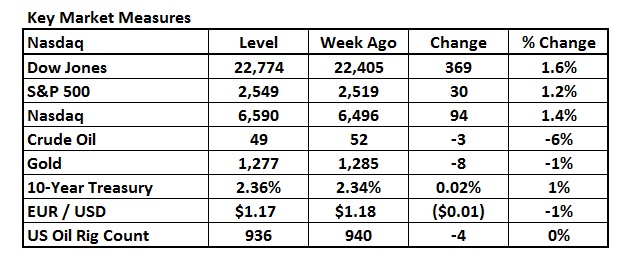
It’s market mania for assets around the world! Financial markets posted fresh records this week, as the upswing in global manufacturing added fresh legs to the relentless rally in equity and credit markets around the world. The most eye-catching: The U.S. stock market’s volatility gauge set an all-time low Thursday while the S&P 500 Index jumped to a fresh high, its sixth consecutive record close -- a feat last repeated back in 1997. Global stocks posted new record highs amid strong economic data. Credit premiums hit fresh post-crisis lows. Let the good times roll.
No matter what is happening out there, there is always a bull market here at The Bull Market Report! This week we highlight some of our favorite stocks where we think you can still make good money, including: Celgene, PayPal, Google, WageWorks, VMware, and Blackrock.
BMR Companies & Commentary
Celgene (CELG: $139, down 5% - all prices herein are for the week)
Celgene entered into a long-term strategic alliance with Nimbus Therapeutics (private) centered on autoimmune disorders.
Nimbus’s preclinical programs target central mediators of inflammation. Nimbus competes in this area against Bristol-Myers and Gilead. But given Nimbus’s demonstrated track record of success and the promising nature of the targets, the consensus view this alliance as particularly encouraging and indicative of Celgene’s dedication to expanding its presence in immunology and inflammation. Awesome!
Celgene will be given an option to acquire each program. Nimbus will receive an upfront payment and potential milestone payments per program that Celgene chooses to acquire. In the interim, Nimbus will retain full control of R&D activities for each program. Financial terms will be disclosed only in the event that Celgene chooses to acquire a program.
BMR Take: We remain bullish on Celgene as total revenues are expected to rise from $13 billion this year to $21 billion by 2020. We expect Celgene’s four blockbuster drugs (Revlimid, Abraxane, Otezla, and Pomalyst) to drive the revenue growth, while the recent acquisitions of Receptos and Delinia as well as investments in collaborators like Acceleron, Epizyme, Agios, and others will ensure growth from 2017 and beyond. We continue to view Celgene as a top large-cap pick in Healthcare.
PayPal (PYPL: $66, up 3%)
Mastercard and PayPal announced a significant expansion of their longstanding partnership into Canada, Europe, Latin America and the Caribbean, and the Middle East and Africa, to make Mastercard the clear payment option within PayPal across the globe. With the addition of these markets – and following the recent expansion of their partnership into the U.S. and Asia Pacific – Mastercard and PayPal have now reached a global agreement.
Similar to previous agreements, the global expansion will create a number of joint growth opportunities that will advance Mastercard and PayPal’s shared vision to offer consumers greater choice and flexibility to manage and move their money.
For example, PayPal will have the opportunity to expand its presence at the point of sale by utilizing services from Mastercard, allowing consumers to use their Mastercard in their PayPal Wallet to make in-store purchases at more than 6.5 million contactless-enabled locations across the globe. Consumers will also have the ability to quickly cash out funds held in their PayPal accounts to a Mastercard debit card.
BMR Take: People everywhere know and trust the familiar Mastercard brand, whether they’re paying in the physical or digital world. The expanded partnership with PayPal affirms the attractive growth outlook for PayPal’s users could go from the current 200 million to upwards of 1 billion, in our view. This should take the stock much higher.
Google (GOOG: $979, up 2%)
Google parent Alphabet’s internet-by-balloon Project Loon tweeted that they hoped to bring emergency connectivity to Puerto Rico after Hurricanes Irma and Maria left more than 90% of the island without cellphone coverage. Just 7 days later, the Federal Communications Commission Friday gave the company a green light to fly 30 balloons over Puerto Rico and the US Virgin Islands for up to 6 months.
If all goes to plan, Alphabet's balloons will soon help replace the thousands of cellphone towers knocked down by hurricane-strength winds. The balloons would provide voice and data service through local carriers to users’ phones.
Alphabet has previously deployed Loon to provide emergency phone service in Peru following flooding there earlier this year. They had already been working closely with a local wireless network, Telefonica, to coordinate spectrum use and prepare handsets to work with its balloons.
Project Loon was born in Alphabet’s moonshot X division, with the aim of serving the half of the world’s population that is still without internet access. It has launched several successful pilot projects, but Loon has yet to be deployed commercially on a wide scale.
BMR Take: This is such a cool innovative initiative to see from one of the US’s leading tech companies. They are truly improving the world. Companies that do that tend to improve the performance of your portfolio. We remain bullish on Google. We see EPS heading to $60 over the next 3-5 years pushing the stock much higher.
We have been reminding you that this stock was cheap in March at $815 and after setting highs in June, got cheap again in July at $900. It has been on one of these slow Google rolls lately, moving up $3-6 a day for weeks now. We sure hope you have some of this great company. And if you don’t it is NOT too late to buy. It is within a whisker of an all-time high at $988 and we can see it breaking four figures and moving much higher from there.
WageWorks (WAGE: $63, up 4%)
WageWorks cares about people and wants to empower everyone - employers, employees, and their families - to lead healthier, happier, and more productive lives. The company simplifies the complex world of Consumer-Directed Benefits. They make benefits programs easier to understand and use so that everyone can take advantage of pre-tax savings and focus on what matters most.
The latest new development is a partnership with none other than Uber! WageWorks and Uber are revolutionizing your commute, giving you more options on how to get to and from work.
WageWorks has entered into a first-in-market partnership with Uber, the world’s leading rideshare company, to offer you the convenience of using a WageWorks Commuter Prepaid MasterCard, WageWorks Visa Prepaid Commuter Card and TransitChek QuickPay Prepaid Visa Card to pay for uberPOOL rides. This new partnership gives the customer the flexibility to use his or her pre-tax funds to pay for uberPOOL rides when they commute.
What does this mean? Customers can now save up to 40% when they rideshare to work via uberPOOL. That’s more money back in their pocket every month. Use of WageWorks commuter benefits with Uber is currently available in the following markets: Atlanta, Boston, Chicago, Denver, Las Vegas, Los Angeles, Miami, New York, Philadelphia, San Diego, San Francisco, Seattle, Washington D.C., and the state of New Jersey. And this will expand dramatically in the coming year.
BMR Take: WageWorks is on track to generate $1.75 of EPS this year. We see a sizeable market opportunity where earnings can double over the next 5 years. WageWorks serves a unique market niche and is an off-the-radar business many people have never heard of, making this name a unique opportunity to outperform the S&P500
VMware (VMW: $112, up 2%)
VMware announced that it is helping Partner Communications (PTNR: $5.20) implement a novel approach to network functions virtualization (NFV) that has resulted in a rapid conversion to NFV and a reduction in cost-per-customer to deliver network services.
What does this mean? First, we will give you the technical jargon. Then, we’ll break it down, as we do best.
Partner Communications, a leading Israeli Telco group, selected Cloudify and VMware to launch its new solution called V-NET. V-NET is delivered through a unique, cloud-based approach to network service orchestration using an incremental approach referred to as "orchestration first."
In layman’s terms, NFV is fundamentally changing the way communications services are provided. The Partner V-NET platform creates intelligent management of communications networks, services and cloud access, enabling IT managers to have direct access to any point or branch of the management interface, while saving significant manpower, time, hardware and money.
BMR Take: VMware has been a solid performer since we started covering the name. We see EPS settling in at around the $5-$6 level. We will continue to scan the opportunities in front of the company for reasons to reassess our EPS outlook higher. This deal above, is just another small reason for the great success of this not-so-small $46 billion market cap company. Remember Dell Technologies owns 83% of VMware. It’s only a matter of time before they make an offer for the 17% it doesn’t own.
We added the stock in January at $83 and currently have a $120 target. We see no reason why this can’t be reached later this year if the stock market stays steady.
BlackRock (BLK: $463, up 4%)
BlackRock is in discussions to invest in financial technology company Capital Preferences to help bolster its focus on retail investors.
Capital Preferences gathers data to help wealth managers understand the risk tolerance and preferences of clients, allowing firms to create portfolios suited to investors’ needs. The talks, which are preliminary, include determining ways of incorporating the company’s software into BlackRock’s existing technology offerings.
The world’s largest asset manager is investing in technology in part to diversify revenue as investor money flows into cheaper passive strategies. BlackRock is also using technology to indirectly expand its reach to retail investors, who are typically charged higher fees than institutions.
BlackRock, which manages $5.7 trillion in assets, has made several strategic investments in startups in recent years with the aim to eventually acquire some. It owns FutureAdvisor and has participated in a funding round for iCapital Network, an online marketplace that offers ultra-wealthy investors and their financial advisers alternative investments.
CEO Larry Fink has recently said that he hopes technology will account for 30% of revenue in the next five years up from 7% currently. BlackRock is counting on its risk management system, known as Aladdin, to help push it toward that goal.
BlackRock's Rob Goldstein, the chief operating officer of BlackRock, thinks there are a lot of misconceptions around one of the biggest trends overtaking Wall Street. BlackRock. One, for instance, is the name.
"We actually believe one of the greatest misnomers is this word “passive” because we don't believe any investment decision is a passive decision."
Passive investing, which means tracking a market-weighted index rather than actively trading single stocks, has steadily eaten away at active-investment management over the past several decades. Index investing has been revolutionary for investors, allowing them to bypass high-fee investment managers, many of which have not performed well. The firms that specialize in index investing and exchange-traded funds, another form of passive investing, have become giants of the industry.
BlackRock is one of them. They pulled in more money into its ETF arm in the first half of this year than all of last year.
And Goldstein added this:
My sales pitch is very simple: BlackRock is a growth company. BlackRock is a growth technology company and we're growing our technology functions. We have a very ambitious plan that we call "Tech 2020." And as part of that, we are looking to extend the 2,000-plus technologists we already have within BlackRock. And we're really excited about the opportunity to take BlackRock, which is already at the forefront of technology in its industry, and keep expanding that.
BMR Take: BlackRock is among the best-positioned companies in investment management, owning the top Exchange Traded Fund franchise (iShares), that is growing rapidly due to “passive” investing, as well as an increasing product portfolio of technology. Recall, there are several top hedge funds on the list of shareholders in BlackRock. With EPS set to approach $30 over the next 3 years, this stock is among our favorites. What a great week the stock had, and we expect much more of the same. Don’t be put off by the high stock price. Think Google at $980 a share!
Upcoming Economic News
JOLTS Job Openings
Wednesday, October 11th,10:00 AM
Period: August
Consensus: 6,170,000
Prior: 6,170,000
PPI ex-Food & Energy
Thursday, October 12th, 8:30 AM
Period: September
Consensus: 2.0%
Prior: 2.0%
Retail Sales ex-Auto
Friday, October 13th, 8:30 AM
Period: September
Consensus: 0.80%
Prior: 0.20%
Update on Shopify
We were able to get our hands on a report from Morgan Stanley recently. Here are some excerpts from it.
Shopify (SHOP: $98, down 16%) Trading at roughly 18 times its forward sales estimate and having never turned a profit, Shopify certainly looks expensive. The company has delivered impressive sales growth so far, but even then, investors are paying a premium for the promise of its business. That tends to be a risky proposition, but sometimes it's one worth pursuing. With that in mind, we think Shopify's momentum and expansion potential actually make the stock cheap, even as it currently trades at all-time highs.
For those unfamiliar with the company, Shopify provides e-commerce platforms as a service -- allowing sellers to quickly launch and conveniently maintain online sales portals. It mostly caters to small- and medium-sized businesses. However, it also counts some larger brands, including Budweiser and Red Bull, among its customers. All told, the company provides service to over 500,000 merchants worldwide -- up from 165,000 roughly two years ago. That's an impressive reach for a young company, but it still leaves lots of room for expansion.
Last quarter saw revenues climb 75% year over year, and the company is doing a good job of growing sales relative to expenses even as it prioritizes expansion over near-term earnings. With Shopify's current customers more or less locked in, reducing its advertising and marketing expenses could quickly shift the company to profitability.
While Shopify is not cheap by the established guidelines of value investing, ownership involves a greater degree of speculation than some investors will be comfortable with. However, Shopify's current price could look like an absolute steal five years from now.
BMR Take: This report was written before this ridiculous Andrew Left started shorting the stock and making a fool of himself on Bloomberg TV and elsewhere. We believe he is wrong and we believe the market will prove him wrong. He is “winning” at the moment as the stock dropped $13 on Wednesday when he went public with his diatribe, $3 on Thursday and $3 on Friday. It had hit $93 on Thursday, so it came back sharply. But he will lose in the end. Remember, he has to BUY BACK his short position at some time, pushing the stock up when he does.
We have to say that the stock was quite strong in the weeks leading up to this Wednesday. This maniac had been shorting the stock in a big way, putting downward pressure on the stock, and yet the stock was moving higher and higher since the middle of August when it was at the $95 level. That tells us there is buying power out there, and as soon as this blows over we expect the stock to start moving back up again. We could easily just bow out of the stock, since we added it in the spring at $73 and thus have a nice gain. But we are going to stay with it because we believe in the company, plus their revenue growth is huge – on the order of 75% last quarter. And you know what we are going to say here: Revenues always win out in the end.
Here is some more from Morgan Stanley:
With Shopify declining 16% this week following circulation of a short report, investors have been digging into details on the company's model. We continue to believe that Shopify has a strong core business model and highlight several of the more frequent questions asked, along with responses:
--- How does Shopify's model compare to a pyramid marketing model?
Answer: Shopify has a success-based model where its revenue is reliant on the success of its merchants. Unlike some pyramid models, there is typically little upfront investment required by merchants on the Shopify platform with no annual commitment required. If a merchant is not successful on SHOP's platform, it can exit the platform with little cost of failure. Historically, we believe churn has been high but Shopify's growth has been supported by the growth of its successful merchants which have outweighed the cost of those that have failed on its platform.
--- How does the company's affiliate marketing platform work?
Answer: Shopify has over 13,000 ad agencies, consultants, and partners that support its marketing efforts with over 500,000 merchants now on its platform. When a partner refers business into Shopify, they can be eligible to receive a bounty. Where bounties are paid, Shopify may continue paying fees associated with referred merchants while they remain on the platform. Affiliate marketing models are not uncommon among small to medium sized web services vendors.
--- How much revenue does Shopify generate from its business exchange?
Answer: Shopify rolled out a myriad of new products and services for its merchants this year. The company's exchange was rolled out this summer and, like other services, is in its early stages and its size is not yet disclosed. We do not believe the company has generated a meaningful amount of revenue from this platform yet. Last quarter, 47% of the company's revenue was generated from Subscription Solutions (subscriptions, themes and apps).
The remainder of the company's revenue (53% of total) can be attributed to its Merchant Solutions business which is primarily payments driven and benefited from approximately $5.8 billion sold over the platform.
--- How much do bloggers contribute to the company's customer acquisition?
Answer: Shopify does not disclose this number. However, the company has stated that most of its merchants are introduced to the platform organically. Paid advertising is the second most meaningful source of new merchants followed by partners, of which bloggers are a subset.
--- To what extent do non-Plus merchants contribute to revenue growth?
Answer: We do not have a breakout of total revenue by merchant category but for Subscription Solutions, management stated that Shopify Plus merchants accounted for over 18% of total monthly recurring revenue last quarter compared to 13% for 2Q16, implying approximately 127% growth for Shopify Plus and 55% for non-Plus business. On the Merchant Solutions side, the company has disclosed that Advanced and Shopify Plus merchants are responsible for over 50% of volume processed over its platform.
Update on Tesla’s Delivery “Problems”
Excerpted from a BusinessInsider article
Tesla has over-promised and under-delivered ever since the company was founded. But investors continue to believe in the genius who runs the company.
Tesla does not benefit from being normal. The company is organized around being special, different, extraordinary. You don't change the world by restraining yourself. And Wall Street doesn't care. Over the past two years, Tesla's stock is up over 1,200% since the company's 2010 IPO.
Tesla's third-quarter delivery numbers were both impressive and depressing. The carmaker is on pace to sell 100,000 vehicles this year for the first time in its 14-year history. But it's also far, far behind with the production of its new Model 3 sedan, the vehicle that's supposed to bring Tesla to the masses and spell the beginning of the end for gas-powered cars.
Getting to 20,000 in monthly production by December now seems like a hopeless expectation, as does CEO Elon Musk's prediction that Tesla will be manufacturing 500,000 vehicles annually by the end of 2018. But the markets are unconcerned. Tesla stock is still up 65% in 2017 and the brand has lost none of its captivating aura.
But it's also obvious that for a car maker that's been around as long as Tesla, they aren’t good at building vehicles.
So why is Tesla struggling to build the Model 3 on its own admittedly ambitious schedule?
1. The Model 3 is all-new production.
Tesla is reasonably good at manufacturing its expensive, luxurious Model S sedans and Model X SUV. Production of these vehicles was designed around a run-rate of about 100,000 per year, and Tesla will hit that mark most likely in 2018.
Of course, the Model X endured "production hell," as Musk memorably put it, during its roll-out in 2016. The Model S also endured early production issues that were later corrected. And Musk declared that production hell would be back for the Model 3.
Musk talks about Model 3 production in terms of an "S curve," with a very slow ramp rapidly speeding up before leveling off at a desired point. But Tesla also has a second S curve, related to learning. It doesn't know, exactly, how to build the Model 3. Established automakers build cheaper cars in volume all the time; Tesla never has.
2. Tesla enjoys endless patience from everybody.
Tesla's brand equity is probably its most valuable asset. And Tesla knows it. Yes, we aren't going to make our goals — but we also aren't going to lose focus on the big picture, which isn't to sell more cars, but rather to save the planet.
3. Tesla isn't actually mass-producing the Model 3 yet.
Even if Tesla had hit its goal of 1,500 Model 3s in September, it would still be a long way from the levels of production needed to meet demand. The low numbers, which the company chalked up to production "bottlenecks," suggest that the ramp to just pre-mass-production is taking longer than expected.
If Tesla hadn't fallen so short of its own run-rate for September, we could assume some bobbles, but unfortunately, it looks more like the decision to forego the process of testing out the Model 3 assembly line before trying to accelerate the production ramp isn't working out.
4. The Model 3 looks simpler then the Model S and Model X — but is it?
The Model X is complicated. The Model 3 is supposed to be simple. Tesla designed the Model 3 to be easier to build than the Model S and Model X, but compared with electric cars that have now been in production for a while - the Chevy Bolt and the Nissan Leaf, for example - there's a lot of "clean slate" to the newest Tesla.
To build an EV that they can get to market quickly, build easily, and price below $40,000, other manufacturers are just adapting existing gas-car platform to the task. The Bolt doesn't feel all that futuristic inside, and the Leaf has a fairly conventional interior. Neither car is dramatic to look at on the outside.
Tesla has eliminated as much dashboard instrumentation as possible with the Model 3, going for a very clean, minimalist vibe that stars a single, horizontal touchscreen. Although that might sound like it makes everything easier, it doesn't necessarily because it's a major departure from how cars are currently put together.
Ultimately, Tesla's plan to simplify will pay off, but in the short term, negotiating the learning curve could slow them down.
BMR Take: As we’ve said many times, this company is speculative. But it sure is fun being on the ride with them.
A Word from Gary Jefferson
Jefferson Financial Group
First Vice-President, Investments
UBS Financial Services
Some good news – bad news. According to Stock Trader's Almanac (STA), October is the last month of the “Worst Six Months” for DJIA and S&P 500 and the last month of Nasdaq’s “Worst Four Months”. The bad news is that in post-election years, the DJIA has been up 11 times in 17 years with an average gain of 0.7%, but in the last three years ending in “7,” October has been trouble. In 2007, the bull ended and the financial crisis began, in 1997 the Dow plunged 12% and in 1987 the market crashed on "Black Monday", a day we will never forget. [We don’t buy these types of things at The Bull Market Report.]
The good news is that, looking back through history, a big upside move of over a 5% gain on the S&P 500 during the Worst Six Months (or the “Sell in May” period) from May through October has usually been followed by great gains in the overall market. Thus far, that 5% gain has happened. There is just one month left in the Worst Six Months. So if the market can pick up further gains in October and not succumb to the historical and often self-fulfilling prophecy of "Octoberphobia" – and particularly the curse of the 7th year - that would be, according to STA, a solid indication for stronger gains over the next Best Six Months (November to April) and 2018.
We understand the argument that this bull market is way long in the tooth. However, there is another maxim of Wall Street that says, "Bull markets don't die of old age; they die because of recessions or policy mistakes". We see nothing on the horizon indicating we are headed for a recession. The Fed could overplay its hand by hiking interest rates too high and too fast. However, we think if the Fed errs it will be on the side of "too little" rather than "too much" because, so far, it has been very conservative in its approach to normalizing both its balance sheet and interest rates. We do think it will be a "policy mistake" for Congress not to pass meaningful tax reform – the market is 100% counting on this happening and if it doesn't, good earnings might keep the market afloat, but probably won't be enough of a catalyst to produce meaningful gains until some of the PE multiple expansions are digested. Bottom line: Tax cuts are now the most credible and legitimate “bullish” or “bearish” wildcard remaining for the markets in 2017.
From a bullish standpoint, real tax cuts could easily push the S&P 500 up another 4% or 5% because that will increase expected 2018 EPS to a conservative $145/share.
From a bearish standpoint, while tax cuts aren’t quite yet "fully" priced into stocks, there is the expectation they will get done, especially regarding foreign profit repatriation. If tax cuts, like healthcare, fail, then we’re now sitting with a market at 18X next year’s earnings and no identifiable future growth catalyst (and a Fed raising rates). We believe that will cause investors to reduce exposure and, if we had to make a guess based on these fundamentals, we would expect a potential pullback in the 5-10% range should Congress fail to enact promised tax reforms, compared to anticipated 5-10% gains over the next Best Six Months if reforms are passed.
An Update on Teva Pharmaceuticals
The FDA approves Mylan's generic Copaxone, Teva shares lower
Shares of Mylan (MYL; $38, up 23%) are 18% higher while shares of Teva Pharmaceuticals (TEVA: $15.94, down 9%) drop sharply following the FDA's approval of Mylan's generic Copaxone: Glatiramer Acetate Injection. Teva management followed up the announcement with a press release estimating the impact of the two launches to its Q4 earnings of at least $0.25/share and while they have planned for the introduction of eventual generic competition and remain confident in Copaxone, but that it is too soon to officially comment on any change to their full year business outlook.
Most analysts see it as a clear negative for Teva as the generic approval comes earlier than expected with most firms anticipating a 1Q18 arrival. That said, this is a long anticipated event and firms estimated the impact to shares should be closer to the 5% range with some preferring to see the news as removing an overhang on shares that could clear the deck for management.
For Mylan, analysts call it a significant win/positive, given the process was a long drawn out 7-year pursuit and Mylan landed the first approval with potential exclusivity.
The firms suggest that any generic entry may take some time and/or over a protracted period, which could make the opportunity for Mylan quite long-tailed with high margins and thus quite negative for Teva.
This is the day that TEVA investors have dreaded for many years. We believe the bulk of the downside from the loss of Copaxone sales is already priced into TEVA shares.
This news comes earlier than Teva expected and some investors had thought possible. Given the potential $0.25 impact per quarter and applying this to full year 2018, it is possible Teva's new 2018 guidance could fall well below $3.00.
BMR Take: We’ve had it. We have put up with a lot of negatives with this company. What’s next? What will they disappoint us with next?
We’re out. We added the stock in May at $29 and it has gone straight down. Bad choice on our part. We are truly sorry.
If you want to stay in and wait, you can. These suggestions of ours are just that. It is always up to you depending on your own goals. More than likely the stock will stay at this level for months and if things go well, will slowly inch back up. We say this is likely, but if things get worse, we could see $13 at this time next year.
The High Yield Corner
By Michael Foster
For a long time, the market simply didn’t believe the Federal Reserve would hike rates three times in 2017. The probability of a rate hike in December, as calculated by Treasury futures markets, was far below 30% for a long time. Then in September Janet Yellen made it very clear that a rate hike was coming. Even through the fog of “Fed speak,” the Fed’s intentions are incredibly clear, and futures markets responded accordingly. As of this time of writing, the futures market is implying an 89% probability of rates going up.
We’ve been here before. In 2015, the market reacted swiftly to Yellen’s public statements, and we saw a lot of carnage in the high yield world as a result. If you were in the market back then, you remember seeing just about anything with a big yield, from BDCs to municipal bonds and everything in between, falling hard at the end of the year. Several analysts (myself included) rightly called this a buying opportunity of a lifetime. Since the start of 2016 to now, many high yield investments, including those recommended by The Bull Market Report, rose by double digits not including dividends. That’s big.
Yet with this reversal in market expectations, the high yield market has remained mostly unfazed. Traders and investors have learned their lesson: A sudden collapse in yield just means a buying opportunity, because the income stream from these investments remains largely sound and trustworthy. This is why the recent Fed announcements haven’t caused as much of a buying opportunity as they did two years ago.
There are, however, exceptions. Unsurprisingly, those exceptions tend to be very popular with retail investors who are somewhat risk averse and tend to sell off too aggressively in times of caution. This is why we’re seeing a pretty big hit among some high yielding REITs, although there’s been virtually no news to suggest there’s any problem with any of these companies.
Among Bull Market Report picks, Welltower (HCN: $68, down 3%) was hit the hardest last week. While there hasn’t been any news that has any material impact on the REIT, Welltower shares continued a protracted slide that began in mid-September and has been aggravated by the Fed’s comments. Nothing has changed in the company’s business operations, and its FFO still exceeds payouts by a healthy margin (although, it must be admitted, not the healthiest). Now shares are yielding 5%, the highest yield since March of this year. And just like March was a great buying opportunity, so is right now, although we may see yields climb up to 5.5% before the stock bottoms, as we saw happen in November 2016 when, you guessed it, investors sold off in a panic over rising interest rates.
Considering the stock is similar to Welltower in many ways, it is not surprising to see Ventas (VTR: $63, down 3%) react similarly. At a 4.6% yield, Ventas’s recent slide also brings it to its lowest point since March, although there’s no news to indicate the firm is facing any new hardships. In fact, one of the exciting things about Ventas is that it’s been diversifying aggressively into the medical office space, where capitalization rates can often grow faster than with skilled nursing facilities. Additionally, medical offices are less exposed to the whims of regulators and Medicare funding. The market isn’t rewarding this shift - at least not yet. Instead, traders are focusing on interest rate issues. Considering Ventas’s size gives it a relatively low borrowing cost, its 0.56 debt-to-asset ratio is conservative in the REIT sector. It’s clear that the selling pressure on this stock is unjustifiable. That doesn’t mean it won’t go lower in the coming weeks, but it does mean the stock is quite likely to go higher after the rate hike and the market realizes this actually didn’t hurt their balance sheet.
Elsewhere in the REIT space, we saw a lot of dull action. Digital Realty Trust (DLR: $118) and Apollo Commercial Real Estate Finance (ARI: $18.20) ended the week flat, despite both REITs’ relative price outperformance throughout 2017. Similarly, we saw Nuveen AMT-Free Municipal Credit Fund (NVG: $15.43) and Invesco Municipal Trust (VKQ: $12.72) stay flat for the week. While comparing muni funds to REITs is very much apples to oranges, in this case the comparison is illuminating. Here we’re seeing a trend that encompasses much of the high yield universe - the market is largely shrugging off Yellen’s rate hike talk. In part that’s because municipal bonds, especially after the recent hurricanes, and these REITs in particular (thanks to their cloud computing and complex financial structure, respectively) are less popular with retail investors right now and more popular with institutional investors, who tend to react less aggressively to upcoming rate hikes.
What, then, should high yield investors do? Right now, there’s no reason to sell anything in The Bull Market Report portfolio. What’s more, the more aggressively sold-off REITs are becoming increasingly attractive. What we are seeing is a buying opportunity more than a cause for concern. Sadly, it’s not as good of an opportunity as late 2015, but we should be grateful for whatever we can get in this incessant bull market.
Good Investing,
Todd Shaver
CEO, Founder and Editor
The Bull Market Report
Since 1998